Ontology-based Competency Analyses
in New Research Domains
Julia Rogushina
1and Anatoly Gladun
21Department of Intelligent systems, Institute of Software Systems, National Academy of Sciences, Kyiv, Ukraine 2Department of Intelligence Networks and Systems, International Research and Training Center of Information
Technologies and Systems, National Academy of Sciences, Kyiv, Ukraine
Ontology-driven methods of competence management oriented on support of scientific research for new do-mains are proposed. Ontologies of research domain are matched with personal information about scientific researchers represented into Web (for example, at the social networks)and results of their work(publications, monographs, reports etc.) are processed by logical methods and ontological analysis. Web-services and multi-agent programming paradigm are used for their software realization.
Keywords: Semantic Web, knowledge management, on-tology, expert competence
1. Problems of Competence Management
Competence-based management is a relatively new way of organizing human resources with high performance. The theory of competence-based management defines competence as the ability to sustain the coordinated deployment of resources in ways that help an organization achieve its goals[1]. In this work we consider the competence management as a part of know-ledge management[2].
The competence concept has to reflect such as-pects of human work in organization as the dy-namic external environment of an organization, internal processes and interactions with other organizations, and, the most important for this work, cognitive processes in an organization and coordination of different human, informa-tional and knowledge resources[3,4].
Now one of the important directions of devel-opment of intelligent informational systems is
associated with the support of management de-cisions to ensure the persons who make deci-sions (PMD) by knowledge about subject do-main and appropriate means of analysis. One of the directions of PMD work deals with personal selection for different tasks.
A common problem today is the situation when PMD have to solve the problem in some new domain(for example, make review of papers). For this solution they need in domain experts – specialists competent in problem domain. In general, an expert is a person who has special knowledge about problems that are directly as-sociated with specific subject domain[5]. In new domains, commonly recognized authori-ties are usually absent. That’s why PMD have to evaluate the competencies of potential experts relative to this subject domain[6]by analysis of accessible information about them – for exam-ple, from social nets, published articles.
The urgency of these problems is increasing in modern society by expansion of complex in-formation processed, continuous emergence of new technologies, research directions, complex information-intensive goods, facilities and ser-vices.
1.1. Definition of Competence
Competenceis the level of achievement(
sci-ence and technology, understanding of the stud-ied problems and possible ways of their solving. To quantify the level of competence the com-petence coefficient is used. In general,
compe-tence coefficient R is a function F of K(A) –
the characteristics of expert knowledge and ex-perience(qualitative and quantitative)for some expert A and of S(B)– the description of expert problem for problem B:
R(A, B) =f(K(A), S(B)).
An expert A can have different evaluations and the problem can have different descriptions. A is a person that can be an expert if he/she has competence coefficient R(A,B)>p for problem B, where p is a constant that specifies the mini-mum PMD requirements to expert.
The competence coefficient can reflect different personal data. For some scientific domains per-sonal data of each expert can be represented by the triple s,r,h, where s∈S, r∈R, h∈H. S={s1,s2,s3}– Higher education of expert(s1 – coincides with the profile priority, s2 – ba-sic education in a related specialty, s3 – baba-sic education in other specialties); R={r1,r2,r3} – scientific schooling (r1 – academician, r2 – professors, doctors, r3 – Ph.D., Senior Scien-tist, Associate Professor), H={h1,h2,h3}– ex-perience with this priority (h1 – not less than ten years, h2 – at least five years, h3 – at least one year). The evaluations r and h are defined quite simply, but to evaluate s for new domains is more difficult(most of experts are evaluated by s2, and it is not possible to set a priority in their level of proficiency).
Also, if new activity has emerged quite recently, any specialist has great experience in this area, and high estimates obtained by the level of sci-entific schooling can be negative for new prob-lem solving – specialist received knowledge when new research domain did not exist and therefore he/she probably are not versed in its specificity. On the other hand, over a long pe-riod of research activities specialists can funda-mentally change the direction of their research, and high evaluation r indicates a high level of intelligence, persistence in scientific work and the ability to get interesting and useful results. Therefore, besides the triples,r,h we have to take into account information about current sci-entific and professional achievements of a
spe-cialist, his/her area of work and working ca-pacity. For employees of many specialties such information appears in their scientific publica-tions, statements of work, descriptions of devel-oped products, prepared learning materials etc. The availability of these data(publishing over the Web, representation in the libraries) deter-mines the degree of expert authority and his/her ability and willingness to credibility of his/her own knowledge. This is directly linked with the specialist’s ability to be an expert.
1.2. Competence Management as a Special Case of Knowledge Management
Modern competence management is an inde-pendent field of research, but from the point of view of informational technologies it can be viewed as a special case of a knowledge management system (KMS)or as an informa-tion retrieval system(IRS), because, with their own specifics, these systems solve the problem of representing and matchmaking of the know-ledge with regard to two different types of ob-jects – tasks and people who can execute these tasks.
The task of competence management is a per-spective area of implementation of Semantic Web technologies. The reasons for this are, on the one hand, the urgency and complexity of the problem (and the lack of automated solu-tions for common cases), and on the other hand – the need for use of distributed heterogeneous Web knowledge.
1.3. Competence Management in the Field of Scientific Research
The second reason is associated with the fact that the research activity and its results usu-ally are well formalized and open for analy-sis: scientific publications, patents, reports and other materials represented as natural language texts with elements of structured data (tables and graphs) and multimedia that usually are accessible in electronic form that allows their automated analysis by corresponding software. For competence management in the scientific research planning, some criteria – such as edu-cation, skills and experience – can be identified already at the beginning of the selection. Com-petencies emerge later, in the process of selec-tion. But competencies can make an important contribution at any stage of selection. However, such studies are quite effective only for profes-sions well formalized and described in detail, and, therefore, are not suitable for the selec-tion and certificaselec-tion of personnel for scientific research.
This fact is caused, firstly, by the use of know-ledge about the subject domain for evaluation of the work of researchers. This domain is con-stantly changed and supplemented. Moreover, in general, it may be controversial from the point of view of different theoretical concepts. Sec-ondly, it is necessary to evaluate objectively the results of their work that are represented mainly in the form of natural language documents( ar-ticles, papers, reports, etc.).
In addition, evaluation of the overall scientific capacity of a person is often important for the decision about his/her participation in solving specific problems or in cooperation with partic-ular team. The problem of semantic interpreting scientific papers is solved by the use of automa-tion of semantic markup of NL-texts, creaautoma-tion and processing of their meta-description etc. Though in this work we try to use the methods of knowledge management based on Semantic Web technologies for task of competence man-agement in scientific subject domain.
2. Knowledge Management in Web Applications
Now, a lot of Web applications are intelligent, and have to use knowledge of some subject do-main or produce some new knowledge. In such
applications, knowledge is represented in in-teroperable form and can be reusable. Onto-logical approach for knowledge representation is widely used because ontologies have a fun-damental theoretical foundation of their formal semantics – descriptive logic.
Ontologies typically provide some general vo-cabularies that describe different domains of user interest or specialization of informational resource and define the meanings of terms used in the vocabulary. The ontology representation contains data and conceptual models, for ex-ample, sets of terms, classifications or theories
[7,8].
One way of domain modeling is creating its the-saurus. Often, the terms “ontology” and “saurus” are used as synonyms, but in IT the-saurus is often used to describe vocabulary in the projection of the semantics, and ontology – to model the semantics and pragmatics in the projection of language representation[9]. For this task, thesaurus can be seen as a special case of ontology.
2.1. Problems of Knowledge Management for Web
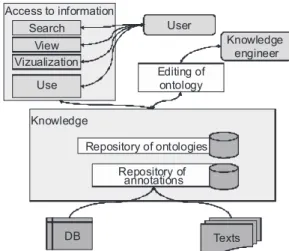
Main problems of knowledge management( Fig-ure 1)for Web deal with[10]:
• Integration of knowledge from different in-formational resources(e.g. integration of on-tologies built on the basis of different texts from one subject domain);
Access to information Search
View Vizualization
Use
User
Knowledge engineer
Knowledge
Repository of ontologies
Repository of annotations
Editing of ontology
Texts DB
• Search of inconsistency of knowledge ac-quired from the content of different infor-mational resources and rating their adequacy and security;
• Knowledge acquisition from accessible in-formation and its representation in the form understandable to user;
• Search of knowledge a user needs for the solution of some specific tasks;
• Automation of metadata creation and im-provement that correctly describes the con-tent of informational resources (textual or multimedia)on semantic level, and efficient search of such metadata.
A lot of other similar examples exist, but all of them come to the following ones[11]:
1. Selection of the means for knowledge
rep-resentation(sufficiently powerful to satisfy
the different requirements of users, but avail-able for rapid processing and understand-able to human): Now for these goals on-tologies are widely used, but the problem deals with selection of ontology represen-tation language version (OWL 1.0 versus OWL.2.0, OWL Lite, OWL DL, OWL Full, RDF, RDF Schema etc.) [12]. Domain on-tology is a certain part of knowledge which describes important concepts and relations that can be used for the solution of problems at this domain;
2. Methods of acquisition of new knowledge
based on some informational resources(for
example, creation of metadescriptions of in-formational resources, generation of new rules by inductive inference or of new facts by traductive inference): new knowledge can be acquired from implicit, uncertain, contradictory textual representations, but lar-ge capacity of such information necessitates some automated methods of their process-ing. Availability of RDF – language for metadata representation – is a necessary, but not sufficient condition for it. For exam-ple, automated creation of metadata that de-scribes the natural language document on se-mantic level requires to use: 1)methods of linguistic analysis; 2) knowledge of subject domain(e.g. domain ontology); 3) applica-tion-dependent methods of inductive, deduc-tive or traducdeduc-tive inference oriented on
pro-cessing of specific structures of knowledge
(e.g. RDF triplets);
3. Methods of matching of different
informa-tional objects on semantic level (e.g.
inte-gration of two ontologies or detection of dif-ferences between them, matching of infor-mational query and inforinfor-mational resource relevant to this query, discovery of subject domain of informational resource by analy-sis of its content): these problems are not trivial and don’t reduce to traditional search because they have to analyze rules and know-ledge of subject domain and their formal representations by special matching algo-rithms. The matching operations deal with the following challenges: large-scale eval-uation, performance of ontology-matching techniques, discovering missing background knowledge, uncertainty in ontology match-ing, matcher selection and self-configuration, user involvement into the process of match-ing, explanation to user of matching results, collaborative ontology matching, alignment management and reasoning with alignments
[2];
4. Quality rating of new knowledge (
verac-ity, consistency, actualverac-ity, completeness). It needs to develop the different models of knowledge representation, to use the ap-propriate mathematical apparatus(e.g. first-order sentence theory, descriptive logics)
and to evaluate the quality of ontologies re-lated to real world and informal knowledge about real world.
2.2. Knowledge Management and Semantic Web
At the present stage of IT, in the majority of cases Web applications use standards and tech-nologies of knowledge management developed by Semantic Web project. Knowledge manage-ment in Semantic Web environmanage-ment needs in creation of adequate tools for retrieval, acquisi-tion, store and use of knowledge subject to such properties of up-to-date Web as dynamics, het-erogeneity, very large capacity and orientation on semantics.
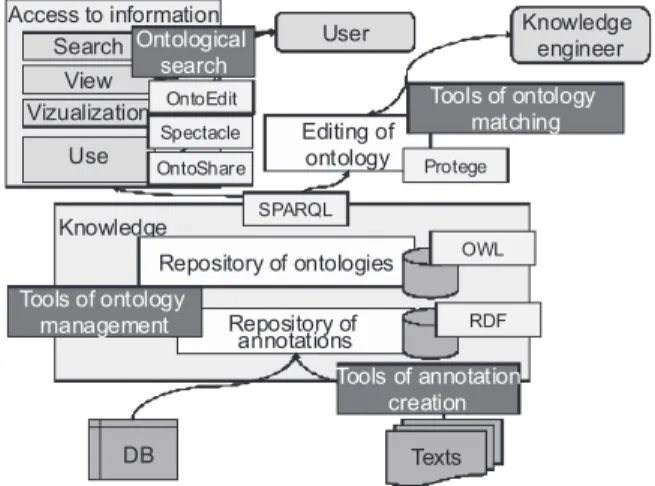
for ontology representation [13]. Different in-strumental tools provide the following possibil-ities: creation of ontologies and their linking with different informational resources, check-ing of ontology’s consistency, refinement of on-tology and executed of inference operations on ontologies but some important problems of KM are not supported by standard software tools. Figure 2 shows what elements of KM are now supported by Semantic Web technologies.
Access to information Search
View Vizualization
Use
User Knowledge
engineer
Knowledge
Repository of ontologies
Repository of annotations
Editing of ontology
Texts DB
OntoEdit Spectacle
OntoShare Protege
OWL SPARQL
RDF
Tools of annotation creation Tools of ontology
management Ontological
search
Tools of ontology matching
Figure 2.Semantic Web in knowledge management.
2.3. Use of Ontologies for Web Knowledge Representation
Analysis of publications shows that ontologies are an adequate and effective means for know-ledge modeling about different subject domains, informational resources and other objects. Dif-ferent authors represent various formal models of ontology, but all these models include[8,10]: — the set of concepts that can be subdivided into the set of classes and the set of individ-uals;
— the set of relations between concepts where some subclasses of relations ( “class-sub-class”, hierarchical, synonymy etc.) and functions (as special relation where the n -th element of relation is uniquely defined by othern−1 elements)can be separated; — axioms and interpretation functions of
con-cepts and relations.
Formal model of ontology is a triple O=X,R,F, where X is a set of concepts, R – a set of re-lations between concepts from X and F – in-terpretation functions for concepts from X and
relations from R. This is a general model, and in practice more precise models are used. For example, in[4]ontology is defined as a structure that includes identifiers of concepts, identifiers of relations, identifiers of attributes, data types and hierarchies of concepts and relations. On-tology can be defined as a tuple that, in addition to sets of classes, individuals, relations and data types, contains a set of values and some special relations(specialization, exception, creation of individual and assignment).
Existing technologies of the Semantic Web pro-pose various means of ontology representation that differ one from another by their expres-siveness and their complexity: RDF Schema is the simplest representation and OWL Full is the most powerful. Decision of ontology represen-tation depends of problem specifics.
Languages for ontology representation can be viewed as syntactic variants of Description Logic
(DL). The fundamental modeling concept of a DL is theaxiom – a logical statement relating roles and/or concepts. There are many different Description Logics that differ in sets of proper-ties and performance capabiliproper-ties.
DLs have an informal naming convention, roughly describing the operators allowed: F – Functional properties; E – Full existential quali-fication(Existential restrictions that have fillers other thanowl:Thing); U – Concept union; C –
Complex concept negation; S – An abbreviation for ALC with transitive roles; H – Role hierar-chy(subproperties – rdfs:subPropertyOf); R – Limited complex role inclusion axioms; reflex-ivity and irreflexreflex-ivity; role disjointness; O – Nominals.(Enumerated classes of object value restrictions – owl:oneOf, owl:hasValue); I –
Inverse properties; N – Cardinality restrictions
(owl:cardinality, owl:maxCardinality); Q
– Qualified cardinality restrictions (available in OWL 2.0, cardinality restrictions that have fillers other than owl:Thing); (D) – Use of
equivalent ALUE. The design of OWL is based on the family of DL. The Prot´eg´e ontology ed-itor supports SHOIN(D). OWL 2.0 provides the expressiveness of SHOIQ(D), OWL-DL is based on SHOIN (D), and for OWL-Lite it is SHIF(D).
2.4. Semantic Search as a Part of Web Knowledge Management
We think that one of the most important tasks in knowledge management for Web deals with semantic search of information – in a lot of intel-ligent Web applications informational retrieval is a part of a system or is called as an exter-nal service. Retrieval of information about ex-perts into the Web – people with some specific competencies – is a particular case of seman-tic search. Therefore, we analyze below the general approaches to this problem. The most promising of them deal with the Semantic Web project.
Semantic search is a superstructure on tradi-tional retrieval procedure where for more effi-cient satisfaction of user’s informational needs. In semantic search of knowledge about a user, his/her personal informational needs and in-terests; about informational resources accessi-ble for retrieval mechanism is processed for the purpose of increasing of search pertinence [14]
– user receives the information that is really necessary for some task.
The result of semantic search can be not only a concrete Web document or fragment of such document, but some more complex informa-tional object:
1. interesting to user information acquired from an accessible informational resource ( tex-tual or multimedia)where this information is contained implicitly;
2. a list of informational resources with some semantic annotations dealing with the user’s query and user’s personal preferences; 3. integration of the knowledge contained in
different informational resources;
4. informational object specific for subject do-main class(corresponding to some concept of domain ontology)– for example, organi-zation, geographical object, human or scien-tific article;
5. composition of classified informational ob-jects (e.g. human with some characteristics that work in organization of specific type and live in some concrete city).
Based on the analysis of current state of work in the sphere of informational content representa-tion and methods of programming for Semantic Web, we can mark out some main problems that we have to solve in the process of designing of intelligent Web application realized in the semantic search procedure (i.e. the questions that have not now some universal standardized methods of solving and for which open software products are not realized):
— automated creation of metadescriptions of informational resources that reflect not only formal characteristics of documents, but their semantics that deals with some sub-ject domain;
— generation of semantic markup of natural language documents by ontological con-cepts;
— automated creation and enhancement of ontology (at initial stage and for existing ontologies) on the basis of informational resources processing and by use of expert knowledge, particularly:
• formation of thesaurus of natural language informational resource;
• formation of initial ontology of subject do-main by the set of natural language docu-ments selected by user;
• enhancement of ontology of subject domain by the set of natural language documents; • acquisition of ontological information from
metadescriptions of informational resources; • use of inductive inference for discovery of relations between the ontological concepts; — operations on ontologies (the most
neces-sary operations are consistency valuation of ontology, matching of pair of ontologies and integration of terminological base of differ-ent ontologies);
It is not easy for a user to formalize the query for semantic search that reflects his/her infor-mational need(as a user we consider either hu-man or agent – software entity with some goals and intentions) because this formalization has to reflect:
1. Description of a problem that needs some information for its solving;
2. What information does a user have before this query?
3. What level of complexity and form of know-ledge representation can a user understand? 4. How to acquire the necessary knowledge
from accessible documents?
Semantic sears show some important differ-ences from the traditional one realized in usual information retrieval systems (IRS) operating at Web environment:
Traditional IRS Semantic IRS Query The set ofkeywords
Informational need deals with some subject domain and problem Information
for search personification
History of user queries
Models of user and his informational needs
Search
results Document withkeywords
Knowledge from relevant documents deal with user’s interesting object Information
about IR Index DBof IRS
Index DB of IRS and their metadata Description
of user domain – Domain ontology
2.5. Linguistic Methods in Creation of Ontologies of Natural Language Informational Resources
We use the algorithm of semantic markup of nat-ural language texts that is described in detail in
[15]. This algorithm factors into morphological and syntactical properties of natural language and knowledge about subject domain. As a re-sult of this algorithm we receive the text where some fragments are linked with concepts and relations of domain ontology. The other result of this step is a set of rules that provide links between ontological entities and word forms of natural language.
The inputs of first stage are: O0– initial
ontol-ogy of subject domain containing the concepts and relations most obvious for the user; T0 –
the set of natural language texts that describe a domain interesting for the user (texts from glossaries, manuals, textbooks, Wikipedia arti-cles, other well structured definitions of domain terminology).
O0 and T0 can be empty. If O0 is empty we
have no knowledge about domain and therefore the retrieval procedure reduces to usual – non-semantic – search. If T0is empty then the search
procedure stops and the user has to propose an-other request.
On the second step the rules of markup are used for new texts. If in one sentence two or more fragments are marked up by ontological con-cepts, but no fragments are marked by ontolog-ical relations, then we can add (if necessary)
new relation to domain ontology.
If one fragment in one sentence is marked up by ontological concepts and the other one – by ontological relations then we can add (if nec-essary) new concept to domain ontology. An algorithm proposes those fragments sentences to user for extracting of new concepts if it is appropriate for subject domain.
An algorithm discovers links of text fragments deal with interesting to user concepts with other fragments of text only by their linguistic prop-erties. Though that fragments can not deal with concrete task of user and then user don’t include them to domain ontology.
This algorithm can mark up not only classes but individuals as well. In natural language the equivalents of individuals are named enti-ties(names, titles etc.).
The results of such semantic markup can be used for development and improvement of ontologies together with linguistic approach. If some text paragraph contains two fragments linked with ontological concepts and a fragment linked with ontological relation and if linguistic analysis of the sentence shows that in this sentence these fragments are associated, but the domain on-tology does not contain such relation of these concepts then the ontology can be enriched by this relation.
some ontological relation and linguistic analysis helps to search the fragment that is semantically associated with these fragments, then user can determine a new ontological concept associated with this fragment.
In the process of linguistic analysis we pro-pose to create and develop a lexical ontology of domain that contains information about natural text fragments that are associated with concepts and relations of domain ontology. This ontol-ogy is created in process of semantic markup of domain texts and then enriched in dialog with the user during the analysis of other texts.
2.6. Use of Thesauri in Semantic Search
Formal model of thesaurus is Th=T,R, where T is the finite set of terms, and R – the finite set of relations between these terms. The term is a word or a verbal complex, which corre-lates with the concept of some organized field of knowledge(science, technology)which be-comes into the system relations with other terms and forms with them some closed highly infor-mative system.
Thesaurus is a special case of ontologyX,R,∅. In some situations we can match in semantic search process the domain thesaurus with the-sauri of available informational resources. The use of thesauri instead of the ontologies reduces the problems of their generation and matching because we can create thesaurus of natural lan-guage document much more easily(by lexical analysis)then ontology.
The thesaurus of domain is created as a union of sets that represent thesauri of natural language documents selected by a user to describe the sphere of his/her interests. Then the user can re-fine this thesaurus according to IDEF5 method-ology for development of ontological models
(www.idef.com/IDEF5.htm).
If we have an ontology of some domain or infor-mational resource, then we can reduce it into the thesaurus. In some situations, for retrieval pro-cedure we can take into account only the set X
(concepts)and then matching of ontologies can be reduced to comparison of these sets (there is no deep semantic analysis, but this procedure can help to reject informational resources with-out corresponding terms).
For modeling of ontological relations mereolog-ical apparatus can be used. Mereology, as a for-mal theory about parts, marks out seven types of “the part of” relation, for example, component-object, part-mass, material-object.
This classification helps in refining of ontolo-gies if a user in the process of adding a new relation to ontology explicitly states the mereo-logical type of this relation.
For analysis of the lot of IR an algorithm of the-sauri building is proposed: term vocabulary is building by the general list of document words, and then words from user list are thrown away from that vocabulary. User list can contain stop-words for some subject domain or natural lan-guage. If IR has some metadata describing its semantics (for example, in RDF), then words for vocabulary can be acquired from this meta-data.
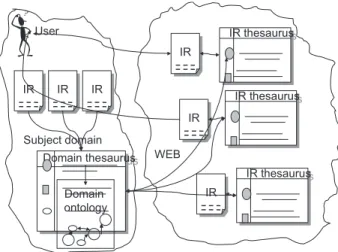
Then this vocabulary is matched with user the-saurus. User thesaurus can be built by extrac-tion of concept names from domain ontology in OWL, as a union of vocabularies of IRs selected by user, manually by user or by combination of these methods(Figure 3).
IR IR
Domain thesaurus Domain thesaurus
Domain ontology
IR thesaurus IR thesaurus WEB
User
Subject domain IR IR IRIR
IR IR
IR thesaurus IR thesaurus IR thesaurus IR thesaurus
IR IR
IR IR
Figure 3.Informational retrieval on the basis of thesauri.
In forming of instances in the ontology of aca-demic competencies a significant part of the knowledge can be acquired from the analysis of various open publications of researchers, that is from information resources available through the Web and represented by natural language
Usually, thesaurus is defined as a dictionary that contains lexical items with explicit semantic links between them. Thesaurus can be viewed as a special case of ontology. We can explore the thesauri of individual specialists (e.g. experts)
or thesauri of subject domains.
2.7. Semantic Search in IRS MAIPS
The results of research work described above were used in the realization of semantic search system MAIPS [16]. This IRS is oriented on users having stable informational interests in the Web and need regular acquisition of corre-sponding information.
In this system, ontologies and thesauri are used for formalized definition of the subject domain interesting for a user, and inductive inference methods provide acquisition of additional in-formation about users by analysis of their per-manent query history (e.g., preferences in in-formational sources, language and size of the text).
In addition, the search is personified with the help of individual indexes of natural language text readability that provides the most under-standable and valuable information to the user. MAIPS integrates ontological representation of knowledge, multiagent paradigm and Semantic Web technologies for the purpose of semantic search. The main features of IRS are:
• use of OWL language for domain ontologies and thesauri interoperable representation; • realization of set-theoretic operations on
the-sauri;
• automated thesauri generation by natural lan-guage documents;
• use of Web 2.0 technologies(tag clouds – for search thesauri visualization, social services – for user cooperation;
• original sequencing algorithms for searched informational resources (IRs) with account of ontological concepts;
• use of natural language texts readability cri-teria for informational retrieval with account of personalized user needs;
• original inductive inference methods for gen-eralization of MAIPS operation experience;
• use of multiagent paradigm for modeling of intelligent IRS behavior on the basis of BDI architecture[17];
• use of intelligent Semantic Web services paradigm for interoperable description of MAIPS functions[18].
3. Use of Inductive Inference in Semantic Search
3.1. Algorithms of Inductive Inference
IID3M Algorithm. A significant drawback of the well-known algorithm of inductive general-ization ID3[19]consists in the fact that it builds a classification rule only for the two classes. An original algorithm IID3M generalizes ID3 to an arbitrary number of classes and takes into account the level of accessibility of attribute values. This algorithm also detects the situa-tion attributes which carry the most informasitua-tion about the result and thus help in constructing of the smallest decision tree. At each step the al-gorithm searches an attribute Ai with maximum information:
C(Am) =
i
j
C(Am =ami,R=Rj)
T(Am)
=max
s C(As)
=max
s
i
j
C(As =asi,R= Rj)
T(Am) (1)
where C(X,Y) is the amount of information C(X,Y)=
i
j
p(X = x,Y = y)∗log p(X =
x,Y =y), where p(X=x,Y=y)is a probability of combined occurrence of the events X=x and Y=y, and T(Am) is the cost of obtaining the
value of Am.
The time for classification of the object by clas-sification rule built IID3M upon the average is not exceeding the classification of the object in any other classification rule built on the learning sample. This follows from(1).
MID3 Algorithm. Attribute selection criterion
the attribute values into two subsets increases the computational complexity by the choice of these subsets.
In this regard, we propose an algorithm MID3 – pseudo-binary generalization of IID3M that avoids complex calculations, but allows to rem-edy these deficiencies. Instead of branching for each value of attribute chosen by(1), it can branch some individual attribute value and other values in the form of a common branch and at each node of the decision tree attribute is a con-ditionally binary and accepts only two values – “X” and “not X”.
For the same attribute these Xs may be differ-ent at differdiffer-ent nodes of the decision tree. The choice of attribute values that is allocated to the separate branch is done based on information entropy measure (2). We choose the value of an attribute that carries the most information about the result:
aki :
p
C(Ak =akp,R=rj)
=max
m
j
C(Ak=aki,R=rj).
(2)
3.2. Processing of Incomplete Data in Inductive Inference
IID3M and MID3 algorithms are designed for processing of complete data during the consulta-tion. But often it is necessary to classify objects where a full investigation is impossible(because of the complexity, cost and other reasons). Data are incomplete (Maybe-data) if their val-ues are currently unknown, but although they can be determined later. Based on these data it is not always possible to unambiguously clas-sify the object, but we can select a subset of classes that object can belong on various meth-ods of completions of incomplete data. We pro-pose a method for constructing such subsets – a method of yellow-green branches.
The most adequate way of formalizing and pro-cessing of incomplete data is proposed by Codd method “Null Values”, according to which data is incomplete if the property value for this ob-ject is currently unknown, although the property is inherent to the object and can be determined later. This unknown value can be defined by special constant, and any occurrence of such
value may be substituted with the concrete value from the set of acceptable ones. The work with unknown values requires a special three-valued logic with the epistemic truth values(T-yes, F-no, W-maybe) and the corresponding truth ta-ble for all logical operations. The application of this logic to incomplete data sorts them into two classes: True-data that values are always accessible, and Maybe-data that values can be not available.
The following technology for inductive gener-alization of incomplete data is proposed:
Step 1: allnattributes are sorted by two classes according to a priori knowledge about their in-completeness: m attributes whose values are always available in the process of consultation,
m≤n, andkattributes whose values during the consultation can be unknown,n= k+m; then from the training set matrix X’ obtained from the matrix X by reordering the columns so that the firstmcolumn of X’ is formed by True-data;
Step 2: matrix X’ is divided into a set of ma-trixes – matrix A containing m columns and matrixes B[h]containingk columns. The ma-trix A consists of such rows that for any row of the matrix A a row of the matrix X’ exists where substring of the matrix A is a substring contain-ing the first mattributes, and there is no other row of A where the firstmvalues coincide with the values of this row, and each of the matrixes B[i], 0<i≤h, consists of such lines that for any row of the matrix B[i]there is a row of X’ that is a substring of it and the firstmvalues of it a substring of thei-th row of the matrix A.
Step 3: decision trees built by the inductive in-ference algorithms for each of the obtained ma-trixes where another meaning – “unknown”(the attribute value is missing, can not be obtained, not known precisely, and so on – the data type Maybe)– is added to the list of possible values for each attribute of B[i]matrix. This value dur-ing the consultation is interpreted in a special way and is not considered in the construction of decision tree because the situation with an at-tribute value “unknown” is possible only in the consultation process.
the correlation of the text with some domain); 2) for ontology enhancement by new relations and concepts. In MAIPS, inductive inference is used also for acquisition of personal pref-erences of users (by generalization of system experience)and for clusterization of users with similar informational needs.
3.3. Inductive Inference as a Means of Knowledge Acquisition in Semantic IRS
Inductive inference algorithms can be used for the automated acquisition of ontological know-ledge from semantically tagged natural texts about subject domain and from DB with user information.
For example, these methods are realized in in-telligent IRS MAIPS oriented on users with per-manent informational needs. MAIPS allows to personify the informational retrieval by induc-tive generalization of search experience and by taking into account personal readability of in-formational resources.
In competence management, the domain can be characterized by domain-specific ontology and by organizational ontology. From the general set of terms in analyzed texts, inductive infer-ence acquires relations and terms important for the domain.
There are three main types of organization mod-els based on ontologies that have structured in-formation: 1)organizational ontology, 2) ontol-ogy of the organization subject domain, 3)the ontology of user activities. Organizational on-tology provides semantic information about the organization structure. This complex structure often uses hierarchical decomposition into sep-arate modules.
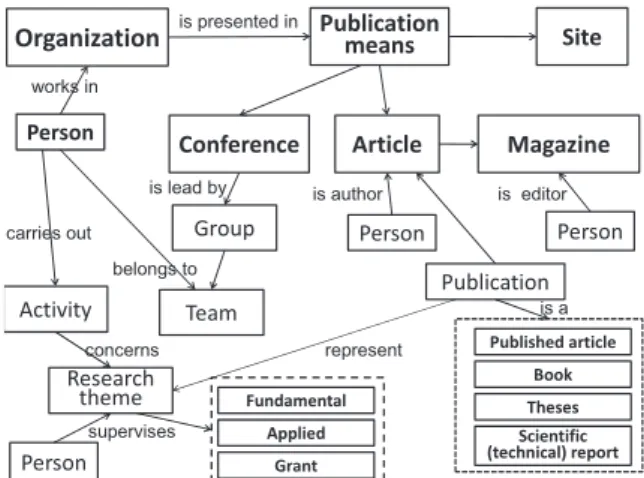
Organizational ontology[20]is an ontology that reflects knowledge about the organizational and functional structure of a particular subject of economic activities, i.e. its main components and connections between them. It contains in-formation about employees, the hierarchy of production relations between them; resources used by the enterprise in the production process; products that is a result of enterprise function-ing; structural units of the enterprise and the relationships between them(Figure 4).
The information about domain where somebody can be considered an expert is contained in the
Organization Publicationmeans
Magazine Site
is presented in
Article Conference
Person
works in
Person Person
Group
Activity
is lead by
belongs to
is editor is author
concerns
supervises
is a
represent carries out
Team Publication
Research theme
Publishedarticle Book
Grant
Scientific
(technical)report
Person
Fundamental Applied
Theses
Figure 4.A fragment of structure of organizational ontology.
titles, UDC(Universal Decimal Classification)
or ISBN and content of his/her publications and scientific reports and into the specialty passport, in the name of the organization and it’s depart-ment where he/she works, and the most impor-tant – into the titles and abstracts of projects that he/she execute. The skill level of a person can also be evaluated by general and scientific expe-rience, the number of publications(total and in recent years), the presence of graduate students etc. Another important source of information is an information about employees in the team with which projects were carried out or articles were published.
4. Use of Semantic Web Technologies in Competence Management
All proposed technologies can be used for task of competence identification of scientific searchers or learning courses as a part of re-search planning. This task is an example of a problem that needs an integrated use of dif-ferent methods of Web knowledge management because knowledge about potential researchers and subject domain has to be attained from the available Web resources: structured descrip-tions of individuals (e.g., FOAF) and institu-tions(organizational ontologies)and their pos-sibilities(for example, in form of Web services)
Finally, methods of srmantic matchmaking have to be applied to founded information.
It is necessary to construct a theoretical model of competence management that includes: 1. DB of competence profiles (similar to IRS
index and meta-descriptions of information resources) and set of services for their for-mation, comparison, storage and analysis; 2. Knowledge base that includes ontology of
subject domain for solving problem, organi-zational ontology and the ontology of scien-tific activity;
3. Generalized model of the problem whose so-lution is formed by a set of actors, including the objectives to be achieved as a result of the work, the initial data, available resources and constraints on the process of the task re-alization (time, financial, legal, etc.) – an analog of the retrieval request;
4. Methods of analysis and semantic markup of NL-texts(texts containing the results of the scientific work of candidates), and a descrip-tion of the goals and objectives of a research project – an analogue of the information re-source indexing;
5. A set of methods and algorithms that can automatically form a set of performers (by formalized description of the scientific ob-jectives and information about potential re-searchers)– search procedure. These meth-ods should include a mechanism for the for-mation of rules of thumb and maintain a log-ical inference(similar to domain specialized IPS engine).
Future plans include the development of tools for optimal selection of team and predict the effectiveness of their collaboration.
Use of Semantic Web technologies provides in-teroperability of developed model and its soft-ware implementation, integration with other IR, KB and Semantic Web applications and the pos-sibility of its extensions and modifications. We intend to use the following Semantic Web technologies, Web 2.0 implementations and Open Source tools for solutions of such subproblems: 1. Intelligent Web-services, OWL-S, the in-formation about people available through the Web (FOAF), as well as information
found in the Web by semantic search en-gine MAIPS (author’s certificates No32015 of 13.02.2010);
2. Ontologies in OWL format – available through the Web(e.g., organizational ontology of the National Academy of Sciences of Ukraine, various taxonomies and classifications)and designed specifically for a particular pur-pose;
3. Task ontology in OWL format and its exten-sions for the specific domains;
4. RDF and semantic markup means where rel-evant ontological terms are used as markup tags, as well as methods for assessing the IR significance similar to methods used in the IRS(for example, Google citation index); 5. Means of logical inference on ontologies
such as Pellet, FaCT++, HermiT, Owlim; 6. Open Source software – for example,
ontol-ogy editors and tools of visualization, means of semantic markup, linguistic processors, and tools for human resources management
(e.g., OrangeHRM).
As a result of analysis of the generalized prob-lem we can assign the following functions that are necessary in the systems of ontological know-ledge management:
1. Methods of automated creation and updating of ontology: analysis of NL texts, processing of available meta-descriptions and semantic markup, on the basis of other ontologies; 2. Comparison of the two (or more)
differ-ent ontologies: consecutive versions of one ontology; ontologies that describe one do-main, but are created independently one of the other, ontologies which are an extension of one ontology for solving of different prob-lems or by different developers;
searching the relationship between certain objects which are described in the ontology and their properties.
4.1. Features of the Scientific Research Ontology
An important class in the ontology of scien-tific research is a summary of researcher. It contains information about publications, expe-rience in research and teaching activities, edu-cational level and history of research.
Standard of Resume RDF Schema can be used as a basis for describing the structure of a re-sume. However, the developers of this ontology have not paid adequate attention to the peculiar-ities of a summary of scientific researchers that, in addition to general information, includes pub-lications, research experience, teaching, attend-ing conferences, etc. Thus, they cannot be used widely for the ontology of scientific workers.
4.2. Algorithm of potential experts competency rating
Determination of competency assessment of specialists to some problem consists of the fol-lowing steps(Figure 5):
• construction of thesauri of potential experts
(by the organizational ontology)and the the-saurus of document under the examination
(by the document content);
• normalizing of these thesauri using appro-priate domain ontologies;
• comparison of the terminology(two sets of terms)of normalized thesauri.
By the content of the document under the ex-amination the thesaurus is constructed. It is assumed that the document belongs to the do-main corresponding to the area of the organi-zation activities. Knowledge about this domain are represented in the form of domain ontology Odomain, Odomain = T,R,F where the set of
concepts T containsnterms,|T|=n.
On the second step of the algorithm this the-saurus of document is normalized by its projec-tion on domain ontology.
ThNn(d)={ti: ti∈T(Odomain)}.
Suppose that the organizational ontology con-tains information aboutsemployees. Thesauri
The document which has arrived for expertise
Subject
domain ontology Organizationalontology
The document thesaurus
The thesaurus of the employee
The thesaurus of the employee
The normalised thesaurus of the document
The normalised thesaurus of the
employee The normalised
thesaurus of the employee
Rating of experts
Figure 5.Building of potential experts ratings.
of these employees are constructed by organi-zational ontology(this ontology contains know-ledge about main scientific works of employers and references on their full texts or abstracts) [21]. This information for thesauri construc-tion is acquired from the organizaconstruc-tional ontol-ogy of research institute where they work and the administration of which may involve them as experts.
It is very important that the employee thesaurus, in contrast to the user thesaurus(for example, in MAIPS), is not built manually by this person, but is generated automatically – and objectively – by proposed methods and based on the content of the Web and organizational ontology.
Some initial constraints can be imposed on the set of employees who can be used as experts
(availability of scientific degree, the number of publications over the past year, age, experi-ence of research, etc.). Thesaurus of employee Thi(p) is a set of words that is formed by the
words from titles of his/her publications, pass-port of specialty, research projects which he/she executes, etc. The normalized thesaurus of em-ployees is a projection of this thesaurus on set the terms of the domain ontology.
Each term tj of the domain ontology Odomain
obtains the set of values mdoc(tj) and weight
of ontology terms mi(tj), i= 1,s. For each
employee, his rating ri = n
j=1mdoc(tj)
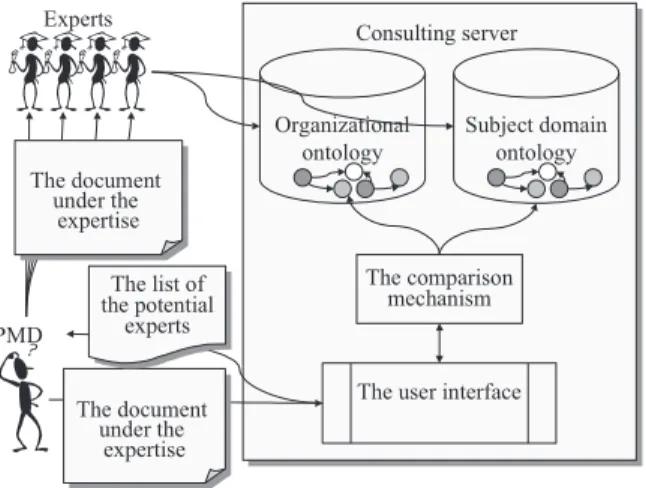
most competent for examination of this paper
(Figure 6).
Consulting server
Organizational ontology
Subject domain ontology
PMD
The user interface The document
under the expertise The document
under the expertise
The comparison mechanism The list of
the potential experts The list of the potential
experts Experts
The document under the
expertise The document
under the expertise
PMD- the person that makes the decision
Figure 6. The process of forming the initial set of experts by organizational ontology.
If the experts face the task not only to estimate an individual document (for example, write a review for an article in a scientific journal or for thesis project), but also make a comparative analysis and sort documents from some finite set of documents(for example, examination is car-ried out for the competition of research projects in some research domain), it is reasonable to use a union of thesauri of all documents un-der examination instead of individual document thesaurus.
5. Summary
This paper presents a new approach to the prob-lem of competence management in the context of new IT technologies – in particular, the Se-mantic Web project and Web 2.0, as well as the results of research in psychology, competence management and so on.
The main idea of proposed approach is based on the use of ontologies for formalized and reusable representation of two main elements of competence management – knowledge about competencies of specialists and about the scien-tific problem that these specialists would solve. These two ontologies are aligned with the use of domain ontology and organization ontology. We propose to build a task thesaurus and the-sauri of potential experts by processing of expert
task description and formal information about specialists(submitted online through the orga-nizational ontology). Then we have to match them and determine based on this matchmak-ing the competence coefficient for each of these specialists – quantitative assessment of special-ist’s availability to solve this expert task. This approach allows to form a group of ex-perts for each task to improve the composition of which other methods can be used.
References
[1] G. HAMEL, A. HEENE,Competence-based
Compe-tition. John Wiley & Sons Ltd, 2000. – 358 p.
[2] G. BERIO, M. HARZALLAH, Knowledge Manage-ment for Competence ManageManage-ment.J. UKM 0(1).
(2005), 21–28.
[3] F. DRAGANIDIS, P. CHAMOPOULOU, G. MENTZAS, A
Semantic Web Architecture for Integrating Compe-tence Management and Learning Paths.Journal of Knowledge Management, vol. 12, Iss: 6, pp. 121 – 136.
[4] E. BIESALSKI, A. ABECKER, Human Resource
Man-agement with Ontologies. Presented in the Proceed-ings of Professional Knowledge Management, WM-2005, 3rd Biennial Conference, Kaiserslautern, Ger-many.
[5] R. CROWDER, G. HUGHES, W. HALL, Approaches
to locating expertise using corporate knowledge. Internet Journal of Intelligent Systems in Account-ing, Finance & Management, 11(4) (2002), pp. 185–200.
[6] I. BECERRA-FERNANDEZ, Searching for experts on the Web: A review of contemporary expertise lo-cator systems.ACM Transactions on Internet Tech-nologies, (6)4 (2006), pp. 333–355. ACM, New York, USA.
[7] P. SHVAIKO, J. EUZENAT, Ten challenges for
on-tology matching. Presented in the Proceedings of the 7th International Conference on Ontolo-gies, DataBases, and Applications of Semantics (ODBASE), 2008.
[8] P. CIMIANO Ontology Learning and Population
from Text: Algorithms, Evaluation and Applica-tions. Ontology Learning and Population from Text: Algorithms, Evaluation and Applications. Springer-Verlag New York, Inc. Secaucus, NJ, USA, 2006. – 347 p.
[9] A. GLADUN, J. ROGUSHINA, R. MART´INEZ-B´EJAR,
[10] J. EUZENAT, P. SHVAIKO, Ontology matching.
Springer-Verlag, Berlin, Heidelberg, 2007. – 332 p.
[11] A. GLADUN, J. ROGUSHINA, Use of Semantic Web
Technologies in Design of Informational Retrieval Systems. In BookBuilding and Environment, Nova Scientific Publishing, New-York, USA, 2009. pp. 89–103.
[12] I. HORROCKS, P. F. PATEL-SCHNEIDER, F. VAN
HARMELEN, From SHIQ and RDF to OWL: The
Making of a Web Ontology Language.Journal of Web Semantics, n. 1(2003), pp. 7–26.
[13] OWL-S: SEMANTICMARKUP FORWEBSERVICES.
http://www.daml.org/services/owl-s/1.0/owl-s.html
[14] A. GLADUN, J. ROGUSHINA, F. GARCIA-SANCHEZ,
R. MARTINEZ-BEJAR, J. T. FERNANDEZ-BREIS, An
application of intelligent techniques and Semantic Web technologies in e-learning environments. Ex-pert Systems with Applications, an International Journal, v. 36(2009), pp. 1922–1931.
[15] A. GLADUN, J. ROGUSHINA, Use of Semantic
Web Technologies and Multilinguistic Thesauri for Knowledge-based Access to Biomedical Resources. International Journal of Intelligent Systems and Ap-plications, v. 1(2012), pp. 11–20.
[16] A. GLADUN, J. ROGUSHINA, V. SHTONDA,
Ontologi-cal Approach to Domain Knowledge Representation for Informational Retrieval in Multiagent Systems. International Jornal Information Theories and Ap-plications, v. 13, n. 4(2006), pp. 354–362.
[17] T. BERNERS-LEE, J. HENDLER, O. LASSILA, The
Se-mantic Web.Scientific American,(2001), pp. 34–43, May.
[18] SH. MCILRAITH, S. TRANCAO, H. HONGLEIZENG,
Semantic Web Services.IEEE Intelligent Systems, Stanford University, vol. 9(March/April 2001), pp. 46–54.
[19] J. R. QUINLAN, Discovery rules from large collec-tions of examples: a case study. Expert Systems in the Microelectronic Age, Edinburg, 1979, – p. 87–102.
[20] AN ORGANIZATION ONTOLOGY, W3C Working
Draft, 2012.
http://www.w3.org/TR/2012/WD-vocab-org-20120405/
[21] A. GLADUN, J. ROGUSHINA, An Ontology-based
Ap-proach to Student Skills in Multiagent E-Learning Systems. International Jornal Information Tech-nologies & Knowledge, v. 1, n. 3 (2007), pp. 219–225.
Received:December, 2011 Revised:July, 2012 Accepted:October, 2012
Contact addresses: Julia Rogushina Department of Intelligent systems Institute of Software Systems National Academy of Sciences Kyiv Ukraine Anatoly Gladun Department of Intelligence Networks and Systems International Research and Training Center of Information Technologies and Systems National Academy of Sciences Kyiv Ukraine
DR. JULIAROGUSHINAwas born in Kyiv in 1967. She received the B.Sc. from Kyiv Taras Shevchenko State University in 1989. She re-ceived her PhD degree in Computer Science from Glushkov’s Institute of Cybernetics, Kyiv, in 1995. She is a senior researcher at the Institute of Software Systems, National Academy of Sciences of Ukraine. Her research interests include the development and application of intel-ligent information systems; theory of software agents behavior, induc-tive knowledge acquisition, intelligent information retrieval, ontological analysis, Semantic Web technologies. She has published more than 140 publications in scientific journals and conferences. She is the coau-thor of monograph “Agent Technologies” and several textbooks. Julia Rogushina has been involved in several national research projects, for example, “Research of intellectualization means for multiagent infor-maion retrieval systems”.
She is an Associate Professor at the Department of Information Sys-tems of Kyiv Slavistic University where she teaches the courses “Mod-ern Int“Mod-ernet Technologies”, “Systems of Artificial Intelligence”, “Data Mining”.
DR. ANATOLYGLADUNwas born in Rivne, Ukraine in 1961. He
re-ceived the B.Sc. and M.Sc. degrees from Technical University in Lviv, Ukraine in 1984. He holds a PhD obtained from the Department of Com-puter Sciences at the Electrotechnical University (Saint-Petersburg, Russia). He is Head of Department of Intelligent Systems at the In-ternational Research and Training Centre of Information Technologies and Systems(National Academy of Sciences). He has been involved in several national and internal research projects(FP5), for example, INCO-Copernicus Project 960114 – EXPERNET "A Distributed Expert System for the Management of the National Network”, Grant NATO NIG 971779 – “National Telecommunication Networks for Scientific and Educational Institutions” – URAN, ATM-Sat Project “ATM-based Multimedia Communication”(in GMD FOKUS, Berlin, 2000-2001)