REVIEW ARTICLE
Demand for Women’s Health Services in Northern Nigeria:
A Review of the Literature
Irit Sinai
1*, Jennifer Anyanti
2, Mohsin Khan
3, Ramatu Daroda
4and Olugbenga Oguntunde
1,5Palladium, 1331 Pennsylvania Ave., NW, Washington, DC 200041; Society for Family Health, Abuja, Nigeria2; eHealth Africa, Kano, Nigeria3; UNFPA ESARO4; Maternal Newborn and Child Health (2) Programme, Kano, Nigeria5
*For Correspondence: Email: [email protected]; Phone: +1 202 7759680
Abstract
Demand for and utilization of women‘s health services in northern Nigeria are consistently low and health indicators in the region are among the poorest in the world. This literature review focuses on social and cultural barriers to contraceptive use, antenatal care, and facility births in northern Nigeria, and influencers of young women‘s health-seeking behavior. A thorough search of peer reviewed and grey literature yielded 41 publications that were synthesized and analyzed. The region‘s population is predominantly Muslim, practicing Islam as a complete way of life. While northern Nigerian society is slowly changing, most women still lack formal education, with a significant proportion married in their teens, and the majority neither socially nor economically empowered. The husband largely makes most household decisions, including utilization of healthcare services by members of his household. These practices directly impact women‘s health-seeking behaviors for themselves and for their children. Programs seeking to improve women‘s health outcomes in northern Nigeria should involve women‘s influencers to affect behavior change, including husbands, religious leaders, and others. More research is needed to identify pathways of information that can be utilized by programs designed to increase demand for health services. (Afr J Reprod Health 2017; 21[2]: 96-108).
Keywords: Maternal health, family planning, demand-side, Northern Nigeria, literature review
Résumé
La demande et l'utilisation des services de santé des femmes dans le nord du Nigeria sont toujours faibles et les indicateurs de santé dans la région sont parmi les plus pauvres du monde. Cette revue de la documentation se concentre sur les obstacles sociaux et culturels à l'utilisation de contraceptifs, les soins prénatals et les naissances dans des établissements dans le nord du Nigéria, et les influences du comportement de recherche de la santé des jeunes femmes. Une recherche approfondie de la documentation grise et évaluée par les pairs a permis d'obtenir 41 publications synthétisées et analysées. La population de la région est majoritairement musulmane, pratiquant l'islam comme toute une mode de vie. Tandis que la société au nord du Nigeria évolue lentement, la plupart des femmes manquent encore d'éducation formelle, avec une proportion importante mariée dans leur adolescence et la majorité n'étant ni socialement ni économiquement habilitée. Le mari prend en grande partie la plupart des décisions du ménage, y compris l'utilisation des services de santé par les membres de son ménage. Ces pratiques influent directement sur les comportements de recherche de la santé des femmes pour eux-mêmes et pour leurs enfants. Les programmes visant à améliorer les résultats de la santé des femmes dans le nord du Nigeria devraient impliquer les gens qui influencent des femmes pour affecter le changement de comportement, y compris les maris, les chefs religieux et d'autres. De plus amples recherches sont nécessaires pour identifier les voies d'information qui peuvent être utilisées par des programmes conçus pour accroître la demande de services de santé dans la région. (Afr J Reprod Health 2017; 21[2]: 96-108).
Mots clés: santé maternelle, planification familiale, côté de la demande, nord du Nigeria, revue de la documentation
Introduction
Women are part of their community, and do not live in isolation. Every decision a woman makes is influenced by those around her – her husband, relatives, friends, and the community. While
seek to increase demand for services must understand the cultural milieu and community perceptions and values that drive demand, as well as who influences women‘s health service-seeking decisions and how.1.2
This paper reviews the literature relating to women‘s health-seeking behavior in northern Nigeria, a region with an estimated population of about 70 million.3 Health indicators in northern Nigeria are among the poorest in the world. The total fertility rate for north-west Nigeria in 2013 was 6.7, only slightly down from 2008 (7.3), compared to the national figures of 5.7 and 5.5 for 2008 and 2013 respectively. Similarly, only 3% of women in the north-east region of the country were using contraception in 2013, and the figure is even lower for rural areas in the region.4
While studies exist on demand for health services in sub-Saharan Africa, not much has been published about the unique case of northern Nigeria. This review fills this gap by evaluating the existing literature (peer-reviewed and grey) about women‘s demand for and utilization of family planning and maternal health services in northern Nigeria, to present a complete picture of all information available on this topic to date. We also examine the types of people who influence young women‘s health-seeking behaviors or interventions that they utilized to affect behavior change. This review offers programmatic implications for projects aiming to improve young women‘s health outcomes in northern Nigeria.
Methods
To identify all published literature on the topic of interest, we searched bibliographic databases, including PubMed/MEDLINE, POPLINE, Web of Science/Social Science Citation Index, and EBSCO host Academic SEARCH Complete. Throughout the search we identified additional literature through web searches, review of relevant international agencies and project websites, current awareness searches of relevant journals, blogs and listservs. The search included a combination of MeSH Terms including ―Nigeria‖ and: ―Maternal health services‖; ―Child health services‖; ―Decision-making‖; ―Health, Knowledge, Attitudes & Practice‖; ―Culture‖;
―Socio-economic factors‖; ―Family planning‖; ―Pregnancy‖; and ―Contraception behavior‖.
Keyword searches were supplemented with free-text and Google searches for those articles not assigned MeSH Terms, including the phrases: ―Peer networks‖, ―Social networks‖, ―Social network analysis‖, and immunization. Additional searches for northern Nigeria and ―ethnographic‖ or ―sociocultural factors‖ were undertaken. Some identified reports included useful bibliographies which were screened for relevant references not retrieved elsewhere. We did not limit our search to a specific time period. Including older literature in the analysis allowed us to review trends over time.
The search was limited to the following north-east and north-west Nigerian states: Adamawa, Bauchi, Borno, Gombe, Jigawa, Kaduna, Kano, Katsina, Kebbi, Sokoto, Taraba, Yobe, and Zamfara, as these are relatively homogenous in terms of geography, ethnicity, religion, and culture. The full search yielded 697 references. We screened titles, and when available abstracts, of all identified publications using the following inclusion criteria to identify studies that: (1) relate to women‘s health in northern Nigeria; (2) are about health-seeking behavior related to family planning, antenatal care, and obstetrics; (3) describe the northern Nigerian culture; (4) assess the effect of northern Nigerian culture on utilization of health services, and on demand-side factors for health-seeking behaviors; (5) describe programs influencing health-seeking behaviors, or people or organizations that can influence health-seeking behaviors, and programs utilizing them.
demand and utilization of immunization and child health services.
This process resulted in 62 references for which we obtained full copies, which were then read thoroughly to ascertain that they met the above criteria, and many were excluded from this review. We included all viewpoints, and used data from formal and grey literature, from quantitative and qualitative data sources, to ensure that the final synthesis provides a complete picture of: (1) aspects of northern Nigerian culture that influence women‘s health behavior (related to contraceptive use, antenatal services, and birth); (2) people and groups who influence women‘s health decisions; and (3) every program documented to have used influencers to affect behavior change related to women‘s health.
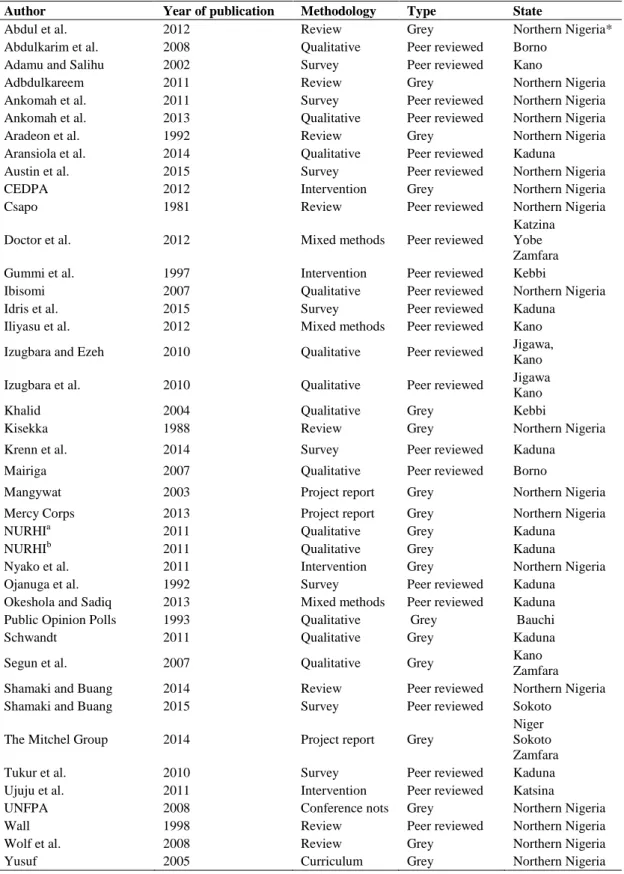
The final number of publications synthesized in this literature review was 41. Given the small number of publications, we used all sources we found, regardless of year or type of publication. The publications are listed on Table 1. Figure 1 summarizes the type of publications we reviewed. More than half were published in peer reviewed journals, and about half were published between 2011 and the present (Figure 1).
Analysis included a through reading of the selected manuscripts, review of themes, finding similarities and differences, triangulating the different resources, and synthesizing all the available information. Initial review was done by one of the authors, and results were further assessed and refined by other authors and members of the broader research team, to assess emerging themes and interpret findings.
Results
A cohesive and consistent story emerged from our synthesis of the evidence which we present here. We start with a description of elements of northern-Nigerian culture that are relevant to women‘s health decisions and how these elements influence demand for and utilization of family planning, antenatal care, and facility delivery services. We continue with a discussion about
Table 1: Reviewed References
Author Year of publication Methodology Type State
Abdul et al. 2012 Review Grey Northern Nigeria*
Abdulkarim et al. 2008 Qualitative Peer reviewed Borno
Adamu and Salihu 2002 Survey Peer reviewed Kano
Adbdulkareem 2011 Review Grey Northern Nigeria
Ankomah et al. 2011 Survey Peer reviewed Northern Nigeria
Ankomah et al. 2013 Qualitative Peer reviewed Northern Nigeria
Aradeon et al. 1992 Review Grey Northern Nigeria
Aransiola et al. 2014 Qualitative Peer reviewed Kaduna
Austin et al. 2015 Survey Peer reviewed Northern Nigeria
CEDPA 2012 Intervention Grey Northern Nigeria
Csapo 1981 Review Peer reviewed Northern Nigeria
Doctor et al. 2012 Mixed methods Peer reviewed
Katzina Yobe Zamfara
Gummi et al. 1997 Intervention Peer reviewed Kebbi
Ibisomi 2007 Qualitative Peer reviewed Northern Nigeria
Idris et al. 2015 Survey Peer reviewed Kaduna
Iliyasu et al. 2012 Mixed methods Peer reviewed Kano
Izugbara and Ezeh 2010 Qualitative Peer reviewed Jigawa,
Kano
Izugbara et al. 2010 Qualitative Peer reviewed Jigawa
Kano
Khalid 2004 Qualitative Grey Kebbi
Kisekka 1988 Review Grey Northern Nigeria
Krenn et al. 2014 Survey Peer reviewed Kaduna
Mairiga 2007 Qualitative Peer reviewed Borno
Mangywat 2003 Project report Grey Northern Nigeria
Mercy Corps 2013 Project report Grey Northern Nigeria
NURHIa 2011 Qualitative Grey Kaduna
NURHIb 2011 Qualitative Grey Kaduna
Nyako et al. 2011 Intervention Grey Northern Nigeria
Ojanuga et al. 1992 Survey Peer reviewed Kaduna
Okeshola and Sadiq 2013 Mixed methods Peer reviewed Kaduna
Public Opinion Polls 1993 Qualitative Grey Bauchi
Schwandt 2011 Qualitative Grey Kaduna
Segun et al. 2007 Qualitative Grey Kano
Zamfara
Shamaki and Buang 2014 Review Peer reviewed Northern Nigeria
Shamaki and Buang 2015 Survey Peer reviewed Sokoto
The Mitchel Group 2014 Project report Grey
Niger Sokoto Zamfara
Tukur et al. 2010 Survey Peer reviewed Kaduna
Ujuju et al. 2011 Intervention Peer reviewed Katsina
UNFPA 2008 Conference nots Grey Northern Nigeria
Wall 1998 Review Peer reviewed Northern Nigeria
Wolf et al. 2008 Review Grey Northern Nigeria
Yusuf 2005 Curriculum Grey Northern Nigeria
of the few documented programs that used influencers to affect behavior change in northern Nigeria.
The northern Nigeria cultural milieu
Religion and culture are closely intertwined in northern Nigeria; both involve systems of actions, justified by values and beliefs. The region‘s ethnic majorities are Hausa and Fulani, and the population is predominantly Muslim. Islam in northern Nigeria is a complete way of life, governing behaviors both inside and outside the home.5 Women in northern Nigeria often refrain from going out, socializing, and working without their husband‘s explicit permission. Some are not even permitted to see their natal relatives after they marry.6 When married women cannot leave their homes they rely on their daughters as the main contact with the outside world, including buying and selling at the market, which these young girls do instead of going to school7.
About two thirds of women of reproductive age in northern Nigeria have no formal education; and of these, about three quarters are illiterate4. While younger women are generally better educated, the figure for women 15-24 years old with no education is still 58.1% and 55.5% for north-west and north-east regions respectively7. Early marriage remains a common practice7,8. In 1981 Csapo stated that ―In most parts of Hausaland child marriage is the rule […] the father has the right to contract his virgin daughter in marriage regardless of her wishes and without consultation with the mother‖9. Marital age has not increased much since Csapo published his work more than thirty years ago. The 2013 DHS showed that among married women in northern Nigeria, age 15-24, the median age of marriage was 15, and many girls married when they were 12 years old or younger4.
Men in northern Nigeria are considered leaders, bread winners, and the authority within the family, community, and society10. Women are valued mainly for their reproductive function and the number of children they bear. Women are therefore highly dependent on their husbands, and defer to them in all household decisions, including
decisions relating to their own health6,8,11.
Demand for family planning services
Couples in northern Nigeria desire many children, and therefore do not wish to use contraception12-15. Several religious and cultural norms contribute to this phenomenon. A 1991 national study found that most Muslim participants followed the religious injunction to procreate with a prevailing belief that children constitute a continuous flow of gifts from divine providence, and, as such, none should be refused12. Focus group discussions conducted with men and women in 2007 and 2013 showed that in Kano State, for example, this very literal interpretation of the scriptures still prevailed13-15. People wanted to have many children also so that their lineage is continued and their prestige improves. An older study found that parents wanted to have many children in the hope that at least a few will be successful enough to provide financial security for the rest of the family12. No recent study was found to corroborate this cultural preference.
Since polygamy is a common practice in the region, wives compete to bear the most children in order to inherit a larger share of their husbands‘ property8
. Women in monogamous marriages often desire more children, to dissuade their husbands from seeking a second wife12,16. Preference for male children, who are perceived to bring honor to their parents, increases the desire for more children8,12, and some men simply feel pride in having more children17.
When couples do want to limit the number of children they have, perceived societal opposition or disapproval inhibits contraceptive use. Women who use contraception are often perceived to be promiscuous; men who allow their wives to use contraception are considered weak14.
Demand for antenatal care and hospital
delivery
that doing so gives them prestige18.
Socio-cultural conventions drive these behaviors, as confirmed by a study conducted in Zamfara and Kano States19. The study identified many reasons for not delivering in a hospital, including poor services (unpleasant attitudes of health workers; lack of adequate equipment, drugs and skilled medical personnel; having male medical personnel attend to pregnant women); others reflected cost and lack of access; but many were socio-cultural. A recent study identified religion in Nigeria as a determinant of poor maternal health utilization, as Muslim women were significantly less likely to obtain services than other women, even when controlling for geographic region20.
A 2002 study surveyed all pregnant women in a rural area in Kano State (n=107) and found that 88% were not receiving antenatal care. When asked why, 17% said that their health is ‗God‘s will‘, and 8% said there was no reason for them to attend, as they were perfectly healthy21. A more recent study found some improvements. The authors interviewed women in Katsina, Yobe, and Zamfara States. Only 27% of those with a live birth in the previous five years (n=1,189) had attended at least one antenatal consultation. While 30% sought advice from friends, family or traditional birth attendants in their community, the remainder did not seek or receive pregnancy-related advice from anyone, not even their mothers22. In focus group discussions the researchers probed and discovered a very deeply ingrained belief that pregnancy is a normal part of married life, and pregnant women do not need any assistance or special treatment. A 1988 presentation claimed that Hausa pregnant women are expected to practice the custom of disguising signs of pregnancy and labor and refraining from discussing their pregnancy, especially their first pregnancy. With the onset of labor, the young mother-to-be is supposed to exhibit bravery and endure pain silently23. This custom was confirmed by Wall (1998)24. The findings from Doctor et al.22 suggest that not much has changed since these earlier studies were published, as only 13% of women delivered their most recent baby in a health facility (compared to the national average of 35%)4. Of those who delivered at home, many
preferred to deliver completely on their own without assistance from anyone. In focus group discussions the view was that there is no reason for mothers not to deliver at home without outside help22. Similarly, respondents to in-depth interviews in Kaduna State said that delivering at home and alone is as safe as in the hospital25.
Of interest also is the couple‘s decision-making process in cases of an obstetric emergency. A 2010 study described how pregnant women in three rural northern Nigerian communities responded to maternal complications outside of a hospital setting26. They interviewed 322 women who had recently given birth, of which 15% had at least one complication. Some 20% did nothing, as they waited for their husband to return and give them permission to seek help (an average of two hours); 35% consumed or applied herbal remedies, and only went to the hospital when these did not work.
Who influences women’s health decisions?
A large survey examined the rates of contraceptive use by women‘s communication about family planning. Results show that women who discuss child spacing with others are much more likely to practice contraception than women who do not. Women who talk about contraceptive use with school teachers are most likely to be using family planning (16%), followed by women who discussed it with religious leaders (15%) and parents (15%)27. While the study did not include women‘s communication with their husbands, men are obvious influencers in women‘s health decisions, since they are considered to be the authority within the family10. An older study28 found that more than three quarters of respondents in a survey of men, senior and junior wives believed that men are, and should be, decision-makers with respect to their wives‘ health. In a more recent study, when asked who women can talk to about family planning, women in Kaduna State said ‗their husband‘29
contraceptive use). Women could also ask their mothers or mothers-in-law to initiate the contraceptive conversation with their husbands for them29.
In-depth interviews with young women and men in Kano and Zamfara States found that most believed the men to be the ultimate decision-maker regarding child spacing and contraceptive use30. Another study found that most men will only allow contraceptive use when the woman‘s life is in danger14. While there is some covert use of modern contraception, this is mitigated by the common belief that a man would leave his wife if he discovers that she uses contraception without his knowledge14.
Couples in northern Nigeria do not usually communicate about contraceptive use and child spacing. It is difficult for wives to initiate the family-planning talk, as many fear the prospect, especially if they suspect that their husband is opposed to contraceptive use14. Formative research for Nigerian Urban Reproductive Health Initiative (NURHI) in four states, among them Kaduna State in the north, found that women felt men should start the conversation, and men felt their wives should start the conversation, and so the contraceptive conversation never happened31. Poor spousal communication is, in many ways, driven by the many reasons couples want to keep having children, as described above32.
Many women in northern Nigeria are still not allowed to leave their home without their husband‘s permission. Many husbands do not give permission, as indicated by the various studies in which respondents said they did not attend antenatal services, or did not deliver in a facility, because they did not have their husband‘s permission19,21,22,33-35. Yet many women would prefer to deliver in a hospital given the opportunity. A 2013 study in Kaduna State found that 83% of women would prefer to deliver in the hospital if they could, mostly for the safety of mother and child25.
Men are not women‘s only influencers. A study that examined communication patterns between mothers and daughters in northern Nigeria found that the majority of daughters acquired reproductive health education from their mothers36. Yet some young women feel that they
cannot talk to their mothers about their pregnancy, and are forced to rely on their friends for information, which is often inaccurate and misleading6. Given how closed the society is, and the difficulty women have of leaving their home, of interest also is where social interactions occur. Younger and older groups of women in Kaduna State recognized schools, mosques, community leaders‘ palaces, and restaurants as places for social interaction37.
The literature shows that religious and community leaders can also influence women‘s decisions about their health. Religious leaders who were discussants at a United Nations Population Fund (UNFPA) conference on roles of traditional and religious leaders in maternal health, held in Sokoto State, acknowledged that traditional and religious leaders can make substantial contributions to reducing maternal mortality, provided they are sufficiently informed and effectively mobilized38.
A study in Borno State interviewed a representative sample of religious leaders and Muslim scholars and found a lot of ignorance about reproductive health issues. Yet, when the concepts were explained to them, they adopted positive attitudes toward reproductive health programming, provided that activities did not conflict with Islamic teaching39. Also, in many cases leaders influence men more than they do women11. Therefore they can influence women through influencing their husbands.
A 2010 study interviewed religious leaders in Zamfara State. Respondents indicated religious tolerance to hospital delivery, and identified programmatic opportunities to increase demand for hospital delivery by engaging religious leaders to give their congregation the message that Islam supports hospital delivery and orthodox medicine19.
religious leaders should be informed and husbands should be educated and counseled on allowing their wives to attend antenatal services and deliver in a health facility40. Few interventions in northern Nigeria utilized influencers to effect women‘s health seeking behavior. In the next section, we present those that we could find.
Interventions involving religious or political
leaders
A 1997 study described a community education intervention in Kebbi State, designed to make opinion leaders, such as village chiefs, change agents in the community. To encourage use of emergency obstetric services they were trained in key messages for four months41. Community awareness and other indicators improved, however since this was one of a package of interventions undertaken in the community concurrently, increases in demand for services cannot be attributed to this intervention alone. Still, the researchers concluded that involving opinion leaders in their communication effort was successful in getting new information to women and men in the community. Note that utilization of services improved in some facilities but declined in others, suggesting that improved knowledge does not necessarily translate to behavior change.
Center for Development and Population Activities (CEDPA) implemented a program in northern Nigeria aimed to improve family welfare by training Imams and sensitizing religious leaders to take action to promote safe motherhood, birth spacing and education of girls. These leaders were also urged to advocate for reproductive health and family planning support. The Chief Imam clarified Islam's position on using modern contraception, affirming the critical message that birth spacing is desirable for the well-being of mother and child. Getting buy-in from the Chief Imam helped to positively influence the network of Islamic leaders in northern Nigeria. No information is available on the impact of this project on health-service utilization42.
A project implemented by Development Research and Projects Center targeted some of the most conservative religious leaders in zones with the highest maternal mortality rates. Using a multi-
stage leadership development model, they trained religious leaders, supported them to attend a study tour in Egypt, facilitated their use of internet and mobile communications technologies to host community dialogues with Egyptian scholars participating via video link to reinforce correct messages, and convened step-down trainings for lower level religious leaders. By the end of the project there was a reduction in negative and incorrect statements by religious leaders and increase in positive and correct pronouncements. An increase in utilization of maternal and child health was noted in all project areas. These results were available on the project web site when we began our review, with no information about how they were obtained or measured. Since then the project ended, and their web site is no longer active. We found reference to the project in the final report of the United States Agency for International Development (USAID) ‗The leadership development for family planning/reproductive health for political office holders, traditional and religious leaders‘ project, but with few details43.
Interventions involving men
The USAID-funded Maternal and Child Health Integrated Program trained 247 male motivators in Kano, Katsina, and Zamfara States to counsel men, religious leaders and traditional rulers in the communities on the importance and benefits of healthy timing and spacing of pregnancies and the use of modern contraceptives. Their intervention demonstrated that male involvement in family planning programming can be successful in increasing demand for family planning services, in northern Nigeria. The 19% contraceptive acceptance rate in the project was significantly higher than the known figures for the region (3% per 2008 DHS44). However, this result means that 81% of the counseled men did not receive a method for themselves or their wives, suggesting that there is room for much improvement45.
on uptake of health services.
Fertility awareness-based methods of family planning are unique in that they are not women‘s methods (such as contraceptive pills) or men‘s methods (such as condoms). Rather, they are couple methods, and cannot be practiced without consistent couple communication. CycleBeads is a modern fertility awareness-based method that is currently available in public health facilities in several northern Nigerian states, as part of the basket of services available to women. The method identifies days 8-19 of the menstrual cycle as fertile for all users, and is most effective for women with cycles that usually range 26-32 days. Users utilize a string of beads (CycleBeads) to determine the days in which they should avoid unprotected intercourse to prevent pregnancy46. An intervention in Katsina State that introduced CycleBeads to couples found that men were very receptive to it. Results show that men who learned about the method and introduced it to their wives were very likely to use the method correctly. An added benefit in polygamous marriages, was that men whose wives were using CycleBeads chose which wife to spend the night with based on the days the method identified as not fertile. The authors concluded that the method should be introduced broadly in the region to increase contraceptive prevalence overall47.
Interventions involving peers or older women
Most traditional birth attendants in northern Nigeria are uneducated and the care they provide is often questionable, yet they have an established role in many communities as respected figures that are thought to promote health. CEDPA implemented a project that used traditional birth attendants in northern Nigeria to distribute contraceptive methods. They were able to reach women in purdah, and were trusted within the community, giving them access to women39. No information is available about changes in uptake of contraception as a result of the program.
We could not identify in the literature programs involving peers or older women, other than traditional birth attendants, to improve health-seeking behaviors of young women. However, the 100 Women Groups is a strategy that may be used
for this purpose. The strategy fosters the participation of women‘s groups in traditional, political, and legislative decision-making processes, by harnessing the strengths of existing
traditional women‘s organizations and community-based organizations, in support of civil society. The program brings together various women‘s groups (cultural, religious, economic, social, or professional), to create larger, stronger, more influential groups. After a large group is formed, members are given an orientation to the program, and are trained in mobilization and networking skills. The groups meet regularly to discuss issues that the group should address. In northern Nigeria, the program‘s success revolved around raising awareness of reproductive health, safe motherhood, and the importance of girls‘ education48.
Discussion
The literature presents a consistent picture of northern Nigeria as a conservative society, with cultural and religious conventions that still limit demand for and utilization of health services. It is not surprising that after years of programming, maternal and child health indicators in northern Nigeria have not significantly improved and are still among the poorest in the world. Women who are not allowed to go out do not attend services even if they understand the need for them; couples who want to have many children do not use contraceptives; women who believe that only God can influence their health, do not seek health services. Therefore programs aimed at improving women‘s health outcomes in northern Nigeria should not only present women with information. To affect behavior change they should influence perceptions, beliefs, and norms, and create enabling communities that allow women to adopt health-seeking behaviors without being stigmatized.
is to educate their husbands. Men need to understand the advantages of having fewer children, utility of contraceptives, importance of antenatal services, and the life-saving benefits of facility-based deliveries. We posit also that programs should promote the practice of men giving their wives blanket permission to go out and seek health services for themselves and their children. This will reduce mortality in medical emergencies where the husband is not at home. Religious and traditional leaders may also influence women‘s health-seeking behaviors. Programs that employ them may contribute to increased demand for services, but only if they target not only the young women, but also their husbands. Since religious beliefs are very deeply ingrained, it is crucial for such programs to exclude messages that could be perceived as inconsistent with the teachings of Islam. Moreover, the literature suggests that religious leaders can be more effective when they do not only preach or promote certain behaviors, but when they practice these behaviors themselves, and make this known to the community. Therefore programs that use religious and traditional leaders as role models hold promise. Older women (mothers, mothers-in-law) may also be used in programs to increase young women‘s demand for health services, but the connection is less obvious. While mothers largely educate their daughters, there is not always communication between them about maternal health. Also, after women marry, some still have little contact with their mothers. Mothers-in-law may therefore be a better programmatic option. It is quite possible that other groups or individuals can be identified to influence women‘s health decision making. One study suggested that women who discussed child spacing with school teachers were more likely to use contraception, yet no program has been implemented using school teachers. Another example is the wives of religious leaders, as in some Muslim communities they influence women‘s opinions more than their husbands. On the other hand, knowing who the people are who can potentially influence women does not tell us much about who would be the most effective influencers or how a program can achieve real measurable change by employing them. For
example, while teachers can influence women‘s behavior, if few girls get formal education, they are not exposed to teachers, and working with teachers may therefore not make a substantial difference in health outcomes.
While this review has clear programmatic implications, much more can be learned to guide the design of innovative programs with a chance of improving demand for women‘s health services, despite cultural opposition to services. For example, social network analysis studies with women and men can provide information important to program design, by more clearly outlining the pathways of information flow in the community, and identifying who, exactly, women and men talk to and seek advice from. Programs can then be designed that capitalize on these relationships to affect behavior change. It may be helpful to study the reasons why men do not give their wives permission to seek health services. Ignorance about the benefits of services and cultural or religious beliefs may be only partially to blame. It is possible, for example, that men cannot afford to give their wives money for transportation to the facility, and withhold their permission so as not to lose face.
maternal and child health services. Few studies evaluated programs that used influencers to affect change in health-seeking behaviors. Therefore studies to determine how these influencers can be used in programs will also be useful. Programs using more than one type of influencer (such as religious leaders and mothers-in-law), should also be designed. These programs must then be evaluated by rigorous operations research. Finally, dose-response studies may also be helpful, to identify the tipping point after which demand for services begins to increase more readily.
Limitations
This review had some limitations. The literature on our issues of interest is limited. Some resources are old enough that social conventions may have changed since they were written; also we did not assess the quality and methodological validity of reviewed sources. Therefore some assertions we make in the review are based on only one or two studies, sometimes from grey literature, and cannot always be substantiated, validated, or generalized. And yet the compelling story the literature presents is consistent, suggesting that it is a true representation of women‘s health decision-making in northern Nigeria today.
Conclusion
Maternal health indicators in northern Nigeria are still among the poorest in the world. This literature review focused on demand-side factors to health service utilization, and confirmed that women are influenced by those around them as they make decisions to utilize health services for themselves and their children. Things are changing in northern Nigeria, albeit slowly. Interventions designed to increase utilization of maternal and child services that involve the people who influence young women‘s decisions, including their husbands, religious leaders, and older women, hold promise.
Acknowledgements
We thank the technical and senior technical advisors of the Maternal, Newborn and Child Health Programme (MNCH2) for their contribution to the discussion as they face the
issues we raised in their daily work. This review was funded by UKaid from the UK government; the views expressed are the authors‘ and do not necessarily reflect the UK government‘s official policies.
Contribution of Authors
Irit Sinai initiated the literature searches, reviewed all references, synthesized the findings, and prepared a first draft of the manuscript; Jennifar Anyanti, Mohsin Khan, and Ramatu Daroda contributed to interpretation and synthesis of the findings; Olugbenga Oguntunde conceptualized the literature review and contributed to research design, interpretation and synthesis of findings. All authors reviewed the manuscript and approved of it.
References
1. Goldberg A. Norms within Networks: Opinion Leader and Peer Network Influences on Mothers/Caregivers' Childhood Immunization Decisions in Rural Northern Nigeria [dissertation], New York (NY): Columbia University; 2014.
2. Valente TW. Social network and health: models, methods, and applications. New York: Oxford University Press. 2010
3. National Population Commission [Nigeria]. Priority table Vol. III: Population distribution by sex, state, LGA, and senatorial district. Abuja, Nigeria: National Population Commission. 2010.
4. National Population Commission (NPC) [Nigeria] and ICF International. Nigeria Demographic and Health Survey 2013. Abuga, Nigeria and Rockville, Maryland, USA: NPC and ICF International. 2014. 5. Abdul, MM, Onose M, Ibrahim MT, Voke‐Ighorodje M,
Adeyeye MO, Adeleke O, Adeleke O, and Babalola A. An analysis of the socio‐economic, socio‐
cultural, religious, environmental, technological, language and educational factors on women‘s right in Nigeria: the case of Northern Nigeria, Fundación Mujeres; 2012.
6. Yusuf B. Sexuality and the Marriage Institution In Islam: An Appraisal, Lagos, Nigeria: Africa Regional Sexuality Resource Centre. 2005.
7. Mercy Corps. Adolescent Girls in Northern Nigeria: Financial Inclusion and Entrepreneurship Opportunities. [Cited 2016 June 30]. Available from http://www.mercycorps.org/research-resources/adolescent-girls- northern-nigeria-financial-inclusion-and-entrepreneurship. 2013. 8. Wolf M, Abubakar A, Tsui S and Williamson NE. Child
9. Csapo M. Religious, Social and Economic Factors Hindering the Education of Girls in Northern Nigeria. Comp Educ. 1981;17(3): 311-319. 10. Khalid, S. Socio-Economic and Cultural Roots of
Reproductive Health Care Problems in North-Western Nigeria, Sokoto, Nigeria: Usmanu Danfodiyo University. 2004. [cited 2016 June 30].
Available from
http://www.gamji.com/article6000/news6048.htm.
11. Public Opinion Polls. MotherCare Project. Arlington (VA): John Snow [JSI]. 1993.
12. Aradeon SB, Onyekwere E, Iwere EN, Etta FE, Abdullahi R, Oloko S and Tanko N. Sociocultural analysis of the USAID interventions in Nigeria : FHSII - family health services, CCCDII - maternal/child health, AIDSCAP - HIV /AIDS prevention and control, SBA Consultants; 1992.
13. Ibisomi, LDG. Fertility Transition in Nigeria: Exploring the Role of Desired Number of Children. Nairobi, Kenya: African Population and Health Research Center. 2007.
14. Ankomah, A., Anyanti J, Adebayo S and Giwa A. Barriers to contraceptive use among married young adults in Nigeria: A qualitative study. Int J Trop Disease & Health 2013;3 (3):267-282.
15. Idris SH, Sambo MN and Ibrahim MS. Barriers to utilization of maternal health services in a semi-urban community in northern Nigeria: The client perspective. Nigeria Med J. 2013; 54 (1):27-32. 16. Izugbara CO and Ezeh AC. Women and High Fertility in
Islamic Northern Nigeria. Stud Family Plann. 2010; 1(3):193-204.
17. Aransiola, JO, Akinyemi AI, and Fatusi AO. Women's perceptions and reflections of male partners and ouple dynamics in family planning adoption in selected urban slums in Nigeria: A qualitative exploration. BMC Public Health. 2014;14 (1): 1-14.
18. Austin A, Fapohunda B, Langer A and Orobaton N. Trends in delivery with no one present in Nigeria between 2003 and 2013. Int J Women‘s Health. 2015;7:345-356.
19. Segun T, Ishola G, Sule S, Isiugo-Abanihe, U, Rawlins B and Otolorin E (2007). Factors enabling and constraining the use of maternal and newborn health services in northern Nigeria: Formative research findings and implications. A poster presented at the 135st annual meeting of the American Public Health Association, Washington, (DC). 2007. 20. Solanke BL, Oladosu OA, Akinlo A and Olanisebe SO.
Religion as a social determinant of maternal health care service utilization in Nigeria. Afr Population Studies. 2015;29 (2):1868-1872.
21. Adamu YM and Salihu HM. Barriers to the use of antenatal and obstetric care services in rural Kano, Nigeria. J Obst Gyn 2002;22(6):600-603.
22. Doctor HV, Findley SE, Ager A, Cometto G, Afenyadu GY, Adamu F and Green C. Using community-based research to shape the design and delivery
of maternal health services in Northern Nigeria. Reprod Health matter. 2012;20(39):104–112. 23. Kisekka MN. A brief on population and socio-cultural life
in Nigeria. Presented at the Training Course for Master Trainers' Workshop, University of Ilorin, October 19-20, 1988. [Cited 2016 June 30].
Available from
http://www.popline.org/node/377673.
24. Wall, LL. Dead mothers and injured wives: the social context of maternal morbidity and mortality among the Hausa of northern Nigeria. Stud Family Plann. 1998;29(4):341-59.
25. Okeshola FB and Sadiq IT. Determinants of Home Delivery among Hausa in Kaduna South Local Government Area of Kaduna State, Nigeria. American Int J Cont Research. 2013;3 (5):78-85. 26. Tukur, BM, Bawa U, Odogwu K, Adaji S, Suleiman I and
Passano P. Praying for Divine Intervention : The Reality of ―The Three Delays‖ in Northern Nigeria. Afr J Reprod health. 2010;14 (3): 113–120. 27. Ankomah A, Anyanti J and Oladosu M. Myths,
misinformation, and communication about family planning and contraceptive use in Nigeria. Open Access J Contraception 2011;2:95-105.
28. Ojanuga D and Johnson M. Hausa families and health care choices: birth injuries in African communities. Family Systems Medicine. 1992;1 (4):413-421. 29. Schwandt, H. Perspectives on Family Planning in Ibadan
and Kaduna, Nigeria: A Qualitative Analysis, Nigerian Urban Reproductive Health Initiative. 2011.
30. Nigerian Urban Reproductive Health Initiative (NURHI), A. Perspectives on Family Planning in Ibadan and Kaduna, Nigeria: A Qualitative Analysis, Nigerian Urban Reproductive Health Initiative. 2011. [cited 2016 June 30]. Available from http://www.nurhitoolkit.org/sites/default/files/trac ked_files/Perspectives%20on%20Family%20Plannin
g
%20-%20Focus%20Group%20Discussions%20Report.pdf.
31. Krenn, S, Cobb L, Babalola S, Odeku M and Kusemiju B. Using behavior change communication to lead a comprehensive family planning program: the Nigerian Urban Reproductive Health Initiative. Global Health: Science and Practice. 2014;2 (4): 427-443.
32. Izugbara CO, Ibisomi AC, Ezeh and M. Mandara. Gendered interests and poor spousal contraceptive communication in Islamic northern Nigeria. J Fam Plan Reprod H. 2010; 36(4):219-224.
33. Abdulkareem S. Socio-Cultural and Economic Factors Affecting Women's Access to Reproductive Health Services in Northern Nigeria. Academia; 2011. [cited 2016 June 30]. Available from
www.academia.edu/9320343/.
35. Shamaki MA and Buang A. The Socio-cultural Behaviors of Women‘s Health Facilities Utilisaiton in Northern Nigeria. Mediterr J Social Sciences. 2015;6(4): 517-534.
36. Iliyasu, Z, Aliyu MH, Abubakar IS and Galadanci HS. Sexual and reproductive health communication between mothers and their adolescent daughters in northern Nigeria. Health Care women In. 2012;33 (2):138-52.
37. Nigerian Urban Reproductive Health Initiative (NURHI). A Family Planning Social Mapping in Ibadan and Kaduna, Nigeria. 2011. [cited 2016 June 30].
Available from
http://www.nurhitoolkit.org/sites/default/files/tracke d_files/FP%20Social%20Mapping%20Report.pdf. 38. UNFPA (2008). Conference on the role of
traditional/religious leaders on reduction of maternal mortalityand survival of women: Held at the Sokoto State College of Education Conference hall. [cited 2016 June 30]. Available from
http://nigeria.unfpa.org/pdf/ctrleasokoto2008.pdf.
39. Mairiga AG, Kyari O, Kulima A and Abdullahi H. Knowledge, perceptions and attitudes of Islamic scholars towards reproductive health programs in Borno State, Nigeria. Afr J Reprod Health. 2007; 11(1):98-106.
40. Abdulkarim G, Mairiga AG, Kawuwa MB and Kullima A.Community Perception of Maternal Mortality in Northeastern Nigeria. Afr J Reprod Health. 2008;12(3):27-34.
41. Gummi, FB, Hassan M, Shehu D and Audu L.
Community education to encourage use of emergency obstetric services, Kebbi State, Nigeria.The Sokoto PMM Team. Int J Gynecol Obstet. 1997;59 Suppl 2:S191- 200. 42. CEDPA. Engaging Social Networks in Family Planning
Programming: Lessons from Research and Interventions. A Report for: Terikunda Jekulu:
Using Network Analysis to Address Unmet Need in Mali. 2012.
43. The Mitchel Group. The leadership development for family planning / reproductive health for political office holders, traditional and religious leaders project: end-of-project performance evaluation final report. Washington (DC). 2014. [cited 2016 June
30]. Available from
http://pdf.usaid.gov/pdf_docs/PA00JP52.pdf. 44. [DHS, 2009] National Population Commission (NPC)
[Nigeria] and ICF International. Nigeria Demographic and Health Survey 2008. Abuga, Nigeria and Rockville, Maryland, USA: NPC and ICF International. 2009. 45. Nyako, Z, Yusuf S, Segun T, Airede L, Ishola G and
Otolorin EO. Use of Male Birth Spacing Motivators to Mobilize Communities for Family Planning Acceptance in Northern Nigeria. 2011 International Conference on Family Planning, Dakar Senegal. 2011. [cited 2016 June
30]. Available from
http://fpconference.org/2011/wp- content/uploads/FPConference2011-Agenda/312-
otolorin-use_of_male_birth_spacing_motivators_to_mobiliz e_communities-1.1.07.pdf.
46. Arévalo M, Jennings V and Sinai I. ―Efficacy of a new method of family planning: The standard Days Method‖. Contraception. 2001; 65(5):333-338. 47. Ujuju C, Anyanti J, Adebayo SB, Muhammad F, Oluigbo
O and Gofwan A. Religion, culture and male involvement in the use of the Standard Days Method: evidence from Enugu and Katsina states of Nigeria." Int Nurs Rev. 2011;58(4): 484-490.