Iranian R ehabilitation Journal
Normalization and Reliability Evaluation of Persian Version
of Two-Pair Dichotic Digits in 8 to 12-Year-Old Children
Mitra Rezapour1, Farzaneh Zamiri Abdollahi2*, Maryam Delphi3, Yones Lotfi2, Enayat-Allah Bakhshi2
1. Department of Audiology, Iran University of Medical Sciences, Tehran, Iran.
2. Department of Audiology, University of Social Welfare and Rehabilitation Sciences, Tehran, Iran.
3. Musculoskeletal Rehabilitation Research Center, Ahvaz Jundishapur University of Medical Sciences, Ahvaz, Iran.
* Corresponding Author:
Farzaneh Zamiri Abdollahi, PhD Candidate
Address: Department of Audiology, University of Social Welfare and Rehabilitation Sciences, Koodakyar Ave., Daneshjoo Blvd., Evin, Tehran, Iran. Tel: +98 (21) 22180100
E-mail: [email protected]
Objectives: All subjects suspected of Central Auditory Processing Disorder (CAPD) were
previously tested by free recall dichotic digits test (DDT). The study objective was normalization and reliability evaluation of two-pair DDT in 750 native Persian subjects aged 8 to 12 years.
Materials: A total of 750 subjects were divided into five age groups varying between 8 years and 12 years and 11 months old. Each age group had 150 subjects. DDT was tested in free recall condition. For evaluating DDT test-retest reliability, 300 participants (60 subjects in each age group) were tested again after one month.
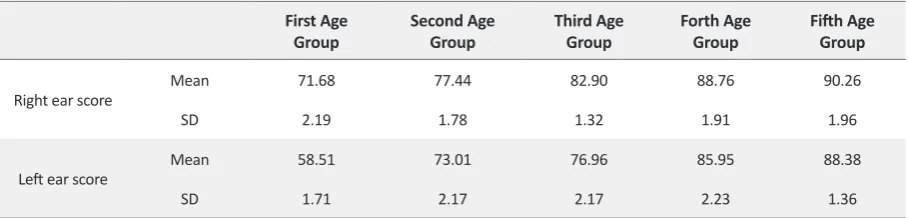
Results: Right and left ear mean score increased from 71.68(±2.19) and 58.51(±1.71) in the 8-year-old group to 90.26(±1.96) and 88.38(±1.36) in 12-year-old group, respectively. The mean Right Ear Advantage (REA) decreased from 13.16(±2.58) in the 8-year-old group to 1.88(±2.49) in the 12-year-old group. A high stability was observed between test-retest results (P<0.0001).
Discussion: Persian version of two-pair dichotic digits exhibited proper reliability for evaluating 8 to 12-year-old subjects, and the study results can be used for evaluating the dichotic hearing function in subjects of the same age group.
A B S T R A C T
Article info: Received: 08 Jan. 2016
Accepted:29 Apr. 2016
Keywords:
Two-pair dichotic digits test, Dichotic hearing processing, Free recall paradigm
Citation: Rezapour M, Zamiri Abdollahi F, Delphi M, Lotfi Y, Bakhshi E.A. Normalization and Reliability Evaluation of Persian Version of
Two-Pair Dichotic Digits in 8 to 12-Year-Old Children. Iranian Rehabilitation Journal. 2016; 14(2):115-120. https://doi.org/10.18869/nrip.irj.14.2.115
:
: https://doi.org/10.18869/nrip.irj.14.2.115
CrossMark
1. Introduction
he auditory function of each ear is usually assessed individually, but listening in every
-day activities is a binaural function. There
-fore, auditory system must integrate the competing information coming from two ears in a quicker way [1]. Subjects with normal periph
-eral hearing, who complain about listening difficulties in
noisy or competing environments, suffer from Central Auditory Processing Disorder (CAPD), which accounts for 2-3% of children. Children with CAPD report certain types of hearing difficulties at school. For example, they report uncertainty about what they have heard, listening difficulties in a noisy environment, understanding and following oral instructions or difficulty in understanding fast or degraded speech. Therefore, for accurate auditory
T
Dichotic hearing is a condition in which different audi
-tory stimuli are presented simultaneously to each ear. A variety of stimuli can be used including syllables, digits, words or sentences. From the introduction of dichotic digit test (DDT) by Broadbent (1954) and its’ modifica
-tions by Kimura (1961) and Bryden (1963), digits have been proven to be effective stimuli for auditory process
-ing assessment [1,5,6]. In addition, ASHA (1996) de
-clared dichotic digits as the most suitable dichotic stimuli for CAPD evaluation. DDT exhibits some relevant char
-acteristics that make it suitable for evaluation of children with hearing difficulties. These characteristics include high sensitivity, fast (less than 5 minutes) and easy to perform, fast scoring, little linguistic load, easy to under
-stand test instructions and respond accordingly, unbiased toward mild conductive/sensorineural hearing loss, and compatible with different response techniques like point
-ing to the correct numbers or writ-ing them down [7,8].
Nowadays, one-pair and two-pair DDT are available for clinical evaluation of CAPD. In one-pair DDT, the hear
-ing impaired patients can score a 100% like that of the normal subjects. But, the two-pair DDT is considered to be the best dichotic test because it is easier to test on chil
-dren. However, it is more complex and challenging for analysis of the auditory system compared to the one-pair DDT [9-11]. In 2000, it was recommended that all sub
-jects with suspected APD should be tested with two-pair DDT due to the higher prevalence of dichotic auditory
disorders [2]. Dichotic tests can also be used for evalu
-ating central auditory maturation and determining hemi
-spheric language dominance in both children and adults. In DDTs, free recall condition is generally used (i.e. to re
-peat all digits heard regardless of ear or digit order). Test interpretation is based on right and left ear score and ear advantage (score difference between the two ears).
In children, right ear score is usually higher than the left ear, and the left brain hemisphere is language domi
-nant. This phenomenon is called Right Ear Advantage (REA). In most of the dichotic hearing tests, the auditory system maturation improves both ears’ score over time. However, left ear score improvement is generally faster and larger than the right ear, and this leads to a progres
-sive reduction in REA. In 11-12-year-old children, REA is similar to hat of the adults [11-15].
One of the criteria for CAPD diagnosis is higher REA and low left ear score. These findings show late maturation or CAPD. Reverse ear advantage (i.e. left ear advantage) is
for having DDT normative data for different age ranges as DDT score changes with age. The DDT normative data for different age groups can enable us to follow up dichotic hearing maturation process in children and differentiate be
-tween late maturation and CAPD. In late maturation, the subjects’ score improves over time, but this does not hap
-pen for the subjects with CAPD [7,11]. For DDT, every language must have stimuli of their own and find normative
data [7]. The aim of the present study is to obtain normative
data and determine the test-retest reliability of the Persian version of two-pair DDT using free recall condition.
2. Methods
This study was conducted on 750 normal hearing chil
-dren including 250 males and 500 females aged 8-12 years (150 subjects in each age group). Subjects were selected from the students of five selected elementary schools in Karaj. Written consent was obtained from the parents before starting the research work. The research process and tests were explained thoroughly to them. The demographic information and medical history were recorded. Exclusion criteria were ear diseases, abnormal peripheral auditory function, speech and language disor
-ders, neurological disorders (especially epilepsy), men
-ingitis, head trauma, math and/or writing and/or reading problems based on the teachers’ report.
All subjects had normal IQ (95 or higher) based on Wechsler IQ test, were right-handed (based on Edin
-burgh test) and monolingual (native Persian speakers). For evaluating the peripheral auditory system, the tech
-niques like autoscopy, immittance audiometry by Mad
-sen Zodiac 901 and pure tone and speech audiometry including speech recognition threshold (SRT) and word recognition score (WRS) by Clinical Audiometer AC 33 were used. The normal peripheral auditory function was determined based on normal autoscopy, tympanogram, with normal hearing criteria like pure-tone average (PTA) ≤20 dB HL at six varied octave frequencies from 250 to 8000 Hz, hearing threshold asymmetry ≤5 dB, word recognition scores (WRS) in quiet ≥90%.
DDT was conducted in an acoustic chamber at Akha
-van rehabilitation center related to the University of So
-cial Welfare and Rehabilitation Sciences. The test con
Iranian R ehabilitation Journal
the subjects had to repeat all numbers regardless of ear or digit order. Twenty pairs of digits (40 digits) were presented to each ear. Total score for both the ears and for each ear individually was recorded. Ear advantage score was calculated by subtracting left ear score from the right ear score. Before the test, some exercise trials
were used [16]. For presenting stimuli, Sony Mp3 player
NWZ-B162F was connected to clinical audiometer, and the stimuli were presented via TDH-39 headphone.
For determining DDT test-retest reliability, first 60 subjects of each age group were selected (300 subjects in all), and DDT was repeated after one month.
For data analysis, SPSS version 16 (IBM Corp., IL, USA) was used and descriptive information such as mean values and standard deviations were extracted. Paired t test was used for comparing mean score be
-tween two ears, and one-way ANOVA test was used for comparing mean REA among different age groups. For evaluating gender effect on DDT score, independent t test was used. For test-retest reliability estimation, Pear
-son correlation coefficient and paired t test were calcu
-lated. Statistical significance level was set at 0.05.
3. Results
In the present study, we included 750 children in the age groups of 8 to 12 years (250 males and 500 females). There were five age groups (150 children in each group): 8 years to 8 years and 11 months old, 9 years to 9 years and 11 months old, 10 years to 10 years and 11 months
old, 11 years to 11 years and 11 months old, and 12 years to 12 years and 11 months old.
DDT score mean value and standard deviation for right and left ears and each age group are summarized in Table 1. Ear advantage mean value and SD (percent) in the five age groups are shown in Table 2. As you can see, in all age groups, right ear score was higher than that of left ear.
The right and left ear DDT score in all age groups showed significant difference based on paired t test (P≤0.001) while the right ear score was significantly higher. Based on the ANOVA and post hoc analysis, REA showed a significant difference between all age groups (P≤0.001). The independent t test showed that gender had no effect on two-pair DDT (P≥0.005).
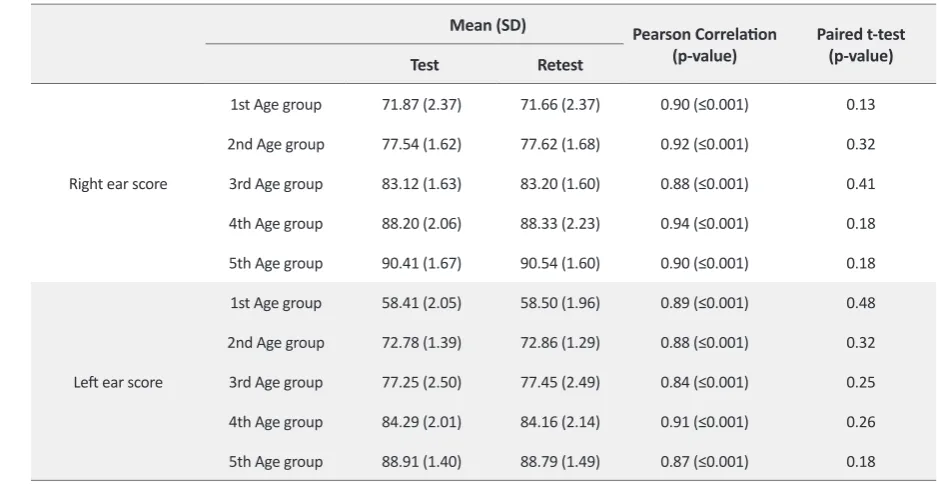
The DDT retest in 300 children after one month showed a correlation coefficient of 0.99. Persian version of two-pair DDT showed high test-retest reliability. In addition, the paired t test showed no significant statistical difference between the mean DDT score value in test and re-test con
-ditions (P≥0.005). The results are summarized in Table 3.
4. Discussion
In the present study, REA was obvious in all age groups. The results suggest the dominance of left-brain hemi
-sphere in language processing [11]. Other studies showed that REA was common in right-handed subjects, and only 15 to 20% had LEA or non-ear advantage (NEA) [17].
Table 1. DDT score mean value and standard deviation (%) for right and left ears and each age group.
Fifth Age Group Forth Age
Group Third Age
Group Second Age
Group First Age
Group
90.26 88.76
82.90 77.44
71.68 Mean
Right ear score
1.96 1.91
1.32 1.78
2.19 SD
88.38 85.95
76.96 73.01
58.51 Mean
Left ear score
1.36 2.23
2.17 2.17
1.71 SD
Table 2. Ear advantage mean value and SD (%) in 5 age groups.
Fifth Age Group Forth Age
Group Third Age
Group Second Age
Group First Age
Group
1.88 2.81
5.93 4.43
13.16 Mean
REA
2.49 2.44
2.46 2.88
2.58 SD
The present study showed increased DDT score in both the ears with age, but this growth was faster for left ear; therefore, REA was seen to reduce with age. The present findings are in agreement with other researches. Similar results were also presented by Pohl et al. (1984) in the case of 4 to 10-years-old children. The reason for DDT score improvement is the maturation of interconnections between the two brain hemispheres over time [12]. Mu
-kari et al. (2006) made Malay version of one and two-pair DDT and found normative data in 120 normal hearing children aged 6-11 years old, for free recall and directed attention condition. In free recall condition, REA and DDT score difference among age groups were larger for two-pair DDT than the one-paired. Two-pair DDT score showed a significant improvement with age for both ears, but the improvement was faster for the left ear [11].
In another study by Zenker et al. (2007), one, two and three-pair DDTs in free recall condition were used to examine age, ear, and task difficulty effects on the DDT score. They used 125 right-handed subjects aged 6 to 72 years and divided them into five age groups (6-11 years, 12-17 years, 18-33 years, 35-59 years, 60-72 years). The results showed a significant difference in two ears scores, age groups, and task difficulty. In all the age groups and three test types, REA was obvious, but it was more signifi
-cant in the youngest and the oldest age groups. The harder the test, the larger was the REA. The results showed that maturation of corpus callosum makes dichotic processing more effective in middle-aged subjects as compared to the
young children. In elderly, the dichotic processing is more like that in the young age [9].Moncrieff (2009) studied 217 subjects aged 10-28 years (11 left-handed, 200 right-handed, and 6 without any handedness).
They used DDT in free recall condition. The score im
-proved with age, and this improvement was greater for the left ear. Both ears’ score, especially left ear, showed a reduction in the score for task difficulty. Highest REA was seen in the 10 to 11-years-old age group [18]. Rosenberg (2011) examined two-pair DDT in 200 chil
-dren aged 5 to 12 years. The score in both ears increased and REA decreased with age, but the decrement was not uniform [7]. Moncrieff (2011) conducted another study on 247 children aged 5 to 12 years and performed ran
-dom DDT (one, two and three pairs DDT) in free recall condition. In younger children, REA was found to be larger. The ear advantage decreased significantly from 8 to 12 years old [1].
In the present study, there was no gender effect on the two paired DDT in free recall condition. This finding is in agreement with Bergen Dichotic Listening database that showed no gender effect on Dichotic consonant-vowel (CV) in 1018 (535 females and 483 males) subjects aged 6 to 88 years [19]. In addition to the language effects on neuropsychologic evaluations, Sommer et al. (2008) conducted a study to examine gender, handedness, and planum temporale asymmetry effects on ear advantage. They used dichotic listening tests and functional brain
(p-value) (p-value)
Retest Test
0.13 0.90 (≤0.001)
71.66 (2.37) 71.87 (2.37)
1st Age group
Right ear score
0.32 0.92 (≤0.001)
77.62 (1.68) 77.54 (1.62)
2nd Age group
0.41 0.88 (≤0.001)
83.20 (1.60) 83.12 (1.63)
3rd Age group
0.18 0.94 (≤0.001)
88.33 (2.23) 88.20 (2.06)
4th Age group
0.18 0.90 (≤0.001)
90.54 (1.60) 90.41 (1.67)
5th Age group
0.48 0.89 (≤0.001)
58.50 (1.96) 58.41 (2.05)
1st Age group
Left ear score
0.32 0.88 (≤0.001)
72.86 (1.29) 72.78 (1.39)
2nd Age group
0.25 0.84 (≤0.001)
77.45 (2.49) 77.25 (2.50)
3rd Age group
0.26 0.91 (≤0.001)
84.16 (2.14) 84.29 (2.01)
4th Age group
0.18 0.87 (≤0.001)
88.79 (1.49) 88.91 (1.40)
Iranian R ehabilitation Journal
imaging. Planum temporale asymmetry had no signifi
-cant difference between males and females as well as there was no gender difference in the case of dichotic hearing tests’ results [20]. Moncrieff (2009) studied 217 subjects aged 10-28 years (131 females and 86 males) and found no gender effect on DDT [18]. Moncrieff (2011) showed that there was a gender effect on random DDT in children aged 5-12 years, and males had a larger ear ad
-vantage. The reasons for this disagreement between the results of the present study and Moncrieff’s study were the differences in sample size, handedness, and prob
-able age range. Moncrieff used 147 subjects aged from 5 to 12 years old (129 males and 188 females). In the present study, 750 subjects aged 8-12 years (250 males and 500 females) were tested. In Moncrieff’s study, 190 subjects were right-handed, 12 were left-handed, and 45 had none handedness, but in the present study, all the subjects were right-handed [1].
Finally, in the present study, the two-pair DDT had good test-retest reliability (higher than 0.84 in all age groups). Koomar and Cermal (1981) found that DDT test-re test re
-liability was 66-90% [21]. Harper et al. (2006) showed that DDT had a good reliability in preschool children, and par
-allel results were also drawn by Mukari et al. (2006) [22].
5. Conclusion
In this study, normative data for Persian version of two pair DDT in free recall condition has been obtained for 8 to 12 years old children. This normative data enables audiologists to use this CAPD test easily in clinical and research domain and interpret results with confidence. In this study, the Persian version of two pair DDT has shown high test-retest reliability and can be used for CAPD evaluation in 8-12 years old children. With nor
-mative data, conducting DDT on children and interpreta
-tion of results would be more reliable and valid.
Acknowledgment
This study is a part of audiology PhD thesis research (No. 892503003) at the University of Social Welfare and Rehabilitation Sciences. The authors are grateful to all participants in this study.
Conflict of Interest
The authors declared no conflict of interests.
References
[1] Moncrieff DW. Dichotic listening in children:
Age-relat-ed change in direction and magnitude of ear advantage. Brain and Cognition. 2011; 76(2):316-22. doi: 10.1016/j. bandc.2011.03.013
[2] Jerger J, Musiek F. Report of the consensus conference on
the diagnosis of auditory processing disorders in school-aged children. Journal of American Academy of Audiology. 2000; 11(9):467-74.
[3] Dawes P, Bishop D. Auditory processing disorder in relation
to developmental disorders of language, communication and attention: A review and critique. International Journal of Lan-guage & Communication Disorders. 2009; 44(4):440-65. doi: 10.1080/13682820902929073
[4] Bellis TJ. Treatment of (Central) Auditory Processing
Dis-orders. In: Valente M, Hosford-Dunn H, Roeser RJ, editors.
Audiology Treatment. 2th ed. New York: Thieme Medical
Publishers; 2008, p. 271-92.
[5] Strouse A, Wilson RH. Stimulus length uncertainty with
dichotic digit recognition. Journal of American Academy of Audiology. 1999; 10(4):219-29.
[6] Carter AS, Wilson RH. The effect of filtering and inter-digit
interval on the recognition of dichotic digits. Journal of Re-habilitation Research and Development. 2000; 37(5):599-606. PMID: 11322158
[7] Rosenberg G. Development of local child norms for the
Di-chotic Digits Test. Florida Journal of Communication Disor-ders. 1998; 18:4-10.
[8] Mahdavi ME, Aghazadeh J, Tahaei AA, Heiran F, Baghban
AA. [Persian randomized dichotic digits test: Development and dichotic listening performance in young adults (Per-sian)]. Audiology. 2015; 23(6):99-113.
[9] Rajabpour E, Hajiabolhasan F, Tahaei AA, Jalaei S.
[Devel-opment of persian single dichotic digit test and its reliability in 7 to 9 year old male students (Persian)]. Audiology. 2014; 23(5):68-77.
[10] Musiek FE, Chermark GD. Handbook of (central) auditory
processing disorders. 1st ed. San Diego: Plural Publishing Inc;
2006.
[11] Mukari SZ, Keith RW, Tharpe AM, Johnson CD.
Develop-ment and standardization of single and double dichotic digit tests in the Malay language. Interational Journal of Audiol-ogy. 2006; 45(6):344-52. doi: 10.1080/14992020600582174
[12] Fernandes MA, Smith ML, Logan W, Crawley A,
McAn-drews MP. Comparing language lateralization determined by dichotic listening and fMRI activation in frontal and temporal lobes in children with epilepsy. Brain and Language. 2006; 96(1):106-14. doi: 10.1016/j.bandl.2005.06.006
[13] Amiriani F, Tahaei AA, Kamali M. [Comparative
evalua-tion of auditory attenevalua-tion in 7 to 9 year old learning disabled atudents (Persian)]. Audiology. 2011; 20(1):54-63.
[14] Jutras B, Mayer D, Joannette E, Carrier ME, Chenard G.
Assessing the development of binaural integration ability with the French dichotic digit test: Ecoute dichotique de chif-fres. American Journal of Audiology. 2012; 21(1):51-59. doi: 10.1044/1059-0889(2012/10-0040)
[16] Lotfi Y, Talebi H, Mehrkian S, Khodaei MR, Faghihzadeh
S. [Effect of cognitive and central auditory impairments on
satisfaction of amplification in hearing impaired older adults
(Persian)]. Iranian Journal of Ageing. 2013; 7(25):45-52.
[17] Schmithorst VJ, Farah R, Keith RW. Left ear advantage
in speech related dichotic listening is not specific to audi -tory processing disorder in children: A machine-learning fMRI and DTI study. NeuroImage: Clinical. 2013; 3:8-17. doi: 10.1016/j.nicl.2013.06.016
[18] Moncrieff DW, Wilson RH. Recognition of randomly
pre-sented one-two-, and tree pair dichotic digits by children and young adults. Journal of the American Academy of Audiol-ogy. 2009; 20(1):58-70. doi: 10.3766/jaaa.20.1.6
[19] Hugdahl K. Dichotic listenig in the study of auditory
later-ality. In: Hugdahl K, Davidson RJ, editors. The Assymetrical Brain. Cambridge: MIT Press; 2004, p. 441-75.
[20] Jafari Z, Toufan R, Aghamollaei M, Malayeri S,
Rahimza-deh Sh, Esmaili M. [Effects of handedness and gender on auditory attention in Bergen dichotic listening (Persian)]. Ad-vanced in Cognitive Sceince. 2012; 14(3):51-62.
[21] Koomar JA, Cermak SA. Reliability of dichotic listening
us-ing two stimulus formats with normal and learnus-ing disabled children. American Journal of Occupational Therapy. 1981; 35(7):456-63. doi: 10.5014/ajot.35.7.456
[22] Harper LV, Kraft RH. Lateralization of receptive language