PLANNING MALAYSIA:
Journal of the Malaysian Institute of Planners
SPECIAL ISSUE IV (2016), Page 121 - 134
THE IMPACT OF ISKANDAR MALAYSIA DEVELOPMENT ON URBAN AMENITIES
Muhammad Rafeq Razak1, Foziah Johar2 & Rabiatul Adawiyah Abd Khalil3
1,2,3
Faculty of Built Environment
UNIVERSITI TEKNOLOGI MALAYSIA
Abstract
For major cities in Malaysia, globalized urban images are enthusiastically pursued by urban policy and explicitly depicted as a blueprint for a civilized city life. These developments have implications to physical and socio-economic developments as well as cultural aspects of cities in Malaysia. This is especially true for Iskandar Malaysia (IM),
a new corridor development envisioned to be a “sustainable conurbation of international standing‟. The whole initiatives targeted an enormous increase in socio-economic development indicators such as populations (222%), workforce (233%), and per-capita GDP (210%) during a 20-year period of 2005-2025. Since its establishment in 2006, Iskandar Malaysia has witnessed wide spread urban renewal and new urban/suburban projects which resulted in distinct physical and socio-economic changes. One of the challenges to urban consumption is the provision and allocation of amenities to people within the region. A main concern of this paper is to identify the impact of Iskandar Malaysia development on urban amenities distribution. The 2000 and 2010 census data will be explored using GIS to explain the spatial distribution of health, education and safety amenities. This information will be matched with the residential distribution to
determine amenities’ location, distribution and accessibility.
Keyword: Gentrification, Iskandar Malaysia, globalization, socioeconomic implication
INTRODUCTION
in Kumar, N. (ed.),International Infrastructure Development in East Asia – Towards Balanced Regional Development and Integration, ERIA Research Project Report 2007-2, Chiba: IDE-JETRO, pp.204-227.)
Over the last decade, globalization and economic competiveness have brought greater pressure on Malaysia particularly in providing high impact infrastructures and facilities to support rapid urbanization and industrialization process. Cities like Kuala Lumpur and Penang have undergone massive physical and social demographic changes similar to other major metropolitan center in Southeast Asian countries (Hogan et. al., 2012; Morshidi, 2000; Nasongkhla and Sintusingha, 2012). Iskandar Malaysia launched in 2006 was the second development region to be established after Greater Kuala Lumpur to strengthen the southern region economic condition (Foziah & Adawiyah, 2014). This region was designed to become an international sustainable metropolis. The rapid urban growth in Iskandar Malaysia however bring multiple challenges in managing the region which include providing adequate urban services and amenities, addressing urban poverty, providing infrastructure, establishing efficient governance and revitalizing slum neighborhood ( Newton, 2001). The tremendous pressure brought by globalization and urbanization caused urban areas to expand as urban population grew dramatically. The region required a high impact infrastructure and utilities as engine to stimulate the growth and meet the global market. According to Noraniza et al.,(2011), development of infrastructure and facilities played a major role in improving the economy and quality of life. It is also argued that a key element in the transition to more urbanised environments is related to the extent to which urban amenities have a role in resident perceptions of quality of quality of urban life (Allen, 2015).
Amenities as claimed by Machado et al., (2013) consist of public and private goods and services that generate positive externalities for the resident and visiting population. While Glaeser et al., (2000) claimed that urban amenities is a driver for urban development and is important in shaping the attractiveness of a place. They also suggested
that amenities are influential in determining the location’s allocation for others
infrastructure and deciding location’s destiny. A city as an entertainment machine
depends on urban amenities to attract people to choose their place for living and travelling (Clark, 2000). Beside the presence of urban amenities itself, proximity to urban amenities play a major role in generating urbanization and gentrification (Glaeser et al., 2000).
The development of socio-economic infrastructure and amenities indicate the quality of life of the people of a particular area. However according to Parry et al., (2012) urban amenities are not worthwhile until they are adequately provided according to local population size and the extent of area. Partial political practices and imbalanced development policies will result in an unequal and irrational distribution of infrastructure in the region leading to the emergence of urban amenities inequality. Inequalities in accessing urban amenities means inefficiency in the distribution and allocation of facilities between areas or unequally distributed over space due to variegated spatial structure of cities (Aderamo & Aina, 2011; Parry et al., 2012; Stevenson, 2004).
CONCEPT OF URBAN AMENITIES
Generally, half of the world’s population now lives in urban area. Urbanization and urban
infrastructure, amenities and housing (Yusuf, 2009). Urban amenities are specific urban facilities that contribute to residents in carrying out their urban daily life such as access to public transport, schools, grocers and professional services like clinics (Randall, 2009). Aderamo & Aina (2011) defined urban amenities as comprising the goods, infrastructure and services required by urban society to sustain them. There are two type of urban amenities which are public and private amenities. Public amenities are those provided by governments such as parks, public clinics and school, while private amenities may include cafe, restaurants, retail or professional services (Allen, 2015).
The importance of urban amenities contribution to urban growth can be explained in terms of economic sense as well as in the context of quality of life. In terms of economic, it seems that diverse urban amenities can attract more firms and labour. The advantages provide by these amenities will generate concentration of economic and population who prefer to be in close proximity to them (Partridge et al., 2007). Quality of life and provision of urban amenities is also closely related (Chhetri et al., 2011). Accessibility and convenience of urban amenities contribute to urban life experiences (Rappaport, 2008). Access to urban amenities such electricity, sanitation, health care facilities and social amenities play a major role in determining a quality of life (Bhagat, 2011; Yasin et al., 2012). Urban amenities is therefore a crucial factor in shaping urban growth and highly influential in maintaining a socially acceptable quality of life (Glaeser et al., 2000; Parry et al., 2012).
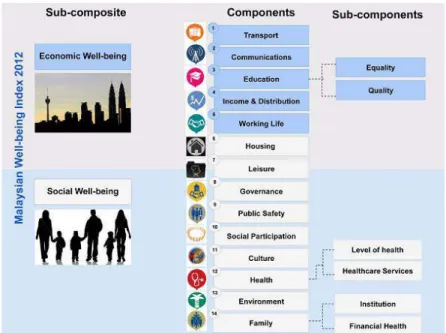
Figure 1: Malaysian Well-being Index 2012
Source: Malaysia Well-Being Report 2013
DEVELOPMENT IN ISKANDAR MALAYSIA
pushing the lower income residents to areas with fewer services, amenities and institutions (Richard, 2014).
Figure 2: Distribution of health, education and safety facilities in IM
METHODOLOGY
This study focused on spatial pattern and adequacy of education, health and safety amenities distribution at Iskandar Malaysia. The data used for this study were obtained from both primary and secondary sources such as census tract report. The 2010 census data is collected to identify the number of population in each zone to facilitate analysis in the next stage. Data of selected amenities such as number of schools, clinics, hospitals and police station were provided by the Centre of Innovative Planning and Development (CIPD) UTM. The study follows the steps below:
Step 1: Adequacy of Selected Facilities
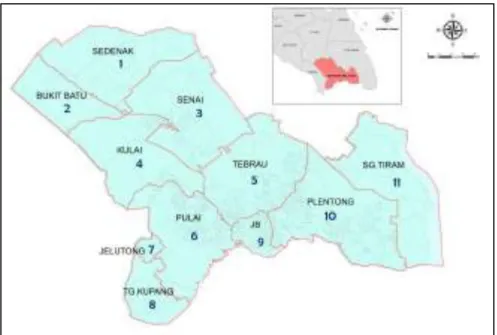
To determine the adequacy of selected amenities, the number of facilities in each Mukims was calculated in Arcgis and data capacity for each selected amenities was recorded. The capacity of each selected amenities were compared with population in each Mukim to identify areas in Iskandar Malaysia which did not have sufficient facilities.
Step 2: Concentration of Selected Amenities
a) Where Zi is the Z-score for observation i b) Xi is the value of X for the ith observation c) X̅ is the mean of all the values of X X d) Sx is the standard deviation of the X values e) N is the total number of observations
The study also utilised proximity analysis. Proximity analysis is able to indicate which neighbourhoods are located outside the standard distance. The standard distance to amenities established by the Federal Town and Country Planning Department in the Guidelines to Infrastructures and Public Facilities Planning is divided into 5 levels which are area within 500 meter, 1000 meter, 1500 meter, 2000 meter and 5000 meter. The neighbourhood area located within 500 meter to selected urban amenities is assumed as very accessible.
ISKANDAR MALAYSIA
Nowadays, due to extensive development, a lot of existing natural and agricultural land cover have been converted into anthropogenic land cover. The city-region has also witnessed widespread urban renewal and new urban/suburban projects which resulted in distinct physical and socio-economic changes. Previous land use in Nusajaya for instance, was largely agriculture and green field occupied by villages and fishing communities. Since the implementation of IM in 2006, almost half of land use in Nusajaya can now be categorized as commercial, institutional and public facilities. These include such uses as a private university, hospitals, retail and theme parks. This changes of land use will soon change the image of Nusajaya in term of cultural and ethnic background, personality, attitudes, motivation, income, age, length of stay, lifestyle, social class and socio-economic group (Nasongkhla & Sintusingha, 2012; Suthasupa, 2011)
𝑍1 𝑋1− 𝑋
𝑆𝑋
𝑆𝑋= (𝑋1 𝑖=1
Figure 3: Study Area
RESULT AND DISCUSSION
Distribution of selected urban amenities
Table 1: Distribution of Education, Health and Safety Amenities at Iskandar Malaysia
Source: 1. Department of Statistic Malaysia, 2. Centre of Planning Development (CIPD UTM)
The provision of education, health and security amenities depend on population size in a particular area. However, educational facilities provided in Mukim Senai are not sufficient to cater for its population which indicate an inequality in distribution when compared to Mukim Bandar Johor Bahru which has almost similiar population range with Mukim Senai. In term of health amenities, the distribution of these amenities in Iskandar Malaysia was adequate and corresponds to population size. There are 4 hospitals within Iskandar Malaysia that have a capacity to accommodate the current population. In terms of safety and security amenities, Mukim Senai, Sedenak, Sg, Tiram, Tanjung Kupang, Jelutong and Bukit Batu do not have a police station although the population in those mukim meet the requirement for the provision of a police station.
Spatial variation of urban amenities distribution
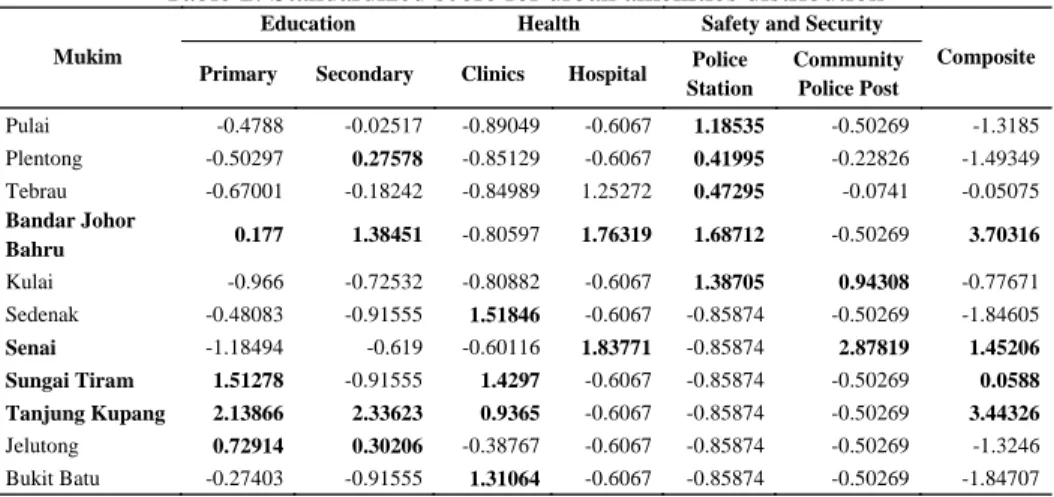
The inequalities and spatial distribution of urban amenities in Iskandar Malaysia was analyse by using Z-score variate. This Z-score variate approach has been used frequently in previous geographic research (Aderamo & Aina, 2011; Parry et al., 2012). Table 5.2 shows the standardized score of spatial pattern of three urban amenities concentration in Iskandar Malaysia which is education, health and safety.
Mukim Population
Education Health Safety and Security
Total
Primary Secondary Clinics Hospital Police Station
Community Police Post
Pulai 360642 42 18 9 0 7 0 76
Plentong 494152 56 33 14 0 6 1 110
Tebrau 316327 29 13 9 2 4 1 58
Bandar Johor
Bahru 124096 25 16 4 1 3 0 49
Kulai 93784 5 1 3 0 2 1 12
Sedenak 17212 2 0 4 0 0 0 6
Senai 120312 3 2 6 1 0 3 15
Sungai Tiram 13348 5 0 3 0 0 0 8
Tanjung
Kupang 10972 5 2 2 0 0 0 9
Jelutong 14651 4 1 1 0 0 0 6
Table 2: Standardized score for urban amenities distribution
Source: Author
Bahru and Jelutong due to the uneven population compare to others mukim. Mukim Johor Bahru has been recognized as city centre for Johor and most of urban amenities have already existed before the implementation of Iskandar Malaysia. Meanwhile, Mukim Senai recorded as less served of education facilities due to its function as industrial area. In term of health facilities, clinics in Iskandar Malaysia were highly concentrated at Mukim Sedenak, Bukit Batu, Tanjung Kupang and Sg.Tiram. Mukim Pulai and Plentong have less concentration of clinics although the numbers of population in both mukim are higher. However, the less provision of clinics in others mukim is not an issue since there are four hospitals has been provided in Mukim Johor Bahru, Tebrau and Senai to meet the requirement of current population for health amenities.
The Malaysia crime index 2013 was higher as much as 74.5% which covered about 111,000 reported cases. Johor Bahru indicates a similar trend where the crime index has increased and ranked as fourth city that has highest crime rates. Despite the state government has provided 16 Community Police Post across Iskandar Malaysia starting from 2010 to prevent crime although crime index does not show any decline (refer figure 4). The higher crime index indicated the level of security and safety still lower. Therefore the distance and location of police station or community police post should be revised to ensure those services are adequate.
Mukim
Education Health Safety and Security
Composite Primary Secondary Clinics Hospital Police
Station
Community Police Post
Pulai -0.4788 -0.02517 -0.89049 -0.6067 1.18535 -0.50269 -1.3185
Plentong -0.50297 0.27578 -0.85129 -0.6067 0.41995 -0.22826 -1.49349 Tebrau -0.67001 -0.18242 -0.84989 1.25272 0.47295 -0.0741 -0.05075
Bandar Johor
Bahru 0.177 1.38451 -0.80597 1.76319 1.68712 -0.50269 3.70316
Kulai -0.966 -0.72532 -0.80882 -0.6067 1.38705 0.94308 -0.77671
Sedenak -0.48083 -0.91555 1.51846 -0.6067 -0.85874 -0.50269 -1.84605
Senai -1.18494 -0.619 -0.60116 1.83771 -0.85874 2.87819 1.45206
Sungai Tiram 1.51278 -0.91555 1.4297 -0.6067 -0.85874 -0.50269 0.0588 Tanjung Kupang 2.13866 2.33623 0.9365 -0.6067 -0.85874 -0.50269 3.44326
Figure 4: Location of Community Police Post and Population in Iskandar Malaysia
The safety and security amenities pattern in Iskandar Malaysia is much focus to the area with higher population such as Mukim Pulai, Plentong, Johor Bahru, Tebrau and Kulai. The provision of this amenities in others mukim should be considered since there are area which have no police station although the population is higher such in Senai and Sedenak. Based on composite indicator for urban amenities, the provision of social amenities in Iskandar Malaysia is best served in Johor Bahru, Senai, Tanjung Kupang and Sg Tiram, followed by Kulai and Tebrau with mediate level of amenities provision. Meanwhile, Pulai, Plentong, Jelutong, Sedenak and Bukit Batu have the worst level of urban amenities distribution.
Proximity of amenities to neighbourhood in Iskandar Malaysia
Figure 5: Proximity to Primary School
For secondary schools, 83% of the residents stay within 5 kilometers. The remaining 17% residents located in Mukim Senai and Pulai need to travel more to access the secondary school. The results indicate the potential area especially at Mukim Senai and Pulai to be provided with secondary schools to cater the demand for future. The proximity to health facilities shows 95% of resident in neighbourhood area have access to this amenities within 5 kilometres. However, only 4% have access within 500 meter which indicates that the health amenities are located at non-strategic area.
Figure 6: Proximity to Secondary School
Primary Access Area inside (%)
500 m 17
1000 m 28
1500 m 20
2000 m 13
5000 m 18
Total 96
Secondary Access Area inside (%)
500 m 10
1000 m 20
1500 m 20
2000 m 14
5000 m 18
Figure 7: Proximity to Healthcare Amenities
In terms of safety and security, the proximity to police station recorded 80% of residents have access within 5 kilometer. The planning standard for distance to police station is 1 kilometer and only 9% have access within that area. Overall, the proximity to selected urban amenities was higher for current situation. However any areas such as Mukim Johor Bahru, Plentong, Kulai and Tebrau whill have to be considered for future population increase.
Figure 8: Proximity to Safety and Security Amenities
CONCLUSION
Public facilities such as schools, health centres, police stations are generally not uniformly distributed. This is common in developing countries where apart from uneven population distribution, many other extraneous factors such as political consideration go into locational decisions. However, consideration for the well-being of the people should be a paramount factor in the provision of facilities so that the people will have a sense of belonging and the orientation of the people towards the use of these facilities will also change positively.
Clinics Access Area inside (%)
500 m 4
1000 m 12
1500 m 15
2000 m 16
5000 m 49
Total 95
Police Access Area inside (%)
500 m 3
1000 m 9
1500 m 13
2000 m 14
5000 m 40
ACKNOWLEDGMENTS
We would like to acknowledge the support by the Grant University Project (R.J130000.7821.4L124) from Universiti Teknologi Malaysia.
REFERENCES
Aderamo, A. J., & Aina, O. A. (2011). Spatial Inequalities in Accessibility to Social
Amenities in Developing Countries : a Case from Nigeria, 5(6), 316–322. Allen, N. (2015). Understanding the Importance of Urban Amenities: A Case Study from
Auckland. Buildings, 5, 85–99. doi:10.3390/buildings5010085
Bhagat R.B. (2011). Access to Basic Amenities in Urban Areas by Size class of Cities and Towns in India., 31(1), 1–13.
Bunnell, T. I. M. (2002). Cities for Nations ? Examining the City – Nation-State Relation in Information Age Malaysia *. International Journal of Urban and Regional
Research, 26(2), 284–298.
Butler, T. I. M., & Robson, G. (2003). Plotting the Middle Classes: Gentrification and Circuits of Education in London. Housing Studies, 18(December 2014), 5–28. doi:10.1080/0267303032000076812
Chhetri, P., Stimson, R., & Western, J. (2011). Investigating Quality of Urban Life, 45, 405–434. doi:10.1007/978-94-007-1742-8
Clark, T. N. (2004). The City as an Entertainment Machine (p. 336). Retrieved from http://books.emeraldinsight.com/display.asp?K=9780762310609&sf1=series& st1=Research in Urban Policy&sort=sort_date/d&cur=EUR&m=4&dc=9 Diener, E. D., & Suh, E. (1997). Measuring quality of life: economic, social, and
subjective indicators. Social Indicators Research, 40, 189–216. doi:10.1023/A:1006859511756
Embong, A. R., & Macmillan, P. (2002). State-led Modernization and the New Middle
Class in Malaysia. doi:10.1057/9781403914286preview
Glaeser, E. L., Kolko, J., & Saiz, A. (2000). H i e r. Harvard Institute of Economic
Research, 1901(June 2000), 1–32.
Hogan, T., Bunnell, T., Pow, C.-P., Permanasari, E., & Morshidi, S. (2012). Asian urbanisms and the privatization of cities. Cities, 29(1), 59–63. doi:10.1016/j.cities.2011.01.001
Jabatan Perangkaan Malaysia. (2010). Population Distribution And Basic Demographic Characteristics.
Jabatan Perangkaan Malaysia. (2013). Laporan Penyiasatan Pendapatan Isi Rumah Dan Kemudahan Asas 2012. Sumber Statistik Rasmi Malaysia. Retrieved from http://www.statistics.gov.my/portal/index.php?option=com_content&view=arti cle&id=1640&Itemid=111&lang=bm
Jahan, S., & Oda, T. (1996). Distribution of Public Facilities in Dhaka , Bangladesh : A
Spatial Analysis. The Bangladesh Urban Studies.
Johar, F., & Adawiyah, R. K. (2014). Gentrification and Its Socio-Economic Implications in Iskandar Malaysia, (IASUR Conference 2014).
Kõrreveski, K. (2011). Measuring Well-Being and Quality of Life Using Oecd, 38–44. Machado, A. F., Simões, R. F., & Diniz, S. C. (2013). Urban Amenities and the
Development of Creative Clusters: The Case of Brazil. Current Urban Studies,
Moore, M., Gould, P., & Keary, B. S. (2003). Global urbanization and impact on health.
International Journal of Hygiene and Environmental Health, 206, 269–278. doi:10.1078/1438-4639-00223
Morshidi, S. (2000). Globalising Kuala Lumpur and the Strategic Role of the Producer
Services Sector. Urban Studies, 37(12), 2217–2240.
doi:10.1080/00420980020002788
Nasongkhla, S., & Sintusingha, S. (2012). Social Production of Space in Johor Bahru.
Urban Studies, 50(9), 1836–1853. doi:10.1177/0042098012465907
Newton, P. (2001). Urban Indicator for Managing Cities. Asian Development Bank (
ADB ) (pp. 1–8).
Noraniza, Y., Azlizan, T., & Yusuf, P. (2011). Impak Pembangunan Infrastruktur ke atas Pembangunan Komuniti Penduduk di Daerah Pendang dan Kubang Pasu , Kedah Darul Aman , Malaysia Infrastructure Development Impact on Inhabitant Community Development at Kubang Pasu and Pendang District , Kedah Darul A, 7, 16–35.
Parry, J. A., Ganaie, S. A., Nengroo, Z. A., & Bhat, M. S. (2012). Spatial Analysis on the
provision of Urban Amenities and their Deficiencies - A Case Study of Srinagar City , Jammu and Kashmir , India (Vol. 2).
Partridge, M., Olfert, M. R., & Alasia, A. (2007). Canadian Cities As Regional Engines of Growth: Agglomeration and Amenities. The Canadian Journal of Economics
/ Revue Canadienne d’Economique, 40(1), 39–68. doi:10.2307/4620596 Randall, T. a. (2009). Preferences of suburban residents in Thunder Bay, Ontario towards
neighbourhood intensification and rediversification. Canadian Journal of Urban
Research, 17, 28–56.
Rappaport, J. (2008). Consumption Amenities and City Population Density. Regional
Science and Urban Economics, 38(6, Nov 2008), 533–552.
Richard, E. A. (2014). The Implications Of The Theory Of Gentrification For Masakare Settlement. Adamawa: Federal University of Technology.
Rizzo, A., & Khan, S. (2013). Johor Bahru’s Response to Transnational and National
Influences in The Emerging Straits Mega-City Region. Habitat International,
40(2013), 154–162. doi:10.1016/j.habitatint.2013.03.003
Sabri, Soheil M. Ludin, Ahmad Nazri Johar, F. (2012). Gentrification and local strategies to mitigate displacement: case of Kuala Lumpur, Malaysia. Malaysian
Townplan Journal, 1–20. Retrieved from http://eprints.utm.my/30490/
Stevenson, D. (2004). “ Civic Gold ” Rush : Cultural Planning and the Politics of the
Third Way Deborah Stevenson Deputy Director , Cultural Industries and Practices Research Centre , University of Newcastle, 1–2.
Suthasupa, S. (2011). The Portrayal of a City ’ s Image by Young People. Journal of ASIAN Behavioural Studies, 1(2), 57–68.
Yasin, G., Sattar, S., & Faiz, F. A. (2012). Rapid urbanization as a source of social and ecological decay: A case of Multan city, Pakistan. Asian Social Science, 8(4), 180–189. doi:10.5539/ass.v8n4p180