Re
fi
ned Deterministic Algorithm
for Biplane Construction
Ivica Martinjak and Mario-Osvin Pav
cevi´c
ˇ
Faculty of Electrical Engineering and Computing, University of Zagreb, Croatia
This paper introduces a way of constructing biplanes that uses “filters” in a step prior to an exhaustive com-puter search, with the objective to make the biplane construction more efficient. The achieved deterministic algorithm classifies biplanes of order 7 and smaller. When performing the search using some additional pre-sumptive conditions, two biplanes of order 9 (k=11) were constructed and a particular inner regularity in the biplane’s structure has been established.
Keywords: combinatorial design, biplane, exhaustive search, filtering, algorithm complexity
1. Introduction
Abiplaneis a symmetric 2-(v,k,2)design, i.e. an incidence structure B consisting of a set P
of v points and of a set B of v blocks, so that each block contains k points and any two dis-tinct blocks intersect in two points. Dual condi-tions are true as well — every point is incident withkblocks and every pair of points with two blocks. The parametersvandkare not indepen-dent, since it can be proven that the following equation holds for them: 2(v−1) = k(k−1). Until now, seventeen biplanes with seven dif-ferent triples of parameters have been known. Among them, biplanes with 79 points are not completely classified, but two examples, pos-sessing additional symmetries, are known [1]. Biplanes are structures of particular interest be-cause of their highly regular structure, which follows from their already mentioned definition properties. The natural solution space size of biplanes increases extremely with the number of pointsv; this effect is usually called the com-binatorial explosion. An additional difficulty
while constructing biplanes is a very small num-ber of found structures(results)in the solution space(they seem to appear very rare).
We have represented the biplane by its incidence matrix throughout this paper.
Definition 1. Let B be a biplane with its point set P = {p1, . . .,pv} and block set B =
{b1, . . .,bv}. The incidence matrix M = [mij]
of B is a v×v 0 −1 matrix, the elements of which are defined by
mij=
1, if pj∈bi
0, if pj∈/ bi .
According to the biplane properties,M = [mij]
contains exactly k 1’s in every row (which is in this representation a binary v-dimensional vector) as well as in every column. Due to the intersection conditions, every two distinct rows both contain 1’s in exactly 2 columns(or equivalently, the “scalar product” of these bi-nary vectors equals to 2)and dually, every two distinct columns have 1’s on the same position twice. This paper addresses a way of biplane construction by means of an exhaustive search of appropriate 0-1 matrices. Classification al-gorithms of similar kind are nicely described in
The notion of an isomorphism can be naturally implemented on incidence matrices of biplanes. It is of crucial importance to avoid constructing isomorphic copies of structures during the con-struction procedure as early as possible. Sev-eral different implementations on how to avoid constructing isomorphic copies of combinato-rial configurations can be found in [11], [12] and[14].
In order to point out the importance of list-ing and classifylist-ing all combinatorial designs for given parameters, in particular biplanes, we remind the reader on the natural commonly used connection between designs and codes. Namely, one may look on the columns of an incidence matrix as on codewords of a block code over a finite fieldFpof prime orderp.
Un-fortunately, ifpdoesn’t dividek-λ, the rank of the incidence matrix is maximal, which means that the columns are linearly independent and span the whole space Fv
p, so the corresponding
code is trivial and of no importance. Hence, when p equals to 2, the most interesting case for applications in coding theory of all biplanes that will be constructed in this paper, are three biplanes of order 4, which lead to nice binary linear codes. For details the reader is referred to[2].
2. Space Size Reduction
Since we want to construct incidence matrices of orderv, row by row, possessingkones in each row, the natural size of our search space equals
v k
v
. One of the main tasks is to shrink that number.
Proposition 1. LetBbe a biplane with param-eters 2-(v,k,2) and let M=[mij] be its incidence
matrix. Thenfirst k rows of M can be uniquely determined, up to isomorphism. We shall call these beginning k rows base vectors.
Proof: It is obvious that the first row can be chosen uniquely (up to isomorphism) as 11
· · · 100 · · · 0, starting with k ones and
end-ing withv−k zeros. Note that the first k and the lastv−kcolumns remain mutually equiva-lent. Without losing generality, we may assume that the first point lies on the first k blocks, so put a 1 on the first position in all k rows.
So, we have filled the upper-left frame of our
k×v incidence matrix. The second row can now be chosen as 1
1
10· · ·0
k−1
1· · ·1
k−2
0· · ·0
v−2k+2 since the intersection with the first row has to be 2. We may fill free positions of the sec-ond columns with zeros now, as the first and the second column already have scalar prod-uct 2. The third row is again uniquely given as
1
1
010· · ·0
k−1
10· · ·0
k−2
1· · ·1
k−3
0· · ·0
v−3k+5
. The free
entries of the third column can be filled with ze-ros because of the same arguments. We proceed in a similar way and obtain for thekthrow the following uniquely determined binary vector:
1
1
0· · ·01
k−1
0· · ·01
k−2
0· · ·01
k−3
· · · 01
2 1
1
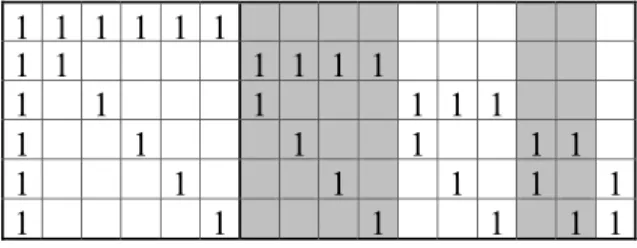
Figure 1 illustrates the base vectors in case of a biplane 2-(16,6,2); we believe that this example gives a good graphical explanation of the con-struction of the base vectors for any biplane, as proven in the previous proposition.
1 1 1 1 1 1
1 1 1 1 1 1
1 1 1 1 1 1 1 1 1 1 1 1 1 1 1 1 1 1 1 1 1 1 1 1
Figure 1.Base vectors of the biplane 2-(16,6,2).
Determining the first k rows of our incidence matrix reduces significantly the solution space
size, at least from
v k v to v k
v−k
. Fur-thermore, the otherv-kvariable rows must have exactly two 1’s among the first k positions, because of the intersection condition with the first vector. That fact leads to a restriction of the upper bound for the complexity to
k
2 vk−−k2
v−k
. Finally, the first el-ement of every variable row must be 0, since the first column already has k 1’s in the base vectors; hence, the solution space size can be
re-duced at least to k−2 1 vk−−k2
v−k
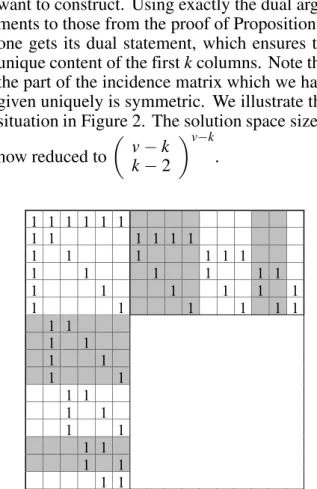
want to construct. Using exactly the dual argu-ments to those from the proof of Proposition 1, one gets its dual statement, which ensures the unique content of the firstkcolumns. Note that the part of the incidence matrix which we have given uniquely is symmetric. We illustrate this situation in Figure 2. The solution space size is
now reduced to
v−k k−2
v−k
.
1 1 1 1 1 1
1 1 1 1 1 1
1 1 1 1 1 1
1 1 1 1 1 1
1 1 1 1 1 1
1 1 1 1 1 1
1 1 1 1 1 1 1 1 1 1 1 1
1 1
1 1 1 1 1 1
Figure 2.First 6 rows and first 6 columns of the biplane 2-(16,6,2)can be determined uniquely.
The up to isomorphism unique determination of the first k rows and columns leads further to a natural decomposition of the incidence matrix
Mwhich we want to construct in a block matrix of orderk-1, as shown in Figure 3.
A1,1 A1,2
…
A1,k-1A2,1 A2,2
…
A2,k-1: : :
: : :
Ak-1,1 Ak-1,2
…
Ak-1,k-1Figure 3. Incidence matrix decomposition.
Here, A2,2 is a matrix of order k-2, whereas Ak−1,k−1 is of order 1. Once the matrix M has been decomposed in such a way, its rows and columns satisfy some additional proper-ties. The conditions on rows can be easily derived from the intersection properties with the first uniquely constructedkrows(base vec-tors), while the conditions on columns can be achieved applying dual arguments. For exam-ple, each row of A2,2 must have exactly one element equal to 1, because of the intersection with the second base vector and the fact that the second column ofA2,1is filled only with 1’s. Proposition 2. Let M=[mij] be an incidence
matrix of a biplane with parameters 2-(v,k,λ)
being decomposed as described above. Then for the entries of M holds:
i) The diagonal submatrix A2,2has in each row and in each column exactly one element equal to 1, whereas the submatrices A3,3, ...,Ak−1,k−1 have zero or one 1’s in each row and each col-umn.
ii) Submatrices Ai,2, i>2, have in each row ex-actly two 1’s; submatrices Ai,3, i>3, have one or two 1’s in each row; submatrices Ai,j, i,j>3,
i=j, have in each row zero, one or two 1’s.
ii’) Submatrices A2,j, j>2, have in each column
exactly two 1’s; submatrices A3,j, j>3, have one
or two 1’s in each column; submatrices Ai,j,
i,j>3, i=j, have in each column zero, one or two 1’s.
A1,1 A1,2
…
A1,k-11 2 2 2 2
A2,1 1
:
0,1 1,2 1,2 1,22 0,1
0,
1
0,
1,
2
0,
1,
2
2 1,2 0,1
0,
1
0,
1,
2
2 1,2 0,1,2 0,1
0,
1
Ak-1,1 2 1,2 0,1,2 0,1,2 0,1
In the next figure, we give a scheme of the de-composed incidence matrix fulfilling these con-ditions.
Knowing the first k rows (the base vectors)
without loss of generality, the next step in bi-plane construction is to generate all possible vectors — row candidates for the variable part
(rows k+1 to v) of the incidence matrix and isolate those candidates which intersect every base vector in two points. Note that we have used thekbase vectors as a filter for thevector candidatesfor the variable rows.
We want to give a simple mathematical argu-ment which avoids the use of the duality for the construction of the first k columns. The equation between the parameters v and k of a biplane can be rewritten as
k−1
2
=v−k, which gives a hint to take all 2-element subsets as incidences in columns 2 to k. Indeed, since the points corresponding to these columns lie together all on the very first block, this is the only possibility (as we already know!). Ac-cording to this, all filtered vector candidates for the rows k+1 to v can be, naturally, sep-arated into groups which contain vectors with the same beginning k-tuple. Vectors in each particular group are admissible candidates for a corresponding row of the incidence matrix. Table 1 shows results obtained for known bi-planes. As we could convince ourselves, each group of filtered row candidates contains the same number of vectors (numvect), which is a natural consequence of the fact that the same condition had to be checked against the base rows. It can be noticed that, already at this step, the biplane(7,4,2)is constructed and classified.
numvect numvect
(v,k,λ) in variable part in a row
(7,4,2) 3 1
(11,5,2) 12 2
(16,6,2) 70 7
(37,9,2) 30016 1072
(56,11,2) 3026655 67259
(79,13,2) 438263364 6640354
Table 1.Number of vector candidates for each row that intersect the base vectors in 2 points.
3. Classification of Biplanes of Small
Orders
Once we have constructed the basekvectors of an incidence matrix and successfully generated
v-kgroups of vector candidates, which all inter-sect the base vectors in two points, the solution space size reduces significantly. The classifica-tion of biplanes withvpoints can now be done by an exhaustive search of vector candidates.
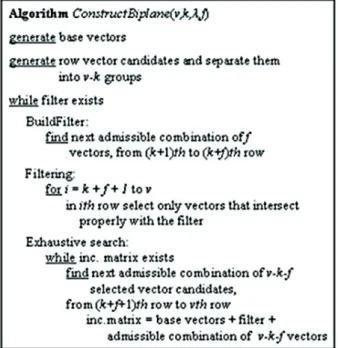
Since an evident approach of using backtrack-ing algorithm wouldn’t be satisfactorily effec-tive, this paper introduces another vector filter-ing prior to an exhaustive search. At the first step of such an algorithm, a proper combination of f vectors ought to be chosen from the vec-tor candidates for rowsk+1,k+2, . . .,k+f, satisfying the condition that every pair of these candidates intersects in 2 points(f is the num-ber of vectors in the filter). After that, vector candidates for the otherv-k-f rows are filtered, meaning in particular that only those vectors survive that intersect with every vector from the chosen filter in 2 positions. Finally, an exhaus-tive search of thesurvived vector candidatesfor thev-k-f rows can be made. Figure 5 presents a pseudocode of the described algorithm. Note that the most time consuming operation in this
algorithm is the determination of intersection of two vectors. Throughout our implementa-tions, we represent the vectors as bit sequences
(the parameters of which have been optimized), which enables us to use bitwise operators for calculations(see[8]).
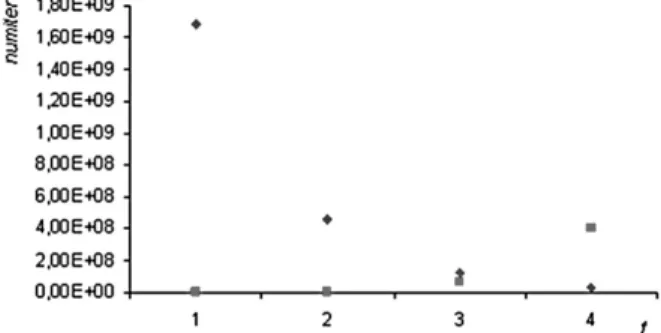
Before using this algorithm, the number f of vectors in the filter was optimized for all bi-plane parameters for which a complete classi-fication is known. Table 2 shows these results in the case of biplane 2-(37,9,2). The number of basic operations (intersection determination between two vectors,numiter)for one local ex-haustive search(for the first vector chosen from the group of vector candidates for the 10throw) is presented and compared with f. Also, the number of basic operations for both filtering and exhaustive search parts of the algorithm is measured and compared (Figure 6). It can be seen that two kinds of operations give the ba-sic operation minimum when the number f of vectors in the filter is equal to 3.
When the algorithmConstructBiplanewas im-plemented, the classification of biplanes with 11, 16 and 37 points was done. After generating all incidence matrices (numincmat), for given biplane’s parameters, non-isomorphic matrices
numiter(for the 1st 10th row candidate)
f exhaustive search filter sum
1 1684894714 28944 1684923658
2 459044053 2608785 461652838
3 117721020 64163364 181884384
4 28719700 396435510 425155210
Table 2.Optimalf for the biplane(37,9,2).
Figure 6.Relationship betweennumiterin filtering and exhaustive search; here in case of biplane(37,9,2).
were extracted by a computer program incfi l-ter [7]. Also, the automorphism group orders of these isolated non-isomorphic matrices were determined. Table 3 presents obtained results. As it was known, there is one biplane of order 3, three biplanes of order 4 and four biplanes of order 7(see[13]).
B numincmat |Aut(B)|
total up to isom.
(11,5,2) 2 1 660
(16,6,2) 46 3 384, 768, 11520
(37,9,2)306720 4 54, 333, 1512, 1512
Table 3.Biplanes classified by the algorithm ConstructBiplane.
4. Construction of Biplanes of Order 9 and Biplane’s Inner Regularities
Examining the set of all constructed incidence matrices of biplanes with parameters (16,6,2) and(37,9,2)more carefully, two interesting fea-tures could be observed. Namely, for some of these matrices the following statements hold.
i) Each element on the main diagonal is equal to 1(mk+1,k+1=mk+2,k+2=. . .mv,v=1).
ii) The matrix is symmetric with respect to the main diagonal.
When we combine the first feature to the decom-position form of the incidence matrix described by Proposition 2, we get strong conditions on the entries of the incidence matrix under con-struction which are again very useful in shrink-ing the size of the solution space. We shall implement this idea without going further into details.
for (56,11,2) possessing an all-1 main diago-nal. When row candidates which fulfill this ad-ditional criterion were generated, the partial ex-haustive search using the introduced filter with
f=4 vectors could be finished successfully and it resulted with two biplanes of order 9. Among 312 constructed incidence matrices, two were non-isomorphic, with automorphism groups of order 144 and 80640(Table 4).
numvect
B in row numincmat |Aut(B)|
(16,6,2) 1 1 11520
(37,9,2) 70 480 1512,1512
(56,11,2) 3507 >312 144, 80640
Table 4. Biplanes with 1’s on the main diagonal.
Except for the two biplanes of order 9, there exist one biplane of order 4 and two biplanes of order 7(duals, with automorphism group of order 1512)having this property. In the case of the parameter set (37,9,2), the optimal number
f of vectors in the filter was 2, whereas in the case of(56,11,2), it was 4.
When constructing biplanes of order 7, in case of having the introduced additional criterion
(all-1 main diagonal), one notable regularity of the incidence matrix structure can be observed. For each row candidate for the 10throw ( rep-resenting in fact a 1-filter), there are either 24 or 30 row candidates for the 11th row which survive the filter. Moreover, in the case when 24 row candidates survive the 1-filter for the 11th row, 4 matrices were constructed and in the other case, when 30 candidates survive, 24 matrices were constructed. An analogue regu-larity has been verified also in case of biplanes of order 9, to be more precise, on those biplanes on 56 points which we were able to construct. Our results are presented in Table 5 and Table
track frequency numincmat |Aut(B)|
30 10 24 1512
24 60 4 1512
Table 5.Inner regularity of biplanes of order 7.
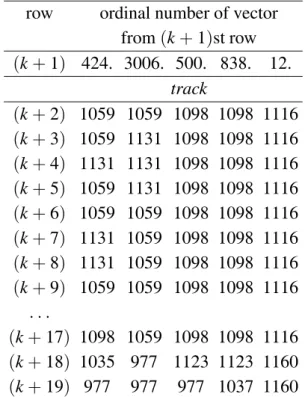
6. Having in mind this regularity we have just described, it makes sense, for any biplane with parameters(v,k,λ), to call the number of vectors for the(k+j)throw(j = 2, . . .,v−k), which survive the 1-filter from the(k+1)th row, the 1-f ilter(k+j)-row track(or shortly, when all the included parameters are obvious, thetrack). Having now in mind, that only for some(k+1) -row candidates(1-filters)a biplane can be con-structed, it would be more efficacious if we could perform further our search for complet-ing the(k+1)×v0-1 matrix to an incidence ma-trix onv points, only for particularly selected, “promising” 1-filters. For example, as shown in Table 6, we get positive results for our con-struction only for those 12throw candidates for which the 13-row track equals 1098 or 1116. So, we would like to know in advance that it makes sense to continue the construction of the incidence matrix only for some12throw candi-dates. But, how to predict which 1-filters are
goodfilters in that sense?
Making a test for a biplane with parameters
(56,11,2), as shown in Table 7, a nice regular-ity appears. Namely, for some of the 1-filters, their track keeps its value constant for many succeeding rows. This fact gives us a hint for our criterion for the choice of a good 1-filter. Furthermore, for anyj, we can admit the set of
(k+j)throw candidates to become row candi-dates for the first variable (k+1)th row, since it is possible (once fixing the first k positions in every variable row)to permute variable rows of the incidence matrix without loss of gener-ality; this leads to a generalization of the term good filter on the whole row candidate vector set. Selecting only good vectors in every row for the row candidates, we are able to construct biplanes more efficiently. During such selec-tive constructions, we have noticed a particular
track frequency numincmat |Aut(B)|
1059 420 0 −
1098 2520 4 144
1116 315 136 144,80640
1131 252 0 −
symmetry in the obtained incidence matrices. In case of the biplane of order 9 construction, for one particular “type” of good vectors, we have obtained symmetric matrices with respect to the main diagonal and with the property that submatricesA2,3 andA3,2are skew-symmetric. In an analogue selective construction of the bi-plane(37,9,2), only a symmetry of submatrices
A2,3andA3,2could be verified.
row ordinal number of vector from(k+1)st row
(k+1) 424. 3006. 500. 838. 12.
track
(k+2) 1059 1059 1098 1098 1116
(k+3) 1059 1131 1098 1098 1116
(k+4) 1131 1131 1098 1098 1116
(k+5) 1059 1131 1098 1098 1116
(k+6) 1059 1059 1098 1098 1116
(k+7) 1131 1059 1098 1098 1116
(k+8) 1131 1059 1098 1098 1116
(k+9) 1059 1059 1098 1098 1116 . . .
(k+17) 1098 1059 1098 1098 1116
(k+18) 1035 977 1123 1123 1160
(k+19) 977 977 977 1037 1160
Table 7.Good filters in the case of a biplane(56,11,2).
5. Conclusion
In this paper we have developed combinatorial algorithms for constructing symmetric designs with parameters (v,k,2) in full generality, for any number of points v. After being able to reduce the solution space significantly without loss of generality, by fixing some parts of the incidence matrix, which represents the struc-ture we are looking for, the deterministic algo-rithmConstructBiplanewas created and imple-mented. Our algorithm makes use of a filtering procedure to increase the algorithm range. Once having the filter size optimized, an ex-haustive search was carried out and biplanes with up to 37 points were classified(Table 3).
Since the construction of a biplane with 56 points was out of range for this algorithm, an additional criterion introducing an all-one di-agonal for the incidence matrix was introduced and a partial exhaustive search was done. This criterion came to our mind when inspecting the biplanes which we had classified before. Af-ter finishing this approach successfully, two bi-planes with 56 points were constructed, with automorphism group orders 144 and 80640. Even with that additional criterion, we could not find any biplane on 79 points, although they are known to exist. Further presumptive strategies led us to particular selections of candidates for rows of the incidence matrix, all leading only to the already mentioned examples.
To speed up the algorithm run time as much as possible, our algorithm uses bitwise operators; still, that was not decisive for any of our con-structions, as we could not move the frontiers of parameters in question.
Algorithm’s behavior has confirmed typical bi-plane characteristics: the solution space size grows enormously with the number of pointsv, while positive results within this space happen to be extremely rare.
References
[1] M. ASCHBACHER, On collineation groups of sym-metric block designs. J. Combin. Theory 11, pp. 272-281, 1971.
[2] E. F. ASSUMSJR.ANDJ. D. KEY, Designs and their codes. Cambridge University Press, Cambrigde, 1992.
[3] M. ESSERT, An efficient algorithm for saving or-dered sets in a compact form.Int. J. Comput. Math. 34, pp. 65–70, 1990.
[4] I.A. FARADˇZEV, Constructive enumeration of com-binatorial objects. in Probl`emes Combinatoires et Th´eorie des Graphes, CNRS, Paris, pp. 131–135, 1978.
[5] P. KASKI, P. R. J. ¨OSTERGARD, Classification Al-˚ gorithms for Codes and Designs.Springer, Berlin, 2006.
[6] P. KASKI, P. R. J. ¨OSTERG˚ARD, There are exactly five biplanes withk=11.J. Combin. Designs, to appear.
[8] D. L. KREHER, D. R. STINSON, Combinatorial algo-rithms.CRC Press, New York, 1999.
[9] C. W. H. LAM, L. THIEL, Backtrack search with iso-morph rejection and consistency check.J. Symbolic Comput. 7, pp. 473–485, 1989.
[10] I. MARTINJAK, Konstrukcije dvoravnina pomo´cu kombinatoriˇckih algoritama.M. Sc. thesis, Univer-sity of Zagreb, 2007.
[11] B. D. MCKAY, Isomorph-free exhaustive genera-tion.J. Algorithms 26, pp. 306–324, 1998.
[12] R. C. READ, Every one a winner, or, how to avoid isomorphism search when cataloguing combina-torial configurations. Ann. Discrete Math. 2, pp. 107–120, 1978.
[13] C. J. SALWACH, J. A. MEZZAROBA, The four bi-planes withk=9.J. Combin. Theory Ser. A 24, pp. 141–145, 1978.
[14] E. SPENCE, A complete classification of symmet-ric (31,10,3) designs. Des. Codes Crypt. 2, pp. 127–136, 1992.
[15] D. R. STINSON, Combinatorial Designs: Construc-tion and Analysis.Springer, New York, 2004.
Received: January, 2009
Accepted: December, 2009
Contact addresses:
Ivica Martinjak Faculty of Electrical Engineering and Computing University of Zagreb Unska 3, 10 000 Zagreb, Croatia e-mail:[email protected]
Mario-Osvin Pavcevi´cˇ
Faculty of Electrical Engineering and Computing University of Zagreb Unska 3, 10 000 Zagreb, Croatia e-mail:[email protected]
IVICAMARTINJAKis a Ph.D. student whose research interests include
combinatorial designs and theory of algorithm complexity. Besides, he also uses heuristic algorithm as well as other computer science tech-niques in mathematical modelling. In 2009 he joined the project “Com-binatorial designs and finite geometries” at the University of Zagreb.