Graphical Model: The Means
for Simulation-based Learning
Nerijus Aukstakalnis, Kazys Baniulis, Jurate Pauliute and Asta Slotkiene
Department of Computer Networking, Kaunas University of Technology, Lithuania
Simulation-based e-learning is recently budding demand for the next generation of e-learning. Learning about dynamic phenomena is essential in many domains. That approach allows the student to imitate real processes using models and to obtain knowledge and experience during the process of learning. The proposed graphi-cal modelling method is based on systematic point of view, experiential learning and expert-based modelling requirements. The contextual graph of action specifica-tion is used as a basis to set the requirements for service software specification and attributes of learning objects (LO). The paper presents the enhanced architecture of the student self-evaluation and on-line assessment system TestTool(TT). The system is explored as an assessment engine capable of supporting and improving the indi-vidualized self-instructional and simulation-based mode of learning, grounded on the GRID distributed service architecture. This architecture, services and method are being examined in study modules for Kaunas University of Technology(KTU)students and some organizations.
Keywords: assessment, learning, flexible educational model, domain of knowledge, ontology
1. Introduction
Traditional e-learning is mainly based on the information transfer paradigm – which is some-times referred to as first generation e-learning – is now past the market creation phase and well into a value creation phase. E-learning tech-nologies, on which it is based, are advancing rapidly; new is the recent and budding demand for the next of e-learning – simulation-based e-learning generation.
Corporations are presently convinced of the benefits of incorporating e-learning in their learn-ing and development strategies. Corporations are utilizing e-learning tools and techniques to train and develop their labour force. Corpo-rate use of e-learning is growing exponentially.
Several driving forces are influencing the atti-tude of organizations towards corporate learn-ing and development: global competition, in-crease of information and communication tech-nology, and rising interest of corporations in at-tracting and developing human resources. Add to that, work environments change ever more rapidly, and workers must learn gradually while working. These forces naturally lead to the in-creased use of technology for efficient and ef-fective management of corporate learning. One feature leading the request for e-learning is simulation capability [5]. Learning about dy-namic phenomena is essential in many domains. Learners must be able to recognize, perceive, initiate and explain dynamical phenomena flow causes and effects. That approach allows the student to imitate real processes using models and to obtain knowledge and experience during the process of learning.
The paper presents graphical modelling(GM)
2. System and Model
Any learning subject can be treated as a system. We can define the system as a group of ele-ments interacting between each other, in order to achieve a goal[2]. Particularly emphasized is a systematic point of view, which is controver-sial to partial or dotted point of view to appear-ances considered. Systematic point of view to appearances highlights interaction between el-ements of the system which forms integral sys-tem, both in ordinary life, politics, economics or scientific research. We intend to use systematic point of view in models and simulations.
3. Simulation-based Learning
Simulations have long held great promise in ed-ucation and in training. Simulation-based learn-ing is a social process of learnlearn-ing of practices
[5]that involves building connections: connec-tions among what is being learned and what is important to the actor, connections among what is being learned and those situations in which it is applied. Learning corresponds to an incremental process of acquisition of new knowledge pieces and learning of a new know-ledge structure. There are different strategies of simulation-based learning
3.1. Procedural Models
Mostly, Intelligent Tutoring Systems(ITS) rep-resent domain knowledge as a procedural model or a declarative model. Procedural models rep-resent subject domain by a network of proce-dures, sub-proceproce-dures, etc., down to a set of primitive actions[9]. In this kind of model, the main knowledge to be communicated is proce-dural, i.e. knowledge about how to perform a task. The aim is to achieve a level of descrip-tion, which enables learner’s performance to be associated directly with individual components of the procedural network. In this case, the com-ponents are not independent, that is, one cannot simply delete any components. This kind of model has strong diagnostic capabilities. In a procedural model, ITS compares the lear-ner’s answer with an intermediate result of an action that an expert performs in order to create
and update the learner model about the domain knowledge. Most systems apply a rule-based approach to induce a procedural model.
Both the weaknesses and strengths of procedu-ral knowledge representations are derived from the fact that they are use-specific. Procedu-ral models are as varied as the context they’re applied to, the subject they simulate and the imagination of designers. Consequently, proce-dural models integration into the other learning content becomes almost impossible.
3.2. Static Graphical Model
To achieve teaching goals, static model can be applied, which allows a student to analyze and construct real processes. One of such models is a graphical model. It consists of movable graphical components which can be manipu-lated by the student on the computer monitor[4]. The graphical models are created by the expert of domain, which systematically describes the knowledge structure of the subject. The graph-ical modelling approach will help to deliver the right content episodes to the user, basically the decisions they make while using the simulation.
3.3. Expert-based Modelling
The expert-based modelling is based on the idea that the learner is somehow a mini-expert and his deficiencies are only a lack of quantitative knowledge[9]. An expert-based system has the goal of transferring the expert knowledge to the student, which makes the student and expert knowledge states equal.
4. The Method of Construction of Graphical Model
4.1. Domain of Knowledge
According to Knowledge Space Theory, a do-main of knowledge is a collection Q of items
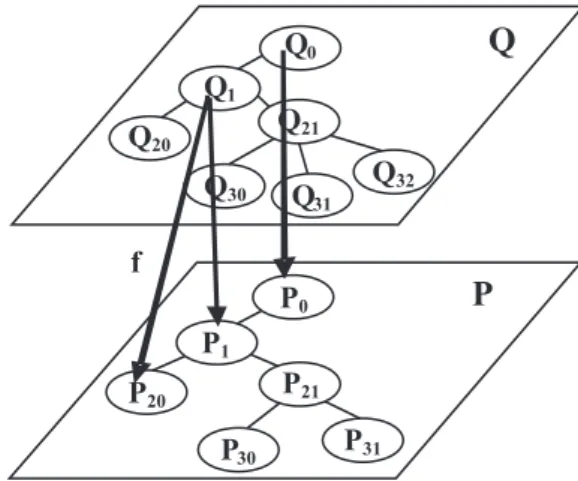
(e.g., learning objects, problems, questions, ex-ercises, examples, etc.) in a given field of knowledge(e.g., mathematics, physics, chem-istry, biology, etc.) [8]. Then, the knowledge state of a student is the set X of all items in Q that this student actually masters. Know-ledge and skills are gained gradually: attend-ing lectures, readattend-ing books, performattend-ing practi-cal exercises, communicating with colleagues and so on. The learning act performs implica-tion f: Q→P, where P is knowledge and skills gained using didactical knowledge acquisition techniques.
Learning objects from set Q can be grouped into difficulty levels, which means defined relation ϕbetween elements of this set and its parts( Fig-ure 1). That way we get a knowledge tree of the discipline where we can identify recommended sequence of knowledge mastering. Relationϕ may be defined as follows:
1. Expert questioning;
2. Didactics and learning plan analysis; 3. Systemically structuring problem scope; 4. Analysis of skill, requirements and
compe-tencies.
So set Q can be decomposed into a sequence of subsets{Q1, Q2,. . .}, where relationϕis valid between them.
Figure 1.Domain of knowledge illustration.
Subject model is a whole of learning objects re-alized according to collection Q of items. Fur-ther on, we analyze the possibilities of LO im-plementation by making graphical questions so that it meets systematic point of view and didac-tical requirements. Such set is called a graphical model.
4.2. The Foundation of Graphical Model: Experiential Learning
The knowledge construction approach is ex-pressed by the principles of experiential learn-ing, which are based on the analysis of current activity and the decision using the possibilities of experimentations. This way of learning was introduced by D. Kolb[7]and its main feature is that the only active construction of knowledge and skills allows the learner to gain new expe-rience and progressively use it in making more and more complex decisions. Active experi-mentation allows learners to test what they have learned in the new, more complex situations. The assumption is that individuals seldom learn from experience unless they assess the experi-ence, assigning their own meaning in terms of their own goals and aims. Hence, assessment is one of the key characteristics of experiential learning.
4.3. Modified Contextual Graph
All decisions which require simulation are based on one or more active operations e.g. change of object properties, change of location, etc. De-signer can construct branched model of know-ledge acquisition, filling up these models with If Then rules. Brezillon[6]present context-based representation for modelling task accomplish-ment by users called contextual graphs and its interest for the tasks of incremental acquisition. Contextual graph is a context-based representa-tion of the model execurepresenta-tion tasks and it consists of the following three nodes[3, 4]:
1. Contextual node C, which specifies the know-ledge and skills that will be adapted to a given situation;
3. The node of recombination(achievement of partial goal).
Contextual graph is acyclic. Every contextual element is a pair of nodes: a contextual node and a recombination node[6].
In this paper we present modified contextual graph (CG+). Differently from Brezillon [6]
contextual graph definition, CG+ allows the cycles. In a modified contextual graph CG+, contextual and recombination nodes are inde-pendent. Each contextual node doesn’t finish with the recombination node.
4.4. Graphical Model
In this paper we describe simulation environ-ment realized by using graphical tests. A stu-dent can manipulate the elements of the graph-ical situation during the process of learning in order to make correct imitation of the real sit-uation[4]. The knowledge structure of graphi-cal model is based on the modified contextual graphs. Statements describing the graphical model:
• Satisfies systematic requirements;
• Satisfies experiential learning requirements;
• Satisfies expert-based modelling require-ments;
• The main feature of the graphical situation is the manipulation of the graphical objects: change of location, impact on state, make structure, add required elements and remove unnecessary elements[4];
• A graphical situation is evaluated to be com-pared with the expert designed decisions;
• When a situation is solved, a part of the pre-vious graphical objects is used for solving the next situation;
• Learning scenario is defined as a sequence of interrelated graphical situations.
The creation of a graphical model shows the structure of knowledge in a particular subject and increases the conceptual understanding in standard situations of the target domain.
5. A Case Study. Simulation-based Learning Environment TestTool
5.1. An Example of Knowledge
Construction for Graphical Model
In the nuclear fission, graphical model nuclear reactions are described by the rules. Nuclear reactions exist as follows: α radiate, β radiate, spontaneous nucleus fission, nuclear fission in-teracting with other nuclear(Figure 2), etc.
Figure 2.Schema of nuclear fission.
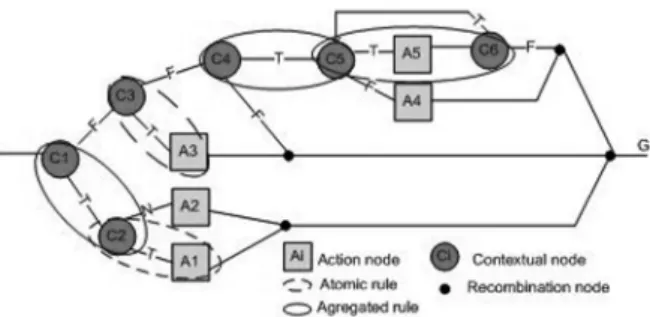
Modified contextual graph of nuclear fission
(Figure 3)is constructed according to the rules presented in Table 1. There are seven possible scenarios of nuclear fission(Table 2). All sce-narios start from contextual node C1. Scenario 7 is cyclic.
Figure 3.Modified contextual graph of nuclear fission.
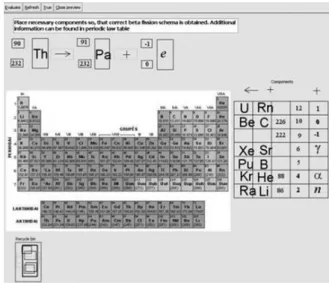
In the simulating environment, a learner is given the situations, which he solves by manipulat-ing the given objects. For example, in the ini-tial situation(Figure 4)a student evaluates two conditions(Nucleus of an element is not stable – C1.true, particleα is radiated – C2.true)and performs action A1 – nucleus turns to an atomic nucleus that has 2 protons and 2 neutrons less
Rule Description of the Rules
R1 IfNucleus of an element is not stable(C1)
ThenR2ElseR3
R2 If Particle α is radiated (C2) Then Nu-cleus turns to an atomic nuNu-cleus that has 2 protons and 2 neutrons less(A1). Goal G
ElseParticleβ radiated. Nucleus turns to an atomic nucleus that has 1 neutron more (A2). Goal G
R3 If Particle α is attached (C3) Then Nu-cleus turns to an atomic nuNu-cleus that has 3 protons more and 1 neutron is radiated (A3). Goal GElseR4
R4 IfNeutron is attached(C4)ThenR5Else
Goal G
R5 IfThe chemical element is uranium(C5)
ThenNucleus splits to two nucleuses and two neutrons are radiated(A5). R6Else
Nucleus turns to an atomic nucleus that has 3 protons less and helium nucleus is radiated(A4). Goal G
R6 IfNucleus division takes place(C6)then
R5ElseGoal G
Table 1.Rules of modified contextual graph.
Scenarios Decomposition 1 scenario C1, C2, A1 2 scenario C1, C2, A2 3 scenario C1, C3, A3 4 scenario C1, C3, C4
5 scenario C1, C3, C4, C5, A4 6 scenario C1, C3, C4, C5, A5, C6 7 scenario C1, C3, C4, C5, A5, C6, C5, A4
Table 2.Scenarios of decomposition.
5.2. Graphical Simulation Environment TestTool
TestTool Graphical simulation environment con-sists of two parts: the authoring tool for the author and the simulation environment for the learner. The authoring tool is used by an expert of the domain to implement knowledge struc-ture of graphical model. The authoring tool itself took place many technical facilities( draw-ing objects, the collection of simulation control elements, explanations of errors in textual and graphical representation, metadata, multimedia and sound effects). It allows creating the ac-tive type of learning objects of high interactivity level.
Figure 4.The screenshot of initial graphical situation of theβradiate.
Figure 5.The right decision of graphical situation of the βradiate.
As we mentioned before, static graphical model consists of changeable and not changeable graph-ical objects and actions of simulation with them. By using them, a student solves given tasks. On the other hand, in the concrete situation not all changeable objects are necessary to achieve the goal. The distribution is judged by the rules of the modified contextual graph.
5.3. Assessment Web Service and GRID
Based on the integrity and interoperability of distributed learning object systems, the experi-mental TestTool version for GRID was imple-mented [10, 11] In order to transform the ex-isting TestTool system to the GRIDTT version, the following steps are needed:
1. The TestTool system based on the Web ser-vices is created as a distributed system. The GRIDTT system consists of three large subsys-tems of services: Client, LO Repository closely linked with LO Registry, Learner Repository
(LR). A Client is a general subsystem which realizes interfaces for the GRIDTT users. LO repository is the service for the storage, reg-istration and retrieval of LOs. LR is a learn-ers’ database containing individual student data records and testing results. The typical service sequence for a learner is:
• a student logs in through LR and chooses an eligible test from the list;
• LO Registry is searched for the chosen test, LO Repository address and LO identifica-tion data are retrieved;
• LR calls LO factory and creates instant ag-gregated questions;
• a learner communicates with the visualized LO to answer the questions;
• LO sends the answers and the evaluations to the LR.
2. To fulfill knowledge domain requirements, Course model and Learner model solutions are performed[1].
6. Conclusions and Discussion
Functionally, the general knowledge acquisition process can be divided into three categories of learning goals: to know the theory and meth-ods; to know the theory and methods and be able to use them in standard situations; to know the theory and methods and be able to use them in unknown situations. The first category can be (more or less) considered as content-centered approach. Graphical modelling be-longs to the second category of knowledge ac-quisition, which enables problem-oriented de-cisions in standard situations. The latter one
in-cludes more complex simulation models, which enable a user to create more purposeful space of actions. Implementation of graphical models requires having an adequate knowledge model. The proposed method of the structured adapt-ing modified contextual graphs clearly decom-poses graphical situations and reasoning pro-cess in each propro-cess of learning. Knowledge structure of the graphical model is like planning paradigm that accomplishes high-level tasks by decomposing them into simpler tasks during problem solving. The Assessment Web ser-vice GRIDTT is explored as an assessment and simulation engine capable of supporting and im-proving the individualized self-instructional and simulation-based mode of learning, grounded on the GRID distributed service architecture. TestTool graphical assessment and simulation environment has been already used for five years for the Data structures(DS)study module(400 students per year, two universities, five facul-ties). For two years the TestTool environment has been used by Algorithm construction lab-oratories in the introductory course “Computer sciences and programming”(four faculties), as well as in the courses “Artificial Intelligence” and “IT in Education”. TT knowledge test-ing environment is used as a tutorial for mobile phone operators.
Teachers of all courses noted, that use of simu-lation environment in the practice mode and in the assessment mode is a very convenient and helps motivating student. For example, in Data Structure course students work with models of various hierarchical DS algorithms: AVL tree, B-tree, hashing, index files, B-tree in file, etc. Later, students have to program one of these al-gorithms, using Java programming language. It has been noticed that students willingly choose to program hashing method only when they have worked with graphical models.
References
[2] R. ASHBY, An Introduction to Cybernetics.
Chap-man & Hall, 1964. http://pcp.vub.ac.be/ books/IntroCyb.pdf (Link was valid 2008
April).
[3] K. BANIULIS, A. SLOTKIEN˙E, Assessment Web
Ser-vice as a Tool to Structure the Knowledge. Interna-tional Conference: Advanced Learning Technolo-gies and Applications. Conference Proceedings, 2007, ISBN 978-9955-751-07-9. pp. 83–89. [4] K. BANIULIS, A. SLOTKIEN˙E, J. PAULIUT˙E,
Know-ledge Modelling Dynamic Phenomena.Young Re-searchers’ Works. – ISSN 1648–8776 – Nr.2(2007), pp. 108–112.
[5] M. BAUER, D. WILLIAMSON, R. MISLEVY, J.
BEHRENS, Using Evidence-Centered Design to Develop Advanced Simulation-based Assess-ment and Training. World Conference on e-learning in Corp., Govt., Health. & Higher Ed. 2003(1), pp. 1495–1502.[Online]. Available:
http://dl.aace.org/13955.
[6] P. BREZILLON, Task-realization Models in
Contex-tual Graphs. Modeling and Using Context,5th Inter-national and Interdisciplinary Conference, Contex 2005, Paris, France, July 5–8, 2005, Proceedings. ISBN 3-540-26924-X. pp. 55–58.
[7] D. KOLB, Experiential learning: experience as the
source of learning and development. Englewood Clifs, NJ: Prentice-Hall, 1984.
[8] L. STEFANUTTI, D. ALBERT, C. HOCKEMEYER,
Derivation of knowledge structures for distributed learning objects. Proc. of the 3-rd International LeGE-WG Workshop: GRID Infrastructure to sup-port future technology enhanced learning, Berlin, Germany. 2003.
[9] X. NIU, Purpose-Based Learner Modeling. Proceed-ings of the Grad Symposium, CS Dept, University of Saskatchewan.
[10] V. REKLAITIS, K. BANIULIS, T. OKAMOTO,
Shap-ing e-LearnShap-ing applications for a service-oriented GRID. 2nd International LeGE-WG Workshop on e-Learning and Grid Technologies:A Fundamental Challenge for Europe, Paris, France. 3rd & 4th March 2003.
[11] B. TAMULYNAS, N. AUKSTAKALNIS, K. T. BANIULIS,
Enhanced learning and understanding in knowledge testing environments. ITI 2007:Proceedings of the 29th International Conference on Information Tech-nology Interfaces, June 25-28, 2007, Dubrovnik, Croatia, University of Zagreb, University Com-puting Centre. 2007, ISBN978-953-7138-09-7, pp. 287–292.
Received:June, 2008 Accepted:September, 2008
Contact addresses: Nerijus Aukstakalnis Department of Computer Networking Kaunas University of Technology Studentu 50, 51368 Kaunas Lithuania e-mail:[email protected]
Kazys Baniulis Department of Computer Networking Kaunas University of Technology Studentu 50, 51368 Kaunas Lithuania e-mail:[email protected], Jurate Pauliute Department of Computer Networking Kaunas University of Technology Studentu 50, 51368 Kaunas Lithuania e-mail:[email protected]
Asta Slotkiene Department of Computer Networking Kaunas University of Technology Studentu 50, 51368 Kaunas Lithuania e-mail:[email protected]
DR. KAZYSBANIULISis associate professor at Informatics Faculty in Kaunas University of Technology. He has many years of experience in teaching information technologies in education, instructional design, programming and data structures, as well as supervision of master’s degree and PhD students in the field of technology enhanced learning. Ten years ago he initiated design of graphical testing and modelling system Testtool. Since 1995 he is an active member of the European Tempus, Copernicus, FR5 and FR6 projects: “Flexible and Distance Learning”, “Multimedia Applications in Telematic Educational Net-works”, “Learning Grid of Excellence Working Group”, ”European Learning Grid Infrastructure”.
NERIJUSAUKSTAKALNIScurrently is a PhD student of informatics en-gineering at Kaunas University of Technology. His PhD thesis is about learning process control using domain ontology.
He has worked as junior research assistant at the Informatics Fac-ulty, Computer Networking Department. His research interests include simulation–based e-learning, learning process control, ontologies and artificial intelligence.
ASTASLOTKIENEis a PhD student of informatics engineering at Kaunas University of Technology. Her PhD thesis is about active learning object information models. Her research interests include simulation-based e-learning, active learning object design and development. Currently, she is a lecturer at the Department of Information Technology, University of Siauliai.