CHAPTER 18 THE CATENARY 18.1 Introduction
If a flexible chain or rope is loosely hung between two fixed points, it hangs in a curve that looks a little like a parabola, but in fact is not quite a parabola; it is a curve called a catenary, which is a word derived from the Latin catena, a chain.
18.2 The Intrinsic Equation to the Catenary
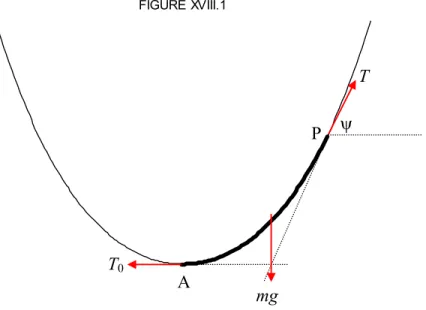
FIGURE XVIII.1
We consider the equilibrium of the portion AP of the chain, A being the lowest point of the chain. See figure XVIII.1 It is in equilibrium under the action of three forces: The horizontal tension T0
at A; the tension T at P, which makes an angle ψ with the horizontal; and the weight of the portion AP. If the mass per unit length of the chain is µ and the length of the portion AP is s, the weight is µsg. It may be noted than these three forces act through a single point.
Clearly, T0 = Tcosψ 18.2.1
and µsg = Tsin , 18.2.2 ψ
from which (µsg)2 T T
0
2 2
+ = 18.2.3
and tanψ = µgs.
T0 18.2.4
T
T0
A
P ψ
Introduce a constant a having the dimensions of length defined by a T
g
= 0
µ . 18.2.5
Then equations 18.2.3 and 4 become
T = µg s2 + a2 18.2.6
and s = atan .ψ 18.2.7
Equation 18.2.7 is the intrinsic equation (i.e. the s , ψ equation) of the catenary.
18.3 Equation of the Catenary in Rectangular Coordinates, and Other Simple Relations
The slope at some point is ' tan , a
s dx
dy
y = = ψ= from which ds dx a
d y dx
= 22 . But, from the usual pythagorean relation between intrinsic and rectangular coordinates ds = (1+ y' )2 1 2/ dx, this becomes
(1+ y' )2 1 2/ = ady' .
dx 18.3.1
On integration, with the condition that y' = 0 where x = 0, this becomes
y' = sinh( / ) ,x a 18.3.2
and, on further integration, y = acosh
(
x/a)
+ C. 18.3.3 If we fix the origin of coordinates so that the lowest point of the catenary is at a height a above the x-axis, this becomes(
/)
. cosh x a ay = 18.3.4
This, then, is the x , y equation to the catenary. The x-axis is the directrix of this catenary. The following additional simple relations are easily derived and are left to the reader:
s = asinh( / ), x a 18.3.5
y2 = a2 + s2, 18.3.6
x = aln(secψ + tan ),ψ 18.3.8
T = µgy. 18.3.9
Equations 18.3.7 and 8 may be regarded as parametric equations to the catenary.
If one end of the chain is fixed, and the other is looped over a smooth peg, equation 18.3.9 shows that the loosely hanging vertical portion of the chain just reaches the directrix of the catenary, and the tension at the peg is equal to the weight of the vertical portion.
Exercise: By expanding equation 18.3.4 as far as x2, show that, near the bottom of the catenary, or for a tightly stretched catenary with a small sag, the curve is approximately a parabola. Actually, it doesn’t matter what equation 18.3.4 is – if you expand it as far as x2, provided the x2 term is not zero, you’ll get a parabola – so, in order not to let you off so lightly, show that the semi latus rectum of the parabola is a.
Exercise: Expand equation 18.3.5 as far as x3.
Now: let 2s = total length of chain, 2k = total span, and d = sag. Show that for a shallow catenary ,
2 and
) 6
/( 3 2
3 a k ad
k k
s− = = and hence that length − span = 38 × sag2/span.
Question: A cord is stretched between points on the same horizontal level. How large a force must be applied so that the cord is no longer a catenary, but is accurately a straight line?
Answer: There is no force however great Can stretch a string however fine Into a horizontal line
That shall be accurately straight.
And if anyone can find the origin of that fine piece of doggerel, please let me know.
And here’s something for engineers. We, the general public, expect engineers to built safe bridges for us. The suspension chain of a suspension bridge, though scarcely shallow, is closer to a parabola than to a catenary. There is a reason for this. Discuss.
18.4 Area of a Catenoid
A theorem from the branch of mathematics known as the calculus of variations is as follows. Let y = y x( )with y' = dy dx/ , and let f y y x( , ', ) be some function of y , y' and x. Consider the line integral of f from A to B along the route y = y(x).
∫
BAf(y,y,'x)dx 18.4.1
In general, and unless f is a function of x and y alone, and not of y', the value of this integral will depend on the route (i.e.y = y(x)) over which this line integral is calculated. The theorem states that the integral is an extremum for a route that satisfies
. ' y f y f dx d ∂ ∂ = ∂ ∂ 18.4.2
By "extremum" we mean either a minimum or a maximum, or an inflection, though in many – perhaps most – cases of physical interest, it is a minimum. It can be difficult for a newcomer to this theorem to try to grasp exactly what this theorem means, so perhaps the best way to convey its meaning is to start by giving a simple example. Following that, I give an example involving the catenary. There will be another example, involving a famous problem in dynamics, in Chapter 19, and in fact we have already encountered an application of it in Chapter 14 in the discussion of Hamilton's variational principle.
Let us consider, for example, the problem of calculating the distance, measured along some route y x( ) between two points; that is, we want to calculate the arc length ∫ds. From the usual pythogorean relation between ds, dx and dy, this is ∫(1+y')1/2dx. The variational principle says that this distance – measured along y(x) – is least for a route y(x) that satisfies equation 18.4.2, in which in this case f = (1+ y') .1 2/
For this case, we have df dy df dy y y = = + 0
1 21 2
and '
'
( ' )/ . Thus integration of equation 18.4.2 gives
y' = c(1+ y' ) ,2 1 2/ 18.4.3
where c is the integration constant. If we solve this for y', we obtain y c c
' = ,
−
1 2 which is just
another constant, which I'll write as a, so that y' = a. Integrate this to find
y = a x +b. 18.4.4
This probably seems rather a long way to prove that the shortest distance between two points is a straight line – but that wasn't the point of the exercise. The aim was merely to understand the meaning of the variational principle.
Let's try another example, in which the answer will not be so obvious.
Consider some curve y = y(x), and let us rotate the curve through an angle φ (which need not necessarily be a full 2π radians) about the y-axis. An element ds of the curve can be written as
1+ y dx'2 , and the distance moved by the element ds (which is at a distance x from the y-axis)
during the rotation is φx. Thus the area swept out by the curve is .
' 1 y2dx
x
A = φ
∫
+ 18.4.5For what shape of curve, y = y(x), is this area least? The answer is – a curve that satisfies equation 18.4.2, where f = x 1+ y' . For this function, we have 2 ∂
∂
∂ ∂ f
y
f y
xy y
= =
+ 0
1 2
and '
' . Therefore the required curve satisfies
xy
y a
'
' .
1+ 2 = 18.4.6
That is,
dy dx
a
x a
=
−
2 2 . 18.4.7
On substitution of x = acosh ,θ and looking up everything we have forgotten about hyperbolic functions, and integrating, we obtain
y = acosh( / ). x a 18.4.8
Thus the required curve in a catenary.
If a soap bubble is formed between two identical horizontal rings, one beneath the other, it will take up the shape of least area, namely a catenoid.