SYNTHESIS OF EVALUATIONS ON SUPPORT
TO BUSINESS DEVELOPMENT
EVALUATION STUDY 2009/5
FROM DANIDA’S EVALUATION DEPARTMENT – DEVELOPMENT COOPERATION, OCTOBER 2009Synthesis of Evaluations on
Support to Business Development
October 2009
Kim Forss, Andante - tools for thinking AB
Henrik Schaumburg-Müller, Centre for Business and Development Studies, Copenhagen Business School
Disclaimer: The views expressed are those of the authors and do not necessarily represent the views of the Ministry of Foreign Affairs of Denmark. Errors and omissions are the responsibility of the authors.
Executive Summary
Background and Purpose
The role of the business sector as a driving force in economic growth and development is generally acknowledged. However, support to the business sector appears more problematic than support in many other sectors and not much is known about overall effects and impact. The purpose of this study is to provide an overview of evaluation findings, studies and research on performance, lessons learned and evidence for effective development cooperation.
Methods
The first step in the study was to build a database of as many evaluations of relevance to the sector as possible, mainly from the past 10 years. 240 reports were found, mainly from the English speaking bilateral and multilateral donor agencies. A selection of 60 reports was established, based on a stepwise approach using randomized and judgmental sampling respectively. In addition to these evaluations, the report makes use of research, technical and policy papers.
Analytical framework
The overall purpose is to show experiences of support to the business sector. There are three major types of interventions: (1) interventions aimed at creating an enabling environment, for example through policy dialogue, privatization measures, developing the legislative framework, labour markets. (2) Interventions aimed at business development services, for example, R&D, standardizations and certification, business management and audits, and at the provision of financial services. (3) Interventions that target specific enterprises with technical assistance, information and advisory services, and provision of equity capital and other forms of finance. The experiences of each type of intervention are treated in the report, and then there is a chapter on business sector programmes and another chapter on trade and trade related capacity building. The aggregated findings are summarized here.
Findings on Sector strategies
Evaluations point to the need for a holistic approach to the business sector, for the importance of macro-level interventions and the need to sequence interventions. They point to common experiences in understanding local needs and specific contexts. Agencies have standardised instruments that are applied uniformly, still the experience is clear that “there is no one size that fits all”. Evaluations discuss the issue of coordination amongst donors and the need for local ownership and point to shortcomings and difficulties, often linked to commercial interests of donors.
Findings on the Enabling Environment
The evaluations of interventions supporting the creation of enabling environment were of two kinds, broad sector programmes and specific projects. In case of the former, evaluations point to specific experiences in timing of intervention elements, role and tasks of technical assistance personnel, and combination of instruments. The importance of context, political sensibility and local ownership were underlined. The latter projects faces similar problems of lacking connection between macro-, meso- and micro-levels, questionable commitment and ownership, too short planning horizons, as well as in some cases basic shortcomings in implementation.
Findings on Business Development Services
There tend to be a greater degree of success for support to financial institutions even those targeting SMEs and micro-enterprises than for programmes supporting provision of non-financial BDSs. One possible explanation for this is that the provision of both types of services has moved into a market based framework from a situation of being provided or controlled by public systems - or that the services have simply been non-existent. The markets for financial services have been emerging relatively quickly, but even so support to private equity institutions requires scale of operations, skills and experience of fund managers, a long time horizon and may be more complicated to target towards small firms.
Financial sustainability is a critical issue for all types BDS services but while market interests and repayment are closer to be realized for financial services it appears more difficult to cover costs for non-financial BDS by customer fees. However, very importantly the positive impact of micro-credit found in many donor evaluations is not supported by methodological more rigorous research studies that do not find a positive relationship. Interventions supporting supplier and producer enterprises organised in clusters or value chains have gained increasing importance among donors and the intervention approaches have been improved on the basis of experiences and best practices. There are only few evaluations of the long-term impact and sustainability but the indication is positive and with this kind of intervention it is possible to achieve a systemic
impact on the stakeholders and actors operating in clusters or value chains. Furthermore training
of labour and youths also shows positive results but only when trained skills are relevant and demand-oriented and labour market stakeholders are involved with effective providers.
Findings on Support at firm level
The outcome of the different forms of direct donor support interventions tends to differ. Direct donor support of non-financial BDS can provide a direct positive impact for the involved enterprises but the programmes are inefficient and lack sustainability. Business partnerships are rarely sustained but may have benefited local partners. Lack of institutional ownership and lack of cost recovery makes the interventions unsustainable. There is no evaluation evidence of spill-over effects. Direct donor credit schemes to enterprises are subsidised and lack sustainability. There is no clear evidence that they have broader development effects. Direct equity funding to private investments have multiple objectives but bilateral donor organizations generally perform well because they can manage their risk exposure. There is generally a trade-off between financial performance and development objectives, which tends to lead to lower performance of investments in Africa than in Asia. Direct intervention projects are costly – the unit cost per enterprise is high and spear effects are rarely demonstrated.
Findings on Trade Capacity Building
The evaluations of trade-related capacity building echo many of the themes from previous types of interventions, such as; the need for integrated approaches; the importance of political commitment and effective local ownership; tailor-made approaches work better and are better adjusted to local context; the most effective interventions have been implemented through small organisations with a practical approach and concrete assistance; the least effective interventions have been diffuse, theoretically dominated, up-stream interventions championed by UNCTAD and other agencies. There are many reservations when concluding on results. It is far more difficult to assess impact of isolated up-stream activities. Very few programmes have developed, let alone used, valid and reliable indicators of achievements.
Conclusions and Lessons Learned
The general conclusions and lessons learned concern major themes such as; the integration of business sector development knowledge in donor agencies, gender and equity, significance of
local context, sequence of interventions, size and duration of programmes, sequence of interventions, monitoring and evaluation and donor coordination. The main issues are:
• The findings of the evaluations are uniform and their conclusions by and large support
each other – but they are not always supported by more rigorous research studies. This is surprising considering the political nature of issues such as the extent of privatization, private – public partnership, subsidies, legislative development, market reforms and other issues that are of a political nature rather than merely technical.
• While there are quite a few reports and many interesting and valid conclusions around
project and programme performance, it is rather difficult to draw lessons for the future. There are four reasons for that:
o Many of the findings concern mistakes, the evidence shows what not to do rather
than what to do, and hence recommendations are often based on speculation about what would work rather than on evidence of what works.
o Most evaluations are conducted at or near the end of projects, but those few that
are done some years later seem to show very different results.
o There is lack of monitoring data and the evaluations cannot substitute for that lack
of basic information about progress and impact
o The nature of impact in business development programmes can be very fast or
very slow and out of proportion to the intervention. The monitoring and evaluation approaches by most agencies are seldom suitable to handling such complex phenomena.
• The nature and dynamics of the business sector is often not fully understood in
development agencies and hence the complexity of the sector is not appropriately reflected at the policy level, for example in relation to poverty and gender policies; nor is it sufficiently integrated in country strategies and in related sector strategies.
• The experience of many donors suggests that business sector interventions need to take
account of the enabling environment as well as to provide scope for interventions at firm level. Interventions at multiple levels are interdependent and support each other and create scope for more relevant and effective programs. The sequence of interventions is important and it is often better to start at the macro-level, with interventions in respect of sector policies, legislative frameworks, and the development of an enabling environment.
Table of Content
EXECUTIVE SUMMARY ...2
TABLE OF CONTENT ...5
LIST OF ABBREVIATIONS ...7
CHAPTER 1. INTRODUCTION ...9
BACKGROUND AND PURPOSE ...9
METHODS ...9
TYPOLOGY OF INTERVENTIONS ... 11
LIMITATIONS ... 12
CHAPTER 2. DESCRIPTION OF THE EVIDENCE BASE ... 14
REVIEWS,EVALUATION AND RESEARCH ... 14
WHAT CONSTITUTES EVIDENCE? ... 14
CHARACTERISTICS OF THE BUSINESS SECTOR EVALUATIONS ... 15
CHAPTER 3. EVALUATION OF APPROACHES TO THE BUSINESS SECTOR ... 16
APPROACHES TO THE SECTOR ... 16
CONCEPTS AND MANAGEMENT ... 18
MANAGERIAL AND ORGANISATIONAL ISSUES ... 19
EFFECTIVENESS OF SUBCOMPONENTS ... 19
INTERVENTION CHANNELS ... 20
OWNERSHIP AND SUSTAINABILITY ... 20
DONOR COORDINATION AND THE PARIS DECLARATION... 21
PSD IN OTHER SECTORS ... 22
CONCLUDING REMARKS ... 23
CHAPTER 4. EXPERIENCES OF SUPPORTING AN ENABLING ENVIRONMENT ... 24
DEFINING AN ENABLING ENVIRONMENT ... 24
POLICY DIALOGUE ... 24
LEGISLATIVE FRAMEWORK ... 26
LABOUR MARKETS ... 28
PRIORITIES AMONG INTERVENTIONS... 29
CONCLUDING REMARKS ... 30
CHAPTER 5. SUPPORT TO BUSINESS DEVELOPMENT AND FINANCIAL SERVICES . 31 PROGRAMME OVERVIEW ... 31
EQUITY PROVISION ... 31
SUPPORT TO CREDIT AND LENDING INSTITUTIONS ... 32
BUSINESS DEVELOPMENT SERVICES ... 35
CLUSTER AND (GLOBAL) VALUE CHAIN APPROACHES ... 39
CHAPTER 6. DIRECT SUPPORT TO PRIVATE SECTOR ENTERPRISES ... 41
INTRODUCTION ... 41
EQUITY PARTICIPATION ... 41
CREDIT SUPPORT... 43
DIRECT ENTERPRISES AND PARTNERSHIP PROGRAMS ... 44
Direct support to individual enterprises ... 44
Direct support to partnerships programs ... 44
CONCLUDING REMARKS ... 47
CHAPTER 7. SUPPORT FOR DEVELOPMENT OF INTERNATIONAL TRADE ... 48
PROGRAMME OVERVIEW ... 48
PROGRAMME LEVEL EXPERIENCES ... 49
SELECTED PROJECTS ... 51
ORGANIZATIONAL CONSTRAINTS AND COORDINATION ... 52
THE INTERNATIONAL TRADE CENTRE ... 53
IMPORT SUPPORT PROGRAMMES ... 54
CONCLUDING REMARKS ... 56
CHAPTER 8. CONCLUSIONS AND LESSONS LEARNED ... 57
CONCLUSIONS ... 57
Business Sector Growth in a Global Perspective ... 57
Contribution Analysis ... 57
Learning from Mistakes ... 57
Obstacles to Learning ... 57
Understanding the Business Sector ... 58
Gender and equity ... 58
LESSONS LEARNED... 59
Significance of Local Context ... 59
Sequence of Interventions ... 59
Size and Duration of Interventions ... 59
No one size fits all ... 59
Donor coordination... 60
List of Abbreviations
ADB Asian Development Bank
AEF Africa Enterprise Fund
AfDB African Development Bank
AusAID Australian Agency for International Development
BDS Business Development Services
BSD Business Sector Development
BRAC Bangladesh Rural Advancement Committee
CBI Dutch Import Promotion Office
CGAP Consultative Group to Assist the Poorest
CIDA Canadian International development Agency
Danida Danish International Development Assistance
DIPO Danish Import Promotion Office
DFID Department for International Development (UK)
DGIS Netherlands Directorate-General of Development Cooperation
DDA Doha Development Agenda
EBRD European Bank for Reconstruction and Development
EDP Enterprise Development Programme
EPOPA Export Promotion of Organic Products from Africa
EuropeAid Directorate for International Development of the European Commission
FDI Foreign Direct Investment
FinnIDA Finnish International Development Cooperation
GATT General Agreement of Tariffs and Trade
GTZ/BMZ German Agencies for Development Cooperation
IADB Interamerican Development Bank
IFC International Finance Corporation
IFU Industrialiserings Fund for Udviklingslandene
IGO Inter-governmental organisation
ILO International Labour Organisation
IOB Policy and Operations Evaluation Department/Netherlands Ministry of Foreign
Affairs
IPO Import Promotion Office
ITC International Trade Centre
JITAP Joint Integrated Technical Assistance Programme
KTPP Kenya Trade and Poverty Programme
MDG Millenium Development Goal
MSME Micro-, Small- and Medium Sized Enterprises
NCP National Commission for Privatization
NGO Non-Governmental Organisation
NORAD Norwegian International Development Cooperation Agency
OECD/DAC Organisation for Economic Cooperation and Development/Development Assistance Committee
PBS Private Business Sector
PEF Private Enterprise Fund
Norad Nowegian Development Cooperation Agency
NORIMPOD Import Office in Norad
PRWP Policy Research Working Paper (World Bank)
RCT Randomized Control Trial
R&D Research and development
SADC Southern African Development Cooperation
SADEV Swedisg Agency for Development Evaluation
SDC Swiss Development Corporation
Sida Swedish International Development Cooperation Agency
SIYB Start and Improve Your Business Programme
SJSR Security and Justice Sector Reform
SME Small and Medium Size Enterprises
SOE State Owned Enterprise
Swedfund Swedish Company for Risk Funds
TACIS Technical Assistance to the Commonwealth of Independent States and
Mongolia
TERF Tacis Enterprise Restructuring Facility
TRCB Trade related capacity building
TRTA Trade related technical assistance
UNCTAD United Nations Conference on Trade and Development
UNDP United Nations Development Programme
UNIDO United Nations Industrial Development Organisation
UK United Kingdom
USAID U.S. Agency for International Development
WB World Bank
Chapter 1. Introduction
Background and PurposeIn the absence of a dynamic business sector, no countries would reach the Millennium
Development Goals on Poverty1. Since the beginning of development cooperation many funding
agencies have invested heavily in support to the business sector. Several countries have specialized agencies that provide tailor-made support for business development, for example in the form of equity investment capital. Most donor agencies have units or sections that specialize in the business sector, either that sector alone or in combination with other sectors such as trade, mining and other extractive industries, or also with special forms of support, for example credit schemes, technical training, or partnership programs.
However, support to the business sector appears more problematic than support in many other sectors. One of the earliest synthesis reports of aid effectiveness (Cassen, 1986) concluded that there were two major obstacles to aid effectiveness – the military and commercial motives of the donor countries. Inevitably, commercial purposes play a major role in the design of business sector support. In some countries, it is explicitly said that such programmes should be mutually beneficial, that is, of benefit to the business sector in both recipient and donor countries. In most other donor countries, that is obviously assumed. Over the years, many evaluation reports have pointed to low performance of projects and programmes in the business sector. Some of the lessons learned on development effectiveness - for example the move from projects to programmes and sector support as well as the five key principles encoded in the Paris Declaration on aid effectiveness - are particularly difficult to implement in the business sector. In Denmark, bilateral assistance has been given through special Business Sector Support Programmes in selected countries (Tanzania, Vietnam, Ghana, Kenya and Mali) as well as through a number of business sector development instruments including mixed credits, business-to-business programmes, and the Public-Private Partnership Facility. This also features prominently in the work of the Africa Commission established at the initiative of the previous Danish Prime Minister. Due to the number of individual initiatives it has been difficult to get an overview of the lessons learned on what works, what does not, and why. At the same time, as the sector will be of great importance in the future of development cooperation, not least with the African countries, it is necessary to locate what evidence can be found on how to provide effective aid to the sector. The purpose of this study is thus to provide an overview of evaluation findings, studies and research on performance, lessons learned and evidence for effective development cooperation. Annex 1 contains the terms of reference for this study.
Methods
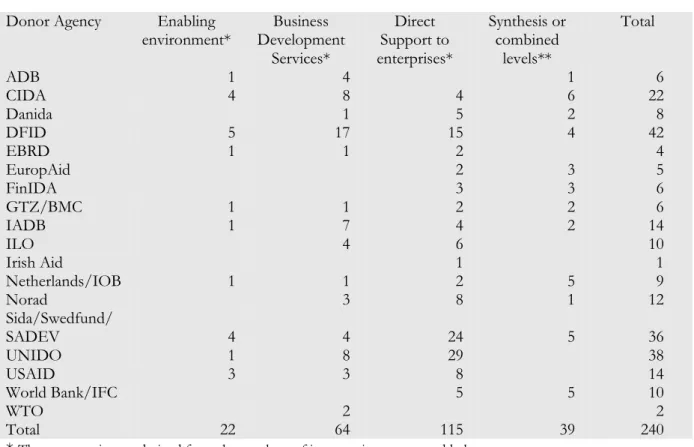
This report has been designed as a meta-evaluation, that is, a study that uses other evaluation reports. The aim has been to locate and use as many evaluation reports and research papers as possible that have something to say on the subject. The reports that were found are listed in annex 2 and Table 1 presents a summary of where they come from. The starting point in our search was the OECD/DAC evaluation database. We found some 50 reports there. We
1 The goal formulations of particular relevance to business development are: “To halve, between 1990 and 2015, the
proportion of people whose income is less than $1 a day” and “Achieve full and productive employment and decent work for all, including women and young people”. See
continued our search at the websites of the bilateral and multilateral donor agencies and found another 190 reports. The precise numbers are evasive as the agencies present the same study in several guises, for example as country case studies, final reports, and synthesis reports. One evaluation exercise may thus result in several different reports. There are fewer evaluations than first meet the eyes. Literature searches through bibliographies, reference lists of reports, and through the databases of Elsevier and Sage gave another 25 research papers.
Table 1. Donor agencies and intervention level of evaluations
Donor Agency Enabling
environment* Development Business Services*
Direct Support to enterprises*
Synthesis or combined
levels**
Total
ADB 1 4 1 6
CIDA 4 8 4 6 22
Danida 1 5 2 8
DFID 5 17 15 4 42
EBRD 1 1 2 4
EuropAid 2 3 5
FinIDA 3 3 6
GTZ/BMC 1 1 2 2 6
IADB 1 7 4 2 14
ILO 4 6 10
Irish Aid 1 1
Netherlands/IOB 1 1 2 5 9
Norad 3 8 1 12
Sida/Swedfund/
SADEV 4 4 24 5 36
UNIDO 1 8 29 38
USAID 3 3 8 14
World Bank/IFC 5 5 10
WTO 2 2
Total 22 64 115 39 240
* These categories are derived from the typology of interventions presented below
** This column consists of evaluations that covered two or more of the categories in the previous columns, for example programmes that included support to the enabling environment, business development services and direct support to enterprises.
Once the database was established a sample of evaluations/studies was selected. The selection of a judgemental randomized sample was done as follows:
1. First we selected a fully randomised sample of 10 reports for joint reading, to check the
formats for quality control and summary of findings.
2. After that we aimed to get another 20 reports that were randomly selected, but in that
process we first made the random selection but discarded studies that were of too low a quality to be useful. We added randomly selected studies until we reached a total of 20 that were of sufficiently high quality.
3. One we had read the 30 randomly selected studies, we reviewed the sample to assess how
it compares to the total population and;
a. Selected additional reports to make sure all major types of interventions were
represented.
b.Selected additional reports to make sure that major categories of recipients were
c.Selected additional reports to make sure that the experiences of major donors were represented
d.The sample was reviewed and we added reports that we knew were significant,
widely quoted and solid studies, so that our sample could not be easily criticised for having missed significant studies that would have altered the main
conclusions.
4. At the end of the analytical process, we returned to the total sample to assess what we
had learnt, compare to the total population, and assess whether there was a need to look at additional reports. In the latter phases we divided labour and at the end of the process we have used a total of 60 evaluations studies for this synthesis report.
With this stepwise development of the sample we (1) get the most interesting and useful reports, (2) have an adequate representation of interventions, countries etc., and (3) have a scientifically acceptable approach to the selection of reports. The randomized selection has made sure that our preconceived ideas of what would be useful and interesting has not dominated the selection process2.
Typology of Interventions
Development cooperation aimed at strengthening the business sector contains many different types of interventions. The donor agencies take the starting point in the OECD/DAC definition
of the Private Sector (see page 13), but the words private sector and business sector seem to be
used interchangeable. The typology used in this report is based on three different levels of activities;
1. support to create an enabling environment, that is, interventions that aim at policy
dialogue on economics, trade policy and the private sector, legislative framework and regulations; privatization, anti-corruption measures, interventions that affect conditions supportive of the sector such as labour markets, infrastructure facilities, etc.;
2. support to business services, that is, interventions that are aimed at services that are in
turn directed at businesses or build market institutions, such as standardization and certification, research and development, financial markets and availability of capital, consulting services, etc.;
3. support to specific firms; that is, interventions that directly target actors in the private
sector through capacity building programmes, lending schemes, business-to-business programmes, trade promotion (import offices).
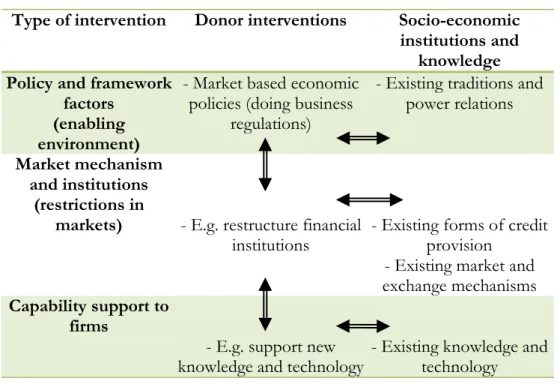
Support to business sector development can thus be given in various ways for example in the form of; 1) policy support to establish the conducive macro economic stability and enabling environment to facilitate the operation of the business sector, 2) support to the establishment of market institutions, and 3) improve the capabilities of the actors in the business sector, i.e. enterprise managers, entrepreneurs, wage earners, business service providers etc. The effect of these three types of interventions is not independent of each other, for example may the support to business actors have limited impact if the macro policy environment is not conducive or the market institutions are not in place. Furthermore, to be effective the design of the intervention must take into account existing knowledge, institutions and behaviour prevalent among the actors and the target group for the interventions. Existing knowledge and institutions can both
2 When we refer to evaluation reports we use the name of the commissioning agency and year of the report, rather
than authors or companies that were commissioned. When we refer to research publications and other studies, we use author names. The evaluation reports are found in annex 2, and the full details of references in our list of references.
facilitate or hamper support interventions. It is for example important to take into account existing ownership institutions and credit provision and use before creating new ownership rights or financial institutions. On this basis we can design an analytical framework for the study of
business sector interventions3
The figure below shows the relationships between government policies, donor supported programmes, and the local institutional context. The first column summarises three policy levels for a government which is keen to promote business sector development. The three levels of policy formulation can be matched by three levels of donor programmes, but these are of course more restricted in scope than the host country government policies are. Finally, the third column emphasises the importance of context, both generally and in respect of each particular level of government intervention policy and donor programme. The essential aspect of this framework is the interdependence between the levels of interventions and between the intervention levels and existing local knowledge and institutions. It means for example that the effectiveness of interventions at firm level will depend on the policy framework and market institutions. Likewise, policy interventions on for example ownership rights to land have to take into account existing local institutional arrangements for land use and ownership. The framework is developed from Sida’s evaluation of rural development and the private sector in SSA (Sida, 2003).
Figure 1. Analytical Framework for Business Interventions
Type of intervention Donor interventions Socio-economic institutions and
knowledge Policy and framework
factors (enabling environment)
- Market based economic policies (doing business
regulations)
- Existing traditions and power relations Market mechanism
and institutions (restrictions in
markets) - E.g. restructure financial
institutions - Existing forms of credit provision - Existing market and exchange mechanisms Capability support to
firms
- E.g. support new
knowledge and technology - Existing knowledge and technology
Limitations
Even though this study aims to sum up donor experiences of business sector support, it suffers from several limitations. First, there is more knowledge available than we have located. As an example, the European Commission’s database presents 4 evaluations in the field of the private sector and trade. But as the private sector is one of the main intervention areas, there is bound to
3 The framework is inspired and developed on the basis of Havnevik et al. (2003) “Rural Development and the
be more knowledge of impact and effectiveness somewhere. But as that knowledge is not listed in public evaluation reports it cannot be included here. The same holds true for many other development agencies.
Second, the evaluation reports included here are mainly in English and it is only agencies that have websites in English that are used. The study is limited by not drawing on the experiences of the whole donor community.
The business sector is elusive and the boundaries to other programme areas are permeable. There
are major programmes in, for example, agriculture and agribusiness4, telecommunication and
other infrastructure (power, transport) where the business sector plays a role and is a target, for example through opening up for competition, privatisation of services, and enhancing effectiveness. Our search for information has taken its starting point the OECD/DAC classification of what constitutes private sector development, but there is a lot of support to the
business sector in other programmes5.
The study is affected by the vagueness of success criteria. It is not always clear what the objectives of assistance were. Sometimes there were a great many objectives and contradictory objectives. Very few evaluations relate to the overall objective of poverty alleviation and this is rarely a benchmark for success of business sector programmes. Even when evaluations conclude that a programme has been successful, the reader is often left to wonder why this was so and what criteria were applied. We could not be assured that an independent and external evaluator of a World Bank programme would apply the same standards of success and achievements as another independent and external evaluator of, say, a DFID programme.
Profits, survival and growth are basic success criteria in the business sector. None of the evaluation reports in the database was completed after 2008, that is, after the onset of the financial crisis and ensuing recession that has deeply affected the business sector globally. Some conclusions would have looked quite different if the evaluation fieldwork had been repeated in 2009.
With these reservations in mind, we assume the report still captures the most relevant experiences of some major donor organisations.
4 As an example, in recent years major sector programmes in agriculture have contained training programmes for
entrepreneurs, support to business development services, institutional development in the form of R&D, standardization facilities, microcredit schemes, etc, that is, all the major components of any private sector development programme. But so are also most actors in the agriculture sector private and business-minded.
5 Sida (2004) concludes that private sector projects account for 7% of the total volumes of aid, but if looking at real
Chapter 2. Description of the Evidence Base
Reviews, Evaluation and ResearchThere are 240 reports in the database in annex 2 and in addition we have 25 research papers published in the scientific journals of interest in development cooperation. A significant number are synthesis reports such as overviews, policy analysis, and policy summaries (that border on being evaluations – systemic and arriving at conclusions of worth and merit). The majority of publications are evaluations or reviews. In spite of the efforts of OECD/DAC there is still no common approach to monitoring and evaluation among donor agencies. While the definition of evaluation as such is clear and shared, the practice of what constitutes an evaluation differs. There are two problems.
First, products (reports) that are called evaluation do not always have a content to match that
title. The most common definition6 of evaluation says that evaluation is a “systematic inquiry in to
the worth and merit of an object”. The OECD/DAC definition and the definitions adopted by donor agencies, elaborate on that basic definition. Nevertheless, sometimes products are called evaluation even though they are neither systematic nor arrive at conclusions on worth and merit. Second, there is much information which is both systematically gathered and analysed and that arrives at conclusions on worth and merit. The database contains monitoring reports and reviews that are of interest and that are de facto evaluations. Many of these are more specific, that is, they evaluate a project or a programme, and perhaps do so before it has come to an end, and thus they are called mid-term reviews. But their evaluative focus can be quite strong. Many policy studies, sector experience assessments, and the like are not called evaluations either, but build on systematic review of experiences and are evaluative. These studies tend to be broader in scope and more closely connected to decision-making.
The distinction between research and evaluation can be difficult. Evaluation builds on scientific method, but it is applied to practical questions and it must arrive at a conclusion of worth and merit. Research can be descriptive, develop hypothesis, it can present an overview of a field, without necessarily arriving at a conclusion of worth and merit. Given that distinction, the two have much in common and research does often conclude on worth and merit as well.
What constitutes evidence?
The discussion of what is to be counted as an evaluation and what should not be counted as evaluation relates to the nature of evaluative evidence. Often, when the term evidence is used, it signifies knowledge gained through randomized controlled trials, or experiments (RCTs). In a recent survey of aid evaluations, Forss and Bandstein (2008) found that less than 5% of all evaluations have a design that can be called an RCT, and about equally few have some form of quasi-experimental approach. The impression that we have formed so far is that even fewer of the evaluations on support to the business sector have an RCT design or a quasi-experimental design. The case study with a narrative approach to analysing causality and contribution/attribution is the dominant design in the studies. The database contains one evaluation that has a quasi-experimental design (World Bank, 1998).
RCTs may not always be the best and most relevant design in order to produce evidence of results. Many interesting things can be said about the processes and results of development cooperation with the use of case studies, quasi-experimental designs, narrative analysis, contribution analysis, etc. RCTs are expensive and often not good enough as they seldom have any explanations of process. Nevertheless this uniform approach (lack of experimental and quasi-experimental approaches) to design is a weakness. The evaluative evidence around the business sector would have benefitted from more plurality in design.
Characteristics of the Business Sector Evaluations
In our first random selection of 10 evaluations we had to discard 3 because of their low quality. In the second selection of 20 reports we had to discard another 8. When we looked for additional information, for example looking for studies on policy dialogue, we found that the chances an evaluation would have valid and reliable conclusions to be some 50%. We had to discard one evaluation out two chosen. The database is thus a glass that is half full, or half empty, depending on how you wish to see it.
There are three major problems. First, many evaluations do not describe their methods at all. In particular their choice of case studies, of interview respondents, and places to visit, is not described and hence the reader cannot assess the methodological choices at all. Second, empirical data of many evaluations is restricted to interviews with project managers, desk officers in donor agencies and recipients in a managerial position. The voices of clients, customers, shareholders, ordinary disinterested people, are seldom heard. Third, most evaluations are conducted while projects and programmes are still ongoing (which is not surprising as they are often meant to provide decision support on whether to continue, change or conclude programmes). The few evaluations that have been conducted several years later often present a rather different picture. Both Sida and CIDA financed partnership programs. The CIDA evaluation was done while the programme was ongoing and concluded that the partnership between firms was mutually beneficial. The Sida evaluation was done four years after the programme had finished and found that 10% of the partnerships remained alive. Timing is important!
When evaluations conclude on impact the worst scenario is often that the project had no visible impact. In business development more than in other programmes, the worst case scenario is actually that the projects may have a highly negative impact - they cause damage. Some evaluations point to companies going bankrupt, viable operations lured into credit programmes where they become indebted, etc. This reflects the non-linear connections between cause and effect that characterise the sector. Few evaluations recognize such risks and that limits their perspective on the dangers as well as the opportunities of business sector development.
Chapter 3. Evaluation of Approaches to the Business Sector
Approaches to the SectorThe discussion of the business sector/private sector7 development presupposes a definition of
the sector. The donors often refer to the 1995 Development Assistance Committee's (DAC) Orientations for Development Cooperation in Support of Private Sector Development. The
DAC considers the "Private Sector" as "a basic organizing principle for economic activity where
private ownership is important, markets and competition drive production, and private initiative
and risk-taking motivate economic activity". This chapter looks at how some donors approach
the sector and how they evaluate the strategic approach – as opposed to project and programme evaluations.
One of the earliest studies of the sector in our sample was commissioned by CIDA. This synthesis study (CIDA, 2002) builds on five evaluations, each assessing support in one of the five categories that define that agency’s private sector programme (these are presented in Table 2). Table 2. Programming categories CIDA’s private sector development programme
Category Description
Enabling Environment Development and implementation of appropriate national policies (macroeconomic, economic, and social policies) and building of institutional capacities (e.g., improving regulations, decreasing corruption, or enforcing the rule of law) which shape the conditions under which PSD takes place within a country.
Capacity Development Development of small and medium enterprises (SMEs); specialized
Canadian training institutes to undertake development work; Canadian educational institutions to develop programmes offshore; and organizations which specialized in SME service delivery.
Linkages This is the most commercially oriented PSD category and includes: CIDA's Industrial Cooperation and Renaissance Eastern Europe programs; the enterprise linkage projects (e.g., Enterprise Thailand); and technology transfer projects focused at linking the Canadian and developing country private sectors.
Local Enterprises This covers micro-finance and micro-enterprise development projects. In addition, a policy dialogue analysis of CIDA's participation in the Consultative Group to Assist the Poorest (CGAP) was undertaken. CGAP is a multi-donor initiative in the micro-finance area.
Economic Integration This covers: trade and economic integration projects focused on the increasing global trade picture including General Agreement on Tariffs and Trade (GATT), World Trade Organization (WTO), and Regional Trade groups; and balance of payments support and food aid supporting structural adjustment programs.
Source: CIDA, 2002, pp. 1 – 2.
7 Though there is a distinction between the words “business” and “private” this report uses the terms
interchangeably. A “business” does not have to be privately owned, there are state-owned businesses in many countries. Business could be run by NGOs. But the spirit of being business-minded is often associated with the private sector and when looking at the evaluations in our database, it seems that there is no consistent use of the one word or the other. They are used synonymously.
CIDA takes a broad view of the private sector starting at the macro-level of policy dialogue and the rule of law to activities in the field of trade, food aid and balance of payments support. While
the evaluation does not address the sector definition as such, it does conclude that: “the very broad
range of initiatives undertaken has meant that the results have been scattered across projects. Limited synergy exists within the PSD priority. The investments to date have been thinly spread over a wide range of areas. The Agency should consider whether future investments in PSD would be better concentrated on fewer areas”. That finding is closely related to the structure of the programme categories.
The evaluation points out that that there is a need for a clearer conceptual framework within CIDA to guide PSD programming and that private sector development has been plagued by a lack of clarity in concepts and definitions. Many of the internal Canadian debates regarding CIDA's PSD programming have focused on issues that place principles at odds with each other
without ever resolving fundamental objectives. “Should the focus be aid or trade? Should the overriding
objectives be commercial or developmental? The character of these debates has left many CIDA staff with a certain residual cynicism concerning the PSD priority. Often, PSD was felt to be a code word for "Canadian private sector interests"” (CIDA, 2002, p.11).
The evaluation concludes that PSD support has produced valuable results in areas such as improving the enabling environment, creating jobs, and assisting with the integration of developing countries into the global economy. Evidence indicates that the programmes for which poverty reduction results have been observed in a consistent manner are the ones targeting micro-finance and micro-enterprise development and small and medium enterprise development. As most donor agencies support the private sector against a background of poverty alleviation as the main goal, this is a significant finding.
As an example of a conceptually focused programme, Danida’s PSD programme started in 19938.
During the first three years the programme had a small enabling environment component, but this was left out after the first three years. The programme consists of business-to-business co-operations that are supported with technical assistance and finance for the partners to initially visit each other, for special studies required for assessing the scope of the co-operation and for subsequent feasibility studies (Danida, 2001). A start-up facility can also be provided to further prepare the partners´ co-operation and for initial technology transfers (of up to DKK 0.5 million).
The programme was subjected to a comprehensive evaluation in 2001. The evaluation concludes that the design is narrowly focused on individual private business-to-business co-operations with limited concern for broader aspects of development of the private sector as a whole and for the role of the private sector in overall development. Consequently, the development impact of the programme was found to be limited and less than optimal. The Canadian and the Danish PSD programmes (which is only a part of Danish support to the sector) seem to represent opposite ends on scale of what such a programme may include – from very broadly defined to narrowly focused on business to business cooperation. The choice of what to include in a PSD programme is open, but broadly defined programmes seem to risk being fragmented and the focused programmes lack critical connections to other parts of the sector.
8 Danida has six types of private sector development interventions out of which the PSD programme is one. The
others are the Danish Import Promotion Office, The Business Sector Programme Support, The Mixed Credit Programme, The Business-to-Business Programme, and the Industrialization Fund for Developing Countries. These were all evaluated in a meta-evaluation (Danida, 2004) to which we return later.
Sida’s PSD policy review was also one of the earliest, published in 2001. The report notes that, to be effective, PSD support needs to be multi-sectoral and multi-disciplinary, integrated with other interventions. The report concludes that interventions in the sector should address a cluster of inter-linked factors rather than factors on their own. Within a cluster, macro- and meso-level factors should be addressed before micro factors. The sequencing of interventions should prioritise the conditions that affect the organising principle and provide incentives to firms before engaging in PSD support directly targeting companies. A pragmatic approach that addresses country-specific conditions is, however, essential. Country analysis should include analysis of the PBS, its performance and characteristics. PSD support interventions should be integrated with other development assistance, integrated into country strategies. The leadership role in the design of interventions should be local. Micro-level interventions should be designed in a way that ensures that markets are not distorted. These conclusions are similar to those of Danida (2001 and 2004) and also resonate in the evaluation from the EU, four years later on. The EU commissioned a major evaluation of its private sector programme (EU, 2005). The evaluation looked at the programme implemented between 1994 and 2003, so it is a little bit
more recent than the other three.
Concepts and Management
The EU report (2005) notes the same weakness in terms of overall strategy and conceptual guidance as the other reports do. Whilst the strategy is comprehensive at covering most dimensions of PSD, one major weakness is the ambiguity on the message conveyed (the activities included in the EU PSD programme are listed in Table 3). The evaluation notes that the strategy gives priority to macro-level interventions but also leaves much room for micro-level programmes. This ambiguity is reinforced by a second weakness; the fact that little orientation is given to prioritise among the areas of intervention proposed. This means that the strategy is too open, scattering efforts among all sorts of programmes in different areas, with different focuses and with different degrees of success. A second consequence of these two limitations is that a majority of the EC staff responsible for implementing Community support to PSD lacks the necessary strategic vision on how to support PSD (EU, 2005, p.16), with direct consequences on the implementation: uneven implementation in the field and a limited contribution to the competitiveness of the private sector - even for more recent programmes.
Table 3. Activities contained in the EU Private Sector Development Programme
Activities included in the Community Support to Private Sector Development
Support for institutional and structural reforms with an indirect effect on PSD, including budget Support
Support for institutional and structural reforms with a direct effect on PSD
Support to local financial institutions & the reinforcement of a reliable financial system Direct capital contributions to local companies or to financial intermediaries
Support to intermediary organisations representing the private sector
Support to facilitate partnership between firms (meetings, workshops, forums, etc.) Encouragement of trade and investment between European and local companies
Encouragement of transfers of know-how and technologies & support to cooperation between industry and scientific research
Support to enhance human resources and capacities (training, etc.)
Support for the development and creation of SME's and micro-enterprises Upgrading of local firms (TA, development of management skills, etc.) Support to firm's restructuring and privatisation
Managerial and organisational issues
The EU evaluation provides critical comments on implementation of the strategy, more so than do the other evaluations. There is, for example, no methodical process to select an intervention area when programming a country PSD strategy. For a given area of intervention, the degree of effectiveness in improving business sector competitiveness will vary depending on a number of factors, including the degree of priority attached to this area in that country, the comparative advantage of the EC in that area and the preconditions that need to be met before intervening. The EC does not systematically assess these factors, let alone take them into account when selecting its areas of intervention in a given country (EU, 2005, p.51).
The Sida evaluation points to the difficulties of integrating PDS in a large organisation where most of the staff members do not have any business background (Sida, 2001,p. 93 -101) . The evaluation notes that the understanding of the role that the PBS can play in achieving Sida goals is not reflected in most departmental strategies or in country analyses and strategies. Moreover, the understanding of the impact of the PBS on Sida goals at the level of project interventions is poor. For example, with respect to the goal of poverty reduction, only 5% of projects were classified as having an (intended) impact on poverty. The evaluation suggests three possible reasons for this. The first is that there was/is an overall perception amongst Sida project officers that poverty reduction is concerned only with actions that have a direct impact on the poor. The second could be that the relationship between growth and poverty reduction is not clearly understood within Sida as a whole. Third, and perhaps most importantly, Sida does not have a clearly elaborated policy in relation to the role that the PBS could play in poverty reduction. Since then, Sida has developed a PSD strategy, so the situation may be different now.
Echoing these findings, an ADB (2007) evaluation notes that an important feature of its Private
Sector Development Strategy was the need for regional departments to use ADB’s country
strategies to interlink public and private sector planning and operational activities. Country-specific Private Sector Assessments were required to be prepared to support that process. The evaluation found that, except in a few countries, private sector development road maps were not included in country strategies, and the Private Sector Assessments did not appear to have influenced significantly the preparation of country strategies (much like the findings of the EU and Sida evaluations). The Bank’s evaluation department had prepared nine Country Assistance Program Evaluations since 2000. A review of these documents indicated that at the strategic level, ADB had failed to develop clear programmes in the country strategies for the development of synergies between public sector and private sector operations (ADB, 2007, p.38).
Effectiveness of Subcomponents
The EU evaluation is particularly interesting as it is one of few evaluations that compares performance across areas of intervention. It concludes that many EC business environment
programmes have been successful, in large part due to their high relevance9
9 This is one example of an evaluation criterion that sounds precise but is open to many different interpretations, as
relevance could never be automatically connected to success. Relevance is certainly a precondition for successful programmes, but much could happen along the way of implementation before an intervention could be said to be successfully completed.
. However, while it is a key precondition for successful implementation of macro-level programmes, strong political involvement of partner governments is not systematically ensured. That said, some EC practices have positively influenced government involvement, for example through minimising delays, consulting all relevant stakeholders, entering into joint implementation with other donors and proposing reforms at provincial rather than central level when applicable. Furthermore, support to intermediary organizations has been an effective way of influencing government policies.
The conclusions in respect of financial services differ from that of the CIDA evaluation, which found these to be the most effective in terms of poverty alleviation. Most meso- and micro-level EC interventions in the financial sector were unsuccessful at addressing the obstacle of access to finance. Programmes aimed at financing specific investment projects through direct capital contribution had usually been successful in delivering expected outputs, but unsuccessful with regards to the objectives of the EC PSD strategy. Finally, the PSD Guidelines are not sufficiently clear regarding the role of the Commission in interventions in the financial sector (EU, 2005, p.48).
Despite the positive evolution towards a greater focus on reinforcing local BDS markets, EC programmes do not adequately address the failures of such markets and in consequence have been unsuccessful in reinforcing local BDS markets (EU, 2005, p. 50). Two factors help explain the inadequacy of EC solutions to existing market failures: first, the EC neither assesses market failures sufficiently nor devises adequate supply-side solutions.
The Sida (2001) study shows that within the PSD interventions, considerable attention was paid to macroeconomic stability, but little to the state of development or needs of the private sector. A surprisingly small amount of support was allocated to the macro level - only 2% of budgeted expenditure. The evaluation notes that while Sida staff understand the role that they play in contributing to the conditions for a well-functioning PBS, in practice they do not take full account of the need to develop these conditions, nor the relationship between factors. Given the fact that the donor agencies operate in many countries where the enabling environment for PSD is weak, one would expect to see more interventions at the macro-level.
In balance, interventions at meso- and micro-level in terms of budgeted expenditure were roughly equal in the Sida programme, with the majority of micro-level interventions focused on human resource development. Less emphasis was accorded to market access, the removal of structural barriers, business development services etc. Furthermore, the Sida evaluation points to an unwarranted predominance of interventions that address individual factors, with only seven interventions working at more than one level. The understanding of how the factors that create the conditions for a well-functioning business sector are linked was not well developed at Sida. Intervention Channels
With respect to the mechanisms used by Sida non-governmental channels were not used much. Most interventions were provided either directly or through government. Several Sida officers expressed concerns about using any channel other than government. According to the evaluation (Sida, 2001, p. 106) this needs to be addressed, as non-governmental channels are almost always cost-effective in providing support to businesses at the micro level. Chapter 7 brings up a similar conclusion from Dutch support to trade, which found that the most effective support was channelled via NGOs. The principles of PSD support at the micro level – of not distorting the market, effective outreach, sustainability and the need to create a demonstration effect – are also not adhered to consistently, although there is some recognition of their importance.
Ownership and Sustainability
All the above-mentioned evaluations and the Danida evaluation (2004) in particular point to the importance of local ownership and the fact that this is often absent from the PSD programmes. It is a lesson learned that ownership, involvement of local actors and building of institutions is a necessary condition for sustainability. However, at least for financial sustainability, this is not sufficient. Interventions aimed at setting up or restructuring firms and institutions have to ensure
that their costs can be covered. In the case of business institutions, financial sustainability implies capacity for self-financing. This has implications for the range of competences that need to be transferred, and for how such transfers are financed. Subsidies may only be justified temporarily, on grounds of very high positive spill-over effects such as the supply of products or services that are absent or difficult to gain access to, at least for targeted (e.g., poorer) segments of the population. Moving from the past evaluations quoted here, it appears that the issue of institutional sustainability has been addressed in the new generation of programmes targeted at the macro- and meso-levels, at least in the form of a focus on transfer of institution-building
competences10. It is, however, not clear whether the issue of financial sustainability has been
given the same degree of attention. In respect of Danish micro-level interventions, hard data on sustainability has been reported only very recently as in the form of enterprise survival rates in the PS programme. It is, in this case, not clear whether attempts have been made to identify what factors have been associated with sustainability and lack of sustainability.
Donor Coordination and the Paris Declaration
The programmes mentioned here predate the Paris Declaration with several years, yet the problems of donor coordination were an issue. In both the Danish, Swedish and Canadian programmes there were business–to–business components, and it would always be rather difficult to coordinate such programmes. The national interests are paramount and the motivations of individual entrepreneurs are not easily coordinated. The EU evaluation concluded that the effectiveness of coordination practices has improved although it is still quite varied. Sharing of information between donors and with the government had, at the time of the evaluation, improved significantly but few joint activities or projects were still in evidence. Furthermore, the risk of overlap was found to be important, especially for meso- and micro-level interventions. National interests in such interventions hamper effective coordination (EU, 2005, p.39). The evaluators conclude that, in spite of this, donor coordination is possible in specific areas where conflicts of interest are less in evident (e.g. legal and regulatory framework, institutional capacity and policy dialogue) as well as in areas in which the potential for coordination across areas of intervention is high, such as local economic development.
Still, the evaluation team found that co-operation between donors was virtually absent from PSD project practice (EU, 2005; p. 41). There was little evidence of distribution of tasks, joint activities or joint projects. Few projects were multi-donor; each donor had its own portfolio of projects to finance and manage. In Zambia, only three PSD-related programmes (out of a sample of some 23) were identified as being jointly funded. Moreover, the degree of success of the few multi-donor projects varies from one country to another. The evaluation quotes projects in Ghana and in Egypt that were globally successful, whereas the micro-finance programme in Uganda was considered a failure.
In conclusion, the risk of overlap was found to be high especially for meso- and micro-level interventions. While it was difficult for the evaluation team to seek detailed information on the beneficiaries of the different programmes funded by donors or the partner government, the evidence revealed a high degree of overlap (Mexico, Zambia). In Zambia, for example, there were 21 micro-level programmes all targeting private sector competitiveness; given the size of the private sector in that country, it would be surprising if no overlap existed. A different situation was found in Morocco, where several interviewees confirmed there was little overlap between donor activities, and similarly in Vietnam the evaluation concluded that overlap is rare. The risk
10 Danida; Business Growth and Development. Action Programme for Danish Support to PSD in the Developing
for overlap is certainly higher in the priority countries of most donors, that is, in the least developed countries in Africa.
PSD in Other Sectors
Private actors are active in many fields, there are entrepreneurs and firms in agribusiness, forestry, mining, fisheries and in infrastructure development. In many countries private firms operate in the health and education sectors, indeed these are often high-growth sectors with huge potential for business. There are of course public entities as well, and in many cases development cooperation in, for example, the power sector, has included policy dialogue on the transformation of public utility companies to private organisations. When donor experiences with PSD are assessed, interventions such as these should not be forgotten.
Norad has evaluated its support to the petroleum sector (Norad 2006) and in power-related assistance (Norad, 2005 and 2007). The evaluators concluded that project finance for large projects, involving private sector funding is a challenge. Project finance is linked to the institutional arrangements that are put in place. International and bilateral financial institutions play a large role in raising commercial funding, and in covering some of the risks. Private sector funding on the equity side may be minor and tied to contracts, by which a part of the investment flows back. On a more general level, the perception of investment risk is formed by the track record of good governance in the host country. On institutional capacity development, the challenge for cooperation partners is to gain a deeper understanding of the capacity development needs, and how to address these with a view to the numerous obstructions.
The World Bank (2000) conducted an evaluation of its performance in promoting private sector development in the electric power sector. That report’s main message was that the private firms have delivered expected benefits and good outcomes where countries showed a commitment to advancing reforms, and PSD programmes were properly implemented. However, the quality of outcomes depended on the objectives pursued and on the types of assistance provided. Most countries were in the early stages of reforming and deepening private sector involvement in their power sectors. The World Bank pursued multiple and complex reform objectives through a range of instruments across all regions - and achieved good results where country ownership and sustained political commitment existed. But the World Bank underestimated the complexity and time required for reforms to mature and achieve lasting and equitable country-sector outcomes; it obtained poor or, at best, mixed results where reforms were weak or reversed. On the other hand, a focus on the single reform objective of private sector participation and responding to market demand for new generation achieved good project-level outcomes overall.
The study also points out that there is no single blueprint for sector reform and PSD. It is an evolving menu of options covering various combinations and sequences of reform steps driven by country-specific objectives and conditions. In addition, poverty reduction and environmental mainstreaming (“doing good” in addition to “doing no harm”) have not been intrinsic components of sector reform and PSD strategies. Independent power producers have had a critical role to play in relieving supply bottlenecks, in leveraging public sector financing capacity, and in demonstrating early wins. But lack of timely reforms in the distribution subsector can jeopardize the gains in the generation subsector.
The ADB (2007) concludes that the general lack of synergy between public and private sector operations is disappointing. ADB’s experience in the power sector provides some examples of good practices that should be used in other sectors. ADB has supported the restructuring of the power sector in many countries. An important element of power sector reform is the creation of opportunities for private sector participation in areas such as generation. Although reforms in
most countries have been slower than originally envisaged, progress is being made. Private sector investment in the power sector, including in projects supported by ADB, has increased in the Asia and Pacific region, and energy projects have been successful. In some cases where problems arose with tariffs for private financed projects, ADB was able to use its access to policy makers to mitigate some of the negative financial consequences for its private sector clients through policy dialogue. The evaluation concludes that in comparison to the energy sector, apart from India, where the government is scaling up private financing for airports and roads, progress on private sector participation in the transport and water sectors has been limited.
Concluding Remarks
The strategic perspective on Business Sector Development is important, still there were only six evaluations at that level of aggregation among the 240 evaluations in the database. None of the strategic evaluations was younger than five years; they all date between 2001 and 2005. They are important though, they point to issues such as the sequencing of interventions, the balance between macro-, meso-, and micro-level interventions, the integration of the business sector in the instruments of development cooperation – strategies, policies, country frameworks, etc. They also point to coordinating issues and human resource development needs in the agencies. Evaluations of projects and programmes at lower levels are not so likely to capture and elaborate such constraints.
There is a striking level of coherence between the different evaluations, in that they mirror each other in pointing to the need for a holistic approach to the sector, for the importance of macro-level interventions and the need to sequence interventions. They point to common experiences in understanding local needs and specific contexts. Agencies have standardised instruments that are applied uniformly, still the experience is clear that “there is no one size that fits all”. The evaluations discuss the issue of coordination amongst donors and the need for local ownership, but much has happened in the field of aid coordination and these evaluations are probably too old for their analysis to be relevant – but whether the rhetoric has been followed by practice since the Paris Declaration was signed remains to be seen.
Chapter 4. Experiences of Supporting an Enabling Environment
Defining an Enabling EnvironmentIn 1996, the OECD’s Development Assistance Committee produced the report entitled Shaping
the 21 Century: the Role of Development Cooperation, which states that enterprise-based economic
growth is essential for decisive reductions in poverty over time. This document, influential
among bilateral donors,asserts that development progress is contingent on a strong commitment
to an effective policy environment and key development priorities aimed at pro-poor growth.
The report also encourages donors to provide increased financial support for such policies,
combined with an emphasis on participation andcapacity-building.
The definition of what constitutes an enabling environment varies among donor organisations and to some extent it is a political issue. The choice of policies to stimulate growth and development is a political choice and it cannot be reduced to a technical issue only. Still, there is a widespread consensus around issues such as the rule of law and absence of corruption. Other issues are controversial, such as the speed and content of privatization policies.
Support to an enabling environment contains a mix of interventions concerning national policies (macro-economic, social and political) and institutional capacities (e.g., enforcement of the rule of law, effectiveness of regulatory instruments, combating corruption). The object of interventions should be issues which are either conducive to, or hinder the development of the private sector. It is a critical segment of development programming given its potential to influence events from the sector to the individual firm level, for instance policies related to property rights or incentives to support the development of grass-roots savings and credit organizations. In addition, structural adjustment programmes addressing inflation, fiscal deficits, the privatization of state enterprises, etc. help determine the extent to which a given country is “enabled” to accede to global markets and attract foreign direct investment.
Enabling environment is squarely positioned at the juncture of national and international PSD initiatives and has strong linkages to other interventions such as Business Services, Micro-finance and Small Enterprise Development, and Trade and Economic Integration. Furthermore, efforts to redefine the respective role of governments and private sector operators in the delivery of essential services (e.g., infrastructure, education, water and sanitation, etc.) as well as efforts to strengthen capacities to develop sound policies (e.g., decentralization, increased influence of civil society in policies and decisions, etc.) are related to Human Rights, Democratization and Good Governance. Empirical studies show that gains in these areas have a positive influence on economic growth and ultimately the reduction of poverty. In this chapter we look at donor experiences in three critical areas; policy dialogue, legislative reform, and labour market interventions.
Policy Dialogue
There are many forms of policy dialogue, and many interventions occur in forms that are not evaluated as specific projects. One of the best documented major policy projects seems to be DFID experience with privatization of state-owned enterprises in China (DFID, 2004). Since 1999, DFID had been working with the Government of China and other partners to use development of the private sector as a way of reducing poverty. The Programme came to an end in 2007, with China having achieved the first Millennium Development Goal of halving the