Estudos e Documentos de Trabalho
Working Papers
25 | 2009
ARE ATM/POS DATA RELEVANT WHEN NOWCASTING PRIVATE CONSUMPTION?
Paulo Soares Esteves
November 2009
The analyses, opinions and findings of these papers represent the views of the authors, they are not necessarily those of the Banco de Portugal or the Eurosystem.
Please address correspondence to Paulo Soares Esteves Economics and Research Department
Banco de Portugal, Av. Almirante Reis no. 71, 1150-012 Lisboa, Portugal; Tel.: 351 21 313 0758, [email protected]
BANCO DE PORTUGAL
Edition
Economics and Research Department Av. Almirante Reis, 71-6th
1150-012 Lisboa
www.bportugal.pt
Pre-press and Distribution
Administrative Services Department
Documentation, Editing and Museum Division Editing and Publishing Unit
Av. Almirante Reis, 71-2nd
1150-012 Lisboa
Printing
Administrative Services Department Logistics Division
Lisbon, November 2009
Number of copies
170
ISBN 978-989-678-006-7 ISSN 0870-0117
Are ATM/POS data relevant when nowcasting private consumption?
Paulo Soares Esteves*
November 2009
Policymakers need timely and reliable information on the current state of the economy as macroeconomic forecasts and policy decisions are strongly affected by the quality and completeness of this assessment. Therefore, forecasters are always in search of new indicators that are related with the macroeconomic variable of interest and available earlier. This paper proposes the use of the ATM/POS data as an indicator to estimate private consumption. An application for Portugal is presented as a case study, where the out of sample performance of this indicator is evaluated against some benchmark naïve models and other alternative bridge models. The results clearly support the use of this information to nowcast non durables private consumption.
Keywords: Macroeconomic nowcasts, private consumption, ATM, POS. JEL codes: E01, E27, C53
*
This paper would not be possible without the information on ATM/POS data and the helpful insights on the issue provided by Hugo Mira of the Payments Systems Department. The author would like to thank Francisco Dias, Maximiano Pinheiro and António Rua for their comments and suggestions on earlier versions of the paper. The usual disclaimer applies.
1. Introduction
Timely and reliable information on the current state of the economy is crucial for both forecasters and policymakers. The quarterly national accounts releases are key looked-for information, but which are disclosed with a significant delay.1
Therefore, when nowcasting or producing short-term forecasts, one of the most important issues is to find indicators related with the targeted variable but that are available much earlier. The construction of such a link between the information included in one or few key indicators and the final variable to measure explains why these models are called “bridge models”. They are widespread used as evidenced by some recent examples. For instance, Baffigi et. al. (2004) is an often referenced application for the euro area, while Kitchen and Monaco (2003) describe the approach adopted at the US Treasury Department to construct “real time” estimates for quarterly GDP.2 More recently, this type of approach was extended to a large number of series, using a
statistical framework that summarizes all the information in a few number of common factors that are then bridged into the variable to estimate – a recent application on real time forecasts for the US economy is given by Gianonne et. al (2008). This paper follows the more traditional and restricted approach, which is suited to investigate the explanatory power of a specific indicator. When thinking of private consumption, the Automated Teller Machine (ATM) and Point of Sale (POS) data seems to fulfil two necessary requirements to emerge as a covariate indicator for private consumption. Firstly, cash withdrawals and card payments are truly associated with private consumption, being a measure of the same phenomenon. Secondly, this information is available very rapidly, typically just a couple of days after the end of the month. The use of this type of information was for the first time suggested and explored by Galbraith and Tkacz (2007), which presented some evidence that debit card data can lower consensus forecasts errors and are correlated with GDP revisions for the Canadian economy. Nevertheless, in general, this information is not taken into consideration by the institutions that usually evaluate the short-term economic fluctuations, in particular Central Banks and National Statistics Institutes. This probably reflects the less relevance of this information in the past, prior to the strong increase of the role of the ATM/POS services since the 90s.
The main objective of this article is to investigate the use of this information to nowcast private consumption, presenting an application for the Portuguese economy as a case study. The paper is organized as follows. Section 2 presents the database on ATM/POS withdrawals and payments for
1
Following the current Eurostat procedures, the flash estimate for GDP in the European Union countries is disclosed within 45 days of the end of the reference quarter, while the first complete set of quarterly national accounts is disclosed 30 days latter. The Bureau of Economic Analysis (BEA) presents the first number for the US GDP one month after the end of the quarter, while the first preliminary estimate is presented one month later.
2
Concerning the Portuguese economy, two applications were recently published. Duarte and Cardoso (2007) and Ramos Maria and Serra (2008) present applications for exports and investment, respectively.
Portugal. The aim is to provide an overall overview of this type of database. Section 3 presents a bridge model to estimate private consumption. The results of this model are compared with those of two naïve models (carry-over and autoregressive) and with some alternative bridge models based on other indicators that are frequently used to forecast private consumption. Finally, section 4 displays the main conclusions.
2. The database
The monthly database used in this paper was built using the information provided by the Banco de Portugal Payment Systems Department, covering a sample period starting in January 1998 to June 2009 and encompassing the ATM/POS cash withdrawals and payments made by local residents. Figure 1 presents the nominal data, both in monthly levels and in month-on-month rates. A notable feature that emerges from the chart is the strong seasonal pattern, characterized by a huge increase at the Christmas season (December) and in the months of the summer holidays (July and August).
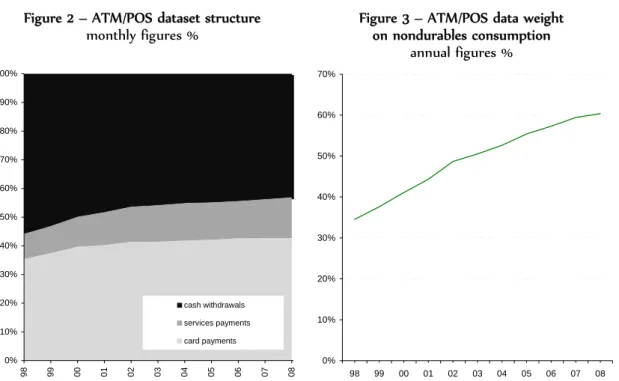
Figure 2 presents the structure of this dataset by type of transaction. From a very rich database, three main aggregates are considered: (i) the ATM cash withdrawals of residents both in the national territory and in foreign countries; (ii) the card payments of residents also in the national territory and abroad, covering both debt and credit cards; (iii) the electronic payments of services, including the telecommunications card charges.
Figure 1 – ATM/POS data
monthly levels (millions of euros) month-on-month rates (%)
0 1000 2000 3000 4000 5000 6000 7000
98 99 00 01 02 03 04 05 06 07 08 09
-0.4 -0.3 -0.2 -0.1 0.0 0.1 0.2 0.3
The results evidence a reduction of the importance of cash withdrawals on total transactions, relatively to card and services payments. Presently, cash withdrawals and card payments dominate the transactions (both slightly above 40%), while the payments of services reaches a share of nearly 20%.
Figure 3 aims to illustrate the dimension of this dataset. Its share in terms of total nondurable consumption has been rising ever since 1998, although at a slow pace, reaching a level close to 60 per cent in 2009.
3. A race between indicators
This section evaluates the usefulness of this ATM/POS data to nowcast private consumption. This exercise is carried-out as a case study, making use of the available data for the Portuguese economy presented in the previous section.
The targeted aggregate chosen to be forecasted is private consumption of non durable goods and services, which corresponds to roughly 90 per cent of the overall private consumption in the Portuguese economy. The decision of excluding durable goods is justified on two grounds.
Firstly, there are very direct, reliable and timely indicators that typically allow to measure quite accurately consumption of durables goods – the main example are cars sales that are available at the end of each month and which are directly used to measure durable consumption. Secondly, the importance of electronic payments must be more relevant when explaining non durables consumption. The expenditures on durable goods is typically less associated with the use of
Figure 2 – ATM/POS dataset structure monthly figures %
Figure 3 – ATM/POS data weight on nondurables consumption
annual figures %
0% 10% 20% 30% 40% 50% 60% 70% 80% 90% 100%
98 99 00 01 02 03 04 05 06 07 08
cash withdrawals services payments card payments
0% 10% 20% 30% 40% 50% 60% 70%
electronic money, being more connected with the use of financing schemes owing the larger amounts usually involved in these transactions.
.
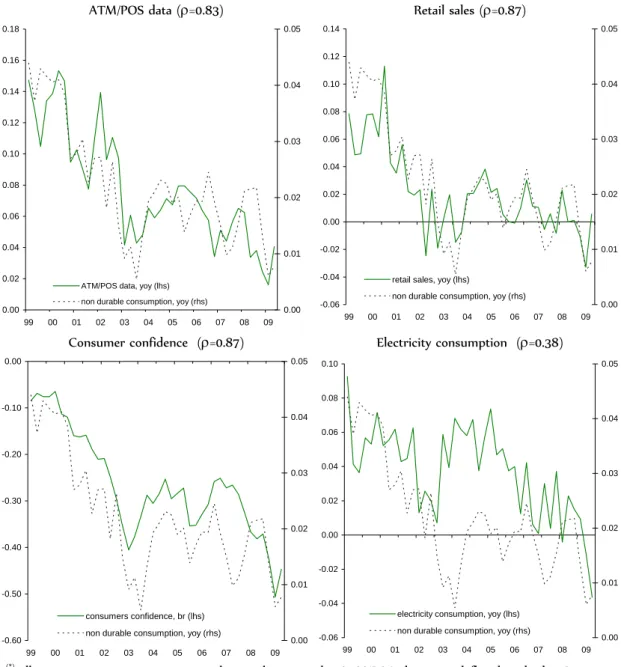
3Besides the ATM/POS data, the retail trade sales; the consumer confidence indicator level and the consumption of electricity are selected as the other competing indicators. Figure 4 presents these indicators vis-à-vis the nondurable consumption, as well the respective correlation coefficients.
3
This option of excluding durables consumption is also validated by the available database. Considering the sample period and using quarterly figures measured in year-on-year rates - in order to overcome the seasonality issue -, the simple correlation coefficient between ATM/POS data and non durables consumption is 83 per cent. This correlation decreases to 65 per cent when computed with the overall consumption.
Figure 4 – Competing indicators vs nondurable private consumption(*)
ATM/POS data (ρ=0.83) Retail sales (ρ=0.87)
0.00 0.02 0.04 0.06 0.08 0.10 0.12 0.14 0.16 0.18
99 00 01 02 03 04 05 06 07 08 09
0.00 0.01 0.02 0.03 0.04 0.05
ATM/POS data, yoy (lhs)
non durable consumption, yoy (rhs) -0.06
-0.04 -0.02 0.00 0.02 0.04 0.06 0.08 0.10 0.12 0.14
99 00 01 02 03 04 05 06 07 08 09
0.00 0.01 0.02 0.03 0.04 0.05
retail sales, yoy (lhs)
non durable consumption, yoy (rhs)
Consumer confidence (ρ=0.87) Electricity consumption (ρ=0.38)
-0.60 -0.50 -0.40 -0.30 -0.20 -0.10 0.00
99 00 01 02 03 04 05 06 07 08 09
0.00 0.01 0.02 0.03 0.04 0.05
consumers confidence, br (lhs) non durable consumption, yoy (rhs)
-0.06 -0.04 -0.02 0.00 0.02 0.04 0.06 0.08 0.10
99 00 01 02 03 04 05 06 07 08 09
0.00 0.01 0.02 0.03 0.04 0.05
electricity consumption, yoy (lhs) non durable consumption, yoy (rhs)
(*)
all quantitative series are measured in real terms. The ATM/POS data was deflated with the Consumer Price Index (CPI).
Concerning the comparability of the results, it should be mentioned that the race is not completely fair, favouring the retail sales indicator, which contrarily to the other indicators is not available at the end of the month. The confidence indicator covers the first two weeks being released at the end of month, while the ATM/POS data and the consumption of electricity are available few days after the end of the month. In contrast, the retail trade is only available at the end of the following month. The results do not take into account these differences.
Finally, the available electricity consumption data cover both households and firms. In the future, a possible breakdown by type of consumption – not available at the moment - may be interesting, changing the assessment on the use of this indicator.
3.1
Rules of the race
The general equation to nowcast private consumption on non durable goods and services is assumed to be the following:
t t i
i t i t
t c C I
C 4
4
1 4 0
4 = + Δ + Δ
Δ
∑
= − −
β
α (1)
The year-on-year rate of change in consumption (Δ4C) is explained by its lagged values and by the contemporaneous evolution of the chosen indicator (Δ4I-i), after its transformation from monthly to
quarterly frequency.
After the estimation of the model considering the ATM/POS data as the relevant indicator, an out-of-sample exercise is implemented. The results are compared with those from other alternative models: (i) two naïve models [random-walk assumption and an AR(4) model that corresponds to dropping the indicator from the equation above]; (ii) and the models using the alternative indicators to mimic private consumption.
Additionally, forecasts combination is also assessed. The several alternative single equations projections are aggregated, following the procedure presented in Diebold (1988). Thereafter, one indicator at a time is excluded from the pool in order to estimate the gain associated with its inclusion as a relevant indicator.
3.2
Final scores
All the models are evaluated to forecast the yoy rate of non durables private consumption or alternatively to foresee the evolution of those rates (acceleration/deceleration). This corresponds to a standard practical technique called “constant adjustment”, which corresponds to adding a
constant to the model in order to assure that it fits exactly the last observable figure for the endogenous variable.
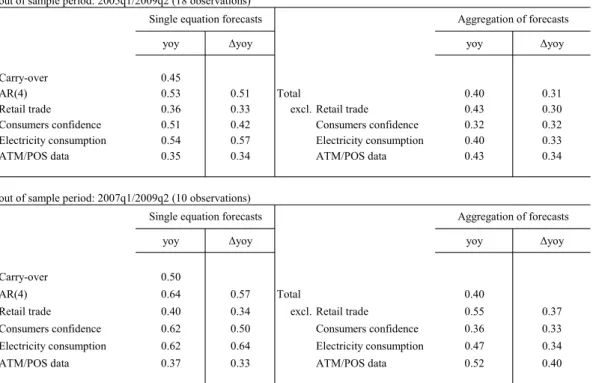
Two periods were considered to evaluate the out-of-sample performance of the several models: [2005q1:2009q2] and [2007q1:2009q2]. The current exercise should be considered as a pseudo real time analysis, not accounting for the usual uncertainty surrounding data revisions. Thus, the magnitude of the reported Root Mean Square Error (RMSE) should be interpreted carefully.4
The results are presented in Table 1. The first general result is that, in general, all the models considered seems to perform better when used to foreseen the first difference of the yoy rate of private consumption.
Other noticeable outcome is that the use of statistical indicators provides usually superior results
Table 1 – Forecasting performance evaluation
Root Mean Square Error – one step ahead out-of-sample forecast
out of sample period: 2005q1/2009q2 (18 observations)
yoy Δyoy yoy Δyoy
Carry-over 0.45
AR(4) 0.53 0.51 Total 0.40 0.31
Retail trade 0.36 0.33 excl. Retail trade 0.43 0.30
Consumers confidence 0.51 0.42 Consumers confidence 0.32 0.32
Electricity consumption 0.54 0.57 Electricity consumption 0.40 0.33
ATM/POS data 0.35 0.34 ATM/POS data 0.43 0.34
out of sample period: 2007q1/2009q2 (10 observations)
yoy Δyoy yoy Δyoy
Carry-over 0.50
AR(4) 0.64 0.57 Total 0.40
Retail trade 0.40 0.34 excl. Retail trade 0.55 0.37
Consumers confidence 0.62 0.50 Consumers confidence 0.36 0.33
Electricity consumption 0.62 0.64 Electricity consumption 0.47 0.34
ATM/POS data 0.37 0.33 ATM/POS data 0.52 0.40
Aggregation of forecasts
Aggregation of forecasts Single equation forecasts
Single equation forecasts
(1) The forecasts aggregation follows the procedure presented in Diebold (1988). Y is the aggregated forecast
from the q individual forecasts Yj ,
* vector w following the from obtained are w weights optimal the where * j 1 *
∑
= = q j j jY w Y . procedures several the of error e between th matrix covariance the is and ones of vectors a represents i , 1 1 1 (q,1) ) 1 , ( 1 ) 1 , ( 1 ) 1 , (* ⎟ Ω
⎠ ⎞ ⎜ ⎝
⎛ Ω Ω
⎟ ⎠ ⎞ ⎜ ⎝
⎛ Ω Ω
= − − q T q T T q i n i n i w
in terms of RMSE against the naïve models
.
The exception is the electricity consumption that in the several experiences underperforms the use of the naïve approaches. Comparing the results obtained with this single indicator approach, the ATM/POS data outperforms versus the other alternative indicators, followed closely by the use of the retail trade sales. On average, the gains – measured by the reduction in the RMSE - are close to 40 per cent when considering the naïve approaches and the models using the electricity consumption and the confidence indicator.5 Theresults are close to the ones obtained with the model using retail trade statistics, which is typically the most frequently used indicator.
Concerning the aggregation of forecasts, the results suggest that the combination of several indicators may be preferable than to rely exclusively on one indicator. In the longer out-of-sample period, there are several combinations of indicators that outperform the approach based on one only indicator. In the shorter out of sample period, this result is not so general, and the use of the ATM/POS or retail sales single equations outperforms the aggregation of all indicators and is relatively equivalent to the aggregation that excludes electricity consumption or consumers confidence.
Comparing the usefulness of each indicator, the performance of combining several indicators increases clearly when the ATM/POS data or the retail trade sales is included in the set of indicators.
4. Concluding remarks
This paper claims the use of electronic payments databases as an instrument to nowcast private consumption, in particular non durable consumption, given that this information is related with private consumption and is timely available – typically just a couple of days after the end of the month. The possible relevance of this data was already explored in Galbraith and Tkacz (2007), which presented some evidence that debit card data can lower consensus forecasts errors and are correlated with GDP revisions for the Canadian economy. Nevertheless, its use does not seem to have captured the attention of the institutions that usually evaluate short-term economic fluctuations, in particular Central Banks and National Statistics Institutes. This may reflect its minor relevance in the past, before the strong increase of the role of the ATM/POS services that started in the 90s.
4
See Cunningham and Jeffery (2007) for a recent survey about the importance of the data uncertainty in the UK and for a discussion into how best to deal with it.
5
It could be argued to account for more lags when using the consumer confidence indicator given its leading properties for consumption. In fact, the inclusion of those additional lags allows to reduce the RMSE of this model, in particular in the most recent period, but without changing the relative performance across the several indicators.
The paper presents an application for the Portuguese economy as a case study, making use of the ATM/POS database available at Banco de Portugal. The use of this indicator is compared with some naïve models and with the use of other indicators that are frequently pointed out as reliable for forecasting private consumption, as retail trade sales, consumers’ confidence or electricity consumption. Overall, the results sustain that the use of associated indicators may outperform the projections of the naïve models (carry-over and AR), and that the combinations of several indicators might be superior to the approaches relying exclusively on one indicator.
Concerning the comparison between the alternative indicators combinations, the ATM/POS and retail trade data outperforms clearly the other indicators. When comparing the out-of sample forecasting errors across the models using only one indicator, the smaller RMSE is registered in the ATM/POS and retail trade models. Moreover, the increasing performance of using several indicators simultaneously is decisively obtained when these two indicators are included in the set of explaining variables. Thus, the use of ATM/POS data compares with the results of using the retail trade index – probably the most frequently used indicator -, but with an advantage of becoming available earlier.
Overall, the results favouring the use of this data as an additional indicator are relatively robust, occurring in both the out-of-sample periods considered, independently of the models specifications being used to forecast the rate of growth of private consumption or its acceleration. The small number of observations underlying the current results is a caveat, which justifies special caution concerning their interpretation and strongly advises for future analyses regarding their stability. Nevertheless, the results raise a question: why should not one explore this data to estimate consumption?
References
Baffigi, A., R. Golinelli and G. Parigi (2004), “Bridge models to forecast the euro area GDP”, International Journal of Forecasting, Volume 20, Issue 3, July-September 2004, 447-460 Cardoso, F. and C. Duarte (2007), “The use of Qualitative Information for Forecasting Exports”,
Banco de Portugal Economic Bulletin, Winter 2006, 67-94.
Cunningham, A. and C. Jeffery (2007), “Extracting a better signal from uncertain data”, Bank of England Quarterly Bulletin, 2007 Q3 | Volume 47 No.3 , 364-375.
Diebold, F. (1988), “Serial Correlation and the Combination of Forecasts”, Journal of Business & Economic Statistics, vol. 6 nº1, 105-111.
Galbraith, J. W. and G. Tkacz (2007), “Electronic Transactions as High-Frequancy Indicators of Economic Activity”, Bank of Canada Working Paper, 2007-58.
Giannone, D., L. Reichlin and D. Small (2008), “Nowcasting: The real-time informational content of macroeconomic data”, Journal of Monetary Economics, 55 (2008), 665– 676
Ramos Maria, J. and S. Serra (2008), “Forecasting Investment: a Fishing Contest using Survey Data”, Banco de Portugal Working Paper, 18|2008.
Kitchen, J. and R. M. Monaco (2003), “Real-time forecasting in practice: the U.S. treasury staff’s real-time GDP forecast system”, Business Economics, 10–19.
WORKING PAPERS 2000
1/00 UNEMPLOYMENT DURATION: COMPETING AND DEFECTIVE RISKS
— John T. Addison, Pedro Portugal
2/00 THE ESTIMATION OF RISK PREMIUM IMPLICIT IN OIL PRICES
— Jorge Barros Luís
3/00 EVALUATING CORE INFLATION INDICATORS
— Carlos Robalo Marques, Pedro Duarte Neves, Luís Morais Sarmento
4/00 LABOR MARKETS AND KALEIDOSCOPIC COMPARATIVE ADVANTAGE
— Daniel A. Traça
5/00 WHY SHOULD CENTRAL BANKS AVOID THE USE OF THE UNDERLYING INFLATION INDICATOR?
— Carlos Robalo Marques, Pedro Duarte Neves, Afonso Gonçalves da Silva
6/00 USING THE ASYMMETRIC TRIMMED MEAN AS A CORE INFLATION INDICATOR
— Carlos Robalo Marques, João Machado Mota
2001
1/01 THE SURVIVAL OF NEW DOMESTIC AND FOREIGN OWNED FIRMS
— José Mata, Pedro Portugal
2/01 GAPS AND TRIANGLES
— Bernardino Adão, Isabel Correia, Pedro Teles
3/01 A NEW REPRESENTATION FOR THE FOREIGN CURRENCY RISK PREMIUM
— Bernardino Adão, Fátima Silva
4/01 ENTRY MISTAKES WITH STRATEGIC PRICING
— Bernardino Adão
5/01 FINANCING IN THE EUROSYSTEM: FIXED VERSUS VARIABLE RATE TENDERS
— Margarida Catalão-Lopes
6/01 AGGREGATION, PERSISTENCE AND VOLATILITY IN A MACROMODEL
— Karim Abadir, Gabriel Talmain
7/01 SOME FACTS ABOUT THE CYCLICAL CONVERGENCE IN THE EURO ZONE
— Frederico Belo
8/01 TENURE, BUSINESS CYCLE AND THE WAGE-SETTING PROCESS
— Leandro Arozamena, Mário Centeno
9/01 USING THE FIRST PRINCIPAL COMPONENT AS A CORE INFLATION INDICATOR
— José Ferreira Machado, Carlos Robalo Marques, Pedro Duarte Neves, Afonso Gonçalves da Silva
10/01 IDENTIFICATION WITH AVERAGED DATA AND IMPLICATIONS FOR HEDONIC REGRESSION STUDIES
2002
1/02 QUANTILE REGRESSION ANALYSIS OF TRANSITION DATA
— José A.F. Machado, Pedro Portugal
2/02 SHOULD WE DISTINGUISH BETWEEN STATIC AND DYNAMIC LONG RUN EQUILIBRIUM IN ERROR CORRECTION MODELS?
— Susana Botas, Carlos Robalo Marques
3/02 MODELLING TAYLOR RULE UNCERTAINTY
— Fernando Martins, José A. F. Machado, Paulo Soares Esteves
4/02 PATTERNS OF ENTRY, POST-ENTRY GROWTH AND SURVIVAL: A COMPARISON BETWEEN DOMESTIC AND FOREIGN OWNED FIRMS
— José Mata, Pedro Portugal
5/02 BUSINESS CYCLES: CYCLICAL COMOVEMENT WITHIN THE EUROPEAN UNION IN THE PERIOD 1960-1999. A FREQUENCY DOMAIN APPROACH
— João Valle e Azevedo
6/02 AN “ART”, NOT A “SCIENCE”? CENTRAL BANK MANAGEMENT IN PORTUGAL UNDER THE GOLD STANDARD, 1854 -1891
— Jaime Reis
7/02 MERGE OR CONCENTRATE? SOME INSIGHTS FOR ANTITRUST POLICY
— Margarida Catalão-Lopes
8/02 DISENTANGLING THE MINIMUM WAGE PUZZLE: ANALYSIS OF WORKER ACCESSIONS AND SEPARATIONS FROM A LONGITUDINAL MATCHED EMPLOYER-EMPLOYEE DATA SET
— Pedro Portugal, Ana Rute Cardoso
9/02 THE MATCH QUALITY GAINS FROM UNEMPLOYMENT INSURANCE
— Mário Centeno
10/02 HEDONIC PRICES INDEXES FOR NEW PASSENGER CARS IN PORTUGAL (1997-2001)
— Hugo J. Reis, J.M.C. Santos Silva
11/02 THE ANALYSIS OF SEASONAL RETURN ANOMALIES IN THE PORTUGUESE STOCK MARKET
— Miguel Balbina, Nuno C. Martins
12/02 DOES MONEY GRANGER CAUSE INFLATION IN THE EURO AREA?
— Carlos Robalo Marques, Joaquim Pina
13/02 INSTITUTIONS AND ECONOMIC DEVELOPMENT: HOW STRONG IS THE RELATION?
— Tiago V.de V. Cavalcanti, Álvaro A. Novo
2003
1/03 FOUNDING CONDITIONS AND THE SURVIVAL OF NEW FIRMS
— P.A. Geroski, José Mata, Pedro Portugal
2/03 THE TIMING AND PROBABILITY OF FDI: AN APPLICATION TO THE UNITED STATES MULTINATIONAL ENTERPRISES
— José Brandão de Brito, Felipa de Mello Sampayo
3/03 OPTIMAL FISCAL AND MONETARY POLICY: EQUIVALENCE RESULTS
4/03 FORECASTING EURO AREA AGGREGATES WITH BAYESIAN VAR AND VECM MODELS
— Ricardo Mourinho Félix, Luís C. Nunes
5/03 CONTAGIOUS CURRENCY CRISES: A SPATIAL PROBIT APPROACH
— Álvaro Novo
6/03 THE DISTRIBUTION OF LIQUIDITY IN A MONETARY UNION WITH DIFFERENT PORTFOLIO RIGIDITIES
— Nuno Alves
7/03 COINCIDENT AND LEADING INDICATORS FOR THE EURO AREA: A FREQUENCY BAND APPROACH
— António Rua, Luís C. Nunes
8/03 WHY DO FIRMS USE FIXED-TERM CONTRACTS?
— José Varejão, Pedro Portugal
9/03 NONLINEARITIES OVER THE BUSINESS CYCLE: AN APPLICATION OF THE SMOOTH TRANSITION AUTOREGRESSIVE MODEL TO CHARACTERIZE GDP DYNAMICS FOR THE EURO-AREA AND PORTUGAL
— Francisco Craveiro Dias
10/03 WAGES AND THE RISK OF DISPLACEMENT
— Anabela Carneiro, Pedro Portugal
11/03 SIX WAYS TO LEAVE UNEMPLOYMENT
— Pedro Portugal, John T. Addison
12/03 EMPLOYMENT DYNAMICS AND THE STRUCTURE OF LABOR ADJUSTMENT COSTS
— José Varejão, Pedro Portugal
13/03 THE MONETARY TRANSMISSION MECHANISM: IS IT RELEVANT FOR POLICY?
— Bernardino Adão, Isabel Correia, Pedro Teles
14/03 THE IMPACT OF INTEREST-RATE SUBSIDIES ON LONG-TERM HOUSEHOLD DEBT: EVIDENCE FROM A LARGE PROGRAM
— Nuno C. Martins, Ernesto Villanueva
15/03 THE CAREERS OF TOP MANAGERS AND FIRM OPENNESS: INTERNAL VERSUS EXTERNAL LABOUR MARKETS
— Francisco Lima, Mário Centeno
16/03 TRACKING GROWTH AND THE BUSINESS CYCLE: A STOCHASTIC COMMON CYCLE MODEL FOR THE EURO AREA
— João Valle e Azevedo, Siem Jan Koopman, António Rua
17/03 CORRUPTION, CREDIT MARKET IMPERFECTIONS, AND ECONOMIC DEVELOPMENT
— António R. Antunes, Tiago V. Cavalcanti
18/03 BARGAINED WAGES, WAGE DRIFT AND THE DESIGN OF THE WAGE SETTING SYSTEM
— Ana Rute Cardoso, Pedro Portugal
19/03 UNCERTAINTY AND RISK ANALYSIS OF MACROECONOMIC FORECASTS: FAN CHARTS REVISITED
2004
1/04 HOW DOES THE UNEMPLOYMENT INSURANCE SYSTEM SHAPE THE TIME PROFILE OF JOBLESS DURATION?
— John T. Addison, Pedro Portugal
2/04 REAL EXCHANGE RATE AND HUMAN CAPITAL IN THE EMPIRICS OF ECONOMIC GROWTH
— Delfim Gomes Neto
3/04 ON THE USE OF THE FIRST PRINCIPAL COMPONENT AS A CORE INFLATION INDICATOR
— José Ramos Maria
4/04 OIL PRICES ASSUMPTIONS IN MACROECONOMIC FORECASTS: SHOULD WE FOLLOW FUTURES MARKET EXPECTATIONS?
— Carlos Coimbra, Paulo Soares Esteves
5/04 STYLISED FEATURES OF PRICE SETTING BEHAVIOUR IN PORTUGAL: 1992-2001
— Mónica Dias, Daniel Dias, Pedro D. Neves
6/04 A FLEXIBLE VIEW ON PRICES
— Nuno Alves
7/04 ON THE FISHER-KONIECZNY INDEX OF PRICE CHANGES SYNCHRONIZATION
— D.A. Dias, C. Robalo Marques, P.D. Neves, J.M.C. Santos Silva
8/04 INFLATION PERSISTENCE: FACTS OR ARTEFACTS?
— Carlos Robalo Marques
9/04 WORKERS’ FLOWS AND REAL WAGE CYCLICALITY
— Anabela Carneiro, Pedro Portugal
10/04 MATCHING WORKERS TO JOBS IN THE FAST LANE: THE OPERATION OF FIXED-TERM CONTRACTS
— José Varejão, Pedro Portugal
11/04 THE LOCATIONAL DETERMINANTS OF THE U.S. MULTINATIONALS ACTIVITIES
— José Brandão de Brito, Felipa Mello Sampayo
12/04 KEY ELASTICITIES IN JOB SEARCH THEORY: INTERNATIONAL EVIDENCE
— John T. Addison, Mário Centeno, Pedro Portugal
13/04 RESERVATION WAGES, SEARCH DURATION AND ACCEPTED WAGES IN EUROPE
— John T. Addison, Mário Centeno, Pedro Portugal
14/04 THE MONETARY TRANSMISSION N THE US AND THE EURO AREA: COMMON FEATURES AND COMMON FRICTIONS
— Nuno Alves
15/04 NOMINAL WAGE INERTIA IN GENERAL EQUILIBRIUM MODELS
— Nuno Alves
16/04 MONETARY POLICY IN A CURRENCY UNION WITH NATIONAL PRICE ASYMMETRIES
— Sandra Gomes
17/04 NEOCLASSICAL INVESTMENT WITH MORAL HAZARD
— João Ejarque
19/04 MONETARY POLICY WITH SINGLE INSTRUMENT FEEDBACK RULES
— Bernardino Adão, Isabel Correia, Pedro Teles
20/04 ACOUNTING FOR THE HIDDEN ECONOMY: BARRIERS TO LAGALITY AND LEGAL FAILURES
— António R. Antunes, Tiago V. Cavalcanti
2005
1/05 SEAM: A SMALL-SCALE EURO AREA MODEL WITH FORWARD-LOOKING ELEMENTS
— José Brandão de Brito, Rita Duarte
2/05 FORECASTING INFLATION THROUGH A BOTTOM-UP APPROACH: THE PORTUGUESE CASE
— Cláudia Duarte, António Rua
3/05 USING MEAN REVERSION AS A MEASURE OF PERSISTENCE
— Daniel Dias, Carlos Robalo Marques
4/05 HOUSEHOLD WEALTH IN PORTUGAL: 1980-2004
— Fátima Cardoso, Vanda Geraldes da Cunha
5/05 ANALYSIS OF DELINQUENT FIRMS USING MULTI-STATE TRANSITIONS
— António Antunes
6/05 PRICE SETTING IN THE AREA: SOME STYLIZED FACTS FROM INDIVIDUAL CONSUMER PRICE DATA
— Emmanuel Dhyne, Luis J. Álvarez, Hervé Le Bihan, Giovanni Veronese, Daniel Dias, Johannes Hoffmann, Nicole Jonker, Patrick Lünnemann, Fabio Rumler, Jouko Vilmunen
7/05 INTERMEDIATION COSTS, INVESTOR PROTECTION AND ECONOMIC DEVELOPMENT
— António Antunes, Tiago Cavalcanti, Anne Villamil
8/05 TIME OR STATE DEPENDENT PRICE SETTING RULES? EVIDENCE FROM PORTUGUESE MICRO DATA
— Daniel Dias, Carlos Robalo Marques, João Santos Silva
9/05 BUSINESS CYCLE AT A SECTORAL LEVEL: THE PORTUGUESE CASE
— Hugo Reis
10/05 THE PRICING BEHAVIOUR OF FIRMS IN THE EURO AREA: NEW SURVEY EVIDENCE
— S. Fabiani, M. Druant, I. Hernando, C. Kwapil, B. Landau, C. Loupias, F. Martins, T. Mathä, R. Sabbatini, H. Stahl, A. Stokman
11/05 CONSUMPTION TAXES AND REDISTRIBUTION
— Isabel Correia
12/05 UNIQUE EQUILIBRIUM WITH SINGLE MONETARY INSTRUMENT RULES
— Bernardino Adão, Isabel Correia, Pedro Teles
13/05 A MACROECONOMIC STRUCTURAL MODEL FOR THE PORTUGUESE ECONOMY
— Ricardo Mourinho Félix
14/05 THE EFFECTS OF A GOVERNMENT EXPENDITURES SHOCK
— Bernardino Adão, José Brandão de Brito
15/05 MARKET INTEGRATION IN THE GOLDEN PERIPHERY – THE LISBON/LONDON EXCHANGE, 1854-1891
— Rui Pedro Esteves, Jaime Reis, Fabiano Ferramosca
2006
1/06 THE EFFECTS OF A TECHNOLOGY SHOCK IN THE EURO AREA
2/02 THE TRANSMISSION OF MONETARY AND TECHNOLOGY SHOCKS IN THE EURO AREA
— Nuno Alves, José Brandão de Brito, Sandra Gomes, João Sousa
3/06 MEASURING THE IMPORTANCE OF THE UNIFORM NONSYNCHRONIZATION HYPOTHESIS
— Daniel Dias, Carlos Robalo Marques, João Santos Silva
4/06 THE PRICE SETTING BEHAVIOUR OF PORTUGUESE FIRMS EVIDENCE FROM SURVEY DATA
— Fernando Martins
5/06 STICKY PRICES IN THE EURO AREA: A SUMMARY OF NEW MICRO EVIDENCE
— L. J. Álvarez, E. Dhyne, M. Hoeberichts, C. Kwapil, H. Le Bihan, P. Lünnemann, F. Martins, R. Sabbatini, H. Stahl, P. Vermeulen and J. Vilmunen
6/06 NOMINAL DEBT AS A BURDEN ON MONETARY POLICY
— Javier Díaz-Giménez, Giorgia Giovannetti , Ramon Marimon, Pedro Teles
7/06 A DISAGGREGATED FRAMEWORK FOR THE ANALYSIS OF STRUCTURAL DEVELOPMENTS IN PUBLIC FINANCES
— Jana Kremer, Cláudia Rodrigues Braz, Teunis Brosens, Geert Langenus, Sandro Momigliano, Mikko Spolander
8/06 IDENTIFYING ASSET PRICE BOOMS AND BUSTS WITH QUANTILE REGRESSIONS
— José A. F. Machado, João Sousa
9/06 EXCESS BURDEN AND THE COST OF INEFFICIENCY IN PUBLIC SERVICES PROVISION
— António Afonso, Vítor Gaspar
10/06 MARKET POWER, DISMISSAL THREAT AND RENT SHARING: THE ROLE OF INSIDER AND OUTSIDER FORCES IN WAGE BARGAINING
— Anabela Carneiro, Pedro Portugal
11/06 MEASURING EXPORT COMPETITIVENESS: REVISITING THE EFFECTIVE EXCHANGE RATE WEIGHTS FOR THE EURO AREA COUNTRIES
— Paulo Soares Esteves, Carolina Reis
12/06 THE IMPACT OF UNEMPLOYMENT INSURANCE GENEROSITY ON MATCH QUALITY DISTRIBUTION
— Mário Centeno, Alvaro A. Novo
13/06 U.S. UNEMPLOYMENT DURATION: HAS LONG BECOME LONGER OR SHORT BECOME SHORTER?
— José A.F. Machado, Pedro Portugal e Juliana Guimarães
14/06 EARNINGS LOSSES OF DISPLACED WORKERS: EVIDENCE FROM A MATCHED EMPLOYER-EMPLOYEE DATA SET
— Anabela Carneiro, Pedro Portugal
15/06 COMPUTING GENERAL EQUILIBRIUM MODELS WITH OCCUPATIONAL CHOICE AND FINANCIAL FRICTIONS
— António Antunes, Tiago Cavalcanti, Anne Villamil
16/06 ON THE RELEVANCE OF EXCHANGE RATE REGIMES FOR STABILIZATION POLICY
— Bernardino Adao, Isabel Correia, Pedro Teles
17/06 AN INPUT-OUTPUT ANALYSIS: LINKAGES VS LEAKAGES
— Hugo Reis, António Rua
2007
1/07 RELATIVE EXPORT STRUCTURES AND VERTICAL SPECIALIZATION: A SIMPLE CROSS-COUNTRY INDEX
2/07 THE FORWARD PREMIUM OF EURO INTEREST RATES
— Sónia Costa, Ana Beatriz Galvão
3/07 ADJUSTING TO THE EURO
— Gabriel Fagan, Vítor Gaspar
4/07 SPATIAL AND TEMPORAL AGGREGATION IN THE ESTIMATION OF LABOR DEMAND FUNCTIONS
— José Varejão, Pedro Portugal
5/07 PRICE SETTING IN THE EURO AREA: SOME STYLISED FACTS FROM INDIVIDUAL PRODUCER PRICE DATA
— Philip Vermeulen, Daniel Dias, Maarten Dossche, Erwan Gautier, Ignacio Hernando, Roberto Sabbatini, Harald Stahl
6/07 A STOCHASTIC FRONTIER ANALYSIS OF SECONDARY EDUCATION OUTPUT IN PORTUGAL
— Manuel Coutinho Pereira, Sara Moreira
7/07 CREDIT RISK DRIVERS: EVALUATING THE CONTRIBUTION OF FIRM LEVEL INFORMATION AND OF MACROECONOMIC DYNAMICS
— Diana Bonfim
8/07 CHARACTERISTICS OF THE PORTUGUESE ECONOMIC GROWTH: WHAT HAS BEEN MISSING?
— João Amador, Carlos Coimbra
9/07 TOTAL FACTOR PRODUCTIVITY GROWTH IN THE G7 COUNTRIES: DIFFERENT OR ALIKE?
— João Amador, Carlos Coimbra
10/07 IDENTIFYING UNEMPLOYMENT INSURANCE INCOME EFFECTS WITH A QUASI-NATURAL EXPERIMENT
— Mário Centeno, Alvaro A. Novo
11/07 HOW DO DIFFERENT ENTITLEMENTS TO UNEMPLOYMENT BENEFITS AFFECT THE TRANSITIONS FROM UNEMPLOYMENT INTO EMPLOYMENT
— John T. Addison, Pedro Portugal
12/07 INTERPRETATION OF THE EFFECTS OF FILTERING INTEGRATED TIME SERIES
— João Valle e Azevedo
13/07 EXACT LIMIT OF THE EXPECTED PERIODOGRAM IN THE UNIT-ROOT CASE
— João Valle e Azevedo
14/07 INTERNATIONAL TRADE PATTERNS OVER THE LAST FOUR DECADES: HOW DOES PORTUGAL COMPARE WITH OTHER COHESION COUNTRIES?
— João Amador, Sónia Cabral, José Ramos Maria
15/07 INFLATION (MIS)PERCEPTIONS IN THE EURO AREA
— Francisco Dias, Cláudia Duarte, António Rua
16/07 LABOR ADJUSTMENT COSTS IN A PANEL OF ESTABLISHMENTS: A STRUCTURAL APPROACH
— João Miguel Ejarque, Pedro Portugal
17/07 A MULTIVARIATE BAND-PASS FILTER
— João Valle e Azevedo
18/07 AN OPEN ECONOMY MODEL OF THE EURO AREA AND THE US
— Nuno Alves, Sandra Gomes, João Sousa
19/07 IS TIME RIPE FOR PRICE LEVEL PATH STABILITY?
20/07 IS THE EURO AREA M3 ABANDONING US?
— Nuno Alves, Carlos Robalo Marques, João Sousa
21/07 DO LABOR MARKET POLICIES AFFECT EMPLOYMENT COMPOSITION? LESSONS FROM EUROPEAN COUNTRIES
— António Antunes, Mário Centeno
2008
1/08 THE DETERMINANTS OF PORTUGUESE BANKS’ CAPITAL BUFFERS
— Miguel Boucinha
2/08 DO RESERVATION WAGES REALLY DECLINE? SOME INTERNATIONAL EVIDENCE ON THE DETERMINANTS OF RESERVATION WAGES
— John T. Addison, Mário Centeno, Pedro Portugal
3/08 UNEMPLOYMENT BENEFITS AND RESERVATION WAGES: KEY ELASTICITIES FROM A STRIPPED-DOWN JOB SEARCH APPROACH
— John T. Addison, Mário Centeno, Pedro Portugal
4/08 THE EFFECTS OF LOW-COST COUNTRIES ON PORTUGUESE MANUFACTURING IMPORT PRICES
— Fátima Cardoso, Paulo Soares Esteves
5/08 WHAT IS BEHIND THE RECENT EVOLUTION OF PORTUGUESE TERMS OF TRADE?
— Fátima Cardoso, Paulo Soares Esteves
6/08 EVALUATING JOB SEARCH PROGRAMS FOR OLD AND YOUNG INDIVIDUALS: HETEROGENEOUS IMPACT ON UNEMPLOYMENT DURATION
— Luis Centeno, Mário Centeno, Álvaro A. Novo
7/08 FORECASTING USING TARGETED DIFFUSION INDEXES
— Francisco Dias, Maximiano Pinheiro, António Rua
8/08 STATISTICAL ARBITRAGE WITH DEFAULT AND COLLATERAL
— José Fajardo, Ana Lacerda
9/08 DETERMINING THE NUMBER OF FACTORS IN APPROXIMATE FACTOR MODELS WITH GLOBAL AND GROUP-SPECIFIC FACTORS
— Francisco Dias, Maximiano Pinheiro, António Rua
10/08 VERTICAL SPECIALIZATION ACROSS THE WORLD: A RELATIVE MEASURE
— João Amador, Sónia Cabral
11/08 INTERNATIONAL FRAGMENTATION OF PRODUCTION IN THE PORTUGUESE ECONOMY: WHAT DO DIFFERENT MEASURES TELL US?
— João Amador, Sónia Cabral
12/08 IMPACT OF THE RECENT REFORM OF THE PORTUGUESE PUBLIC EMPLOYEES’ PENSION SYSTEM
— Maria Manuel Campos, Manuel Coutinho Pereira
13/08 EMPIRICAL EVIDENCE ON THE BEHAVIOR AND STABILIZING ROLE OF FISCAL AND MONETARY POLICIES IN THE US
— Manuel Coutinho Pereira
14/08 IMPACT ON WELFARE OF COUNTRY HETEROGENEITY IN A CURRENCY UNION
— Carla Soares
16/08 IMPROVING COMPETITION IN THE NON-TRADABLE GOODS AND LABOUR MARKETS: THE PORTUGUESE CASE
— Vanda Almeida, Gabriela Castro, Ricardo Mourinho Félix
17/08 PRODUCT AND DESTINATION MIX IN EXPORT MARKETS
— João Amador, Luca David Opromolla
18/08 FORECASTING INVESTMENT: A FISHING CONTEST USING SURVEY DATA
— José Ramos Maria, Sara Serra
19/08 APPROXIMATING AND FORECASTING MACROECONOMIC SIGNALS IN REAL-TIME
— João Valle e Azevedo
20/08 A THEORY OF ENTRY AND EXIT INTO EXPORTS MARKETS
— Alfonso A. Irarrazabal, Luca David Opromolla
21/08 ON THE UNCERTAINTY AND RISKS OF MACROECONOMIC FORECASTS: COMBINING JUDGEMENTS WITH SAMPLE AND MODEL INFORMATION
— Maximiano Pinheiro, Paulo Soares Esteves
22/08 ANALYSIS OF THE PREDICTORS OF DEFAULT FOR PORTUGUESE FIRMS
— Ana I. Lacerda, Russ A. Moro
23/08 INFLATION EXPECTATIONS IN THE EURO AREA: ARE CONSUMERS RATIONAL?
— Francisco Dias, Cláudia Duarte, António Rua
2009
1/09 AN ASSESSMENT OF COMPETITION IN THE PORTUGUESE BANKING SYSTEM IN THE 1991-2004 PERIOD
— Miguel Boucinha, Nuno Ribeiro
2/09 FINITE SAMPLE PERFORMANCE OF FREQUENCY AND TIME DOMAIN TESTS FOR SEASONAL FRACTIONAL INTEGRATION
— Paulo M. M. Rodrigues, Antonio Rubia, João Valle e Azevedo
3/09 THE MONETARY TRANSMISSION MECHANISM FOR A SMALL OPEN ECONOMY IN A MONETARY UNION
— Bernardino Adão
4/09 INTERNATIONAL COMOVEMENT OF STOCK MARKET RETURNS: A WAVELET ANALYSIS
— António Rua, Luís C. Nunes
5/09 THE INTEREST RATE PASS-THROUGH OF THE PORTUGUESE BANKING SYSTEM: CHARACTERIZATION AND DETERMINANTS
— Paula Antão
6/09 ELUSIVE COUNTER-CYCLICALITY AND DELIBERATE OPPORTUNISM? FISCAL POLICY FROM PLANS TO FINAL OUTCOMES
— Álvaro M. Pina
7/09 LOCAL IDENTIFICATION IN DSGE MODELS
— Nikolay Iskrev
8/09 CREDIT RISK AND CAPITAL REQUIREMENTS FOR THE PORTUGUESE BANKING SYSTEM
— Paula Antão, Ana Lacerda
9/09 A SIMPLE FEASIBLE ALTERNATIVE PROCEDURE TO ESTIMATE MODELS WITH HIGH-DIMENSIONAL FIXED EFFECTS
10/09 REAL WAGES AND THE BUSINESS CYCLE: ACCOUNTING FOR WORKER AND FIRM HETEROGENEITY
— Anabela Carneiro, Paulo Guimarães, Pedro Portugal
11/09 DOUBLE COVERAGE AND DEMAND FOR HEALTH CARE: EVIDENCE FROM QUANTILE REGRESSION
— Sara Moreira, Pedro Pita Barros (to be published)
12/09 THE NUMBER OF BANK RELATIONSHIPS, BORROWING COSTS AND BANK COMPETITION
— Diana Bonfim, Qinglei Dai, Francesco Franco
13/09 DYNAMIC FACTOR MODELS WITH JAGGED EDGE PANEL DATA: TAKING ON BOARD THE DYNAMICS OF THE IDIOSYNCRATIC COMPONENTS
— Maximiano Pinheiro, António Rua, Francisco Dias
14/09 BAYESIAN ESTIMATION OF A DSGE MODEL FOR THE PORTUGUESE ECONOMY
— Vanda Almeida
15/09 THE DYNAMIC EFFECTS OF SHOCKS TO WAGES AND PRICES IN THE UNITED STATES AND THE EURO AREA
— Rita Duarte, Carlos Robalo Marques
16/09 MONEY IS AN EXPERIENCE GOOD: COMPETITION AND TRUST IN THE PRIVATE PROVISION OF MONEY
— Ramon Marimon, Juan Pablo Nicolini, Pedro Teles
17/09 MONETARY POLICY AND THE FINANCING OF FIRMS
— Fiorella De Fiore, Pedro Teles, Oreste Tristani
18/09 HOW ARE FIRMS’ WAGES AND PRICES LINKED: SURVEY EVIDENCE IN EUROPE
— Martine Druant, Silvia Fabiani, Gabor Kezdi, Ana Lamo, Fernando Martins, Roberto Sabbatini
19/09 THE FLEXIBLE FOURIER FORM AND LOCAL GLS DE-TRENDED UNIT ROOT TESTS
— Paulo M. M. Rodrigues, A. M. Robert Taylor
20/09 ON LM-TYPE TESTS FOR SEASONAL UNIT ROOTS IN THE PRESENCE OF A BREAK IN TREND
— Luis C. Nunes, Paulo M. M. Rodrigues
21/09 A NEW MEASURE OF FISCAL SHOCKS BASED ON BUDGET FORECASTS AND ITS IMPLICATIONS
— Manuel Coutinho Pereira
22/09 AN ASSESSMENT OF PORTUGUESE BANKS’ COSTS AND EFFICIENCY
— Miguel Boucinha, Nuno Ribeiro, Thomas Weyman-Jones
23/09 ADDING VALUE TO BANK BRANCH PERFORMANCE EVALUATION USING COGNITIVE MAPS AND MCDA: A CASE STUDY
— Fernando A. F. Ferreira, Sérgio P. Santos, Paulo M. M. Rodrigues
24/09 THE CROSS SECTIONAL DYNAMICS OF HETEROGENOUS TRADE MODELS
— Alfonso Irarrazabal, Luca David Opromolla
25/09 ARE ATM/POS DATA RELEVANT WHEN NOWCASTING PRIVATE CONSUMPTION?