ARTIGO ORIGINAL
ABSTRACT
Introduction: The aim of this study was to conduct a systematic review in order to examine the effectiveness of ozone therapy on knee osteoarthritis. The objectives were to evaluate the effect over time of ozone therapy in terms of knee pain, functional improvement and radiographic progression.
Material and Methods: A search was carried out on PubMed, Embase, Cochrane Library, Scopus and Web of Science databases to identify randomized and controlled studies focusing on this association. The following descriptors were used in English: ozone therapy, knee osteoarthritis. A descriptive summary and quality assessment was made of all studies included for analysis.
Results: Six randomized and controlled studies were identified. The risk of bias assessment demonstrated that one study was considered as having a moderate risk of bias and the remainder a high risk of bias. No quantitative analysis of the data was performed, as the studies included were not sufficiently homogeneous. The participants in the studies were generally elderly patients with mild to moderate knee osteoarthritis.
Discussion: The variability of ozone therapy and the comparators demonstrates that there is no standardized therapy. Few studies reported adverse effects, and where they occurred, they were mild and associated with the procedure.
Conclusion: Ozone therapy proved effective in the short-term in relation to placebo and when combined with hyaluronic acid, but it was not superior to other current treatments. More randomised and controlled studies are needed to evaluate the risks/benefits of ozone therapy, both in the short term and the medium/long term.
Keywords: Osteoarthritis, Knee; Ozone/therapeutic use RESUMO
Introdução: O presente estudo teve por objetivo realizar uma revisão sistemática de forma a analisar a eficácia da ozonoterapia na osteoartrose do joelho. Os objetivos visaram avaliar o efeito temporal da ozonoterapia na dor no joelho, na melhoria funcional e na progressão radiográfica.
Material e Métodos: Realizou-se uma pesquisa nas bases de dados PubMed, Embase, Cochrane Library, Scopus e Web of Science a fim de identificar estudos aleatorizados e controlados que tratassem dessa associação. Utilizaram-se os seguintes descritores em língua inglesa: ‘ozone therapy’, ‘knee osteoarthritis’. Realizou-se um resumo descritivo e avaliação de qualidade de todos os estudos incluídos para análise.
Resultados: Identificaram-se seis estudos aleatorizados e controlados relacionados com o objetivo deste trabalho. A avaliação do risco de viés mostrou que um estudo foi considerado como risco moderado de viés e os restantes como risco alto de viés. Não se rea-lizou a análise quantitativa dos dados pois os estudos incluídos não foram suficientemente homogéneos. Os participantes dos estudos eram em geral doentes idosos com osteoartrose do joelho leve a moderada.
Discussão: A variabilidade nas intervenções de ozonoterapia e comparadores, demonstra que não existe uma terapêutica estan-dardizada. Foram poucos os estudos que relataram os efeitos adversos, e quando aconteceu, estes eram ligeiros e associados ao procedimento.
Conclusão: A ozonoterapia mostrou eficácia a curto prazo, em relação ao placebo e quando combinada com ácido hialurónico, sem ser promissora em relação aos restantes tratamentos vigentes. É importante que novos estudos aleatorizados e controlados avaliem os benefícios/riscos da ozonoterapia tanto a curto como a médio/longo prazo.
Palavras-chave: Osteoartrose do Joelho; Ozono/uso terapêutico
Ozone Therapy in Knee Osteoarthritis: A Systematic
Review
Ozonoterapia na Osteoartrose do Joelho: Revisão
Sistemática
1. Serviço de Reumatologia. Hospital de Egas Moniz. Centro Hospitalar de Lisboa Ocidental. Lisboa. Portugal. 2. CEDOC. NOVA Medical School/Faculdade de Ciências Médicas. Universidade Nova de Lisboa. Lisboa. Portugal.
Autor correspondente: Tiago Costa. [email protected]
Recebido: 01 de fevereiro de 2018 - Aceite: 19 de Junho de 2018 | Copyright © Ordem dos Médicos 2018
Tiago COSTA1,2, Santiago RODRIGUES-MANICA1,2, Carina LOPES1,2, João GOMES1,2, José MARONA1,2,
Sandra FALCÃO1,2, Jaime BRANCO1,2
Acta Med Port 2018 Oct;31(10):576-580 ▪ https://doi.org/10.20344/amp.10330
INTRODUCTION
A Knee osteoarthritis is a degenerative joint disease presenting with joint pain, stiffness and progressive func-tional impairment.1 It is a challenging health concern, due to
its high prevalence, particularly in the elderly.2-4 The precise
pain mechanism is still unclear and knee pain has been re-lated to the joint capsule, synovial membrane, menisci, liga-ments and tendons.5,6
Non-surgical treatment refers to a multimodal approach including the use of supplements with glucosamine /
chon-droitin, anti-inflammatory drugs, intra-articular injections, acupuncture, joint protection techniques, physiotherapy, ex-ercise and orthotics, among others.7,8 However, knee pain
and any of the remaining symptoms are not completely re-lieved by any of these modalities. No significant advantage with any of these modalities was found in a 2007 study.4
ARTIGO ORIGINAL
articular function with no severe adverse effects.9 Ozone
has also a bacteriostatic, fungicide and virucide action, therefore with a minimum risk of infection, in addition to the stimulation of oxygen metabolism and activation of the im-mune system.10,11
Ozone medical benefits have been increasingly well-known and put into practice over the past few years, particu-larly in musculoskeletal disorders, including low back pain, lumbar disk herniation, periarticular shoulder disorders and knee osteoarthritis.12
This study was aimed at a systematic analysis of the controlled and randomised trials on the efficacy of ozone therapy in patients with knee osteoarthritis.
MATERIAL AND METHODS
This systematic review has been registered online with PROSPERO (record number: CRD42017080263), accord-ing to the PRISMA declaration guidelines.
Inclusion criteria: Controlled and randomised trials on the assessment of the efficacy of ozone therapy in human knee osteoarthritis. Only studies involving patients 18-years and older with knee osteoarthritis were included in the anal-ysis (P). Studies should include at least one control group of patients treated with placebo, drug or non-drug (C) or other comparison with intra-articular ozone therapy (I). Studies should be written in English or Portuguese and published from 2000 to the end of Oct 2017.
Exclusion criteria: Studies that were only published as an abstract were excluded from the analysis.
Primary and secondary objectives (O): The assessment of pain improvement based on Visual Analogue Scale (VAS) scoring at 1 month, 3 months, 6 months and 12 months was the primary objective of the analysis. Secondary objectives included functional improvement assessment according to the functional Western Ontario and McMaster Universi-ties Osteoarthritis Index (WOMAC) scoring at 1 month, 3 months, 6 months and 12 months in addition to the assess-ment of the radiological progression based on the Kellgren-Lawrence grading system scoring at 6 and 12 months. A quantitative analysis would be carried out in the event that studies included in the analysis were sufficiently homoge-neous.
Research strategy: A systematic search in PubMed, Embase, Cochrane Library, Scopus and Web of Science was carried out by two researchers by use of the follow-ing strategy: ‘ozone therapy’/exp AND ‘knee osteoarthritis’/ exp AND [2000-2017]/py AND [humans]/lim (Appendix 1: https://www.actamedicaportuguesa.com/revista/index.php/ amp/article/view/10330/Apendice_001.pdf). A review on all the titles and abstracts was carried out by two researchers in order to remove any duplicate data and to assess for their relevance according to the inclusion and exclusion criteria. In case of ambiguity, the whole text was reviewed and a third researcher would be added to the analysis, in case of disagreement.
Data collection and analysis: Data were independently collected by two reviewers by use of a pre-developed data
extraction table. The baseline characteristics of the stud-ies were extracted in order to obtain descriptive summarstud-ies. Data were analysed as regards consistency and discrepan-cies were discussed until a consensus had been reached. Data quantitative analysis would depend on whether the studies were sufficiently homogeneous regarding the vari-ables that were described by the objectives.
Quality assessment: The methodological quality of each eligible study has been independently assessed by two re-searchers by use of the Cochrane Risk of Bias tool within the Review Manager 5.3 software in order to assess for the risk of bias of studies in analysis. The following domains were assessed: generation of a randomised sequence (se-lection bias), concealment of allocation (se(se-lection bias), blinding of participants (performance bias), blinding of pro-fessionals (performance bias) blinding of outcome asses-sors (detection bias), incomplete outcome data (attrition bias), selective outcome reporting (outcome bias) and bias from other sources. The risk of bias in each domain was ranked as low (+), high (-) or unclear (?).13 A study was only
considered at low risk of bias when all the domains were ranked at low risk of bias; when one or two domains were ranked at high or moderate risk, the test was considered at moderate risk of bias; when more than two domains were ranked at high or moderate risk, high risk was considered.14
A third researcher would be added to the analysis in case of disagreement.
RESULTS
In total, six controlled and randomised studies published between 2015 and 2017 were included in the analysis.12,15-19
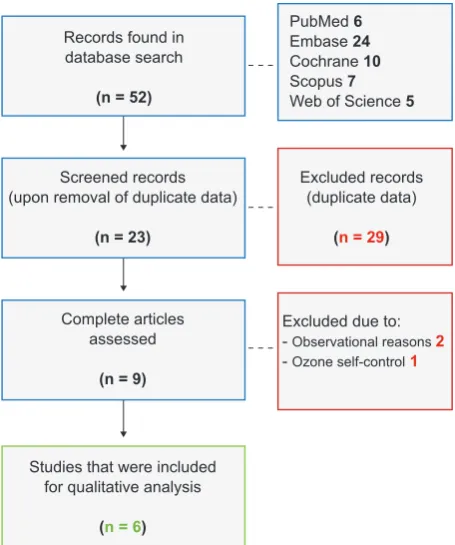
Selection study details are shown in a flow diagram (Fig. 1). The characteristics of the studies are shown in a de-scriptive table (Appendix 2: https://www.actamedicapor-tuguesa.com/revista/index.php/amp/article/view/10330/ Apendice_002.pdf). No quantitative analysis of data was carried out as studies were not sufficiently homogeneous. Mostly female patients were found, with different ages according to the study; however, mostly patients aged over 50 were included. Knee osteoarthritis was only described as idiopathic by three studies.15-17 The Kellgren-Lawrence
radiological grading system has been used for patient inclu-sion in all the studies and patients presenting with Kellgren-Lawrence grade II-III were included in four studies15-17,19 and
patients with Kellgren-Lawrence I-II severity in two
stud-ies.12,18 Patient’s previous therapy has been described in
one study,19 while patients previously on daily analgesics
were excluded from two studies12,18 and patients with no
response to analgesics over the past three months were included in two studies.16,17
ARTIGO ORIGINAL
predominant.
Different comparisons have been used, including with placebo,19 hyaluronic acid,15,16 platelet-rich plasma,15
ra-diofrequency,17 hypertonic dextrose,12 celecoxib +
glucosa-mine.18
The design of the study by Jesus et al. was particularly different from the remaining as a neutral comparison has been used, in addition to a concealment of allocation (par-ticipants and professionals).
Knee pain assessment was based on the VAS scoring in all the studies. The global WOMAC scoring was used in three studies12,15,19 although only two studies15,19 have
used the functional WOMAC in order to assess functional improvement. The Knee injury and Osteoarthritis Outcome Score (KOOS), which is also a functional evaluation instru-ment, was used in one study.16. The radiological progression
was not assessed by any of the studies. Different follow-up intervals were found among the different studies, ranging between six weeks18 and 12 months15. Short-term durability
of clinical outcomes (2-3 months upon the end of treatment)
was analysed by most studies.15,16,18,19 The heterogeneity
of the assessment intervals based on the VAS scoring is shown in Table 1.
Better outcomes when compared to the placebo group regarding knee pain reduction and improvement in joint function, similar outcomes when compared to the group of patients treated with hypertonic dextrose and with celecoxib + glucosamine and poorer outcomes when compared to the group of patients treated with radiofrequency, hyaluronic acid and platelet-rich plasma were found. In addition, ozone + hyaluronic acid combined therapy was successful in the short term.
As regards comparisons, the same dose and number of sessions as with the ozone therapy was found in the study with hypertonic dextrose, with similar outcomes. In the stud-ies involving the use of radiofrequency, hyaluronic acid and platelet-rich plasma, these were used in less number of sessions as with the ozone therapy and yet better outcomes were found.
Complications were only assessed by two studies17,19
and these were mild and particularly associated with the in-jection site. No reference by any study was made regarding the costs associated with the therapy.
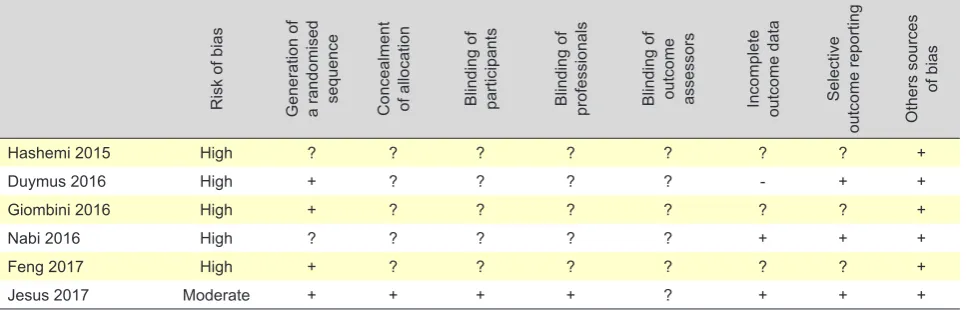
A summary of the assessment of the risk of bias of all the studies that were included in the analysis is shown in Table 2. Only one study was considered at moderate risk of bias,19 while the remaining were considered at high risk. 12,15-18 The rationale for the evaluation of each bias domain is
shown in Appendix 3 (Appendix 3: https://www.actamedica-portuguesa.com/revista/index.php/amp/article/view/10330/ Apendice_003.pdf).
DISCUSSION
This was a systematic literature review of six recently published controlled and randomised studies, showing an increasing interest in ozone therapy, already with a proved efficacy in other areas.12
The fact that predominantly female patients and patients aged over 50 were included in the studies is in line with the prevalence of osteoarthritis in general population.2-4
The small groups of patients (< 100) involved in most of the studies12,16-19 has removed any statistical power to results.
Patients with secondary osteoarthritis with an influence on final outcomes may have been included in studies that did not consider idiopathic osteoarthritis as an inclusion
Figure 1 – Study selection flow diagram Records found in
database search
(n = 52)
Screened records (upon removal of duplicate data)
(n = 23)
Complete articles assessed
(n = 9)
Studies that were included for qualitative analysis
(n = 6)
Excluded records (duplicate data)
(n = 29)
Excluded due to: - Observational reasons 2 - Ozone self-control1
PubMed 6
Embase 24
Cochrane 10
Scopus 7
Web of Science 5
Table 1 – VAS assessment VAS scoring
(baseline) 1 month 2 months 3 months 4 months 6 months 12 months
Hashemi 2015 x
Duymus 2016 x x x x
Giombini 2016 5 w x
Nabi 2016 4 M 1 w
Feng 2017 3 w / 6 w
Jesus 2017 x x x
ARTIGO ORIGINAL
criterion, making any outcome comparison even more diffi-cult. Patients with mild to moderate osteoarthritis according to the Kellgren-Lawrence radiological classification were included in all the studies, leaving patients with severe os-teoarthritis out of the analysis, with a positive influence on the results.
The lack of homogeneity regarding previous or con-comitant therapies was another limitation of the analysis. Some studies have also considered clinical non-response to a previous conservative management as an inclusion cri-terion, while other studies have excluded patients on daily analgesics.
Different therapy regimens (number of sessions, dose/ concentration and treatment duration) in ozone therapy and different comparisons have shown that no standard therapy exists. The study by Jesus et al. is worth mentioning due to the longest duration of therapy (eight weeks) and the study by Feng et al. in which the highest dose of ozone per intervention has been used. It is reasonable consider-ing that better and long-term outcomes would correspond to longer therapies with higher doses. The fact that it was also a combined treatment should be also taken into considera-tion. This approach is one of the most frequently used and allows for an easier intra-articular access.
As regards comparisons, the study by Jesus et al.
should be mentioned as the only study that was based on a neutral comparison with a sham procedure. This was the only double-blinded study considered at a moderate risk of bias, while the remaining studies were considered at high risk, therefore showing their quality.
The outcome comparison has been impaired by the wide variation in study design and the presence of comparisons between different dimensions, namely tablets (celecoxib + glucosamine) vs. intra-articular injections.
A significant reduction in knee pain and rapid onset functional improvement, durable for at least three months has been found with ozone therapy. Retreatment after six months has been recommended by most authors, as symp-toms may recur upon this period of time in a small percent-age of patients.20
Even though VAS is a validated instrument for the as-sessment of knee pain, which is a subjective parameter that
may become influenced by other factors, namely sensitive, emotional and cultural factors. The use of other scales, namely the WOMAC, is worth mentioning as it allows for the assessment of functionality apart from pain and stiffness, enhancing the quality of studies that used this instrument. The inhibition of the high rate of nitric oxide (responsible for apoptosis), inhibition of pro-inflammatory cytokines and improvement in revascularisation were the major mecha-nisms of action underlying ozone therapy.21 The study by
Calunga et al. has shown that oxidative stress (proved by spectrophotometry) and inflammation (proved by ultra-sound imaging) are reduced. The oxidative stress produces the destruction of the cartilage by direct collagen break-down and by activation of matrix metalloproteinase and, in addition, these are molecules of intracellular signalling am-plifying the inflammatory response.22 Therefore, the higher
efficacy of the combined therapy with ozone and hyaluronic acid that was found in the study by Giombini et al. may have been based on the synergy between both mechanisms of action.
Even though few studies have described adverse ef-fects, these are usually mild and short-term. However, it is worth mentioning that ozone has been used as a muta-genic agent in animal models and cases of de-regulation of the cell cycle related to superoxide radicals have been described.23 Therefore, the presence of severe adverse
ef-fects in the medium and long-term is still unclear.
CONCLUSION
Ozone therapy in patients with knee osteoarthritis has shown its efficacy in the short-term, when compared to pla-cebo and when combined with hyaluronic acid, even though no better outcomes were found when compared to the cur-rent treatments (according to VAS and/or WOMAC scoring). There are currently no convincing evidences in favour of a positive risk-benefit ratio of ozone therapy in patients with knee osteoarthritis. Therefore, the effect of ozone should be studied with controlled, randomised, double-blinded, comprehensive and homogeneous trials, using adequate comparisons and always ensuring the presence of patients with similar baseline clinical status in both groups. Homo-geneity regarding the outcomes is very relevant and should
Table 2 – Evaluation of the risk of bias of all the studies included in the analysis
Risk of bias Generation of a randomised sequence Concealment of allocation Blinding of participants Blinding of professionals Blinding of outcome assessors Incomplete outcome data Selective
outcome reporting Others sources
of bias
Hashemi 2015 High ? ? ? ? ? ? ? +
Duymus 2016 High + ? ? ? ? - + +
Giombini 2016 High + ? ? ? ? ? ? +
Nabi 2016 High ? ? ? ? ? + + +
Feng 2017 High + ? ? ? ? ? ? +
ARTIGO ORIGINAL be ensured with the use of validated scales. Despite the high subjectivity of the currently validated scales, the use of
VAS scoring in knee pain and the WOMAC scale should be ensured. The structural damage and progression of knee osteoarthritis with X-ray or MRI imaging is also crucial, in addition to patient follow-up in the short as in the medium/ long-term as well as the assessment of adverse effects and costs.
HUMAN AND ANIMAL PROTECTION
The authors declare that the followed procedures were according to regulations established by the Ethics and Clini-cal Research Committee and according to the Helsinki Dec-laration of the World Medical Association.
DATA CONFIDENTIALITY
The authors declare that they have followed the proto-cols of their work centre on the publication of patient data. CONFLICTS OF INTEREST
The authors declare that there were no conflicts of inter-est in writing this manuscript.
FINANCIAL SUPPORT
The authors declare that there was no financial support in writing this manuscript.
REFERENCES
1. Hawamdeh ZM, Al-Ajlouni JM. The clinical pattern of knee osteoarthritis in Jordan: a hospital based study. Int J Med Sci. 2013;10:790–5. 2. Gupta S, Hawker GA, Laporte A, Croxford R, Coyte PC. The economic
burden of disabling hip and knee osteoarthritis (OA) from the perspective of individuals living with this condition. Rheumatology. 2005;44:1531–7. 3. Li Y, Wei X, Zhou J, Wei L. The age-related changes in cartilage and
osteoarthritis. Biomed Res Int. 2013:916530.
4. Samson DJ, Grant MD, Ratko TA, Bonnell CJ, Ziegler KM, Aronson N. Treatment of primary and secondary osteoarthritis of the knee. Evid Rep Technol Assess. 2007:1–157.
5. Peat G, McCarney R, Croft P. Knee pain and osteoarthritis in older adults: a review of community burden and current use of primary health care. Ann Rheum Dis. 2001;60:91–7.
6. Felson DT. The sources of pain in knee osteoarthritis. Curr Opin Rheumatol. 2005;17:624–8.
7. Shengelia R, Parker SJ, Ballin M, George T, Reid MC. Complementary therapies for osteoarthritis: are they effective? Pain Manag Nurs. 2013;14:e274–88.
8. Buckwalter JA, Stanish WD, Rosier RN, Schenck RJ, Dennis DA, Coutts RD. The increasing need for nonoperative treatment of patients with osteoarthritis. Clin Orthop Relat Res. 2001:36-45.
9. Mishra SK, Pramanik R, Das P, Das PP, Palit AK, Roy J, et al. Role of intra-articular ozone in osteo-arthritis of knee for functional and symptomatic improvement. Ind J Phys Med Rehabilit. 2011;22:65-9. 10. Maslennikov OV, Kontorshchikov CN, Gribkova IA. Ozone therapy in
practice. Health Manual. Nizhny Novgorod Russia. 2008:6-12. 11. Elvis A, Ekta J. Ozone therapy: a clinical review. J Nat Sci Biol Med.
2011;2:66-70.
12. Hashemi M, Jalili P, Mennati S, Koosha A, Rohanifar R, Madadi F, et al. The effects of prolotherapy with hypertonic dextrose versus prolozone (intraarticular ozone) in patients with knee osteoarthritis. Anesth Pain Med. 2015;5:e27585.
13. Higgins JT, Green S. Cochrane handbook for systematic reviews of interventions version 5.1.0 [updated March 2011]: The Cochrane Collaboration; 2011.
14. Laudy AB, Bakker EW, Rekers M, Moen MH. Efficacy of platelet-rich plasma injections in osteoarthritis of the knee: a systematic review and metaanalysis. Br J Sports Med. 2015;49:657–72.
15. Duymus T, Mutlu S, Dernek B, Komur B, Aydogmus S, Kesiktas F. Choice of intra-articular injection in treatment of knee osteoarthritis: platelet-rich plasma, hyaluronic acid or ozone options. Knee Surg Sports Traumatol Arthrosc. 2017;25:485-92.
16. Giombini A, Menotti F, Di Cesare A, Giovannangeli F, Rizzo M, Moffa F, et al. Comparison between intrarticular injection of hyaluronic acid, oxygen ozone, and the combination of both in the treatment of knee osteoarthrosis. J Biol Regul Homeost Agents. 2016;30:621-5. 17. Nabi NB, Sediginegad A, Haghighi M, Mohamad Zadeh A, Biazar G,
Khoshrang H. A comparison of two treatment methods of radiofrequency & intra-peri articular ozone injection in the improvement of knee osteoarthritis. Pain practice. Int J Med Res Health Sci. 2016,5:539-46. 18. Feng X, Beiping L. Therapeutic efficacy of ozone injection into the knee
for the osteoarthritis patient along with oral celecoxib and glucosamine. J Clin Diagn Res. 2017;11:UC01-3.
19. Lopes de Jesus CC, Dos Santos FC, de Jesus LM, Monteiro I, Sant’Ana MSSC, Trevisani VF. Comparison between intra-articular ozone and placebo in the treatment of knee osteoarthritis: a randomized, double-blinded, placebo-controlled study. PLoS One. 2017;12:e0179185. 20. Bernal DS, Rovira-Duplaa G, Monerris-Tabasco M, Gonzalez-Palomares
M, Mazo-Sanchez V. Tratamiento de la gonalgia por gonartrosis con ozono intraarticular. Rev Soc Esp Dolor. 2013;20:107-12.
21. Milanes JR, Acosta W, Trinchet E. La ozonoterapia/resultados del tratamiento en pacientes con artrosis degenerativa sintomática de rodilla. Revista Mexicana de Algologia; 2009;6:18-23.
22. Calunga JL, Menéndez S, León R, Chang S, Guanche D, Balbin A, et al. Application of ozone therapy in patients with knee osteoarthritis. Ozone: Science and Engineering. 2012. 34:469-475.