ISSN-L: 2501 - 1235 Available on-line at: www.oapub.org/edu
doi: 10.5281/zenodo.3342021 Volume 5 │ Issue 10 │ 2019
MANIFESTATIONS OF EXPLOSIVE POWER:
DIFFERENCES IN THE LEG SPRINGS BETWEEN
FOOTBALLERS OF THE DIFFERENT COMPETITIVE LEVEL
Marko Joksimović1,
Ratko Pavlović1i,
Marko Pantović2,
Nebahat Eler3,
Elvira Nikšić4,
Srđan Bijelić1
1Faculty of Physical Education and Sport,
University of East Sarajevo, Bosnia and Herzegovina
2PhD student,
Faculty of Sport and Physical Education, University of Belgrade,
Serbia
3Physical Education and Sports,
Bulent Ecevit University, Zonguldak, Turkey
4Faculty of Education Science,
University of Sarajevo, Bosnia and Herzegovina
Abstract:
Explosive power is the dominant motoric ability in most sports, regardless of the age, gender and level of the competition, and as such participates in the equations of the specification. Vertical jump (Squat Jump) is a test for estimating the explosiveness of caudal extremities in a number of sports, most often in football, athletics, basketball, volleyball. The study included a sample of 39 respondents (19 cadets, ages 15 ± 0.5 years and 20 juniors, age 17 ± 0.5 years). The aim of this study was to determine the differences in the strength of the leg springs between players of junior and cadet ages. For the estimation of explosive power, the Squat Jump was measured using the Chrono Jump contact mat tensiometric platform (Bosco System, Spain). The analysis of the T-test showed statistically significant differences at the level of p <0.000 in favor of boys of junior age.
Keywords: power, explosiveness, caudal extremities, collective sports
1. Introduction
Football is one of the most widespread and most complex sports in the world, where players need technical, tactical and physical skills for success (Joksimović, et. al., 2009, Mirkov, et. al., 2010) and belongs to a group of complex polystructural acyclic activities (Erceg, Rađo, & Sporiš, 2018) with certain time periods. It is defined as a team sport where players must achieve high performance using primary motor and functional skills, as well as technical and tactical skills (Impellizzeri, et. al., 2004; Krespi, Sporiš, & Mandić-Jeleska, 2018). In the football game dominate intermittent activities of different aerobic and anaerobic energy sources. It is often the case that during the game the intensity of the players' activities ranges from a light walk to a sprint, a maximum speed, with the speed of the player approaching the speed of the sprinter (C. Ronaldo). Some authors evaluated factors that greatly contribute to the successful realization of the football game (Wisløff, et. al., 1998; Svensson, & Durst, 2005), and realized football-specific research showed a strong relationship between anthropometric and physical parameters with the success of the football game. It has been proven that there is a correlation between the physical composition of athletes and their functional characteristics, and that the composition of the bodies and variables that define a certain somatotype influence the achievement of good motor-functional parameters (Ostojić, 2002).
In order for to maintain its abilities during the football game, at the required level, a player must have a strong aerobic-anaerobic component that combines strength, speed and power (Gerodimos, Manou, Ioakimidis et. al., 2006). During the game, players often perform activities of great level, sometimes maximum, of intensity (Stølen, et. al., 2005; Swinnen, 2016) characterized by specific frequent movements of caudal extremities (Kocić, Joksimović, & Stevanović, 2016), which are greatly affected by the strength of the leg muscles (Bangsbo, Mohr, & Krustrup, 2006; Nikolaidis, 2014). These are usually short sprints, moment of acceleration and deceleration, ball kicks, spins and jumps, which can be performed over 500 times during the game (Stølen, et. al., 2005). All of this requires a large dose of speed, explosiveness, agility, and so on. For the assessment of explosiveness, a special group of muscle strength tests consist of tests of individual or serial vertical jumps, the measurement and interpretation of which is very widespread in contemporary sports science and practical work (Lara, Abián, Alegre et al., 2006; Ostojić, Stojanović, & Ahmetović, 2010).
Marković, Dizdar, Jukić, et. al., 2004). Explosive power is the decisive motor skills in most sports (Popović, Radanović, Stupar, et. al., 2010; Joksimović et. al., 2018), and defines it as an ability to maximize the acceleration of one's own body, object or partner in activities of throwing, jumping, kicking and sprinting (Milanović, Bašić, & Milanović, 2005; Jezdimirović, et. al., 2013). It is essential for the players to get the necessary height of the jump during a duel game (Knuttgen, & Kraemer, 1987; Paoli, Bianco, Palma, et. al., 2012). Explosive power in the form of a vertical jump is considered extremely functional for optimal performance in football and is taken into account when testing capabilities and talent selection (Stølen, 2005; Castagna, & Castellini, 2013), as well as the identification of bilateral differences (Sannicandro, et. al., 2012; Menzel, et. al., 2013). In this regard, the aim of this research is to determine the differences in the power of the extensors of the caudal extremities of a footballer of different chronological ages.
2. Methods
The survey included a sample of 39 FK Kiker players from Kraljevo divided into two sub-samples. The first sub-sample consists of 20 junior players (17 ± 0.5 years old), and the second sub-sample consists of 19 cadets (15 ± 0.5 years). All footballers volunteered to measure and did not suffer any injury of the locomotor apparatus previously, which would eventually affect the final outcome of the measuring results. For the estimation of explosive power the Squat Jump variable on the tensiometric platform with the Chrono Jump contact mat (Bosco System, Spain) was applied. Measurement was realized in FK Kiker Ballroom in Kraljevo, February 22, 2018 year. The basic central and dispersion parameters were calculated. A T-test module for small independent samples was used to determine the differences. Data was processed with the statistical package for personal computers SPSS Statistic 20.0.
3. Results
Таble 1: Basic statistical parameters of the football players
Variable Age Mean Min. Max. Range Std. Dev. Skew. Kurt.
Squat јump
Cadets 26.13 17.3 34.3 17.0 4.7047 -.153 -.410
Juniors 32.03 25.8 45.0 19.2 4.7792 .962 1.449
Table 2: Differences in the strength of the leg springs of the football players of different ages
Variable Age Mean ± Std.Dev. t-value p
Squat Jump
Cadets
26.13±4.70
-3.882 0.000* Juniors 32.03±4.77
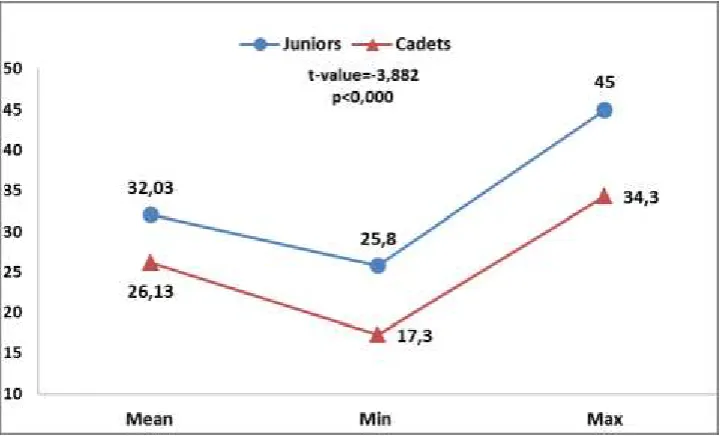
The analysis of the dispersion parameters showed that there are no significant deviations from the normal distribution in junior players, whereas in the cadets the distribution of frequencies with statistically negative asymmetry was formed. In terms of homogeneity, there is a slight leptokurtic curve in junior players, while the platikurtic curve is formed in cadets. Table 2 shows the results of the T-test for players of different age categories. By analyzing the T-test (t = -3.882) it is evident that there are statistically significant differences in explosive power in favor of junior (Squat Jump, p <0.000).
Figure 1: Distribution of the results (Squat Jump)
4. Discussion
and senior soccer players, elite and non-elite, professional and amateur players, higher ranking and lower ranking competitions, confirmed that higher level players have greater speed than lower. This variation can be attributed to the different training levels and requirements of the competition for each category, the time and maturity of the players, and the ability of the body to accept higher loads and strength of training in caudal extremities. On the basis of the facts presented in this research, the aim of the research is to determine the differences in the force of the caudal extremes in the soccer players of different ages using the Squat Jump motor test. The analysis of the results concluded that there are significant differences in favor of junior football players (t = -3.882; r <0.001). Despite the popularity of football in adolescence, several studies have been carried out on the physical properties and motor skills of these athletes in a lab environment, especially with regard to the strength of the leg muscles (Nikolaidis, 2014).
The vertical test jump is one of the most common estimation methods in sports games and sports in general (Linthorne, 2001). This type of jump is in high correlation with the strength of the leg springs. Power, and especially the ability of a vertical jump as an indicator of the strength of the caudal extremities, is a very important parameter for the performance of the football players. Some studies have shown that the force of a football player, measured by a vertical jump, is on average between 38 and 45 cm (Cometi, et. al., 2001; Gil, et. al., 2007). The players of our research, juniors, had larger numerical parameters of explosive power (average 32.03 cm), than cadet age players (an average of 26.13 cm). This study also showed that after the end of puberty young footballers achieve better results in explosive tests. This is particularly manifested in explosive force, a type of vertical jumping ability, which is in line with the results of previous research (Garganta, Maia, Silva, et. al., 2003; Kukolj, Koprivica, & Ugarković, 2002; Gerodimos, et. al., 2006; Veljović, & Stojanović, 2009). The results are obtained from the results of the Asian authors when it comes to the vertical jumping ability of the younger age group. In relation to European and African football players, Asian football players have less explosive power, a type of vertical jumping. This was confirmed by Wong, & Wong, (2009) on a relatively small sample of 16 players, an age of 16.2 ± 0.6 years. However, this might not be generalized to the general population, although the ‘’yellow race’’ in terms of morphological features is inferior to the European, while motor skills did not retain that qualification. Reilly, et al., (2000) state that the differentiation of performance in a vertical jump can be explained by many reasons, of which the most important are power, speed and endurance.
and Petrović et. al., (2012) state that the most important factors of this kind of movement are the muscular and nervous system. Anatomically speaking, in the muscular system, the relationship of fast and slow muscle fibers is important, which is genetically predicted, as well as the elasticity of the muscles and tendons. Research have suggested that children before puberty have a higher percentage of type I muscle fibers (Brownstein, 2015) whose contraction rate is 0.01-0.06 seconds (Rankovic, et. al., 2006). Oertel (1988) conducted a study in which he analyzed the morphometric analysis of skeletal muscle fibers in children, adolescents and adults. The proportion of muscle fibers of type I in children aged 6-10 years was 54%, 10-15 years of age 47%, 15-20 years of age 42%, which clearly defines the inverse relationship of male-fiber type aging with age.
respected. Only with consistent respect for established rules a good result can be expected in any sport branch.
5. Conclusion
The research was carried out on a sample of 39 FC Kiker players from Kraljevo with the aim to determine the differences in the strength of the leg springs between the junior and cadet age players. The analysis of the T-test showed that there are statistically significant differences in favor of junior footballers, since the boys after achieving puberty have better results in explosive power; the explosive force is approaching its maximum peak of manifestation and also their CNS works better. This research provides relevant information for the profession and science, football trainers, to be aware of the biological and chronological laws to be considered when planning training for explosive power with athletes of different ages, training and competitive levels.
References
Aksović, N., & Berić, D. (2017). Razlike u eksplozivnoj snazi između košarkaša različitog uzrasta.[In Serbian] Fizička Kultura. 71(1), 36-42.
Bangsbo, J., Mohr, M., & Krustrup, P. (2006). Physical and metabolic demands of training and match-play in the elite football player. J Sports Sci. 24(7), 665-74. Berthoin, S., Dupont, G., Mary, P., & Gerbeaux, M. (2001). Predicting sprint kinematic
parameters from anaerobic field tests in physical education students. Journal of Strength and Conditioning Research. 15(1), 75–80.
Bosco, C., & Viitasalo, J. T. (1982). Potentiation of myoelectrical activity of human
muscles in vertical jumps. Electromyogr. Clin. Neurophysiol. 22, 549-562.
Brownstein, C. (2015). An investigation into a self-regulated approach to repeated sprint exercise in elite youth association football players.(MSc thesis). Heriot-Watt University, School of Life Sciences. (str. 21).
Caldwell, B. P., & Peters, D. M. (2009). Seasonal variation in physiological fitness of a
semiprofessional soccer team. J Strength Cond Res. 23(5), 1370-7.
Castagna, C., & Castellini, E. (2013). Vertical Jump Performance in Italian Male and
Female National Team Soccer Players. J Strength Cond Res. 27(4), 1156-1161.
Chelly, M. S., Fathloun, M., Cherif, N., Amar, M. B., Tabka, Z., & Van Praagh, E. (2009). Effects of a back squat training program on leg power, jump, and sprint
performances in junior soccer players. J Strength Cond Res. 23(8), 2241–2249.
Chlif, M., Jullien, H., Temfemo, A., Mezouk, A., Manouvrier, C., & Choquet, D. (2010). Suivi physique et physiologique de footballeurs semi-professionnels: versun
Čoh, M. (2004). Metodika i dijagnostika razvoja skočnosti u kondicijskoj pripremi
sportaša. U: Zbornik radova Međunarodnog znanstveno-stručnog skupa “Kondicijska
priprema sportaša”,Zagreb: Kineziološki fakultet, (str. 104-121).
Cometti, G., Maffiuletti, N. A., Pousson, M., Chatard, J. C., & Maffulli, N. (2001). Isokinetic strength and anaerobic power of elite, subelite and amateur French soccer players. Int J Sports Med. 22, 45-51.
Cometti, G., Maffiuletti, N. A., & Pousson, M. (2001). Field and laboratory testing in young elite soccer players. British Journal of Sports Medicine. 38 (2), 191-198.
Diallo, O., Dore, E., & Duche, P. (2001). Effects of plyometric training followed by reduced training programme on physical performance in prepubescent soccer players. Journal of Sports Medicine and Physical Fitness. 41 (3), 342-348.
Erceg, M., Rađo, A., & Sporiš, G. (2018). Razvoj Nogometaša. Antropološki Status
Nogometaša Tijekom Razvojnih Faza. [In Croatian]. (p. 10). Zagreb. Vlastita naklada autora.
Faude, O., Koch, T., & Meyer, T. (2012). Straight sprinting is the most frequent action in goal situations in professional football. Journal of Sports Sciences. 30(7), 625-631. Funato, K., Kanehisa, H., & Fukunaga, T. (2000). Differences in muscle cross-sectional
area and strength between elite senior and college Olympic weight lifters. J Sports
Med Phys Fitness. 40, 312-318.
Garganta, J., Maia, J., Silva, R., & Natal, A. (2003). A comparative study of explosive leg strength in elite and not-elite young soccer players. In: Clarys, J., Reilly, T, & Stible, A. Science and Football II, 304.306.
Gerodimos, V., Manou, V., Ioakimidis, P., Perkos, S., & Kellis, S. (2006). Vertical
jumping ability in elite young soccer players. Journal of Human Movement Studies.
51, 089-101.
Gil, S., Gil, J., & Ruiz, F. (2007). Physiological and anthropometric characteristics of young soccer players according to their playing positions: relevance for selection process. J Strength Cond Res. 21, 438–45.
Haff, G. G., & Triplett, N. T. (2016). Essentials of Strength Training and Conditioning.
(Fourth Edition). NSCA. Human Kinetics.
Helgerud, J., Engen, L. C., Wislöff, U., & Hoff, J. (2001). Aerobic Endurance Training
Improves Soccer Performance. Medicine and Science in Sports and Exercise. 33,
1925-1931.
Ilić, D., & Mrdaković, V. (2009). Neuromehaničke osnove pokreta. [In Serbian]Beograd, SIA. Impellizzeri, F. M., Rampinini, E., Coutts, A. J., Sassi, A., & Marcora, S. M. (2004). Use of
RPE-based training load in soccer. Medicine & Science in Sports & Exercise. 36(6), 1042-1047.
Jezdimirović, M., Joksimović, A., Stanković, R., & Bubanj, S. (2013). Differences in the
Vertical jump in Soccer players According to Their Position on the Team. Physical
Joksimović, A., Stanković, D., Ilić, D., Joksimović, I., & Jerkan, M. (2009). Hematological
profile of Serbian youth national soccer teams. Journal of Human Kinetics. 22 (1),
51-59.
Joksimović, M., Németh, Z., Skrypchenko, I., Trivun, M., & Pantović, M. (2018). Gender Differences in Development of Explosive Power and Rapidity in Schoolchildren
Aged 14-15 Years Old. The Journal of International Anatolia Sport Science. 3 (2),
294-304.
Joksimović, А. (2018). Some physical fitness indicators of young academy football
players according to playing positions in United Arab Emirates. Research in
Physical Education, Sport and Health. 7 (1), 23-30.
Knuttgen, H. G., & Kraemer, W. J. (1987). Terminology and measurement in exercise performance. J AppI Sport Sci Res 1, 1–10.
Kocić, M., Joksimović, A., & Stevanović, M. (2016). Differences in Explosive Strenght of Legs Between Football and Futsal Players. Physical Education and Sport. Vol. 14, No. 2, 269-178.
Krespi, M., Sporiš, G., & Mandić-Jelaska, P. (2018). Effects of Two Different Taperin Protocols on Fitness and Body Composition in Young Soccer Players: Positiona Differences. Acta Kinesiologica. 12 (1), 62-71.
Kukolj, M., Koprivica, V., & Ugarković, D. (2002). Modelne karakteristike motoričkih sposobnosti fudbalera (reprezentativnih takmičara) uzrasta 15 – 18 godina i njihova međusobna povezanost. Godišnjak 10,p. 94 – 104. [In Serbian]. Beograd: Fakultet sporta i fizičkog vaspitanja.
Lago-Penas, C., Casais, L., Dellal, A., Rey, E., & Dominguez, E. (2011). Anthropometric and physiological characteristics of young soccer players according to their
playing positions: relevance for competition success. J Strength Cond Res. 25(12),
3358-67.
Lara, A. J., Abián, J., Alegre, L. M., Jiménez, L., & Aguado, X. (2006). Assessment of power output in jump tests for applicants to a sports sciences degree. J Sports Med Phys Fitness. 46, 419-24.
Lexell, J., Sjöström, M., Nordlund, A. S., & Taylor, C. C. (1992). Growth and development of human muscle: a quantitative morphological study of whole
vastus lateralis from childhood to adult age. Muscle Nerve. 15, 404-409.
Linthorne, N. (2001). Analysis of standing vertical jumps using a force platform.
American Journal of Physics. 69(11), 1198-1204.
Lloyd, R. S., Oliver, J. L., Faigenbaum, A. D., Myer, G. D., & De Ste Croix, M. (2014). Chronological age versus biological maturation: Implications for exercise
programming in youth. J Strength Cond Res. 28, 1454-1464.
Marković, G., Dizdar, D., Jukić, I., & Cardinale, M. (2004). Reliability and Factorial
Validiti of Squat and Countermovement Jump Tests. J Strength Cond Res. 18(3),
551-555.
isokinetic and vertical jump tests in soccer players. Journal of Strength and Conditioning Research. 27(5), 1370-1377.
Milanović, L., Bašić, M., & Milanović, M. (2005). Razvoj brzinsko-eksplozivnih svojstava u tenisu (Development of the speed-explosive characteristics in tennis. In Croatian]. 14. ljetna škola kineziologa, Rovinj.
Mirkov, M. D., Kukolj, M., Ugarković, D., Koprivica, J. V., & Jarić, S. (2010). Development of Anthropometric and Physical Performance Profiles of Young
Elite Male Soccer Players: A Longitudinal Study. J Strength Cond Res. 24(10),
2677–2682.
Nikolaidis, P. T. (2014) Age-related Differences in Countermovement Vertical Jump in Soccer Players 8-31 Years Old: the Role of Fat-free Mass. American Journal of Sports Science and Medicine. 2 (2), 60-64.
Oertel, G. (1988). Morphometric analysis of normal skeletal muscles in infancy,
childhood and adolescence. J Neurol Sci. 88, 303-313.
Ostojić, M. S., Stojanović, M., & Ahmetović, Z. (2010). Analiza vertikalne skočnosti u
testovima snage i anaerobne sposobnosti. [In Serbian]. Medicinski pregled. 63(5-6),
371-375.
Ostojic, S.M. (2002) Anthropometric, physiological and biochemical characteristics of elite Yugoslav soccer players. Doctoral thesis, Medical Faculty, University of Belgrade, Belgrade. 1- 182.
Paoli, A., Bianco, A., Palma, A., & Marcolin, G. (2012). Training the Vertical Jump to Head the ball in Soccer. Strength and conditioning journal. 34(3), 80-85.
Petrović, M., Mihajlović, I., Smajić, M., & Đinić, I. (2012). Differences in the Indicators of
Explosive Power of Legs of Athletes in Different Sports Activities. Acta
Kinesiologica. 6(1), 66-69.
Popović, B., Radanović, D., Stupar, D. & Jezdimirović, T. (2010). Efekti programiranog vježbanja na razvoj brzine i eksplozivne snage u djevojčica predškolske dobi. 8.
godišnja međunarodna konferencija Kondicijska Priprema Sportaša. [In Serbian].
Zagreb.
Ranković, G., Ranković, J., Ranković, B., Stević, L., & Damnjanović, N. (2006). Fiziologija sa Fiziologijom Sporta. [In Serbian]. Niš-Leposavić, SIA.
Reilly, T., Bangsbo, J., & Franks, A. (2000). Anthropometric and physiological predispositions for elite soccer. J. Sports Sci. 18, 669-683.
Sannicandro, I., Rosa, R.A., De Pascalis, S., & Piccinno, A. (2012). The determination of functional asymmetries in the lower limbs of young soccer players using the countermovement jump. The lower limbs asymmetry of young soccer players.
Science and Sports. 27(6), 375-7.
Stølen, T., Chamari, K., Castagna, C., & Wisløff, U. (2005). Physiology of soccer: An
update. Sports Med. 35, 501–536.
Svensson, M. & Drust, B. (2005). Testing soccer players. Journal of Sport Science. 23, 601-618.
Van Praagh, E., & Dore, E. (2002). Short-term muscle power during growth and
maturation. Sports Med. 32, 701–728.
Veljović, D., & Stojanović, M. (2013). Morfo-funkcionalne karakteristike mladih fudbalera. [In Serbian]. TIMS Acta. 3, 35-41.
Vescovi, J., Ruph, R., Brown, T. D., & Marques, C. M. (2011). Physical Performance characteristics of high-level female soccer players 12-21 years of age. Scan. J. of Med. and Sci. in Sports. 21(5), 670-670.
Williams, C. A., Oliver, J. L., & Faulkner, J. (2010). Seasonal monitoring of strength and
jump performance in a soccer youth academy. International Journal of Sports
Physiology and Performance. 6, 264-275.
Wisloff, U., Castagna, C., Helgerud, J., Jones, R., & Hoff, J. (2004). Strong correlation of maximal squat strength with sprint performance and vertical jump height in elite soccer players. Br J Sports Med. 38(3),285-8.
Wisløff, U., Helgerud, J., & Hoff, J. (1998). Strength and Endurance of Elite Soccer Players. Medicine and science in sports and exercise. 30, 462 – 467.
Wong, D. P., & Wong, S. H. S. (2009). Physiological profile of Asian elite youth soccer players. Journal of Strength and Conditioning Research. 23, 1383–1390.
Creative Commons licensing terms