ISSN-L: 2501 - 1235 Available on-line at: www.oapub.org/edu
doi: 10.5281/zenodo.1435942 Volume 4 │ Issue 11 │ 2018
INVESTIGATING HOW PARENTS, WHO GUIDE THEIR
PRESCHOOL CHILDREN TOWARDS SPORTS,
PERCEIVE SPORTS ACTIVITIES
Erol, S.1i, Arabacı, R.1,
Erol, F.2, Doğan, M.1,
Acar, A.1, Gürak, N.1,Vardar, T1. 1Uludag University, Faculty of Sport Sciences,
Bursa, Turkey 2Zekai Gümüşdiş Secondary School,
Bursa, Turkey
Abstract:
Objectives: The aim of this study was to investigate parents’ expectations about general
sport activities for their pre-school children. It is well documented that the awareness of sports knowledge of the parents are essential for the development of healthy life and acquiring a social dimension with a growth of healthy generations. Method: We administrated the ‘’Parents' Expectations of Their Children Questionnaire’’ developed by Keskin (2006). The questionnaire was a Likert type scale from ‘’totally agree’’ to ‘’totally disagree’’ and validity and reliability studies were reported by Keskin as Cronbach’s alpha was 0,86. A total of 125 participants (male; N = 39, Mage=35, 24 ± 5,48 ,
female; N = 86 and Mage=37,92 ± 6,65) were voluntarily participated from 10 different
kinder gardens in Bursa province. The evaluation of the data was analysed with the Chi Square Test. Result: Our results revealed a statistical differences (p < .05) according to the sex groups of parents ‘’I believe my child will gain good eating habits by getting involved with sports activities’’ and age groups of parents; ‘’I believe by getting involved with sport activities, my child will stay away from psychological stress’’. Conclusion: According to parents’ belief and their expectations, attending sports activities for children provides physical, cognitive and social development for them. Developing countries (as well as developed ones) that are aware of the role of the parents on development of human being via sport and exercise activities should take into account their expectations especially in terms of sports policies.
Keywords: pre-school, mother, father, sports
1. Introduction
All communities desire to ensure a healthy growth and development process for new generations, and launch endeavours to this end. A healthy growth and development process for children is linked to the quality of the living conditions offered to them besides their genetic attributes. Environmental factors such as the geographical conditions of the home country, socio-economic and cultural characteristics of the family, social traditions and customs, and familial living conditions may influence the pace and level of the child’s growth and development. The preschool period is a key process involving critical terms during which the child must get equipped with essential gains in order to be a healthy individual. In this period, major advancements in terms of cognitive, social, emotional and physical development requires the provision of rich stimulants to the child (Mülazimoğlu, 2006).
The involvement of sport in social life is getting bigger day by day (Alkurt, 2012). A large majority of people around the world are directly or indirectly interested in sports. By doing physical exercise, people who aim physical, spiritual, mental and social achievement in all parts of the life strive to promote these functions by one step further. Making a habit of doing physical exercise is directly linked with time and possibilities. Acquisition and permanence of this habit can be achieved by getting familiar with and doing sports, starting from early childhood, properly (Muratli S., Şahin G., Kalyoncu O. 2005).
The preschool educational curriculum in Turkey is formulated to support the healthy development of children at the 0-72 months age group in cognitive, affective-social and psychometric terms at both the home and institutional environment. The educational institutions serving to the 0-36 months age group, 37-60 months age group, and 61-72 months age group are called ‚baby farm‛, ‚kindergarten‛ and ‚nursery school‛ respectively, and the programs of these institutions are termed accordingly. Children in nursery schools exhibit developmental deficits and learning difficulties in different areas. Especially distinct familial structures and environmental conditions affect the emergence of differences in children's learning. This requires a good understanding of nursery students and formulating programs that meet their needs. Because, the 0-72 months age group is a critical and unique period for individual development. Blok argues that 60-70% of learning takes place, and Freud argues that the individual characteristics are laid during this period (Dursun, M. Z. 2003).
Skills and habits to be built into the child through guidance in early ages are capable of reshaping the child’s subsequent physical, mental, social and emotional life. By guiding the child towards sports, the child acquires knowledge more effectively and permanently by touching, hearing, feeling and sharing, thus by utilizing its sensory organs extensively.
and responsible for the child's education, care as well as housework while man works outside, earning a living for the family, and is independent, cold-blooded and brave. However, as a result of changing conditions of life, gender roles and stereotypes have gone beyond delimited roles of men and women, and inverted the assumption that father-child relationship has an inferior impact on the child’s development. The belief that roles within the family should not be assigned merely to mother, but father has to assume responsibilities at least as much as mother does, particularly as far as child growing and chores are concerned, is getting widespread (Gültekin, G. Türkoğlu, D., 2013). Among many of its benefits, the family’s contribution in terms of ‚guiding towards sports‛ has been coming into prominence recently. A balanced, well-organized and a peaceful family fostering healthy communication is a precious climate for the child in its sports education and individual development.
In order to attain a high level of efficiency and achievement in a sports branch, the inherited and acquired skills and predisposition of the individual must fit the specific sports branch. Therefore, guiding towards sports, talent selection and development is a combined critical process that is decisive in sportive efficiency. The earlier this process is launched, the higher the accuracy will be (Dündar, 2003).
Parents’ guide children towards different activities, expecting to promote their health, foster their self-management skills, improve their sense of responsibility and urge them to act autonomously in life. Sports organized in parallel to parents’ perspectives are anticipated to withdraw children from unsafe streets and provide them with a safer environment, instill social values in them, develop their character through a joyful activity and put them in good shape, hence yielding health, mental and social gains. However, the socio-economic level, lifestyle and religious belief of families play an effective role in determining the activities the child will join, and in heightening the expectations. Especially in competitive sports, families expect their children to get fully socialized and become successful. In organized sports, despite children perform individual actions that they cherish, parents rather focus on the game result and quality of the performance. If the child fails in sports, parents believe that they have responsibility in the failure, and if the child does well, parents believe that their expectations are satisfied. If the child exhibits a brilliant performance, parents sense a superior level of self-esteem, believing that others should consult them, and further feel that they deserve a special attention. In organized sports, children act seriously in the game. Children are willing to win though they are not obsessed with winning. Those who have the ambition are usually the most successful members of the team and are highly skilled. Although the children have other aims, the main motive for participation is to have fun and have a good time (Keskin, 2006).
2. Method
Bursa during the 2017-2018 school year. Study sample; 125 parents, randomly selected from among the parents of preschool children who do sports and who are attending 10 predetermined public kindergartens in the Nilüfer district of Bursa during the 2017-2018 school term, have voluntarily evaluated the questionnaire developed by Keskin in 2006.
In evaluating the questionnaires, frequency, percentage (%) distribution and chi-square (x2) analysis were carried out in the SPSS 11.00 package software, and the significance level was set as p <0.05.
3. Results
Table 1: Education level of parents who participated in this study
Educational Background Frequency Percent
Primary School 31 24.8
Secondary School 11 8.8
High School 38 30.4
Associate Degree 9 7.2
Bachelor’s Degree 18 14.4
Postgraduate Degree 18 14.4
Total 125 100.0
Table 1 reveals that most of the parents participating in the study are high school graduates (30.4%).
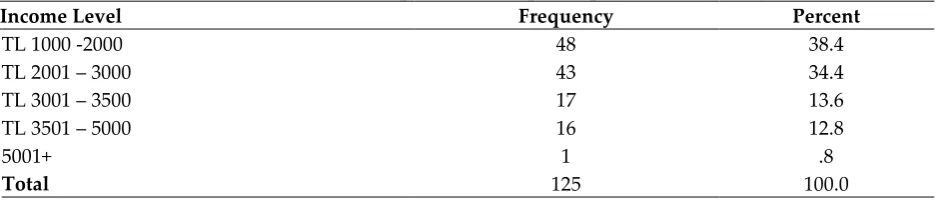
Table 2: Income level of parents who participated in this study
Income Level Frequency Percent
TL 1000 -2000 48 38.4
TL 2001 – 3000 43 34.4
TL 3001 – 3500 17 13.6
TL 3501 – 5000 16 12.8
5001+ 1 .8
Total 125 100.0
Table 2 shows that most of the parents participating in the study have an income level of TL 1000-2000 (38.4%). In evaluating the questionnaires, frequency, percentage (%) distribution and chi-square (x2) analysis were carried out in the SPSS 11.01 package software, and the significance level was set as p <0.05.
Table 3: Opinions of Parents by Child Gender,
‚I Believe Sports Activities Would Yield a Sufficient and Balanced Dietary Habits in My Child‛ Strongly agree Agree No idea Slightly agree Absolutely disagree Total
16 14 6 2 1 39
Male 41.0% 35.9% 15.4% 5.1% 2.6% 100.0%
Female 22 30 17 8 9 86
In Table 3, there is a statistically significant difference at a level of 0.05 between the age groups of parents (p<0.05).
Table 4: Opinions of Parents by Child Gender, ‚I Believe Sports Activities, Would Keep My Child Away From Smoking, Alcohol and Other Harmful Habits‛
Strongly agree Agree No idea Slightly agree Absolutely disagree Total
21 17 1 0 0 39
Male 53.8% 43.6% 2.6% 0.0% 0.0% 100.0%
Female 28 49 5 1 3 86
32.6% 57.0% 5.8% 1.2% 3.5% 100.0%
In Table 4, there is a statistically significant difference at a level of 0.05 between the age groups of parents (P<0.05).
Table 5: The items with trend towards significance
Strongly agree Agree No idea Slightly agree Absolutely disagree
M (n) % F (n) % M (n) % F (n) % M (n) % F (n) % M (n) % F (n) % M (n) % F (n) %
Question: 6 22 46 14 35 1 0 1 4 1 1 56.4% 53.5% 35.9% 40.7% 2.6% 0.0% 2.6% 4.7% 2.6% 1.2%
Question: 7 22 43 14 39 3 3 0 1 56.4% 50.0% 35.9% 45.3% 7.7% 3.5% 0.0% 1.2%
Question: 13 28 46 10 37 1 2 0 1 71.8% 53.5% 25.6% 43.0% 2.6% 2.3% 0.0% 1.2%
Question: 14 20 38 15 41 4 3 0 2 0 2 51.3% 44.2% 38.5% 47.7% 10.3% 3.5% 0.0% 2.3% 0.0% 2.3%
Question: 16 22 38 16 41 0 3 1 3 0 1 56.4% 44.2% 41.0% 47.7% 0.0% 3.5% 2.6% 3.5% 0.0% 1.2%
Question: 19 24 53 15 29 0 1 0 2 0 1 61.5% 61.6% 38.5% 33.7% 0.0% 1.2% 0.0% 2.3% 0.0% 1.2%
Question: 22 24 49 13 30 2 5 0 2 61.5% 57.0% 33.3% 34.9% 5.1% 5.8% 0.0% 2.3%
Question: 25 25 43 13 41 1 1 0 1 64.1% 50.0% 33.3% 47.7% 2.6% 1.2% 0.0% 1.2%
Question: 26 22 43 17 39 0 1 0 1 0 2 56.4% 50.0% 43.6% 45.3% 0.0% 1.2% 0.0% 1.2% 0.0% 2.3%
In Table 5, there is no statistically significant difference at a level of 0.05 between the groups (p<0.05).
Notwithstanding no statistically significant difference between the groups, the following survey questions have yielded the following results:
Question 7: Parent Opinions by Gender: ‚I Believe Sports Activities Would Have Positive Contribution to My Child’s Physical and Physiological Development‛; 56.4% of fathers and 50.0% of mothers strongly agree.
Question 13: Parent Opinions by Gender: ‚I Believe Sports Activities Would Help My Child Experience the Sense of Achievement and Cultivate His/Her Self-Confidence‛; 71.8% of fathers and 53.5% of mothers strongly agree.
Question 14: Parent Opinions by Gender: ‚I Believe Sports Would Promote the Leadership Skills of My Child”; 51.3% of fathers and 44.2% of mothers strongly agree.
Question 16: Parent Opinions by Gender: ‚I Believe My Child Would Make a Social Circle through Sports Activities”; 56.4% of fathers and 44.2% of mothers strongly agree.
Question 19: Parent Opinions by Gender: ‚I Have Guided My Child towards Sports In Order For Him/Her to Earn Good Money In the Future‛; 61% of fathers and 61.4% of mothers strongly agree.
Question 22: Parent Opinions by Monthly Income: ‚I Believe My Child Could Stay Away From Smoking, Alcohol and Other Harmful Habits Thanks to Sports‛; 61.5% of fathers and 57.0 % of mothers strongly agree.
Question 25: Parent Opinions by Monthly Income: ‚I Have Guided My Child towards Sports in Order for Him/Her to Earn Good Money In the Future‛; 64% of fathers and 50.0% of mothers strongly agree.
Question 26: Parent Opinions by Educational Background: ‚I Want My Child to Spend His/Her Leisure Time with Sports Activities”; 56.4% of fathers and 50.0% of mothers strongly agree.
4. Discussion and Conclusion
In this study, a survey was conducted to identify the opinions of parents, who guide their children towards sports, in how sports can contribute to the psychosocial development, physical development and recreational skills of their children as a part of the efforts for popularizing the sports consciously, bringing it a social dimension and growing up healthy generations. The children involved in the study are preschool kindergarten students interested in sports and attending public kindergartens during the 2017-2018 school year in the Nilüfer district of Bursa.
The average age group of the parents is 36.0. A total of 125 parents, 39 male and 86 female, participated in the study. Most of the parents participating in the study are workers (58.4%). Most of the parents guiding their children to sports are high school graduates (30.4%). Families are generally composed of low-income and middle-income parents, and their monthly income is mostly at the range of TL 1500-2000.
the parents involved in the study are high school and university graduates. Monthly income level of parents is diversified and close to each other. To detail, 16.1% is at the TL 250-500 range, 31.2% is at the TL 500-750 range, 27.1% is at the TL 750-1000 range, 9.9% is at the TL 1000-1250 range and 13.9% is at the TL 1250-1500 range. Hence, it is understood that parents involved in the study are composed of low-income, middle-income and high-middle-income brackets. As to the occupational breakdown of parents involved in the survey, 13.9% are teachers, 1.1% are academicians, 4.7% are medical doctors, 7.2% are police officers, 27.1% are self-employed, 19.3% are civil servants, 20.2% are workers and 6.5% are housewives. Of the parents who want their children to spend their leisure time with sports, 87.4% are male and 86.8% are female. Considering the educational background of parents, all (100%) parents with master degree want their children to spend their leisure time with sports, representing a statistical significance at a level of 0.05 compared to other educational levels. (p<0.05).
In his study titled ‚Relationship between Social Circles and Sports‛ that also supports this research, Kircigil (Ankara, 1998) argues that if family members or social circles of a child are interested in sports, this encourages the child to get involved in sports and build a social circle.
Examining the influence of family in the child’s choice of sports branches reveals that 54.1% of fathers and 61.1% of mothers support their children’s choices. In other words, while the percentage of fathers who argue to have a decisive role in their children’s choice of sports branches is 12.5%, it is around 9% for mothers. This shows that fathers are more decisive than mothers in the children’s choice of sports branches. This may be attributed to the patriarchal structure of our society. This difference between mothers and fathers is statistically significant at a level of 0.05 (p<0.05).
As to the educational background of parents, parents mostly respect their children’s choice of sports branches. Of parents that are secondary school graduates, while 50% let their children to freely make their choice of sports branches, 32.3% are decisive in their choice.
Likewise, parents who are primary and secondary school graduates constitute 41.3% of the group. In other words, parents with low income and low educational background are dominant in guiding their children to a specific sports branch. This may be attributed to the educational level.
The choice of the child’s sports branch versus the monthly income level of his/her family shows a statistical significance at a level of 0.05 (p<0.05). 37.5% of the parents have a monthly income of TL 250-500, 22.3% of the parents have a monthly income of TL 500-750 and 17.8% of the parents have a monthly income of TL 1250-1500. 38% of male parents and 23.4% of female parents state that they have guided their children towards sports with the hope that they become reputable and successful athletes. This is statistically significant at a level of 0.05 (p<0.05).
bachelor’s degree and 37.9% of parents with master degree state that they have guided their children towards sports with the hope that they become reputable and successful athletes. This is statistically significant at a level of 0.05 (p<0.05).
As to monthly income level, 55.6% of families have a monthly income range of TL 250-500, 33.1% have a monthly income range of TL 500-750, 25.6% have a monthly income range of TL 750-1000, 37.2% have a monthly income range of TL 1000-1250, and 16.2% have a monthly income range of TL 1250-1500, revealing a significance at a level of 0.05 (p<0.05).
29.2% of the families with a monthly income of TL 250-500, 23.1% of the families with a monthly income of TL 500-750, 17.3% of the families with a monthly income of TL 750-1000, 20.9% of the families with a monthly income of TL 1000-1250, and 8.2% of the families with a monthly income of TL 1250-1500 state that they have guided their children towards sports for financial gains. This is statistically significant at a level of 0.05 (p<0.05).
As to educational background, 30.7% of parents who are primary school graduates, 19% of parents who are secondary school graduates, 21.7% of parents who are high school graduates, 10.6% of parents with associate degree, 12.7% of parents with bachelor’s degree and 24.1% of parents with master degree state that they have guided their children towards sports for financial gains. This is not statistically significant at a level of 0.05 (p<0.05).
As to age groups, 19.7% of the families at the 20-29 years age group, 19.8% of the families at the 30-39 years age group, 21.4% of the families at the 40-49 years age group, 5.9% of the families at the 50-59 years age group state that they have guided their children towards sports for financial gains. This is not statistically significant at a level of 0.05 (p<0.05).
All these findings reveal that families with low education and low income are decisive in the child’s choice of the sports branch, hoping that (s)he earns much money and becomes a reputable athlete in the future. This may be explained by their desire to level up in socioeconomic terms via the achievements of their children. Though motor activities of kids are largely supported during the preschool period, they need to discover their movement potential, improve this potential and get familiar with their body. In this regard, primary responsibility is with families. Families should provide children with enough space to move and take supportive measures to prevent conditions potentially causing immobilization (Özyürek, Özkan I., Beyde Z., Yavuz F. N., 2015).
In their study, Çan and colleagues (1997) reported that the core expectation of parents from the physical training lessons in secondary education is ‚to help children get familiar with the health benefits of physical training and sports, and spend their leisure time with sports activities‛.
female students ‚are willing to get familiar with the health benefits of physical training and sports, and spend their leisure time with sports activities‛.
Parents want their children to spend their leisure time with sports. The opinions of male and female parents on sports’ contribution to the physical and physiological development of their children are similar. Male and female parents believe that their children could learn, through sports activities, to obey the rules and respect the rights of others. Parents believe that their children will gain more self-confidence as they are involved in sports. Compared to female parents, male parents rather believe that their children will have a more balanced mental development during adolescence. As to the influence of the family in the child’s choice of the sports branch, majority of the parents support the ideas of their children. However, male parents are more decisive than female parents in their children’s choice of the sports branches. Parents who are primary school graduates and that have a monthly income of TL 250-500 state that they have guided their children to sports for financial gains (Keskin, 2006).
Positive appreciation of sports by parents promotes the interest of next generations in sports. Therefore, positive attitude of the family towards sports would have a positive influence in the child’s involvement in sports and even in the social propagation of sports (Öztürk, 1998).
In conclusion, the familial knowledge and interest in sports is effective in popularizing the sports consciously, bringing it a social dimension and growing up healthy generations Considering the potential benefits of sports to the child’s psychosocial development, physical development and utilization of leisure time, parents’ guide their children to a sports branch chosen either by the children or the parents themselves.
References
1. Alkurt, Z., 2012. The Effect of Sports Trainings on Physical and Sportive Improvement. The Journal of Defence Sciences, 11: 149-158.
2. Çelik, A., Şahin, M., 2013. Sports and child development. International Journal of Social Science, 467-478.
3. Çan, M., 1997. A Research on the Impact of Primary and Secondary Education Institutions on the Spore Orientation of Elite Level Sportsmen. Gazi University Physical Education and Sport Sciences 2: 41.
4. Dursun, M. Z, 2003. Temel becerileri içeren özel beden eğitimi program tasarısının okul öncesi 6 yaş çocukların motor beceri erişimleri üzerine etkisi,
PhD Thesis, Hacettepe Üniversitesi.(in Turkish)
5. Dündar, U., 2003. Antrenman Teorisi, Nobel Yayın Dağıtım. Ankara. (in Turkish) 6. Gültekin, G., Türkoğlu, D, (2013). Okul öncesi dönem çocuğu olan babaların babalık
incelenmesi. Uluslar Arası Hakemli Aile Çocuk ve Eğitim Dergisi 1 (1), 1-17. (in Turkish)
7. Keskin, V., 2006. Çocuklarını spora yönlendiren anne ve babaların beklentileri. Afyon Kocatepe Üni. Sağlık Bil. Ens. Afyon. (in Turkish)
8. Kılçığı, E., 1998. Sosyal Çevre - Spor ilişkileri, Kültür Ofset, Bağırgan. Yayınevi, Ankara. S. 27.35.43, 92, 95. (in Turkish)
9. Kotan, Ç., Yaman, Ç., 2009. İlköğretim okullarında okuyan sporcu öğrencilerin spor yapmalarında okul ve aile faktörünün etkisi (Sakarla ili örneği), Niğde Üniversitesi Beden Eğitimi ve Spor Bilimleri Dergisi, 3(1), 49-58. (in Turkish)
10.Muratlı, S., 2005. Antrenman ve müsabaka. İstanbul: Yaylım Yayıncılık, s.123,219,341. (in Turkish)
11.Mülazımoğlu Ballı Ö., 2012. The Study of Validity and Reliability of Bruininks Oseretsky Motor Proficiency Test for Five-Six– Years–Old Turkish Children. Hacettepe J. of Sport Sciences 23 (3), 104–11
12.Öztürk F., 1998. Toplumsal boyutlarıyla spor, Bağırgan Yayınevi, Ankara. (in Turkish)
13.Özyürek, A., Ö., Zokan İ., Beyde, Z., Yavuz, F. N. 2015. Physıcal education and sport in preschool periot. International Journal of Science Culture and Sport (IntJSCS). Special Issue 3
14.Polat, G., 2009. 9–12 Yaş grub çocuklarda 12 haftalık temel badminton antrenmanlarının motorik fonksiyonları ve reaksiyon zamanları üzerine etkileri. Yüksek Lisans Tezi, Çukurova Üniversitesi, Sağlık Bilimleri Enstitüsü Beden Eğitimi ve Spor Anabilim Dalı, Adana. (in Turkish)
Creative Commons licensing terms