The Effect of Social Status and Gender on
Realization of Refusal of Suggestion among
Iranian EFL Intermediate Learners
Fariba Hedayatnejad
Department of Applied Linguistic, Zanjan Branch, Islamic Azad University, Zanjan, Iran
Roohollah Maleki
Department of English Language, Shahid Sattari Aeronautical University of Science and Technology, Iran
Ali Asghar Haeri Mehrizi
Iranian Health Education and Promotion Research Group, Health Metrics Research Center, Iranian Institute for Health Sciences Research, ACECR, Tehran, Iran
Abstract—The current study aimed at exploring the dependence of realized and applied strategies in refusal of suggestion on the people of different levels of social status (i.e., equal, low and high) and the gender differences. Teaching communicative rules, social conventions and values of the target nation can help EFL learners to avoid pragmatic failures. One of the important factors in realization of refusal strategies is the speaker's knowledge of the refusals usage to save the interlocutor's face and to be polite. The participants of this study consisted of 60 (30 females and 30 males) intermediate English Foreign Language (EFL) learners in Tehran, Iran. Discourse-completion test (DCT) with 18 situations was used. Chi- square indicated that learners employed more indirect strategies to people of equal social status. They used more direct strategies to people of low social status, and we can claim that they applied the same types of direct and indirect strategies to people of high social status. Learners utilized more adjunct strategies to people of equal social status and the frequency of realized and applied strategies in refusal of suggestion was not statistically different between the female and male participants in each of three levels of social status.
Index Terms—refusals, suggestion, semantic formula, social status, refusal strategies
I. INTRODUCTION
Due to the communication in the community, it should be considered not only the linguistic competence, but also the pragmatic competence. One of the crucial factors in the speech acts field is the refusal of speech acts, which is considered in this study. According to Thomas (1983, p. 94), "Pragmatic competence is the ability to use language efficiently in order to gain a special aim and to comprehend language in context”.
According to Cheng et al. (1995), refusal is a speech act that a speaker denies to employ in an action that is suggested by the converser.
Refusal is the negative reply to someone’s invitation, offer, request, and suggestion. It is a hard task to refuse native or non-native speakers, especially refusing in a foreign language that the speakers have a lack of sufficient knowledge about the refusals. There are some factors that impact the speaker’s action in choose and produce like inter-lingual transfer of pragmatic knowledge. So, to overcome these, comprehending and identifying the cross linguistics in production is important.
The role of gender differences and their plausible impacts on the speech acts of refusal have not been dealt with in an Iranian context with the specific conclusion about the gender so far. However, this research intended to include ‘gender’ as a variable in the study so that the strategies used by both genders could be accounted for.
The purpose of this study was to explore the type of strategies in realization in order to use refusal of suggestion among Iranian males and females in an intermediate level of language proficiency within the formal and informal situations thorough considering social status; and the responses to the situations would be checked whether the responses are related to learners’ sex differences whom the learners integrated to people in daily interaction in order to the people’s face-saving and politeness. Speech acts of refusals of suggestions are so important because they have a crucial role in daily communication. EFL learners should know how to use the appropriate refusals of suggestion in order to save the interlocutor’s face and to be polite when they meet people in formal and informal situations.
II. LITERATURE REVIEW
A. Pragmatics
Pragmatics plays a remarkable role in the perception and production of the language. According to Thomas (1983), non-native speakers have to use linguistic and pragmatic capability. According to Crystal (1997), the knowledge of pragmatics is essential and suitable in second language learning. He also added that pragmatics is the study of language form and the users' point of view. Social interaction has effects in their language use with other participants in the communication. Takahashi (2001) showed several situations in which students can use to express the proper speech acts. So, to use social language properly, people should know and recognize how to use language in order to be polite and save the interlocutors’ face during their communications. Eslami-Rasekh and Fatahi (2004) emphasized on the awareness of EFL learners’ interaction with native speakers, whom may bring pragmatic failure because of the lack of pragmatic knowledge of the socio-cultural norms of the target society. According to Eslami-rasekh and Mardani (2010) Iranian EFL learners have pragmatic problems that are caused by the lack of the speech acts knowledge. They often fail to identify the proper use of speech acts in EFL educational settings. Besides, Fioramonte and Vásquezand (2011) focused on EFL context, and explained the pragmatics conceptualize as pertinent to speech acts, language uses, and politeness linguistic.
B. Speech Acts
According to Austin (1962), speech acts have been defined as the utterances and the total situations in which the utterances are issued. Also, he added that there is a close relationship between language use and speech acts. According to Sanders (2005), Speech acts theory concentrates on the usefulness of formal sayings regarding what differences they make to the social status of hearers and/or speakers.
C. Conversation
One important principle in conversation is the adjacency pair, that is, a sequence of two relevant formal sayings by two various speakers. The second formal saying is a response to the first. Utterances like co-occur such as greeting/greeting, question/answer, request/acceptance/reject, complaints/apology/rejection, Complement/ acceptance/refuse, and farewell/farewell.
According to Schegloff and Sacks (1973), adjacency pairs are the certain sequential speech turns which are closely related to each other, and he also added that managing the adjacency pairs successfully is a main component of conversational competence. Tannen (1987) identified New Yorker’s style as conversational overlap which was a lot of talking, while others are talking in casual conversation. Later, she (1994) called this kind of simultaneous speech as the cooperative overlapping that is supportive. According to Schegloff (2000), there may be just one person who speaks at a time and that person is realized to be the one whose turn it to speech as an exception.
D. Cooperation Principles
Grice (1975) stated that cooperative principle is to make your conversation in the occurred speech by accepted purpose or talk exchange direction in which you are employed. Grice lists four maxims in cooperative principle:
■ Quantity: be informative ■ Quality: be truthfully ■ Relation: be relevant
■ Manner be brief and orderly and avoid ambiguity
In Gricean sense, conversation is a cooperative activity, with dependence of sharing of what happens among listeners and speakers. If nothing went in conversation, nothing would happen.
E. Speech Acts of Refusal
need long progression of negotiation, cooperative attainments, and face-saving change in the direction to provide lodging disobedient nature of the act (Félix-Brasdefer, 2006; Gass & Houck, 1999).
F. Directness and Indirectness
There are two variations of refusal speech acts, directly and indirectly. Searle (1975) stated that a speaker using a direct speech act to transmit the literal meaning and there is a straight association between the form and function. According to Brown and Levinson (1987), the speaker can use special strategies such as directness, indirectness, and polite states to avoid a quarrel.
Cutting (2002) believed that both direct and indirect speech acts are not what we mean in the words themselves mostly, but in the meaning inferred. Felix- Brasdefer (2008) believed that an indirect refusal may increase the degree of intricacy; the speaker has to select the appropriate form (s) to alleviate the negative influence of a direct refusal.
G. Politeness Theory
According to Lakoff (1973), one’s succeed in communication is depend on the message which is conveyed in a clearly manner. Brown and Levinson (1987), define politeness as a form of manner that permits communication to occur between possibilities of developing bold partners. They develop politeness model that will have validity across cultures. The common aspects in the idea's of Brown and Levinson (1987), Lakoff (1975), and Leech (1983) are the universality of their principles for linguistic politeness. According to Locher (2004), politeness is norm dependent, and impoliteness will be arranged by the conversers in the interaction. Kasper (2006) defines politeness as a linguistic behavior which is imagined as a dependent variable settled by the context value.
H. Concept of Face
Brown and Levinson (1978) believe that “Face” is something that is emotionally expended for future benefit, and can be misplaced, well kept, or increased and must be continuously served in mutual action.
Goffman (1967) asserts that there may be some reasons that why people want to save their face. They may have been because of the value on the face which has been built, enjoying the results and the powers that their face has been created, and need of the face by nursing higher social strong desires. Also he defines “face work”, as the way people continue their face.
I. Face Threatening Acts (FTA)
According to this concept, in every day communication, one may threat the others' self image .According to Brown and Levinson (1987), refusals are face-threatening acts and refusals are belonging to the commissive category, because they commit someone who refuses to not to do an action. Tanck (2002) stated the refusal as a face-threatening act, when listeners’, requesters’, and inviters’ expectations and declaration were wrong; and recognized among indirect strategies.
J. Empirical Studies of Gender and Realization of Refusal Speech Acts
According to Boxer (1993), Holmes (1995), Lakoff (1975), and Tannen (1990), gender and speech behavior are interrelated to each other. Chen (1996) examined speech acts of refusal (refusing request, invitations, offers, and suggestions) by American and Chinese speakers of English. Nelson, Carson, Al Batal, and El Bakary (2002) investigated differences and similarities between Egyptian Arabic and American English refusals which applied the modified discourse-completion test (DCT) according to Beebe’s et al. (1990) model. Participants consisted of 30 American interviewers and 25 Egyptian interviewers. Each refusal was divided to its component strategies. Data analysis was according to average frequencies of direct and indirect strategies, and the effect of interlocutor social status on strategy use. Results showed that both groups use similar strategies and frequencies in their refusals. The findings revealed that they fail to show the socio-pragmatic complexity of face - threatening act in refusals.
CheLah and Qusay Abdul Sattar, and Raja Suleimanr (2011) worked on the refusal of request. The aims were to discover the preferred semantic formulas used by Malay academic students in Malaysia to refuse a request in an academic context. The participants consisted of 40 undergraduate and postgraduate students who were asked to respond to different situations in refusing a request. The data gathered by a DCT and were analyzed in terms of semantic formulas and categorized according to the refusal taxonomy of Beeb et al. (1990). The findings revealed that participants were different in their refusals ways. Regret or saying ‘sorry’, and giving excuses or explanations were the preferred formulas. The choice of these semantic formulas suggests the effect of Malay culture in respondents’ realizations of refusals in English.
Sahragard and Javanmardi (2011) also studied refusal situations like refusal of request, order, suggestion, and invitation in EFL context among 20 MA and 28 BA students in both males and females who were randomly selected. They used DCT questionnaire. The results indicated that Iranian learners made use of both direct and indirect strategies to refuse a situation, and also they usually followed indirect strategies to talk to their interlocutors and express their intended meaning in a way that they would not cause any offence or threaten their listener’s and own face. The mostly common strategy used by Iranian learners was the use of the expression of regret followed by an excuse or reason. Regarding offers, many used gratitude to refuse an offer along with an excuse or a reason. Concerning requests, learners used an excuse or an explanation in order to refuse a request which were usually followed by a sense of regret. This is also true about refusing an invitation or a suggestion. The number of participants was not large and accidentally most of the participants were females in comparison to males. So, the researcher could not draw any definite conclusions regarding gender differences among Iranian EFL learners about using the strategies. According to their level, all the participants in both levels of English responded to each situation more or less in the same way, so the researcher could not find a clear cut boundary between the two groups regarding the strategies they used.
Besides, Qadoury Abed (2011) investigated pragmatic transfer of Iraqi EFL learners' refusal strategies as reflected by their responses to a modified version of L2-items written discourse-completion task which compared two groups who were Iraqi native speakers of Arabic and American native speakers of English. The questionnaire consisted of three invitations, three offers, three requests, and three suggestions. Each one of these situations included one refusal to a person of higher status, equal status, and lower status. Data were analyzed according to the frequency types of refusal strategies and interlocutor's social status. Findings revealed that the frequency of use of refusals by Iraqi EFL learners is different from Americans, but they do share some similarities. Iraqi EFL learners express refusals with care and/or caution represented by using more statements of reason/explanation, statements of regret, wish and refusal adjuncts in their refusals than Americans. Americans are more sensitive to their interlocutor's equal and higher status whereas Iraqi learners to lower status. IEFL males and females behaved differently. IEFL males used more refusal strategies at refusal strategies than females. Females were more sensitive to higher status than males, and it is totally related to the values of Iraqi culture and communication. This sensitivity was on using more refusal adjuncts than males; therefore, evidences proved a slight difference between IEFL males and females.
III. METHODOLOGY
A. Research Questions
1. Does the realization of applied strategies of the refusal of suggestion depend on the social status?
2. Does the frequency of realized and applied strategies to people of social status in refusal of suggestion depend on learner’s gender?
B. Participants
In this study, the participants were 60 students of both male and female in intermediate level of language proficiency in Zaban Negar institute in Tehran, Iran. These 60 individuals were asked to represent the accessible population in order to check whether there was any significant difference between both male and female in their type of strategies they would use in different social status situations.
C. Instruments
The instrument which was used in this study was Discourse–Completion Test (DCT) questionnaire based on a uniform and standard way of eliciting data. Also, according to Ary (2006), one of the standards of rigor for research in a qualitative study is dependability or trustworthiness. Dependability is the extent to which change can be followed or explained. This is the most popular instrument which is used in collecting data to investigate different types of speech acts. Wolfson et al. (1989) described the use of DCT, eliciting instrument, is an efficient way tocollect a lot of information in a short period of time.
The questionnaire consisted of eighteen target situations in written form of discourse completion test. The questions had open-ended forms. This instrument was administered to the learners.
The participants received eighteen written situations in English and were asked to write their responses to every one of those situations. The situations were in the form of conversation and learners were asked to put themselves in those specific situations and respond to the questions given.
The questionnaire was coded based on the variables like the kinds of strategies of refusal: direct (D), indirect (IND), adjunct refusal (A); formal and informal situations regarding social status with three levels: low (L), high (H), and equal (E). The English data was coded by the researcher. The data in this study have been coded all of the strategies which are used in each situation in refusals by the researcher. Then the number of refusal strategies which had been made among the three levels of social status was compared with each other. The researcher deliberately distributed the different situations with different orders of social status, because learners may making prediction and presupposition about the situations, and challenge the learners to put themselves in various situations and motivate them to think more actively than answering some related situations which are arranged sequentially.
E. Coding the Semantic Formula
There are more studies which have been done by considering the semantic formula according to Beebe and Takahashi (1990) model of speech acts of refusal that I mentioned in appendix. But the current study just considers the kinds of semantic formulas according to Beebe and Takahashi (1990) without considering the sub categories as the followings:
I. Direct: in this strategy, the refuser frankly turns down the suggestion. Direct strategy cause negative effects and are highly face threatening acts. The direct instance is "NO" and the direct statement instances are: "I don't do that, I can't"
II. Indirect: the indirect verbal style “refers to verbal messages that camouflage and conceal speakers’ true intentions in terms of their wants, needs, and goals in the discourse situation” (Gudykunst & Ting-Toomey, 1988, p. 100). The instances would be “I have some plans to do, I will do that next time, I will join you if you change your party date.
III. Adjuncts: These strategies include the function as extra changes to defend or save the speaker’s positive face. They are part of refusing, but don't set up a refusal by themselves, and plays soften, taking care, and soliciting role in refusals.
The example with considering all variables of refusal strategies would be:
No, I don’t think so Mary; I will solve it by myself. That would be coded as [IND], [EO].
F. Data Analysis
This research made use of the qualitative mode for the analysis. The questions were open- ended. The reliability of the items of the questionnaire for all participants was calculated by Cronbach Alpha, and the inter-item correlation matrix was computed as .82 for both males' and females' questionnaires, and according to Pearson correlations for both questionnaires (r = 86) and Correlation was significant at the .05 level (2-tailed) according to overall alpha level which was set at p <.05, and thus the questionnaire was reliable. To observe the reliability of this study coding, three raters were considered for this study. The validity of DCT was approved by three knowledgeable experts in Teaching English as a Foreign Language.
The qualitative analysis mode of this research was computing the average of frequency of the refusal ways in social status by considering the frequency and Std. Residual, which were analyzed by SPSS, Version 21, within descriptive analysis according to the applied questionnaire responses. To represent the relation between variables, Chi-square Test was performed.
IV. RESULTS
A. Investigating Research Question Number One
The first research question of this study asked whether the realization of applied strategies of the refusal of suggestion depend on the social status. In order to answer this question the analysis of crosstabs (two-way Chi-square) was used to explore any significant differences in the realization of applied strategies of the refusal of suggestion on the different social statuses. Table 1 depicts the frequencies, percentages and standardized residuals (Std. Residual) for the refusal of suggestion (direct, indirect and adjunct) on social status (equal, low and high). The former two indices are descriptive and should be interpreted horizontally, i.e. within each group; while the latter – Std. Residual – is an inferential index based on which conclusions as to the significance of the differences between the three situations of using of strategies can be made. This index should be interpreted vertically for using each of the strategies by the three social statuses. Std. Residuals beyond +/- 1.96 (Filed, 2009) show that the utilization of the strategies is not random; hence significantly beyond expectation.
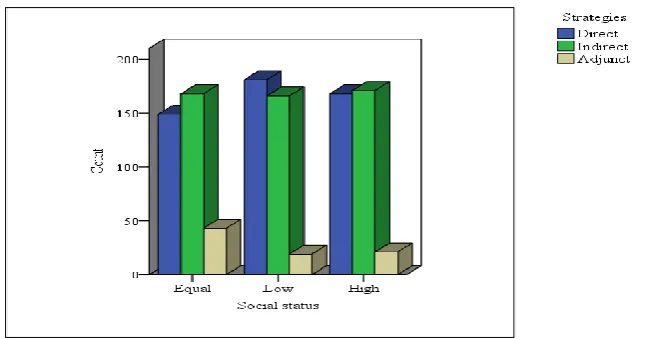
Based on the results set forth in Table 1, it can be concluded that 41.4 percent of the participants expressed refusals by using direct strategies on equal status, but 49.5 percent applied direct strategies on low, and 46.7 percent utilized direct strategies on high social status. Thus the participants expressed refusals by applying more direct strategies to their interlocutors' low status.
In addition, 11.9 percent of the participants used adjunct strategies on equal social status, however 5.2 percent applied adjunct strategies on low, and 5.8 percent utilized adjunct strategies on high social status. As a result, the participants stated refusals by employing more adjunct strategies to their interlocutors' equal status.
TABLE 1.
FREQUENCIES, PERCENTAGES AND STD.RESIDUALS; PARTICIPANTS’
APPLICATION OF REFUSAL OF SUGGESTION ON LEVELS OF SOCIAL STATUS
Strategies
Total Direct Indirect Adjunct
Social status Equal Count 149 168 43 360
% within Social status 41.4% 46.7% 11.9% 100.0%
Std. Residual -1.3 .0 3.0
Low Count 181 166 19 366
% within Social status 49.5% 45.4% 5.2% 100.0%
Std. Residual 1.0 -.3 -1.7
High Count 168 171 21 360
% within Social status 46.7% 47.5% 5.8% 100.0%
Std. Residual .2 .3 -1.2
Total Count 498 505 83 1086
% within Social status 45.9% 46.5% 7.6% 100.0%
Examining Std. Residuals shows that only one of the above mentioned statistics are selected significantly beyond expectation, i.e. Std. Residuals are beyond +/- 1.96. The application of adjunct strategies on equal (11.9%, Std. Residual = 3.0 > 1.96) is significantly above expectation.
The results of Chi-square (x2 (4) = 15.970, p = .003, p < .05) in Table 2 indicate that the differences observed in Table 1 are statistically significant since p value, .003 is well less than .05 level of significance. Thus the first null-hypothesis as the realization of applied strategies of the refusal of suggestion does not depend on the social status was rejected, and it can be asserted that the realization of applied strategies of the refusal of suggestion differ on the social statuses. In fact, learners applied more indirect strategies to people of equal social status, they used more direct strategies to people of low social status, and we can say that they used the same level of direct and indirect strategies to people of high social status. And learners used more adjunct strategies to people of equal social status.
TABLE 2.
CHI-SQUARE TEST FOR APPLICATION OF REFUSAL OF SUGGESTION ON LEVELS OF SOCIAL STATUS
Value df Asymp. Sig. (2-sided)
Pearson Chi-Square 15.970a 4 .003
N of Valid Cases 1086
a. 0 cells (.0%) have expected count less than 5. The minimum expected count is 27.51.
Figure 1 below illustrates the results as laid out in Table 1.
Figure 1. Occurrence of refusal of suggestion on three social statuses
B. Investigating Research Question Number Two
was employed to investigate any significant differences in the frequency of realized and applied strategies to people of social status in refusal of suggestion between the females and males. Before running Chi-square, the frequencies, percentages and standardized residuals (Std. Residual) for the refusal of suggestion (i.e., direct, indirect and adjunct) by females and males on equal (see Table 3), low (see Table 4), and high (see Table 5) were computed.
TABLE 3.
FREQUENCIES, PERCENTAGES AND STD.RESIDUALS; APPLICATION OF REFUSAL
OF SUGGESTION TO MALES AND FEMALES OF ‘EQUAL’ SOCIAL STATUS
Strategies
Total Direct Indirect Adjunct
Gender
Female
Count 67 90 23 180
% within Gender 37.2% 50.0% 12.8% 100.0%
Std. Residual -.9 .7 .3
Male
Count 82 78 20 180
% within Gender 45.6% 43.3% 11.1% 100.0%
Std. Residual .9 -.7 -.3
Total Count 149 168 43 360
% within Gender 41.4% 46.7% 11.9% 100.0%
TABLE 4.
FREQUENCIES, PERCENTAGES AND STD.RESIDUALS; APPLICATION OF REFUSAL
OF SUGGESTION TO MALES AND FEMALES OF ‘LOW’ SOCIAL STATUS
Strategies
Total Direct Indirect Adjunct
Gender
Female
Count 98 80 8 186
% within Gender 52.7% 43.0% 4.3% 100.0%
Std. Residual .6 -.5 -.5
Male
Count 83 86 11 180
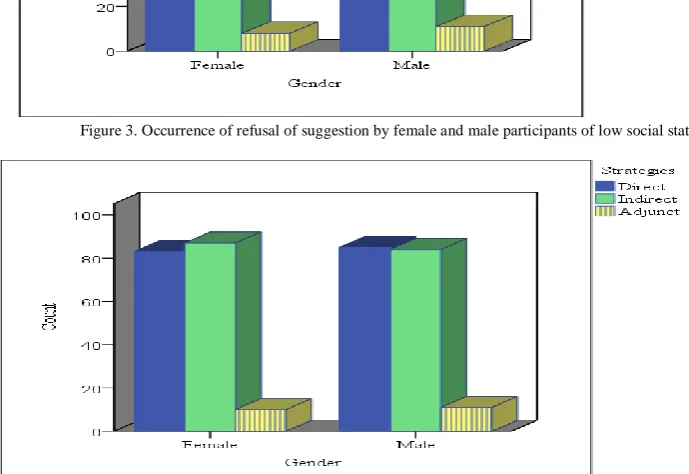
% within Gender 46.1% 47.8% 6.1% 100.0%
Std. Residual -.6 .5 .5
Total Count 181 166 19 366
% within Gender 49.5% 45.4% 5.2% 100.0%
TABLE 5.
FREQUENCIES, PERCENTAGES AND STD.RESIDUALS; APPLICATION OF REFUSAL
OF SUGGESTION TO MALES AND FEMALES OF ‘HIGH’ SOCIAL STATUS
Strategies
Total Direct Indirect Adjunct
Gender
Female
Count 83 87 10 180
% within Gender 46.1% 48.3% 5.6% 100.0%
Std. Residual -.1 .2 -.2
Male
Count 85 84 11 180
% within Gender 47.2% 46.7% 6.1% 100.0%
Std. Residual .1 -.2 .2
Total Count 168 171 21 360
% within Gender 46.7% 47.5% 5.8% 100.0%
Examining Std. Residuals showed that none of the above mentioned statistics are selected significantly beyond expectation, i.e. Std. Residuals are not beyond +/- 1.96 for the three equal, low and high levels of social status between females and males.
Chi-square Test (see Table 6) failed to find any significant difference in the frequency of realized and applied strategies to people of social status in refusal of suggestion between females and males on all three levels of social status, i.e. ‘Equal’ with (x2 (2) = 2.577, p = .27, p > .05), ‘Low’ with (x2 (2) = 1.836, p = .39, p > .05), and ‘High’ with (x2 (2) = .124, p = .94, p > .05) in which p value for all three levels of social status was well above .05 level of significance. Accordingly, the second null-hypothesis as the frequency of realized and applied strategies to people of social status in refusal of suggestion does not depends on learner’s gender was retained. In other words, female and male respondent answered the DCT questions almost similarly
.
TABLE 6.
CHI-SQUARE TEST FOR APPLICATION OF REFUSAL OF SUGGESTION BY
MALES AND FEMALES OF EQUAL, LOW AND HIGH SOCIAL STATUS
Social status N of Valid Cases Pearson Chi-Square Value df Sig. (2-sided)
Equal 360 2.577 2 .276
Low 366 1.836 2 .399
High 360 .124 2 .940
a little more sensitive to the opposite gender (male), by using less direct strategies than males. Females used a little more strategies when they refused people of opposite gender. They used more strategies when encountering people of opposite gender. Males refused people of the opposite gender with many more ‘NO’ phrases. The following figures (i.e., Figure 2, Figure 3 and Figure 4) graphically illustrate the results as appeared in Table 3, Table 4 and Table 5.
Figure 2. Occurrence of refusal of suggestion by female and male participants of equal social status
Figure 3. Occurrence of refusal of suggestion by female and male participants of low social status
Figure 4. Occurrence of refusal of suggestion by female and male participants of high social status
V. DISCUSSION
Furthermore, Qadoury Abed’s (2011) research revealed that EFL learners applied more indirect strategies than the two others strategies. Males used a little more direct strategies to refuse the interlocutor's suggestion; EFL learners used more strategies to people of lower status.
Our study also lends support to Allami and Naeimi’s (2011) finding that Iranian English language learners utilized less direct strategies in response to addressees of either higher or equal social status.
Besides, the results of the current study coincide with Abu Humeid and Altai’s (2013) study which indicated that EFL learners utilized more indirect strategies than direct strategies to refuse their interlocutors' suggestion. They applied more indirect strategies to people of high social status and used the same level of indirect strategies to people of equal and low social status.
VI. CONCLUSION AND IMPLICATIONS
The aim of this study was to investigate into the preferred strategies of refusals of suggestion applied by Iranian female and male intermediate learners to people of social status. This study probed into the refusals of suggestion to high, equal, and low status.
The results revealed that, the learners' realization and application of refusal strategies was depended on the interlocutor's social status. Learners utilized more indirect strategies to people of equal social status, they applied more direct strategies to people of low social status, and we could say that they applied the same level of direct and indirect strategies to people of high social status. And they utilized more adjunct strategies to people of equal social status.
Both females and males were not different from each other due to their application of refusal strategies to people with different socialstatus. Females and males showed the same number of strategies of refusals when they interacted with people of the social status. Both genders used more direct strategies in their refusal of the people of the cross sex society gender.
A teacher should pay more attention to helping learners avoid pragmatic failures by teaching them the pragmatic knowledge. According to Zheng and Huang (2010) teachers should provide learners with the communicative rules, social conventions, and values of the target nation. This study supported the importance of comprehending refusals of speech acts in intermediate level, so EFL teachers should design the tasks which expose the learners to different pragmatic information that help them to carry out the speech acts and refusals of speech acts properly according to the people's social status. Language instructors should develop pragmatic ability by designing contextualized, task based activities that expose the learners to different kinds of pragmatic input and producing the proper output. Language instructors should instruct language forms and functions in the context of communicative oral activities in formal and informal situation in order to carry out speech acts successfully. The sociolinguistics information should be placed into the L2 curriculum and the text books from the beginning levels of language learning. Language instructors should teach how to do speech acts in FL in different situations of social status.
REFERENCES
[1] Abu Humeid, A. M. A. A., & Altai, A. A. (2013).Refusal Strategies Used by Iraqi EFL University Students. British Journal of
Science, 8 (1), 58-86.
[2] Allami, H., & A. Naeimi. (2011). A cross-linguistic study of refusals: An analysis of pragmatic competence development in Iranian EFL learners. Journal of Pragmatics,43 (1), 385-406.
[3] Al-Issa, A. (1998). Socio-pragmatic transfer in the performance of refusals by Jordanian EFL learners: Evidence and motivating factors. PhD diss., University of Pennsylvania.
[4] Al-Issa, A. (2003). Socio-cultural transfer in L2 speech behaviors: Evidence and motivating factors. International Journal of
Intercultural Relations, 27, 581-601.
[5] Al Kahtani, S. A. W. (2005). Refusal in the different cultures: A speech act theoretically based cross-cultural study. Language
Translation18, 35-37.
[6] Ary, D. (2006). Introduction to research in education(7th ed.). Orlando, FL: Harcourt Brace College Publishers.
[7] Azizi Abarghoui, M. (2012). A Comparative study of refusal strategies used by Iranians and Australians. Theory and Practice
in Language Studies, pp. 2439-2445, doi:10.4304/tpls.2.11.2439-2445.
[8] Austin, J. L. (1962). How to do things with words. London: Oxford University Press.
[9] Bardovi-Harlig, K., & Hartford, B. S. (199). Saying “No” in English: native and nonnative rejections. In L. Bouton, & Y. Kachru (Ed.), Pragmatics and language learning, 2, 41-57.
[10] Bardovi-Harlig, K., & Dornyei, D. (1998). Do language learners recognize pragmatic violations? Pragmatic versus grammatical awareness in instructed l2 learning. TESOL Quarter 32, 233-262.
[11] Beebe, L. M., & Takahashi, T. (1989). Sociolinguistic variation in face-threatening speech acts: Chastisement and disagreement. In M. R. Eisenstein (Ed.), The dynamic interlanguage: Empirical studies in second language variation (pp. 199-218). London: Plenum Press.
[12] Beebe, L. M., Takahashi, T., & Uliss-Weltz , R. (1990). Pragmatic transfer in ESL refusals. In R. C. Scarcella, E. S. Andersen, & S. D. Krashen (Ed.), Developing communicative competence in second language (pp. 55-73). New York: Newbury House. [13] Boxer, D. (1993). Social distance and speech behavior: The case of indirect complaints. Journal of Pragmatics, 19, 103-125. [14] Brown, P., & Levinson, S. C. (1987).Politeness: Some universals in language usage.Cambridge: Cambridge University Press. [15] CheLah, S., Qusay Abdul Sattar, H., & Raja Suleimanr, R. (2011). Refusal strategies in English by Malay University students.
[16] Cheng, X., Ye, L. & Zhang, Y. (1995). Refusing in Chineses. In Gabriele Kasper (Ed.), Pragmatics of Chinese as Native and
Target Language (pp.119-163). Manoa, HI: University of Hawaii Press.
[17] Chen, H. J. (1996). Cross-cultural comparison of English and Chinese metapragmatics in refusals, PhD diss., Indiana University.
[18] Cheng, S. W. (2005). An exploratory cross-sectional study of interlanguage pragmatic development of expressions of gratitude by Chinese learners of English. PhD dissertation. The University of Iowa.
[19] Cramer, P. K. (1997). Refusals of Japanese business professionals in Japanese-American companies: An exploratory study. PhD diss. Indiana University.
[20] Crystal, A. D. (1997). English as a global language. Cambridge: Cambridge University Press. House.
[21] Cutting, J. (2002). Pragmatics and discourse: A resource book for students.London and New York: Routledge.
[22] Delen, B., & Tavil, Z. M. (2010). Evaluation of four course books in terms of three speech acts: Requests, refusals and complaints. Procedia Social and Behavioral Sciences, 9, 692-697.
[23] Eslami-Rasekh, Z., Eslami-Rasekh, A., & Fatahi, A. (2004). The effect of explicit metapragmatic instruction on the speech act awareness of advanced EFL students. TESL-EJb (8), 2. Retrieved May 5th, 2006, from http://www-writing.berkeley.edu/TESl-EJ/ej30/a2.html.
[24] Eslami-Rasekh, A., & Mardani, M. (2010). Investigating the effects of teaching apology speech act, with a focus on intensifying strategies, on pragmatic development of EFL learners: The Iranian context. Journal of Language Society and
Culture, 30, 96-103.
[25] Felix-Brasdefer, J. C. (2006). Linguistic politeness in Mexico: Refusal strategies among male speakers of Mexican Spanish.
Journal of Pragmatics, 38, 2158-2187.
[26] Felix-Brasdefer, J. C. (2008). Perceptions of refusals to invitations: Exploring the minds of foreign language learners.
Language Awareness, 17 (3), 195-211. Doi: 10.1080/09658410802146818.
[27] Fioramonte, A., & Vásquez, C. (2011). Integrating pragmatics into the MA-TESL program: perspectives from former students.
TESL-EJ, 15 (2), 1-22.
[28] Fraser, B. (1981). On apologizing. In F. Coulmas (Ed.), Conversational Routine (pp. 259- 271). The Hague: Mouton de Gruyter. [29] Fraser, B. (1990). Perspectives on politeness. Journal of Pragmatics, 4, 219-236. http://dx.doi.org/10.1016/0378-2166 (90)
90081-N.
[30] Gass, S. M., & Houck, N. (1999).Interlanguage refusals: A cross-cultural study of Japanese-English. New York: Mouton de Gruyter 2.
[31] Goffman, E. (1967). Interaction ritual: Essays on face-to-face behavior. New York: Pantheon Books.
[32] Gudykunst, W. B., & Ting-Toomey, S. (1988). Culture and interpersonal communication. Newbury Park. CA: Sage.
[33] Hassani, R., Mardani, M., & J. Vahid Dastjerdi. (2011). A comparative study of refusals: Gender distinction and social status in focus. The internet journal of language, society and culture, 32, 37–46.
[34] Harford, B. S., & Harlig, K. B. (1992). Experimental and observational data in the study of interlanguage pragmatics. In L. Bouton & Y. Kachru (Ed.), Pragmatics and language learning, Monograph Series, 3, 33-52. Urbana-Champaign, IL: University of Illinois.
[35] Holmes, J. (1995). Women, men and politeness. London: Longman.
[36] Honglin, L. (2007). A comparative study of refusal speech acts in Chinese and American English. Canadian Social Science, 3(4), 64-67.
[37] Ikoma, T., & Shimaru, A. (1994). Pragmatics transfer in the speech act of refusal in Japanese as a second language. Journal of
Asian Pacific Communication, 5 (1), 105-129.
[38] Kasper, G. (2006). Beyond repair, conversation analysis as an approach to SLA. In K. Bardovi- Harling, and Z. Dörnyei (eds),
Themes in SLA research. AILTA. Review 19, 83-99. Amsterdam: John Benjamins Publishing Company.
[39] Lakoff, R. (1973). The logic of politeness; or minding your p’s and q’s. Papers from the 9th Regional Meeting of the Chicago
Linguistic Society. (pp. 292-305). Chicago, IL: Chicago Linguistic Society.
[40] Lakoff, R. (1975). Language and woman’s place. New York: Harper and Row.
[41] Lakoff, R. (1990). Talking power: The politics of language in our lives.New York: Basic Books.
[42] Liao, C., & Bresnahan, M. J. (1996). A contrastive pragmatic study on American English and Mandarin refusal strategies.
Language Sciences, 18, (3-4), 703-727.
[43] Leech, G. (1983). Principles of pragmatics. London: Longman.
[44] Locher, M. (2004). Power and politeness in action: disagreements in oral communication. Berlin: Mouton de Gruyter. Morrow, C. K. (1995). The pragmatic effects of instruction on ESL learners’ production of complaint and refusal speech acts. PhD diss. State University of New York, Buffalo.
[45] Nelson, G. L., Al Batal, M., & El Bakary, W. (2002). Directness vs. indirectness: Egyptian Arabic and US English communication style. International Journal of Intercultural Relations, 26, 39-57.
[46] Nguyen, T. P. (2006). Cross cultural pragmatics: Refusals of requests by Australian native speakers of English and Vietnamese learners of English. University of Queensland.
[47] Qadoury Abed, A. (2011). Pragmatic transfer in Iraqi EFL Learners' refusals. International Journal of English Linguistics, 1 (2), 66-185. DOI:10.5539/ijel.v1n2p166.
[48] Richards, J. C., & Schmidt, R. (2002). Longman dictionary of language teaching and applied linguistics (3rd ed.). London: Longman (Pearson Education).
[49] Rintell, E. M., & Mitchell, C. J. (1989). Studying requests and apologies: An inquiry into methods. In S. Blum-Kulka, J. House & G. Kasper (Ed.), Cross-cultural pragmatics: Requests and apologies (pp. 248-272). Norwood: Ablex.
[50] Sadler, R. W., & Eröz. B. (2002). “I refuse you!” An examination of English refusals by native speakers of English, Lao, and Turkish, Arizona Working Papers in SLAT,9, 53-80.
[52] Sahragard, R., & Javanmardi. F. (2011). English speech act realization of “refusals” among Iranian EFL learner’s
cross-cultural communication,7, (2), 181-198. DOI: 10.3968/j.ccc.1923670020110702.021.
[53] Sanders, R. E. (2005). Testing "observations": The methodological relevance of attention to cognition in discourse studies. In H. te Molder & J. Potter (Eds.), Discourse and cognition (pp. 57‐78). Cambridge: Cambridge University Press.
[54] Schegloff, E. A. (2000). Overlapping talk and the organization of turn-taking for conversation. Language in Society, 29, 1-63. [55] Schegloff, E. A., & Sacks H. (1973). Opening up closings. Semiotic, 8, 289-327.
[56] Searle, J. R. (1975). Indirect speech act.In P. Cole, & J. Morgan (Ed.) Syntax and Semantics 3: Speech acts (pp. 59-82). New York: Academic Press.
[57] Searle, J., & Vandervken, D. (1985). Foundations of illocutionary logic. Cambridge: Cambridge University Press. [58] Stadler, S. A. (2011). Coding speech acts for their degree of explicitness. Journal of Pragmatics, 43, 36-50.
[59] Takahashi, S. (2001).The role of input enhancement in developing interlanguage pragmatics competence. In K. Rose & G. Kasper (Eds.), Pragmatics in language teaching. Cambridge University Press. pp. 171-199.
[60] Tanck, S. (2002). Speech act set of refusal and comparison of native and non-native English speakers' production. [Online] Available: http://www1.american.edu/tesol/wptanck.pdf (August 19th, 2009).
[61] Tannen, D. (1987). Repetition in conversation: toward a poetics of talk. Language, 63, 574-605.
[62] Tannen, D. (1990). You just don’t understand: Men and women in conversation. New York: William Morrow & Company. [63] Tannen, D. (1994). Gender and discourse. New York: Oxford University Press.
[64] Thomas, J. (1983). Cross-cultural pragmatic failure. Applied Linguistics, 4, 91-112.
[65] Widjaja, C. (1997). A study of date refusal: Taiwanese females vs. American females. University of Hawai’i Working Papers
in ESL, 15 (2), 1-43.
[66] Wierzbicka, A. (1987). English speech act verbs: A semantic dictionary. Sydney; Orlando, Fla.; London: Academic Press. [67] Wolfson, N., Marmor, T., & Jones, S. (1989). Problems in the comparison of speech act across cultures. In S. Blum-Kulka, J.
House, & G. Kasper (Ed.), Cross- cultural pragmatics: Requests and apologies (pp.174-196). Norwood: Ablex.
[68] Yu, M. Ch. (2011). Learning how to read situations and know what is the right thing to say or do in an L2: A study of socio-cultural competence and language transfer. Journal of Pragmatics, 43, 1127-1147.
[69] Yule, G. (1996). The study of language.Cambridge: Cambridge University Press.
[70] Zheng, L., & Huang, J. (2010). A Study of Chinese EFL Learners’ Pragmatic Failure and the Implications for College English Teaching. Polyglossia, 18, 41-54.
Fariba Hedayatnejad was born in Shiraz, Iran in 1982. She holds MA from Islamic Azad University, Science and Research, Zanjan Branch. Her research interests are sociolinguistics, linguistics, and foreign language teaching.
Roohollah Maleki was born in Nahavand, Iran in 1980. He holds MA in TEFL from Islamic Azad University, South Tehran Branch. He teaches in the English Center at Shahid Sattari Aeronautical University of Technology and Science, Tehran, Iran. His research interests are second and third language acquisition, contrastive analysis, discourse analysis, testing and material development. He has published several articles in language learning acquisitions e.g., A Comparative Study of the Attribution for Failure of English Majors Students versus that of their Instructors published by International Journal of Language Learning and Applied Linguistics World in April 2014.