ISSN: 2501 - 1235 ISSN-L: 2501 - 1235 Available on-line at: www.oapub.org/edu
doi: 10.5281/zenodo.1867713 Volume 5 │ Issue 2 │ 2018
INVESTIGATION OF THE EFFECT OF TABATA TRAINING
ON VITAL CAPACITIES OF SWIMMERS
Yakup Akif Afyon1,
Olcay Mülazımoğlu1,
Abdurrahman Boyacı2i,
Begüm İskender3
1Faculty of Sports Science,
Mugla Sitki Kocman University, Turkey
2School of Physical Education and Sports,
Nisantasi University, Turkey
3Health Sciences Institute,
Giresun University, Turkey
Abstract:
The aim of this study is to investigate the effects of Tabata training exercises on the vital capacity of the athletes in 4 weeks. The study consisted of 10 randomly grouped experiments (age = 21.50 ± 1,649 years, height = 174,70 ± 3,772 cm, weight = 76,40 ± 4,647 kg) and 10 controls (age = 21,10 ± 1,449 years, height = 173,00 ± 4,136 cm, weight = 74,50 ± 4,034 kg A total of 20 voluntary university male athletes, including, were performed on two groups. Vital capacity measurements were made by SPIR-O-FLOW (Peak flow pocket monitor) brand spirometer. Initially, vital capacity measurements (pre-test) of the groups were performed and the control group (KG) and experimental group (DG) performed normal swimming training for 4 weeks. In addition to DG 3 days a week, 1 set of 20 seconds of operation, 10 seconds of rest in the form of 4 min. lasting, 2 sets, total 8 min. They applied the Tabata Training Protocol (TAP). The vital capacities of both groups were measured again (post-test). Pre-test and post-test with variations within groups and between groups (paired-samples t-test) were investigated. The obtained findings (0.05) significance level were evaluated. There was no statistically significant difference between the DG (4.99 ± 0.514L.) And KG (4.65 ± 0.389L.) Pre-test vital capacity values (t = 1.332; p> 0.05). There was a statistically significant difference between the pretest (4.65 ± 0.389L.) And posttest (4.77 ± 0.349L.) Measurements (t = -4.811; p <0.01). A statistically significant difference was found between DG pretest (4.99 ± 0.514L.) And post-test (5.56 ± 0.548L.) Measurements (t = -14,401; p <0.01). A
statistically significant difference was found between the average of the higher vital capacity average DG post-test (5,56 ± 0,548L.) And the KG posttest (4,77 ± 0,349L.) Measurements (t = 3,222; p <0, 05). Tabata training, which was applied in addition to swimming training for 4 weeks, improved the vital capacity of the swimmers. Swimming trainers can apply TAP in addition to swimming training to increase the vital capacity of athletes.
Keywords: swimmer; Tabata training; vital capacity
1. Introduction
Swimming is one of the rare sports that is made in water and provides physical development in the most perfect way. Swimming sport, where gravity is almost zero, ensures that all musicians of this sport work in harmony and harmony. As it is made against water resistance, it increases the body resistance without any corrosive effect. Swimming sport, which is one of the rare sports used in physical therapy, provides a symmetrical and balanced development of body muscles (Bozdoğan, 2006).
Vital capacity is the ability to take as much air as possible to the lungs. It refers to the amount of air that can be removed by maximal expiration after a maximal incision. The reserve reservoir is equal to the total volume of breath and expiration reserve. Oxygen consumption defines the oxygen demand of muscles and other tissues. Swimmers have different physiological characteristics as they are found in water in most of their training and competitions. While swimming, breathe through the mouth, nose and mouth into the water is given. In a person swimming in water, water is applied to the muscles that function in the respiratory system by applying a hydrostatic pressure on the chest. As the oxygen demand of the tissues increases, the amount of oxygen that the respiratory system adds to the organism increases and the activities of the circulatory system that carries oxygen to the tissues also increase. According to the results obtained from general literature reviews, it is accepted that swimming sport increases the value of forced vital capacity (FVC) and maximum voluntary ventilation (MVV) even at 12-15 weeks of moderate training. Since the swimmer is in horizontal position, air enters the upper part of the lungs. Thus, vital capacity (VC) is more developed in swimmers than in other sports (Gökhan et al. 2011).
complete in 4 minutes4. The aim of this study is to investigate the effect of Tabata training protocol on the vital capacity of athletes.
2. Material and Methods
In this study, pre-test, post-test, experimental group was applied.
2.1 Experimental Group (EG)
10 (age = 21,50 ± 1,649 years, height = 174,70 ± 3,772 cm, weight = 76,40 ± 4,647 kg) of the university's swimming team and healthy athlete were informed about the study and voluntarily participated in the form. In addition to EG swimming training, Tabata training was applied for 3 weeks, 2 sets and 8 minutes for 4 weeks.
2.2 Control Group (CG)
10 (age = 21,10 ± 1,449 years, height = 173,00 ± 4,136 cm, weight = 74,50 ± 4,034 kg) of the swimming team at the university, the healthy sportsman participated voluntarily by completing the) informed consent Control form. In addition to swimming training for 4 weeks, the CG did not have any additional training.
2.3 Obtaining data
In the study, Vital capacity measurements were taken with SPIR-O-FLOW (Peak flow pocket monitor) brand spirometer device. After the nose was clamped with a latch or by hand, the person was asked to breathe normally from the spirometer. After a few normal inspirations and expiration, he was asked to rest as deeply as he could at the rest of the expiratory end, and then to slowly and uninterruptedly release the air he had received. The results were recorded in liters (L). They performed the vital capacity test in both groups, pre-training (pre-test) and after two weeks of training (post-test) twice.
2.4 Statistical Analysis of the Data
The data obtained in the study were entered into the computer environment. Pre-test measurements of the experimental and control groups were taken and the differences between the pre-tests were examined. Descriptive statistical methods Mean (X), Standard deviation (ss) were used to evaluate the data. After 4 weeks of training program, pre-test and post-test differentiation between groups and groups were examined. Paired-Samples t-test was used for pre-test and post-test analysis. The findings were evaluated at 5% significance level (0.05) in 95% confidence interval.
2.5 Training Program
in maximum repetition and active rest was given for 10 seconds. Thus, set 1 is completed. After 2 minutes of rest, the 2nd set was started. On the set 2, the same 8 movements were repeated. A total of 8 movements and 2 sets (4 + 4) 8-minute high intensity Tabata Training Program was applied for 3 weeks in total for 3 days a week.
Table 1: Tabata Training Protocol (TAP) Table Applied to EG Swimmers
Array Upload-Rest Time 4 Week Applied Tabata Training Program
1. Ant. Day Set 2. Ant. Day Set 3. Ant. Day Set
1 20’’ / 10’’ Mountain Climber Bulgarian Lunges(Sağ) Deadlift
2 20’’ / 10’’ Sit-Ups Triceps Dıps Crunches
3 20’’ / 10’’ Jumping Squat Bulgarian Lunges(Sol) Box Jumping 4 20’’ / 10’’ Bicesps Curls Row (Terebant) Shoulder Press
5 20’’ / 10’’ Jumping Lunge Deadlift Jumping Squat
6 20’’ / 10’’ Push Ups Biceps Curls Triceps Dıps
7 20’’ / 10’’ High Knees Jump Rope Mountain Climber
8 20’’ / 10’’ Row (Terebant) Shoulder Press Biceps Curls
4. Results and Discussion
Table 2: Descriptive statistics of trusted
Groups n Ort. Std. Sp. t p
EG Age 10 21,50 1,649
0,712 0,494
CG Age 10 21,10 1,449
EG Height 10 174,70 3,772
1,481 0,135
CG Height 10 173,00 4,136
EG Weight 10 76,40 4,647
1,992 0,119
CG Weight 10 74,50 4,034
When the descriptive characteristics of the participants were examined, the experimental group was 21,50 ± 1,649 years, height 174,70 ± 3,772 cm, weight 76,40 ± 4,647 kg, control group age 21,10 ± 1,449 years, height 173,00 ± 4,136 cm weight was found to be 74,50 ± 4,034 kg. There was no significant difference between the descriptive parameters of the participant groups (Table 2).
Table 3: Comparison of pre-test measurements of participants with t-test
Variable n
EG Pre-test
(X±Ss)
CG Pre-test
(X±Ss)
t p
Vital Capacity 10 4,99±,514 4,65±,389 1,332 0,216
Table 4: Comparison of experimental group pre-test - posttest
Variable n
EG Pre-test
(X±Ss)
CG Post-test
(X±Ss)
t p
Effective Size (Cohen’s d)
Vital Capacity 10 4,99±,514 5,56±,548 -14,401 0,000* High
(1,07) p<0.01*
A statistically significant difference was found between the experimental group pre-test (4.99 ±, 514) and post-test (5.56 ±, 548) measurements (p <0.05). The effect size was high (Cohen7s d = 1.07) (Table 4)
Table 5: Comparison of the pre-test post-test of the control group
Variable n
CG Pre-test
(X±Ss)
CG Post -test
(X±Ss)
t p
Effect size (Cohen’s d)
Vital Capacity 10 4,65±,389 4,77±,349 -4,811 0,001* middle
(0,32)
p>0.01*
There was a statistically significant difference between the pre-test (4.65 ± 0.39) and post-test (4.77 ± 0.35) measurements (p <0.01). The effect size was moderate (Cohen 5s d = 0.32) (Table 5)
Table 6: Comparison of the post-test of the participants
Variable n
EG Post-test
(X±Ss)
CG Post-test
(X±Ss)
t p
Vital Capacity 10 5,56±,548 4,77±,349 3,222 0,010*
p>0.05*
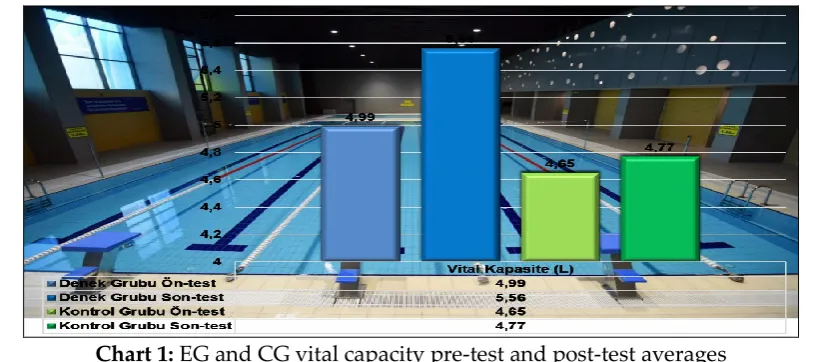
When the post-tests of the participants were examined, a statistically significant difference was found between the EG post-test (5.56 ± 0.55) and the post-test (4.77 ± 0.35) (p <0.05) (Table 6).
Changes in the pre-test and post-test vital capacity values of the EG and CG group during the 4-week training period (Chart 1)
In addition to swimming training, the Tabata Training Program (TAP)
significantly increases the vital capacity of the swimmers. The high effect size of this increase indicates the importance of TAP. Swimming training by the non-trained control group provided vital capacity increase. However, it has a moderate effect rather than development which has a high effect on the subject group (Bozdoğan, 2006).
Tabata et al. (1996) compared the effects of 70% VO2max high intensity interval training with 70% VO2Max consumption and 70% VO2max continuous training. The study consisted of a total of 4 minutes of exercise with 8 20 seconds of maximal loading followed by 10 seconds of active rest. The study showed that interval training increased the aerobic capacity at similar levels with mid-intensity continuous training, and also showed that it improved anaerobic capacity by 28%.
Wells et al. found statistically significant levels of VC values in 34 elite and performance groups of 15 to 15 years old (Gökhan et al., 2011)
Rowland and Boyajian (1995) found significant differences between the control group and the aerobic exercise group 3 days 30 minutes a week 6.
Kubiak and Janczaruk (2005), in the research conducted by the swimmers for the spirometric evaluation of the respiratory system, found a statistically significant difference between the pretest and posttest values of the VC parameters as a result of their 6-month study between 310 elite swimmers7. Kesavachandran et al. (2001) In the 3-month study conducted for the purpose of investigating lung volumes in swimmers, pre-test and post-test values of VC parameters were found statistically significant in swimmers with different swimming styles 8.
Gökhan et al. (2011) Reported that 8 weeks of swimming exercises in 40 adult sedentary men increased respiratory function (FEV, FVC, MVV) and vital capacity (VC). Atan et al. (2013) In this study, the effects of sports and sports on lung function were investigated. Active in sports, judo, athletics, wrestling, taek-wondo, table tennis, swimming branches, 50 athletes and 50 sedentary, including a total of 350 athletes, respiratory function, each of the vital capacity (VC), vital capacity (VC), forced vital capacity (FVC and maximum voluntary ventilation (MVV) values were measured and compared between branches. VC values of the swimmers were found to be better than sedans and other branches as a result of the measurements9. The VC findings of the sedentaries in both studies were in line with the findings of our study.
References
Bozdoğan A. Yüzme, Morpa Yayınları İstanbul 2006 s:20-21
Gökhan İ., Kürkçü R., Devecioğlu S., Aysan H.A. Yüzme egzersizinin solunum fonksiyonları, kan basıncı ve vücut kompozisyonu üzerine etkisi, The effect of swimming on pulmonary functions, blood pressure and body composition, Klink ve Deneysel Araştırmalar Dergisi, Journal of Clinical and Experimental Investigations; 2011, 2 (1): 35-41.
Tabata I. Nischimura K.Kouzaki, M., Hirai Y, Ogita F, Miyachi, M. and Yamamoto, K. Effects of moderate-intensity endurance and high-intensity intermittent training on anaerobic capacity and VO2 max. Medicine & Science in Sports & Exercise 1996, 28 (10), 1327-30.
Wells G.D., Plyley M., Thomas S., Goodman L., Duffin J. Effects of concurrent inspiratory and expiratory muscle training on respiratory and exercise performance in
swimmers. Eur J Appl Physiol 2005; 94(5-6): 527-40.
Rowland T.W., Boyajian A. Aerobik Response to Endurance Training in Children. 1995; Pediatrics 96 (4Pt 1) : 654 -8.
Kubiak -Janczaruk E. Spirometric evaluation of the respiratory system in adolescent Swimmers, PubMed- İndexed for Medline 2005.
Kesavachandran C., Nair H.R., Shashidhar S. Lung. Volume in Swimmers Performing Different Styles of Swimming, Indian Journal of Medical Sciences, 2001,55 (12): 669-676.
Creative Commons licensing terms