Social Capitals and English Language Learning
in an Iranian Language Institute
Ebrahim Khodadady Ferdowsi University of Mashhad, Iran
Mozhgan Ashrafborji
Ferdowsi University of Mashhad, International Branch, Mashhad, Iran
Abstract—This study aimed to 1) explore the social capitals of students who had registered in the three branches of Khorasan Language Institute (KLI) to learn English, 2) establish their factorial validity and 3) explore their relationship with English language achievement. To this end the 40-item Social Capital Scale (SCS) developed by Khodadady and Alaee (2012) and validated with grade three senior high school students in Mashhad was modified and administered to 493 female English language learners (ELLs) in the KLI. The application of Principal Axis Factoring and Varimax with Kaiser Normalization to the collected data showed that the SCS consisted of seven factors, i.e., Social Attachment, Parental Supervision, Parental Expectation, Helpful Others, Social Contact, Religious Activities, and Parent Availability. When the SCS was correlated with the ELLs’ scores on oral and written examinations, no significant relationship could be found between social capitals and English language achievement. Out of seven factors, only Helpful Others correlated significantly but negatively with ELLs' English achievement. The results are discussed from both empirical and theoretical perspectives and suggestions are made for future research.
Index Terms—social capitals, English language achievement, schema theory
I. INTRODUCTION
Social and cultural capitals have been defined differently in the literature. Coleman (1987) and De Graaf, and Kraaykamp (2000), for example, defined them the “norms, the social networks, and the relationships between adults and children that are of value for the child’s growing up” (p. 36) and “widely shared high-status cultural signals (behaviors, tastes, and attitudes)”, respectively. The differences found in definitions are due to the indicators upon which the definition has been formulated. Dika and Singh (2002) reviewed the literature and provided their readers with the most commonly investigated indicators of social capitals as Laureau and Weininger (2003) did with cultural capitals. Khodadady and Zabihi (2011) chose 35 indicators provided by these scholars and developed their Social and Cultural Capital Questionnaire (SCCQ) to explore their Relationship with the school achievement of Iranian university students.
Khodadady, Alaee, and Natanzi, (2011) administered the SCCQ developed by Khodadady and Zabihi, (2011) to 706 students of five public and private high school students in Mashhad, Iran, in order to explore the relationship between English language achievement and social as well as cultural capitals. They found no significant relationship between the capitals and achievement. Nor could they establish any significant relationship between the English language achievement and the ten factors underlying the SCCQ, i.e., family-school interaction,
facility consciousness, extracurricular and religious activities, parental consultation, literary and artistic appreciation, family support, family-peer relation, reading enjoyment, family encouragement, and self-confidence.
Khodadady and Alaee (2012a) decided to develop a psychological measure which addresses just social capitals. To this end, they reviewed the literature and chose forty indicators to develop their Social Capital Scale (SCS). They administered the scale to 1352 grade three senior high school (G3SHS) students, followed Khodadady and Hashemi’s (2010) suggestion regarding the best method of factor analysis and subjected their collected data to Principal Axis Factoring (PAF) and rotated their extracted factors through Varimax with Kaiser Normalization (VKN). Their results showed that the SCS is a reliable measure of social capitals (α = .89) which consists of ten factors, i.e., i.e., Self Volunteering, Receptive Relatives, Maternal Supervision, Parental Monitoring, Teacher Consultation, Parental Expectation, Parental Rapport, Family Religiosity, Helpful Others, and Parent Availability.
The present study is designed to explore the factorial validity of SCS when it is administered to students with different levels of language proficiency, i.e., beginners, intermediate and advanced. It also aims to explore the relationship between social capitals and English language achievement of students who study English in three branches of Khorasan Language Institute (KLI) in Mashhad. It is hypothesized that the forty indicators constituting the social capitals measured by the SCS will load on the same factors extracted by Khodadady and Alaee (2012a). It is also postulated that there will be no significant relationship between social capitals and English language achievement.
II. METHODOLOGY
A. Participants
In total, 493 female learners registered at Tollab (n = 325, 65.9%), Sanabad (n = 100, 20.3%), and Daneshjoo (n = 68, 13.8%) branches of KLI took part in the present study voluntarily. These branches are located in three areas of Mashhad in which mostly people of low, high and middle classes reside, respectively. Their self-reported average family income ranged between less than 200,000 (67 USD) to more than 800,000 tomans (267 USD) in 2013. The participants were studying English at various English language proficiency to be attained at 27 levels established by KLI on the basis of their achievement scores obtained in previous terms. (For new applicants, written placement tests and interviews are held to place them in one of the 27 levels specified.) While nine participants did not specify how old they were, the age of the remaining 484 learners ranged from 9 to 50 (M = 19.12, SD = 7.32). They spoke Persian as their first or second language.
B. Instruments
Two instruments were employed in the study: a Persian Demographic Scale and the Persian Social Capital Scale. The English language achievement scores were also obtained from the registrar’s office of KLI to explore the relationship between social capitals and English language achievement.
1. Demographic Scale
The Persian Demographic Scale (DS) developed by Khodadady and Alaee (2012a) was employed in this study. It consisted of a number of open ended questions and multiple choice items dealing with variables such as participants’ age, gender, family income and mother language.
2. Social Capital Scale
Social Capital Scale (SCS) developed by Khodadady and Alaee (2012a) [henceforth K&A] was employed in this study. It consists of 40 Persian social capital indicators collected from various sources as well as those reviewed by Dika and Singh (2002). Smith, Beaulieu, and Israel (1992), for example, brought up two indicators dealing with parents being at home as an indicator of social capital. It was changed into two Persian items by K&A, i.e., “MADARAM AGHLAB DAR KHANEH AST” and “PEDARAM AGHLAB DAR KHANEH AST”. (The back translation of the first is “My mother is often at home”
Since the SCS was going to be administered to ELLs in the KLI, the content of some of its indicators were changed because K&A had developed them for G3SHS students. Indicator 39 in K&A’s study, for example, reads, “As a whole, during my education, I have had excellent schools with high qualities.” The schemata “excellent schools” were irrelevant to the participants of this study, the item was, therefore, rewritten as “Generally, I have studied in high quality institutes.” These changes will be detailed more in the procedures sections shortly.) The indicators were presented as the stem of a multiple choice item with six alternatives, i.e., never, seldom, sometimes, often, usually and always. The values of 1, 2, 3, 4, 5 and 6 were assigned to these points, respectively, to run statistical analyses.
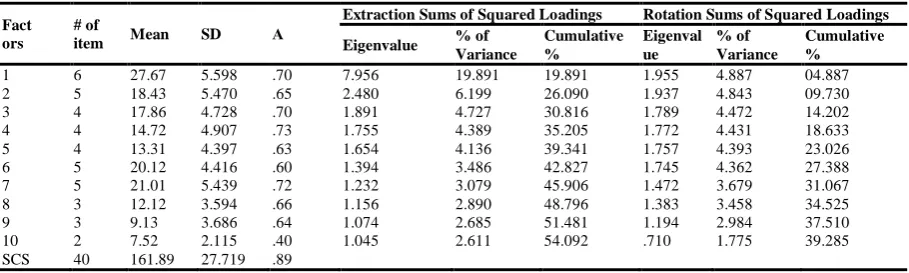
Table 1 presents the descriptive statistics as well as reliability estimates of the SCS and its ten underlying factors extracted from the responses of G3HS students in K&A’s study. As can be seen, the SCS is a highly reliable scale of G3HS students’ social capitals because its alpha coefficient is .89. As it can also be seen, the reliability coefficients of the factors range from.40 (factor 10) to .73 (factor four). The ten factors together explain 54.1% and 39.3% of initial and extracted variances in the Persian SCS, respectively.
TABLE 1
DESCRIPTIVE STATISTICS,RELIABILITY ESTIMATES OF TEN FACTORS UNDERLYING THE SCS
Fact ors
# of
item Mean SD Α
Extraction Sums of Squared Loadings Rotation Sums of Squared Loadings Eigenvalue % of Variance Cumulative % Eigenvalue % of Variance Cumulative %
3. English Achievement Scores
The English language instructors at the KLI have to assess their learners’ speaking ability on the basis of their participation in class activities and discussions and report a single oral score for each individual learner. They are also required to hold paper-and-pencil quizzes, midterm and final examinations and report their average as a single written score at the end of each academic term. These two scores are added up and averaged to get the total score upon which administrative decisions are made. The oral, written, and total scores of participants at the level at which they had registered in 2013 were obtained from the registrar’s office in the institute to explore the relationship between social capitals and English language achievement.
C. Procedures
Since no theory has been employed by the developers of multiple choice item tests in general (Khodadady, 1999) and the designers of psychological measures in particular (Khodadady & Dastgahian, 2013; Khodadady & Yazdi, 2014), there is a lot of confusion as regards the determination and measurement of basic units upon which the tests and scales are developed. The microstructural approach of schema theory was, therefore, followed in this study because it provided the present researchers with a sound rationale to analyze the SCS from both linguistic and cognitive perspectives. Following Khodadady (2008a), the words used in the development of Persian SCS were treated as schemata and assigned into semantic, syntactic and parasyntactic domains. While the semantic domain of language employed in the SCS contains schemata such as adjectives and nous being many in type but few in frequency or tokens, syntactic schemata such as conjunctions are few in type but many in tokens. The schemata belonging to parasyntactic domain such as names can, however, be many in both types and tokens as semantic and syntactic schemata do but have to attach themselves to semantic schemata in order to have a specific meaning as syntactic schemata do (Khodadady, 2013).
Following Khodadady (2008b), Khodadady and Lagzian (2013) and Seif and Khodadady (2003) the microstructural approach of schema theory was also used to translate the Persian SCS into English. The application of the theory to the translation of SCS proved very fruitful because it showed that Alaee (2012) had not translated some of indicators of the scale appropriately. The Persian item three, for example, reads: PEDAR WA MADARAM MARA BEH EDAMEH TAHSIL DAR MAGHATE BALA TASHVIGH MIKONAND (p. 151). In its English version, i.e., my parents encourage me to continue my study (p. 147), no equivalents have been provided for MAGHATEH BALA. The sentence has been translated as “My parents encourage me to continue my studies at higher levels” to fill in the missing schemata. The same procedure has been followed for all the indicators comprising the SCS.
Upon checking the translation of the 40 sentences comprising the SCS and revising them by resorting to schema theory, they were parsed into their constituting schema tokens and their linguistic types, species, genera and domains were determined by assigning the codes used by Khodadady and Fard (2014). This procedure not only helped the present researchers describe the language of SCS statistically but also explain its cognitive structure within a hierarchical system in which schemata combine with each other to form broader concepts called species, genera and domain (Khodadady & Bagheri, 2014). (They will be addressed in the discussions sections.)
After ensuring that all the necessary changes had been made in the SCS, the instruments were copied in adequate number and the authorities of KLI were contacted. Realizing the importance of the topic, they allowed the second researcher administer the scales to the learners registered at the three branches of institute. She attended all the classes held in the branches in person and had the learners take the scales in a single session under standard conditions. Although the scales were all in Persian, she walked along the aisles while the learners were filling out the scale and explained the importance of the topic and its relevance to their learning. They were asked to read all the questions carefully and raise whatever queries they had. No questions were, however, raised regarding the content of the scales indicating that they fully grasped their meaning.
The participants were asked to hand in their completed questionnaires one by one so that the second researcher could check and ensure they had answered all the sections. After the instruments were collected, the researcher reported the case to the authorities of the institute. With their endorsement, she attended the registrar’s office in person and wrote down the learners oral and written scores as they had been reported by their teachers. A specific code was assigned to each student and their names were removed from all documents to secure their anonymity. The scores were employed to explore the relationship between social capitals and English language achievement.
D. Data Analysis
(2007), .32 was adopted as the minimum acceptable loading of an item and the loadings less than the minimum were removed. All analyses were conducted via the IBM SPSS Statistics 20 to test the hypotheses below.
H1. The factors extracted from the SCS in this study will be the same as those established by K&A. H2. The SCS and its underlying factors do not correlate significantly with English achievement scores.
III. RESULTS
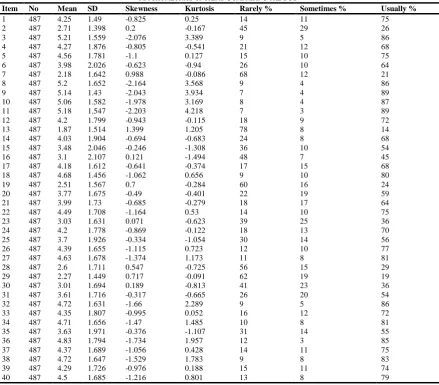
Table 2 presents the descriptive statistics of items comprising the SCS. As can be seen, the highest mean (5.21) belongs to item three, “My parents encourage me to continue my studies at higher levels”, showing that 86% of parents who have registered their children in the KLI encourage them to pursue their studies at higher levels. These results emphasize the importance the Iranian families attach to their children’s academic studies. The lowest mean score (1.87) was, however, obtained on item 13, “My mother follows my achievements with my English instructor during the semester”. This is because 78% of mothers could rarely follow their children’s English achievement. In K&A’s study, however, item 28, “I consult with my teachers when I have a problem” had the lowest mean score (1.47), indicating that 71% of G3SHS students rarely consulted their teacher regarding their problems. Unfortunately, item 28 is ambiguous within the context of G3SHS because it is not obvious whether it refers to English language teachers or the teachers of other courses such as the Persian language and biology.
TABLE 2
PSYCHOMETRICS OF ITEMS COMPRISING THE SCS
Item No Mean SD Skewness Kurtosis Rarely % Sometimes % Usually %
1 487 4.25 1.49 -0.825 0.25 14 11 75
2 487 2.71 1.398 0.2 -0.167 45 29 26
3 487 5.21 1.559 -2.076 3.389 9 5 86
4 487 4.27 1.876 -0.805 -0.541 21 12 68
5 487 4.56 1.781 -1.1 0.127 15 10 75
6 487 3.98 2.026 -0.623 -0.94 26 10 64
7 487 2.18 1.642 0.988 -0.086 68 12 21
8 487 5.2 1.652 -2.164 3.568 9 4 86
9 487 5.14 1.43 -2.043 3.934 7 4 89
10 487 5.06 1.582 -1.978 3.169 8 4 87
11 487 5.18 1.547 -2.203 4.218 7 3 89
12 487 4.2 1.799 -0.943 -0.115 18 9 72
13 487 1.87 1.514 1.399 1.205 78 8 14
14 487 4.03 1.904 -0.694 -0.683 24 8 68
15 487 3.48 2.046 -0.246 -1.308 36 10 54
16 487 3.1 2.107 0.121 -1.494 48 7 45
17 487 4.18 1.612 -0.641 -0.374 17 15 68
18 487 4.68 1.456 -1.062 0.656 9 10 80
19 487 2.51 1.567 0.7 -0.284 60 16 24
20 487 3.77 1.675 -0.49 -0.401 22 19 59
21 487 3.99 1.73 -0.685 -0.279 18 17 64
22 487 4.49 1.708 -1.164 0.53 14 10 75
23 487 3.03 1.631 0.071 -0.623 39 25 36
24 487 4.2 1.778 -0.869 -0.122 18 13 70
25 487 3.7 1.926 -0.334 -1.054 30 14 56
26 487 4.39 1.655 -1.115 0.723 12 10 77
27 487 4.63 1.678 -1.374 1.173 11 8 81
28 487 2.6 1.711 0.547 -0.725 56 15 29
29 487 2.27 1.449 0.717 -0.091 62 19 19
30 487 3.01 1.694 0.189 -0.813 41 23 36
31 487 3.61 1.716 -0.317 -0.665 26 20 54
32 487 4.72 1.631 -1.66 2.289 9 5 86
33 487 4.35 1.807 -0.995 0.052 16 12 72
34 487 4.71 1.656 -1.47 1.485 10 8 81
35 487 3.63 1.971 -0.376 -1.107 31 14 55
36 487 4.83 1.794 -1.734 1.957 12 3 85
37 487 4.37 1.689 -1.056 0.428 14 11 75
38 487 4.72 1.647 -1.529 1.783 9 8 83
39 487 4.29 1.726 -0.976 0.188 15 11 74
40 487 4.5 1.685 -1.216 0.801 13 8 79
Upon scrutinizing the functioning of items comprising the SCS, the Kaiser-Meyer-Olkin (KMO) measure of Sampling Adequacy was employed to find out whether applying factor analysis to the data collected in this study and extracting its latent variables was appropriate. The results presented in Table 3 showed the KMO statistic obtained in this study was in the .90s, i.e., .92, considered “excellent” by Kaiser (1974 cited in DiLalla & Dollinger, 2006, p. 250). It was superior to .86 reported by K&A and thus the sample upon which it was collected was treated as adequate. The significant Bartlett’s Test of Sphericity, i.e., X2
TABLE 3 KMO AND BARTLETT'S TEST
This Study K&A’s Study Kaiser-Meyer-Olkin Measure of Sampling Adequacy .919 .86
Bartlett's Test of Sphericity
Approx. Chi-Square 8820.040 12964.176
df 780 780
Sig. .000 .000
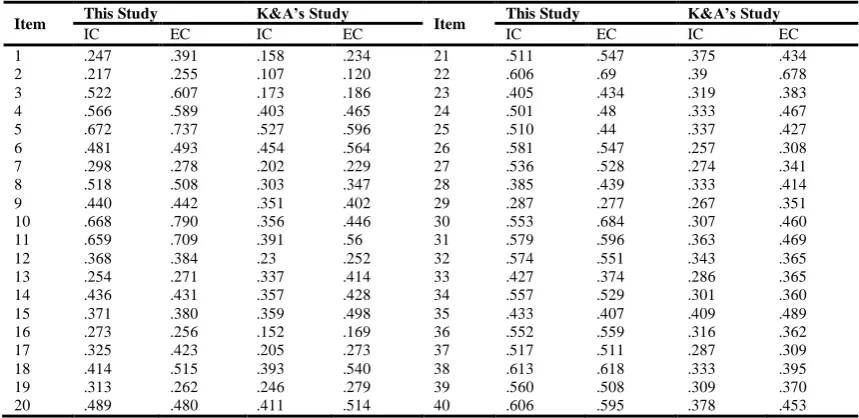
Table 4 presents the initial (I) and extraction (E) communalities (C) of the 40 items comprising the SCS. As can be seen, the lowest EC (.26) obtained in this study belongs to item two, “My father is often at home”. The results reported by K&A show that the same item has the lowest EC (.12) for G3SHS students as well. These findings challenge MacCallum et al.’s (1999) endorsement of communalities in the magnitude of .80 and above and the order of .40 to .70 suggested by Costello and Osborne (2005) and support Khodadady and Yazdi’s (2014) suggestion that communalities “should be analyzed and discussed in terms of item loadings” (p. 168). In spite of having the lowest EC, item two loads acceptably on a single factor.
TABLE 4
INITIAL (I) AND EXTRACTION COMMUNALITIES (EC) OF ITEMS COMPRISING THE SCS
Item This Study K&A’s Study Item This Study K&A’s Study
IC EC IC EC IC EC IC EC
1 .247 .391 .158 .234 21 .511 .547 .375 .434
2 .217 .255 .107 .120 22 .606 .69 .39 .678
3 .522 .607 .173 .186 23 .405 .434 .319 .383
4 .566 .589 .403 .465 24 .501 .48 .333 .467
5 .672 .737 .527 .596 25 .510 .44 .337 .427
6 .481 .493 .454 .564 26 .581 .547 .257 .308 7 .298 .278 .202 .229 27 .536 .528 .274 .341 8 .518 .508 .303 .347 28 .385 .439 .333 .414 9 .440 .442 .351 .402 29 .287 .277 .267 .351 10 .668 .790 .356 .446 30 .553 .684 .307 .460 11 .659 .709 .391 .56 31 .579 .596 .363 .469 12 .368 .384 .23 .252 32 .574 .551 .343 .365 13 .254 .271 .337 .414 33 .427 .374 .286 .365 14 .436 .431 .357 .428 34 .557 .529 .301 .360 15 .371 .380 .359 .498 35 .433 .407 .409 .489 16 .273 .256 .152 .169 36 .552 .559 .316 .362 17 .325 .423 .205 .273 37 .517 .511 .287 .309 18 .414 .515 .393 .540 38 .613 .618 .333 .395 19 .313 .262 .246 .279 39 .560 .508 .309 .370 20 .489 .480 .411 .514 40 .606 .595 .378 .453
TABLE 5 ROTATED FACTOR MATRIXA
Items Factors
1 2 3 4 5 6 7 8
1 -.046 .093 .086 -.056 -.034 .110 .632* .015 2 .009 .112 .038 .073 .003 -.050 .489* -.006 3 .072 .637* .150 -.055 .015 -.018 .003 .426* 4 .137 .692* .024 -.033 .052 .066 .107 .235
5 .141 .823* .164 .005 .017 .026 .042 .068
6 .117 .649* .070 .058 -.019 .015 .169 .087 7 -.030 .486* .019 .094 .154 .034 .058 .028 8 .170 .521* .315* -.034 .116 -.060 .262 -.033 9 .127 .408* .312 -.105 .227 .044 .231 .127 10 .115 .448* .728* -.050 .147 .013 .090 .021 11 .070 .447* .657* -.043 .187 .072 .087 .044 12 .054 .326* .360* .133 .285 -.019 .124 -.116 13 .062 .418* .031 .071 .160 .002 -.094 -.175 14 .060 .577* .112 -.024 .163 .063 .130 -.225 15 .077 .532* .082 .030 .126 -.010 -.023 -.226 16 .024 .374* .101 .034 .304 -.009 -.104 -.017 17 .023 .215* .094 -.047 .584* .016 -.008 .001 18 .037 .309* .143 -.027 .614* .092 .020 -.011 19 .342* .052 -.011 .129 .181 .303 -.015 .108 20 .542* .125 .051 .015 .338* .197 -.100 .071 21 .518* .031 .057 -.024 .126 .488* .103 .047 22 .577* -.008 .014 .095 .048 .579* .056 -.031 23 .408* .087 .021 .153 .002 .459* .026 -.093 24 .586* .107 .101 .178 .003 .244 -.127 .011 25 .567* .279 .113 .123 .028 .021 -.052 .107 26 .677* .020 .105 .270 -.014 .023 -.034 .006 27 .647* .025 -.003 .189 -.033 .145 -.031 -.186 28 .357* .113 -.024 .473* -.134 .168 -.047 -.148 29 .352* -.046 .017 .352* -.112 .123 -.061 .011 30 .410* .043 -.042 .641* .033 -.024 .095 .044 31 .491* .070 -.026 .539* .120 .079 .070 .009 32 .707* .135 .050 .094 .045 .092 .024 .001 33 .575* -.078 .025 .037 -.013 .161 -.078 -.035 34 .712* -.001 .011 .013 -.137 .094 -.007 -.161 35 .510* .296 -.120 .065 .013 .044 .186 -.129 36 .691* .244 .021 -.139 .011 -.011 .109 -.001 37 .686* -.090 .071 .119 .031 .058 .037 .035 38 .754* .067 .114 .094 .086 -.017 .039 .095 39 .659* .187 .037 .152 .063 -.022 .019 .068 40 .713* .178 -.112 .134 .121 .024 .052 .072
Extraction Method: Principal Axis Factoring. Rotation Method: Varimax with Kaiser Normalization. a. Rotation converged in 9 iterations. * Loadings higher than .32
As can be seen in Table 5 above, all forty items forming the Persian SCS have loaded acceptably on the eight factors extracted and rotated via PAF and VKN and thus shown their relevance to social capitals explored in this study. Among the items, eleven have, however, crossloaded on another factor, i.e., 3, 10, 11, 12, 20, 21, 22, 23, 28, 29, 30 and 31. The highest loadings of each of these items on one factor was taken as the indicator of its contribution to the genus represented by that particular factor and its lower acceptable loadings on the second factor was considered redundant and removed from its structure.
Item three, “My parents encourage me to continue my studies at higher levels”, for example, loaded .637 and .426 on factors two and eight, respectively. Since its loading on factor two was higher than that of factor eight, it was considered as a part of the genus represented by factor two and its cross loading on factor eight was removed. Since item three was the only item which had loaded on factor eight, its removal reduced the number of factors from eight to seven. Based on the fact that the purpose of factor analysis is to cluster the most related items under a single genus, the removal of cross loadings not only refines the construct under investigation but also helps reduce the number of factors as it has done in this study.
TABLE 6
DESCRIPTIVE STATISTICS AND RELIABILITY ESTIMATES OF TEN FACTORS UNDERLYING THE SCS(N=487)
Fact ors
# of
item Mean SD α
Extraction Sums of Squared Loadings Rotation Sums of Squared Loadings Eigenvalue % of
Variance Cumulative % Eigenvalue % of
Variance Cumulative %
1 16 67.30 18.483 0.92 9.583 23.959 23.959 7.580 18.949 18.949 2 11 43.01 12.450 0.85 4.864 12.161 36.120 4.648 11.620 30.570 3 3 14.44 4.111 0.78 1.123 2.807 38.926 1.505 3.762 34.332 4 4 11.49 4.958 0.75 .960 2.401 41.327 1.421 3.552 37.883 5 2 8.85 2.617 0.62 .836 2.090 43.417 1.370 3.426 41.309 6 2 7.52 2.940 0.71 .742 1.855 45.272 1.143 2.857 44.166 7 2 6.96 2.374 0.52 .608 1.521 46.794 .999 2.496 46.662 SCS 40 159.57 32.968 0.92 .525 1.313
The seven factors underlying the SCS in this study subsume its 40 items under more representative latent variables than the ten factors extracted and rotated by K&A. While factor one in this study, for example, explains 18.9% of rotation variance in the scale, it drops to 4.9% in K&A’s study. Although the difference is due partly to the number of items loadings on the factor in the two studies, 16 versus 6, it reflects the English language learners’ ability to relate the items to each other within fewer cognitive categories compared to G3SHS students. This is further revealed in the same latent variable extracted as factor seven and factor ten, i.e., Parent Availability, in this and K&A’s studies, respectively. Although the same items constitute Parent Availability in both studies, it explains more variance, i.e., 2.5%, in the present study than it does in K&A’s study, i.e., 1.8%. Furthermore, the total percentage of variance explained in this study (46.7%) is noticeably higher than that of K&A (39.3%).
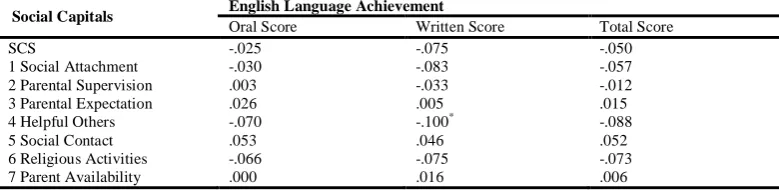
Table 7 presents the correlations between the SCS and the scores the English language learners obtained in their oral and written examinations. As can be seen, no significant relationship could be established. Neither did the learners oral and total scores relate significantly to any of the seven factors underlying the SCS. Nor did six out of seven factors constituting the SCS show any significant relationship with the learners’ written scores. Only the fourth factor, i.e., Helpful Others, correlates significantly but negatively with the written scores (r = -.10, p<.05). These results largely reject the second hypothesis that the SCS and its underlying factors do not correlate significantly with English achievement scores.
TABLE 7
CORRELATIONS BETWEEN ACHIEVEMENT SCORES AND THE SCS AS WELL AS ITS UNDERLYING FACTORS
Social Capitals English Language Achievement
Oral Score Written Score Total Score
SCS -.025 -.075 -.050
1 Social Attachment -.030 -.083 -.057
2 Parental Supervision .003 -.033 -.012
3 Parental Expectation .026 .005 .015
4 Helpful Others -.070 -.100* -.088
5 Social Contact .053 .046 .052
6 Religious Activities -.066 -.075 -.073
7 Parent Availability .000 .016 .006
IV. DISCUSSION
TABLE 7
SCHEMATA CONSTITUTING THE LANGUAGE OF SCS
Domains Genera Tokens Types
Frequency Percent Frequency Percent
Semantic
Adjectives 26 6.4 16 8.5
Adverbs 6 1.5 3 1.6
Nouns 97 24.0 62 32.8
Verbs 73 18.0 53 28.0
Total 202 49.9 134 70.9
Syntactic
Conjunctions 21 5.2 4 2.1
Determiners 62 15.3 8 4.2
Prepositions 40 9.9 14 7.4
Pronouns 59 14.6 17 9.0
Syntactic verbs 5 1.2 5 2.6
Total 187 48.2 48 25.4
Parasyntactic
Abbreviations 3 .7 1 .5
Names 5 1.2 3 1.6
Para-adverbs 3 .7 2 1.1
Particles 5 1.2 1 .5
Total 16 4.0 7 3.7 Total 405 100.0 189 100.0
The linguistic analysis of SCS at genus level provides more information elucidating the nature of its language. As can be seen in Table 5.1 above, most of schema tokens are nouns (n = 97, 24.0%) followed by verbs (n = 73, 18.0%). The significance of these two schema genera becomes more apparent when their types are taken into consideration. They form 61% (n = 115) of all schema types comprising the SCS. Together with adjective and adverb schema types (n = 16, 8.5% and 3, 1.6%, respectively), they form 71% of schema types used in the SCS (n = 189). These results reveal the schema-based structure of SCS language further when they are compared with other psychological measures.
Khodadady and Tabriz (2012), for example, developed their 117-sentence Persian Emotional Intelligence Scale (EQS) by removing the redundant sentences of Bar-On’s (1997) EQ-i and changing its reverse sentences to positive statements. When they administered the EQS to 669 instructors of English in the Iran Language Institute (ILI) in 15 cities in Iran, 112 sentences loaded acceptably on 15 factors, indicating that five of them did not contribute to the language of EQS. A genus-based analysis of these 112 sentences shows that they consist of 48 adjective, 11 adverb, 68 noun and 96 verb genera forming 75% of schema types (n = 223) used in the EQS. A comparative linguistic analysis of the schemata used in the SCS and EQS thus shows that the former is not as rich as the latter simply because the SCS consists of fewer semantic schema types, i.e., 189, than the EQS does, i.e., 223, necessitating the development of a more comprehensive measure for social capitals.
In addition to describing the SCS linguistically, the application of microstructural analysis of schema theory to the results obtained through factor analysis shows that the 405 schema tokens comprising the 40 sentences of SCS contribute to social capitals as a cognitive domain as 112 species do to the domain of English language instructors’ emotional intelligence measured by EQS in Khodadady and Tabriz’s (2012) study. The English language learners’ comprehension, application, analysis, synthesis and evaluation of the schemata comprising the SCS results in accepting its 40 sentences as cognitive species which relate to each other by loading acceptably on seven factors treated as seven cognitive genera forming the domain of social capitals.
Figure 1 presents the components of social capitals as a cognitive domain having a hierarchical relationship with its constituting genera, species and schemata. As can be seen, 189 concepts represented by schema types such as “friends” and “phone” have been combined with each other within the context of 40 sentences to create the broader cognitive concepts of species. A specific number of these species have clustered together to create the broader cognitive concepts called genera. The two species, “I talk to my friends and acquaintances on phone” and “Our relatives and we visit each other”, for example, constitute the Social Contact genus of social capitals. The Social Attachment, Parental Supervision, Parental Expectation, Helpful Others, Social Contact, Religious Activities, and Parent Availability in turn form the domain of social capitals as measured by the SCS.
As it can also be seen in Figure 1 above, 189 schema types and 40 species created by K&A and adapted to English language learners studying in KLI in this study contribute to the domain of social capitals differently because their number differs in terms of the genera under which they come together to bring concepts which would have stayed unknown otherwise. While the genus of Social Attachment, for example, consists of 121 schema types and 16 species, Parent Availability is formed by two species and seven schema types, indicating that the genera differ from each other in linguistic and cognitive complexity. For this very reason, the genera constituting the domain of social capitals enter into different degrees of relationship with each other.
Table 8 presents the correlations between the SCS and its underlying factors. As can be seen, Social Attachment correlates significantly with the other genera except Parent Availability (r = .02, ns). In K&A’s study, however, Parent Availability does correlate significantly with their first factor, i.e., Self-Volunteering (r =.17, p<.05), indicating that what constitutes the domain of social capitals to G3SHS students is not necessarily the same for English language learners. In other words, while the Parent Availability genus of G3SHS students helps the students become socially active and offer help to others whenever necessary, it does not relate to English language learners’ attachment to their society.
TABLE 8
CORRELATIONS BETWEEN THE SCS AND ITS SEVEN UNDERLYING FACTORS
Factors SCS 1 2 3 4 5 6 7
SCS 1 .859** .697** .553** .592** .386** .596** .187** 1 Social Attachment .859** 1 .289** .222** .608** .142** .644** .021
2 Parental Supervision .697** .289** 1 .622** .132** .434** .140** .188**
3 Parental Expectation .553** .222** .622** 1 .076 .419** .117** .187**
4 Helpful Others .592** .608** .132** .076 1 -.002 .458** .006 5 Social Contact .386** .142** .434** .419** -.002 1 .083 .051 6 Religious Activities .596** .644** .140** .117** .458** .083 1 .044
7 Parent Availability .187** .021 .188** .187** .006 .051 .044 1
The Social Attachment genus of social capitals consists of 16 species and 212 schema tokens. It applies to those English language learners who have strong ties with their friends, are satisfied with their social life, accept and do their responsibilities as citizens and are valued by the people around them. They have a high quality and intimate educational environment which is trusted by their parents. They have many friends and acquaintances whom they contact and run to socialize while shopping. They like their teachers, participate in social and extracurricular activities, and help their townspeople. Their family participates in programs dealing with oblations and offers food to people who fast. They easily talk about their feelings with their parents and visit their neighbors.
The very attendance in the KLI and learning English has affected participants’ domain of social capitals because its main genus, Social Attachment, contains some species which contributed to other genera for G3SHS students in K&A’s study. Species “My family participates in programs dealing with oblations and offering food to people who fast”, for example, is religious because it contains the schemata “oblations” and “fast”. According to Onions (1973), the word “oblation” refers to “the action of solemnly offering something (e.g., a sacrifice, thanksgiving, etc.) to God or to a deity” (p. 1427). In K&A’ study this species loads acceptably on a genus they call Family Religiosity. Its loading on the first factor of the SCS indicates that some species of religion lose their supernatural nature and become social.
The role of English language learning in rendering religious species social particularly in relation to Social Attachment genus becomes clearer when its correlations with the genus of Religious Activities (r = .64, p<.01) is compared with that of K&A’s results. In their study, Family Religiosity correlates the highest with their first factor, i.e., Self-Volunteering, too. However, the relationship is relatively weaker (r = .38, p<.01). These results show that 41% of English language learners’ social attachment is explained by their religious activities whereas only 14% of G3HS students’ Self-Volunteering is explained by their family religiosity. In other words, English language learners get involved in religious activities in order to establish social attachment whereas G3HS students employ them to develop themselves.
The second genus of social capitals, i.e., Parental Supervision, consists of 11 species and 98 schema tokens. It entails mothers and fathers’ supervision of English language learners’ educational progress, their talking with learners regarding their future field of study and job opportunities, encouraging them to continue their studies at higher levels, their mothers’ familiarity with the learners’ friends, the mothers’ supervision of their English language learning more than their fathers and the mothers’ being in contact with English instructors to follow the learners’ English achievement. The parents also know where the learners are and what they do and help them with their homework within an intimate and stable family environment. The genus also shows that the learners meet their grandparents weekly.
As mentioned before the 11-species Parental Supervision is broad and thus differs from the genera K&A established in their study. The closest genus seems to be their Parental Monitoring factor which consists of five species. In spite of being narrower in species, i.e., consisting of just five species, the Parental Monitoring relates to Parent Availability to the same degree the Parental Supervision genus established in this study does (r = .19, p<.01), indicating that genera constituting the G3SHS students’ social capitals are more refined in scope, greater in number and enjoy stronger relationships with each other.
As the third genus forming the domain of social capitals, Parental Expectation consists of three species and 32 schema tokens. The genus reveals itself in the parents’ expectation of their English language learning children to be among the top students in their class and to succeed with a good score. It also involves the learners’ friends who expect them to succeed with a good score, emphasizing their friends' important in enforcing parental expectations among learners.
Parental Expectation forms a genus of G3SHS students’ social capitals as well. However, in addition to the three species constituting the same genus in this study it embodies parents’ encouragement of these students to continue their studies at higher levels. It also offers an interesting explanation for the differences found in the degree of relationships in the two studies. While Parental Expectation correlates the highest with Parental Supervision in this study (r = .62, p<.01), its relationship with Parent Monitoring is relatively weaker in K&A’ study (r = .48, p<.01), indicating that parents pay more attention to their children’s English language learning in KLI than they do to their achievement in schools.
As the fourth genus of social capitals, the genus of Helpful Others consists of four species and thirty schema tokens. It represents the people who help the English language learners in general when they need it and help them in particular when they want to made a decision. It involves consulting teachers at the time of facing a problem and considering most people as trustable. Compared to the same three-species genus established by K&A as their ninth factor, the genus of Helpful Others in this study includes the extra species “I consult with my teachers when I have a problem”, revealing the sample-based nature of genera. This particular species in K&A’s study loaded acceptably on a factor called Teacher Consultation.
Helpful Others shows the strongest relationship with Social Attachment in this study (r = .61, p<.01), indicating that English language learners seek the help of others in order to establish social attachment. G3SHS students, however, confine the genus mostly to their teachers because it correlates the highest with Teacher Consultation in K&A’s study (r = .42, p<.01). In spite of having a very strong relationship with Social Attachment, Helpful Others does not relate significantly to three genera to be discussed shortly. It does, however, correlate significantly with all the genera constituting G3SHS students’ social capitals, revealing the significant role others play in their social life.
The two species, “our relatives and we visit each other” and “I talk to my friends and acquaintances on phone” constitute the fifth genus of English language learners’ social capitals, i.e., Social Contact. They are unique to this study because they load acceptably along with three other species on a factor called Receptive Relatives by K&A, i.e., “our neighbors and we visit each other”, “We have many friends and acquaintances and keep in touch with them” and “I meet my grandparents weekly”. The differences in the two studies provide further evidence to approach genus as a sample-based cognitive concept whose constituting species change based on the participants to whom psychological measures such as the SCS are administered.
As the sixth genus of social capitals, Religious Activities comprises two species, i.e., “my family takes part in religious activities such as eulogizing and mourning for Imam Hussein’s death and celebrating Imams’ birthdays” and “we go to mosque to pray in congregation”. These two species loaded acceptably along with species 21, i.e., “my family participates in programs dealing with oblations and offering food to people who fast” on a factor called “Family Religiosity” by K&A. The findings of this study did, however, show that species 21 form a part of English language learners’ Social Attachment.
Similar to Social Contact and Religious Activities, the last genus of social capitals, i.e., Parent Availability, consists of two species, i.e., “my mother is often at home” and “my father is often at home”. It correlates significantly with only two genera of social capitals, i.e., Parental Supervision (r = .188, p<.01) and Parental Expectation (r = .187, p<.01), indicating that parents’ supervision and expectations of their children relates positively to their availability. Almost the same degree of relationship exists between Parent Monitoring and Parent Availability for G3SHS students, i.e., r = .19, p<.01 (K&A, p. 19). Unlike the findings of this study, Parental Supervision, however, shows lesser degree of significant relationship with Parent Availability (r = .15, p<.01) for the G3SHS students. The stronger relationship between English language learners’ Parental Supervision and Parent Availability may, nonetheless, be due to the fact that the genus Parental Supervision contains more species for these learners, i.e., 11, than it does for G3SHS students, i.e., four.
The results of this study do not establish any significant relationship between the domain of social capitals and English language achievement in the KLI. They are in line with Alaee’s (2012) findings. She developed a 43-item schema-based cloze multiple choice item test (S-Test) on the English textbook English Book 3 (Birjandi, Nouroozi & Mahmoodi, 2010) and administered it along with the SCS to 477 G3SHS students in the fourth educational district of Mashhad. The correlational analysis of the students’ performance on the S-Test and SCS did not yield a significant relationship (r = .020, ns), challenging scholars such as Baker (2006) who believed “social capital becomes the modus operandi for sustaining lifelong learning, taking groups and individuals forward in their knowledge and practice” (p.1).
The findings of this study also support those of Khodadady, Alaee and Natanzi (2011). They developed a 35-item Social and Cultural Capital Questionnaire (SCCQ) consisting of a 24-item social capital scale (SCS) and 11-item cultural capital scale (CCS) and administered it to 706 students of five public and private high school students in Mashhad. When they correlated the SCS with the students’ self-reported scores in their English course they obtained no significant correlation coefficient between the two. Neither could they establish any significant relationship between the social capitals and English language achievement when they divided the schools into private and state one.
V. CONCLUSION
Social capitals depend on the language in which they are presented within a specific psychological measure, e.g., SCS, and the participants who relate the schemata to their personal life by resorting to their attitudes, feelings and experiences. Since schemata represent personally acquired concepts, they create different broader concepts called cognitive genera when the SCS is administered to G3SHS students and English language learners in the KLI, rendering the domain of social capitals sample-dependent. While the 40 species formed by 405 schemata combine together to form ten genera for the domain of G3SHS students’ social capitals, they generate seven genera in the case of female students learning English in the KLI. Future research must show whether the same genera constitute the domain of social capitals for male English language learners in the same institute. It must also show whether the domain and its constituting genera are affected by a specific level of language proficiency when it is confined to a specific sample such as advanced learners of English registered in various language institutes.
REFERENCES
[1] Alaee, F. F. (2012). Designing and validating a student social capital questionnaire (SSCQ): Exploring the relationship between social capital and language achievement in a specific foreign language context (Unpublished master's thesis). Ferdowsi University of Mashhad, Iran.
[2] Baker, D. (2006, May). Social Learning Capital–interlinking social capital, lifelong learning and quality learning conversations. Paper presented in the Adult and Community Education Aotearoa Conference, Dunedin, New Zealand. [3] Bar-On, R. (1997). The Bar-On Emotional Quotient Inventory (EQ-i): A Test of Emotional Intelligence. Toronto, Canada:
Multi-Health Systems.
[4] Birjandi, P., Nouroozi, M., & Mahmoodi, G. (2010). English book 3. Tehran: CHAP VA NASHRE KETABHAYEH DARSI
IRAN.
[5] Coleman, J. S. (1987). Families and Schools. Educational Researcher (August–September), 32–38.
[6] Costello, A. B. & Osborne, J. W. (2005). Best practices in exploratory factor analysis: four recommendations for getting the most from your analysis. Practical Assessment Research & Evaluation, 10(7), 1-9.
[7] De Graaf, N. D., De Graaf, P. M., & Kraaykamp, G. (2000). Parental cultural capital and educational attainment in the Netherlands: A refinement of the cultural capital perspective. Sociology of Education, 73, 92-111.
[8] Dika, S. L., & Singh, K. (2002). Applications of social capital in educational literature: A critical synthesis. Review of Educational Research, 72(1), 31-60.
[9] DiLalla, D. L., & Dollinger, S. J. (2006). Cleaning up data and running preliminary analyses. In F. T. L. Leong and J. T. Aus tin (Ed.). The psychology research handbook: A guide for graduate students and research assistants (241-253). California: Sage. [10] Gorsuch, R. L. (1997). Exploratory factor analysis: Its role in item analysis. Journal of Personality Assessment, 68(3), 532-560. [11] Kaiser, H. (1974). An index of factorial simplicity. Psychometrika, 39, 31-6.
[12] Khodadady, E., Hezareh, O. (2016). Social and Emotional Intelligences: Empirical and Theoretical Relationship. Journal of Language Teaching and Research, 7(1), xxx-xxx.
[13] Khodadady, E. (1999). Multiple-choice items in testing: Practice and theory. Tehran: Rahnama.
[14] Khodadady, E. (2008a). Measuring translation ability and achievement: A schema-based approach. Quarterly Journal of Humanities, Al-Zahra University, 18(70), 56-76.
[15] Khodadady, E. (2008b). Schema-based textual analysis of domain-controlled authentic texts. Iranian Journal of Language Studies (IJLS), 2(4), 431-448.
[16] Khodadady, E. (2013). Research principles, methods and statistics in applied linguistics. Mashhad: Hamsayeh Aftab.
[17] Khodadady, E., & Alaee, F. F. (2012a). Designing and validating a social capital scale within a grade specific context.
European Journal of Educational Studies, 4(1), 701-717.
[18] Khodadady, E., & Alaee, F. F. (2012b). Parent Education and High School Achievement in English as a Foreign Language.
Theory and Practice in Language Studies, 2(9), 1811-1817.
[19] Khodadady, E., & Dastgahian, B. D. (2013). Logical-mathematical intelligence and its relationship with English language proficiency. American Journal of Scientific Research, 90, 57-68.
[21] Khodadady, E., & Ghergloo, E. (2013). S-Tests and C-Tests: Measures of content-based achievement at grade four of high schools. American Review of Mathematics and Statistics, 1(1), 1-16.
[22] Khodadady, E., & Hashemi, M. R. (2010). Construct Validity of Beliefs about Language Learning: Componential or Factorial.
Ferdowsi Review, 1(1), 3-20.
[23] Khodadady, E., & Lagzian, M. (2013). Textual analysis of an English dentistry textbook and its Persian translation: A schema-based approach. Journal of Studies in Social Sciences, 2(1), 81-104.
[24] Khodadady, E., & Namaghi, I. M. (2013). Social Intelligence and Language Proficiency: Are They Related? European Journal of Scientific Research, 102(1), 7-14.
[25] Khodadady, E., & Tabriz, S. A. (2012). Reliability and construct validity of factors underlying the emotional intelligence of Iranian EFL teachers. Journal of Arts & Humanities, 1(3), 72-86.
[26] Khodadady, E., & Yazdi, B. H. (2014). Cultural Intelligence of English Language Learners within a Formal Context. Journal of Psychology and Behavioral Sciences, 4(5), 165-172.
[27] Khodadady, E., & Zabihi, R. (2011). Social and Cultural Capital: Underlying Factors and Their Relationship with the School Achievement of Iranian University Student. International Education Studies, 4(2), 63-71.
[28] Khodadady, E., Alaee, F. F., & Natanzi, M. (2011). Factors underlying the social and cultural capitals of high school students and their relationship with English achievement. Theory and Practice in Language Studies, 1(11), 1618-1627.
[29] Khorashad, B. S. (2013). Persian Eyes Test. Retrieved April 7, 2013 from
http://docs.autismresearchcentre.com/tests/EyesTest_Persian.pdf.
[30] Lareau, A., & Weininger, E. B. (2003). Cultural capital in educational research: A critical assessment. Theory and Society, 32, 567-606.
[31] MacCallum, R. C., Widaman, K. F., Zhang, S. B., & Hong, S. H. (1999). Sample size in factor analysis. Psychological Methods, 4(1), 84-99.
[32] Onions, C. T. (Ed.) (1973). The shorter Oxford English dictionary Vol II (3rd ed.). Oxford: Clarendon Press.
[33] Seif, S. & Khodadady, E. (2003). Schema-based cloze multiple choice item tests: measures of translation ability. Universite de Tabriz, Revue de la Faculte des Letters et Sciences Humaines, Langue, 187(46), 73-99.
[34] Smith, M. H., Beaulieu, L. J., & Israel, G. D. (1992). Effects of human capital and social capital on dropping out of high school in the South. Journal of Research in Rural Education, 8(1), 75-87.
[35] Snook, S. C., & Gorsuch, R. L. (1989). Component Analysis Versus Common Factor-Analysis – a Monte- Carlo Study.
Psychological Bulletin, 106(1), 148-154.
[36] Tabachnick, B. G., & Fidell, L. S. (2007). Using multivariate statistics(5th ed.). Boston: Pearson.
Ebrahim Khodadady obtained his PhD in Applied Linguistics from the University of Western Australia. He holds TESL Ontario and Canadian Language Benchmarks Placement Test (CLPBPT) certificates and has taught English as a first, second and foreign language to high school and university students in Australia, Canada and Iran.
He is currently an academic member of Ferdowsi University of Mashhad, Iran. He was invited as a VIP by Brock University in Canada in 2004 and served as the Associate Director of Assessment Center at George Brown College in Toronto for almost a year. His published books are Multiple-Choice Items in Testing: Practice and Theory (Tehran, Rahnama, 1999), Reading Media Texts: Iran-America Relations (Sanandaj, Kurdistan University, 1999), English Language Proficiency Course: First Steps (Sanandaj, Kurdistan University, 2001) and Research Principles and Methods and Statistics in Applied Linguistics (Mashhad, Hamsayeh Aftab, 2013). His main research interests are applied linguistics, psycholinguistics and sociolinguistics.