EFFECT OF VARIOUS SOIL AMENDMENTS ON THE
MINERAL NUTRITION OF SALIX VIMINALIS AND ARUNDO
DONAX ENERGY CROPS
László Simon
a*, Béla Szabó
b, Miklós Szabó
a, György Vincze
a, Csaba Varga
a,
Zsuzsanna Uri
a, József Koncz
cPaper was presented at the 4th International Symposium on Trace Elements in the Food Chain, Friends or Foes, 15-17 November, 2012, Visegrád, Hungary
Keywords: soil amendments, mineral nutrition, Salix viminalis, Arundo donax, energy crops
Basket willow (Salix viminalis L., cv. Inger) and giant reed (Arundo donax L.) energy crops were grown in open-field experiments. The brown forest soil (loamy sand texture, pHKCl 7.5, humus 1.5%, CEC 10.4 cmolc kg-1; As-38.3, Cd-0.11, Cu-12.7, Pb-13.6, Zn-44.3 mg kg-1
in HNO3 - H2O2 extract) was treated with artificial fertilizer and various soil amendments (ammonium nitrateAN: 100, 150, 300 kg ha-1;
municipal sewage sludge compostMSSC: 15, 25 t ha-1; municipal biocompostMBC: 20, 25 t ha-1; willow bioashWB: 600 kg ha-1), and
with their combination in 4 or 3 replications. Three months later, in the leaves of treated Salix cultures (except WB application) 9.8-23.5% more N was detected than in untreated controls. Most of the treatments enhanced the uptake of K, but concentration of P, Mg, Ca, Fe and Zn in leaves was reduced. Highest As concentrations (1.92-2.11 g g-1) were found in WB-treated cultures. Cd concentration in treated
leaves (0.34-0.57 g g-1) was lower than in controls (0.99 g g-1), while Pb concentrations were under the detection limit. Eighteen weeks
after first soil treatments with AN, MBC or MSSC mostly MSSC application influenced the accumulation of macro- and micronutrients in the leaves of Arundo, however the observed changes were statistically not significant. Concentrations of toxic Cd and Pb were under the detection limits in all treatments. In spite of the repeated soil application of AN, MBC or MSSC, thirty four weeks later statistically significant changes were not observed in the uptake or accumulation most of the elements (including toxic Cd and Pb) in giant reed shoots.
* Corresponding Authors E-Mail: [email protected]
[a] Department of Land Management and Rural Development, College of Nyíregyháza, H-4400 Nyíregyháza, Sóstói str. 31/b. Hungary.
[b] Department of Agricultural Science, College of Nyíregyháza, H-4400 Nyíregyháza, Sóstói str. 31/b. Hungary.
[c] Hungarian Academy of Sciences, Centre for Agricultural Research, Institute of Soil Science and Agricultural Chemistry, H-1022 Budapest, Herman O. str. 15., Hungary.
Introduction
Depletion of fossil fuels and continuously increasing emission of carbon dioxide focus attention on energy production from biomass. Energy crops (e.g. Agropyron,
Arundo, Populus, Robinia, Salix, Sida sp.) can significantly
mitigate carbon dioxide anthropogenic emissions, partially replacing fossil fuels. It was estimated that 1 hectare of energy crop save approximately 5 tons of fossil-carbon1,2
Among energy crops, which are cultivated for their high aboveground biomass, the rapidly growing woody basket willow (Salix viminalis L.) and herbaceous giant reed
(Arundo donax L.) are promising. Their annually
harvestable shoot wet biomass can achieve 20 or 30 tons per hectare, respectively. Since short rotation coppice (SRC) energy plantations can be cultivated for 15-20 years in the same field, the regular re-supply of plant nutrients in soil is important.3 One possibility for fertilizing these plants is the
field application of municipal sewage sludge, which is rich in nitrogen, phosphorus and various trace elements.4
It is well documented that Salix sp. (including basket willow) has intensive mineral nutrition, and the Cd and Zn phytoextraction capacity of shoots is high.5 , 6 , 7 , 8 This
phenomenon was confirmed in our pot experiment; shoots of basket willow extracted considerable amounts of Cd and Zn from a galvanic mud contaminated soil.9 Mineral
nutrition of giant reed is less revealed, this plant tolerates well the high concentrations of toxic metals (Cd, Ni, Pb) in soil.10 It was found in our previous pot and open-field
experiments that giant reed shoots principally phytoextracted Zn from a pig slurry or municipal sewage sludge compost amended soil.11
The objective of this study was to investigate the inorganic plant nutrient uptake and toxic metal accumulation in basket willow and giant reed aboveground organs. Plants were grown in a brown forest soil treated with ammonium nitrate fertilizer and various amendments (municipal sewage sludge compost, municipal biocompost, and willow bioash).
Experimental
Open-field small-plot experiments were set up with basket willow (cv. Inger) during April 2011 and with giant reed (unidentifiable ornamental plant cultivar originating from Nyíregyháza) during June 2009 in the demonstration garden of the College of Nyíregyháza, located close to Westsik street in Nyíregyháza, Hungary. In one 27 m2 willows plot
40 plants, and in one 10 m2 giant reed plot 10 plants were
Table 1. Effect of ammonium nitrate, municipal biocompost, municipal sewage sludge compost and willow bioash on the uptake of essential macro- and microelements in the leaves of basket willow (Salix viminalis L., cv. Inger) 12 weeks after treatments (open-field experiment, Nyíregyháza Hungary, September 2011).
Treatments N P K Ca Mg Fe Cu Mn Zn
m m-1 % mg g-1 dry matter g g-1 dry matter
Control 2.85a 5.038a 11.906a 10.187bc 5.180a 124a 6.71a 74.9a 104b
(0.02) (0.539) (0.337) (1.539) (0.230) (21) (0.27) (9.51) (12.5)
Ammonium nitrate (AN) 3.33a 3.199ab 13.391a 9.353ab 4.560a 103a 6.87a 82.5a 38.3ab
(0.19) (0.214) (1.171) (0.294) (0.408) (1.1) 0.39 2.60 12.2
Municipal biocompost (MBC) 3.52a 3.143ab 12.695a 7.349a 4.365a 85.7a 6.48a 76.7a 29.4a
(0.18) (0.335) (1.473) (0.520) (0.184) (1.50) (0.08) (0.04) (5.16)
Municipal sewage sludge compost (MSSC)
3.13a 3.411ab 13.698a 8.655ab 4.254a 91.5a 6.39a 73.8a 37.7ab
(0.29) (0.040) (374) (734) (428) (2.9) (0.54) (19.2) (16.0)
Willow bioash (WB) 2.83a 4.026ab 12.414a 9.831abc 4.447a 107a 7.34a 84.5a 77.9ab
(0.04) (0.527) (0.503) (0.063) (0.098) (3) (0.49) (14.4) (34.4)
MBC + AN 3.13a 3.537ab 13.410a 9.287ab 4.392a 86.7a 7.20a 70.9a 28.8a
(0.47) (0.538) (0.762) (0.483) (0.280) (1.48) (0.08) (5.1) (3.7)
MSSC + WB 3.50a 2.822b 14.125a 12.126c 5.034a 99.0a 11.6a 126b 33.6a
(0.07) (0.503) (1.363) (0.387) (0.633) (4.3) (3.6) (1.1) (3.3)
WB + AN 3.19a 3.243ab 13.052a 9.979abc 4.580a 96.6a 6.46a 98ab 46.9ab
(0.67) (0.824) (1.305) (0.715) (0.112) (18.8) (0.10) (17) (29.7)
Data are means of 3 replications, standard deviations are in parenthesis. ANOVA. Tukey’s b-test. Means within the columns followed by the same letter are not statistically significant at P<0.05.
The uncontaminated brown forest soil (its basic characteristics are in the abstract) of willow plots was treated in June 2011 with ammonium nitrateAN:100 kgha-1
dry weight (producer Nitrogénművek Ltd., Pétfürdő, Hungary); municipal biocompostMBC: 20 t ha-1 wet
weight with 75-76% dry matter (producer Térségi Hulladék-Gazdálkodási Ltd., Nyíregyháza Hungary); municipal sewage sludge compostMSSC:15 t ha-1 wet weight with
48-56% dry matter (producer Nyírségvíz Ltd., Nyíregyháza, Hungary); and willow bioashWB: 600 kg ha-1 dry weight
(produced at the College of Nyíregyháza by burning of basket willow shoots) with 4 replications. Control plots were untreated. Combined treatments were 20 t ha-1 MBC+100
kg/ha AN; 15 t ha-1 MSSC+600 kg ha-1 WB; and 600 kg ha-1
WB+100 kg ha-1 AN. Willow leaves were sampled from 20
plants per plot during September, 2011. Leaves were collected from 30-60 cm section of the uppermost section of shoots. 12
Soil of the giant reed plots was treated in June 2009 with AN (150 and 300 kg ha-1), MBC (25 t ha-1), MBC+AN (25 t
ha-1 +150 kg ha-1), and MSSC (25 t ha-1) with 3 replications.
Control plots were untreated. All treatments were repeated again in July 2010. Eighteen weeks after first soil treatments (in October, 2009) leaf samples, while 34 weeks after second soil treatments (in March, 2011) shoot samples were collected from all experimental plots. First fully developed leaves of the uppermost section of living shoots (from 25 shoots/plot), and middle section of dry shoots (from 10 shoots/plot at approx. 2 m height) were sampled. 12
Concentration of macro- and microelements in mixed, washed, dried and ground plant samples was determined by ICP-OES technique after HNO3 - H2O2 digestion12. Nitrogen
concentration of samples was determined by Kjeldahl method. 12
Statistical analysis of data was conducted with SPSS 18.0 software using analysis of a variance (ANOVA) followed by treatment comparison using Tukey’s b-test.
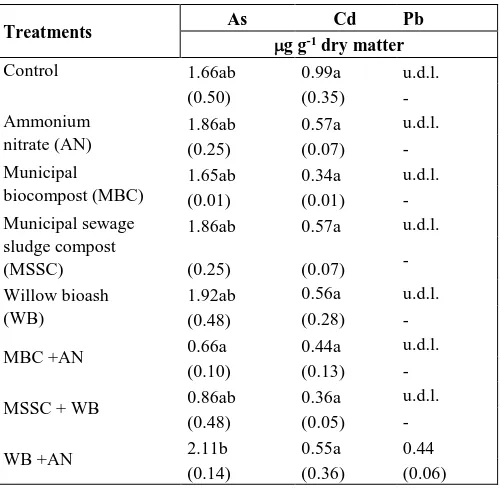
Table 2. Concentration of selected toxic elements in the leaves of basket willow (Salix viminalis L., cv. Inger) 12 weeks after soil treatments (open-field experiment, Nyíregyháza Hungary, September 2011).
Treatments As Cd Pb
g g-1 dry matter
Control 1.66ab 0.99a u.d.l.
(0.50) (0.35) -
Ammonium nitrate (AN)
1.86ab 0.57a u.d.l.
(0.25) (0.07) -
Municipal biocompost (MBC)
1.65ab 0.34a u.d.l.
(0.01) (0.01) -
Municipal sewage sludge compost (MSSC)
1.86ab 0.57a u.d.l.
(0.25) (0.07) -
Willow bioash (WB)
1.92ab 0.56a u.d.l.
(0.48) (0.28) -
MBC +AN 0.66a 0.44a u.d.l.
(0.10) (0.13) -
MSSC + WB 0.86ab 0.36a u.d.l.
(0.48) (0.05) -
WB +AN 2.11b 0.55a 0.44
(0.14) (0.36) (0.06)
Results and Discussion
Table 1 shows the effects of AN, MBC, MSSC, WB and combined treatments on the concentration of essential macro- and microelements in the leaves of basket willow, twelve weeks after soil treatments. Nitrogen concentration was enhanced in basket willow leaves by 9.8-23.5% in all treatments, except WB application. The most pronounced effect was observed at MBC and MSSC+WB treatments, where 23.5% and 22.8% more N was detected than in control culture. All treatments slightly enhanced the potassium content of leaves, while magnesium concentrations were lower than in control. Considering the standard deviation of data, however, the changes in N, K and Mg concentrations were statistically not significant (Table 1).
Treatments lowered the uptake of P, Mg, Fe, Ca (except MSSC+WB application) and Zn concentration in leaves. This phenomenon can be explained by stimulation of the aboveground biomass production of basket willow by most of the treatments.12 Since higher shoot biomass was formed,
the accumulated essential macro- and microelements was more distributed (diluted) in organic matrix. The highest Ca, Cu or Mn concentrations were observed in MSSC+WB-treated cultures.
The Table 2 records the concentration of selected toxic elements (As, Cd, Pb) in willow leaves. The lowest As content (0.660.10 g g-1) was found in MBC+AN-treated
culture, while the highest 2.11 (0.14) was detected in WB+AN treatments. This difference was statistically significant. In the leaves of control cultures 1.66 ( 0.50) g g-1As was measured. Formerly in MBC 6.26 ( 0.03), in
MSSC 20.7 ( 0.60), while in WB 35.4 ( 0.70) mg kg-1
arsenic was found in HNO3 - H2O2 extracts.12 The As
concentration in the basic brown forest soil before treatments was relatively high; 38.3 ( 5.5) mg kg-1. 12 In the
leaves of control cultures the Cd concentration (0.990.35 g g-1) was the highest; all treatments resulted in lower Cd
accumulation. The differences were statistically not significant. Detectable quantity of Pb (0.44 0.06 g g-1)
was present only in WB+AN-treated culture.
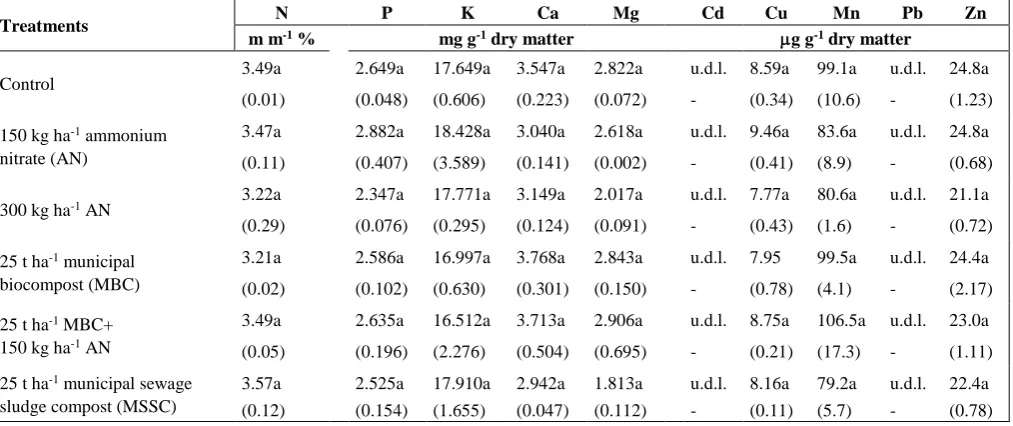
Table 3. Effect of ammonium nitrate, municipal biocompost and municipal sewage sludge compost on the uptake of essential macro- and microelements, and accumulation of selected toxic elements in the leaves of giant reed (Arundo donax L.) 18 weeks after their first soil application (open-field experiment, Nyíregyháza Hungary, October 2009).
Treatments N P K Ca Mg Cd Cu Mn Pb Zn
m m-1 % mg g-1 dry matter g g-1 dry matter
Control 3.49a 2.649a 17.649a 3.547a 2.822a u.d.l. 8.59a 99.1a u.d.l. 24.8a
(0.01) (0.048) (0.606) (0.223) (0.072) - (0.34) (10.6) - (1.23)
150 kg ha-1 ammonium
nitrate (AN)
3.47a 2.882a 18.428a 3.040a 2.618a u.d.l. 9.46a 83.6a u.d.l. 24.8a
(0.11) (0.407) (3.589) (0.141) (0.002) - (0.41) (8.9) - (0.68)
300 kg ha-1 AN 3.22a 2.347a 17.771a 3.149a 2.017a u.d.l. 7.77a 80.6a u.d.l. 21.1a
(0.29) (0.076) (0.295) (0.124) (0.091) - (0.43) (1.6) - (0.72)
25 t ha-1 municipal
biocompost (MBC)
3.21a 2.586a 16.997a 3.768a 2.843a u.d.l. 7.95 99.5a u.d.l. 24.4a
(0.02) (0.102) (0.630) (0.301) (0.150) - (0.78) (4.1) - (2.17)
25 t ha-1 MBC+
150 kg ha-1 AN
3.49a 2.635a 16.512a 3.713a 2.906a u.d.l. 8.75a 106.5a u.d.l. 23.0a
(0.05) (0.196) (2.276) (0.504) (0.695) - (0.21) (17.3) - (1.11)
25 t ha-1 municipal sewage
sludge compost (MSSC)
3.57a 2.525a 17.910a 2.942a 1.813a u.d.l. 8.16a 79.2a u.d.l. 22.4a
(0.12) (0.154) (1.655) (0.047) (0.112) - (0.11) (5.7) - (0.78)
Data are means of 3 replications, standard deviations are in parenthesis. u.d.l.= under the detection limit: Cd-0.02 g g-1, Pb-0.30 g g-1.
ANOVA. Tukey’s b-test. Means within the columns followed by the same letter are not statistically significant at P<0.05.
In Table 3 the effects of AN, MBC, MSSC and combined soil treatments are presented on the elemental composition of giant reed leaves 18 weeks after soil treatments, at the end of the vegetation period. From the data it is obvious that none of the treatments had significant influence on the macro- and microelement uptake or toxic element accumulation of leaves. It is advantageous that treatment of soil with MSSC have not enhanced the cadmium or lead accumulation in leaves (in all cultures the concentration of these toxic elements remained under the detection limit).
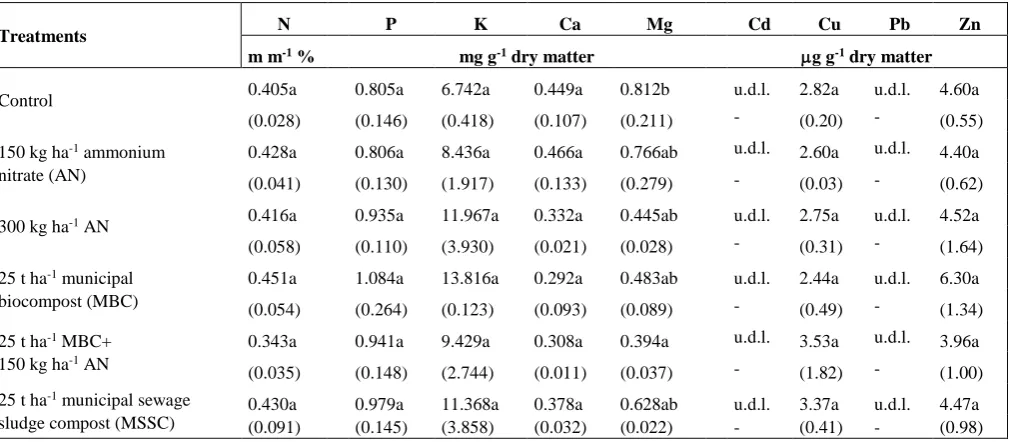
Table 4 shows the elemental composition of giant reed shoots 34 weeks after the second (repeated) soil application of AN, MBC and MSSC. If we compare data in Table 3 and 4, it is evident that in shoots the concentration of macro- and microelements is one order of magnitude lower than in leaves. In spite of the fact that AN, MBC and MSSC were already 2 times applied to the soil, their influence was
statistically nor significant for the uptake or accumulation most of the elements (including toxic Cd and Pb) in giant reed shoots. The only exception was Mg uptake, where statistically significant changes were observed.
Conclusions
Table 4. Effect of ammonium nitrate, municipal biocompost and municipal sewage sludge compost on the uptake of essential macro- and microelements, and accumulation of selected toxic elements in the shoots of giant reed (Arundo donax L.) 34 weeks after their second soil application (open-field experiment, Nyíregyháza Hungary, March 2011).
Treatments N P K Ca Mg Cd Cu Pb Zn
m m-1 % mg g-1 dry matter g g-1 dry matter
Control 0.405a 0.805a 6.742a 0.449a 0.812b u.d.l. 2.82a u.d.l. 4.60a
(0.028) (0.146) (0.418) (0.107) (0.211) - (0.20) - (0.55)
150 kg ha-1 ammonium
nitrate (AN)
0.428a 0.806a 8.436a 0.466a 0.766ab u.d.l. 2.60a u.d.l. 4.40a
(0.041) (0.130) (1.917) (0.133) (0.279) - (0.03) - (0.62)
300 kg ha-1 AN 0.416a 0.935a 11.967a 0.332a 0.445ab u.d.l. 2.75a u.d.l. 4.52a
(0.058) (0.110) (3.930) (0.021) (0.028) - (0.31) - (1.64)
25 t ha-1 municipal
biocompost (MBC)
0.451a 1.084a 13.816a 0.292a 0.483ab u.d.l. 2.44a u.d.l. 6.30a
(0.054) (0.264) (0.123) (0.093) (0.089) - (0.49) - (1.34)
25 t ha-1 MBC+
150 kg ha-1 AN
0.343a 0.941a 9.429a 0.308a 0.394a u.d.l. 3.53a u.d.l. 3.96a
(0.035) (0.148) (2.744) (0.011) (0.037) - (1.82) - (1.00)
25 t ha-1 municipal sewage
sludge compost (MSSC)
0.430a 0.979a 11.368a 0.378a 0.628ab u.d.l. 3.37a u.d.l. 4.47a
(0.091) (0.145) (3.858) (0.032) (0.022) - (0.41) - (0.98)
Data are means of 3 replications, standard deviations are in parenthesis u.d.l.= under the detection limit: Cd-0.02 g g-1, Pb-0.30 g g-1. ANOVA. Tukey’s b-test. Means within the columns followed by the same letter are not statistically significant at P<0.05.
It is questionable whether there could be a considerable accumulation of toxic metals in the harvested biomass or in bioash, which is formed after its incineration, during 15-20 years long life span of an energy plantation when biowastes (MBC, MSSC, WB) would have been applied 7-10 times to the soil. Further experiments are planned to investigate this phenomenon.
Acknowledgements
This work was sponsored by the Scientific Council of the College of Nyíregyháza and by Nitrogénművek Vegyipari Zrt. (Pétfürdő, Hungary) fertilizer producing company.
References
1 Blaskó, L., Cultivation of energy plants, site suitability,
availability. In: Renewable Agriculture (Ed.: Chlepkó, T.). Magyar Katolikus Rádió, Budapest. 2008, 167-207. (in Hungarian)
2 Graham, R.L., Wright, L.L., Turhollow, A.F., Climatic
Change,1992,22, 223–238.
3 Gyuricza, Cs., Nagy, L., Ujj, A., Mikó, P., Alexa, L.. Cereal
Res. Commun., 2008, 36, 279-282.
4 Kabata-Pendias, A., Pendias, H., Trace Elements in Soils and
Plants (3rd edition). Boca Raton, London, New York, Washington, D.C. CRC Press LLC. 2001.
5 Tlustoš, P., Pavlíková, D., Száková, J., Fischerová, Z., Balík, J.,
Exploitation of fast growing trees in metal remediation. In: Phytoremediation, Rhizoremediation (Eds.: Mackova, M., Dowling, D., Macek, T.). Springer. Dordrecht, The Netherlands. 2006, 83102.
6 Keller, C. Efficiency and limitations of phytoextraction by
high biomass plants: the example of willows. In: Trace Elements in the Environment. Biogeochem.,
Biotechnology, and Bioremediation. (Eds.: Prasad, M.N.V., Sajwan, K.S., Naidu, R.). CRC Press, Taylor and Francis Group. Boca Raton, Florida. 2006. 611630.
7 Máthé-Gáspár, G., Anton, A., Acta Biol. Szegediensis, 2005,
49, 6970.
8 Pulford, I. D., Dickinson, N. M., Phytoremediation
technologies using trees. In: Trace Elements in the Environment. Biogeochemistry, Biotechnology, and Bioremediation. (Eds.: Prasad, M.N.V., Sajwan, K.S., Naidu, R.). CRC Press, Taylor and Francis Group. Boca Raton, Florida. 2006, 383-403.
9 Simon, L., Phytoextraction of heavy metals with Salix and
Populus species. In: Proceedings of the conference “Competitive Agriculture”. Nyíregyháza, November 29, 2007. (Eds.: Szabó, B., Varga, Cs.). Bessenyei György Book Publisher, Nyíregyháza. 2007, 197-200. (in Hungarian)
10 Papazoglou, E. G., Karantounias, G.A., Vemmos, S.N.,
Bouranis D. L., Environ. Int., 2005, 31, 243-249.
11 Simon, L., Kovács, B., Barna, S., Varga, C., Dinya, Z.,
Accumulation of heavy metals in Arundo and Salix energy plants treated with pig slurry, municipal sewage sludge and inorganic fertilizers. In: Proc. 7th Int. Symp. Trace Elements in Human: New Perspectives. 13-15 October,
2009. (Ed.: Pollet, E.). University of Athens, Greece. CD-ROM. 258-265.
12 Simon, L., Szabó, B., Szabó, M., Varga, Cs., Vincze, Gy.,
Investigation of the yield and plant mineral nutrient supply of energy crops with special attention to common effect of nitrogen fertilizers and biowastes. Scientific report prepared for the Nitrogénművek Vegyipari Zrt. (Pétfürdő) fertilizer producer. College of Nyíregyháza, Technical and Agricultural Faculty, Nyíregyháza, Hungary. 2011. 1-91. (manuscript in Hungarian).