ISSN: 2278-3369
International Journal of Advances in Management and Economics Available online at: www.managementjournal.info
RESEARCH ARTICLE
A Study Identifying Factors Affecting Branding of Management
Institutes in Madhya Pradesh
Dixit Amit
1*
,
Sharma Kapil
21Research Scholar, Banasthali Vidyapith, P.O. Banasthali Vidyapith-304022, Rajasthan, India.
2Associate Professor (Finance Area) Institute of Management Studies, Khandwa Road, Takshashila Campus Devi Ahilya University Indore (MP-) 452017, India.
*For Correspondence: Dixit Amit
Abstract
In contemporary knowledge driven global economy, higher education systems majorly engage in roles of social development and national economic competitiveness. The last few decades of Management Education in India has witnessed a noteworthy transformation. The perpetual growth and uniqueness of businesses in India, government initiatives for education and government’s acknowledgment to the entrepreneurial efforts of several private players have fostered the growth of Management Institutes. The popularity of management degrees and diplomas has created a clutter, competition and challenge for Management Institutes to prove their distinctiveness. Branding has become an indispensable tool for institutes to stay ahead of the competition by communicating this differentiation. The institutions in India have recognized that by investment of time and resources they can strategically build their educational brands to be more preferable and acclaimed amongst students and the society. The purpose of this paper is to examine the essential role branding plays in successful institutional settings of Management Institutes pertaining to Madhya Pradesh (M.P.), a state in central India. The paper also attempts to uncover the factors which influence the constructs of branding Management Institutes in M.P.
Keywords: Branding, Entrepreneurial, Management Education, Management Institutes.
Introduction
The rapid changes in the global paradigm and demographic shifts have significantly transformed the people's attitude towards education. The cumulative effect of these events is pragmatic in experiencing how Management Institutes have transformed and are striving for a credible image and reputation. The concept of branding has become ubiquitous and has pierced in to the practices of Institutional Building.
The private sector with intent reading the overall scenario has very well tapped in to the need for high-quality Management Institutes in India. It has shown active participation and is working painstakingly for developing high-quality Management Institutes in India. The fierce competition amongst these private sector players has
resulted in making branding an everyday lexicon in Management Education.
The Management Education poses several challenges due to series of characteristics unique to services i.e. intangibility, heterogeneity and perishability. The service oriented nature of Management Education has made branding more pertinent and is now considered to be one of the most valuable intangible assets of any institution.
domain which will always remain far from truth. The Management Institutes should contemplate what the brand of the institute actually signifies otherwise it would be a humiliation for the branding resources who meticulously are working for them.
Brand- An Illustration
The Old Norse word brandr, which means “to burn,” and from which brand was derived has transcended. It has a far more extensive meaning now for products and businesses.
According to the American Marketing Association (AMA), a brand is a “name, term, sign, symbol, or design, or a combination of them, intended to identify the goods and services of one seller or group of sellers and to differentiate them from those of competition.”In the contemporary world a brand is all about perception. It is a personification of the relations and associations that businesses strive to create between the customers and the products, services or the organization which is responsible for it.
Branding charts the audiences what brand messaging will speak to. It also helps choosing the most optimal channels which will be most effective in building awareness, whether advertising, social media, public relations or a combination. Plentiful homogenous products and services are available in the market place today it is a necessity to brand the products and services to make it stand out of the clutter and attract attention.
Marketing, advertising and promotion are the three tools through which a brand can build a credible image based on loyalty and trust. A brand is a clear identity and a promise which differentiates a product from similar other products offered in the market. The marketers should continuously look on to it and properly nurture it to keep it relevant.
Branding in Educational Institutes Branding is a relatively novel practice among institutes and universities that has come into picture only in the past few decades. The reason it has happened is mainly because institutions have moved
aggressively to brand themselves and their component schools and programs. As fees rise sharply and business-friendly courses come up and flourish, students and their families are ever more particular in researching value for money. And with more institutions participating in the race and competing for millions of students, the stakes are high.
While branding has become a prevalent term among higher education communicators and marketers, it is still viewed individually by the people in their own way. To some, it is about a prominent logo and or a catchy tagline. But in its actual sense it’s a statement of how an institution perceives itself and how it wishes to be perceived by others.
In this swift changing marketplace, institutional branding is much more than logos. The role of branding in higher education in general and the factors which contribute to it and there relevance for the students is still a curious enquiry. The answers are undisputed on key principles for institutes; among them certain most important answers remain to be academic integrity; future employability; and, perhaps above all, the value of the student experience.
Branding in higher education has become imperative to institutions. This growing importance is boosted by market changes, however the exact impact these will have on institutions will differ, depending on their history, image, location and reputation. To achieve a successful brand, institutions need to set apart themselves in the market by communicating to their stakeholder maintain consistency, truthfulness and a promise of experience.
Review of Literature
elements [23]; [3]. [11] Summarizes proposing that “the brand is a synthesis of all the elements, physical, aesthetic, rational and emotional”.
A university as a business entity offers a large range of educational products and services to a vast array of consumers through many outlets and service providers [26].On the contrary the business world morally contradicts the values of education [15].
Although many university administrators have avoided viewing themselves as marketers or brand managers, universities recognize opportunities that come from engaging in marketing activities, and take a more proactive approach to understanding and shaping the meaning of the university brand [26].
The debate on the desirability of a marketing culture within higher education continues [17]. A large number of institutions are turning to marketing, advertising and public relations [5]; [21].
Today, the universities branding has become an effort not only for the marketing department, but of the university as the whole [9]. Fundamental changes in the nature and management of higher education have forced universities to adopt many commercial practices and implement them in what are increasingly quasi-commercial organizations [4].
Branding is accepted to be one of the most important elements in the institutional development process. Corporate brand management plays a critical role in forming positive attitudes towards the institution. The intangibility and inseparability of higher education services makes branding even more important [24].
The importance of the development and management of a distinctive brand helps to create and maintain a competitive advantage in the higher education sector [1]; [15]. Branding in higher education helps students and their parent to identify the particular services offered and encourages them to purchase [13].
However, corporate branding is not only about differentiation. It is also about belonging [12]. The award of a degree offers a life-long membership to a university and provides a student with a sense of identification with the corporate brand, which can be viewed as a means of defining self, even after the graduation [2]. [5] stated that people are more likely to support an institution if it has some level of recognition.
Corporate brand names communicate to customers what the organization is about. It provides the employees of a company with what the corporate culture is, and with an understanding of what the brand values are [14].
According to [28], while significant research into corporate image has been established in all fields of marketing and management, relatively less image research has been conducted on service-oriented organizations, including education, hospitals or churches. [28] is of the view that for the university that looks for to improve its image or to create and manage the new desirable image, consideration of the multiplicity of university stakeholders and the effects of numerous factors, such as organizational, situational, personal, and business, are critical in the creation and management of the university image.
[6] argued that “brands present some real challenges in a sector that has been slow to embrace the basic principles of branding.” [18] summed up the consensus from practice when he argued that the higher education system certainly had a long way to go in terms of understanding and incorporating the branding concept.
Whilst the branding literature suggests that successful brands are a worthy independent marketing goals [20] there is little evidence of any work that establishes the precise advantages of successful brands in the university context. It could be argued that the motivation of branding is often to enhance reputation and to positively influence the university’s rankings [8].
rather than generalist approaches, for them to be successful [27]. [7] believes that university brands actually have the potential to create stronger feelings than most brands and that the key to doing this successfully is to create a “unique communicative identity”. [8] however, argues that universities may talk of differentiation through their brands but that they fail to “practice what they preach”
In summary, it seems that what existing work has been undertaken in the area of applying branding theory to HE institutions has largely been borrowed from non-education sectors [16]; [25] and little empirical work has been undertaken to establish what underpins a successful university brand.
Research Methodology
Context
The study is about analyzing the factors influencing the branding of Management institutes in the state of Madhya Pradesh. It is based on Primary data and personal discussions with faculties from management institutes, and with a selected group of students.
The primary objective was to identify the factors affecting branding of management institutes in Madhya Pradesh. The study also aims to accomplish few secondary objectives which are:
The current status of branding efforts and practices by management institutes in Madhya Pradesh
To discuss the current trend of universities to engage in marketing and branding activities
Data Collection
Primary Data was collected by the administration of structured questionnaires to the student and faculty members belonging to the management institutes of MP. 500 questionnaires were distributed to faculty and students of different management institutes of MP of which 391 were found to be suitable for the current study.
Geographical Area
For the purpose of primary data collection management institutes of Indore, Bhopal, Gwalior and Jabalpur cities were considered. Questionnaire Development
In order to develop a questionnaire extensive review of literature was done. A panel of experts was formed to validate, trim and refine the initial items. The panel consisted of five experts:
Two academicians who specialized in marketing averaging approximately 15 years of experience across teaching, consulting and research; and three marketing practitioners having an average of 10 years of experience in branding industry. Apart from dichotomous questions, the questionnaire included statements, which the respondents had to rate on the basis of Likert scale. The questionnaire include in all 41 questions. The questionnaire was made on Likert scale. Validity and Reliability
Content validity of the questionnaire was tested by a panel of experts who found it to be good for the measurement of branding efforts and practices by management institutes. Pre-testing of questionnaire was done.
The questionnaire was given to 20 faculty members and also to 40 students. The pre-testing lead to certain changes which were included and hence the final questionnaire was formed.
The questionnaire was made on Likert scale and responses were marked as
1) “strongly disagree” 2) “disagree”
3) “neutral” 4) “agree”
5) “strongly agree”
so as to suggest roughly equal intervals between scale pointers, which were immediately accepted. For the purpose of computing reliability Cronbach’s coefficient alpha was used and was found to be 0.900. Statistical Tools Used
Table 1: Factors analysis
Factor Variables Loadings % Variance
Admissions Q37 0.782 10.475
Q40 0.782
Q39 0.738
Q36 0.738
Q35 0.622
Q41 0.546
Q38 0.546
Q34 0.4
Q3 0.318
Syllabus and Curriculum Q19 0.68 9.175
Q18 0.627
Q20 0.616
Q17 0.6
Q10 0.538
Q16 0.528
Q15 0.433
Q1 0.422
Placements & Industry Institute Interaction Q6 0.653 9.075
Q5 0.651
Q9 0.619
Q7 0.579
Q4 0.465
Q8 0.458
Q14 0.446
Q12 0.417
Q2 0.415
Q13 0.383
Infrastructural Facilities Q24 0.786 8.253
Q25 0.724
Q23 0.671
Q22 0.583
Q21 0.56
Co curricular & Enrichment Activities Q31 0.738 7.084
Q29 0.674
Q30 0.642
Q32 0.604
Q33 0.52
Q27 0.668
Research & Accreditations Q26 0.606 5.120
Q28 0.605
Q11 0.426
Table 2: Total Variance Explained
Component
Initial Eigenvalues
Extraction Sums of Squared Loadings
Rotation Sums of Squared Loadings
Total Variance Cumulative % Total % of Variance Cumulative % Total % of Variance Cumulative % % of
1 8.528 20.800 20.800 8.528 20.800 20.800 4.295 10.475 10.475
2 3.010 7.341 28.142 3.010 7.341 28.142 3.762 9.175 19.651
3 2.774 6.765 34.907 2.774 6.765 34.907 3.721 9.075 28.725
4 2.379 5.802 40.709 2.379 5.802 40.709 3.384 8.253 36.979
5 1.772 4.322 45.031 1.772 4.322 45.031 2.904 7.084 44.063
6 1.702 4.151 49.183 1.702 4.151 49.183 2.099 5.120 49.183
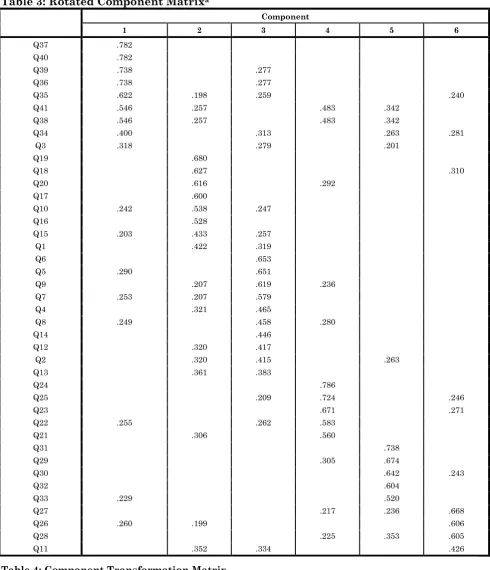
Table 3: Rotated Component Matrixa
Component
1 2 3 4 5 6
Q37 .782
Q40 .782
Q39 .738 .277
Q36 .738 .277
Q35 .622 .198 .259 .240
Q41 .546 .257 .483 .342
Q38 .546 .257 .483 .342
Q34 .400 .313 .263 .281
Q3 .318 .279 .201
Q19 .680
Q18 .627 .310
Q20 .616 .292
Q17 .600
Q10 .242 .538 .247
Q16 .528
Q15 .203 .433 .257
Q1 .422 .319
Q6 .653
Q5 .290 .651
Q9 .207 .619 .236
Q7 .253 .207 .579
Q4 .321 .465
Q8 .249 .458 .280
Q14 .446
Q12 .320 .417
Q2 .320 .415 .263
Q13 .361 .383
Q24 .786
Q25 .209 .724 .246
Q23 .671 .271
Q22 .255 .262 .583
Q21 .306 .560
Q31 .738
Q29 .305 .674
Q30 .642 .243
Q32 .604
Q33 .229 .520
Q27 .217 .236 .668
Q26 .260 .199 .606
Q28 .225 .353 .605
Q11 .352 .334 .426
Table 4: Component Transformation Matrix
Component 1 2 3 4 5 6
1 .541 .423 .524 .345 .311 .195
2 -.563 .793 .122 -.161 -.112 -.023
3 -.330 .009 -.346 .857 .086 .172
4 -.307 -.140 -.010 -.260 .867 .259
5 .015 -.036 -.032 -.160 -.327 .930
6 -.432 -.413 .768 .166 -.158 -.009
Results and Discussion
Factor analysis carried out to find out the factors affecting the branding of
management institute led to identification of following factors.
Table 5: Identified Factors
From the above table it has been observed that the factors considered by students and faculties important for brand building by management institutes are same except that Research & Accreditations is considered to be an important factor by Faculties but not by students.
The section below discusses in detail the role or importance of above mentioned factors: Admissions
Admission is a key factor for brand building by management institutes and is considered both by faculties and students. A thorough selection criterion in admission helps in making up the brand image. Transparency in selection process, reasonable weightageto industry experience boosts the brand image. The management institutes look for making a heterogeneous class of incoming students.
They are doing it with a very objective reason: The greater the heterogeneity among student disciplines, the greater the career choices, which means the greater the possibility of attracting a wider gamut of recruiters, which then moderates the risk of becoming a tagged institute which prefers only one discipline of students and hence few recruiters, especially during rough job markets. That's why the institutes are unwilling to fill the class with only arts, commerce or any other domain specific set of students - even though at most institutes the majority is a set of homogenous disciplines.
Admissions to management institutes are either through a centralized counseling or solely upon a self described selection process. They have the liberty to admit and reject
whom so ever they want, and year by year change the parameters for admission befitting to their needs (to maintain that perception of reputation). Business school admissions is now not a merit, since the admissions process is subjective and in most of the cases depends on the institute. For every acclaimed management institutes and in particular those in the top of the list a big part to make that their management program stays relevant is to sustain their perceived brand image by staying strict and exclusive to the selection of students who as alumni’s would help the institute in every industry. It's that diversity that gives the real edge when it comes to overall brand reputation.
Syllabus & Curriculum
Any management institute will not be able to effectively cater to and to build the required skill set amongst its students till the time it aims to identify the union and gaps between what is required by job providers and what the institute is providing as a value addition in the form of syllabus and curriculum. The syllabus and curriculum should be flexible and has to be designed and updated in a way which is based on the principles of Knowing (Knowledge), Doing (Skills), and Being (Attitude) so as to develop to (i) the analytical, problem solving and decision making abilities, (ii) the awareness of the socio-economic environment, and (iii) the personality with socially desirable values and attitudes.
The syllabus and curriculum should maintain comprehensiveness to acquaint the
S. No. Factors
1. Admissions
2. Syllabus and Curriculum
3. Placements & Industry Institute Interaction 4. Infrastructural Facilities
students with in depth understanding and learning of various paradigms of management and business. It should be coherent and should inculcate intensive models of experiential learning by inculcating case studies, role-play, problem solving exercises, group discussion, computer simulation games, audio-visuals, to empower the students with an integrated approach to management function and managerial skills in practice. The curriculum should be directional in scope and contemporary having the insights of the ever-growing body of knowledge, experiments and explorations in management education.
Placement & Industry Institute Interaction
The management institutes should have a varied basket of companies from diverse domains .Which shows that the institutional brand is considered across various industries. Management Institutes should be like corporate organizations seeking the employment opportunity. Placements should be seen as a stage of interaction between student and prospective employees. It should create opportunity for students for getting exploring the job market.
The major focus of any management institute is make that its students find right and good jobs to meet the needs of the fast growing industries and the economy ignoring the fact that a good looking and a smart student gets the highest package. It becomes essential for management institutes to develop the talent pool befitting to the industry’s potential and those institutes which are executing it rightly should be supported by industry. For management institutes following initiatives should be taken:
A collaborative model should be explored for setting up institutes of higher learning.
Certificate training programs should be floated from industries by collaborating with appropriate education institutes.
Consultancy projects to be jointly cooperated by corporate and institutes.
Skill based vocational training programmes to be inducted
A know how on the contemporary skill set required by the corporate in the present scenario
Infrastructural Facilities
In the current scenario the basic hygiene factor for any management institute to function adequately is the availability of necessary infrastructure, such as a state-of-the-art smart class rooms, high-speed Internet connectivity, well-stocked library with subscriptions to management journals, and computer labs with latest software programs.
Any institute which does not possess these facilities can hardly be counted one among the top institutes. The management institute should strive to offer a fully residential programme to foster holistic development as the period of interaction with peers and faculty is not limited and also creates a sense of belonging and attachment towards the institute.
Co-curricular & Enrichment Activities The co curricular activities in a management institute should specifically be excellent as it present possibilities to students to work in collaboration, to exercising leadership, and enhance the ability to take initiatives. Co curricular activities in management institutes supply wonderful opportunity to student to determine their potentials and improve both academics and non-scholastic know-how also as their social and behavioral skills. In addition, these activities ensure physical, mental, social, emotional and aesthetic improvisation.
Research & Accreditations
The institute should create a conducive environment to foster research across different dimensions of management domain. A robust research policy should be made by the management institutes for the professional development of faculty members. More amount of research activities would contribute to their need for professional growth and self-actualization and can contribute to their teaching. It will also help the management institutes as a tool to project its academic acumen and in turn building its brand image.
The management institute should participate in various national and international surveys which will highlight and uniquely identify the institutes name in a strong way. This would further help the management institute to further scale its weaknesses to be a better institute in future. Acclaimed accreditations indirectly make the institutional brand more credible and hence create a healthy sense of competition among institutions of the same group.
Conclusion
The competition in education is now so fierce that it’s a necessity now for the management institutes/universities to craft a unique representation so as to be distinctly recognized through branding. Furthermore, there is a tint of exaggeration and manipulation in the educational paradigm with effect to the branding effort that might be observed as deceptive and immoral which needs properly addressed and should strictly dealt.
The research study attempts to provide a holistic perspective by identifying six important factors which majorly contribute to building a brand of an Institute or a University. Although, along with these six parameters the role of the promoters should be that of facilitators which has died out in the recent times. They should have a clear vision of what a credible and acclaimed academic institution or a university should possess as basic pillars of higher learning.
Capability and performance should be the existent parameters to award degrees which are achieved by candidates through sheer struggle, a deep sense of dedication and utmost sincerity. The world should not accept incapable professionals who don’t comply with the norms of the society and should be prevented from getting a degree by institutes and universities. The institutes/universities should be self accountable to not let the learner to cruise through the course merely because the economic self interest. The primary focus of any institution or university should be to persuade student to participate in teaching learning process rather than to be a customer to the institute or university.
For institutions and universities to develop in a robust way and to have a strong brand issues such as academic liberty, thoughtfulness and creativity should be supported. The universities and the institutes should understand that education is an enlightening experience which serves more and gains less.
References
1 Aaker DA (2004) Leveraging the Corporate
Brand. California Management Review,
46(3):6-18.
2 Balmer JMT, Liao M (2007) Student corporate
brand identification: an exploratory case study. Corporate Communications: An International Journal, 12 (4):356-375.
3 Balmer JMT, Greyser SA (2006) Corporate Marketing – Integrating Corporate Identity,
Corporate Branding, Corporate
Communications, Corporate Image and
Corporate Reputation. European Journal of Marketing, 40 (7/8):760-741.
4 Becher T, Trowler PR (2001) Academic Tribes and Territories: Intellectual Enquiry and the Cultures. Philadelphia, PA: SHRE and Open University Press.
5 Blanton J (2007) Engagement as a brand position in the higher education marketplace.
International Journal of Educational
Advancement. 7(2):143‐54.
6 Bodoh J, Mighall R (2003) Study here because you’re worth it. The Times Higher Education Supplement. 23.
Higher Education in Europe. XXVIII (4): 449-454.
8 Bunzel D (2007) Universities sell their brands. Journal of Product & Brand Management, 16/2 :152-153.
9 Chapleo C (2007) Barriers to brand building in UK universities?. International Journal of Nonprofit and Voluntary Sector Marketing, 12(1):23‐32.
10 De Chernatony L (2010) From Brand Vision to
Brand Evaluation. Oxford, UK: Elsevier. 11 Hart S, Murphy J (1998) Brands, England:
Essex: Macmillan Business.
12 Hatch MJ, Schultz M (2003) Bringing the
Corporation into Corporate Branding.
European Journal of Marketing. 37(7/8): 1041-1064.
13 Harvey JA (1996).Marketing schools and
consumer choice. The International Journal of Educational Management. 10(4):26-31.
14 Heaney JG, Heaney M (2008) Services
Branding Strategies: using corporate branding to market educational institutions, presented at the Academy of World Business, Marketing and Management Development Conference, Rio de Janeiro, Brazil.
15 Hemsley‐Brown, J and Goonawardana S (2007) Brand harmonization in the international higher education market. Journal of Business Research, 60(9):942‐8.
16 Hemsley-Brown J, Oplatka I (2006)
Universities in a competitive marketplace – a systematic review of the literature on higher education marketing. International Journal of Public Sector Management, 19 (4):316-338. 17 Jevons C (2006) Universities: A Prime Example
of Branding Gone Wrong. Journal of product and brand management, 15(7): 466-467.
18 Johnston A (2001) Branding: the Key to Student Recruitment (or Maybe Not). Education Marketing. March 2001: 28-29. 19 Kapferer JN (2001) (Re) Inventing the Brand.
London: Kogan Page.
20 Kay MJ (2006) Strong brands and corporate brands. European Journal of Marketing. 40(7/8):742-760.
21 Lang DW (2005) “World class” or the curse of comparison?. The Canadian Journal of Higher Education. 35 (3):27‐55.
22 Le Pla, FJ, LM Parker (2002) Integrated Branding. UK: Kogan Page
23 Lowrie A (2007) Branding Higher Education: Equivalence and Difference in Developing Identity. Journal of Business Research 60 (9):990-999.
24 Maringe F (2005) University marketing:
Perceptions, practices and prospects in the less developed world. Journal of Marketing for Higher Education. 15 (2): 129-153.
25 Mc Alexander JH, Koenig, HF and Schouten JW (2006) Building relationships of brand community in higher education: a strategic
framework for university advancement.
International Journal of Educational
Advancement. 6 (2):107‐18.
26 Schubert B (2007) Development and
Implementation of Branding Concepts – The
Case for Internal Marketing. HEIST
information bank.
www.heist.co.uk/corporate_identity/. Retrieved 15.1.07.