SYNTHESIS, STRUCTURAL AND BIOLOGICAL STUDIES OF
Co(II), Ni(II), Cu(II) AND Zn(II) COMPLEXES OF
4-[(3-ETHOXY-
4-HYDROXYBENZYLIDENE)AMINO]-3-MERCAPTO-6-METHYL-5-OXO-1,2,4-TRIAZINE
Kiran Singh,
[a]*Prerna Turk
[a]and Anita Dhanda
[b]Keywords: Metal complexes; Schiff base; 4-[(3-ethoxy-4-hydroxybenzylidene)amino]-3-mercapto-6-methyl-5-oxo-1,2,4-triazine.
Co(II), Ni(II), Cu(II) and Zn(II) complexes with the bidentate ligand 4-[(3-ethoxy-4-hydroxybenzylidene)amino]-3-mercapto-6-methyl-5-oxo-1,2,4-triazine have been synthesized. The Schiff base and its metal complexes have been characterized by various physicochemical techniques like IR, 1H-NMR, ESR, electronic and fluorescence spectroscopy and cyclic voltammetry. Elemental analysis, conductivity measurements and thermal analysis of synthesized compounds were also carried out. All the complexes were colored and non-electrolytic in nature. In vitro biological activities of the ligand and complexes have been checked against some pathogenic gram positive, gram negative bacteria and different fungi and then compared with some standard drugs as control.
* Corresponding Authors
[a] Department of Chemistry, Kurukshetra University Kurukshetra, 136119, India
[b] Department of Microbiology, Kurukshetra University Kurukshetra, 136119, India
Introduction
Schiff bases are generally formed by the condensation of an amine and an active carbonyl group containing compound.1-3 During the recent years, there have been many investigations of Schiff bases possessing nitrogen-containing heterocyclic compounds.4 Amino-group containing heterocyclic compounds consisting of two or more potential donor centers play an important role in the study of competitive reactivity of a bidentate ligand system.5 The development of new drugs based on 1,2,4-triazines further enhances the interest in synthesis of these compounds. It has been well established that the triazine derivatives are potent antibacterial, antioxidant, antifungal, anti-tuberculosis and anti-inflammatory agents.6-13 In addition, their applications as herbicides, fungicides and insecticides are also well known.14-15 Metal ion complexes with Schiff bases are synthesized and their biological activities have been checked.16 These complexes can be used in various catalytic reactions and as models for biological systems. It has been well reported that some drugs possess higher activity when administered as metal complexes than as the free ligand. Increase of biological activity has been reported by the incorporation of transition metals in Schiff bases. Importance of Schiff base metal complexes has spurred the search for new metal-based drugs using different biologically activemetals.17-18
Triazine derivatives with additional N or S donor atoms exhibit strong chelating ability and provide potential binding sites for complexation with various metal ions. Certain cobalt, copper metal complexes are significant antiviral agents.19-22
Here we report the synthesis and characterization of Co(II), Ni(II), Cu(II) and Zn(II) metal complexes of a newly synthesized ligand obtained from the condensation of 3-ethoxy-4-hydroxybenzaldehyde with 4-amino-3-mercapto-6-methyl-5-oxo-1,2,4-triazine.
Experimental
All the chemicals and solvents used were of analytical grade. IR spectra of Schiff base and its metal complexes were recorded in KBr pellets/Nujol mulls on a MB-3000 ABB spectrometer. 1H-NMR spectra of Schiff base and its Zn(II) complexes were recorded on bruker ACF 300 spectrometer at 300 MHz in DMSO-d6 using TMS as a reference compound. Electronic spectra of metal complexes were recorded on T90 (PG instruments Ltd.) UV/VIS spectrophotometer in DMF solvent, in the region of 200-900 nm. Fluorescence spectra of ligand and metal complexes
were recorded on SHIMADZU RF-5301 PC
spectrofluorometer. Ivium Stat Electrochemical Analyzer was used for cyclic voltammetry measurement of Cu(II) complexes. Magnetic moment measurements were carried out on Vibrating Sample Magnetometer at the Institute Instrumentation Centre, IIT Roorkee.
Synthesis of ligand
First, 4-amino-3-mercapto-6-methyl-5-oxo-1,2,4-triazine (AMMOT) was synthesized by a reported procedure.24 Its ethanolic solution (1.50 g, 9.49 mmol) was mixed with an ethanolic solution of 3-ethoxy-4-hydroxybenzaldehyde (1.578 g, 9.49 mmol) and the reaction mixture was refluxed for 7 h. The progress of reaction was checked by TLC. The precipitated ligand, 4-[(3-ethoxy-4-hydroxybenzylidene)-amino]-3-mercapto-6-methyl-5-oxo-1,2,4-triazine (HL), was filtered, washed with ethanol, recrystallized from ethanol and then dried at room temperature, m.p. 182˚-184 ˚C (Figure 1).
Figure 1. Schiff Base: 4-[(3-ethoxy-4-hydroxybenzylidene)-amino]-3-mercapto-6-methyl-5-oxo-1,2,4-triazine.
Synthesis of metal complexes
Synthesis of 1:1 metal complexes
The metal complexes were prepared by the reaction of the ligand (0.4 g, 1.30 mmol) with the respective acetates of Co (0.326 g, 1.30 mmol), Ni (0.325 g, 1.30 mmol), Cu (0.261 g, 1.30 mmol) and Zn (0.286 g, 1.30 mmol) in ethanolic solution. The solid products formed were filtered, washed with warm water, alcohol and acetone and then dried in desiccator.
Synthesis of 1:2 metal complexes
Hot ethanolic solutions of ligand (0.8 g, 2.61 mmol) were mixed with hot ethanolic solutions of acetates of Co (0.326 g, 1.30 mmol), Ni (0.325 g, 1.30 mmol), Cu (0.261 g, 1.30 mmol), Zn (0.286 g, 1.30 mmol). The products formed were filtered off, washed with warm water, alcohol and finally with acetone and then dried in desiccator.
Pharmacology
The newly synthesized ligand and its metal complexes have been screened in vitro for their antimicrobial activity against two Gram-positive (Staphylococcus aureus MTCC 96 and Bacillus subtilis MTCC 121), two Gram-negative (Escherichia coli MTCC 1652 and Pseudomonas aeruginosa MTCC 741) and two fungi (Candida albicans
MTCC 227 and Saccharomyces cerevisiae MTCC 170) by agar well diffusion method as reported in previous papers from our laboratory.25 All the bacterial cultures were procured from Microbial Type Culture Collection (MTCC), IMTECH, Chandigarh. Ciprofloxacin and amphotericin B were used as standard antibacterial and antifungal drugs respectively.
The agar well diffusion method was used to check the antibacterial activity of synthesized compounds.26 All the
microbial cultures were adjusted to 0.5 McFarland Standard, which is visually comparable to a microbial suspension of approximately 1.5 ×10⁸ cfu mL-1. 20 mL of Mueller Hinton agar medium was poured into each Petri dish and dishes were swabbed with 100 μL inoculum of the test microorganisms and kept for 20 minutes for adsorption. Using sterile cork borer of 8 mm diameter, wells were bored into the seeded agar plates and these were loaded with a 100 μL volume with concentration of 4.0 mg mL-1 of each compound reconstituted in DMSO. All the plates were incubated at 36 ˚C for 24 h. Antibacterial activity of each compound was analyzed by measuring the zone of growth inhibition against the test organisms with zone reader (Hi Antibiotic zone scale). This procedure was performed in three replicate plates for each organism.
Minimum inhibitory concentration (MIC) is the lowest concentration of an antimicrobial compound that will inhibit the visible growth of a microorganism after overnight incubation. MIC of the various compounds against bacterial strains was tested through a modified agar well-diffusion method.
Results and discussion
Schiff base and its metal complexes are colored and non-hygroscopic in nature. Though Schiff base is soluble in common organic solvents such as ethanol and methanol, its metal complexes are insoluble in common organic solvents but soluble in DMF and DMSO. The molar conductance of all the complexes was measured in DMF using 10-3 M solutions at room temperature. The molar conductance values (36.89 – 43.29 S cm2 mol-1) indicate that all the complexes are non-electrolytic in nature. The purity of the ligand and its metal complexes was checked by TLC. Analytical data of all compounds are given in Table 1.
IR spectra
The comparative IR frequencies of ligand and its metal complexes were recorded in the region 400-4000 cm-1. The important IR frequencies of Schiff base and metal complexes are summarized in Table 2. In the free ligand, a characteristic band observed at 1697 cm-1 due to azomethine ν(-CH=N) group,27,28 which is shifted to lower frequency (20-30 cm-1) in spectra of the metal complexes, indicating a coordination through the nitrogen of azomethine group. A weak band observed at 2893 cm-1 due to ν (SH) group in the ligand, has disappeared in the metal complexes, which indicates the deprotonation of thiol group. In metal complexes, a broad band appeared in the region 3232-3742 cm-1 due to ν (OH/H2O), which is assigned to phenolic OH and water molecules associated with the complexes. A characteristic band was observed at 1582 cm-1 in Schiff base and its metal complexes due to ν(C=O) stretch, its unaltered position indicates the non-participation of keto group in chelation. In 1:1 metal complexes, band was observed at 1744 cm-1 due to acetate group.25 The coordination of ligand to the metal through the azomethine nitrogen atom and sulfur atom is further supported by (M-N) and (M-S) bands in the range 482-488 cm-1 and 323-342 cm-1 respectively.29,30
H C
HO
N N
N N
CH3
HS O
Table 1. Analytical data of the synthesized compounds.
Compounds Color Mp. C, dec* Yield, % Elemental analysis, calculated (found), %
C H N M
Schiff Base, HL C13H14N4O3S
Light yellow 182 84 % 50.98 (50.32) 4.57 (4.18) 18.30 (18.09)
Co(L)(OAc).3H2O Dark Green 200 81 % 37.74 (37.64) 4.61 (4.56) 11.74 (11.44) 12.35 (11.93) Co(L)2.2H2O Dark Green 202 80 % 44.26 (43.91) 4.25 (4.13) 15.88 (15.80) 8.36 (7.81) Ni(L)(OAc).3H2O Yellowish Green 224 77 % 37.76 (36.39) 4.61 (4.18) 11.75 (11.69) 12.31 (11.87)
Ni(L)2 .2H2O Yellowish Green 210 78 % 44.27 (44.13) 4.26 (4.11) 15.89 (15.43) 8.32 (8.12)
Cu(L)(OAc).H2O Brown 214 84 % 37.38 (37.10) 3.74 (3.15) 11.63 (11.56) 13.18 (12.35)
Cu(L)2 Brown 196 82 % 46.32 (45.74) 3.86 (3.08) 16.63 (15.97) 9.42 (9.06)
Zn(L)(OAc).3H2O Light Yellow 240 80 % 37.24 (37.02) 4.55 (4.26) 11.59 (11.08) 13.52 (12.89) Zn(L)2.2H2O Light Yellow 260 82 % 43.86 (43.23) 4.22 (3.19) 15.74 (14.82) 9.19 (8.23)
d* = decomposed
Table 2. Important IR frequencies (cm-1) of the Schiff base and its metal complexes.
Compound ν(N=CH) ν(C-S) ν(S-H) ν(OCOCH3) ν(H2O/OH) ν(M-S) ν(M-N)
HL 1697 - 2893 - - - -
Co(L)(OAc).3H2O 1674 741 - 1744 3232 340 485
Co(L)2.2H2O 1674 779 - - 3240 341 485
Ni(L)(OAc).3H2O 1671 779 - 1745 3232 342 486
Ni(L)2.2H2O 1674 779 - - 3240 341 485
Cu(L)(OAc).H2O 1674 779 - 1744 3395 325 488
Cu(L)2 1682 779 - - 3742 323 488
Zn(L)(OAc).3H2O 1674 771 - 1744 3456 342 482
Zn(L)2.2H2O 1651 771 - - 3742 342 485
1H-NMR spectra
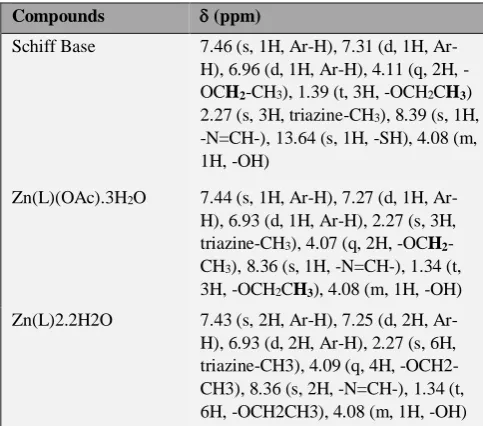
The 1H-NMR spectral data of Schiff base and Zn(II) complexes are displayed in Table 3.
Table 3. 1H NMR spectral data of Schiff base and its Zn(II) complexes.
Compounds (ppm)
Schiff Base 7.46 (s, 1H, H), 7.31 (d, 1H, ArH), 6.96 (d, 1H, ArArH), 4.11 (q, 2H, -OCH2-CH3), 1.39 (t, 3H, -OCH2CH3) 2.27 (s, 3H, triazine-CH3), 8.39 (s, 1H, -N=CH-), 13.64 (s, 1H, -SH), 4.08 (m, 1H, -OH)
Zn(L)(OAc).3H2O 7.44 (s, 1H, H), 7.27 (d, 1H, Ar-H), 6.93 (d, 1H, Ar-Ar-H), 2.27 (s, 3H, triazine-CH3), 4.07 (q, 2H, -OCH 2-CH3), 8.36 (s, 1H, -N=CH-), 1.34 (t, 3H, -OCH2CH3), 4.08 (m, 1H, -OH) Zn(L)2.2H2O 7.43 (s, 2H, H), 7.25 (d, 2H,
Ar-H), 6.93 (d, 2H, Ar-Ar-H), 2.27 (s, 6H, triazine-CH3), 4.09 (q, 4H, -OCH2-CH3), 8.36 (s, 2H, -N=CH-), 1.34 (t, 6H, -OCH2CH3), 4.08 (m, 1H, -OH)
1H-NMR spectra of Schiff base and its metal complexes
were recorded in DMSO-d6. In Schiff base, a peak appears at = 8.39 ppm due to azomethine proton, which is deshielded in the spectra of Zn(II) complexes, indicating the complexation through azomethine nitrogen atom.
The signal for the SH proton appearing at δ=13.64 ppm in the spectrum of the free ligand has disappeared in the spectra of Zn(II) complexes, further supporting the complexation through S atom of the thiol group.29,30 The peak appearing at δ = 2.27 ppm due to CH3 group present in triazine ring did not change in the spectra of metal complexes.
Electronic spectra and magnetic moment measurements
Table 4. Electronic spectral data and ligand field parameters of metal complexes.
Compounds Transitions (cm-1)
ʋ1 ʋ2 ʋ3
Dq (cm-1) B(cm-1) ν2 /ν1 β %
Co(L)(OAc).3H2 O Co(L)2.2H2 O Ni(L)(OAc).3H2O Ni(L)2.2H2O Cu(L)(OAc).H2O Cu(L)2
10230 21615a 19615 10900 22989a 20271 10523 16530 23813 10618 17681 24940 18681
19952
1138.56 1208.98 1052.3 1061.8 - -
702.70 704.05 584.93 717.80 - -
2.11 2.109 1.57 1.665 - -
0.724 0.725 0.562 0.689 - -
27.6 27.5 43.8 31.1 - -
The calculated values of crystal field splitting energy (Dq) are 1138.56 and 1208.98 cm-1 for 1:1 and 1:2 Co(II) complexes, respectively. These values lie within the range reported for octahedral complexes. The value of Racah parameter (B) was less than free ion value (971 cm-1), indicating the orbital overlap and delocalization of d -electron on the ligand. The nephelauxetic ratio (β) was found to be less than 1, which indicated the partial covalent nature of metal ligand bonds.
The magnetic moment data of Co(II) complexes indicate the presence of three unpaired electrons. The magnetic moment values were found in the range of 4.5-5.0 BM, which is in the expected range (4.3-5.2 BM) of octahedral complexes.33
Ni(L)(OAc).3H2O and Ni(L)2.2H2O complexes exhibit three absorption bands in the region 10523-10618 cm-1 (ʋ1), 16530-17681 cm-1 (ʋ2) and 23813-24940 cm-1 (ʋ3), attributed to 3A2g(F) →3T2g(F) (ʋ1), 3A2g(F)→3T1g(F) (ʋ2) and 3A2g(F) →3T1g(P) (ʋ3) transitions, respectively. The ligand field parameters (Dq, B, β, β%) were also calculated for Ni(II) complexes. These parameters indicate octahedral arrangement around the Ni(II) complexes34 and suggest the partial covalent nature of the metal ligand bond. The calculated values of crystal field splitting energy (Dq) are 1052.3 cm-1 and 1061.8 cm-1 for 1:1 and 1:2 Ni(II) complexes respectively. The observed magnetic moment values were found in the range of 3.3-3.4 BM, which is in the range of reported octahedral compounds.35
For 1:1 and 1:2 Cu (II) complexes, a band observed in the region of 18681-19952 cm-1, assigned to 2B1g →2A1g, indicating the square planar geometry of the copper complexes.36 Further confirmation was achieved by magnetic moment measurements 1.9-2.0 BM, which is well within expected range of square planar geometry of Cu(II) complexes.
ESR spectral studies
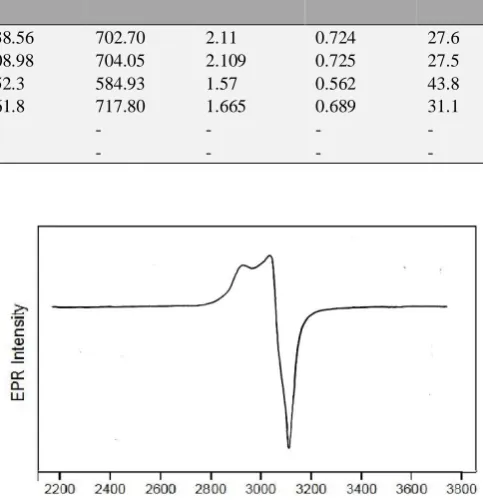
ESR spectra for 1:1 and 1:2 Cu(II) complexes i.e., Cu(L)(OAc).H2O and Cu(L)2 were recorded at room temperature on the X-Band at 9.1 GHz under the magnetic field set 0.3 T. The observed g values for Cu(L)(OAc).H2O (g║=2.197, g┴=2.129, gav =2.152) and Cu(L)2 (g║ =2.197,
g┴=2.126, gav=2.150 ) corresponds to square planar geometry
of both the complexes. The trend g║> g┴> 2.0023 was
observed for Cu(II) complexes, indicates that the unpaired electron is localized in the 𝑑𝑥2−𝑦2 orbital of the Cu(II) ion and corresponds to square planar geometry around Cu(II) ions.37
Figure 2. ESR spectrum of Cu(L)(OAc).H2O.
The g║< 2.3 value confirms the covalent character of the
metal ligand bond. According to Hathaway and Billing38 if axial symmetry parameter i.e. G > 4, the exchange interaction is negligible, but if G < 4, a considerable exchange interaction in the solid complexes would be found. The 1:1 and 1:2 Cu(II) complexes gave the G value in the range of 1.537-1.574 indicating exchange interaction in solid complexes. ESR spectrum of Cu(L)(OAc).H2O is shown in Figure 2.
Fluorescence spectral studies
The fluorescence spectra of the ligand and its Co(II), Ni(II), Cu(II) and Zn(II) complexes (10-3 M) were recorded in DMF solution at room temperature with excitation wavelength at 265 nm.
Table 5. In vitro antimicrobial activity of synthesized chemical compounds and standard drugs.
S. No. Compounds Diameter of growth of inhibition zone (mm)a
Gram positive bacteria Gram negative bacteria Fungi
B. subtilis S. aureus E. coli P. aeruginosa C. albicans S. cerevisiae
1 Schiff Base (HL) 18 - - - - -
2 Co(L)(OAc).3H2O 16 21 16 16 15 16
3 Co(L)2.2H2O 15 - - 23 7 16
4 Ni(L)(OAc).3H2O 11 13 9 - - 18
5 Ni(L)2.2H2O 12 18 7 - 6 18
6 Cu(L)(OAc).H2O 8 - 8 18 - 16
7 Cu(L)2 7 - 8 15 6 15
8 Zn(L)(OAc).3H2O 22 25 20 20 21 20
9 Zn(L)2.2H2O 21 32 19 13 21 20
10 Ciprofloxacin 24.0 26.6 25.0 22 - -
11 Amphotericin-B - - - - 16.6 19.3
(-) No activity;
a Values, not including diameter of the well (8mm), are means of three replicates.Table 6. MIC ( µg ml-1 ) of synthesized chemical compounds and standard drugs.
S. No. Compounds Gram positive bacteria Gram negative bacteria Fungi
B. subtilis S. aureus E. coli P. aeruginosa C. albicans S. cerevisiae
1 Schiff Base 25 - - - - -
2 Co(L)(OAc).3H2O 25 25 25 50 50 -
3 Co(L)2.2H2O 50 - - 12.5 - 50
4 Ni(L)(OAc).3H2O 50 50 - - - -
5 Ni(L)2.2H2O 50 25 - - - 50
6 Cu(L)(OAc).H2O - - - 50 - -
7 Cu(L)2 - - - 50 - -
8 Zn(L)(OAc).3H2O 12.5 12.5 25 12.5 12.5 50
9 Zn(L)2.2H2O 25 6.25 50 50 12.5 50
10 Ciprofloxacin 6.25 6.25 6.25 12.5 - -
11 Amphotericin-B - - - - 12.5 12.5
The data obtained indicate about the changes in fluorescence property of Schiff base, when it binds with metal ions. All the metal complexes show increased fluorescence intensity with strong emission at 510 nm for Co(II), 508 nm for Ni(II), 507 nm for Cu(II) and 472 nm for Zn(II) complexes. The enhanced fluorescence intensity of metal complexes in comparison to ligand may be due to the formation of coordination bonds between metal ions and ligand which increases the rigidity of the complex thereby reducing the loss of energy through vibrational motion.39,40 The decrease in emission maxima was in the order of Zn(II) > Co(II) > Ni(II) > Cu(II) > Schiff base (Figure 3).
Antimicrobial activity
Schiff base and its metal complexes were checked for their in vitro antimicrobial activity by agar well diffusion method against two gram positive bacteria (B. subtilis and S. aureus), two gram negative bacteria (E. coli and P. aeruginosa) and two fungi (C. albicans and S. cerevisiae).
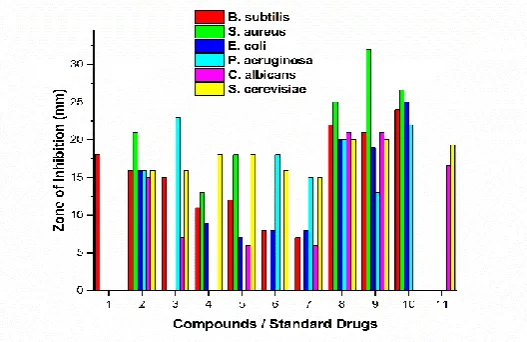
Schiff base (HL) and its metal complexes possessed variable biological activity against B. subtilis, S. aureus, E. coli, P. aeruginosa, C. albicans and S. cerevisiae (Table 5). Zones of inhibition were observed in the range 32 mm, 7-23 mm and 6-21 mm against gram positive bacteria, gram negative bacteria and fungi, respectively (Figure 4). On the basis of growth of inhibition zone, compound
Zn(L)(OAc).3H2O and Zn(L)2.2H2O were found to be most effective against B. subtilis and S. aureus with inhibition zone 22 mm, 25 mm and 21 mm, 32 mm, respectively, Compounds Zn(L)(OAc).3H2O, Zn(L)2.2H2O show good activity against E. coli with inhibition zone 20 mm and 19 mm respectively. Zn(L)(OAc).3H2O and Co(L)2.2H2O exhibit good activity against P. aeruginosa with inhibition zone 20 mm and 23 mm and Zn(L)2.2H2O was found to be most effective against C. albicans with inhibition zone found 21 mm.
Zn(L)2.2H2O, Ni(L)(OAc).3H2O and Ni(L)2.2H2O were found to be effective against S. cerevisiae with inhibition zone 20 mm, 18 mm & 18 mm respectively.
The MIC of the tested compounds have been observed from 6.25-50 µg mL-1 against gram positive and gram negative bacteria and (12.5-50) µg mL-1 in case of fungi (Table 6). Among these compounds, Zn(L)2.2H2O shows best antibacterial activity against S. aureus and shows lowest MIC value 6.25 µg mL-1. Compounds Zn(L)(OAc).3H2O and Zn(L)2.2H2O show good activity against E. coli, C. albicans and P. aeruginosa, S. cerevisiae
respectively with lowest MIC values 12.5 µg mL-1. MIC values of the metal complexes indicate moderate activity against the microbial strains as compared to standard drugs, Ciprofloxacin and amphotericin B.
Thermal analysis
To determine the thermal stability and chemical composition of 1:1 Co(II), Ni(II), Cu(II) and Zn(II) complexes, thermogravimetric analysis has been carried out over a temperature range of 50-600 ˚C by using alumina as a reference compound. The percentage mass loss of the complexes with temperature is shown in the Figure 5.
Figure 5. TG curves of synthesized metal complexes.
Table 7. Calculated activation energies (kJ mol-1) for different stages in degradation of metal complexes.a
Compounds E2* (R2) E3 *(R2) Co(L)(OAc).3H2O 50.26 (0.9892) 100.38 (0.9384) Ni(L)(OAc).3H2O 73.65 (0.9972) 126.0 (0.9132) Cu(L)(OAc).H2O 60.54 (0.9794) 43.00 (0.9895) Zn(L)(OAc).3H2O 28.754 (0.9901) 26.168 (0.9941) aHeating rate was 10 C min-1. *R2 stands for regression coefficient and 2,3 represents second and third stages of degradation.
The Co(II) complex decomposes in the three stages. The TG curve of Co(L)OAc.3H2O indicates first weight loss of 8.26 % (calcd. 11.32 %) in the temperature range 40-205 °C attributed to loss of three coordinated water molecules. The next step represents a mass loss of 40.87 % (calcd. 43.82 %) from 205-400 °C corresponding to the loss of organic moiety. The final step resulted in the decomposition of triazine ring with mass loss of 30.42 % (calcd. 32.50 %) from 400°C to 610 °C.41
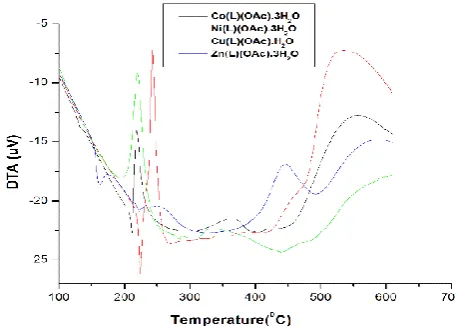
The TG curve of Ni(L)(OAc).3H2O exhibits first weight loss of 9.64 % (calcd. 11.32 %) at 40-230˚C, attributed to the loss of three coordinated water molecules. The subsequent steps correspond to the decomposition of organic moiety with weight loss of 42.66 % (calcd. 43.84 %) within the temperature range 230-380 ˚C and triazine ring with weight loss of 30.73 % (calcd. 32.51 %) from 380-610 ˚C. The TG curve of Cu(L)(OAc).H2O shows three decomposition steps within the temperature range 40-160˚C, 160-310˚C and 310-600˚C corresponding to loss of one water molecule, organic moiety and triazine ring respectively42 whereas the complex Zn(L)OAc.3H2O shows three decomposition steps in the temperature range 40-210˚C, 210-400˚C and 400-595˚C respectively. Activation energies for different stages in degradation of metal complexes are shown in Table 7. The TG curves are further supported by the DTA curves Figure 6.
Figure 6. DTA curves of synthesized metal complexes.
Determination of degradation activation energy
For a second order reaction, Coats and Redfern43 provided an approximation. This is an integral form of the rate equation. The simplified form of the equation is
ln [𝑔(𝛼)𝑇2 ] = ln [𝐴𝑅
𝐸𝛽] − 𝐸
𝑅𝑇 (1)
where,
T=temperature,
A =pre-exponential term (min-1),
R =gas constant,
E =energy of activation, Β =heating rate (˚C min-1), α =degree of conversion and
g(α)=degradation mechanism but 𝑔(𝛼) = (1/1 − 𝛼) − 1
For second order mechanism E can be calculated from the slope of the graph between 𝑙𝑛[ [𝑔(𝑥)/𝑇2 ] and 1/T. Table (7)
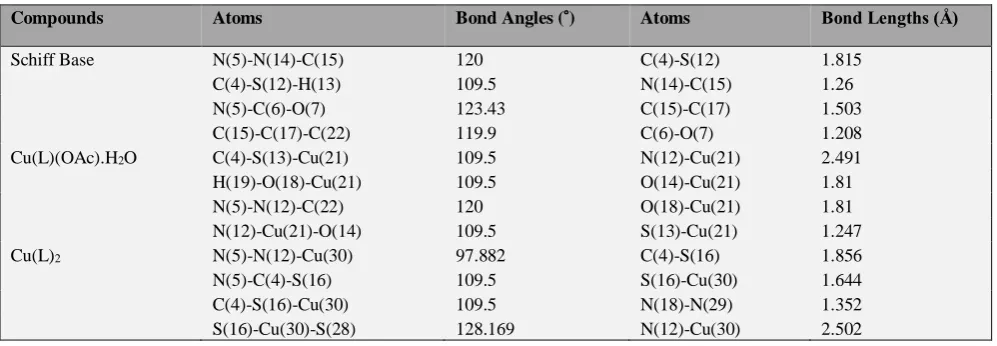
Table 8. Selected calculated bond angles (˚) and bond lengths (Å) for ligand and its 1:1 and 1:2 copper metal complexes.
Compounds Atoms Bond Angles (˚) Atoms Bond Lengths (Å)
Schiff Base N(5)-N(14)-C(15) 120 C(4)-S(12) 1.815
C(4)-S(12)-H(13) 109.5 N(14)-C(15) 1.26
N(5)-C(6)-O(7) 123.43 C(15)-C(17) 1.503
C(15)-C(17)-C(22) 119.9 C(6)-O(7) 1.208
Cu(L)(OAc).H2O C(4)-S(13)-Cu(21) 109.5 N(12)-Cu(21) 2.491
H(19)-O(18)-Cu(21) 109.5 O(14)-Cu(21) 1.81
N(5)-N(12)-C(22) 120 O(18)-Cu(21) 1.81
N(12)-Cu(21)-O(14) 109.5 S(13)-Cu(21) 1.247
Cu(L)2 N(5)-N(12)-Cu(30) 97.882 C(4)-S(16) 1.856
N(5)-C(4)-S(16) 109.5 S(16)-Cu(30) 1.644
C(4)-S(16)-Cu(30) 109.5 N(18)-N(29) 1.352
S(16)-Cu(30)-S(28) 128.169 N(12)-Cu(30) 2.502
Based on activation energy values (E2) and (E3) as deduced using second order model, following stability order is suggested:
Ni(II) > Cu(II) > Co(II) > Zn(II) (E2)
Ni(II) > Co(II) > Cu(II) > Zn(II) (E3)
Electrochemical behavior
Electrochemical properties of 1:1 Cu(II) complex (10 -3M) in DMF was investigated with the help of cyclic
voltammetry in potential ranging from -2.0 to +1.0 V in DMF solution with a scan rate of 0.1 V/s, containing tetrabutylammonium perchlorate as the supporting electrolyte. Cyclic voltammogram (CV) is shown in Figure 8.
The complex Cu(L)(OAc).H2O exhibits two reduction peaks at Epc = 0.5 V and Epc = -0.12 V for Cu(II) to Cu(I) and Cu(I) to Cu(0) and corresponding two oxidation peaks at Epa = -0.82 V and Epa = +0.26 V for Cu(0) to Cu(I) and Cu(I) to Cu(II) complexes. E for these processes is very high, which is consistent with the quasi reversible process. The ratio of cathodic to anodic peak current (Ic/Ia = 0.214) was found to be less than one.44
Figure 7. Cyclic Voltammogram of Cu(L)(OAc).H2O.
Structural determination by computational method.
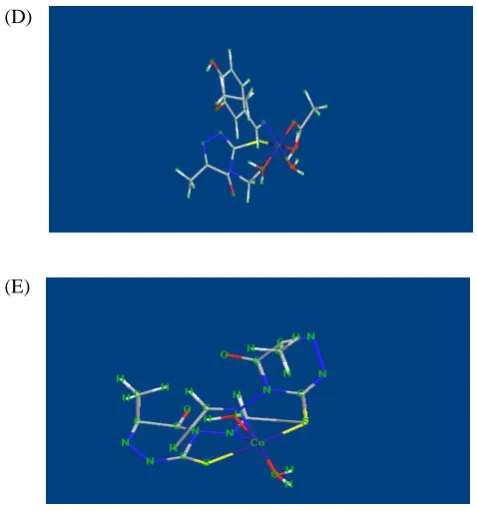
The optimized geometries of Schiff base and its some 1:1 and 1:2 metal complexes are shown in Figure 8. Bond length and bond angles of some complexes are depicted in Table 8 respectively.
(A)
(B)
(C)
(D)
(E)
Figure 8. 3D structures of Schiff base (A),Cu(L)(OAc).H2O (B), Cu(L)2 (C), Co(L)(OAc).3H2O (D) and Co(L)2.2H2O (E)
Conclusion
The synthesized 4-[(3-ethoxy-4-hydroxybenzylidene)-amino]-3-mercapto-6-methyl-5-oxo-1,2,4-triazine (HL) Figure 1. Schiff base is a bidentate ligand, coordinates through azomethine nitrogen and sulphur to the different metal ions. Synthesized compounds were characterized with the help of IR, NMR, ESR, electronic, Fluorescence spectroscopy, cyclic voltammetry, magnetic and thermal studies.
The results of the investigations suggest octahedral geometry for the Co(II), Ni(II) and Zn(II) complexes and square planar geometry around the Cu(II) metal ion. On the basis of above studies, Schiff base is versatile ligand which can coordinate with different metal ions and also biologically active. Metal complexes exhibit enhanced antimicrobial and antifungal activities against various microbial strains as compared to parent ligand and also possess comparable activities with standard drugs.
Acknowledgements
One of the authors (Prerna) expresses sincere gratitude to HSCST (Haryana State Council for Science and Technology, Panchkula) for providing financial support & Department of Chemistry, Kurukshetra University, Kurukshetra for providing the necessary facilities. We would also like to thank SAIF, IIT Bombay for ESR analysis, IIC IIT Roorkee for VSM analysis, SAIF PU Chandigarh for FT-IR and elemental analysis.
References
1Khouba, Z., Benabdallah, T., Maschke, U., Spectrophotometric study of liquid crystal containing pentadentate Schiff base type systems, Phys. Procedia, 2009, 2, 1305. DOI: doi.org/10.1016/j.phpro.2009.11.096
2Schiff, H., The syntheses and characterisation of Schiff bases, Ann. Suppl, 1864, 3, 343.
3Zhang, L. X., Liu, Y., Cia, L.-H., Hu, Y.-J., Yin, J., Hu, P.-Z., Inhibitory study of some novel Schiff base derivatives on staphylococcuss aures by microcalorimetry, Thermochim. Acta, 2006, 440, 51. DOI: doi.org/10.1016/j.tca.2005.10.012.
4Pandey, S. K., Singh, A., Singh, A., Antimicrobial studies of some novel quinazolinones fused with [1,2,4]-triazine and [1,2,4,5]-tetrazine rings, Eur. J. Med. Chem.,2009, 44, 1188. DOI: doi.org/10.1016/j.ejmech.2008.05.033.
5Klayman, D. L., Scovill, J. P., Bartosevich, J. F., Bruce, J., J. Med. Chem., 1983, 26, 35. DOI: 0022-2623/83/1826-0039$01.50/0
6Culakova, H., Dzugasova, V., Gbelska, Y., Subik, J., Antibacterial activity of CTBT (7-chlorotetrazolo[5,1-c]benzo[1,2,4]-triazine) generating reactive oxygen species, Microbiol. Res., 2013, 168, 147. https://doi.org/10.1016/j.micres.2012.10.003
7Singh, K., Kumar, Y., Puri, P., Sharma, C., Aneja, K.R., Synthesis,
spectroscopic, thermal and antimicrobial studies of Co(II), Ni(II), Cu(II) and Zn(II) complexes with Schiff base derived from 4-amino-3-mercapto-6-methyl-5-oxo-1,2,4-triazine,
Med. Chem. Res., 2012, 21(8),1708-1716. DOI:
https://doi.org/10.1007/s00044-011-9683-4
8Abdel-Rahman, R., Role of uncondensed 1,2,4-triazine derivatives as biocidal plant protection agents--a review, Die Pharmazie, 2001, 56, 195.
9Aboul-Fadl, T., Mohammed, F. A.-H., Hassan, E. A.-S., Synthesis, antitubercular activity and pharmacokinetic studies of some schiff bases derived from 1- alkylisatin and isonicotinic acid hydrazide, Arch. Pharm. Res., 2003, 26, 778. DOI: https://doi.org/10.1007/BF02980020
10Sathe, B. S., Jaychandran, E., Jagtap, V., Sreenivasa, G., In vitro anti-inflammatory activity of 2-amino-3-(substituted benzylidine-carbohydrazide)-4, 5, 6, 7-tetrahydrobenzothio-phenes, Int. J. Pharm. Res. Dev., 2011, 3, 164.
11Sondhi, S. M., Singh, N., Kumar, A., Lozach, O., Meijer, L., Synthesis, anti-inflammatory, analgesic and kinase (CDK-1, CDK-5 and GSK-3) inhibition activity evaluation of benzimidazole/benzoxazole derivatives and some Schiff’s bases, Bioorg. Med. Chem., 2006, 14, 3758. DOI: https://doi.org/10.1016/j.bmc.2006.01.054
12Pandey, A., Dewangan, D., Verma, S., Mishra, A., Dubey, R. D., Synthesis of Schiff bases of 2-amino-5-aryl-1,3,4-thiadiazole and its analgesic, antiinflammatory, antibacterial and antitubercular Activity, Int. J. Chem. Tech. Res., 2011, 3, 178. 13Chandramouli, C., Shivanand, M., Nayanbhai, T., Bheemachari,
B., Udupi, R., Synthesis and biological screening of certain new triazole schiff bases and their derivatives bearing substituted benzothiazole moiety, J. Chem. Pharm. Res., 2012, 4, 1151.
14Kearney, P. C., Kaufman, D. D., Herbicides: Chemistry, degradation and mode of action, Marcel Dekker, Inc., 1975.
15Singh, K., Barwa, M. S., Tyagi, P., Synthesis, characterization and biological studies of Co(II), Ni(II), Cu(II) and Zn(II) complexes with bidentate Schiff bases derived by heterocyclic ketone, Eur. J. Med. Chem., 2006, 41, 147. DOI: https://doi.org/10.1016/j.ejmech.2005.06.006
17Santos, M. L. P., Bagatin, I. A., Pereira, E. M., Ferreira, A. M. D. C., Redox behaviour and reactivity of some di-Schiff base copper(II) complexes towards reduced oxygen species, J. Chem. Soc., Dalton Trans., 2001, 838. DOI:10.1039/B004985I.
18Cozzi, P. G., Metal–Salen Schiff base complexes in catalysis: practical aspects, Chem. Soc. Rev., 2004, 33, 410. DOI:10.1039/B307853C
19Yoshikawa, Y., Yasui, H., Zinc Complexes Developed as Metallopharmaceutics for Treating Diabetes Mellitus based on the Bio-Medicinal Inorganic Chemistry, Curr. Top. Med.
Chem., 2012, 12, 210. DOI:
https://doi.org/10.2174/156802612799078874
20Chandra, S., EPR, magnetic and spectral studies of copper(II) and nickel(II) complexes of schiff base macrocyclic ligand derived from thiosemicarbazide and glyoxal, J. Indian Chem. Soc., 2004, 81, 203. DOI: https://doi.org/10.1016/S1386-1425(03)00220-8
21Mohindru, A., Fisher, J. M., Rabinovitz, M., Bathocuproine sulphonate: a tissue culture-compatible indicator of copper-mediated toxicity, Nature, 1983, 303, 64. DOI: https://doi.org/10.1038/303064a0
22Pandeya, S., Yogeeswari, P., Sriram, D., De Clercq, E., Pannecouque, C., Witvrouw, M., Synthesis and Screening for Anti-HIV Activity of Some N-Mannich Bases of Isatin Derivatives, Chemotherapy, 1999, 45, 192. DOI: https://doi.org/10.1159/000007182.
23Vogel, A. I.,, A Text Book of Quantitative Chemical Analysis, 5th edn. Addison Wesley Longman, London. 1999.
24Dornow, A., Menzel, H., Marx, P., Syntheses of nitrogen-containing heterocycles, XXVII. * About 1.2.4-triazines, I view some new s triazolo [3.2- c ] - as triazines, Chem. Ber, 1954, 97, 2173.
DOI: https://doi.org/10.1002/cber.19640970811
25Singh, K., Thakur, R., Kumar, G., Synthesis, spectroscopic, thermal and antimicrobial studies of Co(II), Ni(II), Cu(II) and Zn(II) complexes with Schiff base derived from 4-amino-3-mercapto-6-methyl-5-oxo-1,2,4-triazine, Eur. Chem. Bull., 2016, 5, 46. DOI: https://doi.org/10.1007/s00044-011-9683-4
26Okeke, M. I., Iroegbu, C. U., Eze, E., Okoli, A., Esimone, C., Evaluation of extracts of the root of Landolphia owerrience for antibacterial activity, J. Ethnopharmacol., 2001, 78, 119. DOI: https://doi.org/10.1016/S0378-8741(01)00307-5
27Patil, S. A., Unki, S. N., Kulkarni, A. D., Naik, V. H., Badami, P. S., Co(II), Ni(II) and Cu(II) complexes with coumarin-8-yl Schiff-bases: Spectroscopic, in vitro antimicrobial, DNA cleavage and fluorescence, Spectrochim. Acta A, 2011, 79, 1128. DOI: https://doi.org/10.1016/j.saa.2011.04.032s.
28Singh, K., Barwa, M. S., Tyagi, P., Synthesis, characterization and biological studies of Co(II), Ni(II), Cu(II) and Zn(II) complexes with bidentate Schiff bases derived by heterocyclic ketone, Eur. J. Med. Chem., 2006, 41, 147. DOI: https://doi.org/10.1016/j.ejmech.2005.06.006
29Singh, K., J. Enzyme Inhib. Med. Chem., 2006, 21, 557.
30Singh, K., Singh, D., Singh Barwa, M., Tyagi, P., Mirza, Y., Some bivalent metal complexes of Schiff bases containing N and S donor atoms, J. Enzyme Inhib. Med. Chem., 2006, 21, 749. DOI: https://doi.org/10.1080/14756360600838648.
31Singh, K., Raparia, S., Surain, P., Co(II), Ni(II), Cu(II) and Zn(II) Complexes of 4-(4cyanobenzylideneamino)-3-mercapto-5-oxo-1,2,4-triazine: synthesis, characterization and biological studies, Med. Chem. Res., 2015, 24, 2336. DOI: 10.1007/s00044-014-1298-0
32Reddy, V., Patil, N., Angadi, S., Synthesis, Characterization and Antimicrobial Activity of Cu(II), Co(II) and Ni(II) Complexes with O, N, and S Donor Ligands, J. Chem., 2008, 5, 577. DOI: http://dx.doi.org/10.1155/2008/170631
33Patil, S. A., Unki, S. N., Kulkarni, A. D., Naik, V. H., Badami, P. S., Co(II), Ni(II) and Cu(II) complexes with coumarin-8-yl Schiff-bases: Spectroscopic, in vitro antimicrobial, DNA cleavage and fluorescence studies, Spectrochim. Acta A, 2011, 79, 1128. DOI: https://doi.org/10.1016/j.saa.2011.04.032
34Khalil, S., Dioxouranium(VI) Schiff Base Complexes as Ligands towards Cu(II) and Ni(II) Ions, Chem. Papers-Slovak Acad. Sci., 2000, 54, 12.
35Bagihalli, G. B., Avaji, P. G., Patil, S. A., Badami, P. S., Synthesis, spectral characterization, in vitro antibacterial, antifungal and cytotoxic activities of Co(II), Ni(II) and Cu(II) complexes with 1,2,4-triazole Schiff bases, Eur. J. Med. Chem., 2008, 43, 2639. DOI: baseshttps://doi.org/10.1016/j.ejmech.2008.02.013
36Balhausen, C. J., Introduction to Ligand Fields, McGraw Hill, New York, 1962.
37Drago, R. S., Physical Methods in Inorganic Chemistry, Reinhold Publishing Corporation, New York, 1968.
38Kalanithi, M., Kodimunthiri, D., Rajarajan, M., Tharmaraj, P., Synthesis, characterization and biological activity of some new VO(IV), Co(II), Ni(II), Cu(II) and Zn(II) complexes of chromone based NNO Schiff base derived from 2-aminothiazole, Spectrochim. Acta A, 2011, 82, 290. DOI: https://doi.org/10.1016/j.saa.2011.07.051
39Boghaei, D. M., Behzadian Asl, F., Synthesis, characterization and fluorescence spectra of mixed ligand Zn(II), Cd(II) and Hg(II) complexes with 1,10-phenanthroline-5,6-dione ligand, J. Coord. Chem., 2007, 60, 1629. DOI: https://doi.org/10.1080/00958970601099183
40Maxim, C., Pasatoiu, T. D., Kravtsov, V. C., Shova, S., Muryn, C. A., Winpenny, R. E., Tuna, F., Andruh, M., Copper(II) and zinc(II) complexes with Schiff-base ligands derived from salicylaldehyde and 3-methoxysalicylaldehyde: Synthesis, crystal structures, magnetic and luminescence properties, Inorg. Chim. Acta, 2008, 361, 3903. DOI: https://doi.org/10.1016/j.ica.2008.03.013.
41Coats, A. W., Redfern, J., Kinetic Parameters from Thermogravimetric Data, Nature, 1964, 201, 68. DOI: https://doi.org/10.1038/201068a0
42Vargová, Z., Zeleòák, V. R., Cı́saøová, I., Györyová, K. N., Correlation of thermal and spectral properties of zinc(II) complexes of pyridinecarboxylic acids with their crystal structures, Thermochim. Acta, 2004, 423, 149. DOI: https://doi.org/10.1016/j.tca.2004.03.016
43Singh, K., Kumar, Y., Puri, P., Kumar, M., Sharma, C., Cobalt, nickel, copper and zinc complexes with 1,3-diphenyl-1H-pyrazole-4-carboxaldehyde Schiff bases: Antimicrobial, spectroscopic, thermal and fluorescence studies, Eur. J. Med.
Chem., 2012, 52, 313. DOI:
https://doi.org/10.1016/j.ejmech.2012.02.053
44Kasumov, V. T., Köksal, F., Synthesis, ESR, UV–Visible and reactivity studies of new bis(N-dimethoxyaniline-3,5-tBu2-salicylaldiminato)copper(II) complexes, Spectrochim. Acta A,
2012, 98, 207. DOI:
https://doi.org/10.1016/j.saa.2012.07.122.
![Figure 1. Schiff Base: 4-[(3-ethoxy-4-hydroxybenzylidene)-amino]-3-mercapto-6-methyl-5-oxo-1,2,4-triazine](https://thumb-us.123doks.com/thumbv2/123dok_us/7825780.2088335/2.595.82.228.213.260/figure-schiff-base-ethoxy-hydroxybenzylidene-mercapto-methyl-triazine.webp)