Methodological Aspects of a Quantitative
and Qualitative Survey of Asylum Seekers
in Germany – A Field Report
Sonja Haug
1, Susanne Lochner
2& Dominik Huber
11
Ostbayerische Technische Hochschule Regensburg
2
German Youth Institute (DJI) Munich
Abstract
This field report presents and discusses methodological issues and challenges encountered in a mixed-methods research project on asylum seekers in Bavaria, Germany. It documents the research design of, and field experiences in, a quantitative survey based on a quota sam-pling procedure and a qualitative study, both of which were conducted in collective accom-modation for asylum seekers at selected locations in that federal state. Standardized PAPI multiple-topic questionnaires were completed by asylum seekers from Syria, Afghanistan, Eritrea, and Iraq (N = 779); most of the questionnaires were self-administered. In addition, 12 qualitative face-to-face biographical interviews were conducted in order to gain an in-depth understanding of attitudes and experiences of asylum seekers. This report focuses on the following aspects: the use of gatekeepers to facilitate participant recruitment; sampling procedures; the involvement of interpreters in the data collection process; response bias and response behaviors among asylum seekers; and the experiences gained from data col-lection in collective accommodation for asylum seekers.
Keywords: asylum seekers in Germany, mixed methods, surveys, biographical research, gatekeeper approach; methodological issues; use of interpreters
Acknowledgments
We thank the audience of a presentation delivered at the Congress of the German So-ciological Association in Bamberg in September 2016 and the two anonymous review-ers for their very helpful comments and suggestions. We also thank the research team (Amelie Altenbuchner, Edda Currle, the student assistants, and the native-speaker in-terpreters). The work was supported by the Hanns Seidel Foundation.
Direct correspondence to
Sonja Haug, Ostbayerische Technische Hochschule (OTH) Regensburg,
Fakultät für Angewandte Sozial- und Gesundheitswissenschaften, Seybothstraße 2, 93053 Regensburg
E-mail: [email protected]
In 2015 and 2016, about 1.16 million asylum seekers were registered in Germany (BAMF, 2018, p. 3). During this period − and due to the distribution of asylum seekers among the German federal states according to a quota system known as the “Königstein key” (Königsteiner Schlüssel) − Bavaria was allocated 15.33% of persons seeking asylum in Germany. In absolute figures, this meant that 67,639 first-time asylum applications were registered in Bavaria in 2015 (BAMF, 2016b, p. 16) and 82,003 in 2016 (BAMF, 2017a, p. 16), resulting in a total of almost 150,000 registrations. The increased number of asylum seekers in Germany, and the soci-etal and political implications thereof, heightened the need for empirical data on these new arrivals. In 2016, the Ostbayerische Technische Hochschule Regensburg (OTH Regensburg) initiated a mixed-methods pilot study entitled “Asylsuchende in Bayern” (Asylum Seekers in Bavaria; see Haug, Currle, Lochner, Huber, & Alten-buchner, 2017) on behalf of the Hanns Seidel Foundation in order to gain a better understanding of the asylum seekers who arrived in that federal state in 2015 and 2016. The objective of this study was to enhance understanding of the motivations, sociodemographic characteristics, and attitudes of asylum seekers.
Prior to the qualitative and quantitative surveys carried out within the frame-work of the study, expert interviews were conducted with persons entrusted with the accommodation, distribution, and integration of asylum seekers. The findings of these interviews facilitated the design of a standardized quantitative question-naire, which included questions on sociodemographic characteristics, value ori-entations, religiosity, and intentions to remain in Germany. Data collection was supported by interpreters, who delivered the questionnaires to asylum seekers in collective accommodation centers and were available to clarify in the respondents’ mother tongue any issues regarding the survey questions. In total, 779 asylum seek-ers participated in the quantitative survey.
future aspirations. Time-line analysis and mapping was used to visualize the asy-lum seekers’ biographies and the routes they took when they fled.
This article discusses methodological issues and challenges of collecting and analyzing quantitative and qualitative data from a vulnerable group, in this case asylum seekers. The following sections describe the procedures and research instruments used and discuss issues and challenges such as sampling, response bias, the use of interpreters and gatekeepers, data visualization, and research ethics.
Quantitative Methods
Sampling strategies for surveying asylum seekers in Germany:
Issues and challenges
Standard methods for surveying persons with a migration background in Germany based on address and telephone registers were not applicable in this study. These methods include, first, the drawing of representative samples from addresses listed in municipal population registers. Register sampling requires cooperation with municipal statistics offices, which have access to the population registers. These registers contain addresses that could be used for postal or face-to-face surveys.
As in the case of migration background, the existence of a refugee background can be determined only in screening procedures after the survey. In the case of asylum seekers, the problem of collecting data on rare populations within the framework of a general population survey is particularly pronounced (Schnell et al., 2013a, pp. 285–288): An immensely large sample size would be needed in order to ensure a sufficient number of asylum seekers in the sample. Hence, this method was not a viable option in the present study.
A second method of surveying persons with a migration background in Ger-many entails drawing a disproportionate stratified municipal population register sample with prior classification of the population according to migration back-ground using MigraPro (VDSt, 2013, p. 18; Haug et al., 2014, pp. 308–309). Migra-Pro is a German software tool that enables the classification of the population of persons with a migration background – especially first-generation migrants – in the municipal population registers based on citizenship and place of birth. However, as asylum status is not recorded in the municipal population registers, drawing a sample of asylum seekers using MigraPro would require an additional screening procedure within the random sample of persons with a migration background in order to identify asylum seekers. Hence, this method, too, was not feasible in the present study.
The challenge here is to filter out on the basis of names as many persons as possible from certain countries of origin (Humpert & Schneiderheinze, 2002). As the ono-mastic method has the advantage of reduced screening effort, it is primarily used in Germany to pre-select migrants from certain countries of origin, for example Turkey or Poland, or from groups of countries, such as the former Soviet Union or former Yugoslavia, that have a shared history and a set of common typical names. The onomastic approach was used, for example, in Haug, Müssig, and Stichs’ (2009) study on Muslims with a migration background in Germany, which consid-ered almost 50 countries of origin with a predominantly Muslim population. The onomastic approach is more accurate for some countries of origin, such as Turkey, than for others, for example Russia (Schnell et al., 2013b). A test of the onomastic method using data from the German Socio-Economic Panel (SOEP) revealed that it could assign almost all available full names to a country-of-origin-of-the-language group (Liebau, Humpert, & Schneiderheinze, 2018).
The advantage of the onomastic method is that the language likely spoken by the respondents can be predicted on the basis of their names, so that interview-ers with a knowledge of these heritage languages can be deployed for the process of data collection (Haug & Vernim, 2015). However, in the case of this method, too, prior screening would be necessary to determine the actual country of origin and the asylum status. Because we did not have access to any registers containing recent asylum seekers, it was not possible to employ the onomastic method in the present study.
The fourth method of surveying persons with a migration background in Ger-many is to draw samples of asylum seekers from the Central Register of Foreigners (Ausländerzentralregister, AZR), which is centrally managed by the Federal Office for Migration and Refugees (BAMF) in Nuremberg, Bavaria. The advantage of AZR-based sampling is that asylum status is available as a sampling characteristic – in addition to citizenship, sex, date of birth, year of entry, federal state (but not place) of residence, and the competent foreigners authority. However, as the AZR does not contain addresses, the competent foreigners authorities must be contacted individually in a further step in order to obtain the addresses of the persons in the sample (see Worbs, Bund, & Böhm, 2016 for a first application of this method). The IAB-BAMF-SOEP Survey of Refugees (Brücker, Rother, & Schupp, 2016c) and the qualitative preliminary study (Brücker et al., 2016a), which was conducted by a team including the BAMF research group, used the AZR pursuant to a statutory provision that came into effect on February 2, 2016 (§ 24a (5) of the Act on the Central Register of Foreigners, AZR).1 Access to the AZR for university research
purposes is subject to strict statutory restrictions and requires the permission of
and cooperation with BAMF. At the time of design of the present study in October 2015, permission was denied.
Although the AZR is the best sampling frame for a nationwide, multi-stage stratified random sample of asylum seekers (Schnell et al., 2013a, p. 260), it was only partially valid in 2015 and 2016 due to the rapid increase in the number of persons seeking asylum in Germany. Inaccuracies in the AZR resulted from the delayed registration of asylum seekers and from the use of two separate registra-tion systems: (a) the AZR and (b) EASY, the then newly established system for the initial registration and distribution of asylum seekers among the German federal states on the basis of the above-mentioned quota system, the Königstein key. The use of two registration systems can give rise to duplicate records and to the under-estimation of the number of cases (BAMF, 2015). Furthermore, it can be expected that a certain percentage of refugees will have left Germany without applying for asylum. The use of EASY data for research purposes is problematic because sex and age are not recorded. Asylum seekers nationwide are registered in the AZR when they file a formal application for asylum. The number of asylum seekers reg-istered in the EASY system in 2015 (1,091,894) was more than twice as high as the number of first-time asylum applications filed in that year (441,899; BAMF, 2016b, p. 10). Whereas BAMF (2016b, p. 10) attributed this discrepancy to registration errors and double registrations in the EASY system, Kroh et al. (2017, p. 7) also drew attention to the so-called “EASY gap,” that is, the time lag between initial registration in the EASY system and the filing of a formal application for asylum, which was particularly pronounced in 2015. The introduction of a “proof of arrival” (Ankunftsnachweis, AKN) card for asylum seekers, as well as the integration of the registration systems of the individual authorities at federal, regional, and local level into a so-called “core data system,” enabled the number of asylum seekers who arrived in Germany in 2015 to be determined more precisely. As a result, the revised figure (890,000) was considerably lower than the previously assumed 1.1 million persons (BMI, 2016). By refreshing the sample several times, the IAB-BAMF-SOEP Survey of Refugees was able to overcome the discrepancies in the AZR (Kroh et al., 2017, p. 7).
For the reasons mentioned above, the AZR was not considered a suitable data-base for sampling. Hence, even if we had been given access to the AZR for this pur-pose, a representative sample could not have been drawn for Bavaria. However, the AZR was used in the present study as a data basis for quota sampling, as it enables the drawing of statistics on the number, nationality, and age and sex structure of asylum seekers aggregated at the level of foreigners authorities in cities and rural districts.
Target Population and Sampling
The target population of the sample consisted of asylum seekers who arrived in Germany between January 2015 and February 2016 and who, in the light of high protection rates, had prospects of remaining in the country. At the end of 2015, when the pilot study was designed, this applied to asylum seekers from Syria (pro-tection rate: 97.9%), Eritrea (92.2%), Iraq (70.2%), and Afghanistan (55.8%) (BAMF, 2017a, p. 50). In order to represent the differing circumstances among asylum seek-ers in Bavaria, legal asylum status was not a criterion for selection into the sample. Therefore, the target population comprised persons who had already applied for asylum and persons who had not yet had the chance to apply for asylum due to administrative delays.
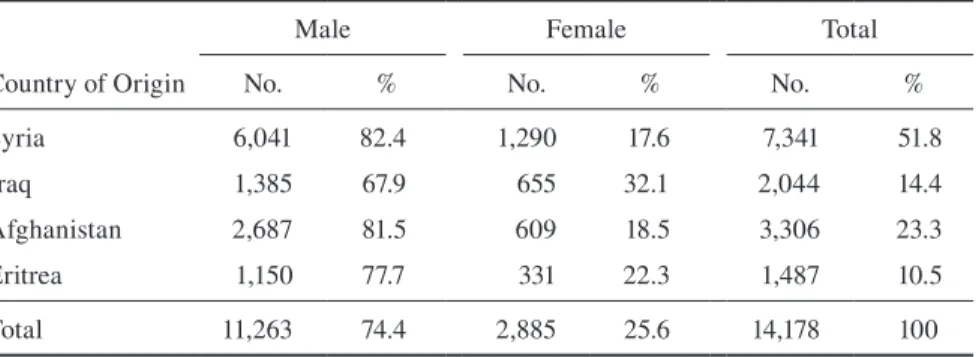
According to AZR data, more than half of the asylum seekers who arrived in Bavaria between January 1 and September 30, 2015 were from Syria; 23% were from Afghanistan, 14% from Iraq, and 11% from Eritrea (see Table 1). These four countries were therefore the target countries of origin in the present study. At the time, the sex ratio among all asylum seekers in Bavaria irrespective of country of origin was 20 females to 80 males, yet the percentage of females among the asylum seekers from the aforementioned four target countries of origin was 25.6%.
While awaiting a decision on their asylum application, asylum seekers live in collective accommodation located in urban districts and rural communities. The research sites for the present study were selected with the aim of including hetero-geneously structured areas and surveying a sufficient number of asylum seekers from the four target countries of origin, Syria, Iraq, Afghanistan, and Eritrea. The city of Nuremberg was chosen to represent urban areas and the district of Ebers-berg, situated on the outskirts of Munich, to represent rural areas.
The target population included all residents aged 18 years or over living in collective accommodation for asylum seekers at the selected locations. The quota sample controlled for country of origin and sex (see Table 3). Although unit non-response was not reported systematically, the interpreters who delivered the ques-tionnaires reported that almost all the target residents participated in the survey. However, in future studies, more exact measurement of nonresponse rates would be useful for further analysis.
residence allocated to them after their arrival and moved elsewhere (within Ger-many or abroad). As a consequence, asylum seekers in Bavaria might be different from those living in other federal states, for example Berlin or North Rhine-West-phalia. It has also been reported that asylum seekers sent to other federal states have sometimes returned to Bavaria. Moreover, it is possible that asylum seekers are allocated to collective accommodation based on their nationality. One indicator for this assumption is that there are only small numbers of asylum seekers from Afghanistan and Eritrea in Nuremberg (see Table 2).
Table 1 Sex ratio of asylum seekers from selected countries of origin in Bavaria (January–September 2015)
Country of Origin
Male Female Total
No. % No. % No. %
Syria 6,041 82.4 1,290 17.6 7,341 51.8
Iraq 1,385 67.9 655 32.1 2,044 14.4
Afghanistan 2,687 81.5 609 18.5 3,306 23.3
Eritrea 1,150 77.7 331 22.3 1,487 10.5
Total 11,263 74.4 2,885 25.6 14,178 100
Source: AZR/BAMF, as of December 10, 2015; aggregate data on asylum seekers in Ba-varia, January 1–September 30, 2015; own analysis of special analyses made available to the authors by BAMF.
Table 2 Population of asylum seekers at the research sites (as of April/May 2016)
Country of Origin
Nuremberg Ebersberg Total
No. % No. % No. %
Syria 1,488 34.5 220 14.3 1,708 29.2
Iraq 1,162 27.0 61 4.0 1,223 20.9
Afghanistan 68 1.6 220 14.3 288 4.9
Eritrea 0 0.0 255 16.6 255 4.4
Other countries 1,591 36.9 784 50.9 2,375 40.6
Total 4,309 100 1,540 100 5,849 100
The survey design implemented was aimed at interviewing all asylum seek-ers from the target group allocated to the collective accommodation centseek-ers that were selected as research sites. As legal asylum status was not a selection criterion, persons who had already applied for asylum and persons who had not yet had the chance to apply for asylum due to administrative delays were eligible to participate in the survey.
As mentioned above, an analysis of the locally registered asylum seekers revealed that there was a relatively small number of persons from Afghanistan and Eritrea residing in Nuremberg (see Table 2). Moreover, in the rural district of Ebersberg near Munich, there were hardly any women among the asylum seekers from the target countries.
A separate evaluation of subpopulations, such as Eritrean or Afghan women, was not possible due to the small number of cases. It was therefore decided to limit the target female population to women from Syria and Iraq. A quota scheme based on country of origin and sex was designed for the sampling procedure (see Table 3). The study was scaled for at least 750 interviews, 20% of which were to be con-ducted with female respondents.
Standardized Survey Design and Data Collection
After conducting expert interviews with persons entrusted with the accommoda-tion, distribuaccommoda-tion, and integration of asylum seekers, a standardized questionnaire was designed and translated into the most frequently used languages in the target population: English, Arabic, Farsi, and Tigrinya. When necessary, the interpreters translated the Arabic-language questionnaire into Kurdish (especially Kurmanji-Kurdish, the dialect spoken in Syria and northern Iraq), as Kurdish is rarely used as a written language. Based on existing literature (see Becher & El-Menouar, 2013; Table 3 Quota plan by country of origin and sex
Country of Origin Male Female Total
Syria 300 100 400
Iraq 190 60 250
Afghanistan 50 – 50
Eritrea 50 – 50
Total 590 160 750
Halm & Sauer, 2015; Pollack & Müller, 2013; Haug et al., 2009; Wetzels & Brett-feld, 2007) and the findings of the expert interviews, the following topics were included in the survey: place of origin and family structures; reasons for flight; intentions to remain in Germany; resources for structural integration (language skills, level of education, work experience); and perceptions and attitudes (toward gender roles, religiosity, tolerance, antisemitism, terrorism, democracy).
A self-administered paper-and-pencil (PAPI) mode was used to interview respondents. The advantage of a self-administered survey is that it reduces inter-viewer effects, such as response bias based on social desirability (Schnell et al., 2013a, p. 359). However, in an exclusively self-administered survey, the high rate of non-formal education among asylum seekers (Rich, 2016, p. 5), especially those from Afghanistan and Eritrea, would have led to bias due to educational back-ground. Therefore, respondents with no literacy skills were able to complete the questionnaire with the help of native-speaker interpreters in a face-to-face inter-view setting.
A pretest with 10 respondents was conducted in a collective accommodation center for asylum seekers in Nuremberg in April 2016. After an initial evalua-tion of the results of the pretest, quesevalua-tions and items were modified. The pretest highlighted challenges relating to the organization of the field phase in collective accommodation for asylum seekers: The inclusion of “gatekeepers” was essential in order to gain access. Gatekeepers in relevant key positions were local government employees and employees of welfare organizations, as well as accommodation cen-ter managers and volunteers. Permission to access the collective accommodation had to be obtained from the agency responsible. The management of each accom-modation was contacted and given information about the project and a description of the research design. Prior to the field work, information sheets in the relevant languages were posted in the collective accommodation in order to inform residents about the purpose and content of the study, as well as the survey period.
use of the research instruments and in appropriate behavior in collective accom-modation centers for asylum seekers. Most interpreters had already been involved in the process of translating the questionnaires and were familiar with the content.
Fieldwork and Challenges
The fieldwork for the study was conducted in June and July 2016. Asylum seek-ers showed strong interest in participating in the study; this has also been the case in other surveys on asylum seekers (see, e.g., Brücker, Rother, & Schupp, 2016c). Participation incentives, such as pens, writing pads, and cloth bags, were offered to the respondents.
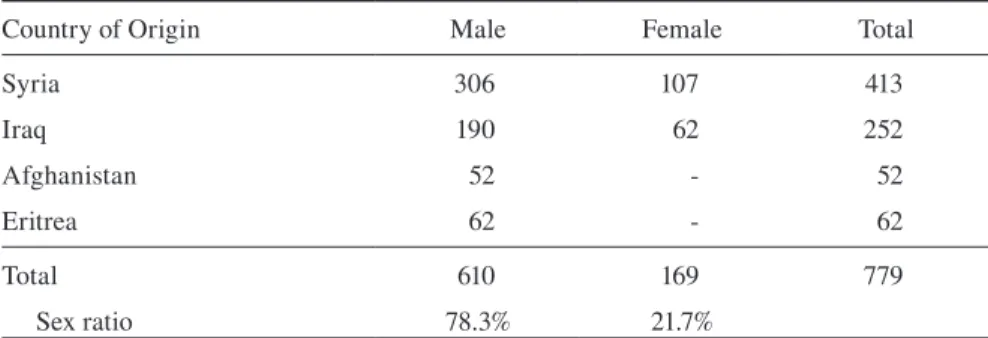
The illiteracy rate turned out to be only 5% of the entire sample, which meant that 95% of the respondents were able to self-administer the questionnaire. The interview duration ranged between 10 and 20 minutes. A total of 779 interviews were conducted with asylum seekers from Syria, Eritrea, Iraq, and Afghanistan at the two research locations, Nuremberg and Ebersberg (see Table 4).
As the quantitative study was designed as a self-administered survey, the influence of the interpreters, and therefore interviewer effects, were assumed to be marginal. This assumption was tested and proven.2
The analysis of the interpreters’ field reports revealed that the respondents ini-tially displayed a tendency to respond to questions about attitudes and values (e.g., concerning gender roles) in a socially desirable way (Paulhus, 2002, p. 50): During the interviews, they asked the interpreters for their opinions on appropriate answer patterns. The presence of the interpreters was important to explain to the respon-dents that their personal opinions were relevant and perfectly acceptable responses. Some respondents tended to rely on country-specific response patterns instead of on their own opinions. Therefore, the cultural context must be taken into account when adapting survey instruments. Another option could be to give recently arrived respondents separate answer options regarding Germany and the country of origin in order to enable the expression of ambivalent attitudes in relation to the country of origin and the host country. For example, some respondents did not support the idea of women going out on their own at night. A deeper examination of this attitude item in the qualitative interviews revealed that this answer has to be interpreted in a political/cultural context: The security situation in countries of origin such as Iraq or Syria would not allow such behavior for safety reasons. Other respondents
accepted this behavior on the part of women, but qualified their acceptance with reference to Germany; they argued that in their home countries this behavior would not be compatible with social norms and values.
Interpreters’ reflections on the data collection process also indicated that reli-gious and ethnic conflicts in the country of origin affected response behavior in the survey. For example, two respondents who self-identified as Sunni Muslims were clearly identified by the interpreters − on the basis of their hometown in Syria − as Alawis.
A further challenge arose from the interview setting in large collective modation centers for asylum seekers and, in particular, in emergency accom-modation. Recruitment gained momentum when the presence of the interpreters attracted the interest of a number of residents: A whole group of asylum seekers could be informed about the survey at the same time, which significantly facilitated the recruitment and information process. On the other hand, conducting interviews in a collective residential setting can lead to socially desirable responses influenced by the proximity of other residents. The intervention of the interpreters was some-times necessary to control these influencing tendencies by pointing out that the questionnaire was to be completed individually. Therefore, interpreters played an important role in avoiding bias due to socially desirable responding related to value concepts specific to the home country. The interpreters’ explanations about how to complete a questionnaire were highly relevant because, for many respondents, it was the first survey of their lives.
Table 4 Sample by sex and country of origin
Country of Origin Male Female Total
Syria 306 107 413
Iraq 190 62 252
Afghanistan 52 - 52
Eritrea 62 - 62
Total 610 169 779
Sex ratio 78.3% 21.7%
Qualitative Methods
The qualitative study employed semi-structured face-to-face interviews with bio-graphical elements. The interviews were conducted between June and October 2016 with the support of consecutive interpreters.
Qualitative research methods are used in cases where research topics cannot be investigated well using standardized methodological procedures and where an in-depth understanding of phenomena and their interpretation is required (Helffe-rich, 2011). The present study employed qualitative methods to explore attitudes and value orientations of asylum seekers, their reasons for flight, and their aspira-tions for the future. The study included (retrospective) biographical research tech-niques, which can be used to describe and analyze changes in (behavioral) patterns over time and cause–effect relationships (Fuchs-Heinritz, 2009; Rosenthal, 2004). The biographical approach allowed a contextual understanding of reasons for flight and other relevant dimensions in the genesis of biographical experiences. It was used to explain and interpret current phenomena, for example employment or train-ing opportunities, and intentions to remain in Germany.
Participant Selection and the Use of Gatekeepers
The selection of 12 participants for the qualitative study was based on a theoretical sampling strategy (Marshall, 1996) that aimed to ensure diversity in the sociode-mographic profiles of the interviewees with regard to country of origin, sex, age, and research location (see Table 5).
Qualitative Data Collection
All interviews were conducted with the support of consecutive interpreters by a 38-year-old male German researcher experienced in the field of qualitative bio-graphical data collection. The interviews took place in collective accommodation for asylum seekers or at facilities of supporting local councils; interviews were audio-recorded.
At the beginning of each interview, the researcher informed the interviewee about the study and stressed that his or her personal data would be anonymized. The respondent was asked to sign a consent form, which had been drafted in his or her mother tongue. It was also emphasized that the study was not related to the interviewee’s personal asylum procedure. The interviews lasted up to three and three quarter hours; a semi-structured interview guide was used, which focused on themes such as personal biography, experiences during flight, experiences in Ger-many, attitudes and value orientations, and future aspirations.
Table 5 Cases in the qualitative survey
Country of Birth Sex Age Arrival in
Bavaria Application Asylum Marital Status
1 Syria M 18 2015 submitted unmarried
2 Syria M 21 2015 submitted unmarried
3 Syria M 37 2015 submitted married,
3 children
4 Syria F 27 2015 submitted married,
4 children
5 Iraq M 19 2016 submitted unmarried
6 Iraq M 27 2016 submitted unmarried
7 Iraq M 51 2015 submitted unmarried
8 Iraq F 32 2015 submitted married,
3 children
9 Eritrea M 19 2015 submitted unmarried
10 Eritrea M 41 2015 approved married,
3 children
11 Afghanistan M 22 2015 submitted unmarried
Visualization techniques were used to minimize memory effects on biographi-cal data. A “life history guide” was developed, which facilitated structured bio-graphical data collection (see Denzin & Lincoln, 1998). The life history guide is a paper-and-pencil technique that shows a simple time line on which biographical events are recorded. The time line follows the life course as it develops, and it allows the researcher to make structured notes as anchor points that can stimulate further memories of the respondent.
In addition, mapswere given to the interviewees to enable them to locate geo-graphically significant locations in their home country and on the route they took when they fled. Reporting the individual way stations proved difficult for most par-ticipants, which suggests that orientation on the route could depend more on exter-nal factors and actors, such as traffickers or fellow refugees.
The Role of Interpreters in the Research Process
The literature suggests that interpreters play an important role in the qualitative interview process with asylum seekers (see, e.g., Brücker et al., 2016a; Brücker et al., 2016b). Interpreters were trained prior to data collection, and it was advanta-geous that they had already been involved in the translation of the semi-structured questionnaire and were familiar with the content of the study.
Ten interviews were conducted in Tigrinya or Arabic with male interpreters; two interviews were conducted in Farsi with a female interpreter. All interpreters were native speakers of the respective languages and were also fluent in German. The fact that the interpreters and asylum seekers had a common cultural and lan-guage background helped build interviewees’ confidence in the study project and make the interviews more enjoyable and effective. Moreover, the fact that some of the interpreters originally came to Germany as asylum seekers themselves had an additional confidence-building effect.
The use of interpreters can influence interviews (the so-called “interpreter effect”; see Jentsch, 1998). Interpreters can affect response behavior due to their presence, behavior, and external characteristics (e.g., sex and age) and thus create bias. Negative effects on the interview process due to different cultural/religious backgrounds on the part of interpreters and respondents (e.g., Kurds, Shia Arabs, & Sunni Arabs) could not be observed in this study (but see, e.g., Jacobsen & Landau, 2003).
Another issue was the discrepancy between literal and free translation, which can significantly influence the interview situation. The present study used an approach that gave the interpreter the option to translate interview questions and answers largely freely. This was also helpful because differing cultural back-grounds, as well as low levels of education on the part of interviewees, sometimes made it necessary to provide explanations for certain terms, such as “integration”.
In some cases, native-speaker transcribers were hired to check the translations of interpreters during the interviews (see Merkens, 1997). In these cases, the Ara-bic content of a recorded interview was additionally translated by a native-speaker transcriber. The comparison of the Arabic originals with the control translations did not reveal any relevant differences. The transcriptions of the other interviews focused only on the German text.
Research Ethics
The principles for research ethics drawn up by the German Data Forum (RatSWD, 2017) focus in particular on interviews with vulnerable groups. Studies on asylum seekers present specific research-ethical challenges concerning research design and the process of data collection (Hugman et al., 2011; Jacobsen & Landau, 2013), a fact that played an important role in the present study.
All persons involved in this study (including researchers, interviewers, inter-preters, and transcribers) were obliged to maintain strict confidentiality of the information obtained in the course of the study. Survey respondents and qualitative interviewees were given written information on the content and objectives of the interview and on data protection, as well as a guarantee of confidentiality of inter-view contents and personal data. The explanatory note on the quantitative survey pointed out the study’s voluntary nature and anonymity, as well as the fact that participation in the study would have no effect on the asylum procedure. For the qualitative study, a declaration of consent form was prepared and translated into the relevant languages. The declaration of consent form mentioned that participation in the study was voluntary, and expressly emphasized that the survey was unrelated to any possible asylum procedure. All qualitative interviews were subject to written consent to participation in the study. Depending on the educational background of the interviewee, an extensive explanation of the concept of declaration of consent was necessary.
data material (audio files, transcripts) was stored securely and will be deleted after completion of the project. The anonymized transcripts were stored and handed over to Hanns Seidel Foundation as an appendix to the final report. Whereas the final report was published (Haug et al., 2017), this appendix was not.
As asylum seekers are a vulnerable group of research subjects, difficult interac-tion situainterac-tions may arise during the research process (Helfferich, 2011). Both trau-matic events in the country of origin and experiences when fleeing to Germany may cause post-traumatic stress disorder (PTSD), and this should be taken into account during biographical interviews, which may cause interviewees to relive traumatic events. None of the respondents showed obvious negative emotional responses to the interviews or exhibited signs of an emotional crisis. In order to fulfill their ethi-cal responsibility, the researchers made sure that information on psychotherapeutic care facilities was passed on to the participants in the course of the study.
Conclusion
In many respects, research on asylum seekers is not easy to conduct. As a pilot study, the research project “Asylum Seekers in Bavaria” offered the opportunity to test methodological approaches to conducting a quantitative and qualitative sur-vey of persons who had recently arrived in Germany in search of asylum. In par-ticular, the use of gatekeepers and interpreters proved to be an essential feature of the research process. The cooperation of native speakers and transcribers was also essential for the interpretation of the data. In order to build trust among the poten-tial respondents, it was important to reduce uncertainties by explaining the rules and concepts of data protection and anonymity and to point out the strict separation of the present research from the asylum procedure. The majority of asylum seekers greatly appreciated being approached in their native language; this was reflected in a high willingness to participate.
One challenge was the sampling of asylum seekers in the quantitative survey. Due to the strong influx of asylum seekers between autumn 2015 and spring 2016, there was no sufficiently valid database at time of the project design that included all asylum seekers who entered Bavaria. The AZR database lists all asylum seek-ers in Germany, but, as explained above, the deviations between the AZR and the EASY registration database (the so-called “EASY gap”; Kroh et al., 2017, p. 7) were particularly pronounced in 2015. Furthermore, due to statutory restrictions, samples can be drawn from the AZR only within the framework of research proj-ects conducted in cooperation with BAMF, which was not the case in the present study; hence a pilot survey was conducted in two research areas in Bavaria.
quantitative survey. For example, findings from the qualitative interviews suggest that it was problematic for interviewees to answer questions on attitudes to religios-ity, freedom of opinion, and gender roles, which were also asked in the quantitative survey.
In 2017, a second wave of qualitative interviews took place in order to col-lect exemplary integration biographies (Haug & Huber 2018). However, as the 2016 quantitative study was designed as a cross-sectional study, no statements can be made about general integration processes or the determinants of integration based on the presented case study. The IAB-BAMF-SOEP Survey of Refugees, a German Socio-Economic Panel (GSOEP) study, will provide such data for future research.
References
Becher, I., & El-Menouar, Y. (2013). Geschlechterrollen bei Deutschen und Zuwanderern christlicher und muslimischer Religionszugehörigkeit [Gender roles among Germans and immigrants of Christian and Muslim faith] (BAMF Research Report No. 21). Nu-remberg: Federal Office for Migration and Refugees (BAMF).
Brücker, H., Fendel, T., Kunert, A., Mangold, U., Siegert, M., & Schupp, J. (2016b). Geflüch-tete Menschen in Deutschland: Warum sie kommen, was sie mitbringen und welche Erfahrungen sie machen [Refugees in Germany: Why they come, what they have to offer, and what they experience] (IAB Short Report No. 15/2016). Nuremberg: Institute for Employment Research (IAB).
Brücker, H., Kunert, A., Mangold, U., Kalusche, B., Siegert, M., & Schupp, J. (2016a). Ge-flüchtete Menschen in Deutschland – eine qualitative Befragung [Refugees in Germa-ny – A qualitative survey] (IAB Research Report No. 9/2016). Nuremberg: Institute for Employment Research (IAB).
Brücker, H., Rother, N.; & Schupp, J. (Eds.). (2016c). Die IAB-BAMF-SOEP-Befragung von Geflüchteten: Überblick und erste Ergebnisse [The IAB-BAMF-SOEP Survey of Re-fugees: Overview and first results]. Berlin: German Institute for Economic Research (DIW).
BAMF (Federal Office for Migration and Refugees). (2015). Sehr hoher Asylzugang im September [Very high number of asylum seekers in September] (press release issued October 7, 2015). Retrieved December 15, 2016 from http://www.bamf.de/SharedDocs/ Meldungen/DE/2015/20151007-asylgeschaeftsstatistik-september.html
BAMF (Federal Office for Migration and Refugees). (2016a). Migrationsbericht 2015 [ Mi-gration report 2015]. Nuremberg: BAMF.
BAMF (Federal Office for Migration and Refugees). (2016b). Das Bundesamt in Zahlen 2015 [The Federal Office in figures 2015]. Nuremberg: BAMF. Retrieved September 7, 2018 from https://www.bamf.de/SharedDocs/Anlagen/DE/Publikationen/Broschu-eren/bundesamt-in-zahlen-2015.pdf
BAMF (Federal Office for Migration and Refugees). (2017b). Erstverteilung der Asylsu-chenden (EASY) [Initial Distribution of Asylum Seekers (EASY)] (as of January 1, 2017). Retrieved June 23, 2017 from http://www.bamf.de/DE/Fluechtlingsschutz/Ab-laufAsylv/Erstverteilung/erstverteilung-node.html
BAMF (Federal Office for Migration and Refugees) (Eds.). (2018) Aktuelle Zahlen zu Asyl, Juli 2018 [Current figures on asylum, July 2018] (monthly report). Retrieved Septem-ber 7, 2018 from http://www.bamf.de/SharedDocs/Anlagen/DE/Downloads/Infothek/ Statistik/Asyl/aktuelle-zahlen-zu-asyl-juli-2018.pdf
BMI (German Federal Ministry of the Interior). (2016). 890.000 Asylsuchende im Jahr 2015 [890,000 asylum seekers in 2015] (press release issued September 30, 2016). Re-trieved October 14, 2016 from https://www.bmi.bund.de/SharedDocs/Pressemitteilun-gen/DE/2016/09/asylsuchende-2015.html
Creswell, J. (2003). Research design. Thousand Oaks, CA: Sage Publications.
Denzin, N., & Lincoln, Y. (1998). Entering the field of qualitative research. In N. Denzin & Y. Lincoln (Eds.), Strategies of Qualitative Inquiry (pp. 1–34). Thousand Oaks, CA: Sage Publications.
Fuchs-Heinritz, W. (2009). Biographische Forschung [Biographical research]. Wiesbaden: VS Verlag.
Halm, D., & Sauer, M. (2015): Lebenswelten deutscher Muslime [Lifeworlds of German Muslims] (research report in the Bertelsmann Foundation series Religionsmonitor). Gütersloh: Bertelsmann.
Haug, S., & Huber, D. (2018). Asylsuchende in Bayern. Eine qualitative Folgebefragung. München: Hanns-Seidel-Stiftung.
Haug, S., Currle, E., Lochner, S., Huber, D., & Altenbuchner, A. (2017). Asylsuchende in Bayern [Asylum seekers in Bavaria] (research report). Munich: Hanns Seidel Founda-tion. Retrieved June 23, 2017 from https://www.hss.de/download/publications/Asylsu-chende_in_Bayern.pdf
Haug, S., & Vernim, M. (2015). Telefonische Befragung. Methodenbericht. Der Einfluss sozialer Netzwerke auf den Wissenstransfer am Beispiel der Reproduktionsmedizin (NeWiRe) [Telephone survey. Methods report. The influence of social networks on knowledge transfer, using the example of reproductive medicine](Working Paper No. 2.01). Regensburg: OTH. Retrieved January 3, 2018 from https://www.oth-regensburg. de/fileadmin/media/fakultaeten/s/forschung_projekte/IST/newire/NeWiRe_2.01_Me-thodenbericht_Telefonbefragung.pdf
Haug, S., Vernim, M., Gelfert, V., & Reindl, A. (2014). Integrationsbericht und Integra-tionskonzept für Regensburg [Integration report and integration concept for Regens-burg] (final report). Regensburg: City of Regensburg/OTH Regensburg.
Haug, S., Müssig S., & Stichs, A. (2009). Muslim life in Germany (Research Report No. 6). Nuremberg: Federal Office for Migration and Refugees (BAMF). Retrieved Octo-ber 19, 2018 from https://www.bamf.de/SharedDocs/Anlagen/EN/Publikationen/For-schungsberichte/fb06-muslimisches-leben.pdf?__blob=publicationFile
Helfferich, C. (2011). Die Qualität qualitativer Daten. Manual für die Durchführung quali-tativer Interviews [The quality of qualitative data. A manual for conducting qualitati-ve interviews]. Wiesbaden: VS Verlag.
Humpert, A., & Schneiderheinze, K. (2002) Stichprobenziehung für telefonische Zuwander-erbefragungen – Erfahrungen und neue Ansätze [Drawing samples for telephone sur-veys of immigrants – Experiences and new approaches]. In S. Gabler & S. Häder (Eds.),
Telefonstichproben – Methodische Innovationen und Anwendungen in Deutschland
[Telephone Samples – Methodological Innovations and Applications in Germany] (pp 187–208). Münster: Waxmann.
Jacobsen, K., & Landau, L. (2003). The dual imperative in refugee research: Some metho-dological and ethical considerations in social science research on forced migration.
Disasters, 27(3), 185-206.
Jentsch, B. (1998). The ‘interpreter effect’: Rendering interpreters visible in cross-cultural research and methodology. Journal of European Social Policy, 8(4), 275–289.
Johannsson, S. (2016). Was wir über Flüchtlinge (nicht) wissen. Der wissenschaftliche Er-kenntnisstand zur Lebenssituation von Flüchtlingen in Deutschland [What we (don’t) know about the living conditions of refugees in Germany] (expert report on behalf of the Robert Bosch Foundation and the Expert Council of German Foundations on Integration and Migration, SVR). Berlin: SVR. Retrieved August 11, 2016 from http://www.svr-migration.de/wp-content/uploads/2016/01/Was-wir-%C3%BCber-Fl%C3%BCchtlinge-nicht-wissen.pdf
Kroh, M., Kühne, S., Jacobsen, J., Siegert, M., & Siegers, R. (2017). Sampling, nonresponse, and integrated weighting of the 2016 IAB-BAMF-SOEP Survey of Refugees (M3/M4) – Revised version (SOEP Survey Paper No. 477: Series C). Berlin: DIW/SOEP.
Liebau, E., Humpert, A., Schneiderheinze, K. (2018). Wie gut funktioniert das Onomastik-Verfahren? Ein Test am Beispiel des SOEP-Datensatzes [How well does the onomastic method work? A test using the example of the SOEP dataset] (SOEP Survey Paper No. 976). Berlin: DIW/ SOEP.
Marshall, M. (1996). Sampling for qualitative research. Family Practice, 13, 522-526. Merkens, H. (1997). Stichproben bei qualitativen Studien [Sampling in qualitative studies].
In B. Friebertshäuser & A. Prengel, (Eds.), Handbuch Qualitative Forschungsmetho-den in der Erziehungswissenschaft [Handbook of Qualitative Research Methods in Educational Science](pp. 97–106). Munich: Juventa.
Paulhus, D. (2002). Socially desirable responding: The evolution of a construct. In H.I. Braun, D.N. Jackson & D.E. Wiley (Eds.), The role of constructs in psychological and educational measurement (pp 49-69). Mahwah NJ: Erlbaum.
Pollack, D., & Müller, O. (2013). Verstehen was verbindet. Religiosität und Zusammen-halt in Deutschland [Understanding what unites people. Religiosity and cohesion in Germany] (research report in the Bertelsmann Foundation Religionsmonitor series). Gütersloh: Bertelsmann.
RatSWD (German Data Forum). (2017). Forschungsethische Grundsätze und Prüfverfah-ren in den Sozial- und Wirtschaftswissenschaften [Principles and review procedures for research ethics in the social and economic sciences] (Output 9 (5)). Berlin: RatS-WD.
Rosenthal, G. (2004). Biographical research. In C. Seale, G. Gobo, J. Gubrium, & D. Sil-verman (Eds.). Qualitative Research Practice (pp. 48–64). London: Sage Publications. Schnell, R., Gramlich, T., Bachteler, T., Reiher, J., Trappmann, M., Smid, M., & Becher, I.
(2013b). Ein neues Verfahren für namensbasierte Zufallsstichproben von Migranten [A new name-based sampling method for migrants]. mda Methoden - Daten – Analysen,
7(1), 5–33.
Schnell, R., Hill, P., & Esser, E. (2013a). Methoden der empirischen Sozialforschung [ Me-thods of empirical social research] (10th. ed.). Munich: Oldenbourg.
VDSt Arbeitsgemeinschaft Bevölkerung (Association of German Municipal Statisticians Population Working Group). (2013). Migrationshintergrund in der Statistik – Defini-tionen, Erfassung und Vergleichbarkeit [Migration background in statistics – Defi-nitions, measurement, and comparability](issue 2 of the VDSt Population Working Group publications Materialien zur Bevölkerungsstatistik). Cologne: Association of German Municipal Statisticians (VDSt). Retrieved September 7, 2018 from http:// www.staedtestatistik.de/fileadmin/vdst/AG_Bevoelkerung/Publikation/Heft2_Mig-rationshintergrund.pdf
Wetzels, P., & Brettfeld, K. (2007). Muslime in Deutschland. Integration, Integrationsbar-rieren, Religion, und Einstellungen zu Demokratie, Rechtsstaat und politisch-religiös motivierter Gewalt [Muslims in Germany. Integration, integration barriers, religion, and attitudes to democracy, the rule of law, and politically and religiously motivated violence] (report of the results of a survey study). Berlin: Federal Ministry of the Inte-rior (BMI).