391
THE INFLUENCE OF SUBSTRATE COMPOSITION ON THE
DEVELOPMENT OF SEEDLINGS OF ANNUAL FLOWERS
CATHARANTHUS ROSEUS L.
Vujosevic A.,
University of Belgrade, Faculty of Agriculture, Department for horticulture, Nemanjina 6, 11080 Serbia, e-mail:[email protected]
Key words: Catharanthusroseus, substrata, seedling, flowers, containers, Tutin peat, perlite, zeoplant, development
ABSTRACT
The substrate of different composition, prepared on the basis of domestic raw
materials and their impact on the development of seedlings of flower
CatharanthusroseusL. were researched.
The selection of species was made according to the length of the vegetation (10-14 weeks) of seedlings as well as on the basis of their presence in the product assortment of producers in Serbia. The production of the initial seedling was carried out by means of speedling system in plastic containers, and further growing was resumed after transplanting in pots and on substrata made of Tutun peat, zeoplant and perlitof 7 different composition.
It has been determined that tested substrata, regarding their physical and agrochemical properties are favourable for growing seedlings of Catharanthusroseus.The development of obtained seedlings (plant height, above-ground mass, root shoot ratio) on the substrata comprising zeoplant, was better than the development achieved on ready-made-commercial substratum. The best development of plants-seedlings Сatharanthusroseus
`Pacifica`-red on the substratum 3, Т80+P10+Z10.
INTRODUCTION
392
perform the function of a nutritious substratum and conditioner. In the glasshouse production of seedlings, a particular kind of fertiliser – Zeoplant has a widespread use today; it is produced on the basis of natural zeolite and it is enriched with nutrients (nitrogen, phosphorus, potassium, calcium, and magnesium). The results of research have shown that the use of zeoplant in substrata for the production of tomatoes, in the amount of 15-25%, enhances the plant development (Glintić and Pavlović, 1994) and improves the quality of fruits (Damjanović et.al., 1994). In substrata for the production annual seedlings flower, results of research have shown that zeoplant improves the quality of seedlings, Vujosevic, 2012.
For mending the water and air capacity of substrata, the materials of mineral origin including perlite are used most frequently according to Gunther (1987). Perlite is produced in Serbia and as an indispensible component in substrata it is easily accessible and cheap. Considering the resources of organo-mineral raw materials which Serbia has in abundance and which can be used for the preparation of substrata, the aim of this research was to test the justifiability of their use for the preparation of substrata suitable for growing one of the most commonly grown kinds of annual flowers, long vegetation of seedlings, Catharanthus roseus L.
MATERIALS AND METODS
The research on the influence of substrate composition for the production of
Catharanthus roseusL.-`Pacifica` redseedlings byusing domestic raw materials was done
during 2010 in the glasshouse of the Faculty of Agriculture, University of Belgrade. We investigated substrata of different composition, prepared on the basis of domestic raw materials: Tutin peat (T), Perlite (P) and Zeoplant (Z). We tested the physical and agrochemical properties of substrata and monitored their impact on the development of seedlings of annual flowers Catharanthus roseus L.series `Pacifica` red PanAmerican seed as the most frequently grown kind of annual flowers. The production of the initial seedling was done according to the seedling system in plastic containers of the HP QP 144/4,5P type in the ready-made seeding substratum Floragard B-fine. After the transplantation to plastic TEKU pots (pot system) of the VVC 9cm series, with a volume of 0.32l, the plants were grown on substrata of different compositions according to the following variants: 1. imported substratum (Floragard Medium Coarse), 2. Control-Tutin peat 100%, 3. Control-Tutin peat 80% with 10% perlite and with 10% zeoplant, 4. Control-Tutin peat 70% with 10% perlite and with 20% zeoplant, 5. Tutin peat 60% with 10% perlite and 30% zeoplant, 6. Tutin peat 70% with 20% perlite and with 10% zeoplant, 7 Tutin peat 60% with 20% perlite and 20% zeoplant.
Substrata were made based on the volume ratio of components. For each variant we tested, we took 50 plants of the initial seedling for transplantation, while the selection was made randomly. The following parameters of seedlings quality were analyze: plant`s high (cm), above-ground masses (g) and the calculated root/shoot ratio.
The laboratory tests of physical and agrochemical characteristics of substrata were performed before as well as after transplantation into pots. The tests were carried out in the Laboratories for Physics and Soil Agrochemistry at the Faculty of Agriculture, University of Belgrade. To determine the physical properties of tested substrata, we used internationally recognised methods which are also adopted by the YU societies (Bošnjak, 1997): density (volume) weight – by Kopecky's cylinders of 100 cm3, and prompt moisture
– by computation.
As regards the agrochemical properties, we analysed: thereaction of substrata – pH
of substrata – using potentiometric method; salt content (EC) – by measuring electrical
393
al.1985); organic carbon and humus – the Tyurin dichromate method, Simakov's
modification (Mineen, 2001); total nitrogen – semi-micro Kjeldah method, Bremner's
modification (Bremner, 1996); accessible nitrogen – the direct distillation method according
to Bremner (Bremner, 1965); accessible phosphorus and potassium – Al method of Egner
Riehm (1960); the content of accessible Ca and Mg – the extraction with 1M of ammonium
acetate, AAS-Atomic Absorption Spectrophotometry (Pantović et al., 1989); the content of
accessible microelements Fe, Mn, Cu and Zn, using the AAS method from the DTPA
solution (Jakovljević 1985).
The experimental results were analyzed by means of descriptive and analitycal statistics with the statistical package STATISTICA. The results of research were reflected in descriptive statistics basic indicators (arithmetic mean, and its standard error, standard deviation, Mediana test, minimum and maximum values and variation ratio). With respect to the objective on the study, from the statistical point of view, was studied the hypothesis that there was no difference between average values of studied features. Since the samples are of the same size, the importance of difference in average values of the testing parameters was tested using the parameter model of the analysis of variance (ANOVA) and the least significant difference test
RESULTS AND DISSCUSION
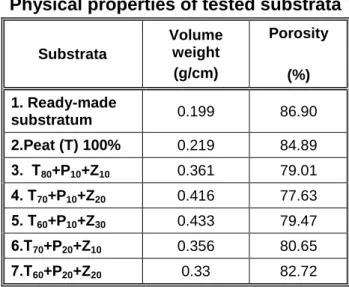
All substrata we tested had good physical properties (Table 1). The volume weight of substrata indicate the suitability of using substrata for growing plants. It is always smaller than the specific mass value because of porosity. Certain values for volume weight in examined substrata ranged from 0.19 g/cm3 (ready-made – commercial substratum) to 0.433 g/cm3 in substratum 5 Т60+P10+Z30 (Table 1). As regards certain values for the overall porosity
which was high in all examined substrata and ranged from 77,63 % to 86,90 % (Table 1) examined substrata can be considered as loose. Substrata in which organic matter (peat) was a dominant component compared to the share of mineral components had the highest values for porosity.
Table 1
Physical properties of tested substrata
As to examined substrata, the difference in terms of agrochemical characteristics was set, it reflected the development of seedlings Catharanthus roseus L.-Pacifica red
(Table 2). Many researchers (Bailey et.al, 1995, Harbaugh, 1994, Compton and Nelson, 1996) indicate the importance of continuous monitoring and maintenance of the most relevant agrochemical properties of substrata in contemporary (container) production of seedlings: pH, the content of soluble salts (EC), the quantity of accessible elements.
Substrata
Volume weight
(g/cm)
Porosity
(%)
1. Ready-made
substratum 0.199 86.90
2.Peat (T) 100% 0.219 84.89 3. Т80+P10+Z10 0.361 79.01 4. Т70+P10+Z20 0.416 77.63 5. Т60+P10+Z30 0.433 79.47 6.Т70+P20+Z10 0.356 80.65
394
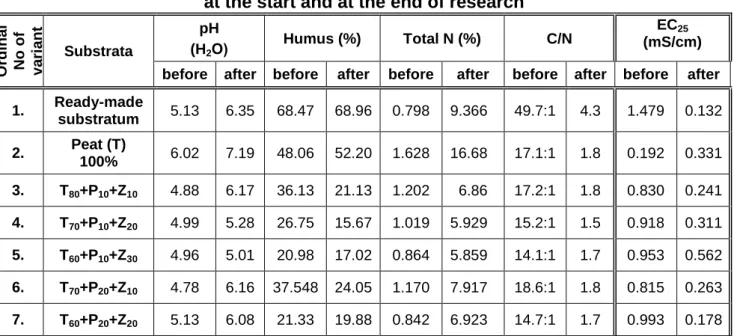
At the beginning of the experiment, pH values of examined substrata were in the category from acidic to weakly acedic (Table 2). Due to the young plants’ ability to affect the change in pH of substratum by increasing or decreasing it, certain pH value of substratum after the research showed that plant seedlings of Catharanthus have the ability to increase pH value, therefore setting the optimal value for growing it 5.01-7.19 (Table 2) which is in accordance with the research of Bailey et al. (1995).
Table 2
The main agrochemical properties of tested substrata at the start and at the end of research
Even though the initial content of the total nitrogen in all examined substrata was high and ranged between 0.798 % and 1,628 % (Tab.2), its content increased at the end of vegetation which is in accordance with the results of Stevanovic and Pavlovic (1995) indicating low fertilising ability of peat in the first part of vegetation due to small mineralisation capacity and wider C/N ratio.
The content of humus in examined substrata decreased as the percentage of peat (Table 2) declined. The highest percentage of humus was found in the ready-made commercial substratum (68.47 %) and then in the examined substratum with 100 % peat (48.06 %). The lowest percentage of humus was determined in the examined substratum with the smallest share of peat, variant 5 and it was 20.98 %. Based on the C/N ratio in the examined substrata with Tutin peat, perlite, and zeoplant (from 14,1:1 to 18,6:1), examined substrata had a favourable C/N ratio with respect to mineralisation compared to the ready-made commercial substratum (49.7:1).
The content of soluble salts (EC) in all examined substrata from variant 2 to varaint 7 both before and after the research was within optimal limits, smaller than 1mS/cm (Table 2) which is in accordance with the recommendation of Harbaugh, (1994); Elfeky et.al, (2007). The initial content of soluble salts in the ready-made commercial substratum was the highest (1.479 mS/cm).
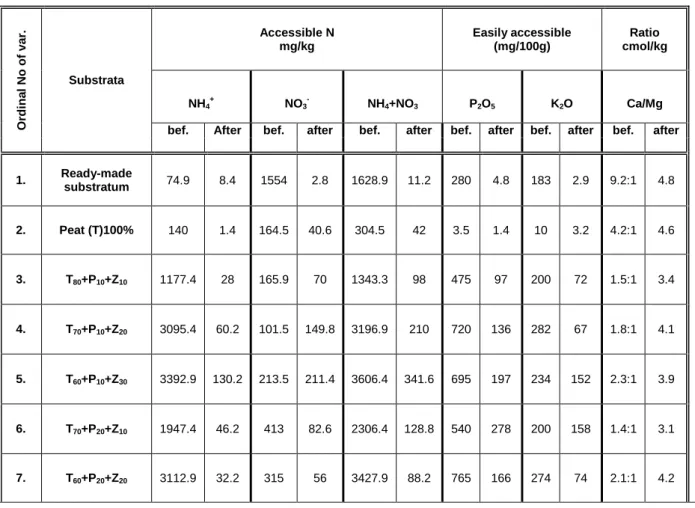
The differences in the content of easily accessible, macro and micro elements (Table 3 and Table 4) in examined substrata were determined. The most deficient substratum in terms of the content of easily accessible macro nutrients was pure peat followed by substrata which had mostly peat without the mineral component – zeoplant (Table 3). The naturally small content of easily accessible nutrients in peat and small fertilisation capacity, especially in the first part of vegetation, are indicated by Stevanović and Pavlović(1995) in their research. The content of easily accessible forms of nitrogen,
O
rd
inal
No
of
va
ri
ant Substrata
pH
(H2О) Humus (%) Total N (%) C/N
EC25 (mS/cm)
before after before after before after before after before after
1. Ready-made
substratum 5.13 6.35 68.47 68.96 0.798 9.366 49.7:1 4.3 1.479 0.132
2. Peat (T)
100% 6.02 7.19 48.06 52.20 1.628 16.68 17.1:1 1.8 0.192 0.331
3. T80+P10+Z10 4.88 6.17 36.13 21.13 1.202 6.86 17.2:1 1.8 0.830 0.241
4. T70+P10+Z20 4.99 5.28 26.75 15.67 1.019 5.929 15.2:1 1.5 0.918 0.311
5. T60+P10+Z30 4.96 5.01 20.98 17.02 0.864 5.859 14.1:1 1.7 0.953 0.562
6. T70+P20+Z10 4.78 6.16 37.548 24.05 1.170 7.917 18.6:1 1.8 0.815 0.263
395
phosphorus, and potassium in examined substrata increased with the application of zeoplant which is in accordance with the research results of Minatо, (1988); Pavlović, (1997) who found that zeolite-zeoplant have a positive effect in substrata as regards nutrients. The initial content of easily accessible forms of nitrogen in examined substrata was smaller in those substrata in which there was use 10% of zeoplant (3 and 6) and higher in substrata with additional 30 volume percent of zeoplant (5) and it ranged between 1343.3 mg/kg and 3606.4 mg/kg (Table 3).
Upon the completion of vegetation, significantly smaller content of nitrogen was determined (Table 3), especially NH4-N which shows that optimal conditions were created
during the production process of seedlings, especially the temperature of substratum which agreed with its transformation to NO3-N. Similarly, the initial C/N ratio in examined
substrata (Table 2) favoured the mineralisation of nitrogen.
The content of easily accessible phosphorus and potassium was also the smallest in substrata without the prepared zeoplant (Table 3). The small content of these necessary macroelements was compensated for by the use of zeoplant. The highest content (765mg/kg P2O5 and 282mg/kg K2O) was reached by using 20 % zeoplant (Table 3).
Reaching the maximum content of easily accessible potassium by using the highest dose of zeoplant is in accordance with the data presented by Hanić, (1990) andPavlović, (1997) in which they underline the fact that peat is very scarce in this macronutrient and that the application of zeoplant leads to the increase of its content.
Table 3
The content of accessible macroelements in tested substrata at the start and at the end of research
As regards the balanced nutrition, it is necessary to establish a good potassium (Ca
2+
) to magnesium ( Mg 2+) ratio in substrata. A well balanced ratio of these elements
Ordi
na
l
N
o
of
v
a
r.
Substrata
Accessible N mg/kg
Easily accessible (mg/100g)
Ratio cmol/kg
NH4+ NO3- NH4+NO3 P2O5 K2O Ca/Mg
bef. After bef. after bef. after bef. after bef. after bef. after
1. Ready-made
substratum 74.9 8.4 1554 2.8 1628.9 11.2 280 4.8 183 2.9 9.2:1 4.8
2. Peat (T)100% 140 1.4 164.5 40.6 304.5 42 3.5 1.4 10 3.2 4.2:1 4.6
3. T80+P10+Z10 1177.4 28 165.9 70 1343.3 98 475 97 200 72 1.5:1 3.4
4. T70+P10+Z20 3095.4 60.2 101.5 149.8 3196.9 210 720 136 282 67 1.8:1 4.1
5. T60+P10+Z30 3392.9 130.2 213.5 211.4 3606.4 341.6 695 197 234 152 2.3:1 3.9
6. T70+P20+Z10 1947.4 46.2 413 82.6 2306.4 128.8 540 278 200 158 1.4:1 3.1
396
affects the acceptance of necessary microelements. Therefore, in examined substrata in which zeoplant accounted for 20 volume percent, an optimal ratio of these two tested indispensible macronutrients was established, 2:1 (Table 3).
Table 4
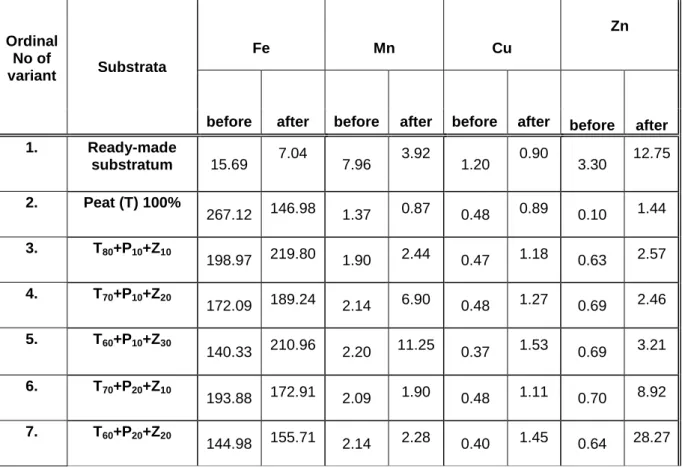
The content of accessible microelements in tested substrata (mg/kg) at the start and at the end of research
In the beginning, the smaller content of easily accessible microelements (manganese-Mn, zinc-Zn, and copper-Cu) in examined substrata was increased by applying zeoplant (Table 4). The content of accessible iron, which was dependent on the amount of organic matter as indicated by Stevanović (2000) decreased in examined substrata in which the share of organic component (peat) was smaller and mineral component (zeoplant) higher. As the percentage of mineral component was higher the content of accessible iron in examined substrata was smaller. Iron was mostly taken in from substrata in which Tutin peat accounted for 80-100 %. This speaks of not only greater demands of vinca for iron but also of favourable conditions for taking it in: favourable water and air properties of substrata, optimal pH, low content of phosphorus in substrata with predominantly organic matter. The use of zeoplant in the amount of 20 to 30 volume percent resulted in an increase in the accessible manganese and copper in examined substrata compared to the small content at the start but even though it was increased, its content remained at the level of low supply. The content of accessible zinc in examined substrata from the initial small values reached the values of mean supply (Table 4).
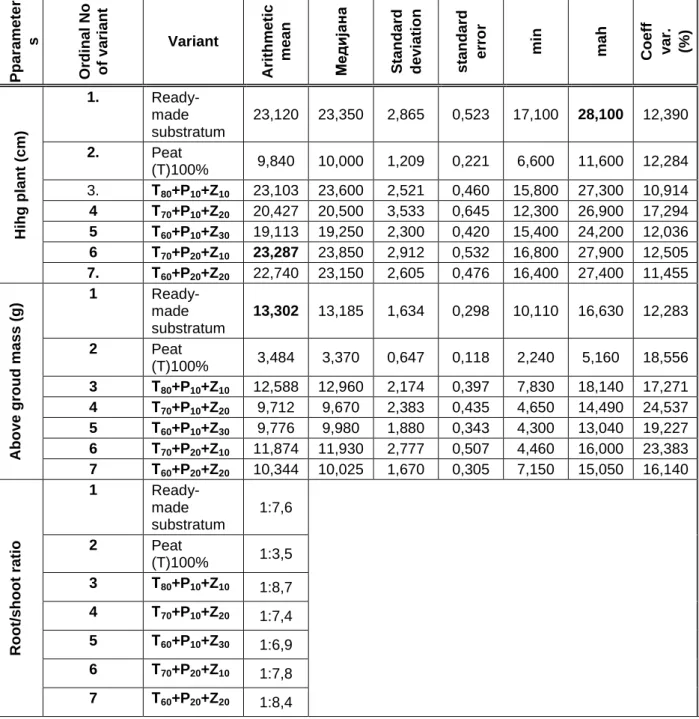
The results on the development of produced seedlings of Catharanthus roseus, seen through the: high plants,above-ground mass and calculated dry root mass to dry above-ground mass ratio (Table 5. and 6) indicate that it is justifiable to introduce domestic raw materials (T, P and Z) into the preparation of substrata for growing it. It can be noted that in all examined substrata (Table 5) without the added zeoplant (variants 2,) the seedlings of Catharanthusroseushad the most unfavourable: average high plant (9,84 cm),
Ordinal No of
variant Substrata
Fe Mn Cu
Zn
before after before after before after before after
1. Ready-made
substratum 15.69 7.04 7.96 3.92 1.20 0.90 3.30 12.75
2. Peat (T) 100%
267.12 146.98 1.37 0.87 0.48 0.89 0.10 1.44
3. T80+P10+Z10
198.97 219.80 1.90 2.44 0.47 1.18 0.63 2.57
4. T70+P10+Z20
172.09 189.24 2.14 6.90 0.48 1.27 0.69 2.46
5. T60+P10+Z30
140.33 210.96 2.20 11.25 0.37 1.53 0.69 3.21
6. T70+P20+Z10
193.88 172.91 2.09 1.90 0.48 1.11 0.70 8.92
7. T60+P20+Z20
397
average above ground mass (3,484g) and ratio in the development of root and above-ground mass (Table 6), 1:3,5. Using the smallest tested dose of zeoplant (10%) the plants of produced seedlings had the most favourable average high (23,287 cm) and average above-ground mass (12,588g).
Table 5
Basic statistical indicators for the analysed parameters of Catharantus
roseus-`Pacifica` red seedlings quality using varios on substrata differente composition
P p ar amet e r s O rd inal No o f va riant Variant Ari th met ic mean Ме д ија на S tand ar d d ev iatio n stan d ar d er ro r
min ma
h Co eff var . (%) Hih g plan t ( cm)
1. Ready-made substratum
23,120 23,350 2,865 0,523 17,100 28,100 12,390
2. Peat
(T)100% 9,840 10,000 1,209 0,221 6,600 11,600 12,284 3. Т80+P10+Z10 23,103 23,600 2,521 0,460 15,800 27,300 10,914 4 Т70+P10+Z20 20,427 20,500 3,533 0,645 12,300 26,900 17,294 5 Т60+P10+Z30 19,113 19,250 2,300 0,420 15,400 24,200 12,036 6 Т70+P20+Z10 23,287 23,850 2,912 0,532 16,800 27,900 12,505 7. Т60+P20+Z20 22,740 23,150 2,605 0,476 16,400 27,400 11,455
Ab o ve grou d m as s (g
) 1
Ready-made substratum
13,302 13,185 1,634 0,298 10,110 16,630 12,283
2 Peat
(T)100% 3,484 3,370 0,647 0,118 2,240 5,160 18,556 3 Т80+P10+Z10 12,588 12,960 2,174 0,397 7,830 18,140 17,271 4 Т70+P10+Z20 9,712 9,670 2,383 0,435 4,650 14,490 24,537 5 Т60+P10+Z30 9,776 9,980 1,880 0,343 4,300 13,040 19,227 6 Т70+P20+Z10 11,874 11,930 2,777 0,507 4,460 16,000 23,383 7 Т60+P20+Z20 10,344 10,025 1,670 0,305 7,150 15,050 16,140
Ro o t/sho o t r atio
1
Ready-made substratum
1:7,6
2 Peat
(T)100% 1:3,5 3 Т80+P10+Z10 1:8,7
4 Т70+P10+Z20 1:7,4
5 Т60+P10+Z30 1:6,9
6 Т70+P20+Z10 1:7,8
7 Т60+P20+Z20 1:8,4
398
produced seedlings of marigoldseen through the calculated dry root ma ss to dry above-ground mass ratio. The widest ratio examined 1:8,7 was achieved in
variant 3 (T80+P10+Z10), and the narrowest in variant 2 (T100) 1:3.6.
The results of Levene's test (Table 6) indicates that the heterogeneous sample variance for the tested parameters. Since the analyzed samples of the same size, the significance of differences of average values has been tested by applying the parameter model analysis of variance (ANOVA). According to the results of this test (Table 6) using the variants were obtained by a group of plants that are statistically significant differences in average test parameters (height, above-ground mass, root / shoot ratio).
Таble 6
Results ofLevene’s variance homogenity test and ANOVA for the using varios on substrata differente composition on Chatharanthus roseus - `Pacifica` red seedlings
Analysed parameters
Levene test ANOVA
F p F p
High
plant(cm) 2,500 0,003** 124,893 0,001**
Above ground mass
masa (g)
3,153 0,000** 94,263 0,000**
Root/shoot
ratio 2,225 0,000** 4,373 0,000**
p≤ 0,05(*) the difference is significant p≤0,01(**)the difference is highly significant
The comparison of differences of average values of seedlongs quality two treatments for all tested parameter of development of seedlings was carried out by means of the LSD test (Table 7). The results of this test showed that growing seedlings
Catharanthus roseus `Pacifica` red on substrates in which the proportion of organic
component ranges from 60-80% and mineral perlit and zeoplant of 10-20% have a significantly favorable effect on the general development of plant seedlings. The Increased of zeoplant of 30% significantly reducing height plants and above ground mass.
Тable 7
The levels of significance among plant parameters of Catharanthus
roseus“Pacifica”-redseedlings on the basis of the LSD test
Analysed
parameters Tretmans
2. Peat (T)100
3. T80+ P10+Z10
4. T70+ P10+Z20
5. T60+ P10+Z30
6. T70+ P20+Z10
7. T60+ P20+Z20
P
lant
s hih
g
cm
1.
Ready-made substratum
.
x=23,120
0,000 0,980 0,000 0,000 0,801 0,566
2.
Peat (T)100 0,000 0,000 0,000 0,000 0,000
3.
T80+P10+Z10 0,000 0,000 0,782 0,583
4. T70+P10+Z20
399 5.
T60+P10+Z30 0,000 0,000
6.
T70+P20+Z10 0,409
7. T60+P20+Z20
Ab
o
ve
grou
n
d
ma
ss
(
g
)
1.
Ready-made substratum
.
x=13,302
0,000 0,001 0,003 0,016 0,937 0,000
2.
Peat(T)100% 0,000 0,000 0,000 0,000 0,000
3.
T80+P10+Z10 0,674 0,325 0,001 0,000
4.
T70+P10+Z20 0,572 0,002 0,000
5.
T60+P10+Z30 0,013 0,000
6. T70+P20+Z10
7. T60+P20+Z20
Ro
o
t/sho
o
t r
atio
s
1.
Ready-made substratum
.
x=1:7,6
0,000 0,002 0,000 0,001 0,001 0,000
2.
Peat (T)100% 0,181 0,911 0,237 0,318 0,904
3.
T80+P10+Z10 0,220 0,876 0,733 0,145
4.
T70+P10+Z20 0,284 0,376 0,817
5. T60+P10+Z30
0,852 0,192
6. T70+P20+Z10
0,264
6. T70+P20+Z10
7. T60+P20+Z20
CONCLUSION
Based on the results of researches on the influence of substrata composition on the development of Chataranthus roseus seedlings the following conclusions can be made:
Examined substrata prepared on the basis of domestic raw materials (Tutin peat, zeoplant and perlite) with their physical and agrochemical properties were suitable for growing Chataranthus roseus –`Pacifica` red seedlings.
400
A certain pH value of examined substrata, from 4.78 - 6.02 was suitable for growing
Chataranthusroseus –`Pacifica` red seedlings.
The content of water-soluble salts in all examined substrata variants on the basis of domestic raw materials was optimal, smaller than 1mS/cm.
The most favourable calcium to magnesium ratio was achieved in all examined substrata in which the share of zeoplant was 20 % (T70+P10+Z20, T60+P20+Z20 ).
The content of accessible nutrients in examined substrata was increased with the use of zeoplant. The highest content of accessible nitrogen, phosphorus and potassium was determined in substrata in which the share of zeoplant was 20 %.
As regards accessible microelements, initially small content of manganese, zinc and copper was increased with the use of zeoplant in the amount of 20-30 %. The amount of accessible iron in substrata decreased as the share of zeoplant increased to 20-30 % at the expense of reducing the organic component (Tutin peat).
Examined substrata had a positive effect on the growth of seedlings Catharanthus roseus-"Pacifica"red.
- The highest average height of plants seedlings Catharanthus roseus "Pacifica"- red
(23,28cm) is achieved on the substrate 6, T70+P20+Z10.It was similar like average height of
plants were grown on the standardised, ready-made commercial substratum (23,120 cm). - Highest average above-ground mass by plants-seedlings Catharanthus roseus
"Pacifica" - red on the finished-commercial substrate and the substrate 3, T80+P10+Z10
(13,3g and 12,588g).
- The best development of Catharanthus seedlings on the basis of the calculated root/shoot ratio was recorded on substrata in which the organic component (Tutin peat) varied from 70-80 %, the share of perlite ranged from 10-20 %, and the share of zeoplant from 10-20 %.
Versions substrate 3,(T80 +P10+Z10) and 6,(T70 + P20 + Z10) are prepared on the basis of
domestic raw materials and their relationship is exactly balanced according to the requirements of seedlings Catharanthus roseus "Pacifica" -red.
Using substrata of these compositions for growing Catharanthus roseus-"Pacifica" red
makes the substitution of the imported substratum possible. The use of these substrata produces the seedlings of good quality. The price of substratum and therefore the price of the final product is lower.
BIBLIOGRAPHY
Abad, M., Noguera P. and Bures S. (2001):National inventory of organic wastes for use as growing media for ornamental potted plant production, Case and study in Spain. Biores. Technol. 77, 197-200.
Adalberto B., Petracchu Ј., Marchella G., Montaron P.,Chavez W. (2006):Evaluation of alternative substratums for bedding plants, International Јournal of Agricultural research 1 (6), 545-554.
Baily D., Nelson P., Fonteno, W., Lee Ј., Huang, Ј. (1995): Plug pH and water quality, Growerş guide to water, media and nutrition, NC Cooperative Extension Service, 59(9) 6-13.
Boyer C., Gilliam C., Fain G., Sibley Ј., Torbert H., Gallagher T. (2007):Lime and micronutritient in clean chip residual substratum amended with composted poultry litter or peat for use in annual production ,SNA Research Conference , Vol. 52, p.76-79.
Bošnjak Đ. (1997):Research methods and determining the physical properties of soilNovi Sad .
401
Bremner J.M, Keeney R. (1965):Steam distillation methods for determination of ammonium, nitrateand nitrite. Anal. Chim. Acta 32, p.485-95.
Compton, A., Nelson, P. (1996): Plug seedling soil sampling-timing is critical, GrowersTalks 59(13): 60-61.
Damjanović, M., Marković, Ž., Zdravković, M., Ljiljak, N., Milić, B.(1994): Uticaj zeoplanta na ranostasnost i ukupan prinos paradajza, Vi Simpozijum ″Povrće i krompir″, savremena poljoprivreda, vanredni broj, Novi Sad, 42 (vanredni broj);172-177.
Stevanović, D., Đžamić R.,(2000): Agrohemija, Partenon Beograd .
Egner, H., Riehm, H., Domingo, W.R. (1960): Untersuchangen uber die shemisce Bodenanalyse als Grundlage fur die Beurteilung des nahrstoffzustandes der Boden II. Shemische Extraktions methoden zur phosphor und kaliumbest–Immung.Kungl. Lantbrushogsko, vol 26.
Elfeky S., Osmen M., Hamada S., Hasan A. (2007):Effect of salinity and Drought on growth criteria and biochemical analysis of Catharanthus roseus shoot, Int. Journal of Botany 3 (2); 202-207 Faculty of science, University of Tanta, Tanta, Egypt.
Frolking S., Roulet N., Moore T., Richard P., Lavoie M., Mullers M. (2001):Modeling northern peatland decomposition and peat accomulation Ecosystems,4, 479-489.
Garcia-Gomez,A., Bernal M., Roig A. (2002):Growth of ornamental plants in two compost prepared from agroindustrial wastes. Biores. Technol., 83, 81-87.
Glintić, M., Pavlović, T. (1994):Zeoplant kao komponenta organskih supstrata u proizvodnji povrća i cveća u zaštićenom prostoru, VI Simpozijum ″Povrće i krompir″, Savremena poljoprivreda, vanredni broj, Novi Sad,42 (vanredni broj) 162-165.
Guerin, V., Lemaire, F., Marfa O., Caseres ,R., Giuffrida F. (2001):Growth of Viburnum tinus in peat-based and peat-substitute growing media. Scien. Hortic., 89, 129-142.
Gunther, Ј. (1987):Die physikalischen Eigenschaften von Torfen und synthetischen Substratumn, Telma 1(2) 23.
Hanić, E. (1990):Uticaj različitih odnosa vermikulita i treseta na oživljavanje karanfila, Јugoslovenski simpozijum ″Intezivno gajenje povrća i proizvodnja u zaštićenom prostoru″, Zbornik radova, 13-16. Februar,Ohrid, 229-236.
Harbaugh B.K. (1994): Root medium components and fertilizer effects on pH, PPGA News 25(11), p. 2-4.
Jakovljević, M., Pantović, M., Blagojević, S.(1985):Praktikum iz agrohemije zemljišta i voda , str. 103-107. Poljoprivredni fakultet, Beograd.
Landis, T. D., Tinus, R. W., McDonald, S. and Barnett, J. (1990):The Biological Component: Nursery Pests and Mycorrhizae: The Container Tree Nursery Manual. Agriculture Handbook. Vol. 5 Department of Agriculture,Forest Service, Washington, DC, US. 674 PP.
Minato, H. (1988):Occurrence and application of natural zeolites, Internacionalna konferencija Natural zeolites’’,’Academia Kiado Budapest, 395 .
Mineen, V.G. et.al. (2001 a):Praktikum po Agrohimi, Univ., p 215-217.
Pantović, M., Đžamić, R., Petrović, M., Jakovljević, M. (1989):Praktikum iz agrohemije,st. 80-81, Naučna knjiga Beograd.
Pavlović, R. (1997):Uticaj različitih organskih đubriva i zeoplanta na kvalitet rasada i produktivnost paradajiza gajenjem u plasteniku, Doktorka teza , Poljoprivredni fakultet, Beograd.
Samadi A.,(2011): Effect of practicle size distribution of perlit and its mixture with organic substratums on Cucumber in hydroponics system, J.Agr. Sci.Tech., Vol 13: 121-129.
402
Stevanović D., Pavlović R. (1995): Potrebe i mogućnosti povećanja proizvodnje i upotrebe organskih đubriva u periodu i posle ekonomskih sankcija, Zbornik radova Jugoslovensko savetovanje, `Revitalizacija sela”, Agronomski fakultet, Čačak, 603-610.
Schilstra,Ј. (2001):How sustainable is the use of peat for commercial energy production? Ecol. Econ. 39, 285-293.
Tinus, R. W. and McDonald, S. E. (1979):How to Grow Tree Seedlings in Containers in Greenhouses. General Technical Report RM-60, Rocky Mountain Forest and Range Exp. Sta., USDA Forest Service (Cap. 9).
Vujošević, M. A., (2012): The influence of substrate composition on the development of seedlings of annual species flowers, PhD Tesies, University of Belgrade, Faculty of Agriculture
Vujosević M. A., Maksimović S., Lakić N., Savić D.,(2013): The optimization of substrata composition for production of marigold seedlings (Tagetes patula L.) using the resources of domestic raw materials, The first Int. Congress on Soil Science XIII National Congres in Soil Science, SOIL-WATER-PLANT, September23-26. Belgrade, Serbia Proceedings,175-195,UDC:631.44.55:631.86www.soilinst.rs/pdf/book_of_proceedings.pdf http:// www.termika.rs/