172
THE CHARACTERISTICS OF FRUITFULNESS OF SOME
INTERSPECIES GRAPEVINE CULTIVARS
TATJANA JOVANOVIĆ CVETKOVIĆ1, DRAGUTIN MIJATOVIĆ1, IVANA RADOJEVIĆ2
, ZORICA RANKOVIĆ-VASIĆ3, DRAGAN NIKOLIĆ3, IVANA MOŠIĆ4
1Faculty of Agriculture, University of Banja Luka, Republic of Srpska (BIH) 2Center for Viticulture and Enology, Serbia 3Faculty of Agriculture, University of Belgrade, Serbia 4College of Agriculture and Food Technology, Serbia
Keywords: cultivar, interspecies, bunch and berry, grape quality.
ABSTRACT
The results of important agro-biological and technological characteristics of three grapevine interspecies cultivars (Medina, Gečej Zamatoš, and Kristala) are presented in this study. The following parameters were monitored: the total number of developed shoots, the number of fertile shoots, the number of bunch per vine, grape yield, fertility coefficient, the average bunch weight, yield per hectare, bunch and berry structural indicators and grape quality expressed through the content of sugar in must. Statistically significant differences were determined between the examined varieties regarding following characteristics: the number and yield of bunches per vine, structural indicators of berries and sugar content in must. The analysis of the obtained results related with the analyzed grape varieties in the agro-ecological conditions of Northern Bosnia showed that those varieties can successfully be cultivated in similar or identical agro-ecological conditions.
INTRODUCTION
The number of grapevine varieties present in the collection all over the world is estimated at around 6,000 to 10,000 varieties (McGowern, 2003). Crossbreeding within the Euro-Asian variety Vitis vinifera L. greatly contributed to a wide variety among cultivars. However, satisfactory level of resistance to various biotic and abiotic stress genetiic factors has not yet been reached. That is why crossbreeding of Vitis vinifera L. with other varieties from Vitis species is done (Nikolić, 2015).
Major development of grapevine breeding started in the 19th century when breeders tried to develop cultivars with improved resistance to diseases and pests through hybridization of Vitis vinifera L. variety and resistant wild varieties from North America, such as V. aestivalis Michx, V. cinerea (Engelm. ex A. Gray) Engelm. ex Millard, V. labrusca L., V. riparia Michx and V. rupestris Scheele (Jackson, 2014). New cultivars obtained by means of such breeding shall have positive adaptation characteristics, including resistance to diseases, pests and low temperatures (Myles et al., 2011; Myles, 2013; Reisch et al., 2012). Some authors think that such cultivars have grape structure and quality which is inadequate for obtaining good quality wine (Sun et al., 2011; Jackson, 2014). Even though vine cultivation conditions and the choice of appropriate enological procedures are very important for obtaining good qualities of the wine (Ugliano and Henschke, 2009; Mahanil et al., 2012; Bell and Henschke, 2015), variety is considered to be one of the crucial and decisive factors with respect to this (Young and Vivier, 2010; Reisch et al., 2012; Nikolić et al., 2015).
173
wine production because good quality wine cannot be produced unless varieties which will give good grape quality necessary for producing good quality wine are selected.
When it comes to interspecies hybrid characteristics (especially those related with their resistance to low winter temperatures, fungal diseases), and taking into account the lack of tradition in Northern Bosnia region and climatic conditions there, Mijatović et al. (1987), point out that these varieties need to be introduced in experiments in this region as there are very favorable conditions for their successful cultivation there.
The main objective of this study was to obtain insight into fertility characteristics and grape quality of interspecies vine varieties Medina, Gečej zamatoš and Kristaly, cultivated in the region of Northern Bosnia and Kozara vineyards.
MATERIAL AND METHOD
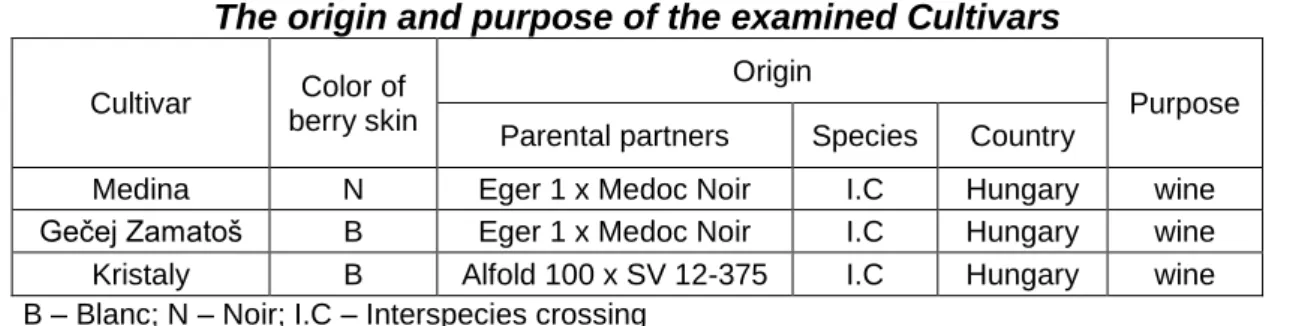
Three interspecies of grapevine cultivars were analyzed: Medina, GečejZamatoš and Kristaly (Table 1).
The experimental part of the study was conducted in the experimental vineyard Sjeverovci near Kozarska Dubica (BIH). The experimental vineyard was established in 2008 with the row spacing of 3.0 x 1.0 m. The training system was Guyot single with 100 cm high trunk and mixed pruning. Vineyard soil is covered with grass and equipped with drip irrigation system. The slope inclination is 2-4%. The terrain faces South, Southeast and the rows are ordered in the North-South direction. Important ecological factors of the site were studied and analyzed in a longer period of time (2003-2013) and also examined in a two-year period (2012 and 2013).
Table 1 The origin and purpose of the examined Cultivars
Cultivar Color of
berry skin
Origin
Purpose
Parental partners Species Country
Medina N Eger 1 x Medoc Noir I.C Hungary wine
Gečej Zamatoš B Eger 1 x Medoc Noir I.C Hungary wine
Kristaly B Alfold 100 x SV 12-375 I.C Hungary wine
B – Blanc; N – Noir; I.C – Interspecies crossing
When it comes to fertility elements, the following parameters were experimentally monitored: the total number of developed shoots, the number of fertile shoots, number of bunches per vine, grape yield. Based on the planned load and fertility elements, the following parameters were calculated: fertility coefficient, the average bunch weight and yield per hectare.
The total number of developed shoots, the number of fertile shoots, and the number of bunches per vine was determined when counted during grape harvest. The fertility coefficient was obtained from the ratio of the number of bunches and the total number of developed shoots. Grape yield per vine was determined by means of weighing grape mass from vines during harvest. The average bunch weight was calculated based on grape yield per vine and the number of bunch per vine. Grape yield per hectare was calculated based on grape yield per vine and the number of vines per hectare.
Bunch and berry indicators were determined in the laboratory by means of the method of Prostoserdov (1946). Grape quality was determined through sugar content in must (%) by means of a manual refractometer.
174
RESULTS AND DISCUSSIONS
Climatic factors strongly influence geographical distribution of vine variety cultivation, grape production and wine quality and characteristics (Bois et al., 2012).
The information regarding mean values of monthly air temperatures in 2012 and 2013 and mean values of the eleven-year period (2003-2013) for the region where the experiment was carried out are presented in Table 2. It has been observed that average annual and average monthly vegetation temperatures in the years in question were higher than those of the perennial average. The obtained results are in accordance with the results obtained by Jones et al. (2005) in their study with climatic models.
Table 2 Average monthly, vegetation and annual air temperatures in the years
when the study was conducted and perennial average (2003-2013)
I II III IV V VI VII VIII IX X XI XII Year IV-X
2012 1.7-2.99.3 12.3 16.2 22.4 24.5 24.4 18.4 12.1 9.0 1.0 12.4 18.6
2013 2.4 2.1 6.1 13.5 16.7 20.4 23.1 23.1 16.4 13.0 7.0 1.8 12.1 18.0
Mean value 0.6 1.6 6.8 12.5 16.9 20.9 22.8 22.1 16.7 11.6 6.8 2.2 11.8 17.7
Table 2 shows that it is possible to cultivate grapevine under these conditions, with
some caution, because the average annual temperature is above 12oC. For normal
grapevine cultivation, the average annual temperature should be between 9 and 21oC. The
average vegetation temperature is around 18oC, which satisfies grapevine cultivation criteria in one region. The minimum value of the average vegetation temperature suitable for grapevine cultivation is 16oC.
Table 3 The amount of precipitation in the years when the experiment was conducted and
the mean values in the longer period of time analyzed (2012-2013)
I II III IV V VI VII VIII IX X XI XII Year IV-X
2012 42.5 45.6 12.8 86.6 115.8 63.9 35.1 1.0 63.8 96.6 70.4 106.0 740.1 462.8
2013 87.0 107.8 87.5 71.6 73.3 53.6 18.4 63.6 63.2 47.3 168.8 2.0 844.1 391.0
Mean value 61.5 50.5 60.8 71.2 77.8 86.1 64.3 61.7 87.6 74.8 81.1 80.3 857.7 523.5
The amount and disposition of precipitation in certain region influence not only grape quality, but they also indirectly influence wine quality (Van Leeuwen et al., 2004). The average annual amount of precipitation for a longer period of time (2003-2013) was 857.7 mm, and 523.5 mm in the period of vegetation. In the years when the experiment was conducted, lower amount of precipitation was determined when compared to the longer period of time analyzed (Table 3).
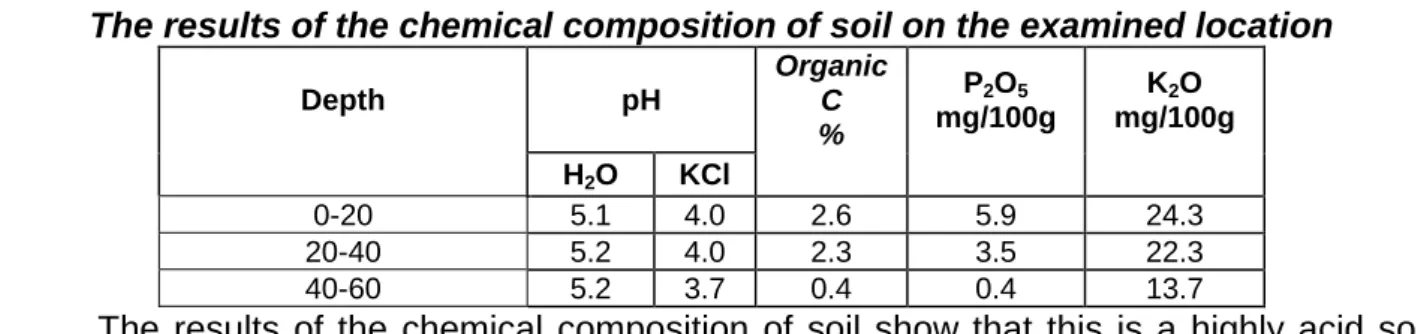
Table 4 The results of the chemical composition of soil on the examined location
Depth pH
Organic C %
P2O5
mg/100g
K2O
mg/100g
H2O KCl
0-20 5.1 4.0 2.6 5.9 24.3
20-40 5.2 4.0 2.3 3.5 22.3
40-60 5.2 3.7 0.4 0.4 13.7
175
the analyses were conducted. Clay soil contains fine clay particles and up to 40-cm- deep humus horizon. It is black and it has unfavorable hydro-physical properties which is why this type of soil is also called “minute soil” due to its very short cultivation time. It is classified as fertile soil and it dominates on hilly terrains of Northern Bosnia combined with marl and magnetite. It is used a lot in agriculture due to its properties.
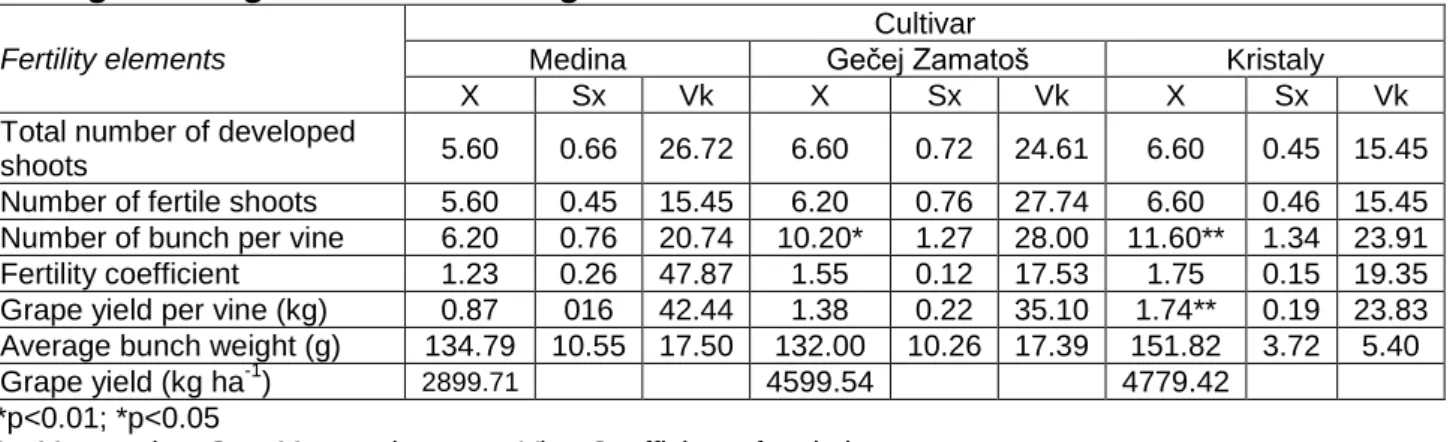
Table 5 Agro-biological and technological characteristics of the examined cultivars
Fertility elements
Cultivar
Medina Gečej Zamatoš Kristaly
X Sx Vk X Sx Vk X Sx Vk
Total number of developed
shoots 5.60 0.66 26.72 6.60 0.72 24.61 6.60 0.45 15.45
Number of fertile shoots 5.60 0.45 15.45 6.20 0.76 27.74 6.60 0.46 15.45
Number of bunch per vine 6.20 0.76 20.74 10.20* 1.27 28.00 11.60** 1.34 23.91
Fertility coefficient 1.23 0.26 47.87 1.55 0.12 17.53 1.75 0.15 19.35
Grape yield per vine (kg) 0.87 016 42.44 1.38 0.22 35.10 1.74** 0.19 23.83
Average bunch weight (g) 134.79 10.55 17.50 132.00 10.26 17.39 151.82 3.72 5.40
Grape yield (kg ha-1) 2899.71 4599.54 4779.42
**p<0.01; *p<0.05
X – Mean value; Sx – Mean value error; Vk – Coefficient of variation
Based on the data presented in Table 5 it can be concluded that there were statistically significant and important differences among cultivars in terms of the number of bunches and grape yield per vine. Kristaly had the highest number of bunches per vine (11.60), whereas Medina had the lowest number of bunches per vine (6.20). There is also a significant difference in the number of bunches pre vine between Medina and Gečej Zamatoš cultivars, and also a highly significant one between Medina and Kristaly cultivars. Kristaly had the highest grape yield value (1.74 kg), whereas Medina had the lowest one (0.87 kg).
Table 6 Structural indicators of bunches and berries and elements
of grape quality in analyzed cultivars
Indicator Cultivar
Medina Gečej Zamatoš Kristaly
Bunch characteristics X Sx Vk X Sx Vk X Sx Vk
Stem percentage in
bunch structure (%) 5.02 0.47 21.27 5.18 0.27
10.9
4 5.23 1.26 53.83
Berry percentage in
bunch structure (%) 94.98 0.47 1.12 94.82 0.25 0.59 94.77 1.26 2.97
Berry characteristics Skin percentage in berry
structure (%) 26.84 0.65 5.49 26.84 0.66 5.49 15.96** 0.97 13.66
Flash percentage in berry
structure (%) 68.91 0.47 1.54 82.39** 0.83 2.27 79.68** 0.97 2.72
Seed percentage in berry
structure (%) 4.25 0.22 12.04 3.11** 0.08 6.02 4.36 1.30 15.68
Grape quality
Sugar content in must
(%) 21.01 0.65 6.93 19.51 0.80 9.23 15.83** 0.13 1.87
**p<0.01; *p<0.05
176
Table 6 shows the elements of bunch and berry structure of analyzed varieties. It can be concluded that there is no significant difference among the analyzed cultivars in terms of grape structure elements.
Grape berry consists of three elements: skin, flash and seed. These elements vary significantly thus contributing differently to the overall composition of wine (Kennedy, 2002). During the flowering period, ecological conditions of the region and nutrients influence fertilization which results in the higher or lower number of seeds in a grape berry (Ebadi et al., 1995).
Medina and Gečej Zamatoš varieties have the same share of skin in the structure of the berry (26.84%), whereas the presence of skin in the structure of the berry is significantly smaller in Kristaly variety (15.96%). Gečej Zamatoš variety has the highest percentage of flash (82.39%) and the lowest share of seeds in the structure of its berry (3.11%).
The content of sugar in grape berries plays one of the most important roles when it comes to wine quality. Sugar content in grape berries varies during the ripening process and it depends on a number of factors, such as, cultivar, climatic and ecological characteristics of the region and location, training system and ampelotechnical measures (Jordão et al., 2015). Table 6 shows that there is significant difference in the content of sugar in must between Medina and Kristaly cultivars and Gečej Zamatoš and Kristaly cultivars. Medina cultivar has the highest content of sugar in must (21.01%), whereas Kristaly variety has the lowest content of sugar in must (15.83%).
CONCLUSIONS
The analyses of the obtained fertility and grape quality indicators of the examined grape cultivars in the agro-ecological conditions of Northern Bosnia showed that, Medina, Gečej Zamatoš and Kristaly varieties can successfully be cultivated in similar or identical conditions. Genotypic specific traits of monitored characteristics were determined in analyzed cultivars. Kristaly variety had the biggest bunches, whereas Gečej Zamatoš variety had the highest percentage of flash and at the same time the lowest percentage of seeds in its berries. Medina and Gečej Zamatoš cultivars have the highest level of sugar content.
Further research should be conducted with the aim of determining the quality of the wine obtained from these varieties so that it can be decided whether it would be economical to cultivate them in this region or not.
BIBLIOGRAPHY
1. Bell, S.J., Henschke, P.A., 2005 - Implications of nitrogen nutrition for grapes, fermentation and wine. Aust. J. Grape Wine Res., 11(3):242–95.
2. Bois, B., Blais, A., Moriondo, M., Jones, G.V., 2012 - High resolution climate spatial analysis of European wine growing regions. Proceedings of the IXth International Terroirs Congress, 2(1):17-20.
3. Ebadi, A., Coombe, B.G., May, P., 1995 - Fruit-set on small Chardonnay and Shiraz vines grown under varying temperature regimes between budburst and flowering. Australian Jour. of Grape and Wine Research, 1:3-10.
4. Jackson, R.S., 2014 - Wine science: Principles and applications. 4th ed. San Diego: Academic Press.
5. Jones, G.V., White, M.A., Cooper, O.R., Storchmann, K., 2005 - Climate change and global wine quality. Climatic Change, 73:319-343.
6.Jordão, A.M., Vilela A., Cosme F., 2015 - From Sugar of Grape to Alcohol of Wine: Sensorial Impact of Alcohol in Wine. Beverages 1:292-310.
177
8. Mahanil, S., Ramming, D., Cadle-Davidson, M., Owens, C., Garris, A., Myles, S., et al. 2012 - Development of marker sets useful in the early selection of Ren4 powdery mildew resistance and seedlesssness for table and raisin grape breeding. Theoret, Appl, Genet., 124(1):23–33.
9. McGovern, P.E., 2003 - Ancient Wine: The Search for the Origins of Viniculture. Princeton United Press, 400.
10. Mijatović, D.,Vuksanović, P., 1987 - Interspecies hibridi i njihova perspektiva za širenje na području sjeverne Bosne.Poljoprivredni pregled, Sarajevo, 41-47.
11. Myles, S., 2013 - Improving fruit and wine: what does genomics have to offer? Trends Genet., 29(4):190–196.
12. Myles, S., Boyko, A.R., Owens, C.L,, Brown, P.J., Grassi, F., Aradhya, M.K., et al. 2011 - Genetic structure and domestication history of the grape. Proc. Natl. Acad. Sci., USA. 108(9):3530–3535.
13. Nikolić, D., 2015 - Properties of two interspecies grapevine hybrids from Serbia. Acta Hortic., 1082:141-147.
14. Nikolić, D., Ranković-Vasić, Z., Atanacković, Z., 2015 - New Serbian grapewine genotypes for red wine production. Vitis, 54 (Special Issue):165-168.
15. Prostoserdov, I.I., 1946 - Tehnologičeskae harakteristika vinograda i produktiv ego pererabotki. Ampelografia SSSR, Tom I, Moskva.
16. Reisch, B., Owens, C., Cousins, P., 2012 - Grape. In: Badenes ML, Byrne DH, editors. Fruit breeding. Handbook of plant breeding. Springer, US, 225–262.
17. Sun, Q., Gates, M.J., Lavin, E.H., Acree, T.E., Sacks, G.L., 2011 - Comparison of odor-active compounds in grapes and wines from Vitis vinifera and non-foxy American grape species. J. Agric. Food Chem., 59(19):10657–10664.
18. Ugliano, M., Henschke, P., 2009 - Yeasts and wine flavour. In: Moreno-Arribas MV, Polo MC, editors. Wine chemistry and biochemistry. Springer, New York, 313–92.
19. Van Leeuwen, C., Friant, P., Jaeck, M.E., Kuhn, S., 2004 - Hierarchy of the role of climate, soil and cultivar in terroir effect can largely be explained by vine water status. Proceedings of the Vth Intrnational Congress on Viticultural Terroir Zoning, Cape Town, South Africa, CD.