Data Mining with Big Data Using HACE Theorem
Pawan.P
1, Trivikram Rao
2 1M.Tech (CSE), Usha Rama College of Engineering and Technology, A.P., India.
2Asst Professor, Dept. of Information Technology, Usha Rama College of Engineering and Technology,
A.P., India.
Abstract—The term Big Data comprises large-volume, complex, growing data sets with multiple, autonomous sources. With the fast development of networking, data storage, and the data collection capacity, Big Data are now rapidly expanding in all science and engineering domains, including physical, biological and biomedical sciences. This paper presents a HACE theorem that characterizes the features of the Big Data revolution, and proposes a Big Data processing model, from the data mining perspective. This data-driven model involves demand-driven aggregation of information sources, mining and analysis, user interest modeling, and security and privacy considerations. We analyze the challenging issues in the data-driven model and also in the Big Data revolution.
Keywords — Big Data, data mining, heterogeneity, autonomous sources, complex and evolving associations
I. INTRODUCTION
According to the sources, every day, 2.5 quintillion bytes of data are created and 90 percent of the data in the world today were produced within the past two years [16]. Our capability for data generation has never been so powerful and enormous ever since the invention of the information technology in the early 19th century.
Let’s take anexample; Dr. Yan Mo won the 2012 Nobel Prize in Literature. This is probably the most controversial Nobel Prize of this category. Searching on
Google with “Yan Mo Nobel Prize,” resulted in
1,050,000 web pointers on the Internet (as of 3 January
2013). “For all praises as well as criticisms,” said Mo
recently, “I am grateful.” What types of praises and
criticisms has Mo actually received over his 31-year writing career? As comments keep coming on the Internet and in various news media, can we summarize all types of opinions in different media in a real-time fashion, including updated, cross-referenced discussions by critics? This type of summarization program is an excellent example for Big Data processing, as the information comes from multiple, heterogeneous, autonomous sources with complex and evolving relationships, and keeps growing.
As another example, on 4 October 2012, the first presidential debate between President Barack Obama and Governor Mitt Romney triggered more than 10 million tweets within 2 hours [1]. Among all these tweets, the specific moments that generated the most discussions actually revealed the public interests, such as the discussions about medicare and vouchers. Such online discussions provide a new means to sense the public interests and generate feedback in real time, and are mostly appealing compared to generic media, such as radio or TV broadcasting. Another example is Flickr, a public picture sharing site, which received 1.8 million photos per day, on average, from February to March 2012 [2]. Assuming the size of each photo is 2 megabytes (MB), this requires 3.6 terabytes (TB) storage
every single day. Indeed, as an old saying states: “a picture is worth a thousand words,” the billions of
pictures on Flicker are a treasure tank for us to explore the human society, social events, public affairs, disasters, and so on, only if we have the power to harness the enormous amount of data.
The above examples demonstrate the rise of Big Data applications where data collection has grown tremendously and is beyond the ability of commonly used software tools to capture, manage, and process
within a “tolerable elapsed time.” The most fundamental
platform to achieve fast response and real-time classification for such Big Data.
II. BIGDATACHARACTERISTICS:HACE THEOREM
HACE Theorem. Big Data starts with large-volume,
heterogeneous, autonomous sources with distributed and decentralized control, and seeks to explore complex and evolving relationships among data These characteristics make it an extreme challenge for discovering useful
knowledge from the Big Data. In a naı¨ve sense, we can
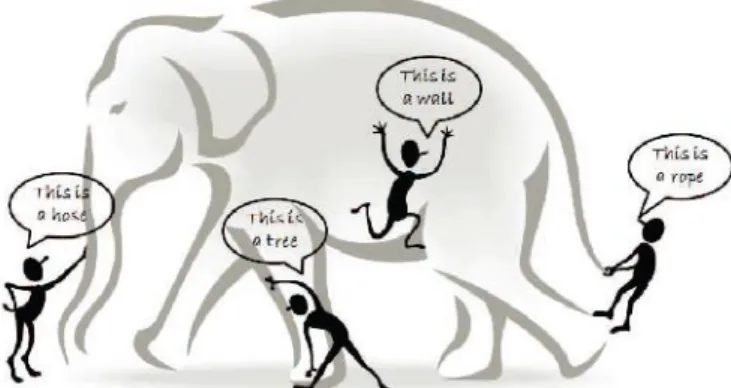
imagine that a number of blind men are trying to size up a giant elephant (see Fig. 1), which will be the Big Data in this context. The goal of each blind man is to draw a picture (or conclusion) of the elephant according to the part of information he collects during the process.
Because each person’s view is limited to his local region,
it is not surprising that the blind men will each conclude
independently that the elephant “feels” like a rope, a
hose, or a wall, depending on the region each of them is limited to. To make the problem even more complicated, let us assume that 1) the elephant is growing rapidly and its pose changes constantly, and 2) each blind man may have his own (possible unreliable and inaccurate) information sources that tell him about biased knowledge about the elephant (e.g., one blind man may exchange his feeling about the elephant with another blind man, where the exchanged knowledge is inherently biased). Exploring the Big Data in this scenario is equivalent to aggregating heterogeneous information from different sources (blind men) to help draw a best possible picture to reveal the genuine gesture of the elephant in a real-time fashion. Indeed, this task is not as simple as asking each blind man to describe his feelings about the elephant and then getting an expert to draw one single picture with a combined view, concerning that each individual may speak a different language (heterogeneous and diverse information sources) and they may even have privacy concerns about the messages they deliberate in the information exchange process.
Figure 1 The blind men and the giant elephant: the
localized (limited) view of each blind man leads to a biased conclusion.
Autonomous Sources with Distributed and Decentralized Control
Autonomous data sources with distributed and decentralized controls are a main characteristic of Big Data applications. Being autonomous, each data source is able to generate and collect information without involving (or relying on) any centralized control. This is similar to the World Wide Web (WWW) setting where each web server provides a certain amount of information and each server is able to fully function without necessarily relying on other servers. On the other hand, the enormous volumes of the data also make an application vulnerable to attacks or malfunctions, if the whole system has to rely on any centralized control unit. For major Big Data-related applications, such as Google, Flicker, Facebook, and Walmart, a large number of server farms are deployed all over the world to ensure nonstop services and quick responses for local markets. Such autonomous sources are not only the solutions of the technical designs, but also the results of the legislation and the regulation rules in different countries/ regions. For example, Asian markets of Walmart are inherently different from its North American markets in terms of seasonal promotions, top sell items, and customer behaviors. More specifically, the local government regulations also impact on the wholesale management process and result in restructured data representations and data warehouses for local markets.
Complex and Evolving Relationships
While the volume of the Big Data increases, so do the complexity and the relationships underneath the data. In an early stage of data centralized information systems, the focus is on finding best feature values to represent each observation. This is similar to using a number of data fields, such as age, gender, income, education background, and so on, to characterize each individual. This type of sample feature representation inherently treats each individual as an independent entity without considering their social connections, which is one of the most important factors of the human society. Our friend circles may be formed based on the common hobbies or people are connected by biological relationships. Such social connections commonly exist not only in our daily activities, but also are very popular in cyberworlds. For example, major social network sites, such as Facebook or Twitter, are mainly characterized by social functions such as friend-connections and followers (in Twitter). The correlations between individuals inherently complicate the whole data representation and any reasoning process on the data.
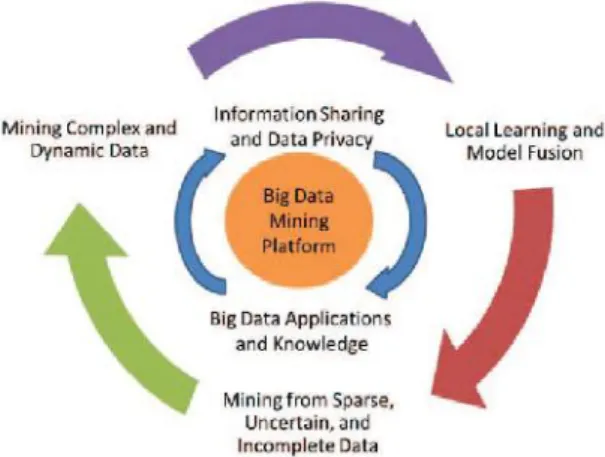
For an intelligent learning database system [6] to handle Big Data, the essential key is to scale up to the exceptionally large volume of data and provide treatments for the characteristics featured by the aforementioned HACE theorem. Fig. 2 shows a conceptual view of the Big Data processing framework, which includes three tiers from inside out with considerations on data accessing and computing (Tier I), data privacy and domain knowledge (Tier II), and Big Data mining algorithms (Tier III).
The challenges at Tier I focus on data accessing and arithmetic computing procedures. Because Big Data are often stored at different locations and data volumes may continuously grow, an effective computing platform will have to take distributed large-scale data storage into consideration for computing. For example, typical data mining algorithms require all data to be loaded into the main memory, this, however, is becoming a clear technical barrier for Big Data because moving data across different locations is expensive (e.g., subject to intensive network communication and other IO costs), even if we do have a super large main memory to hold all data for computing. The challenges at Tier II center around semantics and domain knowledge for different Big Data applications. Such information can provide additional benefits to the mining process, as well as add technical barriers to the Big Data access (Tier I) and mining algorithms (Tier III).
Figure 2 Big Data processing framework
At Tier III, the data mining challenges concentrate on algorithm designs in tackling the difficulties raised by the Big Data volumes, distributed data distributions, and by complex and dynamic data characteristics. The circle at Tier III contains three stages. First, sparse, heterogeneous, uncertain, incomplete, and multisource data are preprocessed by data fusion techniques. Second, complex and dynamic data are mined after preprocessing. Third, the global knowledge obtained by local learning and model fusion is tested and relevant
information is fed-back to the preprocessing stage. Then, the model and parameters are adjusted according to the feedback. In the whole process, information sharing is not only a promise of smooth development of each stage, but also a purpose of Big Data processing.
Tier I: Big Data Mining Platform
In typical data mining systems, the mining procedures require computational intensive computing units for data analysis and comparisons. A computing platform is, therefore, needed to have efficient access to, at least, two types of resources: data and computing processors. For small scale data mining tasks, a single desktop computer, which contains hard disk and CPU processors, is sufficient to fulfill the data mining goals. Indeed, many data mining algorithm are designed for this type of problem settings. For medium scale data mining tasks, data are typically large (and possibly distributed) and cannot be fit into the main memory. Common solutions are to rely on parallel computing [7] or collective mining [12] to sample and aggregate data from different sources and then use parallel computing programming (such as the Message Passing Interface) to carry out the mining process.
Tier II: Big Data Semantics and Application Knowledge
Semantics and application knowledge in Big Data refer to numerous aspects related to the regulations, policies, user knowledge, and domain information. The two most important issues at this tier include 1) data sharing and privacy; and 2) domain and application knowledge. The former provides answers to resolve concerns on how data are maintained, accessed, and shared; whereas the latterfocuses on answering questions like “what are the underlyingapplications ?” and “what are the knowledge
orpatterns users intend to discover from the data ?”
Information Sharing and Data Privacy
Information sharing is an ultimate goal for all systems involving multiple parties [8]. While the motivation for sharing is clear, a real-world concern is that Big Data applications are related to sensitive information, such as banking transactions and medical records. Simple data exchanges or transmissions do not resolve privacy concerns
For example, knowing people’s locations and their preferences, one can enable a variety of useful location-based services, but public disclosure of an individual’s
locations/movements over time can have serious consequences for privacy. To protect privacy, two common approaches are to
entries, so sensitive information is accessible by a limited group of users only, and
2) anonymize data fields such that sensitive information cannot be pinpointed to an individual record [15].
Domain and Application Knowledge
Domain and application knowledge provides essential information for designing Big Data mining algorithms and systems. In a simple case, domain knowledge can help identify right features for modeling the underlying data (e.g., blood glucose level is clearly a better feature than body mass in diagnosing Type II diabetes). The domain and application knowledge can also help design achievable business objectives by using Big Data analytical techniques. For example, stock market data are a typical domain that constantly generates a large quantity of information, such as bids, buys, and puts, in every single second. The market continuously evolves and is impacted by different factors, such as domestic and international news, government reports, and natural disasters, and so on. An appealing Big Data mining task is to design a Big Data mining system to predict the movement of the market in the next one or two minutes. Such systems, even if the prediction accuracy is just slightly better than random guess, will bring significant business values to the developers [9].
Tier III: Big Data Mining Algorithms
Local Learning and Model Fusion for Multiple Information Sources
As Big Data applications are featured with autonomous sources and decentralized controls, aggregating distributed data sources to a centralized site for mining is systematically prohibitive due to the potential transmission cost and privacy concerns. On the other hand, although we can always carry out mining activities at each distributed site, the biased view of the data collected at each site often leads to biased decisions or models, just like the elephant and blind men case. Under such a circumstance, a Big Data mining system has to enable an information exchange and fusion mechanism to ensure that all distributed sites (or information sources) can work together to achieve a global optimization goal. Model mining and correlations are the key steps to ensure that models or patterns discovered from multiple information sources can be consolidated to meet the global mining objective. More specifically, the global mining can be featured with a two-step (local mining and global correlation) process, at data, model, and at knowledge levels.
Mining from Sparse, Uncertain, and Incomplete Data Spare, uncertain, and incomplete data are defining features for Big Data applications. Being sparse, the number of data points is too few for drawing reliable
conclusions. This is normally a complication of the data dimensionality issues, where data in a high-dimensional space (such as more than 1,000 dimensions) do not show clear trends or distributions. For most machine learning and data mining algorithms, high-dimensional spare data significantly deteriorate the reliability of the models derived from the data. Common approaches are to employ dimension reduction or feature selection [10] to reduce the data dimensions or to carefully include additional samples to alleviate the data scarcity, such as generic unsupervised learning methods in data mining.
Mining Complex and Dynamic Data
The rise of Big Data is driven by the rapid increasing of complex data and their changes in volumes and in nature [6]. Documents posted on WWW servers, Internet backbones, social networks, communication networks, and transportation networks, and so on are all featured with complex data. While complex dependency structures underneath the data raise the difficulty for our learning systems, they also offer exciting opportunities that simple data representations are incapable of achieving. For example, researchers have successfully used Twitter, a well-known social networking site, to detect events such as earthquakes and major social activities, with nearly real-time speed and very high accuracy. In addition, by summarizing the queries users submitted to the search engines, which are all over the world, it is now possible to build an early warning system for detecting fast spreading flu outbreaks [11]. Making use of complex data is a major challenge for Big Data applications, because any two parties in a complex network are potentially interested to each other with a social connection. Such a connection is quadratic with respect to the number of nodes in the network, so a million node network may be subject to one trillion connections. For a large social network site, like Facebook, the number of active users has already reached 1 billion, and analyzing such an enormous network is a big challenge for Big Data mining.
IV. RELATEDWORK
Due to the multisource, massive, heterogeneous, and dynamic characteristics of application data involved in a distributed environment, one of the most important characteristics of Big Data is to carry out computing on the petabyte (PB), even the exabyte (EB)-level data with a complex computing process. Therefore, utilizing a parallel computing infrastructure, its corresponding programming language support, and software models to efficiently analyze and mine the distributed data are the critical goals for Big Data processing to change from
“quantity” to “quality.”
services for the public. MapReduce is a batch-oriented parallel computing model. There is still a certain gap in performance with relational databases. Improving the performance of MapReduce and enhancing the real-time nature of large-scale data processing have received a significant amount of attention, with MapReduce parallel programming being applied to many machine learning and data mining algorithms. Data mining algorithms usually need to scan through the training data for obtaining the statistics to solve or optimize model parameters. It calls for intensive computing to access the large-scale data frequently. To improve the efficiency of algorithms, Chu et al. proposed a general-purpose parallel programming method, which is applicable to a large number of machine learning algorithms based on the simple MapReduce programming model on multicore processors. Ten classical data mining algorithms are realized in the framework, including locally weighted linear regression, k-Means, logistic regression, naive Bayes, linear support vector machines, the independent variable analysis, Gaussian discriminant analysis, expectation maximization, and back-propagation neural networks [14].
V. CONCLUSION
Driven by real-world applications and key industrial stakeholders and initialized by national funding agencies, managing and mining Big Data have shown to be a challenging yet very compelling task. While the term Big Data literally concerns about data volumes, our HACE theorem suggests that the key characteristics of the Big Data are 1) huge with heterogeneous and diverse data sources, 2) autonomous with distributed and decentralized control, and 3) complex and evolving in data and knowledge associations. Such combined characteristics suggest that Big Data require a “big mind” to consolidate data for maximum values [13].
To explore Big Data, we have analyzed several challenges at the data, model, and system levels. To support Big Data mining, high-performance computing platforms are required, which impose systematic designs to unleash the full power of the Big Data. At the data level, the autonomous information sources and the variety of the data collection environments, often result in data with complicated conditions, such as missing/uncertain values. In other situations, privacy concerns, noise, and errors can be introduced into the data, to produce altered data copies. Developing a safe and sound information sharing protocol is a major challenge. At the model level, the key challenge is to generate global models by combining locally discovered patterns to form a unifying view. This requires carefully designed algorithms to analyze model correlations
between distributed sites, and fuse decisions from multiple sources to gain a best model out of the Big Data. At the system level, the essential challenge is that a Big Data mining framework needs to consider complex relationships between samples, models, and data sources, along with their evolving changes with time and other possible factors. A system needs to be carefully designed so that unstructured data can be linked through their complex relationships to form useful patterns, and the growth of data volumes and item relationships should help form legitimate patterns to predict the trend and future.
REFERENCES
[1] R. Ahmed and G. Karypis, “Algorithms for Mining the Evolution of Conserved Relational States in
Dynamic Networks,” Knowledge and Information Systems, vol. 33, no. 3, pp. 603-630, Dec. 2012.
[2] M.H. Alam, J.W. Ha, and S.K. Lee, “Novel
Approaches to Crawling Important Pages Early,”
Knowledge and Information Systems, vol. 33, no. 3, pp 707-734, Dec. 2012.
[3] S. Aral and D. Walker, “Identifying Influential and
SusceptibleMembers of Social Networks,” Science, vol.
337, pp. 337-341, 2012.
[4] A. Machanavajjhala and J.P. Reiter, “Big Privacy:
Protecting Confidentiality in Big Data,” ACM
Crossroads, vol. 19, no. 1, pp. 20-23, 2012.
[5] S. Banerjee and N. Agarwal, “Analyzing Collective
Behavior from Blogs Using Swarm Intelligence,”
Knowledge and Information Systems, vol. 33, no. 3, pp. 523-547, Dec. 2012.
[6] E. Birney, “The Making of ENCODE: Lessons for
Big-DataProjects,” Nature, vol. 489, pp. 49-51, 2012.
[7] J. Bollen, H. Mao, and X. Zeng, “Twitter Mood
Predicts the Stock Market,” J. Computational Science,
vol. 2, no. 1, pp. 1-8, 2011.
[8] S. Borgatti, A. Mehra, D. Brass, and G. Labianca,
“Network Analysis in the Social Sciences,” Science, vol.
323, pp. 892-895, 2009.
[9] J. Bughin, M. Chui, and J. Manyika, Clouds, Big Data, and Smart Assets: Ten Tech-Enabled Business Trends to Watch. McKinSey Quarterly, 2010.
[10] D. Centola, “The Spread of Behavior in an Online
Social Network Experiment,” Science, vol. 329, pp.
[11] E.Y. Chang, H. Bai, and K. Zhu, “Parallel
Algorithms for Mining Large-Scale Rich-Media Data,”
Proc. 17th ACMInt’l Conf. Multimedia, (MM ’09,) pp.
917-918, 2009.
[12] R. Chen, K. Sivakumar, and H. Kargupta,
“Collective Mining of Bayesian Networks from
Distributed Heterogeneous Data,” Knowledge and Information Systems, vol. 6, no. 2, pp. 164-187, 2004.
[13] Y.-C. Chen, W.-C. Peng, and S.-Y. Lee, “Efficient
Algorithms for Influence Maximization in Social
Networks,” Knowledge and Information Systems, vol. 33, no. 3, pp. 577-601, Dec. 2012.
[14] C.T. Chu, S.K. Kim, Y.A. Lin, Y. Yu, G.R. Bradski, A.Y. Ng, and K. Olukotun, “Map-Reduce for Machine
Learning on Multicore,” Proc. 20th Ann. Conf. Neural
Information Processing Systems (NIPS’06), pp. 281-288, 2006.
[15] G. Cormode and D. Srivastava, “Anonymized Data:
Generation,Models, Usage,” Proc. ACM SIGMOD Int’l
Conf. Management Data, pp. 1015-1018, 2009.
[16] “IBM What Is Big Data: Bring Big Data to the
Enterprise,” http://