EXPERIMENTAL STUDY OF THE SEDIMENTATION OF SOLID
PARTICLES IN WASTEWATER
ZĂBAVĂ B.ȘT.1), UNGUREANU N.1), VLĂDUȚ V.2), DINCĂ M.1), VOICU GH.1), IONESCU M.1) 1)U.P. Bucharest / Romania;2)INMA Bucharest;
E-mail: [email protected]
Keywords: wastewater, sedimentation, clarifying curves
ABSTRACT
Nowadays, the destruction and pollution of our environment has produced a growing awareness worldwide of the need for more effective wastewater treatment . In wastewater treatment plants as well as in a variety of industrial processes, sedimentation tanks are used to separate suspended solids from water. Sedimentation by gravity is the most common and extensively applied treatment process for the removal of solids from water and wastewater. Nowadays, destruction and pollution of our environment has produced a growing awareness worldwide of the need for more effective wastewater treatment. In wastewater treatment, sedimentation is used to remove both organic solids and inorganic are deposited in water or have been brought into a form that is submitted (coagulation, precipitation). In this paper are presented the experimental results obtained in the process of sedimentation of solid particles in suspension located in a static system.
INTRODUCTION
Wastewater treatment consists of applying known technology to improve or upgrade the quality of a wastewater. Wastewater treatment involves collecting the wastewater in a central, segregated location and subjecting the wastewater to various treatment processes [7].
The principal objective of wastewater treatment is generally to allow human and industrial effluents to be disposed off without danger to human health or unacceptable damage to the natural environment. With the current emphasis on environmental health and water pollution issues, there is an increasing awareness of the need to dispose of these wastewaters safely and beneficially.
Conventional wastewater treatment consists of a combination of physical, chemical and biological processes and operations to remove solids, organic matter and sometimes, nutrients from wastewater. General terms used to describe different degrees of treatment, in order of increasing treatment level, are preliminary, primary, secondary, and tertiary and/or advanced wastewater treatment [2]. The objective of preliminary treatment is the removal of coarse solids and other large materials often found in raw wastewater. The purpose of secondary treatment is the further treatment of the effluent from primary treatment to remove the residual organics and suspended solids and tertiary and/or advanced wastewater treatment is employed when specific wastewater constituents which cannot be removed by secondary treatment must be removed.
Sedimentation is the oldest and most widely used operation in the effective treatment of wastewater. The operation consists of removing sediment, turbidity and floating material from raw wastewater, operation performed by settler tanks. The process of sedimentation of solids in water is used in both the primary stage and the secondary stage to the waste [4].
Figure 1 shows the place occupied by settlers in an advanced wastewater treatment plant.
Fig. 1. The place occupied by settlers in the wastewater treatment plant [1]
1-inlet wastewater; 2-bar screens; 3-grit chamber; 4-primary settling tank; 5-denitrification; 6-oxidation; 7-secondary settling tank; 8-biofiltration; 9-return active sludge; 10-secondary actived sludge; 11-primary
sludge; 12-desinfection; 13-effluent
Sedimentation basins, also called settling tanks or clarifiers, are large tanks in which water is made to flow very slowly in order to promote the sedimentation of particles or flocs. In water and wastewater treatment plants, these are so large that they are situated outdoor and usually have an open surface. Sedimentation basins come in two shapes, rectangular and circular. Longitudinal horizontal decanters concrete basins are characterized by their rectangular shape plan and horizontal direction of water flow [6].
The lengths of these separators are an average of up to 30 m and 100 m; the average depth is 3 m and 4 m maximum. With round sedimentation tanks the wastewater is fed into the middle and is discharged through a trough on the outer periphery.
A final step, known as secondary clarification, allows wastewater to settle before it is reintroduced into the environment or sent for further treatment, which is often referred to as tertiary treatment [1].
Fig. 2. Diluted suspension settling in the stationary column [6]
MATERIAL AND METHOD
The study of solid particles sedimentation in water is done both for stationary systems (stationary columns) and for dynamical systems (currents with different flow directions).
Experimental study of sedimentation process in stationary column of different aqueous suspension of solid particles has as main result the possibility of obtaining clarifying curves which, besides giving a complete image about how the water is clarified during the process, allow through the various processing to obtain important characteristics parameters [3].
Experimental studies of sedimentation process in stationary column were performed on a laboratory stand, manufactured by Armfield Limited, England, UK, which is equipped with five glass columns with an inside diameter of 50 mm and the useful height (with scale) of 940 mm (Figure 3) [6].
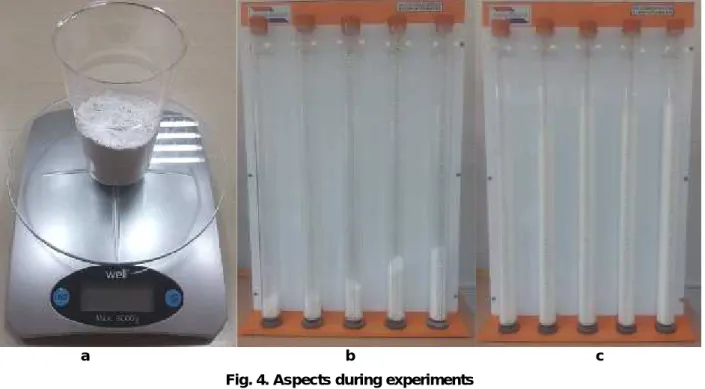
Suspensions used were composed of water and powdered calcium carbonate with concentrations of 2%, 4%, 6%, 8% and 10%. These concentrations correspond to an amount of 30g, 60g, 90g, 120g and 150g. Weighing was done with electronic Lacor weighing balance, (figure 4 a). Powdered calcium carbonate was added in the five columns properly (figure 4 b), then water was added up to 750 mm (figure 4 c). Suspension volume in each column was 1.5 l. It was registered the clarified water – suspension interface position at regular intervals 0.05 h (3 minutes) for one hour.
a b c
Fig. 4. Aspects during experiments
a- weighing of powdered calcium carbonate; b – columns filled with powder; c – columns filled with powder-water suspension
It should be noted that a slow stirring foster the sediment compaction process that forms on the settlers’ foundation. Based on registered values, were plotted variation curves as a function of time for clarified water – suspension interface.
RESULTS AND DISCUSSIONS
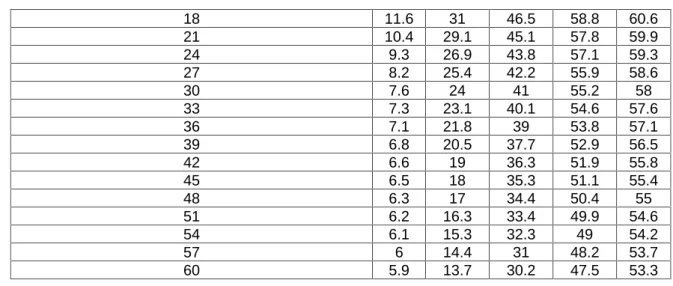
The results obtained in the process of settling in stationary column are shown in Table 1. If the observation is continued, it is observed that the clarified water – concentrated sludge settled interface descends very slowly (the speeds are much lower than the descend speed of clarified water – suspension interface from the first part of this process).
Table 1
Experimental results
Position interface clarified water - suspensions at different concentrations
Time [min] [%] 2 % 4 % 6 % 8 % 10 %
0 56 60.3 62.5 67.3 70.7
3 36.2 50.8 57.5 64.2 66.4
6 23.6 43.8 54 62.6 64.5
9 16.8 39.4 51.5 61.5 63.3
12 14.5 35.8 49.4 60.4 62.2
18 11.6 31 46.5 58.8 60.6
21 10.4 29.1 45.1 57.8 59.9
24 9.3 26.9 43.8 57.1 59.3
27 8.2 25.4 42.2 55.9 58.6
30 7.6 24 41 55.2 58
33 7.3 23.1 40.1 54.6 57.6
36 7.1 21.8 39 53.8 57.1
39 6.8 20.5 37.7 52.9 56.5
42 6.6 19 36.3 51.9 55.8
45 6.5 18 35.3 51.1 55.4
48 6.3 17 34.4 50.4 55
51 6.2 16.3 33.4 49.9 54.6
54 6.1 15.3 32.3 49 54.2
57 6 14.4 31 48.2 53.7
60 5.9 13.7 30.2 47.5 53.3
Figure 5 presents different points during sedimentation specifically in the 6 minute (a), 15 (b) and 60 minutes (c).
a b c
Fig. 5. Different points during sedimentation
If the experiment is continued, it is observed that the clarified water - concentrated settled sludge interface descends very slowly over time (the speeds are much lower than the descend speed of clarified water-suspension interface from the first part of this process) properly to the settled sludge compaction process, and after a long period of time the interface position of clarified water - concentrated settled sludge is stabilized at a certain height that does not undergo changes.
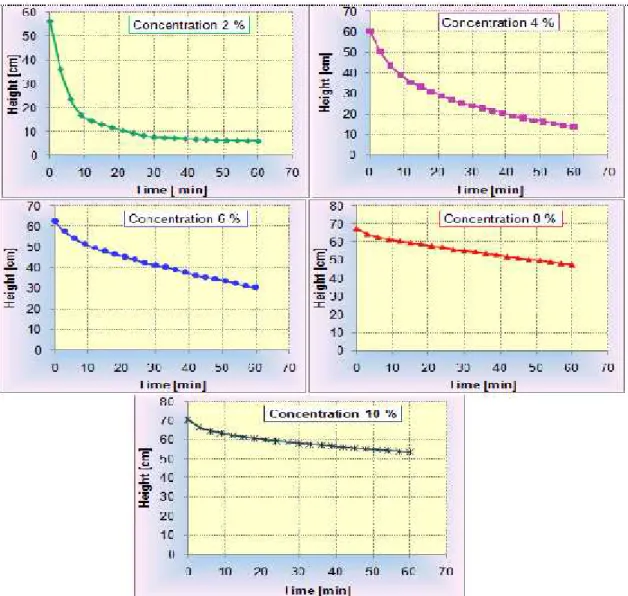
Based on registered values, were plotted variation curves as a function of time for clarified water – suspension interface.
Following these graphics, you can see that:
suspension at a concentration of 2% starting position clarified water interface -suspension is 56 cm and get in one hour to 5.9 cm
suspension at a concentration of 4% starting position clarified water interface -suspension is 60,3 cm and get in one hour to 13,7 cm
suspension at a concentration of 6% starting position clarified water interface -suspension is 62,5 cm and get in one hour to 30,2 cm
suspension at a concentration of 2% starting position clarified water interface -suspension is 70,7 cm and get in one hour to 53,3 cm
- the higher the concentration is lower suspension, the sedimentation process is done quickly
Fig. 6. Variation curves as a function of time for clarified water – suspension interface
CONCLUSIONS
Sedimentation study of different aqueous suspensions of solids particles in stationary column is of great importance for experimentally determining the important parameters required to design and exploitation clarifiers and sludge thickeners from waste water treatment plants.
Suspensions used for the experiment were composed of water and powdered calcium carbonate with concentrations of 2%, 4%, 6%, 8% and 10%. These concentrations correspond to an amount of 30g, 60g, 90g, 120g and 150g
Experimental study of sedimentation process in stationary column of different aqueous suspension of solid particles has as main result the possibility of obtaining clarifying curves.
The higher the concentration is lower suspension, the sedimentation process is done quickly.
process) properly to the settled sludge compaction process, and after a long period of time the interface position of clarified water - concentrated settled sludge is stabilized at a certain height that does not undergo changes.
BIBLIOGRAPHY
[1] Alessandro SPAGNI, 2012 - Lectures for the course of “Wastewater Treatment” Second Cycle Degree (MSc Level) in Environmental Engineering University of Padua, ITALY
[2] McGraw Hill, 2003 - Metcalf & Eddy, Wastewater Engineering. Treatment and Reuse, 4th ed., , New York (USA), 2003.
[3] Safta V.V., Toma M.L., Ungureanu N., 2012 - Experiments in water treatment domain, PRINTECH Publishing;
[4]Templeton M.R., Butler D. - An introduction to wastewater treatment. Bookboon.com [5] Zăbavă B.ȘT, Voicu Gh., Safta V.V., Ungureanu N., Dincă M., Ionescu M., Munteanu M.,2016 - Types of clarifiers used in wastewater treatment plants – A Review. ISB-INMA TEH 2016 International Symposium. Bucharest, Romania;
[6] “W2 Sedimentation Studies Apparatus – Instruction Manual”, ARMFIELD Limited, England, UK, Issue 4, 1995.

![Fig. 3. Equipment for the study of sedimentation [3]](https://thumb-us.123doks.com/thumbv2/123dok_us/8070649.2137844/3.892.123.795.795.1103/fig-equipment-study-sedimentation.webp)