
PRODUCTION STATUS OF BIOMASS PELLETS – REVIEW
UNGUREANU N.1), VLĂDUȚV.2), PARASCHIV G.1), IONESCU M.1),
ZĂBAVĂ B.ȘT.1), GRIGORE I.2)
1)U. P. Bucharest / Romania;2)INMA Bucharest; E-mail:[email protected] Keywords: residues, biomass, energy sources, pellets
ABSTRACT
The use of biomass has become extremely important for the production of clean energy from renewable sources. This is due to the continuously increased need for energy, to the possible depletion of conventional fossil fuels in the near future, and also to the regulations of European Union on the need to reduce significantly the emissions of greenhouse gases. This paper presents a synthesis on the raw materials used for pellets production, some of the important characteristics of pellets (density, ash content and heating power), and also data on the status of pellets production and consumption in different countries. Latest reported data show that the European Union is the biggest wood pellets producer globally, with a production of 13.5 million tonnes in 2014. Romania’s pellets production in 2014 was of 740000 tonnes, and estimations are that in 2020 it will exceed 1.2 million tonnes.
INTRODUCTION
Global warming caused by increased emissions of greenhouse gases, the need to produce thermal and electrical energy and increasing prices of fossil fuel have created a new industry focused on energy production through the use of renewable sources. Worldwide, biomass is the main source in thermal energy production and the third most important source in the production of electrical energy [19].
According to [34], the biomass is “any material of biological origin, excluding fossil fuels or peat, that contains a chemical store of energy (originally received from the sun) and that is available for conversion to a wide range of convenient energy carriers”. The main advantages of using biomass as renewable source of energy are: permanent availability with large amounts of biomass growing, environmental sustainability, low levels of emissions of greenhouse gases, low cost of recollection [13], less dependence on fossil fuels in order to increase security supply, maintains the stability against potential price shocks and reduces imports [3].
In the Renewable Energy Directive 2009/28/EC, the European Union shall achieve a 20% share of renewable energy in final energy consumption across its Member States by 2020. In addition, 42% of total renewable energy is expected to be obtained from biomass, including electricity, heating and cooling [16].
As a renewable source of energy, biomass is commonly used in the production of pellets and briquettes, biogas, biodiesel and bioethanol.
by-harvest is technical wood and stacking wood, and the remaining 10% is waste wood. Thin branches, leaves and needles, whose share of total quantity of wood is about 2%, are left in the forest [5].
The volume of unused partis, such as bark, thin branches and stumps, is about 42% of the total volume of wood mass. Waste from primary processing and final processing of wood margins include: margins from timber processing, bark, twigs, sawdust, veneer and plywood. In furniture manufacturing remain as waste stumps, dust from grinding and sawdust.
As a building material, wood gives waste such as: corners, chips, fibreboard scrap, old doors and window frames, floors, fences, etc. Landfills and collection points are also important sources of wood waste (from packaging, furniture, toys, wooden planks, pieces of wood and boards, waste from gardens and parks) [5].
Recovery of waste from the timber industry, unlike other industries, it is of approximately 83.6%, a percentage that decreases because of the emergence of small producers whose concern for waste recovery is low [4].
As pellets producers acknowledged the fact that using only logging wood residues as feedstock will generate a shortage as the industry does not have the capacity to generate sufficient waste to meet the global demand for pellets, the development of pellets from agricultural waste and from other types of biomass became of particular interest [18]. When pellets are produced from non-woody biomass, they are called mixed biomass pellets [26].
Agricultural residues are the largest biomass feedstock in the world, considering that about 1.5 Gt of straw from cereal crops are annually produced worldwide [6]. Their degradation has potential undesirable consequences, such as the emission of greenhouse gases, so using them as a renewable energy source for pellets production contributes to the mitigation of CH4 emissions from soil and CO2 emissions from the use of fossil fuels [9].
Agricultural residues, such as cereal straws and stalks (wheat, rice, and barley), husks, corn cobs, corn stalks, sugarcane tops are commonly used in the production of pellets.
Some energy crops including Miscanthus, switchgrass, hemp, corn, poplar, willow and sorghum can be used for pellets production [12]. Pellets can also be obtained from different types of residual biomass derived from the production of edible oil (from oleaginous materials such as olive, sunflower seeds, etc.).
MATERIALS AND METHODS
Due to the low densities of agricultural straws and grass (80–150 kg/m3), respectively woody biomass (150–200 kg/m3), their use in energy production is quite difficult. However, this problem is solved through densification at high pressures, resulting in the increase of bulk density, which reduces the technical limitations in feeding, storing, handling and transport processes [27].
Fig. 1. Stages of pellets production [28]
Hence, pellets (Fig. 2) are biofuels made from grinded and densified biomass, with or without addition of binders, that have cylindrical shape and unfinished heads.
Pellets for domestic use have a diameter of 6-8 mm and those for industrial use have a diameter of 10-12 mm, with length between 5-40 mm [1].
Fig. 2. Pellets made of different types of biomass [38]
The binders are substances that may be added to the composition of pellets to increase their strength and durability, thus enhancing their quality [15].
Typically, in the production of pellets from sawdust and other wood waste it is not necessary to add additives or binders, because of natural presence of resins in these residues. Natural binders are lignin, protein, starch and water soluble carbohydrates [11].
Total moisture of biofuel pellets is usually less than 10% by weight of the raw material [1].
Bulk density of biomass pellets is 4-10 times greater than the biomass from which Final
consumer
Household boilers
Electrical power plants Industrial
boilers Hot air
stoves Biomass
preparation Transport Storage
Drying
Grinding
Pelletizing Cooling
Table 1
Properties of pellets obtained from various types of raw materials [2] Biomass Bulk density [kg/m3] Ash content [%]
Sawdust 606 0.45
Bark 676 3.7
Cutting residues 552 2.6
Switchgrass 445 4.5
Wheat straws 475 6.7
Barley straws 430 4.9
Corn cobs 550 3.7
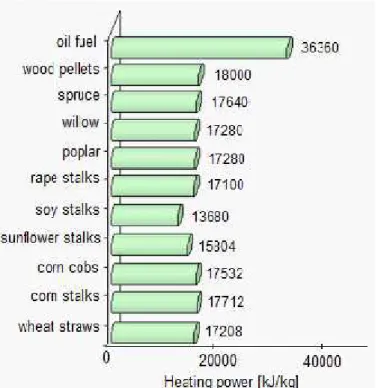
Figure 3 presents a comparison between the heating power of wood pellets and that of oil fuel and several types of biomass.
Fig. 3. Heating power of wood pellets compared to other biofuels materials [36]
Biomass pelleting has some important advantages:
- using pellets as an alternative sustainable energy is an effective tool in the fight against climate change [20];
- reduced handling of biofuel, lower storage and transportation costs [15]; - improved overall biomass quality, stability and durability [15];
- lower dust levels and higher heating values, lower pollution [8];
- reduced deforestation by providing a substitute of wood mass used for fire [21]. Main disadvantages of biomass pelleting are:
-emissions of low quality solid biofuels may damage the combustion plants and cause unwanted effects such as: slugging, corrosion and interference with automatic control of processes [17];
-dust generated by disintegration of low quality pellets represents a health risk, and can also contribute to the risk of ignition and explosion during handling, storage and transport [25].
RESULTS AND DISCUSSIONS
Pellets production has shown a continuous expansion over the years (Fig. 4) and is expected to have a faster growth in the near future [10].
Fig. 4. Global production of wood pellets between 2000-2015 [18]
With a production of 11.5 million tonnes in 2013 (50% of global production) [37] and 13.5 million tonnes in 2014, the European Union is the biggest wood pellet producer globally [29].
In Germany, about 60 production plants were operating in 2013, with a production capacity of 3.3 million tonnes [31].
In 2013, Romania’s capacity of pellets production was of 480.000 tonnes, of which 360.000 tonnes were made by the four large pellets and briquettes producers. The remaining 120.000 tons were made by small producers, for household use and with significantly lower quality. Production for 2014 was of 740,000 tonnes pellets / year. Estimations are that in 2020 Romania’s production capacity of pellets and briquettes will exceed 1.2 million tonnes / year [22].
By the end of 2013, pellet market in Serbia was in its infancy with only four plants, with a production of only 50.000 tonnes of pellets per year [14].
The U.S.A, Sweden and Canada produce about 10 million tonnes of biomass pellets per year [19]. By the end of 2013, there were 128 wood pellet plants across the U.S.A. with a total annual capacity of 10.56 million short tonnes [33] while by the end of 2014, the U.S.A had 184 functional wood pellet plants [34].
demands for private small-scale, medium scale (district heating plants) and large scale (power plant and CHP) consumption [30].
The Netherlands relies on imports of wood pellets. Reports show that the import of wood pellets has decreased significantly in 2013, amounted to about 0.66 MT compared with 1.05 MT in 2012 and 1.59 MT in 2010. Southern Europe, Canada and the U.S.A. are the major suppliers of wood pellets for the Netherlands. Gross consumption of biomass by the utilities for co-firing has dropped from 12.9 TJ in 2010 to 6.8 TJ in 2013 [35].
In 2014, the main wood pellet-producing regions were Europe (roughly 62%) and North America (roughly 34%). The top national producers were the United States (26% of total production), Germany (10%), Canada (8%), Sweden (6%), and Latvia (5%) [34].
Table 2 presents the global production of wood pellets in some regions in 2015 and the estimated production for 2020.
Table 2
Global production of wood pellets (x 106t/yr) in 2010 and 2015, with
forecasts for 2020 [23]
Regions 2010 2015 2020
North America 4.9 8.5 11
South America 0.1 3 4.4
Western Europe 7.7 10.7 13
Eastern Europe 2.2 2.8 3.3
Russia 0.6 1.4 1.6
Japan and Korea 0.1 0.4 1.1
China 0.6 3 10
Oceania 0.2 0.4 0.8
Table 3 presents the status of wood pellet consumption (x 106 t/yr) in 2010 and 2015 with forecasts for 2020.
Table 3
Consumption of wood pellets (x 106t/yr) in 2010 and 2015,
with forecasts for 2020 [23]
Regions 2010 2015 2020
North America 3.4 4.3 5.6
South America 0.05 0.12 0.2
Western Europe 10.8 16.4 23.8
Eastern Europe 0.4 0.6 0.8
Russia 0.03 0.05 0.05
Japan and Korea 0.2 3 5.5
China 0.6 3 10
Oceania 0.03 0.06 0.13
CONCLUSIONS
Biomass is an environmentally friendly and viable solution for the production of energy.
The production, and by default the consumption of biomass pellets has increased significantly in recent years, mostly due to the requirements created by policies and bioenergy use targets in Europe, and are expected to have a faster growth in the near future.
ACKNOLEDGEMENT
The work has been funded by Ministry of National Education and Research through the Executive Agency for Higher Education, Research, Development and Innovation Funding, within the project entitled „Optimizing the composition of biomass mixtures for obtaining high quality pellets””, BG 24 / 2016.
BIBLIOGRAPHY
1. Alakangas E., 2011 - New European pellets standards, EUBIONET 3 (http://www.foex.fi/uploads/bioenergy/New_European_pellets_standards_March_2011.pdf) 2. Ciolkosz D., 2009 -Renewable and Alternative Energy Fact Sheet. Manufacturing Fuel Pellets from Biomass. Pennstate College of Agricultural Sciences. Agricultural Research and Cooperative Extension;
3. Cutz L., Haro P., Santana D., Johnsson F., 2016 - Assessment of biomass energy sources and technologies: the case of Central America. Renewable and Sustainable Energy Reviews, vol. 58, pp. 1411–1431;
4. Danciu A, Vlăduț V., Voicea I., Postelnicu E., 2009 - Possibilities for using solid agricultural and forestry biomass to reduce soil and water pollution. Scientific Papers INMATEH, vol. 27, nr. 1, pp. 86-92;
5. Đerčan B., Lukić T., Bubalo-Živković M., Đurdev B., Stojsavljević R., Pantelić M., 2012 - Possibility and efficient utilization of wood waste as a renewable energy source in Serbia. Renewable and Sustainable Energy Reviews, vol. 16, pp. 1516-1527;
6. Donghui L., Tabil L.G., Wang D., Wang G., Emami S., 2014 - Experimental trials to make wheat straw pellets with wood residue and binders. Biomass and Bioenergy, vol. 69, pp. 287–296;
7. Garcia-Maraver A., Popov V., Zamorano M., 2011 - A review of European standards for pellet quality. Renewable Energy, vol. 36, pp. 3537-3540;
8. Gil M.V., Oulego P., Casal M.D., Pevida C., Pis J.J., Rubiera F., 2010 - Mechanical durability and combustion characteristics of pellets from biomass blends. Bioresource Technology, vol. 101, pp. 8859–8867;
9. Ishii K., Furuichi T., 2014 - Influence of moisture content, size and forming temperature on productivity and quality of rice straw pellets. Waste Management, vol. 34, pp. 2621–2626;
10. Junginger M., Sikkema R., Faaij A., 2009 - Analysis of the global pellet market. Utrecht: Copernicus Institute, Utrecht University;
11. Kaliyan N., Morey R.V., 2009 - Factors affecting strength and durability of densified biomass products. Biomass Bioenerg, vol. 33, no. 3, pp. 337-359;
12. Karkania V., Fanara E., Zabaniotou A., 2012 -Review of sustainable biomass pellets production – a study for agricultural residues pellets’ market in Greece. Renewable and Sustainable Reviews, vol. 16, pp. 1426–1436;
16. Laschi A., Marchi E., Gonzalez-Garcia S., 2016 – Environmental performance of wood pellets’ production through life cycle analysis. Energy, vol. 130, pp. 469-480;
17. Lehtikangas P., 2001 -Quality properties of pelletised sawdust, logging residues and bark. Biomass and Bioenergy, vol. 20, pp. 351-360;
18. Mathews McDermott F., 2015 - Global wood pellet market outlook. WPAC Annual Conference, Halifax;
19. Nunes L.J.R., Matias J.C.O., Catalaõ J.P.S., 2014 - Mixed biomass pellets for thermal energy production: A review of combustion models. Applied Energy, Elsevier, vol. 127, pp. 135–140;
20. Nunes L.J.R., Matias J.C.O., Catalaõ J.P.S., 2016 - Wood pellets as a sustainable energy alternative in Portugal. Renewable Energy, vol. 85, pp. 1011-1016;
21. Oladeji J.T., 2015 - Theoretical aspects of biomass briquetting: a review study. Journal of Energy Technologies and Policy, vol. 5, no. 3, pp. 72-81;
22. Sfaca. D., Romania – The characteristics and potential of the wooden pellets and briquette.Romanian Pellets and Briquettes Association.
23. Sikkema R., et al., 2011 - The European wood pellet markets: current status and prospects for 2020. Biofuels Bioprod. Biorefining, vol. 5(3), pp. 250–278;
24. Sultana A., Kumar A., Harfield D., 2010 - Development of agri-pellet production cost and optimum size. Bioresource Technology, vol. 101, pp. 5609-5621;
25. Temmerman M., Rabier F., Jensen P.D., Hartman H., Böhm T., 2006 -Comparative study of durability test methods for pellets and briquettes. Biomass and Bioenergy, vol. 30, pp. 964-972;
26. Tenorio C., Moya R., 2012 - Evaluation of different approaches for the drying of lignocellulose residues. BioResources, vol. 7(3), pp. 3500–3514;
27. Tumuluru J.S., Wright C.T., Kenny K.L., Hess J.R., 2010 - A review on biomass densification technologies for energy application. Idaho National Laboratory;
28. Vlăduț, V. Danciu A., Nicolescu M., Postelnicu E., 2012 -Technologies for obtaining and using biomass.Terra Nostra Publishing, Iași, 2012;
29. AEBIOM Statistical Report 2015. European Bioenergy Outlook,
http://www.propellets.at/wpcms/wp-content/uploads/2015-aebiom-statistical-report-zusammenfassung.pdf;
30. IEA Bioenergy Task 40: Country Report 2014 for Denmark. Teknologistic Institute,
2015, http://www.bioenergytrade.org/downloads/iea-task-40-country-report-2014-denmark.pdf);
31. IEA Bioenergy Task 40: Country Report Germany 2014,
http://bioenergytrade.org/downloads/iea-task-40-country-report-2014-germany.pdf;
32. IEA Bioenergy Task 40 – Country report 2013 for Norway,
http://bioenergytrade.org/downloads/iea-task-40-country-report-2014-norway.pdf;
33. IEA Bioenergy Task 40, Sustainable International Bioenergy Trade: Securing
Supply and Demand. Country Report 2014 – United States,
http://bioenergytrade.org/downloads/iea-task-40-country-report-2014-us.pdf;
34. REN 21 - Renewable Energy Policy Network for the 21st Century. Renewables
2015 Global Status Report (www.ren21.net);
35. Sustainable biomass and bioenergy in the Netherlands. Report 2014,
http://english.rvo.nl/sites/default/files/2015/04/Sustainable%20biomass%20flows%20Nethe rlands%202014%20by%20UU.pdf;
36. http://www.agropower-energy.ro/index.php?page=agro-biomasa
![Fig. 1. Stages of pellets production [28]](https://thumb-us.123doks.com/thumbv2/123dok_us/8070569.2137820/3.892.82.795.86.474/fig-stages-of-pellets-production.webp)
![Fig. 4. Global production of wood pellets between 2000-2015 [18]](https://thumb-us.123doks.com/thumbv2/123dok_us/8070569.2137820/5.892.185.718.274.588/fig-global-production-wood-pellets.webp)

