www.ijtes.net
E-readers make a Difference for Diverse
Readers
Tammy L. Anderson
The University of Tennessee
To cite this article:
Anderson, T.L. (2018). E-readers make a difference for diverse readers.
International Journal
of Technology in Education and Science (IJTES), 2
(1), 40-56.
This article may be used for research, teaching, and private study purposes.
Any substantial or systematic reproduction, redistribution, reselling, loan, sub-licensing,
systematic supply, or distribution in any form to anyone is expressly forbidden.
Authors alone are responsible for the contents of their articles. The journal owns the
copyright of the articles.
Volume 2, Issue 1, Winter 2018
E-readers make a Difference for Diverse Readers
Tammy L. Anderson
Abstract
Teachers are concerned with creating students who enjoy reading and choose to read because research has proven engagement is necessary for long-term achievement (Baker, Dreher, & Guthrie, 2000). In addition to increasing reading engagement and achievement, according to the International Reading Association (2009) and Common Core State Standards (2010), educators are responsible for integrating technologies and new literacies, the skills and strategies necessary to use new digital technologies, into the language arts curriculum to ensure students are prepared for their literacy futures. Is it possible integrating e-readers into literacy instruction, specifically independent reading, will produce students who not only engage in reading, but also enjoy reading and choose to read? The e-reader is not a replacement for traditional books, but it is an effective addition, allowing students to use digital tools (technology) in developing as passionate readers. The novelty of using digital tools is just one of many ways to engage students in reading. This study investigated third grade students’ use of e-readers for independent reading and the impact on reading behaviors including engagement, motivation, attitude toward reading, and reading volume. Field notes from observations, transcripts of interviews, annotations made on e-readers, and the number of books recorded in reading logs were collected, analyzed, and used to create a representation of the attitudes and habits of young readers. A descriptive case study captured participants’ experiences using e-readers, demonstrated perceived benefits for diverse readers, and provided insight for teachers integrating this digital tool.
Keywords: E-readers, motivation, engagement, diverse readers.
Introduction
Educators teach children to read proficiently, but they do not always focus enough on fostering a desire to read. With an increased focus on accountability and a strong emphasis on high-stakes testing to measure growth and increase student achievement, teachers have concentrated their instruction primarily on the reading skills measured and have provided little time for reading for pleasure (Sanacore, 2002). Therefore, students are taught to read but fail to develop the habit of reading (Morrow, 1991). As a result, more than half of our students do not read for pleasure (National Endowment for the Arts, 2007). In fact, only 38% of fourth grade students read for fun almost every day, according to trend data from National Assessment of Educational Progress 2015 (NAEP; NCES, 2015). This is a recent decrease compared to the average of 53% from 1971-2012 (NAEP; NCES, 2013). Educators should be concerned with the lack of pleasure reading because research has demonstrated that students who read outside of school have higher reading achievement scores than those who never read outside of school (Anderson et al., 1988; Brozo, Shiel, & Topping, 2007/2008).
Students who read more, improve their reading skills and increase their ability to learn about the world, think critically, understand humanity, and realize the importance of their role in society (Edwards, 2011). By choosing to read, students develop the necessary skills and attributes they need in order to be successful in the future. Ensuring students are literate is not enough; they must also choose to read. Children’s digital reading is a relatively new phenomenon and research on e-readers is increasing as educators integrate technology into their literacy instruction. Professionals in the field of education have conducted a number of studies that span a range of educational levels from elementary school to college.
make a difference in students’ reading behaviors such as engagement, motivation, attitude, and reading volume for diverse readers including engaged, disengaged, proficient, and struggling readers. New technologies connect students and books; the e-reader’s portability provides students access to a wide variety of books they are interested in reading, expanding their opportunities to read anyplace and anytime. The e-reader and its special features such as adjustable font size, dictionary, and text-to-speech may provide diverse readers the support they need to become engaged readers (Larson, 2010). Research has provided clear evidence that e-readers can be a motivating factor, increasing engagement (Long & Szabo, 2016). These findings suggest that integrating e-readers into literacy instruction and voluntary practice can potentially produce students who not only read proficiently, but who read for pleasure (Short, 2010).
Literature Review
McKenna and Zucker (2009) in their review of research on using electronic storybooks for reading instruction highlighted the impact technology had on students’ motivation and engagement in reading. In addition, Bates and colleagues (2017) determined that the increased availability of mobile devices and e-book apps provided students access to a larger number of books, a factor proven to increase motivation. Strangman and Dalton (2005) in their review of research found numerous studies reported technology’s positive effect on engaging struggling readers in literacy learning and reading.
Short (2010) concluded from her case study of 7 and 8 year olds’ reading e-books on the computer during their reading period that technology motivated students to read more. These second graders claimed reading e-books was one of their favorite activities. Short observed the ease and speed of students moving from one book to the next on the computer. Second graders were motivated to read e-books during reading centers and independent reading. In fact, these students were excited about reading on the computer and viewed reading e-books as a privilege.
Larson (2010) conducted a small case study of two girls with diverse reading levels using e-readers in the second grade classroom. Data collection included observations, interviews with students, parents, and the classroom teacher, in addition to student generated digital notes. Both girls used the e-reader’s features to interact with the text by adjusting the font size, listening to the text using the text-to-speech feature, highlighting passages and vocabulary, using the built-in dictionary, and annotating as they read. These students also used the pronunciation guide in the dictionary to help decode words. Larson claimed the interactive features of e-readers encouraged children’s reading. The e-reader had an advantage over traditional books because it encouraged and allowed students to interact with the text. Prior to the study one of the girls voiced her dislike of reading; however, her mother reported her daughter’s excitement about reading on the e-reader and increased confidence as a reader. The other student preferred reading on the e-reader because she could take notes on it unlike in a traditional school-owned book. In fact, using the e-reader deepened her transactions with text. E-readers proved to be a valuable tool in assisting the teacher in differentiating reading instruction and providing students with individualized support.
Isley, a third grade teacher, implemented the use of Kindles in her reading block beginning January 2010. She was one of the first elementary teachers to document her use of Kindles with young readers. She found using the Kindles with the text-to-speech option enabled struggling readers to “keep up with the book (like having their own teacher reading aloud the book) and then discuss it in a heterogeneous book club group” (D. Isley, personal communication, March 27, 2010). Isley explained, for students who struggled with fluency and decoding, the voice reading the text as they followed along was enough support to foster comprehension. The dictionary feature allowed students to scroll over a word instead of moving away from the text to get a dictionary and spending more time looking up a word than reading the text. In an interview she claimed the Kindle leveled the playing field by taking away the fear of laboring over each word and reading slower than the rest of the group.
Middle school students also preferred an e-reader to printed text in a study conducted with 199 struggling and reluctant readers (Miranda, Johnson, & Rossi-Williams, 2012). Miranda and her colleagues discovered that students’ attitudes toward reading increased positively after using the e-readers. Students were more engaged and motivated to read during independent reading when given the opportunity to use e-readers. In addition, struggling readers and English Language Learners self-reported an increase in reading comprehension.
Similar to participants in the studies mentioned above, the majority of 31 fourth graders in Milone’s (2011) study indicated on a survey at the end of eight weeks that the e-reader was very easy to use and specified they preferred to read using the e-reader rather than traditional books. Milone measured the fourth grade students’ comprehension of books read for pleasure on e-readers and traditional books. Results showed no statistically significant difference in students’ understanding of books read in the two formats. This implied students with differing levels of reading proficiency could comprehend books read for pleasure on e-readers as well as traditional books.
In a recent study of 16 third grade students’ use of Nook e-readers as an intervention, Union, Union, and Green (2015) compared the Reading and English Language Arts scores to students reading traditional texts and found student achievement improved in English Language Arts as a result of students reading on e-readers in the classroom and at home. Very few studies on reading motivation and engagement have been conducted with young students in primary classrooms. In addition, due to the relatively new introduction of e-readers in the elementary classroom, there is limited research currently on the use and impact on diverse student’s reading behaviors. The purpose of this study was to extend previous research on using e-readers by examining the effects on elementary students’ reading behaviors. Interested in diverse readers’ perspectives, this study examined third grade students’ experiences using e-readers during independent reading and the influence it had on their behaviors including reading engagement, motivation to read, reading attitude, and reading volume.
Method
Participants and Context
Participants in this study attended third grade in a large suburban multi-track year round public elementary school with over 850 students. This school served a diverse population with 31% minority students including Hispanic, Asian, American Indian, and African American students, and students from different socioeconomic backgrounds, including 8% of children who received free or reduced lunch. In grades Pre-K to 5, 14% of the students were English Language Learners and 11% had an Individualized Education Program (IEP).
Every student in one third grade classroom read on a Kindle black and white e-reader with linear text during independent reading time. The start of the school year began in July for these students. Data from 15 of the 20 third grade students who gave assent and returned parental consent forms were used in the study. Of these 15 students, four students were English Language Learners and two had IEPs. The teacher, principal, and parents readily embraced the idea of using e-readers in the classroom for independent reading.
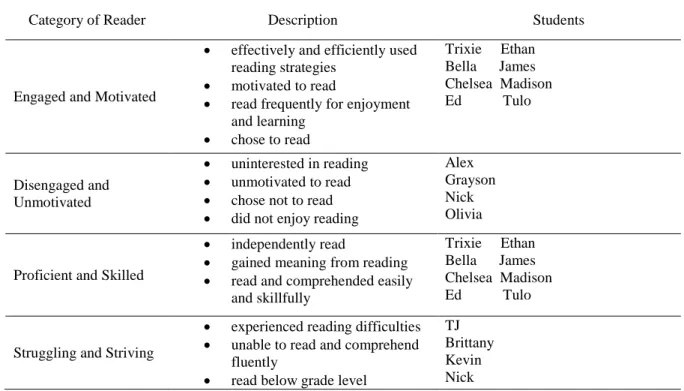
For the purpose of this research diverse readers were defined based on reading engagement and reading proficiency observed by the researcher prior to introducing the e-readers, not to label them, but to acknowledge the range of readers in every classroom and that depending on the environment reading engagement and motivation may vary. Table 1 lists four different categories of readers described in this study, which included (a) the engaged and motivated reader; (b) the disengaged and unmotivated reader; (c) the proficient and skilled reader; and (d) the struggling and striving reader. These categories were not mutually exclusive and many students belonged to multiple and various groups depending on the context.
Study Design and Data Collection Methods
E-readers
or her e-reader. The e-reader afforded the researcher an easy way to send books home with students and allowed students the opportunity to read anytime and anywhere.
Table 1. Description of diverse readers
Category of Reader Description Students
Engaged and Motivated
effectively and efficiently used reading strategies
motivated to read
read frequently for enjoyment and learning
chose to read
Trixie Ethan Bella James Chelsea Madison Ed Tulo
Disengaged and Unmotivated
uninterested in reading unmotivated to read chose not to read did not enjoy reading
Alex Grayson Nick Olivia
Proficient and Skilled
independently read
gained meaning from reading read and comprehended easily
and skillfully
Trixie Ethan Bella James Chelsea Madison Ed Tulo
Struggling and Striving
experienced reading difficulties unable to read and comprehend
fluently
read below grade level
TJ Brittany Kevin Nick
Text Selection
The researcher taught the students how to use the e-reader including how to turn it on and off, select a book, turn the pages, and how to use the various features that allow readers to engage in the reading experience such as the annotation tool, highlighting, and dictionary tools. Students practiced using the features of the e-readers to ensure they were comfortable before taking the e-readers home. Students were given a charger to use at home if needed; however, a single battery charge on the Kindle lasted for weeks, not hours.
Throughout the study, students previewed book titles and sampled books they were interested in reading. After consulting with the researcher, students selected different books based on their interests, meaning they were not all reading the same book. Not all of the books students chose to have loaded on the e-readers were at their independent reading level. Students also created a list of possible books they wanted to read in the future. New books were downloaded by the researcher daily as students finished reading the books they had first chosen. To alleviate the possible challenges of adding e-books every day, several books at a time were downloaded based on students’ preferences and requests. During independent reading in the classroom and at home, students read on their e-readers. In this way e-readers provided students access to ample texts.
Observations
Prior to introducing the e-readers, students’ reading engagement status was obtained by observing the students on four separate occasions during independent reading to assess their reading behaviors and determine their levels of reading engagement. Using Kelley and Clausen-Grace’s (2008, 2009) Silent Reading Behaviors Observation Checklist in addition to taking detailed field notes, the researcher recorded students’ reading behaviors for 30 minutes on each occasion. Within this initial observation period, the number of books each student read each day was also tallied.
involvement in student behavior during independent reading such as on/off task behaviors, text choices, discussions about text, and students’ responses to the books they were reading were recorded. Examples of on task behavior included reading, responding to text, and discussing a book with a peer or teacher. Off task behaviors included looking around the room and changing positions in the classroom.
Each day students recorded what they read by noting the name of the book, the page they ended on, date they started and finished reading each book, and a reaction to the book in a reading log. Not all students remembered to complete the reading logs every day. Some of the students also responded to their reading on e-readers using the annotation tool. Copies of their annotations were made weekly. The absence of information was also recorded.
Book Club Discussions
In addition to reading at school and at home, students gathered every Friday after school in the school library for an optional book club meeting to discuss the books they were reading and their e-reading experiences. On average 10 students attended each of the six book club meetings. All 15 of the participants attended at least one book club meeting except for Trixie (self-selected pseudonyms are used for all children throughout this paper) who rode the bus home. This was significant in the fact that students chose book club over other summer outdoor activities.
Interviews
During the first week of the study, students individually answered digitally recorded interview questions (see Appendix A) and completed a reading interest survey based on Hildebrandt’s (2001) survey, to provide information about themselves as readers, including reading behaviors, attitude toward reading, motivation to read, and the topics about which he or she was interested. This reading interest survey helped guide the selection of e-books that matched students’ interests.
Each student completed a second interview six weeks later at the end of the study. During this digitally recorded interview, the format of a conversational interview allowed the exploration of students’ perspectives on their reading experiences using the e-readers, reading habits, and elaboration on information the students shared in previous conversations and discussions. “The conversational interview offers maximum flexibility to pursue information in whatever direction appears appropriate depending on what emerges from observing a particular setting or from talking with one or more individuals in that setting” (Patton, 2002, p. 342).
Because each reader was unique and his or her reality was based on personal experiences, this type of qualitative interview was best suited for this study. The first two questions in the interview were “Tell me what it was like to read on an e-reader” and “What have you read on the e-reader?” The conversational interview provided flexibility in shaping subsequent questions to match what the students shared in order to explore meaning construction regarding the interview topic (Kendall, 2008).
Basing the questions on observations and discussions during independent reading and knowledge of each child increased the salience and relevance of the questions (Patton, 2002). Consequently, the researcher listened carefully, interpreted participants’ answers, and framed other questions to obtain more in-depth and relevant information. In addition, it was important for the researcher to continually follow the interview questions specifically, reflect on the possibility of leading the child during the interview, and be “prepared to explore the authenticity of the expressions during analysis and validate meaning in subsequent interviews” (Irwin & Johnson, 2005, p. 827).
Data Analysis
The primary goal for data analysis was to create an in-depth description of diverse students’ experiences using e-readers during independent reading and the impact it had on their reading experience and behavior including engagement, motivation, attitude, and volume. Data analysis began with the first classroom observation and continued with each observation, interview, and interaction with participants, as data analysis was ongoing and simultaneous throughout the nine week long study. A descriptive case study database was created, which consisted of separate files for each of the 15 students containing pertinent data sources for each student. Narratives portraying details of participants’ experiences were created. In order to create a narrative for each student’s use of an e-reader, thematic analysis was completed using the constant comparative method across observations and interviews (Bogdan & Biklen, 1992). Quotations were coded to determine explicit examples of each finding. In the last phase of analysis, data from across all of the cases were examined to find recurring patterns and themes relevant to the following research questions:
1. How is reading engagement affected?
2. What is the effect on students’ motivation to read? 3. What is the effect on students’ reading attitudes? 4. How does it influence students’ reading volume?
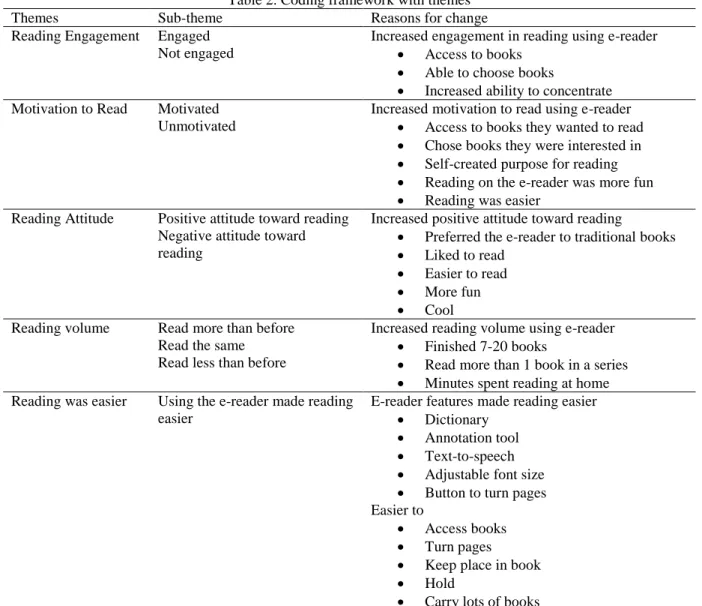
Data summary tables were created to visually display the data from each participant and the frequency of each category within each theme. The data were coded according to the four research questions and examples of students’ perceptions of their e-reading experiences and the impact on their reading behaviors were identified. From these patterns across the data, themes relevant to the research questions were identified (see Table 2).
Table 2. Coding framework with themes
Themes Sub-theme Reasons for change
Reading Engagement Engaged Not engaged
Increased engagement in reading using e-reader Access to books
Able to choose books
Increased ability to concentrate Motivation to Read Motivated
Unmotivated
Increased motivation to read using e-reader Access to books they wanted to read Chose books they were interested in Self-created purpose for reading Reading on the e-reader was more fun Reading was easier
Reading Attitude Positive attitude toward reading Negative attitude toward reading
Increased positive attitude toward reading
Preferred the e-reader to traditional books Liked to read
Easier to read More fun Cool Reading volume Read more than before
Read the same Read less than before
Increased reading volume using e-reader Finished 7-20 books
Read more than 1 book in a series Minutes spent reading at home Reading was easier Using the e-reader made reading
easier
E-reader features made reading easier Dictionary
Annotation tool Text-to-speech Adjustable font size Button to turn pages Easier to
Access books Turn pages Keep place in book Hold
Results
An analysis of 15 third grade students reading on e-readers revealed five major findings obtained from 30 in-depth interviews, 28 thirty-minute observations during independent reading, digital recordings of six 45-minute book club discussions, six weeks of reading logs with daily entries, and annotations made on the e-readers as well as in the students’ reading journals. Five themes were identified: increased reading engagement, motivation, positive reading attitudes, reading volume, and reading is easier. Four themes were directly related to the research questions. In addition, a significant finding that emerged was reading is easier on the e-reader. Examples of each finding were extracted from the data.
Increased Engagement
All 15 third grade students’ level of reading engagement increased with the use of e-readers. Based on observations noted by the researcher, an increased level of reading engagement the first day the e-readers were used remained the same throughout the study. Students finished a book and immediately chose another book from the menu and began reading. TJ described his own observation of student engagement stating, “On the Kindle people don’t whine or anything, they just go read.” In addition, the majority of students self-reported an increase in reading for a variety of reasons including access to more books, ability to choose the books they read, increased ability to concentrate, and reading being easier on the e-readers. During book club Olivia shared, “Sometimes I love the book and I just want to read more.” When asked if his feelings about reading had changed, Grayson answered, “Yeah. Sometimes I don’t get interested in books and ever since I started reading A to Z Mysteries I keep on reading them because they are good.”
Students were engaged in reading and there were fewer distractions in the room which allowed students to concentrate as they read. Madison commented, “I read a lot more because I can concentrate.” Describing his reading experience Kevin recalled, “When I read all of the books, I felt like I was in the book doing stuff that they were doing.” Three third graders indicated they read the same amount using e-readers and traditional books. Talking about reading at home, Ethan informed the researcher, “I read the same. If it said 20 minutes, I would do it.”
These third graders chose to fit book club meetings into their busy after-school summer activities such as football practice, swimming, and playing with friends. They enjoyed this social opportunity to share their reading experiences. At book club meetings, students eagerly shared the books they were reading on the e-readers and information about their reading experience. In fact, students fought for their turn to use the iPod and discuss their favorite books and the features of the e-reader that made reading easier. Students also expressed dissatisfactions they experienced while reading on the e-reader. For example, TJ reported, “Like everybody talked about the other day, I also don’t like when it reads to you.”
Increased Motivation
Each of the 15 participants reported in the second interview he or she was more motivated to read on e-readers because of one or more of the following reasons: choice in what they read, access to books, and perception that reading was more fun on e-readers. “It’s fun to read on the Kindle,” Tulo said. E-readers increased students’ motivation to read beyond the classroom as Trixie and Ed indicated in their comments about reading on the bus and at home. For example, one day in class Trixie shared, “One time I used the Kindle on the bus. My dad said don’t use the Kindle on the bus, you will break it. So I never used it. But with my headphones I left it on my backpack.” Not wanting to disobey her father, Trixie used the text-to-speech feature to listen to Because of Winn-Dixie on her long bus ride home. She continued to listen as she got off the bus: “I kept on listening, I didn’t run. Then at home I took out my Kindle when I was eating my food, I put it next to me so nothing gets on it. And I was waiting and waiting until it was done. No one actually noticed me reading.” This third grader was motivated to listen to her book for an extended period of time because the text-to-speech feature made it easy and she had access to many books she was interested in reading. Chelsea was also motivated to read more and annotated on her e-reader, “I can’t wait to read the next book. I’m going on vacation. I’m going to miss my Kindle if I can’t bring it.” She read several books on the e-reader while she was absent from school.
dictionary, increased students’ motivation and positive attitudes toward reading.
Increased Positive Attitude
As a result of reading on e-readers, a majority of participants reported an increase positively in their attitudes toward reading. In the second interview, 11 students responded that their feelings about reading had changed and each student described how he or she wanted to read more, reading was easier, reading was better, and reading was more fun on the e-reader. James offered, “In second grade I wouldn’t want to read too much, but since I have read on the Kindle it is way better because you can change the font.” “Ever since I got the Kindle, I started to be more of a reader fan,” added TJ. Many third graders claimed they actually preferred reading on e-readers to traditional books. “I like reading more on the Kindle,” Grayson shared.
Four students indicated their reading attitudes had not changed; they enjoyed reading traditional books and using e-readers. Bella explained, “I love reading and I still love reading.” Third graders reported that having increased choice and access to books they wanted to read, as well as the opportunity to read, affected how they felt about reading and in turn influenced their decisions to voluntarily read more often. Ed commented, “I used to not really want to read every night. Now I want to read more at home. I like to read more on my Kindle.”
Increased Reading Volume
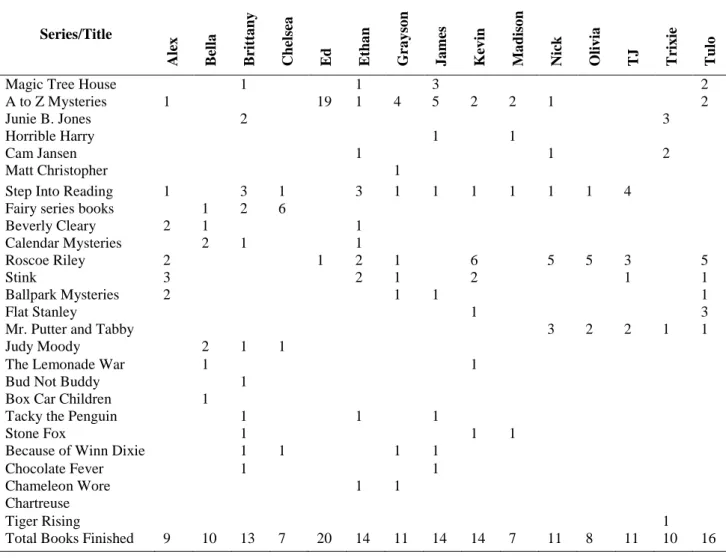
A majority of third grade participants indicated an increase in their reading volume as a result of reading on e-readers. The number of books read on the e-readers and recorded in students’ reading logs documented an increase in reading volume. At the end of the study Trixie said, “I read so many books I don’t remember all of them.” Students finished between seven and 20 books during six weeks of independent reading. Every student read more than one book in a series and some students read between three and 19 books in a single series. Ten students read several books in two or more series. Ethan reveled, “I can finish a book in two days.” Table 3 presents the number of books in a series and some individual titles of books students finished. Appendix B lists the titles in each of the series the third graders read. At book club meetings students talked about increasing their home reading goals. TJ stated, “I raised my goal to be higher and I’m changing 20 minutes reading each night into 30 minutes.” Students reported in the final interview that they read between 20 and 60 minutes each night at home.
Reading is Easier
Interestingly, a recurring theme throughout the book club discussions and final interviews was the idea that the e-reader made reading easier. This was not anticipated and therefore most notable because it made a difference for each of the different types of diverse readers. All of the students claimed reading on e-readers was easier than reading traditional books for a variety of reasons. The dictionary, annotation tool, text-to-speech, adjustable font size, and button to turn the pages made reading easier for students. Students commented on how easy it was to find the definition or pronunciation of an unfamiliar word while reading. James suggested, “Instead of finding a dictionary to look up a word, you can click on the word and it tells you what it means.” Many of the students noted how the text-to-speech feature made reading/listening to a book easy. Describing his experience, TJ mentioned, “You don’t have to read it by yourself – it reads to you.”
Table 3. Books read by each student
Series/Title
Alex Bella Brit
ta
ny
Chels
ea
Ed Etha
n G ra y so n J a mes K ev in M a dis o n
Nick Oliv
ia
TJ Trix
ie
T
ulo
Magic Tree House 1 1 3 2
A to Z Mysteries 1 19 1 4 5 2 2 1 2
Junie B. Jones 2 3
Horrible Harry 1 1
Cam Jansen 1 1 2
Matt Christopher 1
Step Into Reading 1 3 1 3 1 1 1 1 1 1 4
Fairy series books 1 2 6
Beverly Cleary 2 1 1
Calendar Mysteries 2 1 1
Roscoe Riley 2 1 2 1 6 5 5 3 5
Stink 3 2 1 2 1 1
Ballpark Mysteries 2 1 1 1
Flat Stanley 1 3
Mr. Putter and Tabby 3 2 2 1 1
Judy Moody 2 1 1
The Lemonade War 1 1
Bud Not Buddy 1
Box Car Children 1
Tacky the Penguin 1 1 1
Stone Fox 1 1 1
Because of Winn Dixie 1 1 1 1
Chocolate Fever 1 1
Chameleon Wore Chartreuse
1 1
Tiger Rising 1
Total Books Finished 9 10 13 7 20 14 11 14 14 7 11 8 11 10 16
Discussion
Findings from this study captured the multidimensionality of participants’ lived experiences using e-readers for independent reading. These third grade students found reading on e-readers easier and more enjoyable than reading traditional books. The fact that it was easier for students to access the text, keep their place while reading, see the text, turn the pages, and interact with the text motivated students to read, engage in the act of reading, feel confident and successful in reading a book of their choice, and ultimately read more.
Results highlight the reading possibilities e-readers offer elementary students by providing choice of and access to reading materials, the opportunity to read anywhere and anytime, and a context through which to interact socially with others about reading. Students are more likely to engage in activities they find easy and that make them feel successful. The more they choose to read the more proficient they will become at reading and the more they will achieve. This study extends the findings of previous studies examining the use of e-readers and provides a piece that was missing regarding the impact on diverse readers and their reading behaviors.
The Impact on Diverse Readers
Engaged and Motivated Readers
Engaged and motivated readers, like Trixie, were intrinsically motivated to read and read frequently for interest, enjoyment, and learning prior to reading on the e-reader. Trixie and other engaged readers chose to read to gain new knowledge about topics they were interested in and enjoyed reading for pleasure. These students indicated they preferred reading on e-readers and thought it was easier. The various features of the e-reader such as the dictionary, annotation tool, text-to-speech, font size, and a button to turn the pages contributed to making reading easier for students because they permitted readers to access multitudes of text easily, read more text of their choice based on interest, preview new books, sample the first chapter of books they were interested in reading, listen to books, interact with text by highlighting and annotating, and learn new vocabulary. Chelsea explained, “Reading on the e-reader was easier because I could pick the size of the words.” In addition, all of the books students read remained at their fingertips. Trixie found, “It is easy to go back and reread books because they are all right there.”
Even though most students found reading on the e-reader easier than reading a traditional book, some students really did not find it any different. To these students reading was reading and the medium did not make a difference. For example, when asked if he preferred reading on the e-reader or traditional books Ethan replied, “Regular books or Kindle, it doesn’t really matter.” He also reported that he read the same amount of time using the e-reader as traditional books.
The attitudes toward reading of students who were engaged and motivated readers increased positively as a result of reading on readers. This finding validated Adam and Wild’s (1997) claim that students reading e-texts developed strong positive attitudes toward reading. Just as Strangman and Dalton (2005) reported, this study supports the findings that technology can make a positive impact on students’ attitudes toward reading. During the second interview, Chelsea pointed out, “I really like to read and now I know how fun it is. Just getting stuck in a book is fun.” Students found reading on the e-reader more fun than reading traditional books and their attitudes about reading changed as a result.
Analogous to the findings in Moser and Morrison’s (1998) study, third grade participants’ reading volume increased when they had time to read, were allowed to choose the books they wanted to read, and had opportunities to share what they had read with others. This study also confirmed Oakley and Jay’s (2008) findings that students read more when reading e-books. Similar to Grams’ (2003) finding that students read more e-texts and were more interested in books, the data from this study also showed an increase in reading volume and interest in reading and books.
Not only did reading on e-readers in this study make a difference for the students who were identified as engaged and motivated readers, but it also made a difference for students who were disengaged readers and unmotivated readers.
Disengaged and Unmotivated Readers
Disengaged and unmotivatedreaders, like Grayson and Alex, pretended to be reading or avoided reading with many different off task behaviors similar to those found by Kelley and Clausen-Grace (2009) in their study of independent reading. Before introducing the e-readers Grayson and Alex flipped through the pages of their books, looked around the room, and frequented the restroom during independent reading. However, after these boys began reading on e-readers their on task behavior increased and they became more engaged in reading. In fact, on task reading behavior increased for all of the participants after they began reading books of their choice on e- readers. These students read more because they felt empowered as readers by being able to select the books they wanted to read.
Nick, like the disengaged students in Bryan and colleagues’ (2003) study, lacked confidence in his reading, was inattentive and uninterested in reading, and was easily distracted and distractive. Even though the e-reader did not alleviate this problem completely, Nick was far more engaged and less distracted while reading on the e-reader than before. Many of the students who were disengaged the first week of the study when they were reading traditional books may have been reluctant to read because they had not chosen the books they were reading. Worthy (1998) found many disengaged readers are only reluctant to read teacher-selected texts. On the other hand, some students asked to read the books the teacher had chosen for guided reading on their e-readers during independent reading.
Reading on e-readers made a difference for reluctant readers as well as engaged readers. Their level of engagement, motivation to read, and reading volume increased because they were able to choose what they read and they preferred reading on e-readers because it was easier to read for reasons such as being able to increase the font size and find their place in the text. Disengaged readers, like Grayson, changed as readers because they were more engaged in reading and therefore felt they had become better readers.
Proficient and Skilled Readers
Proficient and skilled readers like Ed and Madison used reading strategies effectively and demonstrated comprehension of grade level text during book club discussions. They believed in their reading abilities. Ed, like other proficient readers, was compliant to the teacher’s requests and read the required 20 minutes each night prior to using the e-reader for independent reading. However, Ed was not interested in reading for pleasure. For Ed, having access to the entire A to Z Mysteries series and being allowed to choose the books he read provided the motivation for him to read more. As a result, he read and finished a book almost every night.
Students like Madison and Ed read a variety of texts, responded to what they read, connected what they read to their own lives, asked questions as they read, and made predictions using the annotation tool. Reading on e-readers allowed proficient students an easier way to interact with the text as they read. Even though these readers could read proficiently prior to the study, reading on e-readers also made a difference for them as it did for disengaged and striving readers. Ed found reading on the e-reader easier than traditional books because he could easily find books he was interested in reading, turn the pages with a push of a button, and have easy access to a lot of books whenever and wherever he went. For these reasons Ed read more on the e-reader than before. Using the annotation tool, Madison typed, “P.S. I am reading a lot better on the Kindle then on a real book.”
Every day during independent reading, Ed chose to sit at his desk reading intently so he could reach his goal of reading all of the A to Z Mysteries. He came very close to succeeding. Ed read 24 of the 26 mysteries, finishing 19. Ed would, as a result of access to e-readers, be labeled an engaged reader who is stuck in a series according to Kelley and Clausen-Grace (2008). Kelley and Clausen-Grace described readers like Ed as students who have found a series they enjoy reading and will read every book in the series. Ed had his mind set on finishing the series and found success in finishing a book nearly every day. Data recorded on his reading log revealed he did read a few other books when he finished an A to Z Mystery and didn’t have any other mysteries to read. Having various books loaded on his e-reader introduced him to a variety of books he may not have chosen otherwise. The e-reader made a difference for proficient and skilled readers like Ed and Madison because they considered it more fun and it changed the way they felt about reading, encouraging them to read more and become even better readers. Not only did reading on e-readers make a difference for proficient readers, but it also made a difference for struggling and striving readers.
Struggling and Striving Readers
term “read normal,” he explained, “Like read normal on the Kindle by myself, so I don’t have to listen to it.” Even though he was able to access text using the text-to-speech feature, his goal was to learn all the words so he could read without the additional support.
Corroborating West-Christy’s (2003) research, e-readers offered reluctant and striving students support by providing a wide range of reading materials, incorporating large font size, engaging multiple modalities, teaching vocabulary through the built-in dictionary, and supporting comprehension strategies such as predicting, questioning, and making connections through the use of the annotation tool. The difference the e-reader made for striving readers like TJ was it created a context in which students got lost in the book as they were reading. The researcher observed and students described how they experienced flow, as McKool’s (2007) students described, when the book is so interesting the readers lose track of place and time while reading during independent reading time.
Not only did the features of the e-reader offer students support, but just as importantly the e-reader eliminated the uncomfortable feelings striving readers had in choosing books at their own reading level. The researcher noted that the book a student chose to read was not evident to others, allowing the student to enjoy books at his or her level and increase his or her reading confidence and progress. Using e-readers largely disguised the fact the books read by readers with varying reading abilities were books their classmates had read in previous grades. E-readers supported the self-esteem of students reading texts other students consider too easy (Kara-Soteriou, 2009). In addition, readers with differing reading abilities who wanted to read the same books as their classmates, which may have been too difficult without support, used the text-to-speech feature and headphones to read and prepare to participate in book discussions with their friends. This enabled students to read and listen to more grade level appropriate and interesting books.
The e-reader removed the restraints of word recognition and decoding, allowing students to focus on the meaning of the author’s words. In helping students compensate for a lack of strong decoding skills, the e-reader leveled the playing field (McKenna & Zucker, 2009). No child was marginalized in the activity or excluded from the opportunity to read/listen to and comprehend grade level text from a lack of reading proficiency. Moreover, the text-to-speech scaffold could be removed when the reader no longer needed it (McKenna & Walpole, 2007). The e-reader provided flexibility not only allowing students to access high leveled text, but by providing lots of practice with text at their reading level. With this digital tool, educators can succeed in scaffolding reading instruction and meeting the diverse needs of all learners in new and innovative ways.
Implications for Diverse Readers
The use of e-readers in the classroom may positively impact reading behaviors by increasing reading engagement, motivation to read, students’ attitudes about reading, and reading volume. While findings of this study are limited to this specific group of third graders, results of this study suggest the difference using e-readers can make for diverse e-readers in elementary school. The significance of this study is it illuminates the reading possibilities e-readers offer elementary students by providing choice of a multitude of reading materials based on interest, easy access to a wide variety of reading materials, opportunity to read anywhere and anytime, and a context through which to interact socially with others about reading. Students are more likely to engage in activities in which they find easy and that make them feel successful.
Research has shown that the most effective way of building literacy is the most pleasant (Greenlee, Monson, & Taylor, 1996). Similarly, engaging in more reading may lead to better reading (Allington, 2014). Given this relationship, expanded reading activity due to the introduction of e-readers indicates promise for this digital tool. The overall finding in this study revealed using e-readers for independent reading positively impacted third grade students’ reading behaviors. Based on this finding, e-readers have the potential to develop a reading habit in young children. E-readers are not a replacement for traditional books, but they are an effective addition, allowing students to use digital tools (technology) in developing as proficient and passionate readers. The novelty of using digital tools is just one of many ways to engage students in reading.
Conclusion
This study offers evidence of the efficacy of implementing e-readers during independent reading in the classroom. Obtaining documentation directly from students sharing their experiences, this research provides teachers support to pursue the use of e-readers to promote reading motivation and engagement. It also supplies information on the perceived benefits of incorporating e-readers into literacy instruction to promote more choice, heightened interest, and enhanced motivation in reading, in addition to improved attitudes toward reading and increased reading volume. Incorporating e-readers in the classroom may ignite a passion for reading in students, especially those who are striving or disengaged. Through the use of e-readers, educators can support the needs of all readers. In essence, students and teachers may profit in multiple ways using e-readers for reading activities within and outside of the classroom.
Based on this study and the impact reading on e-readers made on third grade students’ reading behaviors according to their perceptions of their experiences, e-readers can make a difference for diverse readers. E-readers made reading easier for students and as a result they viewed reading as more enjoyable. Students also thought reading was fun on the e-readers and had a positive attitude about reading, which increased their motivation to read. The more motivated they were to read, the more engaged in reading they became. Subsequently, these third graders read more and became more confident in their reading ability. The cycle continued because the more confident they were about reading, the easier reading became. As Beers (1998) writes, “If creating lifelong readers is the goal, then every tool is needed” (p.35). Integrating e-readers into literacy instruction and voluntary practice can potentially produce students who not only read proficiently, but who read for pleasure. The e-reader, according to this research and other studies, is one tool to engage students in reading and make a difference for diverse readers.
References
Adam, N., & Wild, M. (1997). Applying CD-ROM interactive storybooks to learning to read. Journal of Computer Assisted Learning, 13, 119-132.
Allington, R. L. (2014). How reading volume affects both reading fluency and reading achievement. International Electronic Journal of Elementary Education, 7(1): 13-26.
Anderson, R. C., Wilson, P. T., & Fielding, L. G. (1988). Growth in reading and how children spend their time outside school. Reading Research Quarterly, 23, 285-303.
Baker, L., Dreher, M. J., & Guthrie, J. T. (2000). Why teachers should promote reading engagement. In L. Baker, M. J. Dreher, & J. T. Guthrie (Eds.), Engaging young readers: Promoting achievement and motivation (pp. 1-16). New York: The Guilford Press.
Bates, C. C., Klein, A., Schubert, B., McGee, L., Anderson, N., Dorn, L., McClure, E., & Ross, R. H. (2017). E-Books and e-book apps: Considerations for beginning readers. The Reading Teacher, 70(4), 401–411. Beers, K. (1998). Listen while you read: Struggling readers and audiobooks. School Library Journal, 44(4),
30-35.
Bogdan, R. C., & Biklen, S. K. (1992). Qualitative research for education: An introduction to theory and methods. Needham Heights, MA: Allyn and Bacon.
Bray, M., Brown, A., & Green, T. D. (2004). Technology and the diverse learner: A guide to classroom practice. Thousand Oaks, CA: Corwin Press.
Brozo, B., Shiel, G., & Topping, K. (2007/2008). Engagement in reading: Lessons learned from three PISA countries. Journal of Adolescent and Adult Literacy, 51, 304-315.
Bryan, G., Fawson, P. C., & Reutzel, D. R. (2003). Sustained silent reading: Exploring the value of literature discussion with three non-engaged readers. Reading Research and Instruction, 43(1), 47-73.
Common Core State Standards Initiative. (2010). Common core state standards for English language arts & literacy in history/social studies, science, and technical subjects. Washington, DC: National Governors Association Center for Best Practices and the Council of Chief State School Officers.
Edwards, P. A. (2011). Access to books makes a difference. Reading Today, 28(6), 16.
Glesne, C. (2006). Becoming qualitative researchers: An introduction (3rd ed.). Boston: Pearson Education, Inc. Grams, D. (2003, June 30). E-books: Motivating students to read independently (unpublished research report).
Central Michigan University. Mount Pleasant, MI. Retrieved from http://goknow.com/GettingStarted/Documents/Grams_D_e-books.pdf
Guthrie, J. T., & Humenick, N. M. (2004). Motivating students to read: Evidence for classroom practices that increase reading motivation and achievement. In P. McCardle & V. Chhabra (Eds.), The voice of evidence in reading research (pp. 329-354). Baltimore: Brookes Publishing.
Hatch, J. A. (2002). Doing qualitative research in education settings. Albany, NY: State University of New York Press.
Hildebrandt, D. (2001). “But there's nothing good to read” (in the library media center). Media Spectrum: The Journal for Library Media Specialists in Michigan, 34–37.
International Reading Association. (2009, May). New literacies and 21st-century technologies: A position statement.
www.reading.org/General/AboutIRA/PositionStatements/21stCenturyLiteracies.aspx
Irwin, L. G., & Johnson, J. (2005). Interviewing young children: Explicating our practices and dilemmas. Qualitative Health Research, 15(6), 821-831.
Kara-Soteriou, J. (2009). Using technology to differentiate instruction across grade levels. New England Reading Association Journal, 44(2), 86-90.
Kelley, M. J., & Clausen-Grace, N. (2008). R5 in your classroom: A guide to differentiating reading and developing avid readers. Newark, DE: International Reading Association.
Kelley, M. J., & Clausen-Grace, N. (2009). Facilitating engagement by differentiating independent reading. The Reading Teacher, 63(4), 313-318.
Kendall, L. (2008). The conduct of qualitative interviews: Research questions, methodological issues, and researching online. In J. Coiro, M. Knobel, C. Lankshear, & D. J. Leu (Eds.), Handbook of research on new literacies (pp. 133-150). New York: Lawrence Erlbaum.
Kingsley, K. (2007). Empower diverse learners with educational technology and digital media. Intervention in School and Clinic, 43(1), 52-56.
Larson, L. C. (2010). Digital readers: The next chapter in e-book reading and response. The Reading Teacher, 64(1), 15-22.
Long, D., & Szabo, S. (2016). E-readers and the effects on students’ reading motivation, attitude and comprehension during guided reading. Cogent Education 3(1), 1-11. Retrieved from http://dx.doi.org/10.1080/2331186X.2016.1197818
Maynard, S. (2010). The impact of e-books on young children’s reading habits. Publishing Research Quarterly, 26(4), 236-248. doi:10.1007/s12109-010-9180-5
McKenna, M. C., & Walpole, S. (2007). Assistive technology in the reading clinic: Its emerging potential. Reading Research Quarterly, 42(1), 140-145.
McKenna, M. C., & Zucker, T. A. (2009). Use of electronic storybooks in reading instruction: From theory to practice. In A. G. Bus & S. B. Neuman (Eds.), Multimedia and literacy development: Improving achievement for young learners (pp. 254-272). New York: Routledge.
McKool, S. S. (2007). Factors that influence the decision to read: An investigation of fifth grade students’ out-of school reading habits. Reading Improvement, 44(3), 111-131.
Milone, M. (2011). Student comprehension of books in Kindle and traditional formats. Wisconsin Rapids, WI: Renaissance Learning, Inc. Retrieved from http://doc.renlearn.com/KMNet/R0054730029120B5.pdf Miranda, T., Johnson, K. A., Rossi-Williams, D. (2012). E-Readers: Powering up for engagement. Educational
Leadership, 69. Retrieved from https://www.learntechlib.org/p/114198/
Morrow, L. M. (1991). Promoting voluntary reading. In J. Flood, J. M. Jensen, D. Lapp, & J. R. Squire (Eds.), Handbook of research on teaching the English language arts (pp. 681-690). New York: Macmillan Publishing Company.
Moser, G. P., & Morrison, T. G. (1998). Increasing students’ achievement and interest in reading. Reading Horizons, 38(4), 233-45.
National Center for Education Statistics (2013). The Nation’s Report Card: Trends in Academic Progress 2012 (NCES 2013 456). Institute of Education Sciences, U.S. Department of Education, Washington, D.C. National Center for Education Statistics (2015). The Nation’s Report Card: Reading 2015 (NCES 2015-136).
U.S. Department of Education, Institute of Education Sciences, National Center for Education Statistics, National Assessment of Educational Progress (NAEP), 2015 Reading Assessment. Retrieved from https://www.nationsreportcard.gov/reading
National Endowment for the Arts. (2007). To read or not to read. Washington, DC: Author. Retrieved from http://www.nea.gov/research/ToRead.pdf
Neuman, S. B., & Celano, D. (2001). Access to print in low-income and middle-income communities: An ecological study of four neighborhoods. Reading Research Quarterly, 36(1), 8-26.
Oakley, G., & Jay, J. (2008). “Making time” for reading factors that influence the success of multimedia reading in the home. The Reading Teacher, 62(3), 246-255.
Sanacore, J. (2002). Struggling literacy learners benefit from lifetime literacy efforts. Reading Psychology, 23, 67-86.
Short, L. A. (2010). Using electronic books to increase elementary students’ motivation to read (Masters thesis). Retrieved from www.dominican.edu/academics/education/.../shortsp10electronicbooks.pdf
Strangman, N., & Dalton, B. (2005). Technology for struggling readers: A review of the research. In D. Edyburn, K. Higgins, & R. Boone (Eds.), The handbook of special education technology research and practice (pp. 545–569). Whitefish Bay, WI: Knowledge by Design.
Union, C. D., Union, L. W., & Green, T. D. (2015). The use of ereaders in the classroom and at home to help third-grade students improve their reading and english/ language arts standardized test scores. Tech Trends, 59(5), 71-84. doi:10.1007/s11528-015-0893-3
West-Christy, J. (2003). Helping remedial and reluctant readers. Teaching Today. Education Up Close. Retrieved from http://www.glencoe.com/sec/teachingtoday/educationupclose.phtm/29
Worthy, J. (1998). "On every page someone gets killed!" Book conversations you don't hear in school. Journal of Adolescent & Adult Literacy, 41(7), 508-517.
Author Information
Tammy L. Anderson
Adams 12 Five Star School District 1500 E 128th Avenue, Thornton, CO 80241 USA
Appendix A. Guiding Questions for Interview
1. What are you reading for independent reading?
2. What else have you read this week during independent reading? 3. Which books did you choose to read?
4. Can you find the books you want to read?
5. About how many books have you read since school started? 6. Tell me about what it is like to read during independent reading? 7. How often do you read at school? At home? For how long each time? 8. What do you like about reading?
9. Are there things you do not like about reading? 10. What makes reading easy?
11. What makes reading challenging?
Appendix B. Titles in Each of the Series the Third Graders Read
Adler, D. (2004). Cam Jansen: The mystery of the stolen diamonds #1 [Kindle Edition]. Adler, D. (2004). Cam Jansen: The mystery of the U.F.O.#2 [Kindle Edition].
Applegate, K. (2009). Roscoe Riley #1: Never glue your friends to chairs [Kindle Edition]. Applegate, K. (2009). Roscoe Riley #2: Never swipe a bully’s bear [Kindle Edition].
Applegate, K. (2009). Roscoe Riley # 3: Don’t swap your sweater for a dog [Kindle Edition]. Applegate, K. (2009). Roscoe Riley # 4: Never swim in applesauce [Kindle Edition].
Applegate, K. (2009). Roscoe Riley #5: Don’t tap-dance on your teacher [Kindle Edition]. Applegate, K. (2009). Roscoe Riley #6: Never walk in shoes that talk [Kindle Edition]. Bertman, D., & Bloom, S. (2010). The best place to read [Kindle Edition].
Brown, J. (2009). Flat Stanley’s worldwide adventures #1-#7 [Kindle Edition]. Brown, J. (2010). Invisible Stanley [Kindle Edition].
Brown, J. (2010). Stanley flat again [Kindle Edition].
Christopher, M. (2009). Undercover tailback (Matt Christopher Sports Fiction) [Kindle Edition]. Cleary, B. (2008). Beezus and Ramona [Kindle Edition].
Cleary, B. (2008). Ramona Quimby, age 8 [Kindle Edition]. Curtis, C. P. (2001). Bud, not Buddy [Kindle Edition]. Davies, J. (2009). The lemonade war [Kindle Edition].
DiCamillo, K. (2009). Because of Winn-Dixie [Kindle Edition]. DiCamillo, K. (2009). Tiger Rising [Kindle Edition].
Eastman, P. D. (2010). Go dog go [Kindle Edition]. Gardinier, J. R. (2010). Stone fox [Kindle Edition].
Holub, J. (2011). Shampoodle (Step into Reading) [Kindle Edition].
Kelly, D. A. (2011). Ballpark mysteries #1: The Fenway foul-up (A Stepping Stone Book ™) [Kindle Edition]. Kimmel, R. (2006). Chocolate fever [Kindle Edition].
Kline, S., & Remkiewicz, F. (2007). Horrible Harry takes the cake [Kindle Edition]. Kline, S., & Wummer, A. (2010). Horrible Harry goes cuckoo [Kindle Edition]. Lester, H. (2010). Tacky the penguin [Kindle Edition].
McDonald, M., & Reynolds, P. H. (2010). Judy Moody [Kindle Edition].
McDonald, M. (2011). Judy Moody and the not bummer summer. [Kindle Edition].
McDonald, M., & Reynolds, P. H. (2010). Stink and the great guinea pig express [Kindle Edition]. McDonald, M., & Reynolds, P. H. (2010). Stink: Solar system superhero [Kindle Edition].
McDonald, M., & Reynolds, P. H. (2010). Stink: The incredible shrinking kid [Kindle Edition]. Meadows, D. (2010). Bella the bunny fairy [Kindle Edition].
Meadows, D. (2010). Katie the kitten fairy [Kindle Edition].
Meadows, D. (2010). Samantha the swimming fairy [Kindle Edition]. Meadows, D. (2010). Stacey the soccer fairy [Kindle Edition]. Meadows, D. (2010). Stella the star fairy [Kindle Edition].
Meadows, D. (2010). Gabriella the snow kingdom fairy [Kindle Edition].
Osborne, M. P. (2010). Magic tree house #1: Dinosaurs before dark [Kindle Edition]. Park, B. (2009). Junie B., first grader: Cheater pants [Kindle Edition].
Park, B. (2009). Junie B., first grader: Aloha-ha-ha! [Kindle Edition]. Park, B. (2010). Junie B. Jones and the stupid smelly bus [Kindle Edition]. Park, B. (2010). Junie B. Jones smells something fishy [Kindle Edition]. Riordan, R. (2009). The lightning thief [Kindle Edition].
Roy, R. (2009). A to Z mysteries: The zombie zone (A to Z Mystery) [Kindle Edition] Roy, R. (2009). A to Z mysteries super edition 1: Detective camp [Kindle Edition]
Roy, R. (2009). A to Z mysteries super edition 2: Mayflower treasure hunt [Kindle Edition] Roy, R. (2009). Capital mysteries #1: Who cloned the president? [Kindle Edition]. Roy, R. (2010). Calendar mysteries #1: January joker [Kindle Edition].
Rylant, C. (2003). Mr. Putter and Tabby catch the cold [Kindle Edition]. Rylant, C. (2004). Mr. Putter and Tabby stir the soup [Kindle Edition]. Rylant, C. (2006). Mr. Putter and Tabby make a wish [Kindle Edition].