TECNOSCIENZA
Italian Journal of Science & Technology Studies Volume 2(1) pp. 21-30 - ISSN 2038-3460
http://www.tecnoscienza.net ©2011 TECNOSCIENZA
Practice and its Overflows:
Reflections on Order and Mess
Lucy Suchman
Abstract The starting point of this paper is the problem of how STS researchers make the objects of their research, considering that researchers are an integral part of the practices through which their research objects are made. A “center of coordination” in an airport is used as an example to show how a schedule, used as an ordering device within the ongoing work, operates at the same time as a form of normative prescription for what the work should come to. The schedule demonstrates how prescriptive representations presuppose the work of their en-actment, in ways that differ from representations used to describe “natural” events, insofar as the former are constitutive of the processes and practices to which the artifacts are accountable. Finally the paper draws on the work of John Law (2004) to show how consistent relations, i.e. orderings, are maintained through routines that, in producing other relations, constitute mess. In this re-spect, the order created by the researcher in analyzing the situated use of the schedule is not different in kind from the order created by the members’ practic-es to manage the traffic of planpractic-es.
Keywords Apparatus; center of coordination; normative prescriptions; or-der/mess; practice.
My starting point in this paper is the problem of how, as STS researchers, we make the objects of our research.
Given the 2010 EASST conference theme, I address this problem through the figure of “practice” – both in the sense of research methods as practice, and in the sense of “practice” as itself an object of research. My opening question is this one: what are the implications of the fact that we are an integral part of the prac-tices through which our research objects are made?
deeply conjoin agencies of observation, including subjects, and their objects. She emphasizes that we are neither outside of the world looking at it, nor are we in-side of it. Rather we are of it. She writes:
The point is not simply to put the observer or knower back in the world (as if the world were a container and we needed merely to acknowledge our situatedness in it) but to understand and take account of the fact that we too are part of the world's differential becoming. And furthermore, the point is not merely that knowledge practices have material consequences, but that practices of knowing are specific material entanglements that participate in (re)configuring the world (Barad 2007: 91, original emphasis).
Knowing subjects and objects know, in other words – the distinction that un-derwrites the classic Western philosophical differentiation of epistemology from ontology – are mutually constituted, including in their enactment as separate things. And delineating lines around and between things is, as we know, a prac-tice of boundary-making. It follows that responsible knowing requires an atten-tiveness to the reiterative, material-discursive practices through which object boundaries are drawn, and to the constitutive relations – and exclusions – that boundary making enacts.
In an argument that I read as deeply resonant with Barad’s construct of the apparatus, John Law (2004: 14) characterizes this practice of knowledge making as a “method assemblage”; that is, enactments of “relations that make some things (representations, objects, apprehensions) present “in-here”, whilst making others absent “out-there”. The “out-there” comes in two forms: as manifest ab-sence (for instance as that which is represented); or, and more problematically, as a hinterland of indefinite, necessary, but hidden Otherness,” where by Otherness in this context he means that which is taken for granted, unknowable within par-ticular knowledge systems, or actively repressed. So Law takes us, explicitly, to questions of method, of practices of drawing things together, and of making dif-ference.
These arguments resonate for me as well with the ethnomethodological dic-tum that method – understood as members of the society’s everyday practices of ordering, of making the social world intelligible – rather than being taken by so-cial science to be its distinctive provenance and resource, is rather an integral part of our subject matter (Garfinkel and Rawls 2002). It is in this sense that so-cial science methods are radically reflexive; that is, our own work of making sense of the world relies upon the same basic competencies through which its intelligi-bility is collectively enacted in the first place.
way, but “in practice” it is different – where usually practice is seen as a flawed approximation of the ideal.
But a radically different strategy is to take an STS, or material-semiotic ap-proach, and to treat these prescriptive formulations as themselves particular kinds of artifacts. Like all artifacts, these things are made in specific locations to be put into use in others – in fact, the more you think about it, the more resem-blances there are to devices, with all of the problematic relations between loca-tions of design and use that have become familiar to us through the study of technologies.
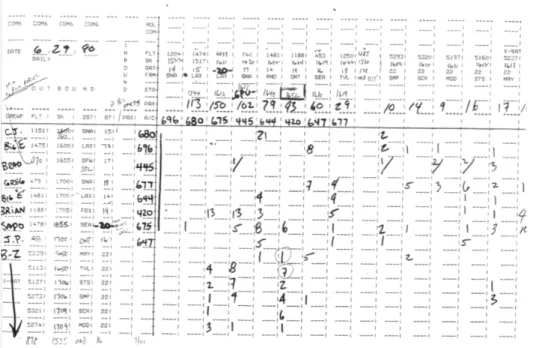
To make this all more concrete, I go back to some of my earlier research, in-volving a form of close analysis that, while I have not continued it in my own work, deeply informs my sense of what we might mean by “practice,” as well as my understanding of how prescriptive devices operate as artifacts (see Suchman 1993). The central device in this case is this one, the airline schedule (Fig. 1)
Fig. 1 – Airline schedule
of coordination” (citing Latour’s famous category, the “center of calculation” – Latour 1987; Suchman 1997).
Centers of coordination – control rooms, emergency dispatch centers and the like – are concerned with problems of space and time, specifically the deploy-ment of people and equipdeploy-ment across distances according to a canonical timeta-ble, or in response to the emergent requirements of a time-critical situation. We can think of centers of coordination as designed to maintain two somewhat con-tradictory states of affairs.
On the one hand, to function as centers requires that they occupy a stable site to which participants distributed in space can orient, and which at any given moment they know how to find. At the same time, to coordinate a system of widely distributed activities, personnel within the site must somehow have access to the situation of others distant in space and time. A job of technologies in such settings is to resolve this contradiction through the reconfiguration of relevant spatial and temporal relations.
This particular center – the ground operations room of an international airline at a metropolitan airport in the Western United States – was the focus of a pro-ject carried out by myself and my colleagues in the Work Practice & Technology research group at Xerox PARC in the late 1980s. Our interest was to show how workers in this site, through their work’s material practice, act as skillful media-tors between regimes of time and among spatially distributed participants, in the ongoing reproduction of an accountable social order. Most directly influenced by ethnomethodology at the time, our project followed a prime poststructuralist di-rective: the order is in the detail.
I’m going to take you through one brief sequence recorded during an after-noon of work in the branch of the airline’s operations dedicated to small com-muter flights1. But as I get into the specifics, keep in mind that we are interested
in the work of the operations room as the production of an accountable relation between a normal order of events prescribed by the airline schedule, and a lived, contingent order of events observed and enacted by operations room personnel. We’re theorising those relations, in other words, through our close examination of this instance.
Let’s start by looking more closely at the schedule. The schedule is a technol-ogy that plots the movement of airplanes onto a two-dimensional grid of space and time. The schedule is produced at one site in the airline network (which is, in turn, constituted as central in part through its production of the schedule), and distributed to others throughout the world where it is taken up both as an in-struction for the work, and as a form on which to record the work’s course. (I will come back to that shortly.) In this way the schedule travels throughout a network which, through those travels, it helps to create.
So the schedule as instruction and record is both an immutable mobile in the Latourian sense (1986), and a dynamic participant in the work of the local site. It
1 I am grateful to my colleagues Charles and Marjorie Goodwin for recording this particular
has an indexical relation to the order of events that it prescribes, and to the work that is required to establish an accountable relation between it and those events: work that it presupposes, but does not itself fully specify (again, a basic ethno-methodological premise, and true of all forms of prescriptive representation). Personnel at each site in the airline’s network are oriented to achieving a normal order of on-time arrivals and departures, in the face of endlessly many contingen-cies some subset of which, due to requirements of interdependency and account-ability, must be recorded and conveyed to other sites throughout the network. The discipline of the schedule is implemented through the medium of the na-tionwide computer system, accessible at each local site.
One task for the workers at the local site is to enter departure times for each aircraft into the system, both as a resource for colleagues at other airports and as an audit trail of the day's work. For example, on this particular afternoon we see Rick, one of two co-workers in the operations room, entering the time out of 1715 for a flight 5321 (Fig. 2):
Fig. 2 – Record of departure time
We have here a simple bit of screen-based activity – an entry by Rick, received with an “OK” from the system. “OUT” here refers to the time at which an aircraft leaves the gate and moves out onto the runway, the performance of ground crew being measured by the difference between the scheduled time and the time of ac-tual push back (all other things being equal; that is, in the absence of delays at-tributable to circumstances beyond the local site’s control). Rick next enters the “ETO” or “estimated take off” time; that is, the time at which the plane can be
expected to leave the ground, which he enters as 1535 (Fig. 3a).
a. b.
Fig. 3 – Estimated time off entered as 15:35 with error message (a.) and estimated time cor-rected to 17:35 (b).
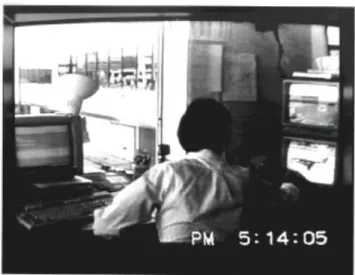
In this case, the work of inspecting for logical inconsistencies in time entries has been delegated to the machine, in a way that becomes for Rick a bit of ma-chine-support for the detection and repair of a routine error made at the key-board. Part of Rick's competence is his familiarity with this machine-based logic. But if we follow this line, it turns out that the work we’ve just watched isn’t a simple reporting on events at the gate at all, but a more subtle round of negotia-tion with a machine-based system of temporal accountability. So let’s look at that more closely (Fig. 4).
Fig. 4 – Interaction with the computer system
be-fore turning to a document beside his keyboard. At this juncture we get an in-quiry from the ethnographer who’s running the camera, regarding the sense of the work he’s just seen:
5:14:20 pm
Chuck: S’cuse me, Rick, what were you just doing there? You were getting some stuff from the computer and then you were jus-
Rick: Oh. Yea, this is our Tahoe trip, it is supposed to leave at 5:15 and it’ll be board-ing abou- a couple of minutes late. It is they’re startboard-ing right now which, we like to have, actually the engines running a couple of minutes before departure time. Chuck: Uh huh.
Rick: So I just (inaud) y’know and I check and just look at the screen and see, you know, how they hold out and if they close the door, they’re just starting the en-gines now, so
Chuck: Uh huh, uh huh.
Rick: Uh, I just want to make sure he stays on time.
So Rick's job is to maintain a consistent relation between an order of events prescribed via the schedule from the national center, and events at the local site.
Through his entries into the computer system, Rick must represent the site's adherence to the prescribed order – in this case, that the Tahoe trip is supposed to leave at 17:15 – while ensuring that his entries also have a reasonable corre-spondence to unfolding events observable by him through the video monitor and outside his window. In this instance he can see that the Tahoe flight is boarding a couple of minutes late: a situation he judges to be close enough to be recorded as on-time, but problematic enough to require continuous monitoring for signs of further delay. It is in that sense that Rick's work is, as he says, “to make sure [the pilot] stays on time”; that is, to maintain an acceptable relation between the on-time departure he’s just entered into the computer system, and the inevitable contingencies of an actual on time departure.
But his mediation goes further. By talking with Rick about his work we learn that the basis for his “estimated take off” time, which was 17:35 or twenty minutes from the “time out,” is not simply his observation of the work outside his window but his orientation to another discipline of time inscribed in the ma-chine. As Rick goes on to explain it, once he’s entered the time out of the gate for a particular plane a clock starts ticking within the system which, if a time off is not forthcoming within a specified interval, triggers an alert message. To forestall the alert message Rick can enter an estimated take off time, before which the sys-tem will not complain. He routinely enters that time as twenty minutes after the time out of the gate, giving him generally ample time to receive and enter the ac-tual time off from the pilot.
forits routine enactment, the management of the inevitable contingencies of actu-al events.
It is not that routines run off “automatically” (even, as we’ve seen, when they’re delegated to machines), but rather that routines are made to work through what Leigh Star (see Star and Strauss 1999) has identified as the general-ly invisible work of their enactment. Routines presuppose unremarkable acts of improvisation. The difference between routine and exceptional situations is not one of kind, in other words, but of degree, and is itself an effect of practices of boundary-making, of identification of what falls within, or outside, the bounds of the “normal” case.
In the original paper where I presented this analysis, I opened with Mike Lynch’s classic paper “The externalized retina” (1988), in which he examines the technology of diagrammatic images in the work of biology. Among the examples that he cites is the scientist's work of tracking the movement of lizards within a given habitat. He describes how an array of wooden stakes is driven into a plot of ground to form a grid, against which the movements of the lizards can be plotted. To distinguish a lizard within the habitat from its fellows and to aid in the pro-cess of tracking its movements, each lizard is assigned a unique identification number. Grid and numbers then provide the basis for a diagrammatic represen-tation of, and claims about, lizard behavior.
In the documentary practice of the life sciences, the diagram mathematizes and makes claims about the “nature” of objects. Through the impositions of the grid, lizards come to occupy territories with a graphically depictable shape, in much the same way that planes can be diagrammed as moving through time and across space within the orderly array of the airline schedule. In the case of the liz-ards, however – and this was the central point of my argument – their movement is taken by their observers to be independent of the tracking process; that is, to be a “natural” event of which the technology of the grid and its numbers simply provides a map. In airport operations, in contrast, the movement of planes is it-self coordinated within a process of which the schedule and its numbers are a part. Like the lizard diagram, the schedule represents a course of events as “co-ordinates” on a two-dimensional grid.
However, the work of the grid and its mathematizations is not to explicate the airplane’s properties, so much as to enjoin the plane and its personnel into a spe-cific course of practical action. It is in this sense that the airline schedule is a dis-ciplinary technology, in the Foucauldian sense (1979). More precisely, the sched-ule is a of technology of accountability, a device that is simultaneously a resource for participants in organizing their own activities, and a regime created else-where, to which their activities are accountable.
At the same time, my own ordering, like theirs, has placed outside the frame an open ended horizon of details, contingencies, and so forth that it presupposes, but doesn’t fully articulate. It is these that constitute mess in the Lawian sense (2004). Order and mess have of course colloquially been used as normative, eval-uative terms, a classic dualism with the first term privileged over the second. It is these politics that it is John’s project to challenge. Order and mess are mutually constitutive: order obscures mess; mess obscures the practices of ordering for which it is, in John’s terms, the necessary hinterland.
And just what is the practice here? If we take this as a sequence of work, where are its boundaries both spatially and temporally? I have drawn them for you here, of course, in the images that I have shown you, framed in particular ways, in the transcript, and in the story as I have told it. But we could of course redraw those boundaries, following connections out in various other directions – taking as our analytic focus the plane on the ramp, other relevant sites at the air-port like baggage handling, passenger service, the passengers themselves, the wider airline network, the larger day’s work or the airline’s longer history, the po-litical economies of transport regulation, climate change and so forth.
The point is that these objects, while arguably relevant to practitioners, are al-so analytic ones, of our making. I have made them here in a particular way, one which I could defend in relation to my practical and analytic purposes, but which I would also always want to recognize could be otherwise. These objects are, in short, part of a practice, my practice as a researcher and speaker here at this con-ference, talking to you now. Like all object making, the delineation of a practice is always and irremediably part of a practice that informs what constitute produc-tive and coherent units of analysis. It is that which makes us responsible and ac-countable for our research and its inclusions. And it is that which calls on us to be attentive to our own practice’s systematic and necessary exclusions, and re-spectful of its constitutive overflows.
Thank you.
References
Barad, K. (2007) Meeting the Universe Halfway: Quantum Physics and the Entan-glement of Matter and Meaning, Durham, North Carolina, Duke University Press.
Foucault, M. (1979) Discipline and Punish: The birth of the prison, New York, Vintage.
Latour, B. (1986) Visualization and Cognition: Thinking with Eyes and Hands, in “Knowledge and Society”, 6, pp. 1-40.
Latour, B. (1987) Science in Action: How to Follow Scientists and Engineers Through Society, Cambridge, Mass., Harvard University Press.
Law, J. (2004) After Method: Mess in Social Science Research, London and New York, Routledge.
Lynch, M. (1988) The Externalized Retina: Selection and Mathematization in the Visual Documentation of Objects in the Life Sciences, in “Human Studies”, 11, pp. 201-234.
Star, S.L. and Strauss, A. (1999) Layers of Silence, Arenas of Voice: The Ecology of Visible and Invisible Work, in “Computer Supported Cooperative Work” 8, pp. 9-30.
Suchman, L. (1993) Technologies of Accountability: On lizards and airplanes, in G. Button (ed), Technology in the Working Order, London, Routledge, pp. 113-126
Suchman, L. (1997) Centers of Coordination: A Case and Some Themes, in L.Resnick, B. Säljö, R. Pontecorvo and B. Burge (eds.), Discourse, Tools, and Reasoning: Essays on Situated Cognition, Berlin, Springer-Verlag, pp. 41-62. Yates, J.A. (1989) Control Through Communication: The Rise of System in
Ameri-can Management, Baltimore, Johns Hopkins.
Lucy Suchman Lancaster University Centre for Science Studies
Bowland College North