AN ATTEMPT AT AN ALGEBRAIC THEORY OF CRYSTAL
STRUCTURE. PART 4.
DAVID A ABOAV
29 Clements Road, Chorleywood, Hertfordshire, WD3 5JS, UK.
(Accepted July 18, 2000)
ABSTRACT
Since, for reasons to be examined in a later instalment of this work, the postulates of Euclid do not seem suited for the purpose, an attempt is made to classify regularities in the observed diffraction of X-rays by matter in the crystalline state on a ‘Pythagorean’, or purely numerical basis
Keywords: crystal structure, Yarmolyuk and Kripyakevich’s rule.
“I am quite satisfied if we have the machinery for making predictions, even if we are unable to understand it clearly” (Einstein, 1953).
INTRODUCTION
It has been shown that in some cases the number of polyhedra that go to make up the postulated unit cell of a crystal, and the number of the cell’s vertices, are proportional to the solutions of a simple Diophantine equation (Aboav, 1997; 1998a). These solutions do not describe the partition of the cell into its differently shaped polyhedra (Aboav, 1998b), though as we shall see in a moment a further numerical assumption makes such a description possible.
Relations depending on arithmetical operations, like the adding or multiplying of integers, will here be considered separately from those that depend on geometrical ones, such as the measurement of length and angle.
NUMERICAL
Pythagoras’s discovery that the interval of 7 octaves is roughly equal to that of 12 major ¿IWKV LH that 27~(3/2)12, or
2a
~
3b (1)where a = 19, b = 12, may be regarded as a borderline case (x = y = 1) of a more general approximation
2ax~3by (2)
where x and y in this instance are integers, one of which is prime, and the other is either prime, or the product of 5 (or 7) and a prime number.
A pair of composite numbers, m and n, are now
defined thus:
m = 2ax/27 (3)
and
n = 3by/36 (4)
Since these numbers are co-prime, m is not a multiple of n. Their ratio m/n, here denoted by A, is equal to (2ax/3by)(36/27). Hence, since 2ax~3by, A is approximately equal to 36/27, that is,
A~5· 7 (5)
The fraction 1–36m/27n, or 1–3by/2ax, which is a measure of how closely 2ax approximates 3by, is here
GHQRWHG E\ WKH *UHHN OHWWHU DQG FDOOHG WKH comma: = 1–36
n/27m (6)
[Note: In the above-quoted, celebrated instance of antiquity, where m and n are effectively put equal to 212 and 36 UHVSHFWLYHO\ __ = 1–312/219, or roughly 1/73. Known to musicians as the comma of
Pythagoras WKLV YDOXH RI UHSUHVHQWV WKH VPDOO EXW
perceptible interval between such notes as Dþ and C# played on a violin.]
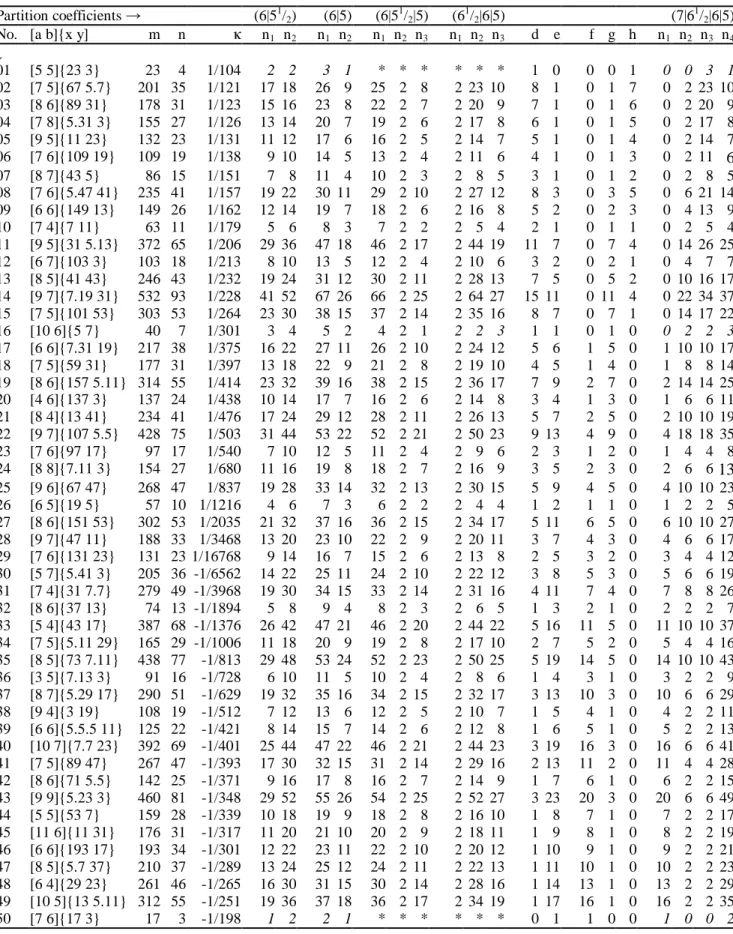
Table 1. Partition of numbers m n proportional to solutions of ‘Pythagorean’ approximation 2ax ~ 3by.
Partition coefficients : (6|51/2) (6|5) (6|51/2|5) (61/2|6|5) (7|61/2|6|5)
No. [a b]{x y] m n n1 n2 n1 n2 n1 n2 n3 n1 n2 n3 d e f g h n1 n2 n3 n4
;
01 [5 5]{23 3} 23 4 1/104 2 2 3 1 * * * * * * 1 0 0 0 1 0 0 3 1 02 [7 5]{67 5.7} 201 35 1/121 17 18 26 9 25 2 8 2 23 10 8 1 0 1 7 0 2 23 10 03 [8 6]{89 31} 178 31 1/123 15 16 23 8 22 2 7 2 20 9 7 1 0 1 6 0 2 20 9 04 [7 8]{5.31 3} 155 27 1/126 13 14 20 7 19 2 6 2 17 8 6 1 0 1 5 0 2 17 8 05 [9 5]{11 23} 132 23 1/131 11 12 17 6 16 2 5 2 14 7 5 1 0 1 4 0 2 14 7 06 [7 6]{109 19} 109 19 1/138 9 10 14 5 13 2 4 2 11 6 4 1 0 1 3 0 2 11 6
07 [8 7]{43 5} 86 15 1/151 7 8 11 4 10 2 3 2 8 5 3 1 0 1 2 0 2 8 5 08 [7 6]{5.47 41} 235 41 1/157 19 22 30 11 29 2 10 2 27 12 8 3 0 3 5 0 6 21 14 09 [6 6]{149 13} 149 26 1/162 12 14 19 7 18 2 6 2 16 8 5 2 0 2 3 0 4 13 9 10 [7 4]{7 11} 63 11 1/179 5 6 8 3 7 2 2 2 5 4 2 1 0 1 1 0 2 5 4 11 [9 5]{31 5.13} 372 65 1/206 29 36 47 18 46 2 17 2 44 19 11 7 0 7 4 0 14 26 25 12 [6 7]{103 3} 103 18 1/213 8 10 13 5 12 2 4 2 10 6 3 2 0 2 1 0 4 7 7 13 [8 5]{41 43} 246 43 1/232 19 24 31 12 30 2 11 2 28 13 7 5 0 5 2 0 10 16 17 14 [9 7]{7.19 31} 532 93 1/228 41 52 67 26 66 2 25 2 64 27 15 11 0 11 4 0 22 34 37 15 [7 5]{101 53} 303 53 1/264 23 30 38 15 37 2 14 2 35 16 8 7 0 7 1 0 14 17 22 16 [10 6]{5 7} 40 7 1/301 3 4 5 2 4 2 1 2 2 3 1 1 0 1 0 0 2 2 3 17 [6 6]{7.31 19} 217 38 1/375 16 22 27 11 26 2 10 2 24 12 5 6 1 5 0 1 10 10 17 18 [7 5]{59 31} 177 31 1/397 13 18 22 9 21 2 8 2 19 10 4 5 1 4 0 1 8 8 14 19 [8 6]{157 5.11} 314 55 1/414 23 32 39 16 38 2 15 2 36 17 7 9 2 7 0 2 14 14 25 20 [4 6]{137 3} 137 24 1/438 10 14 17 7 16 2 6 2 14 8 3 4 1 3 0 1 6 6 11 21 [8 4]{13 41} 234 41 1/476 17 24 29 12 28 2 11 2 26 13 5 7 2 5 0 2 10 10 19 22 [9 7]{107 5.5} 428 75 1/503 31 44 53 22 52 2 21 2 50 23 9 13 4 9 0 4 18 18 35 23 [7 6]{97 17} 97 17 1/540 7 10 12 5 11 2 4 2 9 6 2 3 1 2 0 1 4 4 8 24 [8 8]{7.11 3} 154 27 1/680 11 16 19 8 18 2 7 2 16 9 3 5 2 3 0 2 6 6 13
25 [9 6]{67 47} 268 47 1/837 19 28 33 14 32 2 13 2 30 15 5 9 4 5 0 4 10 10 23 26 [6 5]{19 5} 57 10 1/1216 4 6 7 3 6 2 2 2 4 4 1 2 1 1 0 1 2 2 5 27 [8 6]{151 53} 302 53 1/2035 21 32 37 16 36 2 15 2 34 17 5 11 6 5 0 6 10 10 27 28 [9 7]{47 11} 188 33 1/3468 13 20 23 10 22 2 9 2 20 11 3 7 4 3 0 4 6 6 17 29 [7 6]{131 23} 131 23 1/16768 9 14 16 7 15 2 6 2 13 8 2 5 3 2 0 3 4 4 12 30 [5 7]{5.41 3} 205 36 -1/6562 14 22 25 11 24 2 10 2 22 12 3 8 5 3 0 5 6 6 19 31 [7 4]{31 7.7} 279 49 -1/3968 19 30 34 15 33 2 14 2 31 16 4 11 7 4 0 7 8 8 26 32 [8 6]{37 13} 74 13 -1/1894 5 8 9 4 8 2 3 2 6 5 1 3 2 1 0 2 2 2 7 33 [5 4]{43 17} 387 68 -1/1376 26 42 47 21 46 2 20 2 44 22 5 16 11 5 0 11 10 10 37 34 [7 5]{5.11 29} 165 29 -1/1006 11 18 20 9 19 2 8 2 17 10 2 7 5 2 0 5 4 4 16 35 [8 5]{73 7.11} 438 77 -1/813 29 48 53 24 52 2 23 2 50 25 5 19 14 5 0 14 10 10 43 36 [3 5]{7.13 3} 91 16 -1/728 6 10 11 5 10 2 4 2 8 6 1 4 3 1 0 3 2 2 9 37 [8 7]{5.29 17} 290 51 -1/629 19 32 35 16 34 2 15 2 32 17 3 13 10 3 0 10 6 6 29 38 [9 4]{3 19} 108 19 -1/512 7 12 13 6 12 2 5 2 10 7 1 5 4 1 0 4 2 2 11 39 [6 6]{5.5.5 11} 125 22 -1/421 8 14 15 7 14 2 6 2 12 8 1 6 5 1 0 5 2 2 13 40 [10 7]{7.7 23} 392 69 -1/401 25 44 47 22 46 2 21 2 44 23 3 19 16 3 0 16 6 6 41 41 [7 5]{89 47} 267 47 -1/393 17 30 32 15 31 2 14 2 29 16 2 13 11 2 0 11 4 4 28 42 [8 6]{71 5.5} 142 25 -1/371 9 16 17 8 16 2 7 2 14 9 1 7 6 1 0 6 2 2 15 43 [9 9]{5.23 3} 460 81 -1/348 29 52 55 26 54 2 25 2 52 27 3 23 20 3 0 20 6 6 49 44 [5 5]{53 7} 159 28 -1/339 10 18 19 9 18 2 8 2 16 10 1 8 7 1 0 7 2 2 17 45 [11 6]{11 31} 176 31 -1/317 11 20 21 10 20 2 9 2 18 11 1 9 8 1 0 8 2 2 19 46 [6 6]{193 17} 193 34 -1/301 12 22 23 11 22 2 10 2 20 12 1 10 9 1 0 9 2 2 21 47 [8 5]{5.7 37} 210 37 -1/289 13 24 25 12 24 2 11 2 22 13 1 11 10 1 0 10 2 2 23 48 [6 4]{29 23} 261 46 -1/265 16 30 31 15 30 2 14 2 28 16 1 14 13 1 0 13 2 2 29 49 [10 5]{13 5.11} 312 55 -1/251 19 36 37 18 36 2 17 2 34 19 1 17 16 1 0 16 2 2 35 50 [7 6]{17 3} 17 3 -1/198 1 2 2 1 * * * * * * 0 1 1 0 0 1 0 0 2
Since by definition the comma cannot equal zero, relation (2) is necessarily approximate only. Exact
of positive integers ms and ns
m =
sms (7)and
n = sns (8)
such that 2ms is a multiple of ns for any value of s,
that is,
ms = Asns (9)
where As = p or (p+1/2), p being a positive integer.
The partitions depend on the chosen values of s and As; but the corresponding values of ns are in general
indeterminate.
Our attention is here confined to partitions for which s = 4, with the aim of determining whether, from among the solutions of Table 1, there exist partitions of that kind for which no value of ns is
greater than 3; and, if so, to express the partition of the remaining solutions in the table in terms of them, the underlying object being to base the sought-after partitions on the simplest possible assumptions. To that end the requisite partition coefficients are determined as follows.
n is first expressed as the sum of a pair of integers, n1 and n2 (col. 5), the chosen values of As
needed to express ms being those nearest to A (Eq. 5),
namely A1 = 6, and A2 = 51/2: [(6|51/2)]; while in col.
6 the next nearest pair of values, A1 = 6, and A2 = 5:
[(6|5)] is used for the same purpose. The immediate aim is to identify solutions of relation (2) for which no value of ns exceeds 3. As the data show, there are
in this case only two such solutions, namely [5 5]{23 3} and [7 6]{17 3}, listed in the table at Nos. 01 and 50, respectively, with their values of ns shown in italics.
Again with the aim of identifying solutions for which no value of ns exceeds 3, n is next expressed as
the sum of three integers n1, n2, n3 (cols. 7 and 8), the
values of As for col. 7 being the closest to those
already chosen, namely A1 = 6, A2 = 5 1
/2, and A3 = 5:
[(6|51/2|5)]; while for col.8 the values A1 = 6 1
/2,
A2 = 6, and A3 = 5: [(6 1
/2|6|5)] are chosen. With the
partition of n into three numbers in this way the values of ns are in general indeterminate. In the table
therefore, where lack of space does not allow more than one of the possible partitions to be shown, n2 in
col. 7, and n1 in col. 8, are given the same, arbitrarily
chosen value 2. It will be seen that for the partition (6|51/2|5) (col. 7) there are no solutions, and that for
the partition (61/2|6|5) (col. 8) there is only one
solution --- [10 6]{5 7}, listed at No.16 --- for which no value of ns is greater than 3.
Finally, by introducing the further, proximate coefficient, A1 = 7, into the partition (6
1
/2|6|5) of
col. 8, which as we have seen already possesses one of the required solutions, we obtain the partition (7|61/2|6|5), in which n is expressed as the sum of four
numbers n1, n2, n3, and n4. This partition has two
further solutions for which no value of ns is greater
than 3. The components (n1, n2, n3, n4) of the three
solutions, namely (0 0 3 1), (0 2 2 3) and (1 0 0 2), are listed in italics (Nos. 1, 16, 50) in the last column of Table 1.
These solutions enable the components of n for the remainder of the column to be expressed as sums of their products with positive integers f,g,h, which are functions of m and n only, thus:
(n1+n2+n3+n4) A f(1 0 0 2)+g(0 2 2 3)+h(0 0 3 1) (10)
so that the components of n on the left-hand side of this identity may be equated to the sum of the corresponding products on the right-hand side as follows:
n1 = f
n2 = 2g
(11) n3 = 2g+3h
n4 = 2f+3g+h.
Hence
m1 = 7f
m2 = 13g
m3 = 12g+18h
m4 = 10f+15g+5h;
so that
n = 3f+7g+4h
= 3u+4v, (12)
and
m = 17f+40g+23h
= 17u+23v, (13)
where u = (f+g) and v = (g+h). Hence g u and
g v. Moreover
m/n = (17u+23v)/(3u+4v) i.e.
u(3m-17n) = v(23n-4m) or
ud = ve (14)
where
d = (3m-17n), and
e = (23n-4m);
so that
d+2e = 29n-5m
= 2f+3g+h,
from which it follows that
n4 = 29n-5m. (15)
The choice of coefficients (7|61/2|6|5) thus makes
one of the four numbers ns, namely n4, independent of
the partition, the other three numbers, n1, n2, n3, being
in general indeterminate; though, as Eqs. (11) show, they are subject to the restrictions n1 < n4, and n2 n3.
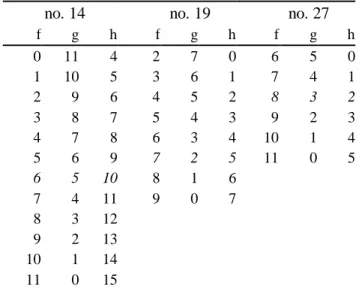
The following illustration, with Nos. 14, 19, and 27 taken as examples (Table 2), shows how the numbers d, e of Eq. (14), which are listed for each of the solutions of Table 1 (col. 9) facilitate the evaluation of f, g, h (col. 10).
Table 2. Some solutions for nos. 14, 19, 27 of Table 1.
no. 14 no. 19 no. 27
d 15 7 5
e 11 9 11
Eq(14) 15u = 11v 7u = 9v 5u = 11v Soln u = 11, v=15 u = 9,v = 7 u = 11, v = 5 f g h 0 11 4 2 7 0 6 5 0
Table 3. Complete solutions for nos. 14, 19, 27 of
Table 1.
no. 14 no. 19 no. 27
f g h f g h f g h
0 11 4 2 7 0 6 5 0
1 10 5 3 6 1 7 4 1
2 9 6 4 5 2 8 3 2
3 8 7 5 4 3 9 2 3
4 7 8 6 3 4 10 1 4
5 6 9 7 2 5 11 0 5
6 5 10 8 1 6
7 4 11 9 0 7
8 3 12 9 2 13 10 1 14 11 0 15
Whereas a single trio of numbers f, g, h as shown in the bottom line of Table 2 represents for these three examples a possible solution of the indeterminate equation (14), to obtain the complete solutions the trios with all possible values of g, in this case those
for which 0 g 1; 0 g 7; and 0 g 5,
respectively (Table 3), have to be taken into account. These solutions are set out in full in Table 3, beginning in each case with the trio for which g has its largest value, i.e. for which g = 11, 7, or 5, respectively, and f or h = 0. Since for lack of space not all values of f,
g, h like those shown in Table 3 can be included in Table 1, only those for which f and/or h = 0 are listed. From these numbers and Eq. (10) a required partition of n (col. 11) can be obtained for each entry in the table, thus realizing the first aim of this investigation.
There remains to be seen, however, whether such a purely numerical system can contribute to the setting up of an axiomatic framework on which to base an adequate description of Nature.
PHYSICAL
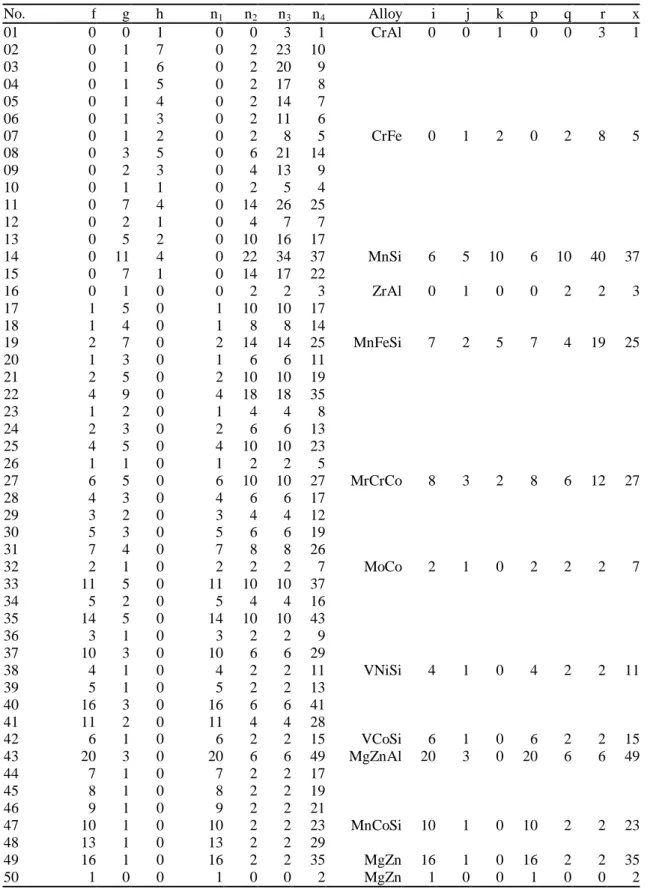
The aspect of Nature to be considered here is the behaviour of light (or, more generally, of radiation) in the presence of matter in the crystalline state, the example chosen being the scattering of X-rays by some tetrahedrally close-packed alloys of the transition metals. Shoemaker and Shoemaker (1986) listed experimental data for 20 such alloys, some metrical properties of whose crystal structure have already been considered (Aboav, 1998b). Our attention is now briefly directed to the topology of the structure.
In Table 4, cols 2 and 3 are the same as cols 10 and 11 of Table 1. In col. 4 are listed the alloys investigated by Shoemaker and Shoemaker, while p, q, r, x, the numbers of 16-, 15-, 14-, and 12-hedra (called P, Q, R, X, respectively) per unit cell of the alloys are given in col. 6.
For each of these unit cells Yarmolyuk and Kripyakevich (1974) found an empirical formula for PpQqRrXx expressible as
Pp Qq RrXx: (PX2)i(Q2R2X3)j(R3X)k (16)
where i, j, k, whose values for the alloys of Shoemaker and Shoemaker are listed in col. 5 of Table 4, are integers. This apparent restriction on the relative values of p q r x is here referred to as the rule
of Yarmolyuk and Kripyakevich. As the following
fact suggests, the rule being a numerical one may not require a geometrical explanation.
From the above table it will be seen that to each value of [i j k] there corresponds an identical value of [f g h], and to each value of [p q r x] an identical value of [n1 n2 n3 n4]. When these identical numbers
Table 4. Relation of numerical solutions of Table 1 to the crystal structure of some tetrahedrally close-packed
alloys (Shoemaker and Shoemaker, 1986).
No. f g h n1 n2 n3 n4 Alloy i j k p q r x
01 0 0 1 0 0 3 1 CrAl 0 0 1 0 0 3 1
02 0 1 7 0 2 23 10
03 0 1 6 0 2 20 9
04 0 1 5 0 2 17 8
05 0 1 4 0 2 14 7
06 0 1 3 0 2 11 6
07 0 1 2 0 2 8 5 CrFe 0 1 2 0 2 8 5
08 0 3 5 0 6 21 14
09 0 2 3 0 4 13 9
10 0 1 1 0 2 5 4
11 0 7 4 0 14 26 25
12 0 2 1 0 4 7 7
13 0 5 2 0 10 16 17
14 0 11 4 0 22 34 37 MnSi 6 5 10 6 10 40 37
15 0 7 1 0 14 17 22
16 0 1 0 0 2 2 3 ZrAl 0 1 0 0 2 2 3
17 1 5 0 1 10 10 17
18 1 4 0 1 8 8 14
19 2 7 0 2 14 14 25 MnFeSi 7 2 5 7 4 19 25
20 1 3 0 1 6 6 11
21 2 5 0 2 10 10 19
22 4 9 0 4 18 18 35
23 1 2 0 1 4 4 8
24 2 3 0 2 6 6 13
25 4 5 0 4 10 10 23
26 1 1 0 1 2 2 5
27 6 5 0 6 10 10 27 MrCrCo 8 3 2 8 6 12 27
28 4 3 0 4 6 6 17
29 3 2 0 3 4 4 12
30 5 3 0 5 6 6 19
31 7 4 0 7 8 8 26
32 2 1 0 2 2 2 7 MoCo 2 1 0 2 2 2 7
33 11 5 0 11 10 10 37
34 5 2 0 5 4 4 16
35 14 5 0 14 10 10 43
36 3 1 0 3 2 2 9
37 10 3 0 10 6 6 29
38 4 1 0 4 2 2 11 VNiSi 4 1 0 4 2 2 11
39 5 1 0 5 2 2 13
40 16 3 0 16 6 6 41
41 11 2 0 11 4 4 28
42 6 1 0 6 2 2 15 VCoSi 6 1 0 6 2 2 15
43 20 3 0 20 6 6 49 MgZnAl 20 3 0 20 6 6 49
44 7 1 0 7 2 2 17
45 8 1 0 8 2 2 19
46 9 1 0 9 2 2 21
47 10 1 0 10 2 2 23 MnCoSi 10 1 0 10 2 2 23
48 13 1 0 13 2 2 29
49 16 1 0 16 2 2 35 MgZn 16 1 0 16 2 2 35
50 1 0 0 1 0 0 2 MgZn 1 0 0 1 0 0 2
It is remarkable that, despite their different origin, relations (2) and (16) should furnish identical groups of numbers, either of which can be used to describe
play a seemingly essential part in our customary interpretation of the X-ray photograph of a crystal. A doubt therefore arises as to whether this phenomenon requires such notions for its description.
Such doubts are not new: indeed, a century-and-a-half has elapsed since Riemann (1854), recognizing that the rules of everyday geometry do not necessarily apply in cases where, as for example in Haüy’s (1784) ‘molecular’ picture of a crystal, the scale is so reduced that the notions of the solid body and the ray of light are no longer valid, expressed the opinion:
“...es ist also sehr wohl denkbar, dass die Massverhältnisse des Raumes im Unendlichkleinen den Voraussetzungen der Geometrie nicht gemäss sind, und dies würde man in der That annehmen müssen, sobald sich dadurch die Erscheinungen auf einfacherer Weise erklären liessen.” (Riemann, 1854).
(“….it is thus quite conceivable that relations of size on an infinitesimally small scale are not in accord with the postulates of geometry, and this one would indeed have to assume, as soon as it allowed the phenomena to be more simply accounted for.”)
This doubt, which haunts us still, is not easy to allay; for, in seeking to be rid of it, not only are we faced with the task of finding suitable assumptions to take the place of those laid down in the Elements, but history has left little or no trace of the discoveries and decisions known to have been made by Pythagoras and his successors in the 2 centuries before the
publication of that great work, discoveries and decisions which must have played no small part in determining the path Euclid was eventually to follow and which would help us immeasurably in our present task, could we but know what they were. All we can do, alas, is to guess what they may have been and try to reconstruct the route by which Euclid arrived at his assumptions, an undertaking we venture to hazard in the next instalment of this work.
(to be continued)
REFERENCES
Aboav DA (1997). An attempt at an algebraic theory of crystal structure. Acta Stereol.
Aboav DA (1997). An attempt at an algebraic theory of crystal structure. Acta Stereol, 16:41-53; 1998a. Aboav DA (1997). An attempt at an algebraic theory of
crystal structure. Acta Stereol, 17:113-22; 1998b Aboav DA (1997) An attempt at an algebraic theory of
crystal structure. Acta Stereol, 17:273-82.
Einstein A (1953). Letter to M Born dated December 3. Haüy R-J (1784). Essai d’une théorie sur la structure des
crystaux. Paris.
Riemann B (1854). Ueber die Hypothesen welche der Geometrie zu Grunde liegen. Göttingen.
Shoemaker DP and Shoemaker CB (1986). The relative number of atomic coordination types in tetrahedrally close packed metal structures. Acta Cryst B46:3-11. Yarmolyuk YP and Kripyakevich PI (1974). (Kristallografiya,