2007
A corpus-based study of mandative subjunctive
triggers in published research articles
Pamela Jo Pearson Iowa State University
Follow this and additional works at:https://lib.dr.iastate.edu/rtd
Part of theEnglish Language and Literature Commons,Linguistics Commons, and theRhetoric and Composition Commons
This Thesis is brought to you for free and open access by the Iowa State University Capstones, Theses and Dissertations at Iowa State University Digital Repository. It has been accepted for inclusion in Retrospective Theses and Dissertations by an authorized administrator of Iowa State University Digital Repository. For more information, please [email protected].
Recommended Citation
Pearson, Pamela Jo, "A corpus-based study of mandative subjunctive triggers in published research articles" (2007).Retrospective Theses and Dissertations. 14534.
by
Pamela Jo Pearson
A thesis submitted to the graduate faculty
in partial fulfillment of the requirements for the degree of
MASTER OF ARTS
Major: Teaching English as a Second Language/Applied Linguistics (English for Specific Purposes) and (Literacy in English as a Second Language)
Program of Study Committee: Viviana Cortes, Major Professor
Barbara Schwarte Dawn Bratsch-Prince
Iowa State University
Ames, Iowa
2007
1443067 2007
UMI Microform Copyright
All rights reserved. This microform edition is protected against unauthorized copying under Title 17, United States Code.
ProQuest Information and Learning Company 300 North Zeeb Road
P.O. Box 1346
Ann Arbor, MI 48106-1346
TABLE OF CONTENTS
LIST OF TABLES………iv
LIST OF FIGURES……….………..v
LIST OF ACRONYMS AND ABBREVIATIONS………..……….……….vii
ABSTRACT………..………...…..viii
CHAPTER 1: INTRODUCTION…………...……….……….1
CHAPTER 2: LITERATURE REVIEW……….…...…………..………4
2.1. The Subjunctive………...………..………….4
2.2.The Mandative Subjunctive...………..…….………...6
2.3. Corpus Linguistics………..………8
2.4. A Corpus-Based Approach to Grammar……….9
2.5. Previous Corpus-Based Investigations of the Mandative Subjunctive...9
CHAPTER 3: METHODOLOGY………..……12
3.1. The Corpus………12
3.2. The Concordancing Program………13
3.3. Procedures……….…....15
3.3.1. Preliminary Analysis: Frequency………...15
3.3.2. Secondary Analysis: Form……….………...…....16
3.3.3. Tertiary Analysis: Pattern………...………..………..….……….17
3.3.4. Quaternary Analysis: Structure..………...…....19
3.3.5. Quinary Analysis: Function...………...19
CHAPTER 4: RESULTS………...……….………...……...22
4.1. Preliminary Analysis: Frequency………...…..22
4.2. Secondary Analysis: Form……….………..24
4.3. Tertiary Analysis: Pattern………..………..………...….28
4.4. Quaternary Analysis: Structure.………...35
4.5. Quinary Analysis: Function...………...………...36
CHAPTER 5: DISCUSSION AND CONCLUSIONS………...……....41
5.1. Summary of the Results………...41
5.2. Interpretations………...……....42
5.3. Pedagogical Implications and Applications………...……...45
5.4. Limitations………...……….46
5.5. Suggestions for Further Research………...………..47
APPENDIX A: List of Realizations of the Lexical Items and their
Frequencies in the ISURAC……….51
APPENDIX B: Instances of Co-occurrences Compared: With and
without That-clauses…….……….…..52
APPENDIX C: Complete Listing of Occurrences of Mandative
Subjunctive Structures in the ISURAC……..……….……….54
REFERENCES………...…….60
LIST OF TABLES
Table 2.1: An Overview of the Subjunctive in English Grammars……….…….5
Table 3.1: The Iowa State University Research Article Corpus (ISURAC) by Discipline and Word Count…………...……….………12
Table 3.2: Composition of the Sub-Corpus/Sub-Corpora……….……..………13
Table 3.3: Summary of the Data Analysis Procedures………...……....21
Table 4.1: Preliminary Concordance Results: Unanalyzed Strings…….………..22
Table 4.2: Preliminary Concordance Results Less Extraneous Uses………..…….. 23
Table 4.3: Five Most Frequent Realizations of the Lexical Items in the ISURAC………...…….24
Table 4.4: Frequency Distributions of the Lexical Items as Verb Constituents……...……..27
Table 4.5: Instances and Percentage of That-clause Co-occurrence by Lexical Item……….………28
Table 4.6: Distributions of the Grammatical Pattern of the That-Complement Clause……….29
Table 4.7: Distributions of the Grammatical Pattern of Zero That-Complement Clauses………..……….34
Table 4.8: Structural Analysis: Verb Forms of Main Clauses and Complement Clauses………..……….35
LIST OF FIGURES
Figure 3.1: Sample Concordance Return for require in the Biology
Sub-corpus……...14
Figure 3.2: Sample Concordance Return for requir* in the Biology Sub-corpus………...15
Figure 3.3: Frequency of Lexical Items as Verbs in the ISURAC………...……...17
Figure 3.4: Taxonomy for Classifying Verb Form in the That-Complement Clause……….…19
Figure 3.5: Taxonomy for Classifying the Function of MS and Non-MS Structures……….………...….…20
Figure 4.1: ask……….………25
Figure 4.2: demand……….………...…..25
Figure 4.3: direct……….………25
Figure 4.4: insist……….………25
Figure 4.5: order……….………25
Figure 4.6: propose……….………25
Figure 4.7: recommend………...……26
Figure 4.8: request………..…………26
Figure 4.9: require………..………...…….26
Figure 4.10: suggest………26
Figure 4.11: Frequency of Lexical Items as Verbs in the ISURAC………...27
Figure 4.12: That-clause Co-occurrence vs. Non-co-occurrence by Lexical Item……...…..29
Figure 4.13: Percentages of Structures Triggered by Lexical Item………...…….31
Figure 4.15: Function of MS Structures in Biology………..………..………...37
Figure 4.16: Function of MS Structures in Business……….…….38
Figure 4.17: Function of MS Structures in Electrical Engineering…………..………..…....38
Figure 4.18: Functional Analysis of MS Structures: Proposed
Course of Action……….……….39
LIST OF ACRONYMS AND ABBREVIATIONS
AmE American English
AL Applied linguistics
BrE British English
DDL Data-driven learning
EAP English for academic purposes
ISURAC Iowa State University Research Article Corpus
KWIC Key word in context
MS Mandative subjunctive
MST Mandative subjunctive trigger
SLA Second language acquisition
Ani Sci Animal Science
App Ling Applied Linguistics
Arch Architecture
Art & Des Art and Design
Bio Biology
Bus Business
Econ Economics
Elec Eng Electrical and Computer Engineering Mat Eng Materials and Civil Engineering Phys & Ast Physics and Astronomy
Stat Statistics
Inf Infinitive
Ing -ing clause
M aux Modal auxiliary
Non-subj Non-subjunctive
Pass Passive
P aux Primary auxiliary
Perf Perfect
ABSTRACT
This corpus-based investigation of the mandative subjunctive (MS) (Quirk &
Greenbaum, 1973) explored the structure as it co-occurred in published research articles with 10 lexical items previously identified as MS triggers (Overgaard, 1995; Peters, 1998;
Crawford & Albakry, 2004): ask, demand, direct, insist, order, propose, recommend, request, require and suggest. Through a variety of quantitative (frequency, form and pattern) and qualitative (function) analyses, the present study examined the use of these lexical items in a corpus of published research articles ( 1.75 million words) by authors in four academic disciplines (Applied Linguistics, Biology, Business and Electrical & Computer Engineering) with the purpose of identifying the discourse factors that contribute to the triggering of the MS structure in academic writing as its main objective.
Results of the quantitative analyses revealed that when functioning as verbs, the majority of these lexical items infrequently co-occurred with that-clauses in the corpus; and, of the 1337 instances that did co-occur with a that-clause, only 50 (3.74%) contained a subjunctive verb form. In the qualitative analysis, 24 of the MS structures (48%) were found to be used to call for a particular action (Peters, 2004) or propose a potential course of action (Biber et al., 1999); one significant exception was require, which co-occurred with an MS structure 17 times (34% of the total instances) to report a necessary condition.
The findings of this study indicate that use of these lexical items does not alone trigger the mandative subjunctive in that-complement clauses in academic writing; rather, the factors involved in triggering the structure were determined to be multiple and complex. Thus, although the structure does indeed co-occur with certain verbs, this study has found the rules governing the triggering of the MS structure to be unpredictable.
Therefore, explicit teaching of the MS structure is not recommended. However, students in an upper level EAP course (those already familiar with advanced English grammar and the conventions of published research articles) could benefit from
consciousness-raising activities to “discover” the MS structure and its use(s) for the purpose of awareness and comprehension of the structure in academic writing, and not necessarily production.
CHAPTER 1: INTRODUCTION
For more than a century, linguists have reported that the subjunctive is disappearing from the English language (Ramsey, 1892; Krapp, 1908; Fowler, 1926; Vallins, 1956; Strang, 1962), describing it with terms like ‘archaic’, ‘moribund’, ‘fossilized’, ‘nearly extinct’ or ‘nearly perished’. In fact, “the statement that the English subjunctive is dying has been made so often and by so many that it has come to be generally accepted and has been handed down from one generation of grammarians to another” (Jacobsson, 1975, p. 219).
Some grammarians have downplayed the importance of the feature (Quirk,
Greenbaum, Leech & Svartvik, 1972), while others have pointed to the rarity of the structure in present-day English (Biber, Conrad & Leech, 2002; Peters, 2004). Still, the subjunctive has featured quite widely in the literature of the past century, although many of the claims made about it have been based on intuition rather than on empirical evidence.
Now that corpus linguistics technology is readily available, however, it is possible to explore “rare” linguistic features—like the subjunctive—in large collections of text, and thereby gather the empirical evidence needed to make more descriptive claims about their existence in the language than ‘moribund’ or ‘nearly extinct’.
The current investigation uses a corpus-based approach to grammar to explore one aspect of the subjunctive: the mandative subjunctive, a structure occurring in
that-complement clauses, recognizable for its display of the base form of a verb (where subject-verb concord would normally be expected), as in this sample extracted from the Business sub-corpus used in this study:
... potentially serious problem, some analysts have recommended the use of premium-priced stock option plans or indexed options. For example, Rappaport proposes that exercise prices be fixed at a premium above the market price on the date options are granted. He suggests that ... (Bus)
The mandative subjunctive is often described in the literature as being “triggered” by certain verbs, nouns and adjectives (those expressing demand, necessity, obligation, etc.), such as propose in the sample above. These mandative subjunctive triggers (MSTs) have been identified through the previous corpus-based studies of Overgaard (1995), Peters (1998), and
Crawford and Albakry (2004)—10 of which were common to the findings of all three of the studies and are thus the focus for this investigation: ask, demand, direct, insist, order, propose, recommend, request, require and suggest.
While the purpose of this study is to add to what is already known about MSTs and the mandative subjunctive, it approaches the topic in a way previous research has yet to do: instead of using corpus linguistics methodology to first locate mandative subjunctive
structures in subordinate clauses, then reverting back to the main clause to identify the lexical items that trigger them (as Overgaard, Peters and Crawford & Albakry have done), the
present study first locates the 10 MSTs in main clauses and then examines the context subsequent to them. Hence, the aim of this study is not to simply identify the triggers of the mandative subjunctive structure but to understand the functions of these 10 lexical items and identify the factors that contribute to the triggering/non-triggering of the mandative
subjunctive structure in academic writing.
More generally, this study was designed to 1) characterize the mandative subjunctive in the English of contemporary research articles, providing evidence to either support or refute its disappearance from them; 2) determine the role of the mandative subjunctive in academic writing (specifically, the research article), and establish whether prescriptive rules governing its usage indeed match its actual use; and 3) demonstrate how the investigation of actual language use (grammar in context) might inform the teaching of English as a
second/foreign language.
The following research questions guided this investigation:
1. What are the frequency distributions of ask, demand, direct, insist, order, propose, recommend, request, require and suggest in the Iowa State University Research Article Corpus?
2. Are ask, demand, direct, insist, order, propose, recommend, request, require and suggest manifested strictly as lexical verbs in the corpus? If not, which other word classes do they represent?
3. When these items function as lexical verbs, do they always co-occur with that-clauses and subjunctive verb forms in actual use in academic writing;
in other words, do ask, demand, direct, insist, order, propose, recommend, request, require and suggest “trigger” the mandative subjunctive? If not, with what other structures do they co-occur?
4. Is there a correlation between the form of the trigger in the main clause and the grammatical structure of the that-complement clause?
5. What is the function of structures identified as mandative subjunctives? What is the function of structures identified as non-mandative
subjunctives? Are there any significant differences in use of the mandative subjunctive structure across disciplines?
In order to accomplish the objectives set forth here in this introductory chapter, the remainder of the study is arranged as follows: Chapter 2 defines the subjunctive and its mandative use, presents the theoretical framework for this investigation, and summarizes the work previously done in this area. Chapter 3 describes in detail the data (the corpus) and procedures for data analysis (quantitative and qualitative methods) used to answer the research questions. Chapter 4 presents the results of the analyses and provides evidence through examples of each finding. Chapter 5 discusses the results, offering interpretations and pedagogical implications and applications of findings; the fifth chapter also addresses the limitations of the present study and suggests directions for further research.
CHAPTER 2: LITERATURE REVIEW
This chapter will treat the subjunctive and its mandative use in greater depth, situating them within the applied linguistics literature of the past century; it will also 1) present the theoretical framework for the current investigation, and 2) review the relatively few relevant studies that have been conducted into the use of the mandative subjunctive structure to date.
2.1. The Subjunctive
A definition of “the subjunctive” isn’t easily procured, as there has traditionally been considerable disagreement among grammarians about its features and functions: some have called it an idea or a mood, others a tense, and still others a form. Cannon (1959) recognizes the difficulty in arriving at consensus when attempting to define the subjunctive: “the person who would attempt to define the subjunctive mood wholly in notional or in formal terms is on the horns of a dilemma, for the mood successfully resists definition if either of these two approaches is used to the exclusion of the other” (p. 11).
Curme (1947) offers the broadest definition, claiming that the subjunctive is an idea, which “has never been associated with a particular form, but has always been expressed by a variety of means” (Jacobsson, 1975, p. 219), and classifying it into two uses: “the optative subjunctive, which represents the utterance as something desired or planned, and the potential subjunctive, which represents the statement, not as an actual fact, but only as a conception of the mind” (1947, p. 234).
According to Poutsma (1922), the subjunctive is a mood, “a form of the finite verb, or verb-group, by means of which the speaker expresses his mental attitude towards fulfillment of the action or state expressed by the predicate” (p. 1). Cannon concurs, adding that “if the attitude is one of uncertainty, nonfulfillment, unreality, improbability, or impossibility, most grammarians would recommend the use of the subjunctive mood” (1959, p. 11).
Quirk, Greenbaum, Leech and Svartvik have also called it a mood, suggesting, however, that there are two forms, “traditionally called the present and past subjunctive, although the distinction relates more to mood than to tense” (1990, p. 43), and defining the present subjunctive as a structure “used in that-clauses…even if the matrix verb is past, after
verbs, adjectives or nouns that express a necessity, plan or intention for the future” (p. 294). This definition extended on a previous claim made by Quirk and Greenbaum that “mood is expressed in English to a very minor extent by the subjunctive” (1973a, p. 51).
Biber, Conrad and Leech focus more on form in their definition of the subjunctive in the glossary of the student version of the Longman Grammar: “the form of a finite verb that is sometimes used in hypothetical or non-factual cases…The subjunctive is rarely used in English” (2002, p. 460). The text handles the topic in a section on “Subjunctive verbs in dependent clauses,” where its structure is explicitly defined, though its use and function are not:
“[It] is the base form of the verb, used where the s-form of the verb would occur normally. It occurs in special kinds of finite dependent clauses, particularly in some
that complement clauses and occasionally in some adverbial clauses… With regular
verbs, the present subjunctive is recognizable only with a singular subject. The past subjunctive is restricted to the form were used in the singular, usually to express unreal or hypothetical meaning” (p. 261).
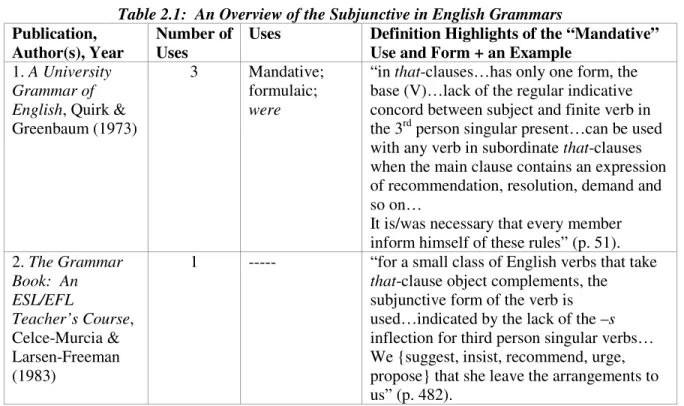
Suffice it to say that defining the subjunctive is no simple task: for over a century, it has not only been described in the literature with much inconsistency (see Table 2.1), but it appears to have generated a lot of debate in linguistic circles, as well.
Table 2.1: An Overview of the Subjunctive in English Grammars Publication,
Author(s), Year
Number of Uses
Uses Definition Highlights of the “Mandative”
Use and Form + an Example
1. A University
Grammar of English, Quirk &
Greenbaum (1973)
3 Mandative; formulaic;
were
“in that-clauses…has only one form, the base (V)…lack of the regular indicative concord between subject and finite verb in the 3rdperson singular present…can be used with any verb in subordinate that-clauses when the main clause contains an expression of recommendation, resolution, demand and so on…
It is/was necessary that every member inform himself of these rules” (p. 51). 2. The Grammar
Book: An ESL/EFL Teacher’s Course, Celce-Murcia & Larsen-Freeman (1983)
1 --- “for a small class of English verbs that take
that-clause object complements, the
subjunctive form of the verb is used…indicated by the lack of the –s inflection for third person singular verbs… We {suggest, insist, recommend, urge, propose} that she leave the arrangements to us” (p. 482).
Table 2.1: An Overview of the Subjunctive in English Grammars (cont’d)
3. The Longman
Grammar of Spoken and Written English,
Biber, Johansson, Leech, Conrad & Finegan (1999). 5 Subjunctive “forms;” communication verbs; necessity or importance adjectives; special cases of inversion (formulaic); exclamations (expletives)
“subjunctive forms, which are possible in certain finite dependent clauses, do not show subject-verb concord…
I told her she could stay with me until she found a place, but she insisted that she pay her own way (FICT)” (emphasis in original,
p. 180).
“some communication verbs can be used with a that-clause to propose a potential course of action (rather than report information…
We ask that this food be blessed (CONV)”
(emphasis in original, p. 667).
“necessity or importance adjectives also control extraposed that-clauses…reflect[] the writer’s belief that a proposed course of action is essential or important…most common in academic prose…
It is important that it be well sealed from air leakage (ACAD)” (emphasis in original, p.
674). 4. The Cambridge
Guide to English Usage, Peters (2004) 3 Mandative; “unreal” or impossible conditions; formulaic
“the kind of construction that calls for a particular action…use the present forms of the subjunctive…often only detectable in the third person singular…can be prefaced by any one of a number of verbs including:
advise, ask, beg, demand, desire, direct, insist, move, order, propose, recommend, request, require, stipulate, suggest, urge…appears in positive and negative
constructions…primarily associated with formal style…
They recommended that he present hard evidence for the claim” (emphasis in
original, p. 520).
2.2. The Mandative Subjunctive
As previewed in the table above, one “surviving use” (Peters, 2004, p. 520) of the subjunctive is the mandative subjunctive, which is triggered by a class of verbs known as mandatives (Quirk & Greenbaum, 1973a, 1973b, 1990; Peters, 2004), suasives (Nichols, 1987; Crawford & Albakry, 2004) or indirect-discourse imperatives (Jacobsson, 1975), such as demand, insist, recommend, require and suggest. The right-hand column of Table 2.1 summarizes the mandative use and form, and provides examples of it as featured in
well-known English grammars from each of the past four decades; it shows that while some differences in terminology to express the mandative subjunctive exist, unlike the general subjunctive, it seems there is more agreement than not regarding both its function and form.
The function of mandative subjunctives appears to be closely related to that of imperatives—Jacobsson admits that “it is sometimes difficult to keep them apart” (1975, p. 220), which is logical, given that the term ‘mandative’ derives from mandate, meaning ‘command’. According to the information contained in English grammar handbooks, this construction is used to “call for a particular action” (Peters, 2004, p. 520) or to “propose a potential course of action (rather than report information)” (Biber et al., 1999, p. 667), if the “main clause contains an expression of recommendation, resolution, demand and so on” (Quirk & Greenbaum, 1973, p. 51), thus conveying a force similar to that of a command.
The definition of the form of mandative subjunctives in English grammars generally involves: 1)a main verb trigger: “for a small class of English verbs” (Celce-Murcia & Larsen-Freeman, 1983, p. 482), “some communication verbs” (Biber et al., 1999, p. 667), “prefaced by any one of a number of verbs including: advise, ask, beg, demand, desire, direct, insist, move, order, propose, recommend, request, require, stipulate, suggest, urge” (Peters, 2004, p. 520); 2)a that-clause: “in subordinate that-clauses” (Quirk & Greenbaum, 1973, p. 51), “that-clause object complements” (Celce-Murcia & Larsen-Freeman, 1983, p. 482), “possible in certain finite dependent clauses” (Biber et al., 1999, p. 180), “used with a that-clause” (p. 667); and 3)a subjunctive verb form: “has only one form, the base (V)…lack of the regular indicative concord between subject and finite verb in the 3rdperson singular present” (Quirk & Greenbaum, 1973, p. 51), “indicated by the lack of the –s inflection for third person singular verbs” (Celce-Murcia & Larsen-Freeman, 1983, p. 482), “do not show subject-verb concord” (Biber et al., 1999, p. 180), and “often only detectable in the third person singular” (Peters, 2004, p. 520).
At present, apart from mostly prescriptive information in grammar books, little has been written on the mandative subjunctive. Of the few studies that do exist, most are corpus-based and will be discussed at the end of this chapter after an orientation to the corpus-corpus-based methodology and approach to grammar used in both them and the present study.
One non-corpus-based study on the use of the “suasive” subjunctive was conducted by Nichols (1987), who explored student preference for complements following mandative subjunctive triggers (e.g., importance adjectives, request verbs) through a modified cloze test. She found that students in Freshman Composition at Winona State University, including some classified as ‘semiliterate’, tended to provide subjunctive forms following request verbs: 70% of the responses after the prompt suggesting that were subjunctive, 18% modal and 0% infinitive; 53% after asked that were subjunctive, 30% modal and 0% infinitive; order, unaccompanied by that, produced 7% subjunctive forms, 14% modal and 72% infinitive, as in ordered him to (p. 143).
Nichols then substantiated her findings by replicating the study at two other academic institutions: Western Illinois University and Duke University. Similar results were found, leading Nichols to conclude that “the suasive subjunctive, at least, still flourishes, and students classified asREMEDIALuse it appropriately” (emphasis in original, p. 150).
2.3. Corpus Linguistics
“In the language sciences a corpus is a body of written text or transcribed speech which can serve as a basis for linguistic analysis and description. Over the last three decades the compilation and analysis of corpora stored in computerized databases has led to a new scholarly enterprise known as corpus linguistics” (Kennedy, 1998, p. 1).
Corpus linguistics makes use of technology to process and describe (usually very large quantities of) naturally-occurring language:
“The unifying characteristics of corpus-based research include the use of a large, representative electronic database of spoken or written texts, or both (the corpus), and the use of computer-assisted analysis techniques (Biber & Conrad, 2001, p. 331). “Corpus linguistics technology requires a computer that can store a collection of text files (the corpus) and then apply software to those files to produce frequency lists, lists of key words, and most importantly, strings of words showing which words co-occur (or collocate) with others” (emphasis in original, Simpson & Swales, 2001, p. 1).
While data retrieved using the technology of corpus linguistics may be seen by some as “objective evidence” (Sinclair, 1991, p. 1), the undisputed advantage of a corpus-based approach to language is its emphasis on describing actual language use: “the most important
achievement of corpus linguistics is undoubtedly that it has put the use of language at the centre of linguistics” (Aijmer & Altenberg, 2004, p. 1). In any case, corpus linguistics is “not an end in itself but is one source of evidence for improving descriptions of the structure and use of languages, and for various applications, including…understanding how to learn or teach a language” (Kennedy, 1998, p. 1).
2.4. A Corpus-Based Approach to Grammar
A corpus-based approach to grammar focuses on describing language “based on the patterns of structure and use found in a large collection of spoken and written texts, stored electronically, and searchable by a computer” (Biber et al., 1999, p. 4), patterns that are “otherwise impossible to ascertain” without the quantitative analyses characteristic of this kind of approach (Biber & Conrad, 2001, p. 332).
Since the quantitative analyses of a corpus-based approach provide natural examples of words or grammatical features in context, several researchers have pointed to the benefits of using corpus-based techniques to examine the co-occurrence of lexis and grammar, “lexicogrammar” (Biber & Conrad, 2001; Biber, Conrad & Reppen, 1998) or “lexical grammar” (Sinclair, 2004). Biber and Conrad (2001) assert that with a corpus-based study, “researchers can analyze associations between grammatical features and lexical items” (p. 334), adding that lexicogrammar “show[s] how related grammatical constructions tend to be used with different sets of words” (p. 335).
2.5. Previous Corpus-Based Investigations of the Mandative Subjunctive
Several researchers have previously used corpus-based methodologies to investigate the mandative subjunctive (Johansson & Norheim, 1988; Overgaard, 1995; Peters, 1998; Crawford & Albakry, 2004).
Johansson and Norheim (1988) compared the frequency of the mandative subjunctive to the modal paraphrase should following “mandative governing verbs” in two, million-word corpora, the American Brown Corpus (Francis & Kucera, 1979) and the British LOB Corpus (Johansson et al., 1985). They found that in the Brown Corpus, the subjunctive was used 116 times, compared to 14 times in the LOB Corpus; should was used 19 times in the Brown
Corpus, as opposed to 97 times in the LOB Corpus (p. 29). To Johansson and Norheim, this confirmed the general view that “the mandative subjunctive is more common in American English, while British English prefers the should construction” (p. 28).
Similarly, Overgaard (1995) examined the use of the mandative subjunctive in American and British English; however, her study traces the structure’s use diachronically (throughout the 20thcentury), as triggered by both verbs and nouns. Using corpora
representing the two varieties of English at five given points during the 1900’s, Overgaard determined that “in the course of the last hundred years the drift [“the unidirectional change leading to the possible elimination of the non-inflected subjunctive”] has been reversed in both AmE and BrE, though at a different pace and at different times and for different reasons” (p. 89).
Peters (1998) explored the preference for the subjunctive and subjunctive paraphrases (e.g., modals, quasi-modals) following suasive verbs in the ACE (Australian Corpus of English, 1986), a million-word corpus of written text. She found that the subjunctive count (78) was higher than the paraphrase count (36), and that the modal paraphrase should was the most common alternative to the mandative structure (29). Peters compared her findings to those of Johansson and Norheim (1988), and noted that the mandative subjunctive
construction was still most frequent in American English but that the Australian totals “show it to be quite resilient in comparison with the earlier British data from the LOB” (p. 98).
Crawford and Albakry (2004) examined the marked mandative subjunctive as triggered by verbs, nouns and adjectives in two corpora of US news writing: 1) the
Associated Press sub-corpus of the Longman Grammar of Spoken and Written English (two million words), and 2) a smaller, local corpus collected from newspapers in Arizona (500,000 words). After normalizing their findings to 1,000,000 words, they found that verbs were the strongest triggers of the marked mandative subjunctive (197 instances), followed by nouns (39) and adjectives (11). Crawford and Albakry were able to identify seven “triggers” of the marked mandative subjunctive (those that “resulted in the subjunctive at least 10
times/million words” (p. 4)): demand (57), recommend (30), ask (20), insist (18), propose (18), suggest (15), and request (10).
The following corpus-based, lexicogrammatical investigation of MSTs took the definitions, approaches to grammar and findings of previous research presented here in this review of literature, and used them as the foundation on which to base the remainder of this study.
CHAPTER 3: METHODOLOGY
In order to begin this investigation, verbs normally co-occurring with mandative subjunctive structures—mandative subjunctive triggers (MSTs)—had to be identified. The following lexical items were selected for analysis, as they were found to be the 10 most frequently appearing verbs triggering the mandative subjunctive common to the work of Overgaard (1995), Peters (1998, 2004) and Crawford and Albakry (2004): ask, demand, direct, insist, order, propose, recommend, request, require and suggest. Once the MSTs were identified, they then had to be located in the corpus for analysis.
3.1. The Corpus
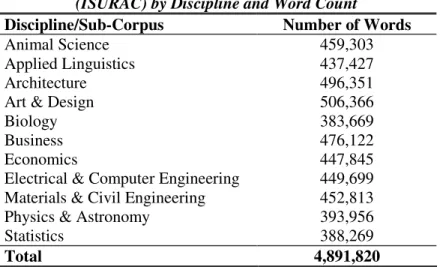
The collection of texts used to carry out this study was the Iowa State University Research Article Corpus (ISURAC), a compilation of published research articles from 11 different academic disciplines (Cortes, 2006). The articles from each discipline form a sub-corpus, resulting in 11 discipline-specific sub-corpora, which range from 383,669 to 506,366 (mean = 444,711) words for a total of nearly 5,000,000 words of written text in all (see Table 3.1 for disciplines and word counts). The sub-corpora sample between two and six online journals identified by academics at Iowa State University as writing that could be considered exemplary within their fields. Articles were collected in reverse chronological order,
beginning with those published in 2004 and dating back no further than 2001.
Table 3.1: The Iowa State University Research Article Corpus (ISURAC) by Discipline and Word Count
Discipline/Sub-Corpus Number of Words
Animal Science 459,303
Applied Linguistics 437,427
Architecture 496,351
Art & Design 506,366
Biology 383,669
Business 476,122
Economics 447,845
Electrical & Computer Engineering 449,699 Materials & Civil Engineering 452,813
Physics & Astronomy 393,956
Statistics 388,269
The ISURAC was selected as the corpus for this investigation of MSTs based on 1) existing claims (i.e., Quirk & Greenbaum, 1973b) that “the use of this subjunctive [the mandative] occurs chiefly in formal style” (p. 51), and 2) corpus availability. Moreover, written texts were desired in order to be able to compare the present study’s findings with those of previous research on MSTs in written English, such as Johansson and Norheim (1988), Overgaard (1995), Peters (1998), and Crawford and Albakry (2004).
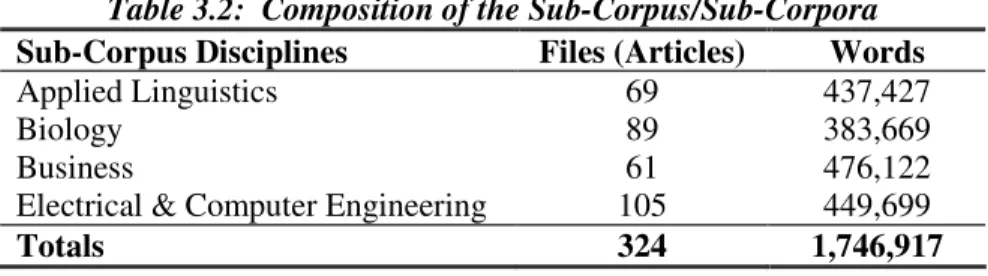
Although the ISURAC in its entirety was used for the initial analyses of the present investigation, it was narrowed to a sub-corpus consisting of research articles from only four disciplines to conduct the later analyses. Specifically, 69 articles, or files, in Applied Linguistics, 89 in Biology, 61 in Business and 105 in Electrical and Computer Engineering comprised the sub-corpus to represent 1,750,000 (mean = 436,729) words of academic prose. (Incidentally, as comparison of the structure across these four disciplines was only a
secondary objective of this study, no normalization for corpora of differing sizes was performed.) Table 3.2 below offers a description of the sub-corpus.
Table 3.2: Composition of the Sub-Corpus/Sub-Corpora
Sub-Corpus Disciplines Files (Articles) Words
Applied Linguistics 69 437,427
Biology 89 383,669
Business 61 476,122
Electrical & Computer Engineering 105 449,699
Totals 324 1,746,917
3.2. The Concordancing Program
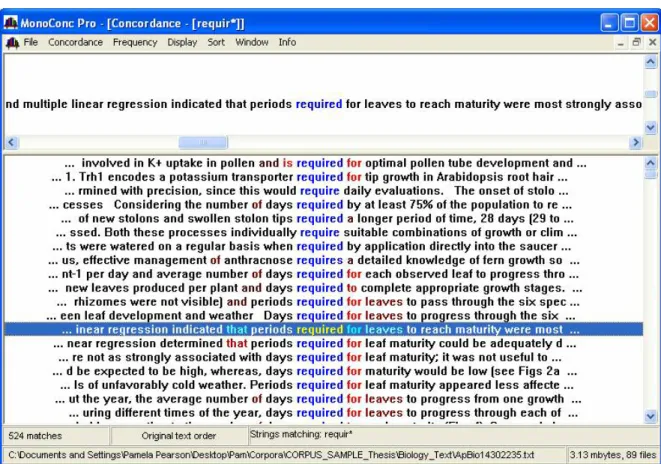
The first step in investigating mandative subjunctive triggers in context was to locate them in the corpus. To facilitate the search for each and every instance of the 10 MSTs in almost 1.75 million words of text, a commercially available computer concordancing program was employed: MonoConc Pro 2.2 (Barlow, 2004). MP2.2 is software that reads electronic text, allowing the user to search for a key word in context with a high degree of reliability. Figure 3.1 shows a sample concordance return for the search term require in the Biology sub-corpus.
Because lexemes, instances of the lexical item in all its linguistic variants (i.e., require, requires, required, requiring) were desired for analysis, it was necessary to structure each concordance in a way so as to capture the sum of the data (forms) and not simply one-to-one correlations (words). This was achieved through a wildcard search parameter: the asterisk (e.g., ask*), which retrieves any context subsequent to the search pattern.
Despite the fact that the 10 lexical items under investigation here constitute regular verbs, thus receiving normal inflections (base form + suffix –(e)s, -ing, or –ed), and therefore not requiring modified searches for retrieval of irregular verb forms (see, saw, seen, for example), one additional search accommodation was arranged in order to locate all lexemes: as propose and require end in a vowel, they had to be concordanced without the final vowel (e.g., requir*); overlooking this detail would have resulted in a significant loss of data. The difference in data return of these two search types can be observed by comparing the results in Figure 3.1 to those in Figure 3.2: the discrete item require returned 58 matches in the Biology sub-corpus, whereas requir* returned 524 in the same corpus.
3.3. Procedures
A combination of quantitative and qualitative research measures was used to answer the questions underpinning this investigation of MSTs in academic writing. Pairing these distinct methodologies allowed for the analysis of function (qualitative procedures) in addition to form and frequency (quantitative procedures) of each lexical item in context, thereby ensuring a more thorough overall methodology, and, consequently, more
comprehensive findings.
Figure 3.2: Sample Concordance Return for requir* in the Biology Sub-Corpus
3.3.1. Preliminary Analysis: Frequency
In order to answer the first research question [What are the frequency distributions of ask, demand, direct, insist, order, propose, recommend, request, require and suggest in the Iowa State University Research Article Corpus?], each of the 10 lexical items was
concordanced in each discipline-specific sub-corpus (all 11 sub-corpora) of the ISURAC, and the 110 resulting KWIC displays were sorted—first by the search term, and then by the first
word to the right of it in context. Then, the unanalyzed strings of text, the search term plus 20 words of context to both the left and right, were copied and saved into Word®files and archived in folders according to discipline. Counts of these raw instances of the lexical items in the unanalyzed strings were then tabulated.
Next, each string was analyzed for irrelevant data. Some returns were undecipherable, while others constituted cases in which the writer had no autonomy in word choice:
instances of headings, bibliographic entries, direct quotations, citations, dialogue, proper names, titles, parenthetical notes, lexical items as themes (say, explain, tell and ask), and lexical bundles (in order to) were discarded based on their inflexibility in use. This data was not deleted, rather saved in separate files (e.g., ask_other); this way, it could be referred to later in the study, if needed. The remaining strings were then counted and tabulated.
3.3.2. Secondary Analysis: Form
To answer the second research question [Are ask, demand, direct, insist, order, propose, recommend, request, require and suggest manifested strictly as lexical verbs in the corpus? If not, which other word classes do they represent?], two separate steps were taken: the first to establish how the lexical items appear in the corpus (morphological possibilities), and the second to determine how they function within their respective clauses (grammatical constituency).
First, to establish how the lexical items are realized in the corpus (and retrieve all morphological possibilities), each item was again concordanced under the same conditions as in the preliminary analysis, but this time in the entire corpus (not by discipline). Returns were then sorted, variants and their frequencies tallied and the results recorded.
Next, each of these instances needed to be individually, or manually, analyzed to determine grammatical constituency—that is, their function at the sentence level. In order to do this, the archived data from the preliminary analysis was utilized. Each instance was examined in context, and classified by constituency, or word class (verb, noun, adjective, adverb or other), with the descriptions of word class in the Longman Grammar of Spoken and Written English (Biber et al., 1999) serving as the taxonomy. Findings were again tallied, recorded, tabulated and archived.
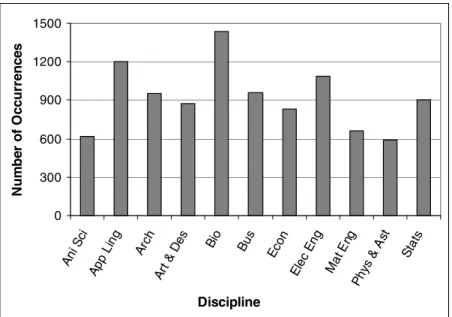
It was at this point in the investigation that the initial data set needed to be narrowed to a smaller sub-corpus in order to perform the more qualitative analyses (those relying heavily on human analytic techniques) involved in the remaining procedures. As mentioned previously, four disciplines were selected for in-depth analysis: Applied Linguistics, Biology, Business and Electrical & Computer Engineering. These four sub-corpora were chosen due to the fact that they contained the highest number of lexical items occurring as part of a verb phrase—which could be hypothesized as MSTs, thus potentially triggering the highest number of mandative subjunctive structures (see Figure 3.3 below).
0 300 600 900 1200 1500 An
i Sci
Ap pL ing Arc h Art &D
es Bio
Bu s Eco n Ele cE ng Ma t E ng Ph ys &A st Sta ts Discipline N u m b e r o f O c c u rr e n c e s
Figure 3.3: Frequency of Lexical Items as Verbs in the ISURAC
3.3.3. Tertiary Analysis: Pattern
In order to answer the third research question [When these items function as lexical verbs, do they always co-occur with that-clauses and subjunctive verb forms in actual use in academic writing; in other words, do ask, demand, direct, insist, order, propose, recommend, request, require and suggest “trigger” the mandative subjunctive? If not, with what other structures do they co-occur?], the analysis was again broken down into two steps, the first to locate a pattern, and the second to classify the structure following the pattern.
In the first step, each instance of the lexical items in verb form (from the archived data of the secondary analysis) in each of the four sub-corpora (Applied Linguistics, Biology,
Business and Electrical & Computer Engineering) was analyzed and classified as either containing a co-occurring that-clause or not. As a check and balance for this procedure, the lexical items were again concordanced in each of the four disciplines for the pattern (item* that) to ensure that no instance was overlooked. Results were sorted, tallied, recorded, archived and tabulated.
Next, in order to perform the second step of the third analysis, the mandative subjunctive structure itself had to be identified; that is, the exponents and features that “mark” the mandative subjunctive as such needed to be defined. Therefore, based on a synthesis of previous researchers’ descriptions (Quirk & Greenbaum, 1973; Celce-Murcia & Larsen-Freeman, 1983; Biber et al., 1999; Peters, 2004), the following pattern was
established as the criterion to be met in order to be considered a mandative subjunctive:
lexical item (any form) + () that + singular subject + verb (base form)
Strings of that-clause co-occurrence were analyzed; those conforming to the above pattern were classified as subjunctive structures, and those that didn’t, as non-subjunctive structures. For the structures classified as non-subjunctives, a syntactic analysis of the structures
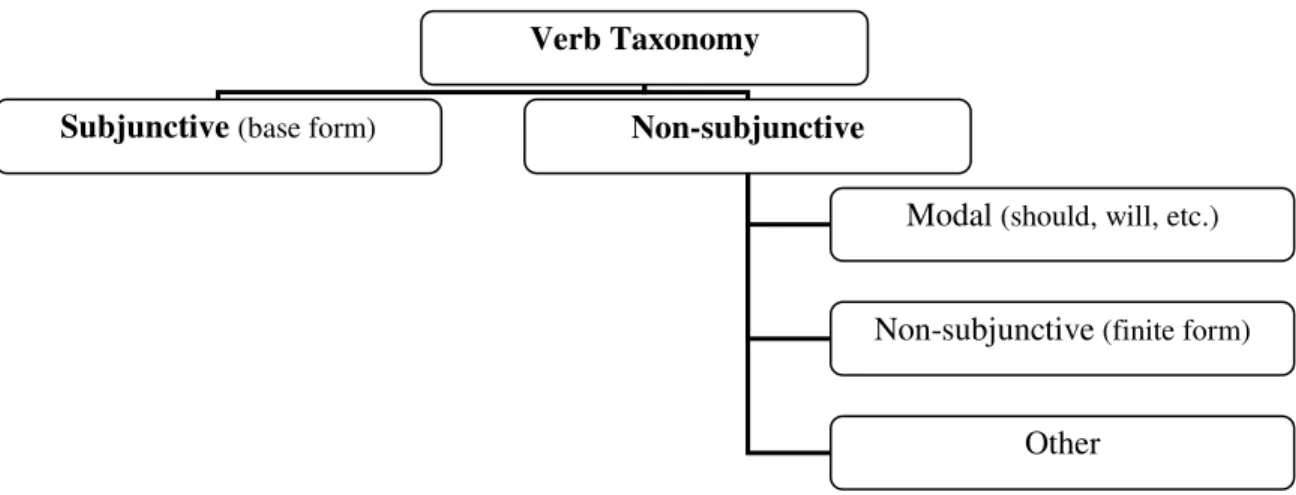
following the co-occurring that-clause was performed and a new taxonomy created to describe them: modal, non-subjunctive (finite verb forms (e.g., indicative, present perfect)) or other (see Figure 3.4 for the organization of the taxonomy). All coding was then validated by a second researcher, and the results were tallied and tabulated.
Figure 3.4: Taxonomy for Classifying Verb Form in the That-Complement Clause
Finally, in the event that any of the instances of non-that-clause co-occurrence contained a zero (that) complementizer, the pattern analysis described above was repeated for strings not co-occurring with that-clauses.
3.3.4. Quaternary Analysis: Structure
To answer the fourth research question [Is there a correlation between the form of the trigger in the main clause and the grammatical structure of the that-complement clause?], a syntactic analysis of the strings used in the tertiary analysis was performed. Each string was re-examined for two things: first, for the grammatical form of the lexical item (MST) in the main clause, and second, for the structure it triggered in the co-occurring complement clause. The results were recorded, tallied and tabulated. Then, the data was analyzed for correlations.
Additionally, the MS structures were further examined in isolation. Each instance was reverse-analyzed: that is, as the structure of the that-complement clause was known, only the structure preceding it (the form of the MST) was analyzed and general trends noted.
3.3.5. Quinary Analysis: Function
In order to answer the fifth, and final, research question [What is the function of structures identified as mandative subjunctives? What is the function of structures identified
Verb Taxonomy
Subjunctive(base form) Non-subjunctive
Modal(should, will, etc.)
Non-subjunctive(finite form)
as non-mandative subjunctives? Are there any significant differences in use of the mandative subjunctive structure across disciplines?], a semantic (contextual) analysis of each MS
structure was performed to determine whether it was used to indicate a proposed course of action or not.
Instances were classified as either expressing a proposed course of action or ‘other’, and taxonomized accordingly (Figure 3.5). This two-step process was repeated for structures identified in the tertiary analysis as “non-subjunctive” (modals, non-subjunctives and others), as well. All coding was then validated by a second researcher. Finally, the results of the functional analysis were compared across disciplines for similar/dissimilar trends in use.
Figure 3.5: Taxonomy for Classifying the Function of MS and Non-MS Structures Function Taxonomy
Table 3.3: Summary of the Data Analysis Procedures
Research Question Method(s) Steps
1. What are the frequency
distributions of ask, demand, direct,
insist, order, propose, recommend, request, require and suggest in the
ISURAC?
Quantitative (Frequency)
1. Concordance the lexical items in each of the sub-corpora.
2. Archive strings in electronic files. 3. Discard instances of irrelevant uses. 4. Count and tabulate findings.
2. Are ask, demand, direct, insist,
order, propose, recommend, request, require and suggest manifested
strictly as lexical verbs in the corpus? If not, which other word classes do they represent?
Quantitative (Form)
1. Concordance each lexical item in the corpus. Sort, tally and record variations and frequencies.
2. Individually examine unanalyzed strings and classify each use by word class: verb, noun, adjective, adverb or other. Count, record, tabulate and archive uses by word class.
3. Narrow the corpus for in-depth analysis. 3. When these items function as
lexical verbs, do they always co-occur with that-clauses and subjunctive verb forms in actual use in academic writing; in other words, do ask,
demand, direct, insist, order, propose, recommend, request, require and suggest “trigger” the mandative
subjunctive? If not, with what other structures do they co-occur?
Quantitative (Pattern)
1. Examine the instances of the lexical items in verb form and distinguish between co-occurrence with or without a that-clause. 2. Perform a syntactic analysis of the
structures co-occurring with that-clauses and classify them according to the taxonomy as either subjunctive or non-subjunctive; further classify non-subjunctives as modals, non-subjunctives or other. Tally, record and tabulate findings.
4. Repeat the process for instances of
non-that-clause co-occurrence.
4. Is there a correlation between the form of the trigger in the main clause and the grammatical structure of the
that-complement clause?
Quantitative (Structure)
1. Perform a syntactic analysis of the verb form of the main clause (of the MST) and the verb form of the complement clause (that-clause) it triggers.
2. Analyze the findings for correlations. 3. Examine the form of the MST in each MS structure to determine if a structural
preference exists. 5. What is the function of structures
identified as mandative subjunctives? What is the function of structures identified as non-mandative subjunctives? Are there any significant differences in use of the mandative subjunctive structure across disciplines?
Qualitative (Function)
1. Perform a semantic analysis of each MS structure to determine if its function is to express a proposed course of action or not. 2. Classify functions and taxonomize, tallying and tabulating findings.
3. Repeat the process for non-MS structures. 4. Compare use across disciplines.
CHAPTER 4: RESULTS
Results of the five analyses described in Chapter 3: Methodology are presented here in Chapter 4: Results, with a discussion of the findings to follow in Chapter 5: Discussion and Conclusions.
4.1. Preliminary Analysis: Frequency
An initial concordancing of the lexical items ask, demand, direct, insist, order, propose, recommend, request, require and suggest in the corpus produced the following frequency distributions:
Table 4.1: Preliminary Concordance Results: Unanalyzed Strings Ani
Sci App Ling
Arch Art
& Des
Bio Bus Econ Elec
Eng Mat Eng
Phys & Ast
Stat Totals (by lexical item)
ask 4 379 138 132 9 130 91 66 3 8 18 983
demand 20 100 135 108 11 209 272 62 78 5 8 1096
direct 239 412 486 420 439 448 298 643 450 466 216 4621
insist 0 9 23 64 0 5 3 1 0 8 0 113
order 154 386 254 336 177 183 315 398 262 320 387 3319
propose 54 296 217 209 160 169 320 193 272 79 568 2661
recommend 126 59 90 21 12 24 18 23 103 4 58 553
request 2 101 24 13 7 23 15 610 2 1 20 822
require 461 323 524 246 524 291 314 842 333 312 278 4567
suggest 356 428 291 336 811 482 523 159 176 293 292 4328
Totals (by discipline)
1416 2493 2182 1885 2150 1964 2169 2997 1679 1496 1845 22,276
As stated in the methodology, some instances of these preliminary 22,276 hits had to be eliminated, however, due their status as either a) undecipherable, such as the following example of order:
…measurements are commensurate and need not be standardised. We varied L oversmallervalues than those used forthe arti$cial data sets in orderto $nd peaks with smallersupport. The numberof peaks signi$cant at the 5% level found by PEAKER forthese parametervalues on the Quakes… (Stat)
or b) non-representative of the author’s own writing (word choice) or part of a fixed phrase, as in these uses of suggest, order, direct and request:
... example: Some processes may be classified under more than one type depending on their use in the text. Verbs like suggest and indicate can be categorised as relational processes when the nominal elements in the transitivity structure are abstractions, or as ... (AL)
... isolation required the assumption that the population density within each species was uniform across the area where it occurred. In order to allow for differences in density between species, the species proportions in all mixed sites combined (pj and pb for ... (Bio)
... issued their reports in early 2002.30 The International CSR and Social Reporting Working Group was led by Geoffrey Bush, Director of Corporate Citizenship at Diego (a leading food maker which owns Pillsbury and other big U.S. brands as well) ... (Bus)
... framework. Current technology for building distributed, component- based applications uses sockets, messages, remote procedure calls such as DCE™, or Object Request Brokers (ORBs, such as CORBA, JavaRMI™, and
DCOM). Without too much loss of generality, we focus on ORB frameworks and ... (Elec Eng)
Once the extraneous uses were discarded, the results were again tabulated:
Table 4.2: Preliminary Concordance Results Less Extraneous Uses Ani Sci App Ling Arch Art & Des
Bio Bus Econ Elec
& Comp Eng Mat & Civ Eng Phys & Ast Stat Totals (by lexical item)
ask 4 364 135 132 9 130 89 66 3 8 17 961
demand 19 99 135 108 11 207 271 62 76 5 8 1088
direct 236 403 475 406 439 438 294 639 441 460 216 4551
insist 0 9 23 64 0 5 3 1 0 8 0 113
order 94 161 85 128 70 49 132 288 68 182 257 1600
propose 54 288 217 205 160 169 135 192 270 75 536 2421
recommend 126 59 83 21 12 24 18 23 97 4 58 540
request 1 95 24 13 0 20 8 600 2 1 16 784
require 448 322 517 246 524 290 314 840 333 311 277 4541
suggest 356 420 291 336 811 482 523 158 176 293 292 4319
Totals (by discipline)
4.2. Secondary Analysis: Form
Concordancing revealed that the lexical items were realized in various ways in the corpus. Table 4.3 below presents the five most frequent manifestations of each lemma (see Appendix A for a comprehensive listing).
Table 4.3: Most Frequent Realizations of the Lexical Items in the ISURAC Lexical Item Five Most Frequent Realizations and their Frequencies
ask asked (526), ask (219), asking (131), asks (62), bid/askspread (26)
demand demand (649), demands (233), demanding (62), demanded (46),
demand-driven (6)
direct direct (1270), directly (1046), direction (864), directions (352), directors (171)
insist insist (27), insisted (24), insists (22), insistence (21), insisting (9), insistent (5)
order order (2794), orders (162), ordered (81), ordering (70), orderly (16)
propose proposed (1309), proposition (377), propose (317), proposal (152), proposals
(133)
recommend recommended (285), recommendations (104), recommendation (68),
recommend (49), recommends (19)
request requests (358), request (312), requested (115), requesting (25), request’s (3)
require required (1726), requires (842), requirements (718), require (653), requirement
(358)
suggest suggests (1260), suggest (1218), suggested (910), suggesting (531), suggestion
(90)
Variations on the lexical item, as overviewed in brief above in Table 4.3 and in detail in Appendix A, were not, as the second research question asks, manifested solely as verb constituents (e.g., direct, directed, directing, directs). Results of an analysis of form show that the realizations of the lexical items were also manifested as nouns (e.g., direction, directive, director, directory), adjectives (e.g., direct, directional), adverbs (e.g., directly, directionally) and others. Figures 4.1 to 4.10 depict each item (ask, demand, direct, insist, order, propose, recommend, request, require and suggest) broken down by word class.
Lexical Items by Word Class in the ISURAC
Figure 4.1: ask verb noun
adjective other
Figure 4.2: demand noun
adjective other
verb
Figure 4.3: direct verb
noun
adjective adverb
other
Figure 4.4: insist verb noun
adjective adverb
Figure 4.5: order verb
noun
adjective adverb other
Figure 4.6: propose verb
noun adjective
adverb other
Lexical Items by Word Class in the ISURAC, cont’d
Figure 4.7: recommend verb
noun adjective
other
Figure 4.8: request verb
noun adjectiveother
Figure 4.9: require verb noun
adjective other
Figure 4.10: suggest verb adjective
adverb
noun
other
Figures 4.1 to 4.10 demonstrate that ask, insist, require and suggest appear to be the most frequently used as verbs of the 10 lexical items, with over two-thirds of their
occurrences in the corpus representing a verb use. Propose and recommend rank in as the second-most frequent, with approximately half of their manifestations functioning as verbs; demand and request do so less than a quarter of the time, while direct and order in particular almost never manifest themselves as verbs in the corpus.
Based on this information, an informal hypothesis was formed: if the mandative subjunctive structure is indeed “triggered” by a verb controlling a that-clause, then ask, insist, require and suggest should produce the form more consistently than the other lexical items.
The numerical data corresponding to the verb sections of the pie graphs in Figures 4.1 to 4.10 follow in Table 4.4 below.
Table 4.4: Frequency Distributions of the Lexical Items as Verb Constituents Ani Sci App Ling Arch Art & Des
Bio Bus Econ Elec
& Comp Eng Mat & Civ Eng Phys & Ast Stat Totals (by lexical item)
ask 4 353 125 123 9 127 20 65 3 8 17 854
demand 1 13 29 39 3 26 14 15 3 3 0 146
direct 5 46 49 66 26 17 4 17 9 16 8 263
insist 0 8 18 42 0 5 3 1 0 5 0 82
order 3 10 9 14 4 4 2 18 0 4 10 77
propose 49 69 117 102 135 74 63 148 160 58 321 1296
recommend 26 20 40 7 5 14 7 18 63 4 43 247
request 1 29 14 6 0 14 8 66 0 0 2 140
require 187 272 305 190 461 222 200 594 251 223 233 3138
suggest 341 378 246 286 795 458 510 145 169 267 272 3867
Totals (by discipline)
617 1198 952 875 1438 961 831 1087 658 588 906 10,110
Based on the totals (by discipline) of Table 4.4 above, the four disciplines containing the highest frequencies of the lexical items as verbs (collectively) were selected for in-depth analysis due to the fact that they could potentially trigger the mandative subjunctive structure.
0 300 600 900 1200 1500 An
i Sci
Ap pL ing Arc h Art &D
es Bio
Bu s Eco n Ele cE ng Ma t E ng Ph ys &A st Sta ts Discipline N u m b e r o f O c c u rr e n c e s
As can be inferred from Table 4.4 and Figure 4.11, the four disciplines chosen for the three subsequent analyses consisted of two social sciences, Applied Linguistics and Business, and two hard sciences, Biology and Electrical & Computer Engineering. Biology boasted the highest number of the lexical items appearing as verbs (1438), followed by Applied Linguistics (1198), Electrical & Computer Engineering (1087), and Business (961).
4.3. Tertiary Analysis: Pattern
The results of the pattern analysis indicate that four of the lexical items as verbs rarely co-occur with clauses in actual use: direct and order never co-occur with a that-clause, while ask does only .18% and request .92% of the time. Four more of the lexical items co-occur with that-clauses only somewhat more frequently: require (4.91%), demand (10.53%), recommend (14.04%) and propose (16.43%). Insist co-occurs with a that-clause 28.57% of the time, while suggest, with 65.93% of all its instances co-occurring with that-clauses, demonstrates the highest rate of co-occurrence. A comparison by lexical item of that-clause co-occurrence versus non-co-occurrence is represented in Table 4.5 below and Figure 4.12 on the next page, with a graphical representation for each in Appendix B.
Table 4.5: Instances and Percentage of That-Clause Co-occurrence by Lexical Item
+ that-clause no that-clause that-clause co-occurrence (%)
ask 1 553 0.18
demand 6 51 10.53
direct 0 106 0.00
insist 4 10 28.57
order 0 36 0.00
propose 70 356 16.43
recommend 8 49 14.04
request 1 108 0.92
require 76 1473 4.91
suggest 1171 605 65.93
Of the 1337 instances of the lexical items co-occurring with a that-clause, just 50 (3.74%) actually triggered a subjunctive structure. Table 4.6 reveals that four of the lexical items (direct, insist, order and request) did not trigger the mandative subjunctive even once, whereas ask, demand, and recommend do only once apiece; samples of each of these are found after Table 4.6.
0% 20% 40% 60% 80% 100%
ask
de
ma
nd
dire
ct ins ist ord er pro po se reco mm en d req
ues
t
req
uir
e
su
gge
st
no that-clause v + that-clause
Figure 4.12: That-clause Co-occurrence vs. Non-co-occurrence by Lexical Item
Propose produced three instances of the mandative subjunctive pattern in the that-complement clause, suggest eight, and require 36. The verb require is noteworthy, as it triggers the subjunctive more often than modals or non-subjunctives, which was atypical of the present data set. Again, a sample of a mandative subjunctive structure per MST can be found following Table 4.6 below, while a complete listing of all of the instances of the mandative subjunctive structure occurring in the sub-corpus is located in Appendix C.
Table 4.6: Distributions of the Grammatical Pattern of the That-Complement Clause
Lexical Item Subjunctive Modal Non-Subj Other
ask 1 0 0 0
demand 1 0 3 2
direct 0 0 0 0
insist 0 2 2 0
order 0 0 0 0
propose 3 15 51 1
recommend 1 5 2 0
request 0 0 1 0
require 36 2 32 6
suggest 8 354 807 2
Samples of mandative subjunctive structures occurring in the ISURAC
ask
... involving a mining company’s impact upon human rights—the Rio Tinto case involving human rights violations in New Guinea. The Department asked that it be dismissed and the judge agreed.58 While this case was quite different, it also raises the question of ... (Bus)
demand
... came to believe that the power of multinationals to influence the U.S. and foreign governments must be checked. They demanded that the U.S.
government send clear signals as to what business practices were unacceptable and how violators would be punished. ... (Bus)
propose
... reduces their rate of divergence between species, relative to those levels experienced by the core genes. Lan and Reeves thus propose that the species-specific shared, core genes, which comprise the shared species genome, be used to define species boundaries. The consensus molecular ... (Bio)
recommend
... the British government should promote consensus on such codes of practice “whilst ensuring a level playing field.” It also recommended that the
government integrate CSR more widely into procurement practices. The third ministerial working group looked at social labeling. It ... (Bus)
require
... abilities to understand and use mainstream narratives to succeed in the academic setting. By third through fifth grades, mainstream curricula require that students be able to comprehend and to produce goal-directed stories. Such stories rely on thoughts and feelings of characters to ... (App Ling)
suggest
... into their lives. The system now allows them to easily add new contacts manually, one at a time. Users also suggested that any automatic updates be incremental and preserve the spatial relations among preexisting contacts. They viewed ContactMap as a visual workspace ... (Elec Eng)
1 49 13 4 17 100 30 3 63 21 50 25 69 43 73 50 100 50 5 1 33 0% 10% 20% 30% 40% 50% 60% 70% 80% 90% 100% ask dem an d dir ect ins ist ord er pro po se rec om men d req ue st req uir e su gg es t P e rc e n ta g e Other Non-Subjunctive Modal Subjunctive
Figure 4.13: Percentages of Structures Triggered by Lexical Item
It is evident that, even when functioning as verbs, the lexical items do not always co-occur with that-clauses—nor do they always trigger the mandative subjunctive in actual use in published research articles. Figure 4.13 above compares the percentages of mandative subjunctive structures (by MST) to those of the other structures with which they were found to co-occur: modals, non-subjunctives and others.
Several of the lexical items were found to trigger modals: require (3%), propose (21%), suggest (30%), insist (50%) and recommend 63% of the time. For example:
... Internet Relay Chat (IRC). Log-file analysis is becoming the greatest time consumer for system administrators. Identifying actual intrusions and misuses requires that they must know the user’s intentions while examining the user’s activity because the same activity can have a more disconcerting ... (Elec Eng)
... in neurite extension. We further determined that extracellular domain four of N-cadherin was necessary and sufficient for this activity and proposed that it may interact directly with the FGF receptor (Kim et al. 2000). Hazan’s laboratory recently showed that N-cadherin is also ... (Bio)
... is user friendly for consumers in one culture may be different for another group of consumers in another culture. This suggests that Web interfaces should be designed with the correct mix of cognitive and behavioral stimuli for the different cultural audiences. Conclusion ... (Elec Eng)
... when the paper is assigned and ends when we hand back that last draft. Plus, it bears great weight (some insist that grading should be done away with in comp classes) in terms of the whole process, their process, of addressing and ... (App Ling)
... Citizenship at Diego (a leading food maker which owns Pillsbury and other big U.S. brands as well). The group recommended that ultimately for CSR to succeed, companies would have to adopt “internationally agreed Codes of Practice.” The Group also suggested ... (Bus)
Others were found to trigger non-subjunctive structures: recommend (25%), require (43%), demand and insist (50%), suggest (69%), propose (73%), and request 100% of the time. These non-subjunctive structures could consist of the base form of a verb displaying subject-verb concord (e.g. plurals); any finite subject-verb form (including primary auxiliaries, but excluding modal auxiliaries, as they have their own category); or any verb phrase displaying aspect (i.e., perfects or progressives) or voice (e.g., passives), as in the following samples:
... Unfortunately, all timings—such as average frame time, total time, and so on—can’t be made such without losing their meaning. We recommend that users report both the deviation and continuity. The deviation reports a deviation globally, while the continuity is good because ... (Elec Eng)
... environmental conditions is then called a reaction norm (Schmalhausen, 1949). As for any biological feature, the evolution of phenotypic plasticity requires that (1) it is adaptive, (2) it is genetically based, and (3) it exhibits sufficient genetic variability in the population considered. ... (Bio)
... or something. K1 106. Teacher: Yep. Marion is her servant. Good. In move 103, David selects imperative mood as he demands that students stop reading. However, the imperative force of this demand is mitigated, both by his