PMSS: Producer Mobility Support Scheme
Optimization with RWP Mobility Model in Named
Data Networking
M. Hussaini
1, S. A. Nor
2, A. Ahmad
3InterNetWorks Research Laboratory, School of Computing College of Art and Science, Universiti Utara Malaysia
Abstract: The movement pattern of mobile producer plays an important role in mobility performance analysis of the wireless and mobile network. However, the producer mobility behavior is directly affecting the handoff latency and signaling overhead cost. Many researchers provide analytical investigation to analyze and solve the handoff problems and compared with the simulation result. To justify between simulation and analytical investigation, movement behavior of mobile node needs to be included in the analytical investigation to make it possible to compare with the simulation-based result. This paper incorporated Random WayPoint Mobility (RWPM) model, to determine the behavior of mobile producer, for analytical solution of producer mobility support in NDN. In this paper, we introduce mobility Interest packets to conveyed new prefix or location of mobile producer, a broadcasting strategy to facilitate the handoff process and the immobile anchor router was modified to perform a dual function that is, tagging of anchors and broadcasting of tagged mobility Interest packets. The performance analysis for mobile producer behavior and handoff latency shows that our proposed Producer Mobility Support Scheme (PMSS) reduces handoff latency compared to DNS-like and Home Agent routing approach.
Keywords: Network analytical model, random waypoint model, handoff latency, Named data networking, Producer mobility support, Signaling cost.
1.
Introduction
The current Internet technology was engineered in the 1960s and 1970s for managing resource and distribution over the network [1], [2]. That purpose was achieved beyond its imagination. Currently, Due to the extensively increased in data, information and services distribution over the Internet, an efficient web technology as networking development emerged, efficient and scalable network overlay Peer-to-Peer technology (P2P) and Content Delivery Network (CDN) was proposed [3]–[5] to support the Internet architecture for efficient and smooth services execution to the user. The demand for Internet services is increasing rapidly that forces researchers to think twice about the future of the Internet. The yearly statistical analysis by Cisco inspired many researchers to focus on Internet user’s demand. An annual Cisco’s Visual Networking Index (VNI) gives a realistic forecast about the expected demand of data, services and connectivity over the Internet. It was forecasted that in 2016 nearly 429 million mobile devices were connected to the Internet, added-up and making the total of 8.0 billion globally. It was estimated that by 2021 mobile connection will grow to 11.6 billion. The Global mobile data traffic was 7.2 EB (7.2 billion Terabyte) per month in 2016, which will considerably rise to 49.0 EB per month, almost seven times in 2021 [6]. However, current Internet architecture may not effectively address those future issues due to the limitations and challenges facing the Internet
architecture. Consequently, the Information-Centric Networking (ICN) prototype was proposed to overlay or completely replace current Internet architecture [3].
ICN architecture was proposed as a clean-slate redesign Internet architecture that replaces current IP address with a content name. Depending on the ICN approaches, different architectures can be called as content-centric, information-centric, data-oriented, data-centric and content-aware networking. The ICN prominent features are content to name and security to support mobility and provide efficient and scalable content distribution. Mobility support in ICN is the support for the mobile content node (consumer or producer) to relocate from one access point to another without disrupting access routers, intermediary routers and corresponding node for content availability with minimal hand-off cost and latency.
Named Data Networking (NDN) is an architecture under the umbrella of ICN that re-design entirely for the proposed future Internet [7], that uses named-base routing to the forwarding of packets from producer to consumer. NDN maintains Forwarding Information Base (FIB), Pending Interest Table (PIT), and Content Store (CS) as data structures. Also, two different formats of packets: data packets and Interest packets are used to accomplish named-based routing and packets forwarding [8]. From the consumer or Interest perspectives, FIB decides when and where to transmit a received Interest packets, PIT records and store any incoming Interest information. The data looks-up the PIT record, and then forward to appropriate face and CS cached the data for subsequent use.
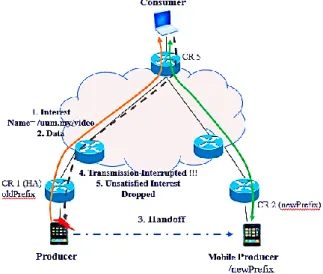
data transmission, especially for large or real-time data. Once content producer moved and completed handoff process, the transmission becomes interrupted due to the change in the name prefix at CR2.
Figure 1. Mobility Support in NDN
2.
Related Work
Global mobile communication and number of Internet users’ flourishes in daily basis as indicated by Cisco Visual Networking Index [6] seeking for real-time data traffic while moving as vehicle-to-vehicle networking, MANET, Internet of Things and wireless sensor network. Global mobile network connectivity, voice and video data demands are vastly increasing. The current TCP/IP Internet architecture turned to be inefficient to accommodate such kind of demand despite the mobility support in terms of handoff performance for Mobile IPv6 and reliability management [15]. Recently, some researches were conducted for the reliable mobility management of Internet-of-Things and wireless sensor networking [15], [16], due to the advantages and vast area of WSN application such as remote sensing and data monitoring [17]–[20] to support and improved the networking mobility performance. Other researches for the routing performance, scalability, stability of the network and reachability in OLSR [21], data security, authentication and availability in MANET and VANET [21], [22] addresses future and recent development for the solution of mobility problems. The future internet solution were also provided to support both consumer and producer mobility, reviews are conducted specifically for mobility support for named data networking [7], [9], [10].
In the effort to provide a solution to the producer mobility support problems in NDN many researchers identified producer mobility support schemes or approaches with different name and grouping. Ying et al. [20, 21] identified mobility support as indirection point based mobility approach (IBMA) and home repository or rendezvous point based mobility approach (RBMA) [20, 21]. Saxena et al. [10] classified as a locator-free approach (LFMA) and mapping-based approach (MBMA). Also, temporary separation (TS) and partial separation (PS) [9]. This paper classified them into Home Agent (HA) approach and DNS-like approach.
Location-aware on-demand multipath protocol based on NDN MANETs was proposed by Asif and Kim [23] to solve the intermittent connectivity, low battery power, data redundancy, packet flooding that affect network performance due to the nature of broadcast nature of wireless mobile
ad-hoc network in NDN. However, the solution cannot be suitable for general NDN architecture as its targeted NDN MANET only. Azgin, Ravindran and Wang [24] anchor chain on-demand mobility support solution for ICN was proposed to manage producer mobility and handoff processes to avoid data loses. The architecture used decentralized micro-level resolution system and chained distributed anchors that provide forwarding functionalities to help for the efficient packets forwarding to the mobile producer after handoff [24]. However, the solution imposed high signaling as a result of pre-handoff, post-handoff messages from the mobile producer and path remove messages when anchor removed from the path. Joao et al. [25] proposed Controller-based Routing Scheme for NDN to solve the scalability problems caused by content mobility that intensifies high number of content in different locations. The scheme splits content identity and content location from name prefix to facilitate content mobility. However, the scheme does not ensure path optimization after handoff. Yan et al. [26] proposed a distributed mobility management scheme as a solution for both consumer and producer mobility in NDN architecture and all mobile IP architecture supported by NDN overlay [27]. The distributed mobility management handover scheme, supports both consumer and producer mobility which minimized handoff latency and routing update cost or signaling overhead cost. However, in this solution the Interest packets received by the home domain router must be encapsulated and forward it to the foreign domain router, to the mobile.
2.1 Home Agent Approach
The approaches uses the concept of HA router derived from the mobile IP solutions approach, MIPv4 and MIPv6, to provide producer mobility support in NDN architecture [10]. A home router was provided to maintain the mapping, binding or location information update once location ID prefix changed. In LBMA, when producer handover from CR1 to CR2, it sends the location update to CR1. Then CR1 updates all received Interest and forward it to the CR2, as shown in Figure 2. The IBMA perform the same thing as LBMA, the only difference is IBMA perform tunnelling of packets, unlike LBMA that forward the Interest packets.
handoff processes [24]. However, the solution imposed high signaling as a result of pre and post-handoff messages; the solution imposed high signaling handoff.
Figure 2. Indirection and Location Based Mobility Approach
2.2 DNS-like Approach
The Server approach uses the concept of the DNS-like server for mapping separation between content identifier and content location, or separation of control plane nada data plane for name resolution to provide producer mobility support in NDN architecture. In DNS-like approach, after the handoff process, when producer handover from CR1 to CR2 it sends the location update to the Server, notifying about the new location of mobile producer, as shown in Figure 3. The consumer queried the Server for the new location information of whereabouts of the mobile producer. Then the consumer can send Interest directly to the mobile producer via the optimal path. The difference with the control plane data plane separation is the controller or server updated the entire FIBs of the network. Jiang et al., [65, 67] provide a solution using DNS-like mapping approach to support mobile content producer in NDN. The mapping processes of content and location ID is carried out by the DNS server by adding the forwarding hint to the Interest packets upon request by the consumer [30]. However, the proposed solution required to have independent and distributed mapping servers to represent every particular domain, which may cause high delay and signaling overhead cost. Also, Gao and Zhang [32] proposed mapping based approach named scalable mobility management (SMM) scheme. The scheme uses management/routing separation access/core separation and locator/ID separation to addresses scalability and non-optimal routing. However, the distributed mapping system provided may result in high delay and signaling overhead cost for a global binding update.
Ren et al. [33] proposed a solution to the producer mobility support problem to minimized signaling cost and handoff latency. The author used the concept of Software Define Controller (SDC). When mobile producer relocated, the original content name prefixes are maintained, because data and Interest are forwarded by the FIBs update provided by SDC. The SDC server frequently updates the new prefix to the entire FIBs of the network. Moreover, Joao et al. [25] proposed Controller-based Routing Scheme for NDN. The proposed scheme use separation of content location and
content identifier to simplify content mobility and to ensure that valid path is established between consumers to the mobile producer. However, after the after handoff processes, the scheme does not ensure data path optimization when the rate producers on mobile increases
Figure 3. DNS-Like Approach
3.
The Concept of Proposed Scheme
For NDN to support mobile producer some issues needs to be address: The network must find a way to routes pending or unsatisfied Interest packets to producer’s new location, mobile producer should receive Interest packets after the handoff processes, decouple and mapping between identifier and locator for name prefix and the means to map or resolve name should be provided [7].
3.1 Mobility Interest Packet
We proposed a new packet Mobility Interest (MI) similar to the forwarding hint [11], [34], mobility management packet [14], [28], [35], binding update [34], [36], traced and tracing Interest [37], [38] etc. In our MI packet, two fields were added anchor tag and a mobility flag.
3.2 Broadcast Strategy
When a content producer is a move to a certain location, automatically the name prefix changed by default setup of NDN network. Therefore, the FIBs of the intermediate routers need to be updated about the new prefix name of producer’s new location. NDN support Interest broadcasting from the side of the consumer, as the Interests are relatively small, thus making it feasible to be broadcasted. A broadcasting strategy is a set-up in this solution to make intermediate routers aware of the new update in a restricted domain to track the location of the mobile producer.
Figure 4. PMSS Design Processes
3.3 Anchor Point
One of the access routers is designated as anchor point which is located in a well-known location in the domain. Once producer move, it sends the MI packets as an update to the anchor, the anchor tags the MI packets and announce it to the intermediate routers. The consumer can directly communicate with relocated producer through optimal route as intermediates routers FIBs were updated.
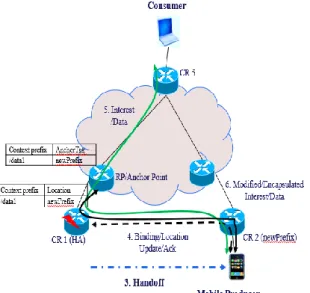
Figure 5. Producer Mobility Support Scheme Operation
To demonstrate the mobility support, Figure 5 shows the operational architecture of proposed NDN mobility support scheme. The execution stages are described below:
Step 1-2: The consumer normally sends Interest package requesting data from the content producer. The producer automatically reply data with data through FIBs trace. Step 3: Content producer decided to move and
facilitates the process of handoff to a new location.
Step 4: Once handoff completed, the Producer sends MI packet towards the known location of the immobile anchor.
Step 5: Upon recipient of MI packet, the immobile anchor broadcast it to the intermediate routers within the network domain. The routers uses the MI packet to updates their FIBs with the new prefix.
Step 6: Content consumer reissues the unsatisfied Interest through best route toward the content producer.
3.4 Model Design and Algorithms
There are three main algorithms for the implementation of conceptual of mathematical formulation into computerized model. The first algorithm determined the movement behavior of mobile producer as special density function, followed by the handoff latency and signaling cost algorithm.
ALGORITHM 1
***Coceptual model verification and validation *** # A function that will determine the spatial density function of mobile producer moving in [0, x]^a according to RWPM. Begin
def spatDenstFunct(Fx):
""" returns the spatial density function """ u = 0.1
v = 1 float (u)
Fx = (u/(u+(0.3 * v))) + ((1 - (u/(u+0.3)))* abs(6*x*(x - 1))) return Fx
for x in (0, 0.1, 0.2, 0.3, 0.4, 0.5, 0.6, 0.7, 0.8, 0.9, 1):
print(x, ": ", round(spatDenstFunct(x), 2)) End
ALGORITHM 2
"""
*** HANDOFF LATENCY ANALYSIS ***
The period of time that Mobile producer required from the last Packets (Interest or Data) received via old PoA to the arrival of the first Packets via the new POA during handoff
""" Begin
Qd = 5 # Queueing delay Bw = 100 # wired link bandwidth Bwl = 11 # wireless link bandwidth Ldw = 2 # wired link delay Ldwl = 10 # wired link delay q = 0.1 # probability of link failure S_int = 40 # Size of Interest packet Sn_int = 56 # Size modified Interest packet S_up = 72 # Size of binding/query/location update
Ipn = 100 # Time interval between producer disconnected from PAR to NAR
a = 1 # Transmission latency between producer/consumer to AR
b = 5 # Transmission latency between old AR to new AR c = 5 # Transmission latency between new AR to consumer AR
e = 5 # Transmission latency between new, old & consumer AR to anchor router
d = 9 # Transmission latency between Server to new AR
#"""The delay between two consective hops for wired and wireless link"""
Lw_up = (S_up/ (Bw + Ldw + Qd)) # Wired delay for update btw 2 hops
Lw_int = (S_int/ (Bw + Ldw + Qd)) # Wired delay for Interest btw 2 hops
Lwl_int = ((1 + q)/(1 - q) * (S_int/Bwl + Ldwl)) # Wireles delay for Interest btw 2 hops
Lw_nint = (Sn_int/ (Bw + Ldw + Qd)) # Wired delay for mdf Interest btw 2 hops
Lwl_nint = ((1 + q)/(1 - q) * (Sn_int/Bwl + Ldwl)) # Wireles delay for mdf Interest btw 2 hops
print ("The handoff latecy for existing and proposed schemes")
print ("b: MBMA: LBMA: CDBMA: IBMA: PMSS")
#"""The handoff latecy for existing and proposed schemes"""
for b in (5, 7, 9, 11, 13, 15, 17, 19, 21, 23):
L_name = Ipn + a*Lwl_up + d*Lw_up + d*Lw_up + a*Lwl_int + c*Lw_int # Handoff latency for MBMA print (b, ":", round(L_mba),":", round(L_lba), ":", round(L_cdba), ":", round(L_iba), ":", round(L_propose)) End.
ALGORITHM 3
*** HANDOFF COST ANALYSIS ***
The number of overhead handoff related messages over the network during
handoff processes Begin
scr = 0.05 # Subnet crossing rate iar = 0.5 # Interest arrival rate
utc_w = 0.5 # unit transmission cost for wired utc_wl = 2 # unit transmission cost for wireless t = 1000 # Residence time
S_qry_rep = 56 S_up_ack = 72 S_reg_ack = 72 S_fibup = 72 S_encInt = 56 S_locInt = 56 S_mobInt = 56 S_int = 40 S_data = 2000 a = 1
c = e = 5 d = 9
print ("The cost of signalling messages for existing and proposed schemes")
print ("b: MBMA : LBMA : CDBMA : IBMA : PMSS") #"""The cost of signalling messages for existing and proposed schemes"""
for b in (5, 7, 9, 11, 13, 15, 17, 19, 21, 23):
C_name = S_up_ack*(a + d) + S_qry_rep*(d + a) + S_int* (a + c)
print (b, C_mba,":", C_lba, ":", C_cdba, ":", C_iba, ":", C_propose)
End.
3.5 Model Verification and Validation
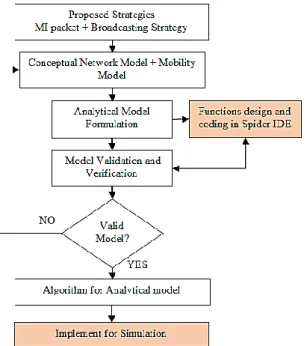
Figure 6 shows a simple modelling process [39]–[41] that presents conceptual model validation processes of the propose producer mobility support scheme. The Figure highlights levels of computerized model verification during implementation and model operational validity. Verification comprises accuracy of the model and ensures the implementations realized the conceptual model. Therefore, the concept of proposed scheme were formulated into mathematical representation as shown in Eq (7) to Eq (14)
and used python programming language in the Anaconda Spyder IDE environment for verification and validation.
Figure 6. Simple Modelling Processes
A static verification was used in Spyder IDE environment represented. Spyder IDE is a powerful tool for python language with advanced interactive testing, debugging and editing. Also provide interactive prompt IPython console with the ability to execute codes from the editor and visual warning about potential errors. The conceptual model programming codes was verified at the implementation phase for code review and inspection, to ensure the correctness of implementation design, used of variables, functions and procedures matches. A Spyder IDE provides code analysis windows with editor, variable explorer, console, object inspector of parameters for easy verification and validation. For validation, the model output behavior was measured using assigned values of the model parameter shown in Table 1, to observe the accuracy of model’s applicability in relation to the handoff latency and cost, for both existing and proposed scheme models.
4.
Random Waypoint Model
The movement pattern of mobile node, consumer or producer plays an important role in mobility performance analysis of wireless and mobile network, The producer mobility behavior is directly affecting the handoff signaling cost [42]. Random WayPoint Mobility model frequently used in mobile and wireless networking simulation, the model was designed to mimic mobility behavior of mobile nodes in a simplified manner [43]–[46]. RWPM is widely accepted because of its simplicity and adequately captured mobility characteristics without geographic restriction, spatial and temporal dependency [43]. The model was already implemented in certain simulators like NS-2 GlomoSim and NS-3 [42].
In RWPM model, all mobile nodes move independently from others, and they have the same unpredicted pattern or random probability distribution (stochastic). Velocity (vs)
and paused time (tp) are the parameters determine the
arrival of the previous session time and the arrival of the new session.
Figure 7. Producer Mobility Behavior Analysis
The point is randomly selected with probability density function F(x) = 1/A where A is the coverage area for x ϵ [0, A] α. For each period i, and ti is the duration of that period,
and txi denotes the duration that producer spends during the
period. The total time that producer spends during the entire movement divided by the total movement of the node converges to infinity [47]–[50]. In general the expected probability of pause time can be represented in Eq. (1)
(1)
The component distribution function of producer with RWP movement composed of paused, static and a mobility component. [50]. Spatial distribution with pause time when forr x ϵ [0, 1] α and 0 otherwise, .
[47], [50]. Where and .
Therefore the probability density function of the movement behavior can be represented as Eq. (2):
(2)
5.
Analytical Modeling
5.1 Network Analysis Model
To analyze the movement behavior of producer and evaluate the handoff performance of propose scheme, we consider producer behavior analysis based on RWPM model shown in Figure 9 [48], [50] and network analysis model shown in Figure 8 [11]. The performance evaluation of both propose scheme and existing schemes were conducted to evaluate the integration RWP model in the analytical solution of producer mobility support. The handoff latency and handoff signaling cost were mathematically formulated for home agent and DNS-like approaches. The model parameters and values are presented in Table 1.
Figure 8. Network Analysis Model
Table 1. Network Analysis Model Parameters
Notation Parameters Value
Sname Size of signaling packet + 16 byte Sdata Size of data packets 2000 bytes Siint Size of Interest packet 40 bytes Vcp Average speed of content
producer
50, 200, 350m/s
tp Content producer pause time 100, 200,
300ms
Lpar Transmission latency between
producer to AR
a
Lcar Transmission latency between
consumer to AR
a
Lsar Transmission latency between
Server to new AR
d
Lo-nar Transmission latency between old
AR to new AR
b
Lars Transmission latency between
new ARs/Anchors
c
Ipn Time interval btw producer
disconnection and reconnection from old AR to new AR
ipn
5.2 Movement Behavior Analysis
Figure 9. Movement Behavior of the Producer
6.
Handoff Latency Analysis
Handoff refers to the processes where a producer on mobile disconnects from current AR, then moves and connects to new neighboring AR. The period that mobile producer requires from the last Interest or Data packets received to the arrival of the first Packets after reconnection to the new AR is called handoff latency. To ascertain a good performance of the proposed scheme, the latency needs to be small. Eq. (1) And (2) express the delay for the wired and wireless linked between two consecutive hops as used in [14]. Where Bw and
Bwl are bandwidth for wired and wireless, Ldw and Ldwl are
link delay for wired and wireless respectively, Qd is the
queuing delay and q is the probability of link failure,
(3)
(4)
6.1 DNS-like handoff latency and signaling cost The handoff latency and signaling cost of DNS-like approach can be expressed as Eq. (5) and Eq. (6) for MBMA and Eq. (7) and Eq. (8) for CDBMA. When the mobile producer relocated from AR1 to AR2, it generates a new prefix name and sends an update packet to the DNS server. The server
generates a binding update or forwarding hint through the mapping process. When round trip time elapsed, the content consumer sends a query to the server and server reply with the forwarding hint. Then the AR3 routed the Interest packets with the forwarding hint though best and optimal path to the content producer
The total handoff latency can be derived in Eq. (5) and handoff signaling cost in Eq. (6), together with the random movement behavior of the producer and integration of consecutive delays Eq. (1) and (2).
(5)
(6) The handoff latency and handoff signaling cost of CDBMA is closely related to MBMA, both were explained under DNS-like approach. The only different was a consumer directly queries the control server, or the update can be done automatically by the control serve for the whole intermediate router’s FIBs. The derived equations were stated in Eq. (7) and Eq. (8) for handoff latency and handoff signaling cost respectively. Coupled with the random movement behavior of the producer and integration of consecutive delays Eq. (1) and (2), as follows:
(7)
(8)
6.2 Home router approach handoff latency and Signaling Cost
The handoff latency and signaling cost of IBMA can be expressed in Eq. (9) and Eq. (10) respectively, is also similar to that of LBMA shown in Eq. (11) and (12). When handoff process is over between AR1 and AR2, the AR2 send a binding update to the AR1. Upon recipient of an Interest from the consumer access router (AR3), The AR1 encapsulates and forwards the encapsulated Interest to the producer through AR2. The total handoff latency for the delay of messages exchange and handoff signaling cost of hops per packets count can be generated for IBMA, together with the random movement behavior of the producer and integration of consecutive delays Eq. (1) and (2) as:
(9)
(a)
(10) The handoff latency and signaling overhead cost of LBMA can be expressed as Eq. (11) and Eq. (12). When handoff process is over between AR1 and AR2, the AR2 send a location update to the AR1. Upon recipient of an Interest from the consumer access router (AR3), The AR1 redirects or forwards the Interest to the producer through AR2. The total handoff latency for the delay of messages exchange and handoff signaling cost of hops per packets count can be generated for IBMA, together with the random movement behavior of the producer and integration of consecutive delays Eq. (1) and (2). As:
(11)
(12)
The handoff latency and signaling cost of proposed scheme (PMSS) can be expressed as Eq. (13) and (14). When content producer moved to new location and completed the handoff process between AR1 and AR2. The mobile producer sends MI packet to the AR2, then AR2 forward to the known location of the immobile anchor. The immobile anchor maintained the broadcast strategy and updates the intermediate routers in the domain. Therefore, a content consumer re-issues unsatisfied Interest toward the AR2 via the optimal route. The expression can be generated together with the random movement behavior of the producer and integration of consecutive delays Eq. (1) and (2) as follows:
(13)
(14)
7.
Performance Evaluation
For the numerical evaluation of the existing and proposed solution for both handoff latency analysis, we set a = 1, b = c = 5 and d = 9 as used in [11], [14]. 16 bytes is added for any packets with the additional field, especially for MI packets. The number of signaling message sent over the network during handoff processes is represented as Sname.
The name is referring to an update to the server or query, a binding or location update, data and Interest packets. The additional field is 16 bytes [14] as shown in Table 1. Therefore, SmobInt = 56 bytes, Supack = 72 bytes, SencInt = 56
bytes, Sint = 40 bytes, Sregack = 72 bytes, Sfibup = 72 bytes
The numerical results of the handoff latency analysis with speed (v) variation have shown in Figure 10, 11 and 12 respectively. The results shows the impact of RWPM model, after varying speed (v) and pause time (tp), to determine the
significance of the producer movement behavior.
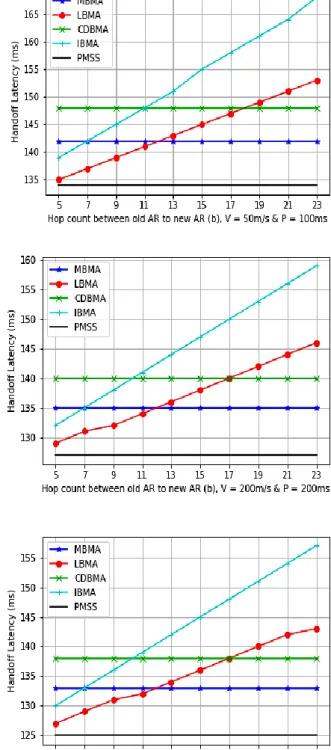
Figure 10. The impact of d on handoff latency by varying V
and P
Figure 10 (a) shows the effect of varying b as transmission latency between AR1 and AR2 and server. The handoff latency results are compared between MBMA, IBMA, LBMA, CDBMA and PMSS. In Figure 8 (a), the handoff latency of IBMA and LBMA significantly increase from 138ms to 168ms and 135ms to 153 respectively, by setting v
(a)
(b)
= 50m/s, p = 100ms and varying b, as the entire packet has to go through AR1 known as home router. While the MBMA, CDBMA and PMSS remain uniformly unchanged, because there is no effect on them due to the variation of b and their signaling does not necessarily route via AR1.
Figure 11. The impact of c on handoff latency by varying V
and P
The result inFigure 10 (b) and (c) shows similar outline as presented in Figure 10 (a). However, the latency of all approaches was linearly decreased from 135ms to 128ms to 126ms for LBMA and 138ms to 132ms to 127, due to the effect of varying speed and pause time. For the increase in velocity and pause time, the latency becomes smaller. Hence,
we can realize our propose scheme (PMSS) is the lowest when the speed and pause time goes higher.
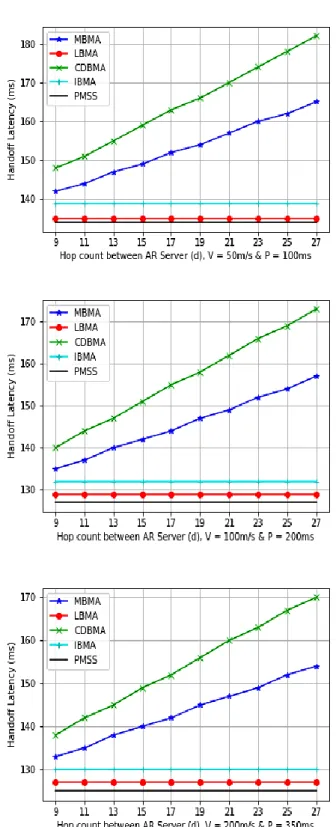
Figure 12. The impact of d on handoff latency by varying V
and P
In Figure 11 (a), the handoff latency for all approaches are significantly increase, from 132ms to 140ms (PMSS), 140ms to 148ms (MBMA) and 148ms to 154ms (CDBMA) by varying c and v = 50m/s, p = 100ms, v = 100m/s, p = 200ms and v = 300m/s, p = 350ms respectively. The variation of c, velocity and pause time is significantly increasing the handoff latency. The result in Figure 11 (b) and (c) shows similar outline as presented in Figure 11 (a). Therefore, the
(a)
(b)
(c) (a)
(b)
latency of all approaches was slightly and linearly increased, due to the effect of varying speed and pause time. Hence, we can realize that our propose scheme (PMSS) is the lowest and closed to LBMA for all v and p.
In Figure 12 (a), the handoff latency of MBMA and CDBMA significantly increase from 143ms to 163ms and 148ms to 182ms respectively, by setting v = 50m/s, p = 100ms and varying d, as the mobile producer has to send an update to the server. Similarly, the content consumer needs to query the update from the server. In CDBMA case, the server can automatically update the entire FIBs of the domain. While the IBMA, LBMA and PMSS remain uniform and smaller because there is no effect on them due to the variation of d. The result in Figure 12 (b) and (c) shows similar outline as presented in Figure 12 (a). However, the latency of IBMA, LBMA and PMSS remain uniformly constant for all the variant of speed and pause time. Moreover, for the increase in velocity and pause time, the latency becomes stable. Hence, we can realize our propose scheme (PMSS) is the lowest when the speed and pause time goes higher.
In general, movement behavior affects the analytical solution of producer mobility support. In Figure 10, the latency of all approaches was decreased linearly by almost 5ms, due to the effect of varying speed and pause time. In Figure 11, the latency of all approaches was slightly decreased by 7ms for PMSS at d = 27 across Figure 12 (a), (b) and (c) due to the impact of varying speed and pause time. Moreover, in Figure 10 for the increase in velocity and pause time, the latency becomes stable and closely related between LBMA, IBMA and PMSS, while the PMSS has the lowest latency.
8.
Conclusion and Future Work
The movement pattern of mobile producer plays an important role in mobility performance analysis of wireless and mobile network, where the producer mobility behavior is directly affecting the handoff latency and signaling overhead cost. Many researchers provide analytical investigation to analyze and solve the handoff problems and compared with the simulation result. To justify between simulation and analytical investigation, movement behavior of mobile node needs to be included in the analytical investigation to make it possible to compare with the simulation-based result. This paper incorporated RWP model to determine the behavior of mobile producer for analytical solution of producer mobility in NDN. The RWP model is widely used for the simulation investigation of handoff performance in wireless communication networks for ad-hoc, NDN, CCN etc.
In this paper, we introduce mobility Interest packets to convey new prefix or location of mobile producer, a broadcasting strategy to simplify the handoff problems and the immobile anchor router was modified to perform a dual function through, tagging of anchors and broadcasting of tagged mobility Interest packets. The performance analysis for mobile producer behavior and handoff latency shows that our proposed PMSS reduces handoff latency with averagely 45ms compared to DNS-like and home agent routing approach. Henceforth, our future work focuses on simulation investigation to determine the data path optimization and deployment of distributed anchors for the large network to prevent scalability issue of a broadcast
storm. The analytical investigation result would be compared with the simulation investigation result.
References
[1] V. Jacobson, D. K. Smetters, J. D. Thornton, M. Plass, N. Briggs, and R. Braynard, “Networking named content,” Commun. ACM, vol. 55, no. 1, pp. 117–124, 2012. [2] V. Jacobson, D. K. Smetters, J. D. Thornton, M. F. Plass,
N. H. Briggs, and R. L. Braynard, “Networking named content,” in CoNEXT ’09: Proceedings of the 5th international conference on Emerging networking experiments and technologies, pp. 1–12, 2009.
[3] B. Ahlgren, C. Dannewitz, C. Imbrenda, D. Kutscher, and B. Ohlman, “A Survey of Information-Centric
Networking,” IEEE Commun. Mag., vol. 50, no. 7, pp. 26– 36, 2012.
[4] A. Chaabane, E. De Cristofaro, M. A. Kaafar, and E. Uzun, “Privacy in content-oriented networking:Threats and contermeasures,” ACM SIGCOMM Comput. Commun. Rev., vol. 43, no. 3, p. 25, 2013.
[5] G. White and G. Rutz, “Content Delivery with Content- Centric Networking,” CableLabs, Strategy & Innovation, no. February, pp. 1–26, 2016.
[6] Cisco, “Cisco Visual Networking Index: Global Mobile Data Traffic Forecast Update, 2016-2021,” CISCO White paper, 2016-2021., pp. 1–35, 2017.
[7] M. Hussaini, S. A. Nor, and A. Ahmad, “Producer Mobility Support for Information Centric Networking Approaches : A Review,” Int. J. Appl. Eng. Res., vol. 13, no. 6, pp. 3272–3280, 2018.
[8] L. Zhang et al., “Named Data Networking,” ACM SIGCOMM Comput. Commun. Rev., vol. 44, no. 3, pp. 66– 73, 2014.
[9] B. Feng, H. Zhou, and Q. Xu, “Mobility support in Named Data Networking: a survey,” Eurasip J. Wirel. Commun. Netw., vol. 2016, no. 1, 2016.
[10] D. Saxena, V. Raychoudhury, N. Suri, C. Becker, and J. Cao, “Named Data Networking: A Survey,” Comput. Sci. Rev. Elsevier, vol. 19, pp. 15--55, 2016.
[11] Y. Rao, H. Luo, D. Gao, H. Zhou, and H. Zhang, “LBMA: A novel Locator Based Mobility support Approach in Named Data Networking,” China Commun., vol. 11, no. 4, pp. 111–120, 2014.
[12] Y. Rao, D. Gao, and H. Luo, “NLBA: A novel provider mobility support approach in mobile NDN environment,” in 2014 IEEE 11th Consumer Communications and Networking Conference, CCNC 2014, pp. 188–193, 2014. [13] G. Tyson, N. Sastry, R. Cuevas, I. Rimac, and A. Mauthe, “A survey of mobility in Information-Centric Networks,” Commun. ACM, vol. 56, no. 12, pp. 90–98, 2013. [14] T. X. Do and Y. Kim, “Optimal provider mobility in
large-scale Named- Data Networking,” KSII Trans. Internet Inf. Syst., vol. 9, no. 10, pp. 4054–4071, 2015.
[15] M. Saberi, “Private and Mobile Inter-Network Routing for Wireless Sensor Networks and Internet of Things,” Int. J. Commun. Networks Inf. Secur., vol. 10, no. 1, pp. 131–138, 2018.
[16] M. N. A. Riski, D. Perdana, and R. M. Negara,
“Performance Analysis of Mobility Impact on IEEE 802 . 11ah Standard with Traffic Pattern Scheme,” Int. J. Commun. Networks Inf. Secur., vol. 10, no. 1, pp. 139–147, 2018.
[17] M. Hussaini, F. Anwar, and A. A. H. Hassan, “A Survey of Power-Efficient Gathering of Sensor Information System Based Routing Protocols of Wireless Sensor Networks,” Sens. Transducers, vol. 142, no. 7, pp. 10–22, 2012. [18] M. Hussaini, I. S. Maijama’a, A. Isah, and A. Aminu,
[19] M. Hussaini and Z. C. Mansor, “Wireless and Wireless Sensor Network Routing Techniques Muktar,” J. Sci. Manag. Technol., vol. 1, no. 10, pp. 64–77, 2012. [20] M. Hussaini, A. F. Salami, F. Anwar, A. H. Abdalla, and
R. Islam, “Enhanced Clustering Routing Protocol for Power- Efficient Gathering in Wireless Sensor Network,” Int. J. Commun. Networks Inf. Secur., vol. 4, no. 1, pp. 18– 28, 2012.
[21] A. Abdellaoui, J. Elmhamdi, and H. Berradi, “Multipoint Relay Selection based on Stability of Spatial Relation in Mobile Ad hoc Networks,” Int. J. Commun. Networks Inf. Secur., vol. 10, no. 1, pp. 180–187, 2018.
[22] A. Ram and M. K. Mishra, “Mobility Adaptive Density Connected Clustering Approach in Vehicular Ad Hoc Networks,” Int. J. Commun. Networks Inf. Secur., vol. 9, no. 2, pp. 222–229, 2017.
[23] R. A. Rehman and B.-S. Kim, “LOMCF: Forwarding and Caching in Named Data Networking-based MANETs,” IEEE Trans. Veh. Technol., vol. 66, no. 10, pp. 1–1, 2017. [24] A. Azgin, R. Ravindran, and G. Wang, “On-demand
mobility support with anchor chains in Information Centric Networks,” IEEE Int. Conf. Commun., 2017.
[25] J. V. Torres, I. D. Alvarenga, R. Boutaba, and O. C. M. B. Duarte, “An autonomous and efficient controller-based routing scheme for networking Named-Data mobility,” Comput. Commun., vol. 103, pp. 94–103, 2017. [26] Z. Yan, S. Zeadally, S. Zhang, R. Guo, and Y.-J. Park,
“Distributed mobility management in Named Data Networking,” Wirel. Commun. Mob. Comput., vol. 16, no. 13, pp. 1773–1783, Sep. 2016.
[27] Z. Yan, G. Geng, S. Zeadally, and Y. J. Park, “Distributed All-IP Mobility Management Architecture Supported by the NDN Overlay,” IEEE Access, vol. 5, no. c, pp. 243– 251, 2017.
[28] D. Han, M. Lee, K. Cho, T. Kwon, and Y. Choi, “Publisher mobility support in content centric networks,” Int. Conf. Inf. Netw. 2014, pp. 214–219, 2014.
[29] D. Han, M. Lee, K. Cho, T. T. Kwon, and Y. Choi, “PMC : Publisher Mobility Support for Mobile Broadcasting in Content Centric Networks,” ASIA Futur. Internet 2012 Summer Sch. Kyoto, Japan, August. 2012., pp. 214–219, 2012.
[30] X. Jiang, J. Bi, and Y. Wang, “What benefits does NDN have in supporting mobility,” Proc. - Int. Symp. Comput. Commun., 2014.
[31] X. Jiang, J. Bi, Y. Wang, P. Lin, and Z. Li, “A content provider mobility solution of Named Data Networking,” in Proceedings - 2012 20th IEEE International Conference on Network Protocols (ICNP), pp. 1–2, 2012.
[32] S. Gao and H. Zhang, “Scalable mobility management for content sources in Named Data Networking,” 2016 13th IEEE Annu. Consum. Commun. Netw. Conf. CCNC 2016, pp. 79–84, 2016.
[33] F. Ren, Y. Qin, H. Zhou, and Y. Xu, “Mobility management scheme based on Software Defined Controller for Content-Centric Networking,” in Proceedings - IEEE INFOCOM, 2016, vol. 2016–Septe, no. 2, pp. 193–198, 2016.
[34] F. Hermans, E. Ngai, and P. Gunningberg, “Global Source Mobility in the Content-Centric Networking Architecture,” in Proceedings of the 1st ACM workshop on Emerging Name-Oriented Mobile Networking Design - Architecture, Algorithms, and Applications - NoM ’12, pp. 13–18, 2012. [35] D. Kim, J. Kim, Y. Kim, H. Yoon, and I. Yeom,
“End-to-end mobility support in Content Centric Networks,” Int. J. Commun. Syst., vol. 28, no. 6, pp. 1151–1167, Apr. 2015. [36] J. Lee, S. Cho, and D. Kim, “Device mobility management
in Content-Centric Networking,” IEEE Commun. Mag., vol. 50, no. 12, pp. 28–34, 2012.
[37] Y. Zhang, H. Zhang, and L. Zhang, “Kite: A Mobility Support Scheme for NDN,” in Proceedings of the 1st ACM
Conference on Information-Centric Networking- (ICN) ACM-ICN ’14, no. 1, pp. 179–180, 2014.
[38] Y. Zhang, H. Zhang, and L. Zhang, “Kite,” NDN, Technical Report NDN-0020, 2014., no. 1, NDN Project, pp. 1–10, 2014.
[39] R. G. Sargent, “An introduction to verification and validation of simulation models,” in Proceedings of the 2013 Winter Simulation Conference (WSC) IEEE, pp. 321– 327, 2013.
[40] R. G. Sargent, Modeling and Simulation in the Systems Engineering Life Cycle. Springer, London, 2015. [41] R. G. Sargent, “Verification and validation of simulation
models,” J. Simul., vol. 7, no. 1, pp. 12–24, 2013. [42] C. Bettstetter, “Smooth is better than sharp: A Random
Mobility Model for Simulation of Wireless Network,” Proc. 4th ACM Int. Work. Model. Anal. Simul. Wirel. Mob. Syst. - MSWIM ’01, pp. 19–27, 2001.
[43] F. Bai and A. Helmy, “A Survey of Mobility Models in Wireless Adhoc Networks,” in Wireless Ad Hoc and Sensor Networks, University of Southern California,U.S.A, 2004, pp. 1–30.
[44] T. Camp, J. Boleng, and V. Davies, “A survey of mobility models for ad hoc network research,” Wirel. Commun. Mob. Comput., vol. 2, no. 5, pp. 483–502, 2002. [45] R. Alubady, M. Al-samman, S. Hassan, S. Arif, and A.
Habbal, “Internet Protocol MANET vs Named Data MANET : A Critical Evaluation,” 4th Int. Conf. Internet Appl. Protoc. Serv. Internet, no. July 2016, pp. 70–76, 2015.
[46] H. Lamaazi, N. Benamar, M. I. Imaduddin, A. Habbal, and A. J. Jara, “Mobility Support for the Routing Protocol in Low Power and Lossy Networks,” in 2016 30th International Conference on Advanced Information Networking and Applications Workshops (WAINA), pp. 809–814, 2016.
[47] P. Pratt, C. P. Dettmann, and O. Georgiou, “How does mobility affect the connectivity of interference-limited ad hoc networks?,” 2016 14th Int. Symp. Model. Optim. Mobile, Ad Hoc, Wirel. Networks, WiOpt 2016, 2016. [48] G. Resta and V. G. Moruzzi, “An Analysis of the Node
Spatial Distribution of the Random Waypoint Mobility Model for Ad Hoc Networks,” Pomc’02, pp. 44–50, 2002. [49] C. Bettstetter, H. Hartenstein, and X. Pérez-Costa,
“Stochastic properties of the random waypoint mobility model,” Wirel. Networks, vol. 10, no. 5, pp. 555–567, 2004.
![Figure 6 shows a simple modelling process [39]–[41] that presents conceptual model validation processes of the propose producer mobility support scheme](https://thumb-us.123doks.com/thumbv2/123dok_us/8123016.2154485/5.892.469.788.127.401/figure-modelling-presents-conceptual-validation-processes-producer-mobility.webp)
![Figure 7. Producer Mobility Behavior Analysis The point is randomly selected with probability density function F(x) = 1/A where A is the coverage area for x ϵ [0, A] α](https://thumb-us.123doks.com/thumbv2/123dok_us/8123016.2154485/6.892.482.811.85.363/producer-mobility-behavior-analysis-randomly-probability-function-coverage.webp)