Using Media Independent Handover to Support
PMIPv6 Inter-domain Mobility Based Vehicular
Networks
Haider N. Hussain
1, Kamalrulnizam Abu Bakar
1and Shaharuddin Salleh
21Faculty of Computer Science & Information Systems 2
Faculty of Science, Universiti Teknologi Malaysia, 81310 UTM Skudai, Johor D. T, Malaysia [email protected]
Abstract: Proxy Mobile IPv6 (PMIPv6) was proposed by the
Internet Engineering Task Force (IETF) as a new network-based mobility protocol which does not require the involvement of MN’s in any form of mobility management. MN can handover relatively faster in PMIPv6 than in host-based mobility protocols (e.g. Mobile IPv6 (MIPv6)) because it actively uses link-layer attachment information which reduces the movement detection time, and eliminates duplicate address detection procedures. However, the current PMIPv6 cannot provide continuous mobility support for MN when roaming between different PMIPv6 domains; we introduce a novel inter-domain PMIPv6 scheme to support seamless handover for vehicle in motion to support continuous and seamless connection while roaming in the new PMIPv6 domain. In this paper we analytically evaluate our novel scheme to support inter-domain mobility for vehicle roaming between two PMIPv6 domains by using Media Independent Handover (MIH) and Fully Qualified Domain Name (FQDN) to support the handover in addition to a continuous connection.
Keywords: PMIPv6, MAG, MIH, FQDN.
1.
Introduction
Recently, the development of wireless technologies for Next Generation Networks (NGN), such as Wireless-Fidelity (WiFi), Worldwide Interoperability for Microwave Access (WiMAX), and General Packet Radio Service (GPRS), have opened the door for deploying IP mobility support. This has laid the foundation for vehicular communications allowing vehicles to connect with the Internet while travelling roaming between networks. It is expected that Vehicle Ad-Hoc Networks (VANETs) communication will become a pressing need in the near future while providing ubiquitous connectivity over homogeneous and heterogeneous networks. Since next generation networks will deploy IP-based networks deeper in its access network than the current 3G cellular networks [1], it will be important to introduce protocols that are capable of supporting seamless mobility. VANET mobility is different from other type’s mobility, such as static mobility, in several ways. Vehicles in the vehicular network environment have high dynamic topologies, unpredictable mobility and geographically constraints. These characteristics make it difficult to apply traditional host-based or network-based mobility protocols directly to VANETs. As a result, mobility protocols designed by the Internet Engineering Task Force (IETF), (i.e. Mobile IPv6 (MIPv6), Fast Mobile IPv6 (FMIPv6), Hierarchical Mobile IPv6 (HMIPv6), and NEMO (Network
Second, if the MN does not support MIPv6 (PMIPv6 does supports mobility regardless of supporting MIPv6), the vehicle attaches to a new Mobile Access Gateway (new MAG), irrespective of handing over between two MAG. However, MAG does not have any function to support inter-domain handover. Thus, it cannot maintain a continuous communication session.
In this paper, we propose a novel inter-domain handover scheme using MIH to support continuous vehicle connection. We will compare our novel scheme with the global mobility support using MIPv6. In addition, we will compare our schema with I- PMIPv6 and iMAG support and then analyze their performance. In other words, to provide a more in depth study on these protocols, a mobility model is adapted that represents the behavior of real vehicles, and a network model that represent the network topology for the performance evaluation.
The novel scheme introduces a novel solution for inter-domain support in PMIPv6 networks by which the MAG, on behalf of the vehicle, can maintain the vehicle’s communication sessions during the handover process, irrespective of intra-domain or inter- domain handover. In this novel inter-domain PMIPv6 mechanism, the vehicle is still not aware of its movement when it moves in to another Local Mobile Anchor (LMA) domain (nLAM domain). Thus, the vehicle is not involved in any IP-mobility related signaling, regardless of its movement. When the vehicle moves into a new LMA domain, the new MAG will perform the correspondent registration on behalf of the vehicle. Accordingly, it can reduce latency and packet losses and avoid host-based signaling. With this inter-domain PMIPv6 solution, the nature and advantageous characteristics of network-based mobility management of the PMIPv6 are retained, while still supporting inter-domain mobility management.
The rest of the paper is organized as follows; Section 2 provides the background and related work. In Section 3, we describe our novel inter-domain PMIPv6 mechanism. Section 4 estimates the performance of the novel mechanism and the PMIPv6 mechanism through an evaluation model. Numerical results are given in Section 5. Finally, we conclude this paper in Section 6.
2.
Related Works
The Internet Engineering Task Force designed Proxy Mobile IPv6 (PMIPv6) to support network-based IP mobility management for MNs, without requiring its involvement in any related IP-mobility functions. Mobility management in PMIPv6 is provided to MN irrespective of the presence or absence of Mobile IPv6 functionality [3]. PMIPv6 extends the signaling of MIPv6 and reuses most of MIPv6 concepts such as HA functionality. In addition it introduces two new elements known as Local Mobility Anchor (LMA) and Mobile Access Gateway (MAG) [4]. Arnold in [5] believed that the LMA behaves similar to the HA in MIPv6 in the PMIPv6 domain and that it also introduces additional capabilities required for network-based mobility management.
PMIPv6 protocol operation consists of four phases. In the first phase, MAG retrieves the MN’s profile using its current identifier. The Binding Update (BU) is the second
phase, in which the MAG sends a Proxy Binding Update (PUB) request to the LMA in order to register the current point of attachment of the MN. Accordingly, a binding cache entry and a tunnel for the MN’s home prefix will be created. The third phase will be the MAG emulating the mobile node’s home interface on the access interface. Therefore, the MN will always believe it is in the home network. Fourthly, the LMA replies with a Proxy Bind Acknowledge (PBA) message with the MN’s HNP. After receiving the Router Advertise (RA) message, the MN configures its IP address by using the contained prefix. For packet routing, the LMA is able to route all received packets over the established tunnel to the MAG. The MAG forwards these packets to the MN. Additionally, the MAG will relay all the received packets over the tunnel to the LMA and then they will be routed towards the CN. Fig1 show the procedure when a MN joins a PMIPv6 domain. While the MN is roaming in the PMIPv6 domain, the protocol ensures that the MN is eligible to obtain its home address on any access link [5] on condition that it is roaming in the same PMIPv6 domain. That is, that the serving PMIPv6 assigns a unique home network prefix, Pre-MN-Prefix, to each MN and this prefix conceptually follows the MN wherever it moves within the PMIPv6 domain [6]. As a result there is no need to perform address configuration to reconfigure a new address for the MN every time it changes its point of attachment. This in turn, optimizes handover performance by reducing the latency that is caused due to address configuration. Also, because the MAG network element performs the network signaling on behalf of the MN, PMIPv6 reduces the binding update delay by reducing the round trip time, thus reducing handover latency.
To support inter-domain PMIPv6 connection, new approaches and enhancements have been developed to provide inter-domain mobility management [7] and they can be classified into two groups:
The first group aims to unify PMIPv6 protocol and global mobility management protocols, such as MIPv6 [8]-[9]-[10]. The second group expands PMIPv6 protocol, focusing on the context transfer and the handover procedures between PMIPv6 domains [11]-[12].
in the handover operation and data forwarding using the Binding Cash Entry (BCE).
However, in this approach the handover latency is increased because of implementation complexity and MN-HA Round Trip Time (RTT).
In the second approach, Neumann in [11] defined a Session Mobility Anchor (SMA), Virtual Mobility Anchor (VMA) and a Steady Anchor Point in order to support seamless mobility for a MN that roamed between different PMIPv6 domains. Although Neumann’s proposal provided inter-domain mobility support to MN, there was a problem. Under Neumann’s proposal, the LMA played the role of both home LMA (HLMA) and the new LMA (NLMA). Consequently, LMA had to keep a Binding Cash Entry (BCE) for two kinds of MN. The first MN was the one that registered itself in this domain. As MN’s HLMA, LMA kept the BCE for MN no matter what domain the MN resided. In addition, LMA also kept the BCE for the MN that was visiting its domain. Under Neumann’s proposal, the number of BCEs increased. If there are many MN visiting the domain, the number of BCEs will become a burden for LMA and will limit the serving range of LMA. Jee-Hyeon in [12] on the other hand, introduced a roaming mechanism to provide seamless and transparent inter-domain mobility between PMIPv6 domains. Yet, it could not support seamless service continuity during the inter-domain handover because of the long handover latency.
A MAG has no functions that support inter-domain handovers and cannot maintain communication sessions with its correspondent node.
To support global mobility for PMIPv6, a number of methods have been introduced. Feng in [15] proposed an inter-domain mechanism using traffic distributes (TD). This method connects the PMIPv6 domains with number of routers that support inter-domain mobility. Soonghwan in [16] introduced a global mobility solution (G-PMIPv6) using bootstrap and MIPv6 to extend PMIPv6 to support inter-domain communication.
Lee in [17], introduced a mobility scheme based on Proxy Mobile IPv6 to enable global mobility support. Under this scheme, the authors introduced a tunneling mode to achieve global mobility support. Lee in [14], introduced an inter-LMD handover mechanism, in which the GMA entity acts like a HA to provide global mobility between two LMDs. Although these schemes provide global mobility support for a MN that roams between two PMIPv6 domains, none of these schemes consider vehicular mobility. Additionally, most of these schemes did not show how the information is transferred within the network (context transfer) or how the LMA interacts with global and inter-intra continues mobility support. However, Lee in [7], introduced an inter- domain handover procedure that used an intermediate mobile access gateway to support vehicles global mobility roaming. Lee in [18], introduced the scheme of global mobility management (GMM) for the inter-VANET handover of vehicles. The scheme supported fast handover process using Data Link Layer triggering and route optimization for packet transmission.
The approaches explained thus far have not considered the unique behavior of vehicles in vehicular network environments. All the inter-domain PMIPv6 approaches were based on a one-network topology that consisted of
two PMIPv6 domains and one ISP domain.
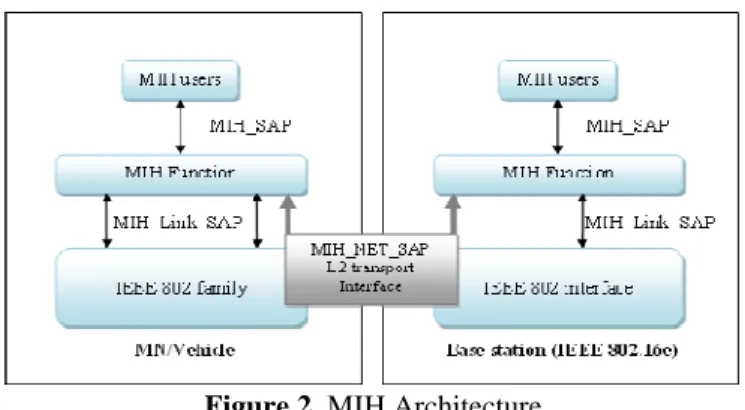
The IEEE 802.21 is the standard that provides services facilitating handovers between heterogeneous networks and an optimized handover framework that leverages generic link- layer intelligence independent of the specifics of mobile nodes or radio access networks. In this regard, the mobility management protocol stack of the network elements engaged in handover signaling is readdressed, and a logical entity is introduced between the link and upper layers. This entity, called MIH function (MIHF) provides three kinds of services: event, command and information services. To provide these services a group of primitives included in a media-independent service access point (SAP) MIH-SAP are used; on the other hand, to communicate with link layers the MIHF uses primitives that are defined in the media Independent MIH-LINK-SAP and mapped to technology-specific primitives. The architecture is shown in Fig 2. MIHF facilitates handover initiation (Network discovery, network selection, handover negotiation) and handover preparation
(layer 2 and layer 3 connectivity,
resource reservation).•
MIH_SAP: provides a media-independent interface for higher layers to control and monitor heterogeneous access links.•
MIH_LINK_SAP: provides a media-specific interface for MIHF to control and monitor media-specific links.•
MIH_NET_SAP: supports the exchange of MIH information and messages with a remote MIHF.Figure 2. MIH Architecture
3.
Novel Inter-Domain Proxy Mobile IPv6
This section describes the novel inter-domain PMIPv6 scheme based vehicular environment, including the LMA, PBU message novel extensions and handover procedures. To support the inter-domain mobility, LMA operation is extended as shown in Fig 3.
LMA PBU/PBA process Module Home Network Prefix Binding Cache Buffer FQDN/MIIS
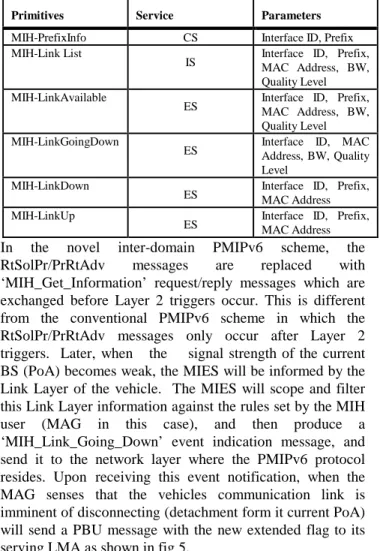
This novel LMA extension is introduced to solve the long handover latency issue when the vehicle roams between two PMIPv6 domains. For this extension we first define new MIH primitives and parameters. As shown in table 1, a new primitive is introduced in our novel handover scheme known as “MIH-Prefix Info” (Media Independent Handover Prefix- Information). The MIH-Prefix Info will contain information about the current serving PMIPv6 network domain. The stored information pulled by MIHF of the serving MAG represents lower and upper layer (e.g. L2, L3) information of the serving PMIPv6 domain. MAG pulls the information from the vehicle using MIH-links list and MIH-link Available. In this novel PMIPv6 handover scheme we suggest that the “Prefix” parameter is added to these primitives and thereby the serving MAG gets the information by pulling and using the prefix. Fig 4 shows the novel handover mechanism using MIH. It is assumed that the information will be stored in a Homogeneous Network Information (HNI) Container (HNI).
Table 1. New primitives and parameters of the novel inter-domain PMIPv6 scheme
Primitives Service Parameters
MIH-PrefixInfo CS Interface ID, Prefix
MIH-Link List
IS Interface ID, Prefix, MAC Address, BW,
Quality Level MIH-LinkAvailable
ES Interface ID, Prefix, MAC Address, BW,
Quality Level MIH-LinkGoingDown
ES Interface ID, MAC Address, BW, Quality
Level MIH-LinkDown
ES Interface ID, Prefix, MAC Address
MIH-LinkUp
ES Interface ID, Prefix, MAC Address
In the novel inter-domain PMIPv6 scheme, the RtSolPr/PrRtAdv messages are replaced with ‘MIH_Get_Information’ request/reply messages which are exchanged before Layer 2 triggers occur. This is different from the conventional PMIPv6 scheme in which the RtSolPr/PrRtAdv messages only occur after Layer 2 triggers. Later, when the signal strength of the current BS (PoA) becomes weak, the MIES will be informed by the Link Layer of the vehicle. The MIES will scope and filter this Link Layer information against the rules set by the MIH user (MAG in this case), and then produce a ‘MIH_Link_Going_Down’ event indication message, and send it to the network layer where the PMIPv6 protocol resides. Upon receiving this event notification, when the MAG senses that the vehicles communication link is imminent of disconnecting (detachment form it current PoA) will send a PBU message with the new extended flag to its serving LMA as shown in fig 5.
0 1 2 3
Sequence # 0 1 2 3 4 5 6 7 8 9 0 1 2 3 4 5 6 7 8 9 0 1 2 3 4 5 6 7 8
Lifetime A H L K M R P HNI Reserved
Mobility operations
Figure 5. Modified PBU Message
As can be noticed from fig 5 we extend the PBU message by adding a new flag to indicate the HNI report.
Since both pLMA and nLMA already knows the radio link information (i.e. MAC address and channel range of PoAs, etc.) of the PMIPv6 network domains from the HNI Report, the time to discover them is eliminated. Hence, there will be no need to use the ‘scanning’ mechanism to find neighboring BSs. In addition, Layer 2 and Layer 3 are assumed to start simultaneously this is because of all the necessary information will be known by both pLMA and nLMA as described above. In other words, with the MIH services, the vehicle and the PMIPv6 domain network entities, in particular the MAG in the access routers, are informed about the values of the relevant parameters necessary in handover decision making prior to the actual handover process. The overall LMA handover management is presented in fig 6.
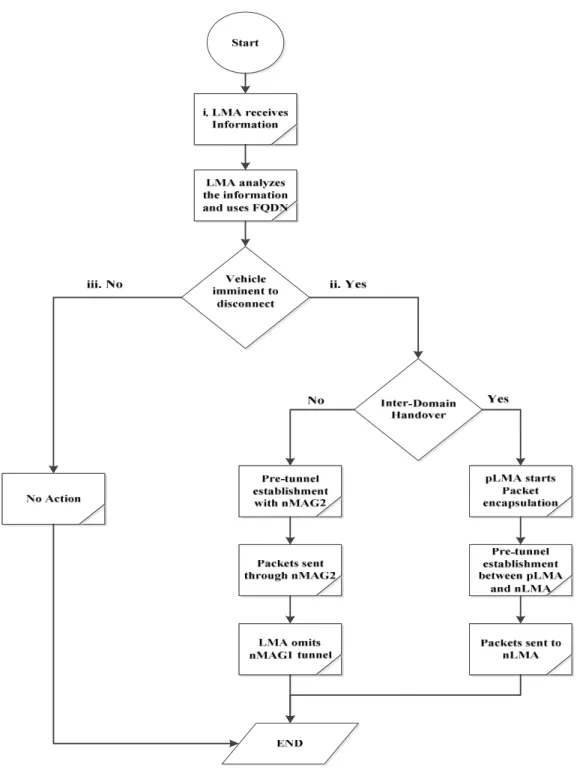
The process of the LMA extension presented in fig 6 can be summarized as:
i. When the LMA receives the HNI container from MAG, the information will be analyzed and FQDN will be used to solve the address. ii. If imminent to disconnect, then the vehicle will
switch to a new BS.
iii. If roaming in the same network LMA will establish a pre-tunnel with nMAG2 and forward the packets through the nMAG2 before the vehicle disconnects from its current nMAG1 connection. Finally, LMA deletes the tunnel with nMAG1. Otherwise, iv. pLMA starts packet encapsulation, and a
pre-tunnel will be established between pLMA and nLMA.
v. At the same time nLMA will know about pLMA from the information received, and a pre-connection will be provided to the vehicle vi. If not imminent to disconnect, then vehicle disconnection is not imminent and no action will be taken by the LMAs.
In other words, packet encapsulation process will start simultaneously with Data Link and Network Layer handover.
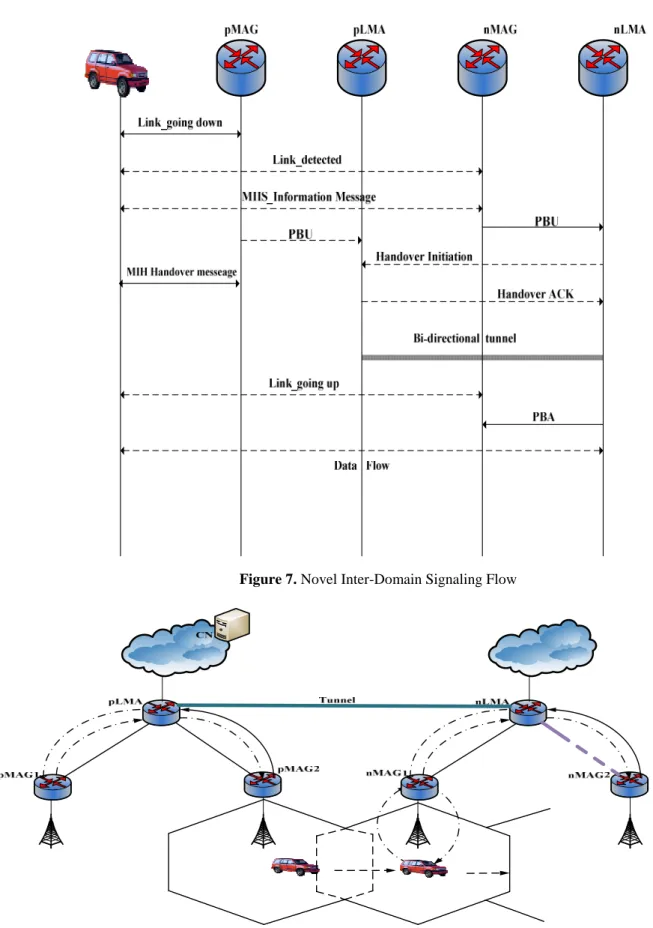
The novel Inter-domain PMIPv6 scheme exploits the services of the MIHF, in particular MIIS information contained in the HNI to reduce handover delay, e.g., inter- domain handover delay which can cause significant delay. The handover signaling flow is shown in fig 7.
MIH services enable some operations to be performed prior to the handover process while the vehicle is still connected to the old MAG’s link in the pLMA domain. Thus, when the handover is eventually performed, there will be less delay-causing procedures executed. For example, the inter-domain handover delay is dealt with by enabling the new nLMA to begin the handover procedure ahead of time by making use of the HNI information and the use of FQDN. Utilizing the HNI information, the vehicle and MAGs (pMAG and nMAG) get to know of their homogeneous neighboring networks’ characteristics by requesting from information elements at a centralized information or MIIS server. The information server is assumed to be collocated within the LMA.
The HNI information elements provide information that is essential for making handover estimation, such as, general information and accesses network specific information (e.g. network cost, service level agreements, QoS capabilities, etc.), point of attachment specific information (e.g. proxy care-of-address, data rates, MAC addresses, etc.), and other access network specific information.
4.
Performance Analysis
4.1 Network model
Fig 8 shows the network model, which includes vehicle, BS, mobile access gateway (MAG), local mobile anchor (LMA), and correspondent node (CN). There are two LMA domains and each LMA has n MAGs. The coverage of LMA is called domain, and the coverage of BS is known as cell. In other words, each domain has n cells. A BS connected to a MAG has a wireless interface for connecting vehicle (s). In this paper, we suppose that the vehicle is moving to a different LMA domain.
Furthermore, we assume that once the vehicle passes the overlap area the nLMA will be able to intelligently calculate the stay time of the vehicle within the communication range of the first serving MAG based on the MIH information.
We adopt the vehicle mobility model in where the direction of the vehicle motion in an LMA domain is uniformly distributed on [0, 2π].
For simplicity, we assume that the shape of the coverage area of a MAG is circular (non-circular areas, such as hexagonal shaped areas, can be reasonably approximated with the same size) and an inter-PMIPv6 consists of n MAGs with the same size of the coverage area of a Vehicle (s) move at an average velocity of V.
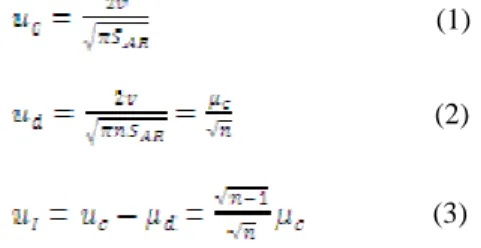
Let , be cell crossing rate and domain crossing rate, respectively. Furthermore, let be the cell crossing rate for that vehicle which is within the same PMIPv6 domain. Assuming that each AR has a coverage area of , the border crossing is given by [19].
(1)
(2)
(3)
The residence time in a cell and in a domain follows exponential distribution with parameters and , while session arrival process follows a Poisson distribution with rate . Hence, the average number of cell crossing and domain crossing can be obtained as follows:
(4)
. (5) From (2) and (5), we obtain:
(6)
Let be the average number of cell crossing rate of a vehicle, which is in the same PMIPv6 domain (intra-domain). The expression will be as follows
(7)
Crossing between to LMA domains, a vehicle crosses between two subnets. Thus, from (4) and (5), the average number of intra-domain handover is given by (8).
(8)
4.2 Parameter Analysis
We analyze the important performance metrics such as handover latency and binding update cost by using the network model and the mobility model.
Handover latency has a significant impact on supporting real-time applications. In PMIPv6 novel scheme, there is no need for movement detection and DAD. This is because the vehicle uses MN_pre address to uniquely configure its IP address.
(9)
Where represents the time needed for rout advertisement.
Hence, the total handover latency of the novel intra-domain PMIPv6 as introduced above is given by:
(10)
For the inter-domain PMIPv6 handover latency case,
and can be expressed as
(2* and
(2* ), respectively. Thus inter-domain PMIPv6 handover latency is expressed by:
(11)
As the handover operation between our novel scheme and I-PMIPv6 novel scheme is different, the handover latency of the two proposals is also different. From [13] I-PMIPv6 handover novel is represented by the given equation:
(12)
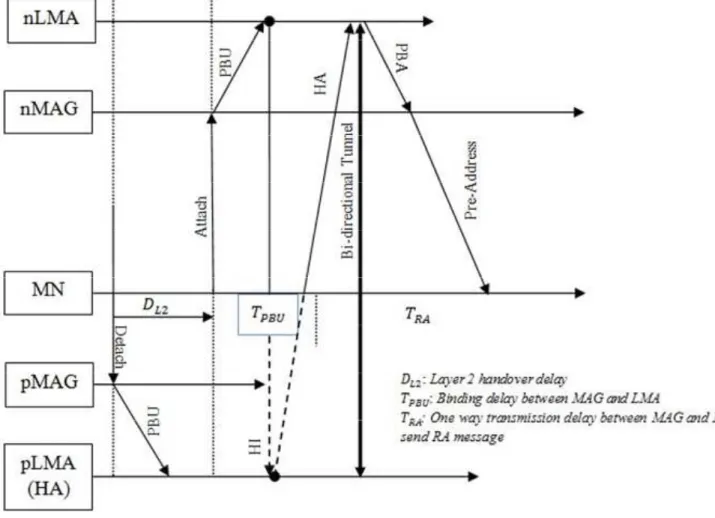
In the novel inter-domain scheme, since the vehicle is enabled to store the information needed (such as (lower layer information, profile, etc.)), pre-inter-domain Layer 3 handover process could be performed before performing the Layer 2 handover process. The NMAG retrieves the vehicle profile in addition to the lower layer information which is sent to the NLMA, establishing a pre-tunnel between the NLMA and PLMA. Furthermore, the NMAG does not need to perform the authentication because the vehicle will be pre- authenticated as well as requesting for the vehicles profile from the AAA server. Therefore the inter-domain PMIPv6 handover latency for the novel scheme is expressed by the following equation:
= (13)
Equation (13) could be re-written as follow:
= (14)
Where 2 equals 2 which represents the transmission of Handover Initiation (HI) and Handover Acknowledgment (H-ACK).
Route Advertisement (RA) is not calculated in our novel scheme because of applying MIH function instead we use link-going up, link-going down. Fig 9 shows the handover latency of the novel inter-domain.
Binding update depends on the sort of mobility management protocol and movement. Two classes of binding updates can be performed: intra-domain binding update ( ) and inter-domain bind update ( ) [19]. PMIPv6 inter-domain binding update is performed when the vehicle moves out of an LMA domain. The binding update is defined as follows:
(15)
(16)
In the novel inter-domain scheme, we assume that the binding update between the vehicles, HA and the CN does not occur within the inter-domain PMIPv6. Therefore, the binding update for the novel scheme can be expressed by the following equation:
(17)
5.
Numerical Results
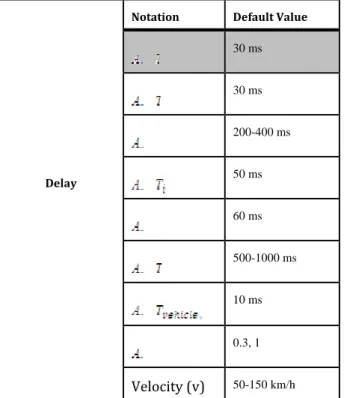
In this section, we use the parameters listed in Table 2 to calculate the handover latency for our novel solution and compare it with other existing PMIPv6 handover methods (IMAG, I-PMIPv6 and inter-domain) PMIPv6 introduced [7], [11], and inter-domain PMIPv6.
Table 2. Parameters to calculate the performance metrics
Delay
Notation Default Value
30 ms 30 ms 200-400 ms 50 ms 60 ms 500-1000 ms 10 ms 0.3, 1
Velocity (v) 50-150 km/h
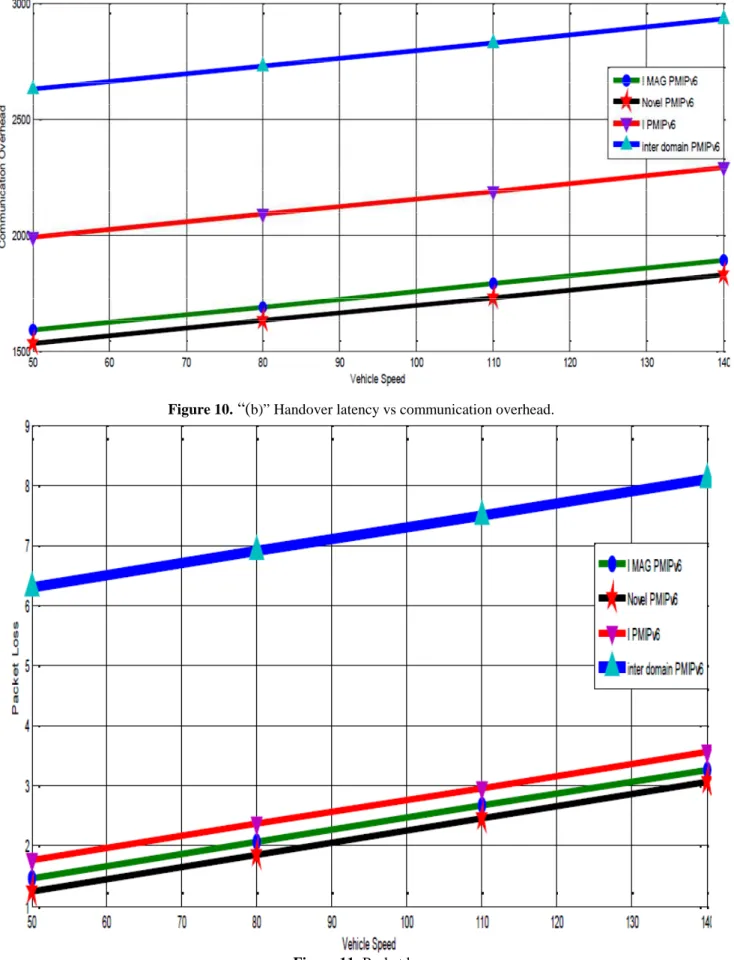
The communication overhead was measured against various numbers of hops between the major core network entities affecting the handover. The novel inter-domain PMIPv6 technique outperformed all of I-MAG, I-PMIPv6 and inter-domain PMIPv6 because the novel inter-inter-domain PMIPv6 technique exchanged fewer messages during the handover procedure as shown in fig 10b. In fact, the novel inter-domain PMIPv6 technique scheme, about 23% compared with I-PMIPv6 scheme and about 27.5% compared with Inter-domain PMIPv6 for a speed of 50 km/h. Furthermore, when the speed reached 140 km/h, the novel inter-domain PMIPv6 technique outperformed the other schemes because the novel inter-domain PMIPv6 technique reduced the communication overhead by 4.5%, 20.5%, and 24.6% for all of I-MAG, I-PMIPv6 and Inter-domain PMIPv6 schemes, respectively.
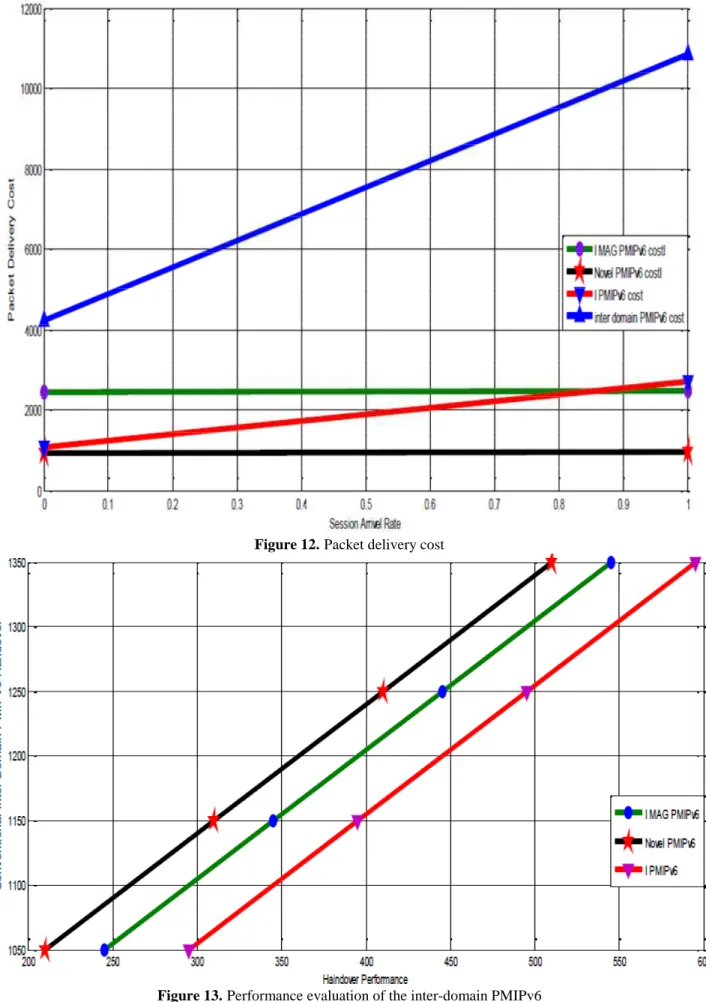
The novel inter-domain PMIPv6 reduced the number of the packets that were lost during the vehicles journey between the PMIPv6 domains as it can be noticed in fig 11 above. Furthermore, In terms of the average session arrival rate as shown in fig 12, the novel inter-domain PMIPv6 packet delivery performance was more efficient than MAG, I-PMIPv6 and Inter-domain I-PMIPv6. The novel inter-domain PMIPv6 reduced the number of packets lost about 5%, 8%, and 80% for all of I-MAG, I-PMIPv6, and Inter-domain PMIPv6 schemes, respectively.
From fig 12 it can be noticed that the variation of packet delivery cost agents an interesting observation is that the novel inter-domain PMIPv6 does not have any influence when crossing between inter-intra domains (sessions ) on the other hand, inter-domain PMIPv6 and I-PMIPv6 protocols are noticeably influence by
.
As increases the packet delivery cost for inter-domain PMIPv6 and I-PMIPv6 in addition IMAG does not have any influence of. Moreover, it could be noticed that the novel protocol generates less cost compared with all of inter-domain PMIPv6, IMAG and I-PMIPv6 protocols.
To evaluate the novel inter-domain PMIPv6 Protocol a relative gain for the handover latency with the conventional inter-domain PMIPv6 handover process is define as in [20]. Fig 13 shows the performance evaluation of the novel inter-domain PMIPv6 scheme, IMAG and I-PMIPv6.
It could be noticed that the novel inter-domain PMIPv6 scheme has better performance compared to IMAG and I-PMIPv6 this is because the novel inter-domain I-PMIPv6 introduces less handover latency therefore the novel protocols gain will be higher.
6.
Conclusions and Future Work
In this paper, we introduced a novel inter-domain PMIPv6 handover scheme for vehicular environment and compared our novel scheme with the inter-domain PMIPv6, I-PMIPv6 and iMAG. The novel PMIPv6 handover scheme is based on MIIS information function. Using the MIH services (MIIS), the vehicle can obtain information without rout discovery or RtSolPr/PrRtAd messages. Thus, the handover latency time due to concurrent start of L2 and L3 handover process is reduced. In this way, our scheme is suitable for a cost-effective network compared with I-PMIPv6 scheme. Furthermore, the novel inter-domain PMIPv6 performs better in terms of reducing the handover latency, packet loss
and the network communication overhead.
Our future direction consists of plans to develop a mathematical model and network simulator to evaluate the novel inter-domain handover scheme in different network environments for both inter-domain and intra-domain schemes. We will further investigate the novel intra-domain schema and its impact on seamless connection support for vehicles roaming in PMIPv6 domains.
Acknowledgement
The authors would like to thank to the administration of Faculty of Computer Science & Information Systems and Universti Teknologi Malaysia for their encouragement and generous support.
References
[1] Park, S., Euisin Lee, Min-Sook Jin, & Ang-Ha Kim, “Inter-domain Roaming Mechanism Transparent to Mobile Nodes among PMIPv6 Networks,” IEICE TRANSACTIONS on Communications Vol.E93-B, No.6, pp.1608-161, 2010.
[2] Johnson, D., C. Perkins, & J. Arkko, “Mobility Support in IPv6,” IETF, RFC 3775, 2004.
[3] Chung-Ming Huanga, Meng-Shu Chianga & Tz-Heng Hsub, “A packet forwarding control scheme for vehicle handover over the ITS networks,” Computer Communications, Vol. 31, No 12, pp. 2815-2826, 2008. [4] Fazio, Palazzi, Claudio E., Das Shirshanka & Gerla M.,
“Facilitating real-time applications in VANETs,” Consumer Communications and Networking Conference (CCNC) IEEE, pp. 981-985, 2007.
[5] Arnold, T., Lloyd W., Jing Zhao, & Guohong Cao, “IP address passing for VANETs,” Pervasive Computing and Communications Conference, PerCom Sixth Annual IEEE, pp. 70-79, 2008.
[6] Bechler, M., & L. Wolf, “Mobility management for vehicular ad hoc networks,” IEEE Vehicular Technology Conference (pp. 2294-2298), IEEE, 2005.
[7] Lee, K.-W., Won-Kyeong Seo, You-Ze Cho, Jong-Woo Kim, Jin-Soo Park, & Byoung- Sub Moon, “Inter-domain handover scheme using an intermediate mobile access gateway for seamless service in vehicular networks,” International Journal of Communication Systems, pp. 1127–1144, 2009.
[8] Giaretta, G, “Interactions between PMIPv6 and MIPv6: scenarios and related issues,” IETF Internet Draf-ietf-netlmm-mip-interactions-07, 2010.
[9] Giaretta, G, “Interactions between Proxy Mobile IPv6 (PMIPv6) and Mobile IPv6 (MIPv6):Scenarios and Related Issues,” Internet Engineering Task Force (IETF), 2012.
[10] Weniger, K., G. Velev, & V. Devarapalli, “Data forwarding behaviour of co-located HA/LMA in PMIP6-MIP6 nteractions scenario C,” IETF Internet Draft-weniger-netlmm-mip-pmip-forwarding-00, 2008.
[12] Jee-Hyeon, N., Soochang Park, Jung-Mo Moon, Sangho Lee, Euisin Lee, & Sang-Ha Kim, “Roaming Mechanism between PMIPv6 Domains,” ETF Internet Draft- park-netlmm-pmipv6-roaming-01, 2008.
[13] Gundavelli, “Proxy Mobile IPv6, IETF, 2008.
[14] Lee, J.-H., Jong-Hyouk Lee, & Tai-Myoung Chung “A Novel Inter-LMD Handoff Mechanism for Network-Based Localized Mobility Managemen,” International Conference on Next Generation Teletraffic and Wired/Wireless Advanced Networking, pp. 356-366, Springer, 2007.
[15] Zhong, F., Chai Kiat Yeo, & Bu Sung Lee, “Enabling inter-PMIPv6-domain handover with traffic distributors,” Journal of Network and Computer Applications, 397-409, 2010.
[16] Soonghwan, R., & Nguyen Van Hanh, “Global Mobility Support in Proxy Mobile IPv6 for Mobility-Unaware Hosts,” IEEE 34th Conference on Local Computer Networks (LCN 2009), IEEE, 2009.
[17] Lee, J.-H., Hyung-Jin Lim, & Tai-Myoung Chung, “A competent global mobility support scheme in NETLMM,” AEÜ - International Journal of Electronics and Communications, 950-967, 2008.
[18] Lee, J. M., M. J. Yu, Y. H. Yoo, & S. G. Choi, “A new scheme of global mobility management for inter-VANETs handover of vehicles in V2V_V2I network environments,” in Proceedings of IEEE NCM, pp. 114-119, IEEE, 2008.
[19] Xiao, L., & Jiawei YANG, “Performance analysis of proxy mobile IPv6 based on IEEE802.16e,” Springer, 2010.
Figure 1. The Procedure of MN Joining a PMIPv6 domain
Vehicle-MIH
pLMA pMAG nMAG nLMA
MIH-Link List with Prefix
MIH-Link Going Down MIH-Link Available
with Prefix
MIH-Link Going Up
MIH-Prefix Information
MIH-Prefix Information
PBU
HI FQDM
Hack
PBA
MIH-Link Down MIH-Link Up
Figure 7. Novel Inter-Domain Signaling Flow
Figure 9. Novel Inter-domain PMIPv6 Handover Procedure and timing diagram
Figure 10. “(b)” Handover latency vs communication overhead.
Figure 12. Packet delivery cost