
The causes of External Recognition:
A Crisp Set Analysis
Master Thesis
Master of Political Science (Conflict and Cooperation)
Institute of Political Science
Faculty of Social and Behavioural Sciences
Leiden University
Student: Justina Bieliauskaitė (s1453025)
Supervisor: Dr. A. Chalmers
2nd reader: Dr. F. Ragazzi
Word count: 16.598
Leiden
Table of contents
List of tables 4
Abbreviations 5
Introduction 6
1. Literature review 7
2. Time frame and selection of the cases 13
3. Research design 16
4. Operationalization and discussion of variables 20
4. 1. External recognition ... 20
4.2. Violations of human rights and injustice ... 20
4.3. Ethnic differences ... 22
4.4. Effective governance and quality of life ... 24
4.5. Separatist challenges within the borders of the Veto Powers ... 25
4.6. Relations between the Veto Powers and the mother state ... 27
5. Application of the qualitative comparative analysis 28 6. Discussion of the results 39 6. 1. Violations of human rights and injustice ... 40
6.2. Ethnic differences ... 41
6.3. Effective governance and quality of life ... 43
6.4. Separatist challenges within the borders of the Veto Powers ... 44
6.5. Relationship between the Veto Powers and the mother state ... 45
6.6. What leads to recognition? ... 46
Conclusion 49
List of references 52
Appendix 1. Types of conditions 62
4
List of tables
Table 1: Research cases ... 15
Table 2: Ethnic differences ... 23
Table 3: Dichotomized data ... 29
Table 4: Truth Table ... 31
Table 5: Boolean minimization formula for [1] outcome (RECOGNITION) ... 31
Table 6: Boolean minimization formula for [0] outcome (non-recognition) ... 33
Table 7: Minimization with logical remainders for [1] outcome (RECOGNITION) ... 34
Table 8: Minimization with logical remainders for [0] outcome (non-recognition) ... 34
Table 9: Intermediate solutions for [1]outcome RECOGNITION ... 35
Table 10: Intermediate solutions for [0] outcome (non-recognition) ... 35
Table 11: Consistency and coverage of conditions for [1] outcome (RECOGNITION) ... 37
Table 12: Consistency and coverage of conditions for [0] outcome (non-recognition) ... 37
Table 13: Types of conditions ... 62
Table 14: Boolean minimization formula for [1] outcome (RECOGNITION), excluding case of Kosovo ... 63
Table 15: Minimization with logical remainders for [1] outcome (RECOGNITION), excluding case of Kosovo ... 63
Table 16: Intermediate solution for [1] oucome (RECOGNITION), excluding case of Kosovo ... 63
Table 17: Consistency and coverage of conditions for [1] outcome, excluding case of Kosovo ... 64
Table 18: Boolean minimization formula for [0] outcome (non-recognition), excluding case of Kosovo ... 64
Table 19: Minimization with logical remainders for [0] outcome (non-recognition), excluding case of Kosovo... 64
Table 20: Intermediate solutions for [0] outcome (non-recognition), excluding case of Kosovo ... 65
5
Abbreviations
cs/QCA – crisp set qualitative comparative analysis
DV – dependent variable
fs/QCA – fuzzy set qualitative comparative analysis
H1 – hypothesis 1 (same for the H2; H3; H4; H5)
IV – independent variable
mv/QCA – multivalue qualitative comparative analysis
QCA – qualitative comparative analysis
UK – United Kingdom
UN – United Nations
US – Unites States
6
Introduction
The twentieth century witnessed a dramatic rise in the number of newly created states, especially big changes are noticeable after WWII as the number of states almost quadrupled (Coggins, 2011a: 27-28). The United Nations officially had 51 members by 1945 when it was created; at the moment there are 193 official members (United Nations, 2014a). Coggins (2011a: 28) demonstrated that secession was the most common cause of state creation, Pavkovic (2008: 1) supported her idea by claiming that secession became the principal way of gaining independent statehood. Despite that, not all the ‘attempted secessions’ are so successful: some of the entities that claim to be independent states are not recognized internationally. Without the international recognition these states cannot keep diplomatic and economic relations, join international organisations or sign international treaties (Fabry, 2010: 7).
7
Different theories stemming from the disciplines of political science, international law, philosophy and ethics provide answers to this question. It is argued here that the question of state acknowledgement can only be answered by combining these various theoretical approaches. As such, hypothesis in this thesis are derived from a few different competing theories. It is argued here that there is not one specific factor that leads to external recognition; rather, there is a set of factors that together explain selective recognition of secessionist states. In order to answer the research question and to define this set of factors qualitative comparative analysis is used in this work. More precisely, the crisp set that is analysed using fs/QCA 2.5 programme.
1. Literature review
Although states are considered to be the main actors of the international system, and secessionism has become the main avenue for the creation of states, this process has gained much more interest in academia outside political science. It is a widely discussed topic among scholars of international law: the issues of right of self-determination (Radan, 2011; Cop and Eymirlioglu, 2005), secession in the framework of constitutionalism (Macedo and Buchanan, 2003), border disputes in the case of secession (Johanson, 2011) and other questions are widely discussed. Legal and political philosophy is another discipline that examines various issues such as the legitimacy of secession and a peoples’ right to decide (Buchanan, 2003).
8
growing attention to the secession and creation of new states in the twenty-first century. Radan (2008; 2011) is one of these contemporary authors who concentrates on legality and explanations of secession. His definition of the term is used throughout this thesis. Secession, according to Radan (2008: 18-19), ‘is a creation of a new state upon territory previously forming part of an existing state.’ Consequently, the unfinished or unsuccessful attempt to
create a new state is called the ‘attempted secession’. What is more, the term ‘secessionist state’ in this work is also employed to name a state that is not (yet) recognised by the
international community, although it has proclaimed its de facto independence. The instruments and manner of the creation of a new state, whether it is a violent conflict, threat of force or a mutual agreement does not change the outcome, so these issues are outside the scope of this thesis.
It was argued elsewhere (e.g. Peterson, 1997) that external recognition does not play any role in the creation of the state, and as long as this newly created state meets the requirements of statehood, it is a state. These requirements are set in the Montevideo Convention of 1933: permanent population, defined territory, effective governance and the capacity to enter into relations with other states (Convention on Rights and Duties of States, 1933). However, as real world cases prove, unilateral secession is still a taboo in the international system—even if a secessionist state fulfils all the formal requirements (Fabry, 2008: 52). This is why I both support a constitutive theory and assert that only external recognition of a state creates that state. As Fabry (2008: 51) put it, it is a ‘foreign
acknowledgment that gives the community the standing of a sovereign state in international relations and law,’ and thus unrecognized states are not able to exercise their full sovereignty.
9
If an entity is not internationally recognized but fulfils all the formal statehood requirements, it can be called a de facto independent state, or as Caspersen (2011; 2012) called it, an ‘unrecognized state’. Caspersen examined all of the different aspects of
unrecognized states: their status, origins, capabilities of state building, function within the international system, likely future trajectories, etc. Her definition of the unrecognized or de facto independent state is also used throughout this thesis. The state is called an ‘unrecognized state’ when: 1) it has achieved de facto independence covering at least
two-thirds of the territory to which it lays claim, including the main city and the key regions; 2) its leaders are seeking to develop further state institutions; 3) the entity has existed at least for 2 years; 4) the entity has not gained international recognition or has only been recognized by a patron state and few other states of less importance; 5) the entity has declared formal independence (Caspersen, 2012: 6, 11).
Another author, Siroky (2011: 47), explained the reasons that lead to international recognition of secessionist states and asserted that different existing explanations can be grouped in three main categories according to the unit of analysis: 1) those that concentrate on the secessionist group, 2) the secessionist state and 3) external actors of foreign powers. Sometimes, scholars use mixed explanations that include factors from all of the above categories. Siroky (2011) argued that extremely impoverished or very distinctive ethnic groups; weak, poor, and ineffective mother states; political and economic support from external forces; and support of ethnically similar external forces are all factors that shape and influence secessionist movements and have an impact on their outcomes. Although Siroky’s
10
The first category, as mentioned above, stresses the importance of the secessionist group. Two different approaches are identified within this category. Some authors claimed that the general right to secession exists only when the group in question (secessionist group) has suffered injustices, while others claimed that group’s ethnic distinctness plays the most important role. The former idea was held by A. Buchanan, (1991; 2003) who asserted that a group can only secede and be recognized internationally when: 1) physical survival of its members is threatened by actions of the parent state (e.g. policy of the Iraqi government towards Kurds in Iraq) or 2) it suffers from violations of basic human rights (e.g. East Pakistanis who seceded to create Bangladesh), or 3) its previously sovereign territory was unjustly taken by the mother state (as with the Baltic Republics). Similar claims were supported by Dersso (2012: 231), who pointed out that external powers are more willing to recognize a secessionist group when it has suffered violations of human rights or systematic discrimination (it can be ethical, regional, economic, etc.). Moreover, Orentlicher (2003) in her study of democratic principles behind the external recognition also asserted that the international community should recognize unilateral rights to secede when a secessionist group has survived serious injustice and exclusion. Finally, Sterio (2013: 60-61) included injustice and violation of human rights as one of the four factors essential for external recognition. She claimed that the secessionist group must prove that it has been subject to oppression or has faced human rights’ violations; otherwise it cannot have international
support. The first hypothesis summarized these considerations.
Hypothesis 1: international recognition is more likely if the group in consideration (secessionist group) has suffered injustices or human rights’ violations.
11
distinctive from the majority or the ruling elite in a parent state. Heraclides (1991: 19) argued that if the secessionist group is ethnically (or otherwise culturally) different from a parent state, the role played by the group’s inequality or disadvantage becomes secondary. In other words, a group’s distinctness is the most important factor for the secession. The same view
was held by Song (2003) who maintained that being a distinctive nation within the parent state gives people a right for self-determination, and this right should be supported by the international community. Casperson (2012: 54-55) added that an ethnically different secessionist group will receive even more international support if there are people of the same ethnicity living in another (for example, neighbouring) country. Accordingly, the second hypothesis stressed the significance of ethnical distinctiveness.
Hypothesis 2: international recognition is more likely if the secessionist group is ethnically different from the majority or ruling elite in a patron state.
The second category of authors derived their explanations from the state level. Many scholars who refer to the state level indicators stress various capabilities of secessionist states that help them gain international support. However, scholars differ in their opinion about the specific factors: Buchanan (1997), Orentlicher (2003), Sterio (2013) maintained that the newly created state must ensure that no (or less) human rights’ violations will appear;
12
the international community is more convinced to act in favour of recognition. All together these factors imply that the secessionist state offers better governance and quality of life to its citizens compared to what was provided by a parent state1.
Hypothesis 3: international recognition is more likely if a secessionist state provides more effective governance and better quality of life for its people than the parent state.
Finally, the third category concerns external factors. Coggins (2006; 2011; 2011a) proved in her works that these factors are as important as the internal. She demonstrated that states within the international community (most importantly – the biggest and most important states) will act on their own political motives while deciding upon recognition. The main factors to look at are those that shape the power games between the Great Powers: their relation with the parent state, disorders in domestic politics, etc. The author’s main claim was that realist theories of international relations should be taken into
consideration when explaining the support of the most important states of the international system. The same ideas were adopted by Sterio (2013), who concluded her book with the claim that rule of the Great Powers became the most important in theory of external self-determination; therefore, the motives of these countries should be studied carefully. Saideman (2011) also based his research on the assumption that support from the strongest players in the international community is essential for the success of secessionist movements. He concluded that power and parochial interest govern the foreign policies of the most powerful countries and their decisions towards states’ recognition. Additionally, Walker (1998: 36) argued that most states (including the Great Powers such as Russia and the US) are reluctant to recognize the new members of the international community because of the risk of
1
13
self-determination and separatism within their own borders. To sum up all these discussions, the hypothesis are based on Coggins’s (2006: 62-65) assumptions about the behaviour of the most powerful states and their external and domestic security considerations on the question of recognition.
Hypothesis 4: international recognition is more likely if the Veto Powers2 are not beset by separatist challenges at home (by the time when a question of recognition is
raised abroad).
Hypothesis 5: international recognition is more likely if it weakens the enemies of the Veto Powers and does not weaken their friends.
2. Time frame and selection of the cases
The cases were chosen from the time period of 1992 to the present day because during the Cold war era secessionist countries had different possibilities and constraints that are not present today (mainly due to another form of secessionism – decolonization) (Caspersen, 2012: 11). What is more, although dissolution is also a kind of secessionism, there are many different interpretations in both political science and international law about the cases of the Soviet Union, the Socialist Federal Republic of Yugoslavia and Czechoslovakia, so these events were left out. Finally, due to the scope of the research it was too difficult to include more cases and extend the time frame.
2
14
All the cases that were included in the research were either states that managed to succeed and gain recognition after 1992 or that had existed as unrecognized states (the criteria of unrecognized states are mentioned above) until 2013 and had fulfilled the Montevideo criteria. These criteria helped to eliminate such entities as Western Sahara (Sahrawi Arab Democratic Republic) and Aceh movement because they did not control more than 70% of the clamed territory. Moreover, territories that maintained a very high level of independence but had not officially proclaimed their intentions of independence such as Puntland in Somalia or Nakhichevan in Azerbaijan were also excluded from the research (Caspersen: 2012: 8-11).
Due to its limited length this research excluded ex-secessionist states that re-seceded. That means the cases that in the time period of 1992 to the present day were unrecognized states, and because of some developments do not enjoy this status anymore. For example, Chechnya in 1996-2000 was claiming its independence from Russia, but after the war it was made to renounce these claims. Other cases of re-secession which were not included to the research: Bougainville (1975-1997) in Papua New Guinea, Republika Srpska (1992-1995) and Republika Srpska Krajina (1991-1995) in Croatia, Tamil Eelam in Sri Lanka (1986-2009), Kurdish Autonomous Region in Iraq (1991-2004) (Caspersen, 2012:12).
The cases of Taiwan and Kosovo were treated as unrecognized states, because they were not members of the UN and they were not recognized by some of the most powerful countries in the international system (Caspersen, 2012: 10).
15
secession was very unproblematic—supported by a mother state and based on the precedents of the other countries that seceded in 1992 (Sterio, 2013: 49-50).
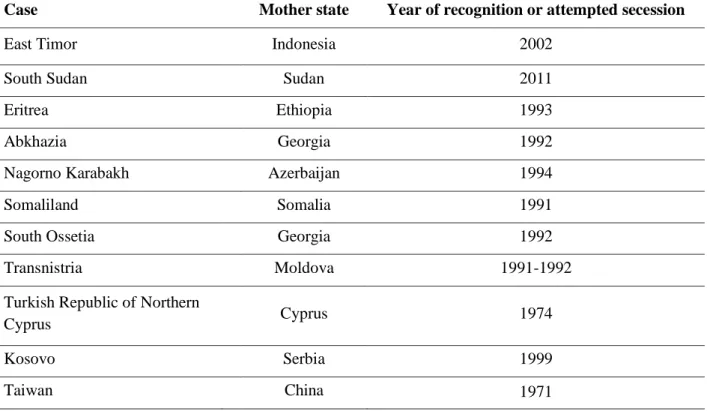
It means there are three secessionist countries that gained recognition in the time period from 1992 to the present day: East Timor, South Sudan and Eritrea. Eight unrecognized or de facto independent countries were also examined: Abkhazia, Nagorno Karabakh, Somaliland, South Ossetia, Transnistria (also called Transdniestria), the Turkish Republic of Northern Cyprus, Kosovo and Taiwan (Caspersen 2012: 12; Caspersen and Stansfield, 2011: 185; Pavković and Radanan, 2007: 257-259). Table 1 shows all of the
selected cases as well as the mother state from which they seceded or attempted to secede and the dates of either independence or of the announced but unrecognized independence.3
3
All three recognized states were admitted to the UN (denoting recognition) in the same year as they proclaimed their independence.
Table 1: Research cases
Case Mother state Year of recognition or attempted secession
East Timor Indonesia 2002
South Sudan Sudan 2011
Eritrea Ethiopia 1993
Abkhazia Georgia 1992
Nagorno Karabakh Azerbaijan 1994
Somaliland Somalia 1991
South Ossetia Georgia 1992
Transnistria Moldova 1991-1992
Turkish Republic of Northern
Cyprus Cyprus 1974
Kosovo Serbia 1999
16
3. Research design
The qualitative comparative analysis (QCA) is a research design that makes this project unique because it is a middle ground between case-oriented (qualitative) and variable-oriented (quantitative) approaches. The goal of this strategy is to combine the best features of both approaches (Rihoux and Lobe, 2009: 223). The method was developed by Charles Ragin for a comparative case study research with the small- and moderate-N datasets (for those research studies ranging from 5-10 and from 50-80 cases) (Delreux and Hesters, 2010: 4). It is said to be among the most widely influential and most innovative strategies in social science
methodology (Thiem and Dusa, 2013: 87; Breiger, 2009: 243).
The method is based on the logic of Boolean algebra (see more: Ragin, 1987) and is carried out by special computer programmes. Using this method one has first to produce a data table, wherein each case is displayed as a combination of conditions (with dichotomous variables that have values of 0 or 14) and an outcome (also having a value of 0 or 1). Afterwards a truth table is produced (mostly by using computer programmes), and it reconstructs data as a list of configurations5. Every such configuration might correspond to a few observed cases (Rihoux and Lobe, 2009: 224). Next, a Boolean expression can be constructed, which is a long formula consisting of configurations described in a truth table. Finally, Boolean minimization, a procedure that reduces long Boolean expressions to their shortest possible expression (also called minimal formula)6 and is the main procedure of comparative qualitative analysis, is performed. This minimal list of prime implicants unveils
4
Dichotomous values are only used for cs/QCA (as applied in this research); for a fuzzy set QCA various values between 0 and 1 are possible, meanwhile values of mv/QCA can be 0, 1, 2, 3, 4, etc.
5
‘A configuration is a given combination of some conditions and an outcome’ (Rihoux and Lobe, 2009: 224). 6
17
the regularities in the data and allows researchers to make generalizations and interpret this minimal formula, possibly in terms of causality (Rihoux and Lobe, 2009: 225).
One of the advantages of the QCA method is, that being a middle way between qualitative and quantitative approaches, QCA consolidates contradicting goals of both strategies. As a qualitative method, it requires a thorough knowledge of the cases therein (needed in order to complete a data table, resolve possible contradictions, interpret the final solution7), and thus allows researcher to gather in-depth insight and capture the complexity of cases (Rihoux and Lobe, 2009: 223; Rihoux and Ragin, 2009: 6). As a quantitative approach, it allows researchers to analyze more cases than other case-orientated methods, thus enabling researchers to produce generalizations. Additionally, as put by Rihoux and Lobe (2009: 224), ‘the Boolean algorithms allow the minimal formulas that are parsimonious, i.e. that can be
expressed with the fewest possible conditions within the whole set of conditions that are considered in the analysis‘.
What is more, the idea that each cause has its own single, independent impact on the outcome is rejected in the QCA; it is instead replaced by the assumption that several causes can be present simultaneously (a combination of factors thus lead to an outcome), that is so-called ‘conjunctural causation’ (Rihoux and Ragin, 2009: 8-9). As it is argued in this work that external recognition might be caused by a set of distinct conditions, this is an appropriate method whereby one might assess these conditions.
Another big advantage of the QCA is that it allows researchers to assess and identify different combinations of causal conditions that are capable of generating the same outcome. It means that not only several factors in one configuration may lead to an outcome, but that even different configurations of factors can lead to the same outcome (Sehring,
7
18
Korhonen-Kurki and Brockhaus, 2013: 2). Using Boolean algebra, QCA can evaluate multiple conjectural causation, i.e. different paths (that is, different sets of conditions) that lead to the same outcome (Rihoux and Ragin, 2009: 8-9). Additionally, the method enables researchers to observe those situations wherein a given condition is combined with other conditions that may sometimes act in favour of the outcome, and sometimes, when differently combined, that act against it (Rihoux and Ragin, 2009: 8-9; Delreux and Hesters, 2010: 4-6). In other words, the certain (or given) factor, depending on its configuration with other factors, can have either a positive or negative effect on the outcome (Sehring, Korhonen-Kurki and Brockhaus, 2013: 2). Using other methods such factors would be considered as irrelevant; meanwhile, with QCA one assumes that causality also depends on its underlying configuration (Sehring, Korhonen-Kurki and Brockhaus, 2013: 2-3).
Finally, this method is ideal to analyse this study’s breadth of cases, as eleven cases is too broad for an in-depth case analysis whereas it is also too limited for the quantitative analysis. Qualifying case numbers for this method could be between 5 and 50, but the ideal number is from 8-10 or 20-30 (Norkus ir Morkevičius, 2011: 48-52). It is as well ‘a particularly powerful tool for theory testing’ (Rihoux and Lobe, 2009: 225) that helps test this study’s hypothesis and its main assumption that recognition of secessionist states is
19
Crisp set QCA analysis was chosen instead of fuzzy set QCA because the hypothesis did not require an assessment of the level or degree of the conditions. Instead, the presence or absence of the described hypothetical conditions is important (that is, differences in kind matter more than differences in grade), so the cs/QCA was a more appropriate choice in this case (Sehring, Korhonen-Kurki and Brockhaus, 2013: 19). What is more, dichotomization means some degree of simplification which allows researcher to reduce the complexity, that is, to explain difficult social phenomenon in a less complicated and less complex manner (Yamasaki, De Meur and Rihoux, 2009: 148-149). Although this choice resulted in the loss of some information (while coding information to dichotomous variables), this ‘loss’ is compensated by the in-depth knowledge that the researcher gains while examining the cases and which is later used when interpreting results and resolving contradictions. Finally, cs/QCA allows a greater degree of generalization and produces more parsimonious results than does fs/QCA.
20
4. Operationalization and discussion of variables
4. 1. External recognition
The dependent variable—external recognition—was measured by a membership in the UN. Although membership does not mean that all of the UN member states recognize the secessionist country, it does allow the newly created country to enjoy all of the privileges of sovereignty on the international stage. What is more, it means that more than two-thirds of UN members have supported the independence of the newly created state (United Nations, 2014b). Pavković and Radan (2007: 36) argued that admission to the UN qualifies a secessionist state as recognised and independent and called it ‘the ultimate form of recognition of independence.’ Information on the history of recognition was provided in an
official website of the UN (United Nations, 2014c). If the secessionist state was recognized and admitted to the UN it got a positive value 1, if not – it got 0.
4.2. Violations of human rights and injustice
As for the independent variables, the first one concerned human rights violations and injustice (either violation of human rights or injustice had to be present). Injustice was understood as the existence of discriminatory or repressive policies towards the secessionist group. Qualitative data of the Minorities at Risk (2014a) reports were analysed in order to identify if there were any violations of the rights or unjust policies towards the secessionist group8; additional secondary sources were also taken into consideration. For recognised states, injustice in the year of independence and a time period of 10 years9 before the secession was analysed, whereas for attempted secessions – 10 years before the announced secession and the
8
No information was given on the East Timor case, the secondary literature sources were analysed instead. 9
21
time period until 2014 when it was existing as an unrecognized state. If there were violations of human rights or unjust policies during this time, the value for this variable was 1, if not – 0.
Eritrea, South Sudan, East Timor and Kosovo were the only places where injustice or strong violations of human rights occurred. As for Eritrea, after WWII it was incorporated into federation with Ethiopia and enjoyed strong autonomy. However, in 1962 the new Emperor imposed a strong centralised rule and abrogated all rights of autonomy for Ethiopia. The Tigrayans, who are the majority in current Eritrean territories, lost their political rights and privileges (even the official Arabic and Tigrinya languages were replaced by Ahmaric), and Ethiopian leaders repressed the opposition (prohibition of Eritrean national symbols, imposition of the censorship) (Minorities at Risk, 2014b; Sturman, 2011: 498; Giorgis, 2010: 6). Similar patterns of injustice were also found in Sudan where the South and North had been divided since colonization: the southern people were restricted from political participation and decision-making, Sharia law was imposed (although the majority of southerners were not Muslim). What is more, despite the fact that the South has always been less developed, the Sudanese government did not attempt to improve the quality of life in the underdeveloped South (Minorities at Risk, 2014c; de Kock, 2011: 505). East Timor, though, was a different case as Indonesian rule over the country was marked by violations of human rights such as ‘extreme violence and brutality of the armed forces,’ human massacre (it was
22
Meanwhile, in the other cases of Abkhazia, Nagorno Karabakh, South Ossetia, Transnistria, Somaliland and Taiwan the secessionist regions have high levels of autonomy and are entitled to decide themselves upon the most important issues. No political, linguistic, religious or other injustice was reported (see: country profiles for the each case in Minorities at Risk, 2014a). The Turkish Cypriots do not have representation in the government, and most of them do not vote in the elections; however, it is their choice and mean of protest. Economically and culturally, they are also not discriminated and enjoy full autonomy (Minorities at Risk, 2014e).
4.3. Ethnic differences
The second independent variable is ethnic differences. In order to identify if the secessionist group was ethnically different from the rest of the population at the time of (attempted) secession information about the ethnic composition from the CIA World Factbook (2014) was used. The data was gathered for the year of proclamation of independence, in cases there this information was inaccessible the data from the closest census was used. In a few cases where the data about ethnicity was not provided, other official reports were used. If most of the population in secessionist territory was ethnically different from the majority of the population in a mother state the value 1 was given for this variable, if not – 0.
23
Table 2: Ethnic differences
Case Ethnic groups in a
secessionist state
Ethnic groups in a mother state
Other major cultural differences (that cause problems or dissatisfaction between the mother state and
the secessionist state)
East Timor
Austronesian (Malayo-Polynesian); Papuan; small Chinese minority
Javanese 40.1%; Sundanese 15.5%; Malay 3.7%; Batak,
Madures, Betawi, Minangkabau, Buginese, Bantenese 16.9%; other 23.7%
Religious differences: most of the Indonesians are Muslim meanwhile most o f t he Timo rese are Christ ia n
South Sudan
Local tribes, black Africans: Dinka 35.8%;
Nuer 15.6%; Shilluk; Bari; Kakwa; Kuku; Mandari; Ndogo; others
Sudanese Arab 70%; other 30%
Religious differences: most of the Sudanese are Sunni Muslim while South Sudanese are animist
or Christian
Eritrea
Tigrinya 55%; Tigre 30%; Saho 4%; Kunama, Rashaida, Bilen (6%); other 5%
Oromo 34.5%; Amhara 26.9%; Somali 6.2%; Tigray 6.1%; Sidama 4%; Gurage, Welaita
4.8%; ot her 17. 5%
- Abkhazia Abkhaz 44.7%; Hemshin Armenian 20.8%; Georgian 18,6%; Russian 10.9%; other
5% (Human Rights Watch, 2011: 9-10)
Georgian 83.8%; Azeri 6.5%; Armenian 5.7%; Russian 1.5%;
other 2.5%
- (N.B. Linguistic difference exist, but Abkhazian autonomy is
granted a right to use Abkhaz as an official language)
Nagorno Karabakh
Armenian ( 95%, according to the official
figures of the local governance); 5% other
(Office of the Nagorno Karabakh Republic,
2005)
Azerbaijani 91.6%; Lezgian 2%; other 6.3%
Religious (majority of Muslim in Azerbaijan and majority of Armenian Aspostolic Christian in
Azerbaijan) and liguistic (Azerbaijani vs. Armenian)
Somaliland Majority of Somali (no official census)
Somali 85%, Bantu and other
non-Somali 15% -
South Ossetia Majority of Ossetians (no official census)
Georgian 83.8%; Azeri 6.5%; Armenian 5.7%; Russian 1.5%;
other 2.5% - Transnistria Moldovans 31.9%; Russians 30.4%; Ukrainians 28.8%; other 8.9% (Ministry of
Foreign Affairs of the Pridnestrovian Moldavian Republic,
2004)
Moldovan/Romanian 78.2%; Ukrainian 8.4%; Russian 5.8%;
Gagauz 4.4%; other 3.2%
Various disputes between the ethnic Slavs (Russians, Ukrainians) and Moldovans are
salient; linguistic differences (Cyrillic vs. Latin alphabet for
Moldovan language ) (Roper, 2001: 106-107)
Turkish Republic of
Northern Cyprus
Majority of Turkish Cypriots (no official
census)
Greek 77%; Turkish 18%; ot her 5%
Religious differences: Turkish Cypriots are Muslim and Greek
Cypriots are Christian
Kosovo Alba nians 92%; ot her 8%
Serb 83.3%; Hungarian 3.5%; Ro many, Bo sniak
4.1%; ot her 5.7%; undec lared 3.4%
Notable religious (Muslim vs. Christian) and linguistic differences (Alabian vs. Serbian)
differences
Taiwan
Taiwane se 84%; ma inland Chine se
14%; ind ige no us 2%
Han Chinese 91.6%;
24
4.4. Effective governance and quality of life
The third independent variable concerning effective governance and quality of life was measured by looking at the Freedom Index provided by the Freedom House (2014) because its calculation entailed both political rights and civil liberties. Political rights ratings in this index were based on the following subcategories: electoral process, political pluralism and participation, and functioning of government, while civil liberties ratings were based on freedom of expression and belief, associational and organizational rights, rule of law, and personal autonomy and individual rights. Additionally, various economic indicators (poverty headcount ratio, employment, GNI per capita) as well as different indicators of welfare (public spending on education and health, ratio of people obtaining primary education, ratio of population with access to drinking water source) were taken into consideration. Although all possible cases utilized data from the World Bank (World Bank, 2014), there was no data for some unrecognized states. In such cases the information from various reports was considered (UNDP/World Bank, 2008; World Bank, 1997; International Crisis Group, 2010; Gunadvi and Kucukcifci, 2009; Bradbury, Abokor and Yusuf, 2003; Institute of Political Research, 2009). In order to decide upon a value for this variable, the Freedom Indexes between the parent and the secessionist states were compared at the time of announced independence (when possible). Secondly, the indexes for unrecognized states were compared for all of the years that the secessionist state was not recognized (until 2014)10. Finally, other mentioned indicators were reviewed for the same time periods. If for more than half the time that the de facto independent state was unrecognized and was providing more effective governance and better quality of life than the patron state, the value for this variable was 1, if not – 0.
10
25
Only three cases demonstrated better Freedom House indexes than their mother states: Somaliland, Taiwan and South Sudan. In the same three cases other economic indicators also yielded better results when compared with their mother states. South Sudan, however, performed only slightly better than Sudan in most of the indicators,11 or even worse, when comparing access to the drinking water. However, its superior protection of civil liberties and fast development of education services and infrastructure led to the conclusion that it was performing slightly better and was also trying to provide the better quality of life to its citizens (Dagne, 2011).
4.5. Separatist challenges within the borders of the Veto Powers
As mentioned above (see: Literature review) the Veto Powers that were mentioned in hypothesis 4 and 5 are: The United States, Russia, The United Kingdom, France and China. These five states are permanent members of the UN Security Council, and only they have a right to veto admission of newly created states.
The fourth independent variable is the existence of separatist movements within the Veto Powers. In this work, the list of separatist movements in the world was used (provided by Coggins (2006: 367-374), and only those movements that were still active during the time frame of this research were considered. For the unrecognized countries I compared the length of a new country’s period of non-recognition with the existence of a separatist movement in at least one12 of the Veto Powers. If a separatist group afflicted the Veto Power member during more than half of the duration of the new country’s non-recognition period, the value for this variable was 0. For instance, Kosovo announced its independence in 1999; from 1999 to the beginning of 2014 the years 1999, 2000 and 2008
11
The notably better performance was only in the case of civil liberties. 12
26
were marked by separatist challenges in one of the Veto Powers (explanation is given in the next paragraph), as it is less than half of the time, value for this case is 0. For recognized countries I assumed that the value for this variable was 0 if at least one of the Veto Powers had secessionist problems at the time when the recognition was given to the newly created state.
27
Nonetheless, China has always managed to control Tibetan protesters, and only sporadic outbursts of violence were recorded there. Despite that relative peace, what were initially minor and peaceful protests escalated suddenly into spurts of violence before the Olympic Games, in 2008. These comprised the largest demonstrations and caused the greatest number of deaths thus far, therefore the year of 2008 was also included in the research (Dumbaugh, 2008). As a result, the years of 1994-1996; 1999-2000; 1990-1998; 1996-1998 and 2008 were marked by daunting separatist activities in at least one of the Veto Powers.
4.6. Relations between the Veto Powers and the mother state
Finally, the last independent variable was the relation between the Veto Powers and the mother state. The list of militarized interstate conflicts (Correlatesofwar, 2014) was first analyzed, and it was assumed that if there were any military clashes between at least one of the Veto Powers and the parent state during the time of attempted secession13 the relations were not good, and the value given for this variable was 1. What is more, if there were serious diplomatic problems (such as a sudden rupture in diplomatic relations or a recall of all diplomats) between one of the Veto Powers and the mother state, the value 1 was also given to this variable. Information regarding diplomatic relations was attained from the websites of the Ministries of Foreign Affairs and the embassies of respective states.
The only military conflict throughout this time was between Georgia and Russia in 2008. Additionally, diplomatic relations between the two were announced as dissolved. The diplomatic problems appeared in two cases – between the UK and Sudan and between the US and Serbia. As for the UK-Sudan case, some British aid agencies and their staff members were expelled from Sudan due to the crisis in Darfur and amidst continuing pressure to
13
28
extradite the President of Sudan. The same issue of extradition also triggered diplomatic problems between the two countries, including the withdrawal of some British diplomats. Although the recall of the Serbian ambassador from the US and temporal evacuation of the American embassy also happened during this time, it was not considered as a crisis of diplomatic relations due to the fact that officials soon commented that this was due to domestic unrest in Serbia; they also stressed that there was no reversal of diplomatic relations (Woehrel, 2013: 9).
5. Application of the qualitative comparative analysis
As mentioned earlier, fs/QCA 2.5 was implemented to analyze the crisp-set and apply the rules of Boolean algebra that comprise the crisp set QCA. As it is recommended in a relevant literature (Hanley, 2011: 21), I carried out three analyses: 1) a first analysis that excluded unobserved cases and thus generated a complex QCA solution for [1] and [0] outcome, which means for recognition and non-recognition respectfully (e.g. what leads to recognition and non-recognition of secessionist states?); 2) the second analysis, which included not-empirically-observed but logically-possible combinations, thus yielded the most parsimonious solution for the [1] and [0] outcomes; 3) the third analysis consisted of intermediate solutions for the [1] and [0] outcomes.
As mentioned earlier, each condition (or independent variable) and the resulting outcome (or dependent variable) were derived following careful examination of existing literature, and the rules for dichotomizing these conditions were established (see Operationalization and discussion of variables). Furthermore, in this study each condition and outcome will be shortened as following:
29
injustice (IV; H1) – violations of human rights and/or injustice; difference (IV; H2) – ethnic differences;
quality of life (IV; H3) – effective governance and quality of life;
challenges (IV; H4) – separatist challenges within the borders of the Veto Powers; enemies (IV; H5) – relations between the Veto Powers and the mother state.
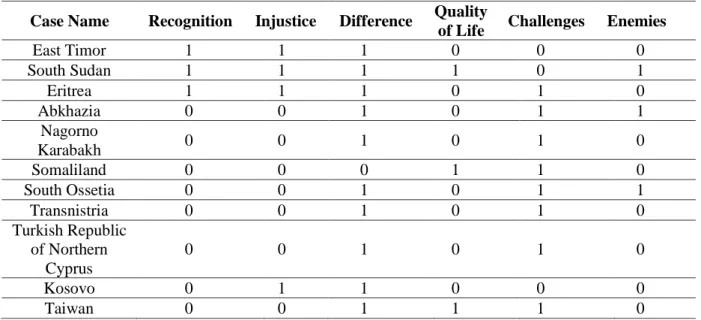
The first step before carrying out the QCA was to make a dichotomized data table that would summarize all the information concerning the existence or absence of dependent and independent variables in all cases. As mentioned previously, [1] was given if the condition was present in a particular case and [0] – if it was not.
Table 3: Dichotomized data
Case Name Recognition Injustice Difference Quality
of Life Challenges Enemies
East Timor 1 1 1 0 0 0
South Sudan 1 1 1 1 0 1
Eritrea 1 1 1 0 1 0
Abkhazia 0 0 1 0 1 1
Nagorno
Karabakh 0 0 1 0 1 0
Somaliland 0 0 0 1 1 0
South Ossetia 0 0 1 0 1 1
Transnistria 0 0 1 0 1 0
Turkish Republic of Northern
Cyprus
0 0 1 0 1 0
Kosovo 0 1 1 0 0 0
Taiwan 0 0 1 1 1 0
In the next step the Truth table (Table 4) was created using the fs/QCA 2.5 programme. This table represents the first ‘synthesis’ of the raw data table (Rihoux and De
30
of injustice, distinctness and challenges, together with the absence of quality of life and enemies are associated with a presence of recognition (this is a configuration in the third row). By looking at Table 4 one can also see that this configuration was observed in one of the cases – Eritrea. In other words, this table matches the empirically observed combinations with their outcomes and the empirical cases representing these combinations. Using this ‘synthesis’ eleven cases were transformed into seven configurations.
This table also demonstrates that there are 2 cases exhibiting contradictory configurations (marked with a letter C in the table). According to Delreux and Hesters (2010: 5), two cases cannot be logically defined by the same combination of conditions and must display a different outcome, which is called a contradiction. As one can see, East Timor and Kosovo are contradictions in this research study. In this case, typical strategies of removing or re-examining these conditions cannot be applied14 (Rihoux and De Meur, 2009: 48-49). According to one of the other options offered up by scholars (Rihoux and De Meur, 2009: 50) it is possible to proceed with an analysis and retain even the contradictory data in the table, which has been done in this study. However, this problem will be addressed again in the following section; in addition, its implications for the results and other possible strategies will be discussed.
14
31
Following the Truth Table, the key operation of cs/QCA – the Boolean minimization – was carried out. fs/QCA 2.5 software was used to minimize the configurations and non-observed cases were not included in this first operation. The software utilized configurations from Table 4 in order to carry out Boolean minimization algorithms. The result is displayed in a Table 5 and the same result is described in a formula. The same solution was obtained using TOSMANA software. Conditions in capital letters show that a condition was present while the ones in minuscule letters reference the absence of a condition.
Table 5: Boolean minimization formula for [1] outcome (RECOGNITION)
Boolean minimization formula Raw
coverage
Unique
coverage Consistency
INJUSTICE*DIFFERENCE*QUALITY OF LIFE*
*challenges*ENEMIES
0.333333 0.333333 1.000000
INJUSTICE*DIFFERENCE*quality of life*
*CHALLENGES*enemies 0.333333 0.333333 1.000000
Solution coverage: 0.666667
Solution consistency: 1.000000
Table 4: Truth Table
Injustice Difference Quality
of life Challenges Enemies Recognition Case Name
1 1 0 0 0 C East Timor, Kosovo
1 1 1 0 1 1 South Sudan
1 1 0 1 0 1 Eritrea
0 1 0 1 1 0 Abkhazia, South
Ossetia
0 1 0 1 0 0
Nagorno Karabakh, Transnistria, Turkish Republic of Northern
Cyprus
0 0 1 1 0 0 Somaliland
32
INJUSTICE*DIFFERENCE*QUALITY OF LIFE*challenges*ENEMIES +
INJUSTICE*DIFFERENCE*quality of life*CHALLENGES*enemies RECOGNITION
As one can see, this formula shows the same results that can be observed from empirical cases, which is why it is also called a ‘descriptive’ formula and rarely proceeds
beyond the observed cases (Rihoux and De Meur, 2009: 57). The formula consists of two terms, both of which result in RECOGNITION. These two terms represent two different paths that ultimately lead to recognition of secessionist states. Additionally, it is possible to manually modify this formula and produce a more structured version. The first part of this formula illustrates the necessary conditions, meanwhile the second part – INUS conditions (insufficient but necessary parts of a condition which is unnecessary but sufficient)15:
INJUSTICE*DIFFERENCE*{
RECOGNITION
The modified formula is not more parsimonious (as no conditions were eliminated), but it shows what is common between the recognised secessionist states: all of them suffered injustice or violations of human rights and their population was ethnically different from that of the mother state.
What is more, the second analysis was performed to see the opposite result: what leads to the non-recognition of the secessionist state. The following formulas and Table 6 demonstrate the results that were obtained using fs/QCA 2.5 (the same results were obtained repeating the same procedures with TOSMANA software).
15
33
Table 6:Boolean minimization formula for [0] outcome (non-recognition)
Boolean minimization formula Raw
coverage
Unique
coverage Consistency
injustice*DIFFERENCE*quality of
life*CHALLENGES 0.625000 0.625000 1.000000
injustice*QUALITY OF
LIFE*CHALLENGES*enemies 0.250000 0.250000 1.000000
Solution coverage: 0.875000
Solution consistency: 1.000000
injustice*DIFFERENCE*quality of life*CHALLENGES + injustice*QUALITY OF
LIFE*CHALLENGES*enemies recognition
injustice*CHALLENGES*{ recognition
34
Table 7: Minimization with logical remainders for [1] outcome (RECOGNITION)
Solution (simplifying
assumptions) Raw coverage Unique coverage Consistency
INJUSTICE*CHALLENGES 0.333333 0.333333 1.000000
QUALITY OF LIFE*challenges 0.333333 0.000000 1.000000
challenges*ENEMIES 0.333333 0.000000 1.000000
INJUSTICE*QUALITY OF
LIFE 0.333333 0.000000 1.000000
INJUSTICE*ENEMIES 0.333333 0.000000 1.000000
QUALITY OF
LIFE*ENEMIES 0.333333 0.000000 1.000000
Solution coverage: 0.666667
Solution consistency: 1.000000
Table 8: Minimization with logical remainders for [0] outcome (non-recognition)
Solution (simplifying
assumptions) Raw coverage Unique coverage Consistency
injustice 0.875000 0.875000 1.000000
Solution coverage: 0.875000
Solution consistency: 1.000000
There is, however, a zone ‘in between’ the most complex and the most
35
researcher manually sets the circumstances under which a condition contributes to the outcome, meaning that the researcher decides if a condition should be absent or present for the outcome to occur) (Legewie, 2013). Intermediate solutions for [0] outcome and [1] outcome are demonstrated bellow in Table 9 and Table 10, respectfully.
Table 9: Intermediate solutions for [1]outcome RECOGNITION
Solution (simplifying assumption) Raw
coverage
Unique
coverage Consistency
DIFFERENCE*INJUSTICE*challenges 0.333333 0.333333 1.000000
INJUSTICE*DIFFERENCE*QUALITY OF LIFE*
*ENEMIES
0.333333 0.333333 1.000000
Solution coverage: 0.666667
Solution consistency: 1.000000
Formula: INJUSTICE*DIFFERENCE*{ = RECOGNITION
Table 10: Intermediate solutions for [0] outcome (non-recognition)
Solution (simplifying assumption) Raw coverage Unique
coverage Consistency
CHALLENGES*qualityoflife*injustice 0.625000 0.250000 1.000000
enemies*injustice*CHALLENGES 0.625000 0.250000 1.000000
Solution coverage: 0.875000
Solution consistency: 1.000000
Formula: CHALLENGES*injustice*{
36
the coverage and consistency of each. Consistency represents the extent to which a condition leads to an outcome (Elliott, 2013). Put simply, it demonstrates how well each condition explains the outcome and is often compared to statistical significance in qualitative research (Ragin, 2008a: 110-117). The particular condition is necessary (necessity is further explained below) only when its consistency value is 1 (Devers, et al., 2013: 34). Table 11 illustrates the consistency of each condition for the outcome RECOGNITION, and Table 12 demonstrates consistency for [0] outcome (non-recognition)16. It is also important to remember that, according to the QCA experts, the recommended consistency threshold is 0.75 (Ragin, 2009: 121).
The tables also demonstrate another statistical measurement – coverage. According to Elliot (2013: 5), coverage illustrates how many cases within the observed outcome are represented by a particular causal condition. In other words, this measure shows the degree to which a condition explains the observed outcome. The bigger the coverage is the more empirical importance each condition has; this measure is similar to correlation in quantitative methods (Devers, et al., 2013: 35). What is more, very often the higher the coverage is, the lower the consistency becomes, because the condition or combination of conditions that covers many cases has less explanatory power for each case. If there is a high consistency, but the coverage is low, the result is not compelling as it does not describe many cases. However, if there is a high degree of coverage and low consistency, such a result does not make a strong causal argument and is not worth any further consideration (Elliot, 2013: 6). While assessing results there should thus always be a balance between consistency and coverage.
16
37
Table 11: Consistency and coverage of conditions for [1] outcome (RECOGNITION)
Conditions tested Consistency Coverage
INJUSTICE 1.000000 0.750000
DIFFERENCE 1.000000 0.300000
QUALITY OF LIFE 0.333333 0.333333
challenges 0.666667 0.666667
ENEMIES 0.333333 0.333333
Table 12: Consistency and coverage of conditions for [0] outcome (non-recognition)
Conditions tested Consistency Coverage
injustice 0.875000 1.000000
difference 0.125000 1.000000
quality of life 0.750000 0.750000
CHALLENGES 0.875000 0.875000
enemies 0.750000 0.750000
It should be noted that consistency and coverage do not apply only for the particular conditions, but they also hold the same importance for combinations of conditions (i.e. simplifying assumptions). Nevertheless, no additional analysis is required to assess combinations of conditions as this was done automatically for each calculation. In some of the tables one can notice ‘different kinds’ of coverage: raw coverage, unique coverage and
38
differences between these terms: if one thinks about the outcome RECOGNITION, raw coverage is the proportion of ‘recognized cases’ (that means cases with an outcome
RECOGNITION) that are covered by a given combination of conditions (but the same cases can also be covered by other combinations); unique coverage shows the proportion of ‘recognized cases’ that no other combination covers; solution coverage is the proportion of ‘recognized cases’ that are covered by all the combinations given in a table. For instance, if
one considers the combination QUALITY OF LIFE* the challenges in Table 7 (the second simplifying assumption in the table), then the raw coverage is 0.333333, which means that this combination pertains to 33.(33)% of cases in which the secessionist state was recognized. Meanwhile, unique coverage is 0.000000, and it shows that all of the cases exhibiting the final result of this combination can also be achieved by other combinations. The solution coverage 0.666667 shows that all of the combinations given in Table 7 explain only 66.(66)% of all the cases in which recognition was given to secessionist states.
Another term that should be explained here is the ‘necessary (combination of) conditions’. These are the (combination of) conditions that must be present for the desired
outcome to occur; the outcome cannot happen without a necessary condition, and the absence of a necessary condition would always lead to the absence of an outcome (Sehring, Korhonen-Kurki and Brockhaus, 2013: 3). Put simply, necessary conditions are always present when the outcome occurs. However, the presence of a necessary condition does not always imply the presence of an outcome because the necessary condition might have to be accompanied by yet another condition in order to cause an outcome. A particular condition has to be both necessary and sufficient17, meaning that it would always be observed in every case when the result occurs18 (Elliot, 2013: 25; Sehring, Korhonen-Kurki and Brockhaus, 2013: 3). If one
17
Following the same logic, sufficient (combination of) conditions are those that are present when a particular outcome is observed in some cases but that are not present in others (Elliot, 2013: iii)
18
39
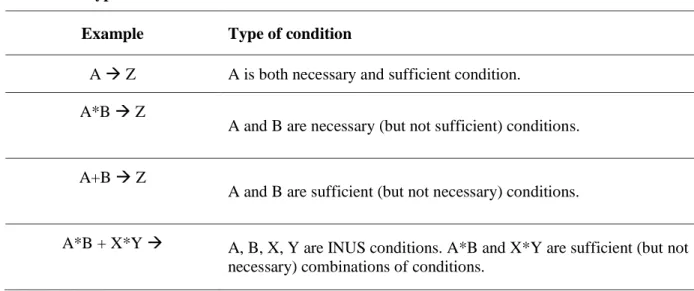
condition is neither sufficient nor necessary by itself but is part of a configuration that has a causal effect on an outcome, it is called an INUS19 condition (Sehring, Korhonen-Kurki and Brockhaus, 2013: 3). Appendix 1 provides examples of these types of conditions.
Additional analysis is needed for solving the contradictory configurations. As both Kosovo and East Timor had the same combinations of conditions that ultimately led to different outcomes, one has to return to the primary assumptions about these cases. Kosovo definitely raises more doubts than East Timor. Although it is not a member of the UN, it is already recognized by 107 states worldwide (Ministry of Foreign Affairs of the Republic of Kosovo, 2014). This study, however, assumes that it is not quantity of supporters but power that matters most in the international system; thus, recognition from such states as Tonga, Lesotho or Tuvalu is not as important as non-recognition from powerful states such as China or Russia. Additionally, there is still an ongoing debate about the status of Kosovo among legal and political science scholars (e.g. Vidmar, 2009). This is why an additional analysis was carried out (excluding the Kosovo case) in order to find new Boolean minimization formulas, parsimonious results, intermediate solutions for both [1] and [0] outcomes. The results are reflected in Appendix 2, and they are taken into consideration while discussing the research results.
6. Discussion of the results
In this section, each condition will first be discussed separately with attention paid to both research results and empirical findings. Afterwards, the combinations of conditions will be reviewed, answering the question of this research – what combination(s) of conditions lead to the recognition of secessionist states. Finally, some limitations and recommendations for
19
INUS - insufficient (not sufficient by itself) but necessary components of causal combinations that are
40
future research will be introduced.
6. 1. Violations of human rights and injustice
The first hypothesis in this work stated that violations of human rights or unjust policies towards the secessionist group make recognition of a secessionist state more likely. This independent variable proved to be a necessary but insufficient condition (one can see it from the results of Boolean minimization formula and from the independent solutions with- and without the inclusion of Kosovo) which led to recognition as it was present in all of the three recognized states (East Timor, South Sudan and Eritrea). To the contrary, it was missing in all of the unrecognized states with an exception of Kosovo. However, serious violations of human rights and unjust policies were employed against Kosovar people at the time of Milosevic’s rule; meanwhile, independence of this entity was announced almost ten years
after his resignation. If independence instead of autonomy (with UN supervision) would have been announced by Kosovar people while repressions were still present or immediately after NATO intervention, recognition might have been possible much earlier than nearly ten years later, especially considering the fact that current Serbian authorities claim to be willing to ensure strong regional autonomy and equal rights for Kosovo Albanians (Vidmar, 2009). Despite that claim, Table 11 demonstrates that, while not even considering the case of Kosovo (total coverage 0.750000), this independent variable had a high importance on the outcome (it was both consistent and demonstrated a vast coverage). What is more, after excluding the Kosovo case, injustice not only thoroughly explained the recognition of secessionist states (consistency 1.000000) but also covered all the cases (Table 17).
41
that a secessionist entity will remain unrecognized is considerably high. Absence of injustice is also the only parsimonious solution with- and without excluding Kosovo (Tables 8 and 15, respectfully) that leads to non-recognition. Although the results explain the [0] outcome very well (consistency 1.000000) (Table 12), one cannot claim that this generalized parsimonious solution can alone explain non-recognition of all secessionist states. First of all, in all of the empirically-observed unrecognized cases it was not sufficient (only necessary). Second, seven empirically-observed cases (excluding Kosovo) are not enough to deny the theories (discussed in literature review) that consider recognition to be comprised of a combination of factors instead of one particular condition. Third, if one considers cases that were excluded from this research such as re-seceded Chechnya, the existence of human rights violations did not lead to recognition.
To sum up, violations of human rights or unjust policies towards a secessionist group is a necessary condition that leads to the recognition of a secessionist state, and it has a strong explanatory power. Though it is not sufficient by itself and has to be present in concert with other conditions. The same can be said about the conditions that lead to non-recognition of a de facto state, as absence of injustice is an important factor for the international community to not recognize the state, although it is not by itself sufficient.
6.2. Ethnic differences
42
ethnically distinctive secessionist group. This means that this condition cannot explain the different outcomes among the cases even though the results show that ethnical difference is a necessary but insufficient condition for the recognition (in both Boolean minimization and intermediate solution, with and without Kosovo), and it also explains the outcome well (consistency 1.000000, see Tables 11 and 17). It is important to note that this condition covers only around 30% of cases (Tables 11 and 17) and is therefore too low for such a condition to be treated as important (Legewie, 2013).
What is more, the absence of an ethnically different secessionist group has no importance for non-recognition of the state (very low consistency in Table 12 and Table 21). Because most of the unrecognized secessionist states also had an ethnically distinctive secessionist group, it may be concluded that ethnical difference is probably not a factor that leads to (non-)recognition but is instead the factor that encourages a secessionist group to secede from an ethnically different mother state.
Finally, I carried out one more additional operation to identify results without this condition: Boolean minimization, intermediate solutions, parsimonious solutions and analysis of necessary conditions for [0] and [1] outcomes were performed. The absence of this condition did not have any influence on the final results as all factors remained the same, except in the intermediate solutions and Boolean minimization that obviously no longer contained DIFFERENCE. However, neither consistency nor coverage results changed.
so-43
called ‘remedial right20’ scholars (Buchanan, 1997).
6.3. Effective governance and quality of life
The theory suggesting that those secessionist states that provide better governance and better quality of life to their citizens than does the mother state are more likely to be recognized. However, the consistency and coverage rates for this condition are very low (see Table 11), thus it does not have a strong explanatory power and is not relevant for the final results. Empirical results also did not demonstrate any causal relationship: only South Sudan provided better life quality and better governance to its citizens than did its mother state, Sudan. However, both countries performed very similarly in most of these indicators. In addition, the cases of Taiwan and Somaliland (both unrecognized, but both performed better than the parent states) contradicted the theory. It is possible that operationalization of this variable was not correct and one should look instead at different indicators, but as long as there is no agreement among scholars who stress the importance of state-level factors, it is difficult to decide what exactly (economic factors, other indicators of the quality of life, services provided by the state, civil liberties, etc.) should be analysed.
On the other hand, the absence of better governance and quality of life provided by the secessionist state might increase the chances of its non-recognition. According to the research results, it is an INUS condition for intermediate solutions (including and excluding the case of Kosovo), and its consistency and coverage – although not high – is sufficient enough to be treated as having some causal importance. It could be possible that this condition does not have an effect on the decision of the international community to recognize a secessionist state, but it could influence their choice not to (especially because it is neither
20
44
sufficient nor necessary, but is only an additional INUS condition). In such a case Taiwan and Somaliland would be treated as exceptions to a general trend, but examination of more cases is required in order to make a good judgment.
In conclusion, the findings of this research demonstrate that better governance and quality of life does not play a role in the recognition of secessionist states, yet its absence might influence other countries not to recognize a secessionist state. Nevertheless, further examination of this condition and additional cases are necessary in order to strengthen these findings.
![Table 5: Boolean minimization formula for [1] outcome (RECOGNITION) Boolean minimization formula Raw](https://thumb-us.123doks.com/thumbv2/123dok_us/8143121.2159683/31.893.121.819.159.431/boolean-minimization-formula-outcome-recognition-boolean-minimization-formula.webp)
![Table 6: Boolean minimization formula for [0] outcome (non-recognition) Boolean minimization formula Raw](https://thumb-us.123doks.com/thumbv2/123dok_us/8143121.2159683/33.893.129.821.156.328/boolean-minimization-formula-outcome-recognition-boolean-minimization-formula.webp)
![Table 7: Minimization with logical remainders for [1] outcome (RECOGNITION) Solution (simplifying](https://thumb-us.123doks.com/thumbv2/123dok_us/8143121.2159683/34.893.119.810.158.477/table-minimization-logical-remainders-outcome-recognition-solution-simplifying.webp)
![Table 10: Intermediate solutions for [0] outcome (non-recognition)](https://thumb-us.123doks.com/thumbv2/123dok_us/8143121.2159683/35.893.162.817.762.890/table-intermediate-solutions-for-outcome-non-recognition.webp)
![Table 12: Consistency and coverage of conditions for [0] outcome (non-recognition)](https://thumb-us.123doks.com/thumbv2/123dok_us/8143121.2159683/37.893.129.817.525.859/table-consistency-coverage-conditions-outcome-non-recognition.webp)
![Table 14: Boolean minimization formula for [1] outcome (RECOGNITION), excluding case of Kosovo](https://thumb-us.123doks.com/thumbv2/123dok_us/8143121.2159683/63.893.147.818.612.681/table-boolean-minimization-formula-outcome-recognition-excluding-kosovo.webp)
![Table 19: Minimization with logical remainders for [0] outcome (non-recognition), excluding case of Kosovo](https://thumb-us.123doks.com/thumbv2/123dok_us/8143121.2159683/64.893.143.819.783.851/table-minimization-logical-remainders-outcome-recognition-excluding-kosovo.webp)
