African Journal of Reproductive Health September 2019; 23 (3):
149
REVIEW ARTICLE
Barriers and Enablers to Task Shifting for Caesarean Sections in
sub-Saharan Africa: A Scoping Review
DOI: 10.29063/ajrh2019/v23i3.13
Sheillah Matinhure
1* and Moses J. Chimbari
2IntraHealth International/ Public Sector Systems Strengthening Project1; University of Kwazulu Natal, College of Health Sciences, Howard College Campus2
*For Correspondence: Email: [email protected]; Phone: +263783279494
Abstract
Task shifting of Caesarean-sections to non-physician clinicians (NPCs) has raised concerns over NPCs‘ competences and rationale of using them in facilities where medical doctors (MDs) are scarce to provide mentorship. We conducted a scoping review to provide an update on NPCs‘ contribution to C-sections including barriers and enablers to task shifting. Using the PRISMA Flow Diagram, we identified 15 eligible articles from Google Scholar, PubMed and Africa Index Medicus using specific search terms and a pre-established inclusion criterion. All 15 studies characterised NPCs: their names, training, challenges and enablers to task shifting. NPCs performed 50%-94% C-sections. Outcomes of such C-sections were comparable to those performed by MDs. Enablers included supportive policies, pre-existing human resources for health shortage, well-resourced health facilities and supervision of NPCs. Weak health systems were major barriers. While NPCs make a significant contribution to accessing C-sections services, there is need to address challenges to fully realize benefits. (Afr J Reprod Health 2019; 23[3]: 149-160).
Keywords: Task shifting; task sharing; caesarean section, associate clinicians; comprehensive emergency obstetric care; clinical officers; non-physician clinicians
Résumé
Le transfert de tâches des césariennes à des cliniciens non médecins (CNP) a suscité des inquiétudes quant aux compétences de ces derniers et aux raisons de les utiliser dans des établissements où les médecins ne sont pas en mesure de fournir un mentorat. Nous avons procédé à un examen de la portée afin de fournir une mise à jour de la contribution des CNP aux césariennes, y compris les obstacles et les facteurs permettant le transfert de tâches. À l'aide du diagramme de flux PRISMA, nous avons identifié 15 articles éligibles de Google Scholar, PubMed et Africa Index Medicus en utilisant des termes de recherche spécifiques et un critère d'inclusion préétabli. Les 15 études ont toutes caractérisé les PNJ: leurs noms, leur formation, leurs défis et les moyens de transférer des tâches. Les PNJ ont réalisé des césariennes de 50% à 94%. Les résultats de telles césariennes étaient comparables à ceux obtenus par les médecins. Les catalyseurs incluaient des politiques de soutien, des ressources humaines préexistantes pour lutter contre la pénurie en matière de santé, des établissements de santé disposant de ressources suffisantes et la supervision des CNP. La faiblesse des systèmes de santé constituait un obstacle majeur. Bien que les CNP apportent une contribution importante à l‘accès aux services des césariennes, il est nécessaire de relever les défis pour tirer pleinement parti des avantages. (Afr J Reprod Health 2019; 23[3]: 149-160).
Introduction
Sub-Saharan Africa (SSA) has the highest
maternal mortality ratio (MMR) of 546/100,000
and accounts for 66% of the global maternal
mortality burden
1.
Shortage of medical doctors
(MDs) and specialist obstetricians has been
blamed for the high maternal mortality (MMR)
ratios in the region
2-3. Task shifting is increasingly
being utilised by many countries in sub-Saharan
Africa (SSA) as a stop-gap measure to alleviate
shortage of professional health workforce
4-8. Task
shifting has been reported as having potential to
increase both access and coverage to maternal and
child health services by expanding roles of MDs
and obstetricians through the utilisation of NPCs
9-12. Although non-physician clinicians (NPCs), also
known as associate clinicians, have for a long time
performed obstetric surgery in SSA, the potential
has not been fully exploited
8. Some countries
have viewed task shifting with scepticism and
doubted capacity of NPCs to perform quality
obstetric surgery
6, 13while others referred to task
shifting as controversial
14-15. We conducted a
scoping review to provide an update on (i)
characteristics of NPCs and their contribution to
the provision of C-sections services and (ii)
barriers and enablers of task shifting for
C-sections. A greater understanding of the nature of
task shifting for C-sections is likely to help policy
makers to make decisions for adopting or scaling
up this strategy, thus contributing to universal
coverage of maternal and newborn care.
Methods
We utilized the scoping review methodology as
we found it most suitable
16-17in identifying,
analysing and summarising relevant research
literature from PubMed/Medline, African Index
Medicus (AIM), and Google Scholar. The
inclusion criteria were: (i) studies on task shifting
of C-sections from MDs to NPCs; (ii) studies
published in English conducted in SSA from 2007
to May 2017. The following terms were used
individually and in combination: task shifting, task
sharing,
caesarean
sections,
comprehensive
emergency obstetric care, clinical officers,
assistant medical officers, associate clinicians,
non-physician clinicians, mid-level health workers
and obstetric surgery using the Boolean operator
18―AND.‖ We used the Preferred Reporting Items
for Systematic Reviews and Meta-Analyses
(PRISMA) to guide the review process. Google
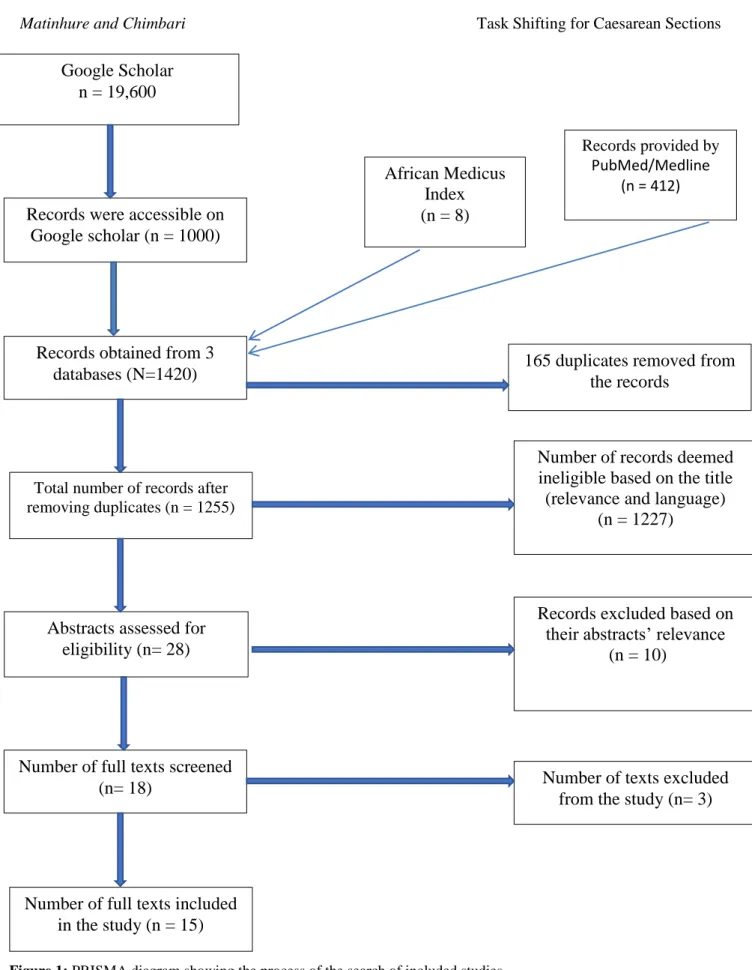
scholar indicated 19,600 records in the data base,
but only 1,000 records were accessed after
browsing through 100 pages. Pub/Med yielded
412 articles and AIM yielded 8. Thus, total
records accessed from the 3 data bases were 1420.
Following removal of 165 duplicates, 1255
records remained. Initial screening was conducted
based on title, language and geographical region
where the study was carried out, making 1227
records ineligible, and 28 records remained.
Based on the abstracts, further 10 records were
excluded for not meeting the inclusion criteria.
Full articles for the remaining 18 articles on task
shifting and C-sections in SSA for the past 10
years were identified and assessed for eligibility
Out of these, 3 were excluded; The remaining
fifteen articles were included in the final scoping
review (Figure 1).
Data abstraction
We designed a template that ensured abstraction of
relevant data. To determine nature of studies, we
extracted study objectives, design, sample size,
outcome variables and statement of results
summary. To determine nature of NPCs, we
extracted cadre names and type of trainings. For
the contribution to meeting C-section demand, we
extracted the proportion of C-sections performed
by NPCs. We also extracted data on challenges
and enablers.
Results
Figure 1: PRISMA diagram showing the process of the search of included studies
Google Scholar
n = 19,600
Records were accessible on
Google scholar (n = 1000)
Total number of records after
removing duplicates (n = 1255)
Records obtained from 3
databases (N=1420)
Number of full texts screened
(n= 18)
Abstracts assessed for
eligibility (n= 28)
African Medicus
Index
(n = 8)
Records provided by
PubMed/Medline
(n = 412)
Number of full texts included
in the study (n = 15)
165 duplicates removed from
the records
Number of records deemed
ineligible based on the title
(relevance and language)
(n = 1227)
Records excluded based on
their abstracts‘ relevance
(n = 10)
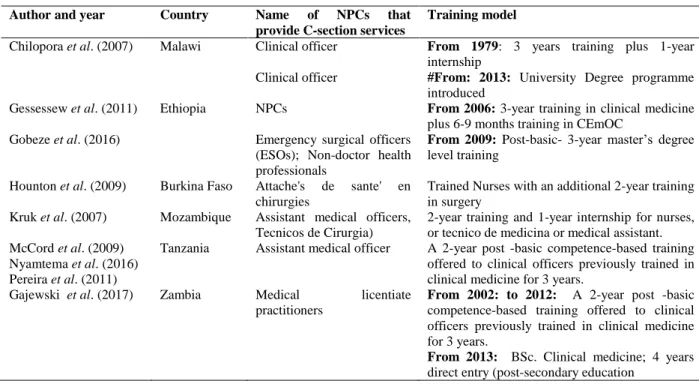
Nomenclature of C-sections providers
Health workers utilised for task shifting purposes
have been collectively referred to as NPCs,
associate clinicians, mid-level health workers,
non-doctors and non-surgeons. However, there are
specific country-based nomenclatures to describe
C-section care-providers. In Tanzania, they were
called AMOs
6, 11, 15. In Malawi, they were called
clinical officers while Ethiopia called them
Emergency Surgical Officers (ESOs)
5, 13. Burkina
Faso, Mozambique and Zambia referred to them as
attaché‘s de sante' en chirurgies, Técnicos de
Cirurgia (TCs) and medical licentiate practitioners
(MLPs)
19respectively (Table 1).
Training models for NPCs that provide
C-section services
Six studies described different training Models
(Table 1). Burkina Faso, Ethiopia, Malawi, and
Zambia offered university degrees. Tanzania and
Mozambique were offering advanced diplomas.
The contribution of NPCs towards meeting
the need for C-Section services
The proportion of C-sections performed by NPCs
was equal to or greater than those performed by
MDs. In Burkina Faso and Ethiopia, NPCs
performed
50%
20and
94%
13C-sections
respectively. In yet another study in Tanzania, all
2980 C-sections were conducted by AMOs in 10
health centers which did not have MDs
11.
Performance of NPCs and quality of care
10 studies found no significant differences
between NPCs‘ and MDs‘ performance of
C-sections
4-6, 13, 21. This was based on four outcome
measures of (i) risk indicators for which C-section
was performed; (ii) Maternal or fetal death, (iii)
post-operative major complications and length of
hospital stay. However, in contrast to these
positive outcomes, two studies in Burkina Faso
found that NPCs performed 12 % of C-sections
without medical justification
22and a higher
neonatal mortality was recorded in C-sections
performed by NPCs
20.
Cost effectiveness of C-sections performed by
NPCs
The cost of training, deploying and utilising
técnico de cirurgia in Mozambique was found to
be only 27% compared to that of physicians
23.
Another evaluation was conducted in Ethiopia
using the extended cost-effectiveness analysis
framework
24. In addition to analysing costs, the
study also analysed the impact of task shifting
policy in making C-section accessible; universal
public financing policy that makes services
affordable; and how these policies might
impoverish intended beneficiaries if opportunity
costs like transport and accommodation were not
taken care of. This is the only study that we found
that evaluated the impact of policies. Results of
the
cost-effectiveness
analysis
framework
indicated that without travel vouchers for
beneficiaries, such policies may paradoxically
induce poverty. However, a study in Burkina Faso
found that training and deploying MDs to perform
C-sections was more cost-effective given that
neonatal outcomes were significantly better with
MDs
20. Notwithstanding this, the study concluded
that investment in NPCs was a viable and rational
option given the high attrition rate of MDs.
Enabling factors for task shifting
Table 1: Cadre names and training models of NPCs that provide C-section services in selected SSA countries
Author and year Country Name of NPCs that provide C-section services
Training model
Chilopora et al. (2007) Malawi Clinical officer From 1979: 3 years training plus 1-year internship
Clinical officer #From: 2013: University Degree programme introduced
Gessessew et al. (2011) Ethiopia NPCs From 2006: 3-year training in clinical medicine plus 6-9 months training in CEmOC
Gobeze et al. (2016) Emergency surgical officers (ESOs); Non-doctor health professionals
From 2009: Post-basic- 3-year master‘s degree level training
Hounton et al. (2009) Burkina Faso Attache's de sante' en chirurgies
Trained Nurses with an additional 2-year training in surgery
Kruk et al. (2007) Mozambique Assistant medical officers, Tecnicos de Cirurgia)
2-year training and 1-year internship for nurses, or tecnico de medicina or medical assistant. McCord et al. (2009)
Nyamtema et al. (2016) Pereira et al. (2011)
Tanzania Assistant medical officer A 2-year post -basic competence-based training offered to clinical officers previously trained in clinical medicine for 3 years.
Gajewski et al. (2017) Zambia Medical licentiate practitioners
From 2002: to 2012: A 2-year post -basic competence-based training offered to clinical officers previously trained in clinical medicine for 3 years.
From 2013: BSc. Clinical medicine; 4 years direct entry (post-secondary education
Key
#: Government of Malawi has since introduced a degree programme for COs that wish to advance their careers
described where a donor upgraded 10 rural health
facilities, equipped them for C-sections, trained
AMOs in CEmOC and supported structured
monthly supervision and monitoring. Dramatic
increases of up to 300% facility deliveries
including C-sections were achieved
11.
Challenges of task shifting for C-sections
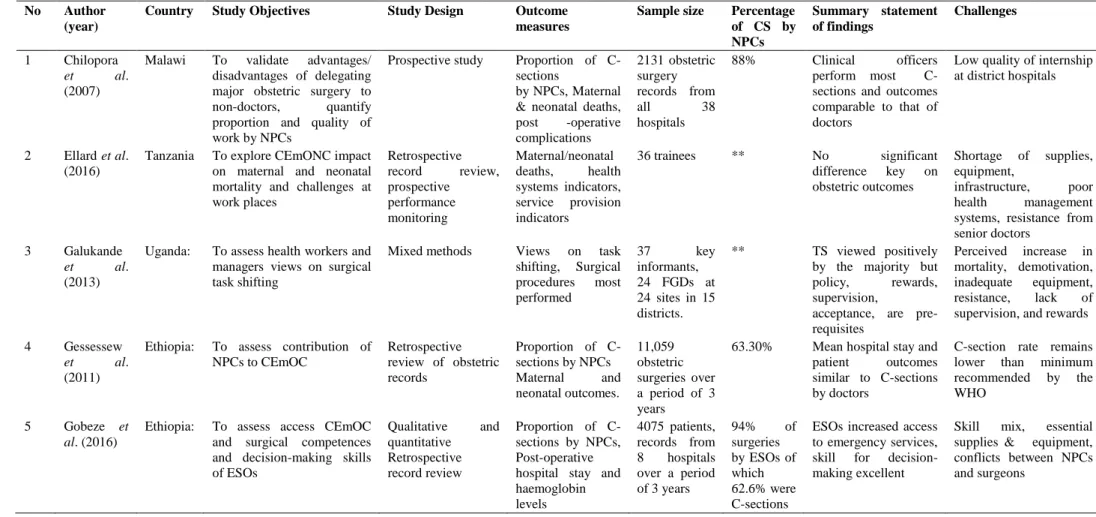
Numerous challenges were described in all 15
studies (Table 2). Concerns were raised about
capacity for decision making and clinical skills of
NPCs, sometimes leading to unnecessary
C-sections and referrals
13, 22. Human resources
management challenges included unavailability of
anaesthetists
11, conflicts between surgeons and
NPCs
13, poor remuneration, lack of incentives,
demotivation
20-23,
unclear
career
ladder
20,
unnecessary
absenteeism
and
inadequate
supervision
22,25. Training challenges included
inadequate numbers of trained cadres resulting in
persistent HR deficits, limited exposure to cases
for practising competences and lack of recognition
of
qualifications
8, 25.
Reported
operational
challenges included shortage of equipment and
essential supplies (anaesthetic drugs, antibiotics,
suction machines, blood)
3,6,11, weak referral
system, sub-optimal CEmOC service availability
and poor health information management system
as mostly data on case fatality rates were
missing
3,21.
Discussion
Table 2: Summary of studies included in the scoping review and key findings
No Author (year)
Country Study Objectives Study Design Outcome measures
Sample size Percentage of CS by NPCs
Summary statement of findings
Challenges
1 Chilopora
et al.
(2007)
Malawi To validate advantages/ disadvantages of delegating major obstetric surgery to non-doctors, quantify proportion and quality of work by NPCs
Prospective study Proportion of C-sections
by NPCs, Maternal & neonatal deaths, post -operative complications
2131 obstetric surgery records from
all 38
hospitals
88% Clinical officers perform most C-sections and outcomes comparable to that of doctors
Low quality of internship at district hospitals
2 Ellard et al. (2016)
Tanzania To explore CEmONC impact on maternal and neonatal mortality and challenges at work places
Retrospective record review, prospective performance monitoring
Maternal/neonatal deaths, health systems indicators, service provision indicators
36 trainees ** No significant difference key on obstetric outcomes
Shortage of supplies, equipment,
infrastructure, poor health management systems, resistance from senior doctors
3 Galukande
et al.
(2013)
Uganda: To assess health workers and managers views on surgical task shifting
Mixed methods Views on task shifting, Surgical procedures most performed
37 key
informants, 24 FGDs at 24 sites in 15 districts.
** TS viewed positively by the majority but policy, rewards, supervision,
acceptance, are pre-requisites
Perceived increase in mortality, demotivation, inadequate equipment, resistance, lack of supervision, and rewards
4 Gessessew
et al.
(2011)
Ethiopia: To assess contribution of NPCs to CEmOC
Retrospective review of obstetric records
Proportion of C-sections by NPCs Maternal and neonatal outcomes.
11,059 obstetric surgeries over a period of 3 years
63.30% Mean hospital stay and patient outcomes similar to C-sections by doctors
C-section rate remains lower than minimum recommended by the WHO
5 Gobeze et al. (2016)
Ethiopia: To assess access CEmOC and surgical competences and decision-making skills of ESOs
Qualitative and quantitative Retrospective record review
Proportion of C-sections by NPCs, Post-operative hospital stay and haemoglobin levels
4075 patients, records from 8 hospitals over a period of 3 years
94% of surgeries by ESOs of which 62.6% were C-sections
ESOs increased access to emergency services, skill for decision-making excellent
No Author (year)
Country Study Objectives Study Design Outcome measures
Sample size Percentage of CS by NPCs
Summary statement of findings
Challenges
6 Hounton et al. (2009)
Burkina Faso
To evaluate effectiveness and cost effectiveness of alternative training strategies to increase access to emergency obstetric surgery
Retrospective cross-sectional facility-based survey of C-section deliveries
Mothers‘ and newborns‘ case fatality rates,
Costs of
performing C-sections
Incremental cost effectiveness ratios
2305 records in 2 years in 12 hospitals.
50% Non-specialist doctors are cost- effective but training substitutes is a viable option
Demotivation, lack of supervision, no clear-cut career, no salary review
7 Kouanda et al. (2013)
Burkina Faso
To assess the level and determinants of C-sections with no medically justified indicators for low risk women
Retrospective analysis of C-Section records for low risk women.
Factors associated with C-sections done with no medically justified reason
300 Low risk women in 10 referral hospitals
** Clinical officers associated with a 12% risk of unnecessary C-sections
Lack of skills and inadequate supervision implicated for unnecessary C-sections
8 Kruk et al. (2007)
Mozamb ique
To compare training, deployment and surgical productivity of AMOs and specialist physicians
Cost Analysis Desk review of budgets and C-section performance reports
Surgical productivity-proportion of AMO contribution,
12,178 major obstetric surgery performed by 47 MDs and 53 TCs
57% Training, deployment and productivity costs for TCs were all far less than MDs
Limited capacity to train more NPCs. Results cannot be applied to other countries with different country contexts.
9 McCord et al. (2009)
Tanzania To determine quantity and quality of obstetric surgery performed by AMOs
prospective study of all complicated deliveries
Proportion of C-sections performed by NPCs,
Maternal/ neonatal outcomes
1087 C-section records in 14 district hospitals
87% Difference between AMO and MDs, performance not significant.
Inadequate blood supply. Unmet C-section need
10 Nyamtema
et al.
(2016)
Tanzania To determine feasibility and impact of decentralizing CEmONC services in underserved areas using NPCs.
Operations research Proportion of C-sections performed by NPCs
2, 890 records over a period of 4 years in 10 health centers
*
100% Upgrading, equipping health centres, training NPCs in CEmONC, increase access to CEmOC & reductions in referrals
inadequate supplies; drugs; staff; incentives. Absenteeism
11 Nyamtema
et al.
(2011)
Tanzania Addressing skill mix needs through a 3-months training of course of AMOs in
To determine if the 3-months CEmOC course for facility
Improved access to CEmOC: number of C-sections,
** 107% CEmOC coverage
improved, referrals reduced
No Author (year)
Country Study Objectives Study Design Outcome measures
Sample size Percentage of CS by NPCs
Summary statement of findings
Challenges
CEmOC at upgraded health centers
teams will result in improved accessible acceptable quality care
Anaesthetic procedures, normal deliveries and referrals
systematic supervision required
12 Pereira et al. (2011)
Tanzania To calculate met need for CEmOC and to document contribution of AMOs and MDs
Retrospective survey or obstetric surgery
Proportion of C-sections performed by NPCs
C-section met need Case fatality rates
4599 major obstetric surgeries from 16 hospitals
85% Despite AMO
performing most C-sections, unmet need remains high at 23%
Weak referral system, CEmOC service availability sub-optimal, Missing CFR data
13 Pereira et al. (2007)
Mozamb ique
To document surgery by TCs, To elucidate retention of TCs at district level.
Retrospective document reviews, qualitative work histories
Proportion of obstetric surgeries by TCs and MDs, Proportion of TCs and MDs retained for 7 years
59 MDs and 34 TCs in 34 district hospitals
92% Retention better with AMOs.
inadequate number being trained and HR deficit being the major impediment in meeting MDGs
14 Shrime et al. (2016)
Ethiopia To determine how Universal Public Financing (UPF), Task shifting and Support for opportunity cost policies expand access to surgery
Extended cost-Effectiveness analyses methodology,
No. of deaths and number of cases of poverty averted
** ** UPF +task shifting +
Support for
opportunity cost had greatest impact on health
Uncoordinated policy implementation
15 Gajewski
et al.
(2017)
Zambia Describe MLPs roles, contributions & challenges
Qualitative roles, contributions & challenges
43 Health professionals
** MLPs increase access to emergency & elective surgery
Studies
conducted
in
Ethiopia,
Malawi,
Mozambique
and
Tanzania,
reported
high
proportions of 94%, 88%, 92%, 87% of C-sections
performed
by
NPCs
compared
to
MDs
respectively
4,6,8,13. NPCs alleviate HRH crisis;
improve access to CEmOC, contribute to universal
health coverage, reduce MMR, avert maternal
disability; thus, contribute to the attainment of the
third Sustainable Development Goal
27. However,
all the countries where studies were conducted
were still unable to provide all the essential
C-sections services and the HR crisis continues
9,
implying
sub-optimal
utilisation
of
task
shifting
6,25.
Inadequate
institutional
training
capacity
11and resistance by academic institutions
to recognise NPCs
5were reported as contributory
to sub-optimal utilisation of task shifting. The
challenges that we found, corroborated those of a
systematic review by Lawn
et al
, that revealed an
association between poor intrapartum outcomes
and weak health systems
29.
Cost effectiveness studies have shown that
investing in training, deployment and utilising
NPCs for C-sections costs much less than the costs
associated with use of MDs and obstetric
specialists
23-24. As such, investing in NPCs would
be a rational policy decision for under resourced
countries.
This review showed that maternal and
fetal outcomes of C-sections performed by NPCs
were comparable with those performed by MDs
5-6,8, a factor on which quality of C-sections by
NPCs was based. UNFPA introduced a process
indicator of CFR where MMR of 1% or below is
acceptable
performance.
However,
some
researchers argue that this UNFPA indicator gives
an impression that it is acceptable for a certain
number of women to die at child birth
21. We
recommend studies on quality of C-sections
performed by both MDs and NPCs to give
credence to comparability. Only two studies
reported negative NPCs‘ performance (high
neonatal CFR)
20, and unnecessary C-sections
22.
However, these challenges can be addressed
through refresher courses, mentoring, couching
and supportive supervision of NPCs.
Although task shifting for C-section is a
technical clinical issue, it is also an HR aspect. We
found
only
two
studies
that
specifically
investigated retention of NPCs in Mozambique
and Zambia. There is need to investigate other HR
indicators such as adherence to staffing norms,
vacancy
rate,
turnover
rate,
absenteeism,
rural/urban
distribution,
supervision,
staff
satisfaction, percentage of total budget spent on
staff salaries and their impact on health outcome
indicators. These challenges are known to weaken
performance of health systems in Africa
12.
With regards to task shifting policy, our
review revealed two aspects namely; the paucity
of policy impact evaluation studies and lack of
commitment
to
implement
policies
in
a
coordinated manner. These observations are
consistent with findings of a survey on tracking
policies and practices of countries experiencing
HRH crisis
30. Researchers found that only 42% of
countries increased investment in HR development
over a period of 4 years. We also found that that
NPCs work in challenging environments where
there are shortages of supplies, equipment and
infrastructure. Similar observations were made in
a study that assessed the impact of poor funding
for surgical task shifting in 132 district health
facilities in 8 LMICs, including Tanzania, Liberia,
Sierra Leone and Gambia.
The study revealed that all health facilities
had some shortfalls in basic infrastructure, water,
electricity, oxygen, and functioning anaesthetic
machines although surgical procedures were being
performed
31. Resistance to task shifting for
C-sections by some policy makers and senior
academics and the controversy surrounding task
shifting has been documented
12-13. Other studies
found that task shifting for C-sections is
considered unethical as it subjects vulnerable
women to substandard care
12, 10, 32. Such negative
perceptions may impede the implementation and
scaling up of task shifting. There is therefore need
for policy makers and program managers to
address
perceptions
to
maximise
on
the
contribution of NPCs in meeting the C-section
need.
Limitations
Furthermore, our sample comprised of articles
published in English, dating ten years back for
practical reasons, implying that studies in other
languages and those earlier than 2007, were
excluded. In addition, studies that covered task
shifting for surgery without specifying C-sections
were excluded as it was difficult to know if
C-sections were included. Given that our search may
have not been exhaustive our conclusions and
recommendations should be considered in that
context. As typical for scoping reviews, the rigor
of the research processes was not assessed
16, hence
bias in the results of the reviewed papers cannot be
discounted given that most studies used the
retrospective records review design that may be
affected by selection bias, recall bias, missing and
incomplete documentation. This is an indication
that more studies, preferably systematic reviews
and meta analyses studies need to be conducted to
enhance credibility of findings.
Conclusion
Evidence has demonstrated that task shifting for
C-sections, implemented through trained NPCs
continues to play a critical role in improving
access to services in SSA where MDs are scarce.
NPCs‘ performance is of good quality as it was
found to be comparable with that of doctors
despite differences in the rigour and duration of
the training programmes for the two cadres. It is
evident that HR crisis, coupled with high MMR
and reports of quality performance by NPCs,
stimulated adoption of task shifting for C-sections.
Utilising NPCs was shown to be cost-effective and
to have potential to alleviate HRH crisis especially
where doctors are scarce. However, many
operational and HRM challenges that impede
implementation of task shifting for C-sections
were noted and need to be addressed if full benefit
of investing in NPCs is to be realised.
Acknowledgements
This study received financial support from the
College of Health Sciences of the University of
KwaZulu-Natal through PhD studentship bursary
awarded to Matinhure S. Authors are grateful to
Mr. Martin Steven Mapunda from the Tanzania
Ministry of Health, Community Development,
Gender, Elderly and Children, Department of
Human Resources for Health Planning, for his
assistance in and searching for research articles on
task shifting.
Contribution of Authors
SM contributed to the development of the concept,
conducting document search, screening of
identified documents based on the predetermined
inclusion criteria, abstracting data, synthesis of
findings, drafting of the manuscript and revised it
to its final form with inputs from the co-authors.
MJC contributed to the refining of the concept,
provided the overall direction for the development
of the manuscript, reviewed the draft manuscript
and provided comments, contributed to the
revision and finalization of the manuscript. Both
authors have read and approved the final version
for submission and publication.
References
1. World Health Organisation. Trends in Maternal Mortality: 1990 to 2015 Estimates by the WHO, UNICEF, UNFPA, the World Bank and the United Nations Population Division. [WHO Website]. 2015.
http://apps.who.int/iris/bitstream/10665/193994/1/ WHO_RHR_15.23_eng.pdf?ua=1 Accessed July 05, 2017
2. Sharma G, Mathai M, Dickson KE, Weeks A, Hofmeyr GJ, Lavender T, Day LT, Mathews JE, Fawcus S, Simen-Kapeu A and de Bernis L. Quality care during labour and birth: a multi-country analysis of health system bottlenecks and potential solutions. BMC Pregnancy and Childbirth. 2015;15(Suppl 2): S2
3. Ellard DR, Shemdoe A, Mazuguni F, Mbaruku G, Davies D, Kihaile P, Pemba S, Bergström S, Nyamtema A, Mohamed H and O‘Hare JP. Can training non-physician clinicians/associate clinicians (NPCs/ACs) in emergency obstetric, neonatal care and clinical leadership make a difference to practice and help towards reductions in maternal and neonatal mortality in rural Tanzania? The ETATMBA project. BMJ Open. 2016;6(2):e008999.
5. Gessessew A, Barnabas GA, Prata N and Weidert K. Task shifting and sharing in Tigray, Ethiopia, to achieve comprehensive emergency obstetric care. Int J Gynaecol Obstet. 2011;113(1):28-31.
6. McCord C, Mbaruku G, Pereira C, Nzabuhakwa C and Bergstrom S. The quality of emergency obstetrical surgery by assistant medical officers in Tanzanian district hospitals. Health Aff. 2009;28(5):876-85. 7. Mullan F and Frehywot S. Non-physician clinicians in
47 sub-Saharan African countries. Lancet. 2007; 370:2158—63.
8. Pereira C, Cumbi A, Malalane R, Vaz F and McCord C, Bacci A and Bergstrom S. Meeting the need for emergency obstetric care in Mozambique: work performance and histories of medical doctors and assistant medical officers trained for surgery BJOG. An Int. J. of Obstet & Gynaecol. 2007;114(12):1530-3.
9. World Health Organization. The world health report: Working together for health. [WHO Website]. 2006. http://www.who.int/whr/2006/whr06_en.pdf. Accessed December 15, 2014.
10. Galukande M, Kaggwa S, Sekimpi P, Kakaire O and Katamba A, Munabi I, Runumi FM, Mills E, Hagopian A, Blair G, Barnhart S and Luboga S. Use of surgical task shifting to scale up essential surgical services: a feasibility analysis at facility level in Uganda. BMC Health Services research. 2013;13(1):292.
11. Nyamtema AS, Mwakatundu N, Dominico S, Mohamed H and Pemba S, Rumanyika R, Kairuki C, Kassiga I, Shayo A, Issa O, Nzabuhakwa C, Lyimo C and van Roosmalen. Enhancing Maternal and Perinatal Health in Under-Served Remote Areas in Sub-Saharan Africa: A Tanzanian Model. PLoS One. 2016;11(3):e0151419.
12. Dovlo D. Using mid-level cadres as substitutes for internationally mobile health professionals in Africa. A desk review. Human resources for health. 2004;2(1):7.
13. Gobeze AA, Kebede Z, Berhan Y and Ghosh B. Clinical Performance of Emergency Surgical Officers in Southern Ethiopia. Ethiop J Health Sci. 2016;26(5):463-470.
14. Milland M and Bolkan H. Surgical task shifting in Sierra Leone: a controversial attempt to reduce maternal mortality. BJOG: An International Journal of Obstetrics & Gynaecology. 2015;122(2):155-.155. 15. Pereira C. Task-shifting of major surgery to midlevel
providers of health care in Mozambique and Tanzania: A solution to the crisis in human resources to enhance maternal and neonatal survival. Institutionen för folkhälsovetenskap/Department of Public Health Sciences; 2010
16. Grant MJ and Booth A. A typology of reviews: an analysis of 14 review types and associated methodologies. Health Information & Libraries Journal. 2009;26(2):91-108.
17. Colquhoun H. Current best practices for the conduct of Scoping Reviews: Impactful Biomedical Research: Achieving quality and transparency. 2016.
http://www.equator-network.org/wp- content/uploads/2016/06/Gerstein-Library-scoping-reviews_May-12.pdf Accessed June 20, 2016 18. Database Search Tips: Boolean operators. [MIT
Website]
http://libguides.mit.edu/c.php?g=175963&p=11585 94 Accessed November 12, 2016.
19. Gajewski J, Mweemba C, Cheelo M, McCauley T, Kachimba J, Borgstein E, Bijlmakers L and Brugha R. Non-physician clinicians in rural Africa: lessons from the Medical Licentiate programme in Zambia. Hum Resour Health. 2017;15(1):53. Published 2017 Aug 22. doi:10.1186/s12960-017-0233-0
20. Hounton SH, Newlands D, Meda N and De Brouwere V. A cost-effectiveness study of caesarean-section deliveries by clinical officers, general practitioners and obstetricians in Burkina Faso. Human Resources for Health. 2009;16;7(1):34
21. Pereira C, Mbaruku G, Nzabuhakwa C, Bergström S and McCord C. Emergency obstetric surgery by non-physician clinicians in Tanzania. Int J Gynaecol Obstet. 2011;114(2):180-3.
22. Kouanda S, Coulibaly A, Ouedraogo A, Millogo T, Meda BI and Dumont A. Audit of cesarean delivery in Burkina Faso. Int J Gynaecol Obstet. 2014;125(3):214-8.
23. Kruk ME, Pereira C, Vaz F, Bergström S and Galea S. Economic evaluation of surgically trained assistant medical officers in performing major obstetric surgery in Mozambique. BJOG: An International Journal of Obstetrics & Gynaecology. 2007;114(10):1253-60.
24. Shrime MG, Verguet S, Johansson KA, Desalegn D, Jamison DT and Kruk ME. Task-Sharing or Public Finance for Expanding Surgical Access in Rural Ethiopia: An Extended Cost-Effectiveness Analysis. In: Debas HT, Donkor P, Gawande A, Jamison DT, Kruk ME, Mock CN, eds. Essential Surgery: Disease Control Priorities, Third Edition (Volume 1). Washington (DC). The World Bank; 20. Chapter 19.
25. Nyamtema AS, Pemba SK, Mbaruku G, Rutasha FD and van Roosmalen J. Tanzanian lessons in using non-physician clinicians to scale up comprehensive emergency obstetric care in remote and rural areas. Human resources for health. 2011;9(1):28.
26. Pemba SK, Meckel M and Cobb N. The United Republic of Tanzania‘s Clinical Officers and Assistant Medical Officers. Transformative Education for Health Professionals; 2015
27. UNDP Sustainable development Goals: Goal 3, Good
health and well-being
28. De Brouwere V, Dieng T, Diadhiou M, Witter S and Denerville E. Task shifting for emergency obstetric surgery in district hospitals in Senegal. Reproductive Health Matters. 2009; 17(33):32-44. 29. Lawn JE, Kinney M, Lee AC, Chopra M, Donnay F,
Paul VK, Bhutta ZA, Bateman M and Darmstadt GL. Reducing intrapartum-related deaths and disability: can the health system deliver? Int J Gynaecol Obstet. 2009;107 Suppl 1:S123-40, S140-2.
30. World Health Organization. Policies and Practices of Countries that Are Experiencing a Crisis in Human Resources for Health: Tracking Survey. 2010.
World Health Organization, Geneva
31. Kushner AL, Cherian MN, Noel L, Spiegel DA, Groth S and Etienne C. Addressing the millennium development goals from a surgical perspective essential surgery and anesthesia in 8 low- and middle-income countries. Arch Surg. 2010;145:154–159