ORIGINAL RESEARCH ARTICLE
Determinants of Maternal Health Services Use among Vulnerable
Women in a Rural Community in the Moroccan High Atlas
DOI: 10.29063/ajrh2020/v24i1.10
Majda Sebbani
1,2*, Latifa Adarmouch
1, Mohamed Amine
1and Mohamed Cherkaoui
2Clinical Research Unit, Mohammed VI University Hospital, Community Medicine and Public Health Department, Research Laboratory, PCIME, School of Medicine, Cadi Ayyad University, Marrakech, Morocco1; Human Ecology Laboratory, Biology Department, Science Faculty Semlalia, Cadi Ayyad University, Marrakech, Morocco2
*For Correspondence: Email: [email protected]; Phone:00212 6 14 36 02 04
Abstract
Several factors affect the use of maternal health care services in developing countries. The aim was to describe the knowledge and attitudes of women in a rural area of the Moroccan High Atlas regarding aspects of maternal health, and to identify the determinants of use of maternal health care services. A cross-sectional study of 87 participants was conducted in a mountainous area near Marrakech utilizing two sampling methods (a door-to-door approach, and a mobile health caravan). Fisher test was used to compare two proportions, and the non-parametric Mann-Whitney test to compare two means (p value was 0.05). Median participants‘ age was 24 years old [15-60]. Findings indicated that husband's education (p=0.005), woman's age (p=0.011), awareness of warning signs during pregnancy (p=0.01) and use of health center for other purposes other than pregnancy (p=0.007) were important influencing factors for use of prenatal consultation services. Factors that influenced supervised birth outcomes were the age of the woman (p=0.013), her education (p=0.027) and a positive attitude towards monitoring her pregnancy by a health professional (p=0.006). To improve utilization rates for maternal health services, these factors must be considered when designing interventions that aim to improve the quality of these services in the community. (Afr J Reprod Health 2020; 24[1]: 97-105).
Keywords: Maternal health services, prenatal care, postnatal care, determinants, utilization, vulnerable population, Morocco
Résumé
Plusieurs facteurs affectent l'utilisation des services de santé maternelle dans les pays en développement. L'objectif était de décrire les connaissances et les attitudes des femmes dans un milieu rural du Haut Atlas marocain concernant les aspects de la santé maternelle et d'identifier les déterminants de l'utilisation des services de santé maternelle. Une étude transversale de 87 participantes a été menée dans un milieu montagneux près de Marrakech en utilisant deux méthodes d'échantillonnage (une approche porte-à-porte et une caravane sanitaire mobile). Le test de Fisher a été utilisé pour comparer deux proportions, et le test non paramétrique de Mann-Whitney pour comparer deux moyennes (la valeur p était de 0,05). L‘âge médian des participantes était de 24 ans [15-60]. Les résultats ont indiqué que l'éducation du mari (p = 0,005), l'âge de la femme (p = 0,011), la sensibilisation aux signes d'alerte pendant la grossesse (p = 0,01) et l'utilisation du Centre de santé à d'autres fins que la grossesse (p = 0,007) étaient d'importants facteurs d'influence pour l'utilisation des services de consultation prénatale. L'âge de la femme (p = 0,013), son éducation (p = 0,027) et une attitude positive envers la surveillance de sa grossesse par un professionnel de la santé (p = 0,006) ont été des facteurs qui ont influencé les résultats de l'accouchement sous surveillance. Pour améliorer les taux d'utilisation des services de santé maternelle, ces facteurs doivent être pris en compte lors de la conception d'interventions visant à améliorer la qualité de ces services dans la communauté. (Afr J Reprod Health 2020; 24[1]:97-105).
Mots-clés: Services de santé maternelle, soins prénatals, soins postnatals, déterminants, utilisation, population vulnérable, Maroc
Introduction
Accessing efficient and quality obstetric care services is of primary importance to monitor and improve the health of both the mother and child,
revealed that mortality rates could be significantly decreased if delivery (child birth) is assisted by qualified personnel3. Nevertheless, a great number of women continue to give birth in poor sanitary conditions, especially in rural areas where access to quality, affordable health care services remains low4.
Various studies have analyzed the factors linked to the underuse or non-use of maternal health services, particularly in Africa, revealing that poverty, distance, lack of transportation and traditions (cultural practices) are the many factors affecting the use of such services5,6. To address some of these challenges through a health care provider perspective, the analysis of these variables is crucial for the implementation of policies and strategies adapted for each community7.
Morocco has endured a long battle to decrease high rates of maternal mortality and launched a variety of strategies targeting the improvement of access to maternal care services, and the promotion of reducing maternal mortality as a prioritized health policy. Some progress has been made across the country, with mortality rates having decreased by 67% between 1990 and 20105, and by 35% between 2010 and 2017 (maternal mortality went down from 112 to 72,6 per 100 000 live births in 2010); however, regional data highlights disparities between rural and urban areas. Again, the issue arises acutely at the level of certain landlocked and vulnerable areas.
Identifying the core indicators that influence use of health services can help to shed light on individual behavior(s) and attitudes that influence decisions to seek and use service, to help guide strategies to improve the quality and availability of those services from a health management perspective. The development of these strategies must consider the interregional differences related to social and cultural practices that favor or hinder the use of health services. Given this observation, and with the aim to develop a better understanding of interventions capable of improving factors related to maternal health, we have conducted this research to assess women‘s attitude and knowledge about maternal health in the region, describing the level of use of maternal health services available, and
highlighting the determinant factors of the care utilization in the rural area of The Moroccan High Atlas.
Methods
A cross-sectional descriptive survey was conducted among women aged over 15 years and residing at the municipality of Zerkten. This area is a mountainous, rural region, located on the northern flank of the High Atlas chain, 78 km from the city of Marrakesh. Its position on the High Atlas gives it very harsh ground; especially in winter, the weather makes some "douars" (small villages) landlocked8. The poverty rate was estimated to be at 23.9% in 2007 according to the High Commissioner Office for Planning in Morocco9,10: significantly higher than national average of 8.9%, which ranks this municipality among the poorest in the region. Regarding health care services, the municipality is served by a single health center, a delivery house located at 23 km, three rural dispensaries and a provincial hospital located 87 km from the municipality. The study recruitment comprised of two methods: 1. Comprehensive sampling of all pregnant
women coming to the health center to monitor their pregnancy as a part of consultations organized by a mobile team during the study period.
2. A convenience sampling by visiting the households of four different sites of the municipality using the door-to-door method. Data collection took place during March and April 2014 using a questionnaire designed in Moroccan Arabic dialect hetero-administered during a face-to-face interview by Berber-speaking interviewers, taking into consideration the cultural specificity of the region. These interviewers were 15 medical students who were trained in advance.
The seven pages questionnaire was pre-tested before its use. It was organized into 3 sections: 1. Knowledge, attitudes and practices related to
family planning, the conduct and monitoring of pregnancy and childbirth, and the postpartum period.
2. Socio-demographic characteristics: age, family and economic situation, social security.
The required time to answer the questionnaire varied from 20 to 30 minutes.
The use of maternal health care services was defined as:
1. Three prenatal consultations,
2. Assisted childbirth by a health professional 3. Or postnatal consultation within 40 days We have adopted Kroeger's categorization of determinants adapted by Assarag et al11,12, which explains the socio-economic inequalities in the use of health care services according to three levels: 1. Dimensions related to women such as
socio-demographic characteristics (age of the woman and her spouse, level of education of the woman and her spouse) as well as parity, cultural characteristics, level of knowledge on maternal health.
2. Dimensions related to health professionals and care services such as satisfaction and quality of the relationship (trust).
3. Dimensions related to the organization and accessibility of services such as affordability, and geographic accessibility.
A double entry of the collected data was done on Excel then the analysis was carried out using SPSS software version 16.0.
Descriptive statistical analyzes consisted of: 1. Calculating numbers and percentages for
qualitative variables.
2. Calculating measurements of central tendency (mean or median) and dispersion measures (standard deviation or range) for quantitative variables.
Bivariate analyzes used the Fisher test to compare two proportions, and the non-parametric Mann-Whitney test to compare two means. The statistical significance threshold was set at 5%.
Results
Sociodemographic characteristics
The total sample size was 87 women (exhaustive sampling). Their median age was 24, within a range of 15 to 60 years. Married women constituted a total of 67 (75.9%), 49.2% were married before the age of 18 and 29.9% between the ages of 19 and 30. However, 20.9% of women did not remember their age of marriage. Inbred marriage accounted for 29.9% of cases.
It should be noted that 46 of married women were pregnant (68,6%), including 11.7% in the first trimester, 48.9% in the 2nd trimester and 39.6% in the 3rd trimester. The proportion of married women who gave birth to 2 or more children was almost one in two women (51.6%).
Half of the participants had an elementary school education. Regarding occupations at the time of the study, 84.9% of the participants were housewives, 12.8% of the participants were students, and only 2.3% had paid occupation. The most frequent lifestyle was the nuclear family lifestyle (47.1%).
Access to health services
Many participants did not have any health insurance. They traveled more than 30 minutes to reach the nearest health center according to 93% of responses (N = 75), with walking as the most frequently reported means of transportation (52.9%) (Table I).
Knowledge, attitudes and practices
Oral contraception was the most known contraceptive method (88.6%). Only 24.2% of married women (N = 67) used a contraceptive method (pill). The number of children desired by most participants 73% was 3 or less (N = 83). According to one-third of surveyed women, the ideal intergenesic interval was 2 years.
Among the participants, only 36% knew the warning signs to watch for during pregnancy. Hemorrhage was reported in half of the answers followed by lower limb edema in 30% of cases.
More than two thirds of our participants said that the pregnancy should be monitored by a health professional, against 10.3% who said that there is no need for monitoring the pregnancy.
Table 1: Characteristics of the use of health care among women in a rural community in the Moroccan High Atlas
Characteristics Numbers
(n)
Proportion (%)
Health insurance 17 19,5
Way to get to the nearest health center
Walking 46 52,9
Public transport 41 47,1
Time to get to the nearest health center (N=75)
< 30 minutes 05 06,7
30 minutes to 2 hours 64 85,3
More than 2 hours 06 08,0
Utilization of health center outside pregnancy
51 59,3
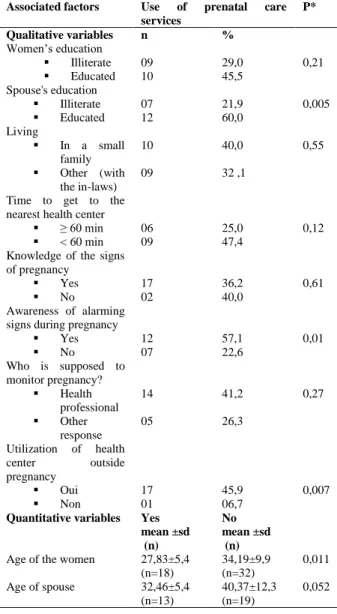
Table 2: Determinants of the prenatal care services utilization by women in a rural community in the Moroccan High Atlas
Associated factors Use of prenatal care services
P*
Qualitative variables n %
Women‘s education
Illiterate 09 29,0 0,21
Educated 10 45,5
Spouse's education
Illiterate 07 21,9 0,005
Educated 12 60,0
Living
In a small
family
10 40,0 0,55
Other (with
the in-laws)
09 32 ,1
Time to get to the nearest health center
≥ 60 min 06 25,0 0,12
< 60 min 09 47,4
Knowledge of the signs of pregnancy
Yes 17 36,2 0,61
No 02 40,0
Awareness of alarming signs during pregnancy
Yes 12 57,1 0,01
No 07 22,6
Who is supposed to monitor pregnancy?
Health
professional
14 41,2 0,27
Other
response
05 26,3
Utilization of health
center outside
pregnancy
Oui 17 45,9 0,007
Non 01 06,7
Quantitative variables Yes mean ±sd (n)
No mean ±sd (n)
Age of the women 27,83±5,4
(n=18)
34,19±9,9 (n=32)
0,011
Age of spouse 32,46±5,4
(n=13)
40,37±12,3 (n=19)
0,052
* : p value ** : standard deviation
Moreover, 65.4% of births took place at home, compared to only 34.6% in hospitals, mainly in public structures.
Only 27.6% of participants reported the possibility of complications during the postpartum period; a similar proportion of respondents did not know the answer, while 42.5% said there was no risk of complications for the woman after childbirth. The most commonly reported complication was hemorrhage (20%).
Among married women who were already pregnant (N = 53), 78.4% did not seek consultations from a health professional postpartum, compared to only 21.6% who attended a health facility during this period for the main reason of vaccinating the newborn (45%).
Determinants of the use of maternal health
care services among married women
The study of the determinants of the use of maternal health care services concerned the subgroup of married women.
The use of health care services during pregnancy (at least one prenatal consultation) was significantly linked to the spouse's education (p = 0.005), to the young age of the woman (0.011), to the awareness of alarming signs during pregnancy (p = 0.01) and to the use of local health center outside pregnancy for another health problem (p = 0.007) (Table 2).
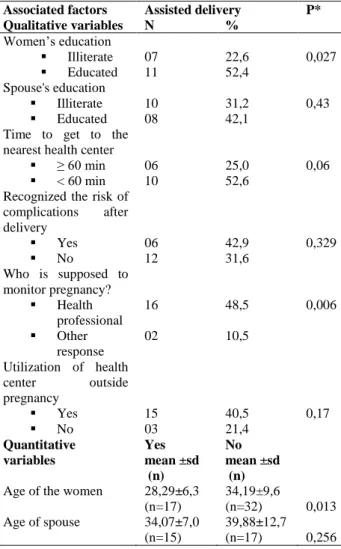
As for the use of assisted delivery, it was significantly linked to the young age of the woman (0.013), her education (p = 0.027) and the positive attitude towards monitoring her pregnancy by a health professional (p = 0.006) (Table 3).
Use of postnatal consultation services
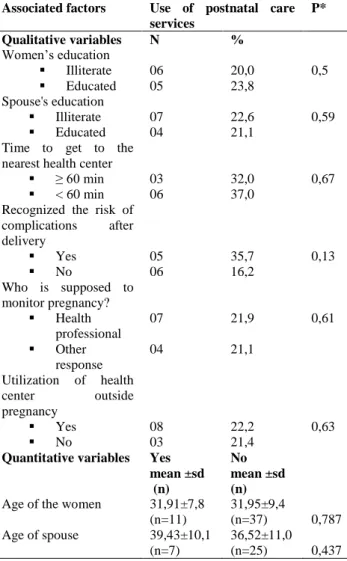
The use of postnatal care services was more common among the group of women living less than an hour from the health center (31.6% versus 13%), and among those who recognized the risk of complications after delivery (35.7% versus 16.7%), but these factors were not significantly linked from a statistical point of view (Table 4).
Discussion
Table 3: Determinants of the assisted delivery utilization by women in a rural community in the Moroccan High Atlas
Associated factors Assisted delivery P* Qualitative variables N %
Women‘s education
Illiterate 07 22,6 0,027
Educated 11 52,4 Spouse's education
Illiterate 10 31,2 0,43
Educated 08 42,1 Time to get to the
nearest health center
≥ 60 min 06 25,0 0,06
< 60 min 10 52,6 Recognized the risk of
complications after delivery
Yes 06 42,9 0,329
No 12 31,6
Who is supposed to monitor pregnancy?
Health professional
16 48,5 0,006
Other response
02 10,5
Utilization of health center outside pregnancy
Yes 15 40,5 0,17
No 03 21,4
Quantitative variables
Yes mean ±sd (n)
No mean ±sd (n) Age of the women 28,29±6,3
(n=17)
34,19±9,6
(n=32) 0,013 Age of spouse 34,07±7,0
(n=15)
39,88±12,7 (n=17) 0,256
* : p value ** : standard deviation
rural populations. Whilst it is important to understand the supply side perspective relating to this (though was not explored in this study), it is equally important to explore the knowledge and attitudes of this population to understand the determinants of this underutilization. As early onset marriage is a common practice in our study site, our sample population was young, inclusive of girls aged between 15 and 18 whose point of view was important to approach given these circumstances. Indeed, early marriage was reported by half of the married participants, which is well above the national percentage of 25%13.
In terms of knowledge, most participants (88.6%) mentioned only contraceptive pills. This
method is most reported by authors in surveys conducted in similar contexts14. In Morocco, there is active encouragement of the use of oral contraception during awareness campaigns set up by the Ministry of Health, as well as its free cost and availability at health centers that could explain this result. In addition, cultural practices play a significant contributory role to this as pregnancy planning is often the responsibility of women, and contraceptive pills are often a preferred method. However, among married women, only 24.2% used the pill, which reflects the mismatch between knowledge and practices of our respondents.
Many respondents - of which nearly half was pregnant and in last trimester of pregnancy (40%) - did not know any sign of pregnancy complications. Bleeding was the most reported sign. This shows a lack of knowledge among women in the region during or without pregnancy. Education and communication sessions on maternal health care from an early age will need to be established.
In terms of attitudes, home delivery was frequently reported in this region, with nearly 79.3% of participants expressing their preference for this way of delivery for several reasons: availability of health services; proximity of services, as many are too far to travel to; and the little cost involved along with the warmth of the home environment. Home delivery is still common in the municipality of Zerkten. In fact, 65.4% of women gave birth in their homes while the proportion of skilled birth attendance in Morocco was 73.6% in 201115. Indeed, it is a widespread observation in the more rural environments given the many conditions of social and economic vulnerability that hinder access to care. This is seen more sharply in the mountainous regions where the population face many challenges related to high expenses for transportation, medicines and possible referral to the university hospital of Marrakech. This decision of referral is interpreted by the people of the municipality as being a situation of shame and disgrace and incapacity of the future mother.
Table 4: Determinants of the postnatal care services utilization by women in a rural community in the Moroccan High Atlas
Associated factors Use of postnatal care services
P*
Qualitative variables N % Women‘s education
Illiterate 06 20,0 0,5
Educated 05 23,8 Spouse's education
Illiterate 07 22,6 0,59
Educated 04 21,1
Time to get to the nearest health center
≥ 60 min 03 32,0 0,67
< 60 min 06 37,0 Recognized the risk of
complications after delivery
Yes 05 35,7 0,13
No 06 16,2
Who is supposed to monitor pregnancy?
Health professional
07 21,9 0,61
Other response
04 21,1
Utilization of health center outside pregnancy
Yes 08 22,2 0,63
No 03 21,4
Quantitative variables Yes mean ±sd (n)
No mean ±sd (n) Age of the women 31,91±7,8
(n=11)
31,95±9,4
(n=37) 0,787 Age of spouse 39,43±10,1
(n=7)
36,52±11,0 (n=25) 0,437
* : p value ** : standard deviation
In prenatal care, the age of women is a determining factor in the use of health care services. Several studies have shown that older women are more likely to attend maternal care services for both pregnancy monitoring and assisted delivery16-19. Contrariwise, we found that younger women had more use of prenatal consultation and supervised childbirth (p = 0.011 and p = 0.013, respectively).
The level of education of women is another factor reported in the literature20,21, given that education provides women with resources to access knowledge about safe maternal health care, and grants them a certain autonomy and level of
decision-making power outside the socially attributed tasks22,23. School enrollment in our population was significantly linked to safer childbirth practices in a medically controlled environment. Compared to the education of women, which has been shown as a major determinant in the use of prenatal visits by number of authors24-27, that of the spouse remains controversial. It seems to play a major role in influencing utilization of prenatal services in the Philippines16, as in our population.
Women surveyed who were aware of the warning signs during pregnancy were more likely to use prenatal care, as was reported in India, Pakistan and Ecuador28-30. As for the attitude towards pregnancy monitoring by a health professional, it was a determining factor in the choice of medical delivery in our study. Indeed, as demonstrated by Ajzen and Fishbein, there is a strong link between a person's attitudes and behavior and their choice of delivery setting31.
More than half (52.9%) of the participants were living with the in-laws, which may reduce the woman's level of independence and therefore the use of maternal health care, but this factor was not significant. Indeed, aside from the illiteracy of women, their young age and lack of personal resources (largely economic), often translates into decisions regarding pregnancy monitoring and delivery process being largely influenced by the spouse and the family environment.
In this region, and in the absence of the husband for work, the wife is the responsibility of the mother-in-law, who in general is careful to preserve all the cultural and traditional practices concerning the period of pregnancy and childbirth. This result is referred to by many authors, particularly in Kenya and Niger32,33 and raises the importance of education of the couple and of the population, especially in rural areas.
77.1% nationally15. Only 15% have regularly monitored their pregnancy following the recommendations, which remains below the figures reported by studies in similar contexts such as in Malawi and the Republic of East Timor (40% and 55% respectively)35,36. The remoteness of the health care structure negatively influences the use of maternal health care services37,38, but this was not significant in our results (p = 0.12). It should be noted that, culturally speaking, physical examination during prenatal consultations can be considered a threat for the woman‘s intimacy especially when performed by a male health professional. This factor is described by other authors as an obstacle to the use of health care services by pregnant women39,40. The presence of a male health professional in the health center of the municipality seemed to negatively affect attendance for this study. The same observation is made in studies concerning other regions of the Moroccan High Atlas41,42.
In the postpartum period, 35.6% of participants felt that postnatal consultation was not necessary, and 72.4% did not know the possibility of complications. Women who reported having consulted a health facility in postpartum accounted for 21.6%, which is close to the national proportion of 22%13. However, the reason for this use in our context remains largely related to the vaccination of the newborn. Non-users have reported as main reason the lack of knowledge of the existence and importance of postnatal care even if it is a free service at public health structures. The determinants of the use of postpartum care most described in the literature are the onset of complications, and the educational level of women and their husbands43. Despite the observed differences, these factors were not statistically significant in our analysis.
Ethical Approval
Participation in the survey was voluntary, and anonymity and confidentiality of the data were ensured throughout the study. The necessary authorizations from the Ministry of Health and
local regulatory authorities were obtained prior to data collection.
Conclusion
This study focused on the knowledge and attitudes of a vulnerable population of women and the factors linked to their use of maternal health care services and provide insight into the challenges to accessing quality maternal health services that are being faced in a landlocked, rural area of the High Atlas region. The mountainous environment and the vast dispersion of its inhabitants made it difficult to recruit a larger sample. The results showed a certain evolution of maternal health knowledge, but the attitudes and practices for this across this population are influenced by the local culture.
The level of education of woman and her spouse, the age of woman, the use of health center for other purposes other than pregnancy, the awareness of warning signs during pregnancy, and the positive attitude towards pregnancy monitoring by a health professional were the main determinants of the use of maternal health care by women in the prenatal period and during delivery. Interventions to encourage the use of maternal health care services must take these factors into consideration. Education and communication strategies are also important to consider for improving women's knowledge and positively influencing their attitudes and behaviors toward maternal health care, and further research into the most effective strategies to be developed by both health care providers and other stakeholders to address this issue in similar settings should be encouraged.
Acknowledgement
Conflicts of Interest
No conflict of interest.
Contribution of Authors
MS analyzed the data and wrote the article.
LA contributed to the writing, translation and revision of the article
MC contributed to the revision of the article. MA contributed to the revision of the article. All the authors approved the manuscript.
References
1. Audibert M and de Roodenbeke E. Utilisation des services de santé de premier niveau au Mali: analyse de la situation et perspectives. Banq Mond Région Afr Dép Dév Hum. 2005;
2. Yakoob MY, Ali MA, Ali MU, Imdad A, Lawn JE and Van Den Broek N. The effect of providing skilled birth attendance and emergency obstetric care in preventing stillbirths. BMC Public Health. 2011;11(3):1.
3. Amooti-Kaguna B and Nuwaha F. Factors influencing choice of delivery sites in Rakai district of Uganda. Soc Sci Med. 2000;50(2):203–213.
4. Addai I. Demographic and sociocultural factors influencing use of maternal health services in Ghana. Afr J Reprod Health. avr 1998;2(1):73‐80. 5. Nyathi L, Tugli AK, Tshitangano TG and Mpofu M.
Investigating the accessibility factors that influence antenatal care services utilisation in Mangwe district, Zimbabwe. Afr J Prim Health Care Fam Med. 29 juin 2017;9(1):e1‐5.
6. WHO | 10 facts on maternal health. [Accessed on 19th June, 2016]. Available from: http://www.who.int/features/factfiles/maternal_healt h/en/
7. Munyamahoro M and Ntaganira J. Determinants de l‘utilisation des services de santé par les ménages du district de Rubavu. 2013 [Accessed on 19th June,
2016]; Available from:
https://tspace.library.utoronto.ca/handle/1807/41169 8. Indicateurs regionaux_ENPSF-2011.pdf. [Accessed on
21th April, 2016]. Available from: http://www.sante.gov.ma/Publications/Etudes_enqu ete/Documents/Indicateurs%20regionaux_ENPSF-2011.pdf
9. SANTE EN CHIFFRES 2015 Edition 2016.pdf. [Accessed on 15th August, 2017]. Available from: http://www.sante.gov.ma/Publications/Etudes_enqu
ete/Documents/04-2016/SANTE%20EN%20CHIFFRES%202015%20 Edition%202016.pdf
10. Niveau de vie et pauvreté | Site institutionnel du Haut-
Commissariat au Plan du Royaume du Maroc. [Accessed on 19th June, 2016]. Available from: http://www.hcp.ma/downloads/Niveau-de-vie-et-pauvrete_t11884.html
11. Kroeger A. Anthropological and socio-medical health care research in developing countries. Soc Sci Med. 1983;17(3):147–161.
12. Assarag B, Nassiri K and Kharbach A. Les déterminants de l‘utilisation de la consultation postnatale à la préfecture de Skhirat-Témara, Maroc. Rev DÉpidémiologie Santé Publique. 2014;62:S175– S176.
13. Enquête Nationale Sur La Population Et La Santé Familiale (ENPSF-2011). [Accessed on 19th June,
2016]. Available from:
http://www.sante.gov.ma/Documents/Enqu%C3%A Ate%20.pdf
14. Bara I. Analyse des connaissances, attitudes, perceptions et pratiques des populations en matière de santé de la mère et de l‘enfant dans le département de Gaya. 2012 [Accessed on 19th June, 2016]; Available from: http://pdf.usaid.gov/pdf_docs/PA00JJBH.pdf 15. Principaux indicateurs régionaux- ENPSF 2011.
[Accessed on 20th June, 2016]. Available from: http://www.sante.gov.ma/Publications/Etudes_enqu ete/Documents/Indicateurs%20regionaux_ENPSF-2011.pdf
16. Miles-Doan R and Brewster KL. The impact of type of employment on women‘s use of prenatal-care services and family planning in urban Cebu, the Philippines. Stud Fam Plann. 1998;69–78.
17. Ciceklioglu M, Soyer MT and Öcek ZA. Factors associated with the utilization and content of prenatal care in a western urban district of Turkey. Int J Qual Health Care. 2005;17(6):533–539. 18. Burgard S. Race and pregnancy-related care in Brazil
and South Africa. Soc Sci Med. 2004;59(6):1127– 1146.
19. Navaneetham K and Dharmalingam A. Utilization of maternal health care services in Southern India. Soc Sci Med. 2002;55(10):1849–1869.
20. Babalola S and Fatusi A. Determinants of use of maternal health services in Nigeria-looking beyond individual and household factors. BMC Pregnancy Childbirth. 2009;9(1):1.
21. Gitimu A, Herr C, Oruko H, Karijo E, Gichuki R, Ofware P, Lakati A and Nyagero J. Determinants of use of skilled birth attendant at delivery in Makueni, Kenya: a cross sectional study. BMC Pregnancy Childbirth. 2015;15(1):1.
22. Elo IT. Utilization of maternal health-care services in Peru: the role of women‘s education. Health Transit Rev. 1992;49–69.
23. Raghupathy S. Education and the use of maternal health care in Thailand. Soc Sci Med. 1996;43(4):459– 471.
P. Factors affecting the utilization of antenatal care in developing countries: systematic review of the literature. J Adv Nurs. 2008;61(3):244–260. 26. Furuta M and Salway S. Women‘s position within the
household as a determinant of maternal health care use in Nepal. Int Fam Plan Perspect. 2006;17–27. 27. Lino Y, Sillabutra J and Chompikul J. Factors related to
the perception of pregnant women regarding antenatal care in Nakonpathom province, Thailand. Jour Pub Hea Dev. 2011;9:105–16.
28. Matthews Z, Mahendra S, Kilaru A and Ganapathy S. Antenatal care, care-seeking and morbidity in rural Karnataka, India: results of a prospective study. Asia Pac Popul J. 2001;16(2):11–28.
29. Nisar N and White F. Factors affecting utilization of antenatal care among reproductive age group women (15-49 years) in an urban squatter settlement of Karachi. JPMA J Pak Med Assoc. 2003;53(2):47–53.
30. Paredes I, Hidalgo L, Chedraui P, Palma J and Eugenio J. Factors associated with inadequate prenatal care in Ecuadorian women. Int J Gynecol Obstet. 2005;88(2):168–172.
31. Ajzen I and Fishbein M. Attitude-behavior relations: A theoretical analysis and review of empirical research. Psychol Bull. 1977;84(5):888.
32. Fotso J-C, Ezeh AC and Essendi H. Maternal health in resource-poor urban settings: how does women‘s autonomy influence the utilization of obstetric care services? Reprod Health. 2009;6(1):1.
33. Doctor HV, Bairagi R, Findley SE, Helleringer S and Dahiru T. Northern Nigeria maternal, newborn and child health programme: selected analyses from population-based baseline survey. Open Demogr J. 2011;4(11‐12):11.
34. Organisation mondiale de la Sante´. Antenatal care: Report of a Technical Working Group, 1994.WHO/FRH/MSN/96.8. Geneva : WHO, 1996; [cited 2016 June 20]. Consultable a` l‘adresse: http://www.who.int/reprductivehealth/
publications/MSN_96_8/MSN_96_8chapter1. 35. Kambala C, Lohmann J, Mazalale J, Brenner S, De
Allegri M, Muula AS and Sarker M. How do Malawian women rate the quality of maternal and newborn care? Experiences and perceptions of women in the central and southern regions. BMC Pregnancy Childbirth. 2015;15(1):1.
36. Khanal V, da Cruz JLNB, Mishra SR, Karkee R and Lee AH. Under-utilization of antenatal care services in Timor-Leste: results from Demographic and Health Survey 2009–2010. BMC Pregnancy Childbirth. 2015;15(1):1.
37. Gage AJ and Guirlène Calixte M. Effects of the physical accessibility of maternal health services on their use in rural Haiti. Popul Stud. 2006;60(3):271–288. 38. Malqvist M and Sohel N, Do TT, Eriksson L and Persson
LA. Distance decay in delivery care utilisation associated with neonatal mortality. A case referent study in northern Vietnam. BMC Public Health. 2010;10(1):1.
39. Telfer ML, Rowley JT and Walraven GE. Experiences of mothers with antenatal, delivery and postpartum care in rural Gambia. Afr J Reprod Health. 2002;74–83.
40. Adekunle LV. Problems and Progress of Obstetric Care in Nigeria: Home or Hospital Delivery? Views from a Rural Community. Trop J Obstet Gynaecol. 2002;19(2):82–85.
41. Zouini M, Baali A, Cherkaoui M, Amor H, Hilali MK and Vimard P. Maternal morbidity and health care seeking in the western high Atlas mountains in Morocco (Azgour, Anougal and Imnane valleys, Al Haouz Province, Marrakech District). Biom Hum Anthropol. 2009;27(3/4):165–172.
42. Zouini M, Cherkaoui M, Baali A, Amor H, Hilali MK, El Hamdani FZ and Virmard P. Obstetric care: Supply and demand care in three valleys of the western High Atlas region of Morocco (Anougal, Azgour and Imnane). Sante Montrouge Fr. 2010;20(4):225– 231.