doi: 10.15802/stp2018/146437 © M. M. Biliaiev, O. V. Berlov, I. V. Kalashnikov, V. A. Kozachyna, 2018
ЕКОЛОГІЯ НА ТРАНСПОРТІ
UDC 502.3:504.5
M. M. BILIAIEV
1*, O. V. BERLOV
2*, I. V. KALASHNIKOV
3*, V. A. KOZACHYNA
4*1*Dep. «Hydraulics and Water Supply», Dnipropetrovsk National University of Railway Transport named after Academician V. Lazaryan, Lazaryan St., 2, Dnipro, Ukraine, 49010, tel. +38 (056) 273 15 09, e-mail [email protected], ORCID 0000-0002-1531-7882
2*Dep. «Life Safety», Public higher education institution «Prydniprovska State Academy of Civil Engineering and Architecture», Chernyshevskyi St., 24а, 49600, tel. +38 (056) 756 34 57, e-mail [email protected], ORCID 0000-0002-7442-0548
3*State Enterprise «Design and Exploration Institute of Railway Transport of Ukraine «Ukrzaliznychproekt», Konariev St., 7, Kharkiv, 61052, tel. +38 (057) 724 41 25, e-mail [email protected], ORCID 0000-0002-2814-380X
4*Dep. «Hydraulics and Water Supply», Dnipropetrovsk National University of Railway Transport named after Academician V. Lazaryan, Lazaryan St., 2, Dnipro, Ukraine, 49010, tel. +38 (056) 273 15 09,
e-mail [email protected], ORCID 0000-0002-6894-5532
CALCULATION OF «VULNERABILITY» ZONE IN CASE OF
TERRORIST ATTACK WITH CHEMICAL AGENTS
Purpose. The work involves the development of a numerical model for calculating the «vulnerability» zone of a possible terrorist attack objective with the use of a chemical agent in a built-up environment. The «vulnerability» zone is a territory near the attack objective, where the emission of a chemical agent during the attack will lead to undesirable consequences. The emission of a chemical agent outside the «vulnerability» zone will not create a dan-gerous concentration near the attack objective. Methodology. To solve this problem, we use the equation for the velocity potential, on the basis of which we determine the wind stream velocity field, and the equation adjoint to the equation of mass transfer in the atmospheric air of the chemical agent emitted in the event of a terrorist attack. Dur-ing simulation, we take into account the uneven wind stream velocity field, atmospheric diffusion and the rate of emission of a chemically hazardous substance. For the numerical integration of the velocity potential equation, we use the method of A. A. Samarsky. For numerical solution of the adjoint equation, we introduce new variables and use an implicit difference splitting scheme. The peculiarity of the developed numerical model is the possibility of operative estimation of the «vulnerability» zone near a possible attack objective. Findings. The developed numeri-cal model and computer program can be used for scientifinumeri-cally grounded assessment of the «vulnerability» zone near significant facilities in the event of possible attacks with the use of chemical (biological) agents. The constructed numerical model can be implemented on computers of small and medium power, which allows it to be widely used to solve the problems of this class when developing the emergency response plan. The results of the computational experiment are presented, which allow us to evaluate the possibilities of the proposed numerical model.
Originality. An effective numerical model is proposed for calculating the «vulnerability» zone near the facility, which may be the target of a terrorist attack with the use of a chemical agent. The model is based on the numerical integration of the velocity potential equation and the equation adjoint to the equation of mass transfer of a chemical-ly dangerous substance in the atmosphere. Practical value. The developed model can be used to organize protective actions near the target facility of a possible chemical attack by terrorists.
Keywords:terrorist attack; chemical pollution; «vulnerability» zone; adjoint equation; numerical simulation; air contamination
Introduction
Recently, special attention has been drawn to
the tasks related to the assessment of the
doi: 10.15802/stp2018/146437 © M. M. Biliaiev, O. V. Berlov, I. V. Kalashnikov, V. A. Kozachyna, 2018
task – determining the «vulnerability» zone for the
terrorist chemical attack objectives. The
«vulnera-bility» zone is a territory near the attack objective,
where the emission of a chemical agent during
a terrorist act will lead to undesirable
consequenc-es at the facility. The release of a chemically
haz-ardous substance outside this zone will not create
a «problem» at the attacked facility.
Mathematically, this provision can be expressed
as follows: at the objective of the potential terrorist
chemical attack, up to the time point
, the
concentration of the hazardous substance must not
exceed a certain dangerous value
:
i,
C r
.
(1)
Here
is the concentration which results in
a certain severity affects for a person.
It should be noted that the solution to this
problem becomes quite complicated if the emission
of a chemical agent is considered in a built-up
environment – which is, in fact, the most obvious
situation in the case of a chemical attack. As
a «zero» approximation, one can neglect the
influence of specific buildings and other facilities
on the formation of chemical contamination area
and use, for example, Gaussian models to solve the
problem, as was done in the «ALOHA» code. For
a more detailed assessment of the the contaminated
areas, it is necessary to make calculations taking
into account the influence of facilities on the
formation of concentration fields. Such detailing
can be different and determined by a number of
factors (for example, availability of a sufficient
amount of input information for modeling,
available software package for calculations, time
for obtaining results, etc.). The models used in
practice for assessing the consequences of a
terror-ist act are based on solving the «direct» problem of
mass transfer – i.e. direct solution of the equation
of convective-diffusion dispersion of impurities in
the
atmosphere at a given place
of emission of
a hazardous substance. However, the use of such
models requires considerable time to determine the
«vulnerability» zone, since the solution to the
problem is found by going through different
emis-sion points of a chemical agent during a possible
terrorist attack, i.e. the problem is solved by the
trial-and-error method. Using this approach
re-quires a lot of time to obtain the desired result. In
this regard, the actual problem is the development
of effective methods for solving the
«vulnerabil-ity» zone determination problems for various
facil-ities in the context of the growing terrorist threat.
Purpose
The purpose of this work is to create a
numeri-cal model to determine the «vulnerability» zone of
a facility in case of a chemical attack by terrorists
in a built-up environment.
Methodology
We consider the solution method on the
exam-ple of solving two problems that can be formulated
when analyzing terrorist acts with the use of
a chemical or biological agent.
Direct problem.
If a chemical (biological) agent
is used in a terrorist attack, contaminated area can
be calculated on the basis of the following mass
transfer equation (plan task) [2–5, 7, 8]:
C
uC
C
C
t
x
y
x y
C
C
x
x
y
y
0
0
,
Q
x
x
y
y
(2)
where
С
–
average concentration of chemical
(bi-ological) agent in atmospheric air;
– coefficient
taking into account the agent decomposition in the
atmosphere;
u v
,
– components of the air velocity
vector;
x,
y
– coefficients of atmospheric
turbulent diffusion;
Q
– intensity of agent
emis-sion during the terrorist attack;
x
x
0
y
y
0
–
Dirac delta function;
x
0,
y
0– coordinates of the
agent emission source during the terrorist attack;
t
– time.
The boundary conditions for the equation (2)
are written as [3]:
0
С С
for
t
0,
0
C
at the boundaries of the calculated area,
where
C
0is the known value.
doi: 10.15802/stp2018/146437 © M. M. Biliaiev, O. V. Berlov, I. V. Kalashnikov, V. A. Kozachyna, 2018
To apply the equation (1) in the case of
disper-sion of a chemical (biological) agent in a built-up
environment, it is necessary to know the uneven
velocity field of the wind flow, i.e. the value of the
variables
u=f(x,y), v=f(x,y).
The definition of this
field in the presence of buildings is a complex
hy-drodynamic problem. Abroad, to solve this
prob-lem, one traditionally uses the Navier-Stokes
equa-tions, supplemented by one or another turbulence
model. This base allowed developing specialized
software packages such as ANSYS Fluent, FAST,
etc. These packages are a powerful tool for solving
a wide class of problems. However, it is known that
the use of the Navier-Stokes equations for
calculat-ing flows with large Reynolds numbers
(
iRe),
re-quires the use of a very small computational grid,
which immediately leads to large expenditures of
computer time in the practical implementation of the
model. In addition, very powerful computers are
needed. This becomes a significant obstacle when it
is necessary to carry out serial calculations, for
ex-ample, when developing the ERP (Emergency
Re-sponse Plan). In MES or in other competent
organi-zations it is necessary to have fast-reading models,
which, in this case, would take into account the
most significant physical factors of the simulated
process. In this work, to determine the wind velocity
field
u=f(x,y), v=f(x,y)
in the built-up environment,
the potential flow model will be used [5]:
2 2
2 2
0
P
P
x
y
,
(3)
where
Р
is the velocity potential.
The value of the components of the wind
velocity vector are determined on the basis of the
ratios:
P
u
x
,
P
v
y
.
(4)
For equation (2) the following boundary
condi-tions are set:
– On solid boundaries the impermeability
con-dition is set:
P
n
=0,
where
n
is the unit vector of the outer normal to the
boundary;
– On the boundary of the «out-flow» from the
computational domain, the Dirichle boundary
con-dition of the form
P
=const is set;
– On the boundaries where the air «in-flow»
occurs, the Neumann boundary condition is set:
P
n
=
V
, where
V
is the known velocity of the air
flow.
The solution of problems for determining the
size and intensity of contaminated area on the basis
of equations (1), (2) is called the direct mass
trans-fer problem solution.
To determine the «vulnerability» zone of a
fa-cility in case of a possible chemical attack, one can
use the equations (1) and (2) and determine this
zone by «brute force searching» for various
coor-dinate values
x
0,
y
0, i.e. perform calculations for
various points of chemical agent emission. It is
quite obvious that such a solution of the problem
for determining the «vulnerability» zone using the
brute force method for parameters
x
0,
y
0requires
a lot of computational work, which is not always
convenient.
Adjoint problem.
Now we will consider
a different approach to determining the facilty
«vulnerability» zone in case of a chemical terrorist
attack.
This approach is based on the application of the
adjoint equation (3) [3]:
* * *
*
C
uC
C
C
t
x
y
* *
x y
C
C
p
x
x
y
y
,
(5)
where
С
*is the function associated with the
function
С
,
p
is a certain function [3].
The boundary conditions for the adjoint
problem have the form [3]:
* *
T
С
C
–
concentration of the chemical agent
in atmospheric air at
t=T
;
*
0
doi: 10.15802/stp2018/146437 © M. M. Biliaiev, O. V. Berlov, I. V. Kalashnikov, V. A. Kozachyna, 2018
The form of the function
p
can be extremely
diverse [3], for example:
, ,
i
i
p x y t
x
x
y
y
t
.
(6)
If the solution of the adjoint equation (5) is
found, then, further, it is necessary to find the
value of the following functional [3]
* 0 0,
TI
Q C
r t dt
,
(7)
Having constructed the isolines of this
functional, we find the solution of the problem
posed out of the condition
0,
I r
(8)
We now consider the methodology for solving
the adjoint equation. To solve the adjoint problem
(4), we introduce new variables [3]:
'
u
u
,
v
'
v
,
t
'
T
t
.
The solution of the adjoint problem begins with
the time t = T.
When using new variables, the equation (5)
takes the form of equation (2). Next, we will
con-duct an approximation of the derivatives, following
[2, 5]. The approximation of the time derivative is
as follows:
* 1 *
* ' ' n n ij ij
C
C
С
t
t
.
Further, in the formulas, the symbols «*», ««
will be omitted.
The first derivatives are approximated by the
relations [5]
,
,
uС
u C
u C
x
x
x
vC
v C
v C
y
y
y
where
,
,
,
2
2
2
2
u
u
u
u
v
v
v
v
u
u
v
v
.
For approximation of the first derivatives, we
use the formulas [2, 5]:
1 1
1, 1, 1
n n
i j ij ij i j n x
u
C
u C
u C
L C
x
x
,
1 11, 1, 1
n n
i j i j ij ij n x
u
C
u C
u C
L C
x
x
,
1 1, 1 , 1 1
n n
i j ij il i j n y
v
C
v C
v C
L C
y
y
,
1 1, 1 , 1 1
n n
i j i j ij ij n y
v
C
v C
v C
L C
y
y
.
Approximation of the second derivatives is
car-ried out as follows [5]:
1 1 1 1
1, 1,
2 2
(
)
n n n n
i j i j i j i j
x x x
C
C
C
C
C
x
x
x
x
1 1,
n n xx xxM C
M C
1 1 1 1
, 1 , 1
2 2
(
)
n n n n
i j i j i j i j
y y y
C
C
C
C
C
y
y
x
x
1 1.
n n yy yyM
C
M
C
Taking into account the above designations of
difference operators, we write the difference
ana-logue of equation (2):
1
1 1 1
n n
ij ij n n n
x x y
C
C
L C
L C
L C
t
1 1 n n y ijL C
C
1 1 1 1
(
M C
xx nL C
xx nL C
yy nL C
yy n)
.
ij ijQ
(9)
Now we carry out the splitting of the difference
equation (9). The splitting equations at each step
are written as:
At the first step (
1
4
k
n
):
, ,
,
1
2
4
n k n
i j i j k k k
x y i j
C
C
L C
L C
C
t
1
,
4
k n k n
xx xx yy yy
M C
M C
M C
M C
(10)
At the second step (
1
;
1
2
4
doi: 10.15802/stp2018/146437 © M. M. Biliaiev, O. V. Berlov, I. V. Kalashnikov, V. A. Kozachyna, 2018
, ,
,
1
2
4
k c
i j i j k k k
x y i j
C
C
L C
L C
C
t
1
,
4
k c k c
xx xx yy yy
M C
M C
M C
M C
(11)
At the third step (
3
;
1
4
2
k
n
c
n
;) the
de-pendence (11) is applied.
At the fourth step (
1;
3
4
k
n
c
n
;) the
de-pendence (10) is applied.
The desired value of the function
C
at each
fractional step is determined by the «point-to-point
computation» formula. At the last calculation step,
we have the equation
*
'
C
p
t
.
To solve this equation, the Euler method is used.
For the numerical solution of the equation (2),
the method by A.A. Samarskii is used.
Preliminari-ly the equation (2) is reduced to evolutionary form.
2 2
2 2
P
P
P
t
x
y
,
(12)
here
t
is fictitious time.
When
t
, solution of the equation (12)
tends to solution of the Laplace equation (3). To
solve the equation (12), it is necessary to specify
the potential field at
t
=0, for example, one can take
P
=0 in the entire computational domain.
The solution of equation (12) is split into two
steps, at each step of splitting the difference
equa-tions have the form
1 2 1 2 1 2
, , 1, , , 1,
2 2
0,5
n n n n n n
i j i j i j i j i j i j
P
P
P
P
P
P
x
x
1 2 1 2
, 1 , , , 1
2 2
,
n n n n
i j i j i j i j
P
P
P
P
y
y
1 1 2 1 1 1 2 1 2
, , 1, , , 1,
2 2
0,5
n n n n n n
i j i j i j i j i j i j
P
P
P
P
P
P
x
x
1 1 1 2 1 2
, 1 , , , 1
2 2
.
n n n n
i j i j i j i j
P
P
P
P
y
y
The unknown value
P
i j,, at each splitting step,
is calculated using the explicit point-to-point
com-putation formula.
For the software implementation of the
con-structed numerical model, FORTRAN was used.
Findings
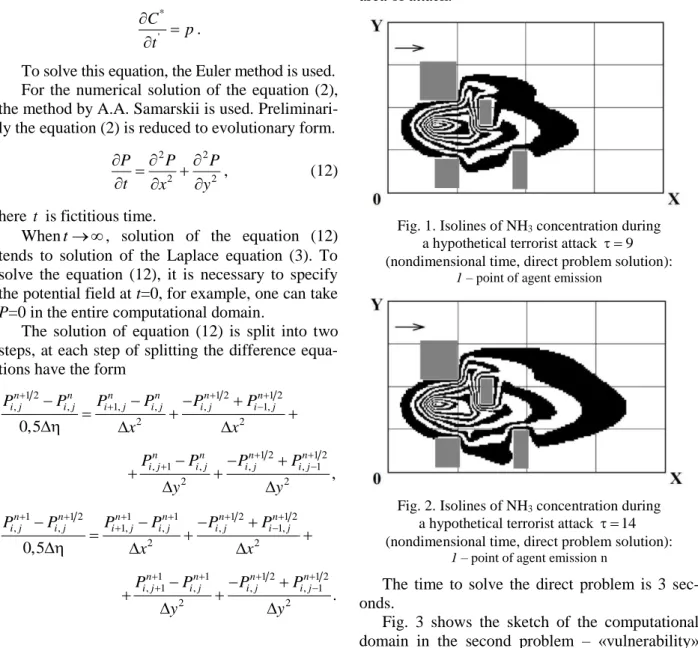
Figures 1, 2 present the results of solving the
«direct» task – the calculation of the chemical
con-tamination zone during ammonia emission at
a specific point of the area. The characteristic
di-rection of the wind speed is shown by an arrow in
the figure. As can be seen from the presented
fig-ures, the chemical contamination zone increases
with time and covers the buildings located in the
area of attack.
Fig. 1. Isolines of NH3 concentration during
a hypothetical terrorist attack 9
(nondimensional time, direct problem solution):
1 – point of agent emission
Fig. 2. Isolines of NH3 concentration during
a hypothetical terrorist attack 14 (nondimensional time, direct problem solution):
1 – point of agent emission n
The time to solve the direct problem is 3
sec-onds.
doi: 10.15802/stp2018/146437 © M. M. Biliaiev, O. V. Berlov, I. V. Kalashnikov, V. A. Kozachyna, 2018
zone determination based on the adjoint equation.
The situation of a possible chemical attack in the
area of three buildings is simulated (Fig. 3). It was
assumed that near the attack objective (building),
the concentration of ammonia should not exceed
the threshold value
9
for time moment
16
(nondimensional concentration and time).
Fig. 3. Sketch of computational domain (the second task – «vulnerability» zone determination
for the facility):
1 – target of terrorist attack
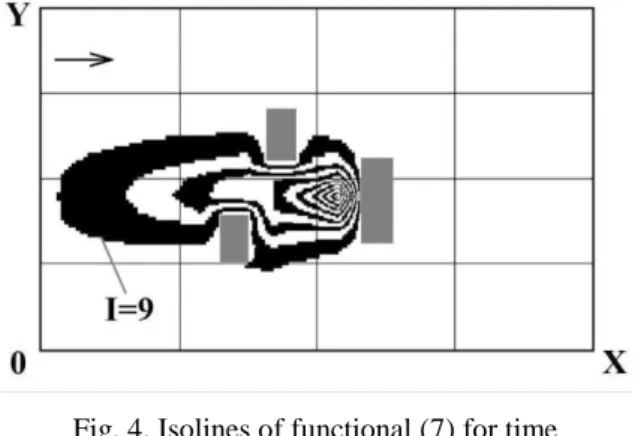
Figure 4 shows the lines of the functional (7)
defined after solving the adjoint equation (5). The
arrow in Fig. 3 and 4 indicates the wind direction.
Fig. 4. Isolines of functional (7) for time moment 16( nondimensional time)
The isolines in Fig. 4 show that if the chemical
agent emission source is along one of the lines
I=const,
then the chemical effect on the objective
of attack will be the same. Thus, isoline
I=9
shows
that if the chemical agent emission is at one of the
points on this isoline, then at the time moment
16
the concentration of the chemical agent near
the objective of attack will correspond to a given
value
9
(here the concentration is
nondimen-sional value).
The chemical agent emission inside the zone
constrained by this isoline will lead to an even
greater degree of atmospheric air contamination
near the objective of attack.
It should be noted that the calculation time of
the «vulnerability» zone is about 3 seconds.
Originality and practical value
The numerical model has been developed that
allows determining the «vulnerability» zone near
the objective of a possible terrorist attack with the
use of a chemical (biological) agent.
The peculiarity of the developed model is the
use of the adjoint equation to solve the problem
together with the potential flow equation for
calcu-lating the wind velocity field in build-up
environ-ment. The computer time consumed for the
imple-mentation of the model is a few seconds.
Conclusions
The numerical model has been developed for
determining the «vulnerability» zone of a facility
during a possible chemical attack by a terrorist in
build-up environment. The calculation basis is the
solution of the adjoint mass transfer equation. The
constructed model can be used to develop a
strate-gy to minimize the consequences of terrorist
at-tacks with the use of chemical (biological) agents.
Further improvement in this direction should be
carried out for developing a three-dimensional
nu-merical model that allows determining the
dimen-sions of the facility
«
vulnerability
»
zone during
a possible terrorist attack.
LIST OF REFERENCE LINKS
1. Алымов, В. Т. Техногенный риск. Анализ и оценка : учеб. пособие для вузов / В. Т. Алымов, Н. П. Та-расова. – Москва : Академкнига, 2004. – 118 с.
2. Беляев, Н. Н. Защита зданий от проникновения в них опасных веществ : монография / Н. Н. Беляев, Е. Ю. Гунько, Н. В. Росточило. – Днепропетровск : Акцент ПП, 2014. – 136 с.
doi: 10.15802/stp2018/146437 © M. M. Biliaiev, O. V. Berlov, I. V. Kalashnikov, V. A. Kozachyna, 2018
4. Оценка техногенного риска при эмиссии опасных веществ на железнодорожном транспорте / Н. Н. Бе-ляев, Е. Ю. Гунько, П. С. Кириченко, Л. Я. Мунтян. – Кривой Рог : Р. А. Козлов, 2017. – 127 с.
5. Численное моделирование распространения загрязнения в окружающей среде / М. З. Згуровский, В. В. Скопецкий, В. К. Хрущ, Н. Н. Беляев. – Киев : Наук. думка, 1997. – 368 с.
6. Barret, A. M. Mathematical Modeling and Decision Analysis for Terrorism Defense: Assessing Chlorine Truck Attack Consequence and Countermeasure Cost Effectiveness : Degree of Doctor of Philosophy / Antho-ny Michael Barret ; Carnegie Mellon University. – Pittsburg, Pennsylvania, 2009. – 123 p.
7. Berlov, O. V. Atmosphere protection in case of emergency during transportation of dangerous cargo / O. V. Berlov // Наука та прогрес транспорту. – 2016. – № 1 (61). – С. 48–54. doi: 10.15802/stp2016/60953 8. Biliaiev, M. M. Numerical Simulation of Indoor Air Pollution and Atmosphere Pollution for Regions Having
Complex Topography / M. M. Biliaiev, M. M. Kharytonov // NATO Science for Peace and Security. Series C: Environmental Security. – Dordrecht, 2012. – P. 87–91. doi: 10.1007/978-94-007-1359-8_15
9. CEFIC Guidance on safety Risk Assessment for Chemical Transport Operations [Electronic resource]. – Available at: https://app.croneri.co.uk/news/cefic-guidance-safety-risk-assessment-chemical-transport-operations?product=139 – Title from the screen. – Accessed : 29.01.2018.
10. Development of advanced mathematical predictive models for assessing damage avoided accidents on poten-tially-dangerous sea-based energy facility / Aleksandr Tumanov, Vasily Gumenyuk, Vladimir Tumanov // IOP Conf. Series: Earth and Environmental Science. – 2017. – Vol. 90. doi: 10.1088/1755-1315/90/1/012027 11. Effect of barriers on the status of atmospheric pollution by mathematical modeling / Zahra Naserzadeh,
Fa-rideh Atabi, Faramarz Moattar, Naser Moharram Nejad // Bioscience Biotechnology Research Communica-tion. – 2017. – Vol. 10 (1). – P. 192–204.
12. Multi-Objective Optimization Model of Emergency Organization Allocation for Sustainable Disaster Supply Chain / Cejun Cao, Congdong Li, Qin Yang, Fanshun Zhang // Sustainability. – 2017. – Vol. 9. – Іss. 11. doi: 10.3390/su9112103
13. Protective Action Criteria. A Review of Their Derivation, Use, Advantages and Limitations [Electronic re-source] / Environmental Public Health Science Unit, Health Protection Branch, Public Health and Compliance Division, Alberta Health. – Edmonton, Alberta, 2017. – Available at: http://open.alberta.ca/publications/ 9781460131213 – Title from the screen. – Accessed : 14.06.2018.
14. The analysis of the use of mathematical modeling for emergency planning purposes / Ondrej Zavila, Pavel Dobes, Jakub Dlabka, Jan Bitta // Bezpecnostni vyzkum. The Science for Population Protection. – 2015. – No. 2.
М. М. БІЛЯЄВ
1*, О. В. БЄРЛОВ
2*, І. В. КАЛАШНІКОВ
3*, В. А. КОЗАЧИНА
4*1*Каф. «Гідравліка та водопостачання», Дніпропетровський національний університет залізничного транспорту імені
академіка В. Лазаряна, вул. Лазаряна, 2, Дніпро, Україна, 49010, тел. +38 (056) 273 15 09, ел. пошта [email protected], ORCID 0000-0002-1531-7882
2*Каф. «Безпека життєдіяльності», Державний вищий навчальний заклад «Придніпровська державна академія
будівниц-тва та архітектури», вул. Чернишевського, 24а, Дніпро, Україна, 49600, тел. +38 (056) 756 34 57, ел. пошта [email protected], ORCID 0000-0002-7442-0548
3*ДП «Проектно-вишукувальний інститут залізничного транспорту України «Укрзалізничпроект», вул. Конарєва, 7,
Ха-рків, Україна, 61052, тел. +38 (057) 724 41 25, ел. пошта [email protected], ORCID 0000-0002-2814-380X
4*Каф. «Гідравліка та водопостачання», Дніпропетровський національний університет залізничного транспорту імені
академіка В. Лазаряна, вул. Лазаряна, 2, Дніпро, Україна, 49010, тел. +38 (056) 273 15 09, ел. пошта [email protected], ORCID 0000-0002-6894-5532
РОЗРАХУНОК ЗОНИ «УРАЗЛИВОСТІ» ОБ’ЄКТА ЗА МОЖЛИВОГО
ТЕРАКТУ ІЗ ЗАСТОСУВАННЯМ ХІМІЧНОГО АГЕНТА
doi: 10.15802/stp2018/146437 © M. M. Biliaiev, O. V. Berlov, I. V. Kalashnikov, V. A. Kozachyna, 2018
були враховані нерівномірне поле швидкості вітрового потоку, атмосферна дифузія, інтенсивність викиду хімічно небезпечної речовини. Під час чисельного інтегрування рівняння для потенціалу швидкості використаний метод Самарського А. А. Для чисельного розв’язання спряженого рівняння введені нові змінні та застосована неявна різницева схема розщеплення. Особливістю розробленої чисельної моделі є можливість оперативної оцінки зони «уразливості» біля можливого об’єкта атаки. Результати. Розроблена чисельна модель і комп’ютерна програма можуть бути використані для науково обґрунтованої оцінки стану зони «уразливості» біля важливих об’єктів у разі можливих терактів із застосуванням хімічних (біологічних) агентів. Побудована чисельна модель може бути реалізована на комп’ютерах малої і середньої потужності, що дозволяє широко використовувати її для вирішення завдань зазначеного класу під час розробки плану ліквідації в аварійній ситуації. Наведені результати обчислювального експерименту, що дозволяють оцінити можливості цієї чисельної моделі. Наукова новизна. Запропоновано ефективну чисельну модель для розрахунку зони «уразливості» біля об’єкта, який може бути ціллю терористичної атаки із застосуванням хімічного агента. Модель заснована на чисельному інтегруванні рівняння для потенціалу швидкості й рівняння, що є спряженим до рівняння масопереносу хімічно небезпечної речовини в атмосфері.
Практична значимість. Розроблена модель може бути використана для організації захисних заходів біля об’єктів можливої хімічної атаки терориста.
Ключові слова: теракт; хімічне забруднення; зона «уразливості»; спряжене рівняння; чисельне моделювання; забруднення атмосфери
Н. Н. БЕЛЯЕВ
1*, А. В. БЕРЛОВ
2, И. В. КАЛАШНИКОВ
3*, В. А. КОЗАЧИНА
4*1*Каф. «Гидравлика и водоснабжение», Днепропетровский национальный университет железнодорожного транспорта
имени академика В. Лазаряна, ул. Лазаряна, 2, Днипро, Украина, 49010, тел. +38 (056) 273 15 09, эл. почта [email protected], ORCID 0000-0002-1531-7882
2*Каф. «Безопасность жизнедеятельности», Государственное высшее учебное заведение «Приднепровская
государствен-ная академия строительства и архитектуры», ул. Чернышевского, 24а, Днипро, Украина, 49600, тел. +38 (056) 756 34 57, эл. почта [email protected], ORCID 0000-0002-7442-0548
3*ГП «Проектно-изыскательный институт железнодорожного транспорта «Укрзализнычпроект»,
ул. Конарева, 7, Харьков, Украина, 61052, тел. +38 (057) 724 41 25, эл. почта [email protected], ORCID 0000-0002-2814-380X
4*Каф. «Гидравлика и водоснабжение», Днепропетровский национальный университет железнодорожного транспорта
имени академика В. Лазаряна, ул. Лазаряна, 2, Днипро, Украина, 49010, тел. +38 (056) 273 15 09, эл. почта [email protected], ORCID 0000-0002-6894-5532
РАСЧЕТ ЗОНЫ «УЯЗВИМОСТИ» ОБЪЕКТА ПРИ ВОЗМОЖНОМ
ТЕРАКТЕ С ПРИМЕНЕНИЕМ ХИМИЧЕСКОГО АГЕНТА
doi: 10.15802/stp2018/146437 © M. M. Biliaiev, O. V. Berlov, I. V. Kalashnikov, V. A. Kozachyna, 2018
«уязвимости» возле объекта, который может быть целью террористической атаки с применением химиче-ского агента. Модель основана на численном интегрировании уравнения для потенциала скорости и уравне-ния, являющегося сопряженным к уравнению массопереноса химически опасного вещества в атмосфере.
Практическая значимость. Разработанная модель может быть использована для организации защитных
мероприятий возле объектов возможной химической атаки террориста.
Ключевые слова:теракт; химическое загрязнение; зона «уязвимости»; сопряженное уравнение; числен-ное моделирование; загрязнение атмосферы
REFERENCES
1. Alymov, V. T., & Tarasova, N. P. (2004). Tekhnogennyy risk. Analiz i otsenka: Uchebebnoe posobie dlya vuzov. Moscow: Akademkniga. (in Russian)
2. Belyaev, N. N., Gunko, Y. Y., & Rostochilo, N. V. (2014). Zashchita zdaniy ot proniknoveniya v nikh opasnykh veshchestv: Monografiya. Dnepropetrovsk: Aktsent PP. (in Russian)
3. Marchuk, G. I. (1982). Matematicheskoye modelirovaniye v probleme okruzhayushchey sredy. Moscow: Nau-ka. (in Russian)
4. Belyaev, N. N., Gunko, Y. Y., Kirichenko, P. S., & Muntyan, L. Y. (2017). Otsenka tekhnogennogo riska pri emissii opasnykh veshchestv na zheleznodorozhnom transporte. Krivoi Rog: Kozlov R. A. (in Russian) 5. Zgurovskiy, M. Z., Skopetskiy, V. V., Khrushch, V. K., & Belyaev, N. N. (1997). Chislennoe modelirovanie
rasprostraneniya zagryazneniya v okruzhayushchey srede. Kуiv: Naukova dumka. (in Russian)
6. Barret, A. M. (2009). Mathematical Modeling and Decision Analysis for Terrorism Defense: Assessing Chlo-rine Truck Attack Consequence and Countermeasure Cost Effectiveness. (Dissertation of Doctor of Philoso-phy). Carnegie Mellon University, Pittsburg. (in English)
7. Berlov, O. V. (2016). Atmosphere protection in case of emergency during transportation of dangerous cargo.
Science and Transport Progress, 1(61), 48-54. doi: 10.15802/stp2016/60953 (in English)
8. Biliaiev, M. M., & Kharytonov, M. M. (2012). Numerical Simulation of Indoor Air Pollution and Atmosphere Pollution for Regions Having Complex Topography. NATO Science for Peace and Security. Series C: Envi-ronmental Security, 87-91. doi: 10.1007/978-94-007-1359-8_15 (in English)
9. CEFIC Guidance on safety Risk Assessment for Chemical Transport Operations. Retrived from
https://app.croneri.co.uk/news/cefic-guidance-safety-risk-assessment-chemical-transport-operations?product=139 (in English)
10. Tumanov, A., Gumenyuk, V., & Tumanov, V. (2017). Development of advanced mathematical predictive models for assessing damage avoided accidents on potentially-dangerous sea-based energy facility. IOP Conf. Series: Earth and Environmental Science, 90. doi: 10.1088/1755-1315/90/1/012027 (in English)
11. Zahra Naserzadeh, Farideh Atabi, Faramarz Moattar, & Naser Moharram Nejad. (2017). Effect of barriers on the status of atmospheric pollution by mathematical modeling. Bioscience Biotechnology Research Communi-cation, 10(1), 192-204. (in English)
12. Cao, C., Li, C., Yang, Q., & Zhang, F. (2017). Multi-Objective Optimization Model of Emergency Organiza-tion Allocation for Sustainable Disaster Supply Chain. Sustainability, 9(11).
doi: 10.3390/su9112103 (in English)
13. Government of Alberta. Protective Action Criteria: A Review of Their Derivation, Use, Advantages and Limi-tations. Environmental Public Health Science Unit, Health Protection Branch, Public Health and Compliance Division, Alberta Health. Edmonton, Alberta. Retrived from http://open.alberta.ca/publications/9781460131213 (in English)
14. Ondrej Zavila, Pavel Dobes, Jakub Dlabka, & Jan Bitta. (2015). The analysis of the use of mathematical mod-eling for emergency planning purposes. Bezpecnostni vyzkum. The Science for Population Protection, 2. (in English)