ORIGINAL ARTICLE
Expression of
ustR
and the Golgi
protease KexB are required for ustiloxin B
biosynthesis in
Aspergillus oryzae
Akira Yoshimi
1, Myco Umemura
2, Nozomi Nagano
3, Hideaki Koike
4, Masayuki Machida
2and Keietsu Abe
1,5*Abstract
Ustiloxin B, originally isolated from the fungus Ustilaginoidea virens, is a known inhibitor of microtubule assembly. Usti-loxin B is also produced by Aspergillus flavus and is synthesized through the ribosomal peptide synthesis pathway. In A. flavus, the gene cluster associated with ustiloxin B production contains 15 genes including those encoding a fungal C6-type transcription factor and ustiloxin B precursor. Although the koji mold Aspergillus oryzae, which is genetically close to A. flavus, has the corresponding gene cluster, it does not produce ustiloxin B, which may be explained by the fact that the gene encoding the transcription factor UstR is not expressed. Here, to investigate whether ustiloxin B can be produced by expressing ustR in A. oryzae, we constructed ustR expression (ustREX) strains and analyzed usti-loxin B production. In the ustREX strains, all genes in the cluster were up-regulated, in line with expression of ustR, and ustiloxin B produced. To elucidate whether the KexB protease is involved in the processing of the ustiloxin B precur-sor protein UstA, which has repeats of basic amino acid doublets resembling KexB target sites, we also constructed a ustREX strain with the ∆kexB genotype. Although ustR was expressed in this strain, ustiloxin B was barely detectable. This finding strongly suggests that KexB is required for ustiloxin B production.
Keywords: Aspergillus oryzae, Ustiloxin B, Secondary metabolite, Fungal C6-type transcription factor, RiPS pathway
© 2016 Yoshimi et al. This article is distributed under the terms of the Creative Commons Attribution 4.0 International License (http://creativecommons.org/licenses/by/4.0/), which permits unrestricted use, distribution, and reproduction in any medium, provided you give appropriate credit to the original author(s) and the source, provide a link to the Creative Commons license, and indicate if changes were made.
Introduction
The koji mold Aspergillus oryzae is an important filamen-tous fungus used in the traditional Japanese fermentation industry to produce sake (rice wine), shoyu (soy sauce), and miso (soybean paste) (Machida et al. 2008). Filamen-tous fungi are generally able to secrete large amounts of various hydrolytic enzymes. Aspergillus oryzae has a high potential for secretion of industrially important enzymes such as amylases and proteases (Kobayashi et al. 2007; Machida et al. 2008). In addition, its long history of exten-sive use in the food industry has placed A. oryzae on the list of Generally Recognized as Safe (GRAS) organisms compiled by the Food and Drug Administration (FDA) in the USA (Abe et al. 2006). The safety of this organ-ism is also supported by the World Health Organization
(WHO) (FAO/WHO 1987). Although A. oryzae is geneti-cally very close to Aspergillus flavus, which produces many secondary metabolites, including the most potent natural carcinogen aflatoxin and the tremorgenic myco-toxin aflatrem, there is no record of A. oryzae producing any toxic metabolites because its secondary metabolite genes are silenced (Machida et al. 2005). For instance, the A. oryzae homologs of the aflatoxin biosynthesis gene cluster are not expressed even under conditions that are favorable for aflatoxin production in A. flavus and Asper-gillus parasiticus (Kusumoto et al. 1998; Watson et al.
1999; Takahashi et al. 2002; Zhang et al. 2005). Therefore, A. oryzae may be a suitable host for production of not only heterologous proteins but also secondary metabo-lites with important medical activities (Kobayashi et al.
2007; Machida et al. 2008; Sakai et al. 2008).
Ustiloxin B is a toxic cyclic peptide that was originally identified in Ustilaginoidea virens, a pathogenic fungus affecting rice (Koiso et al. 1992, 1994, 1998). Recently, the ustiloxin B biosynthetic gene cluster was identified in
Open Access
*Correspondence: [email protected]
A. flavus using a novel method to predict gene clusters from transcriptome data, and subsequently validated by LC-MS analysis of ustiloxin B production by gene dele-tion mutants (Umemura et al. 2013, 2014). Although usti-loxin B production by A. oryzae is undetectable under normal growth conditions, the corresponding gene clus-ter is present in the A. oryzae genome (Machida et al.
2005; Umemura et al. 2013); it contains 15 genes, includ-ing ustR, which encodes a fungal-type Zn(II)2Cys6 (C6)
transcription factor (Umemura et al. 2013). Interestingly, the upstream region of ustR, which might be involved in the transcriptional regulation of ustR, is deleted in A. ory-zae (Umemura et al. 2013).
Fungal secondary metabolites are biosynthesized by proteins encoded by clusters of coordinately regulated genes, and most of these clusters encode enzymes, such as polyketide synthase (PKS) and non-ribosomal peptide synthase (NRPS), which catalyze condensation reactions of monomeric units to form oligomeric intermediates. Ustiloxin B synthesis does not involve PKS or NRPS: this is the first case of a ribosomally synthesized peptide in a filamentous fungus (Umemura et al. 2014). Ustiloxin B consists of tetrapeptides, Tyr-Ala-Ile-Gly (YAIG). It is circularized at the side chains of Tyr and Ile, and modified with a methyl group, a hydroxyl group, and the non-protein-coding amino acid norvaline; all three modifications are at the tyrosine (Umemura et al. 2014). Since the protein encoded by ustA contains 16 repeats of YAIG, UstA is thought to be the precursor of ustiloxin B (Umemura et al. 2014). The U. virens gene for the pre-cursor (UstA) has five Tyr-Val-Ile-Gly (YVIG) and three YAIG motifs, corresponding to the sequences of usti-loxin A and ustiusti-loxin B, respectively (Koiso et al. 1992,
1994; Tsukui et al. 2015). Thus, ustiloxins produced by U. virens (both are cyclic peptides) are probably synthe-sized via the ribosomal peptide synthesis (RiPS) path-way, as in the case of A. flavus ustiloxin B (Tsukui et al.
2015).
In both A. flavus and U. virens, the UstA protein pos-sesses an N-terminal signal peptide for import into the endoplasmic reticulum, followed by a novel repeating sequence containing basic amino acid doublets, KR, which resemble the target sites of the subtilisin-like endoprotease Kex2 from Saccharomycescerevisiae (Miz-uno et al. 1988; Fuller et al. 1989). Kex2 of S. cerevisiae is a Ca2+-dependent transmembrane serine protease that
cleaves secretory proproteins at the carboxyl side of KR and RR in a late Golgi compartment (Fuller et al. 1989; Redding et al. 1991). Therefore, the UstA proteins may be processed in the Golgi apparatus at the C-terminal side of KR by the KexB protease, which is an A. oryzae ortholog of S. cerevisiae Kex2 (Mizutani et al. 2004). However, the relationship between the biosynthesis of
RiPS compounds, such as ustiloxin B, and the KexB pro-tease has not been characterized directly.
In the present study, we constructed several ustR expression (ustREX) mutants of A. oryzae to determine
whether they would be able to produce ustiloxin B, in contrast to the wild-type strain. Analyses of the tran-scription of ustiloxin B biosynthetic cluster genes in these strains revealed that ustR expression induced the expression of all other genes in the cluster and ustiloxin B production in the ustREX strains. Because ustR
expres-sion and ustiloxin B production were never detected in the wild-type strain, A. oryzae might silence ustR, result-ing in the lack of ustiloxin B synthesis. The involvement of the KexB protease in the processing of the precur-sor protein, UstA, was validated by the analysis of usti-loxin B production in a ustREX strain with kexB deletion
(ustREX/∆kexB). We propose that the expression of the
transcription factor ustR is critical for the production of ustiloxin B in A. oryzae, and that the KexB endopeptidase is involved in UstA processing.
Methods
Strains and growth media
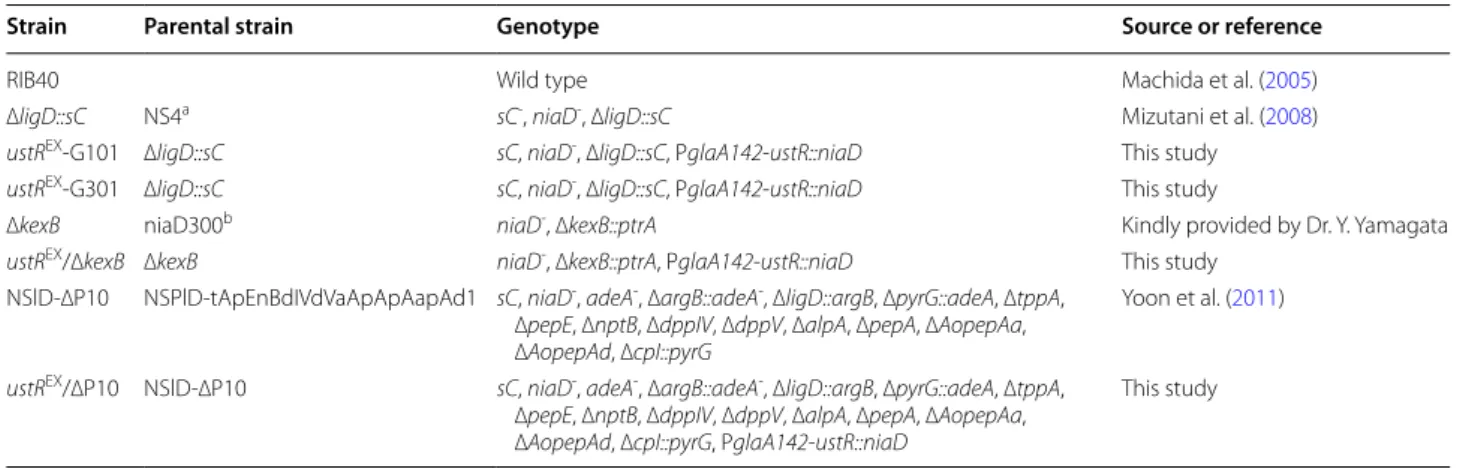
Aspergillus oryzae strains used in this study are listed in Table 1. RIB40 was used as the wild-type strain; ∆ligD::sC, ∆kexB and NSlD-∆P10 were used as parents to construct ustR-expressing (ustREX) strains. These strains
were grown in Czapek-Dox (CD) minimal medium or CDE medium, which is CD medium supplemented with 70 mM monosodium glutamate instead of sodium nitrate (NaNO3) as a nitrogen source for preparation of
conidial suspension (Mizutani et al. 2008). CDE medium containing 2 % maltose as a carbon source (designated CDEm medium) or YPM medium (1 % yeast extract, 2 % polypeptone, 2 % maltose) was used for up-regulation of glaA142 promoter-driven ustR in the ustREX strains.
To analyze gene transcription and to measure ustiloxin B production, strains were cultured in V8-juice liquid medium referred to hereafter as V8 medium [20 % (v/v) V8 juice (Campbell’s, Camden, NJ, USA) with 0.3 % CaCO3] at 30 °C on a rotary shaker at 160 rpm.
as a selectable marker in A. oryzae. The resulting plasmid (pNGAustR) was used to transform the ∆ligD::sC, ∆kexB, and NSlD-∆P10 strains and was integrated into their genomes as described previously (Fujioka et al. 2007). Two mutant lines of ustREX, designated G101 and G301,
were obtained by transformation of the parental strain ∆ligD::sC strain; both G101 and G301 were used in the following experiments.
Analysis of the transcription levels of the ustiloxin B gene cluster by quantitative RT‑PCR
Real-time RT-PCR was performed as described previ-ously (Yoshimi et al. 2013, 2015). Primer sets for quan-tifying the expression of the ustiloxin B cluster genes are listed in Additional file 1: Table S1. The histone H2B gene was used as a normalization reference (internal control) for target gene expression ratios. A sample of unmanip-ulated cells of the control strain (∆ligD::sC) cultured in V8 medium was set as a calibrator in each experiment. Statistical analyses were performed using Welch’s t test (p < 0.01 was considered significant).
Production of ustiloxin B
Three replicates of the control and each ustREX strain
were cultivated in 100 mL of V8 medium in 200-mL Erlenmeyer flasks at 30 °C and 160 rpm. After 1, 3, 5, and 7 days, 10-mL culture aliquots were harvested and the equivalent volume of acetone was added. The mix-tures were incubated for 1 h at room temperature, and the mycelia were removed by filtration through Mira-cloth. Each filtrate was stirred with an equal amount of ethyl acetate for 1 h at room temperature, centrifuged at 13,000×g for 10 min, and the water layer was collected.
A 3-μL aliquot of each water extract was separated using an UPLC-MS system (Acquity UPLC I-Class, Xevo
G2 QTof, Waters Corp., MA, Milford, USA) equipped with a reversed-phase column (2.1 × 150 mm; Acquity
UPLC BEH C18; Waters Corp.) Peptides were eluted with a water–acetonitrile gradient containing 0.1 % formic acid (98:2 for 0.5 min, to 70:30 for 10 min) at a flow rate of 0.4 mL/min. The production of ustiloxin B (C26H39N5O12S) was quantified by calculating the
peak area of extracted ion chromatograms (EICs) of m/z 646.239 ± 0.03 [M + H]+ at the retention time of
3.1 min. An authentic sample of ustiloxin B (Umemura et al. 2013) was used for external calibration with the QuanLynx software (version 4.1, Waters Corp.).
Results
Expression of ustR in A. oryzae
In the wild-type strain, no transcript of the ustR gene was detected at the time points examined (Fig. 1), whereas in the ustREX strains the ustR transcript was detectable
in CDEm (data not shown) and V8 media (Fig. 1). There were no notable differences between the two independ-ent ustREX mutant lines (G101 and G301; Fig. 1).
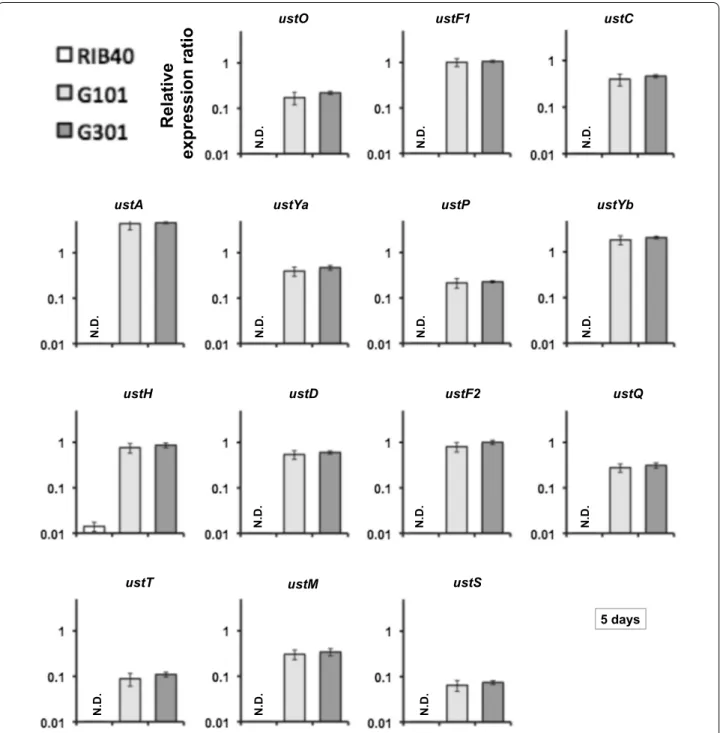
Next, we analyzed the expression of the other 14 genes in the ustiloxin B biosynthetic cluster to test whether it is affected by ustR expression. Whereas the transcripts of all these genes (except ustH) were undetectable in the wild-type strain, they were strongly induced in both ustREX strains grown in V8 medium for 5 days (Fig. 2).
The transcripts of all genes were present from day 1 until at least 7 days after inoculation (Fig. 2; Additional file 1: Figures S1, S2, S3), in line with the expression of ustR (Fig. 1). The co-expression of ustR and other genes of this cluster was also detected in CDEm and YPM liquid media (data not shown). These results suggest that the C6-type transcription factor UstR regulates all genes in the ustiloxin B biosynthetic cluster.
Table 1 Strains used in this study
a Yamada et al. (1997)
b Minetoki et al. (1996)
Strain Parental strain Genotype Source or reference
RIB40 Wild type Machida et al. (2005)
∆ligD::sC NS4a sC-, niaD-, ∆ligD::sC Mizutani et al. (2008)
ustREX-G101 ∆ligD::sC sC, niaD-, ∆ligD::sC, PglaA142-ustR::niaD This study
ustREX-G301 ∆ligD::sC sC, niaD-, ∆ligD::sC, PglaA142-ustR::niaD This study
∆kexB niaD300b niaD-, ∆kexB::ptrA Kindly provided by Dr. Y. Yamagata
ustREX/∆kexB ∆kexB niaD-, ∆kexB::ptrA, PglaA142-ustR::niaD This study
NSlD-∆P10 NSPlD-tApEnBdIVdVaApApAapAd1 sC, niaD-, adeA-, ∆argB::adeA-, ∆ligD::argB, ∆pyrG::adeA, ∆tppA, ∆pepE, ∆nptB, ∆dppIV, ∆dppV, ∆alpA, ∆pepA, ∆AopepAa, ∆AopepAd, ∆cpI::pyrG
Yoon et al. (2011)
ustREX/∆P10 NSlD-∆P10 sC, niaD-, adeA-, ∆argB::adeA-, ∆ligD::argB, ∆pyrG::adeA, ∆tppA, ∆pepE, ∆nptB, ∆dppIV, ∆dppV, ∆alpA, ∆pepA, ∆AopepAa, ∆AopepAd, ∆cpI::pyrG, PglaA142-ustR::niaD
Production of ustiloxin B in the ustREX mutants
To investigate whether ustR expression induces ustiloxin B production, we assessed the presence of ustiloxin B in both ustREX strains, G101 and G301. Although the genes
in the ustiloxin B cluster were transcribed in CDEm or YPM media in the ustREX strains, the production of
usti-loxin B was not detected (data not shown). However, ustiloxin B was detected in V8 medium culture, and its concentration increased continuously at least from 1 to 7 days (Fig. 3). These results indicate that ustiloxin B can be produced in A. oryzae, and that ustR expression and consequent induction of the genes of the ustiloxin B bio-synthetic cluster are responsible for its production.
Involvement of the KexB protease in ustiloxin B biosynthesis in A. oryzae
To investigate whether the precursor protein UstA was processed by KexB, we used the ustREX mutant lacking
this protease (ustREX/∆kexB). The transcription levels of
the ustiloxin B biosynthetic genes and ustR were simi-lar in the ustREX/∆kexB and ustREX strains grown in V8
medium (Figs. 2, 4; Additional file 1: Figure S4). We then analyzed ustiloxin B production in both ustREX strains
(ustREX and ustREX/∆kexB) and the corresponding
con-trol strains (wild-type and ∆kexB) (Table 1). After 5 days of culture in V8 medium, ustiloxin B was not detectable in the control strains; a considerable amount of usti-loxin B (approximately 7 mg/L) was produced by the ustREX strain, but ustiloxin B was barely detectable in the
ustREX/∆kexB strain (approximately 0.35 mg/L; Fig. 5).
We also generated a ustREX mutant in the NSlD-∆P10
strain, in which the genes encoding 10 secreted proteases of
A. oryzae are disrupted (Yoon et al. 2011). The ustREX/∆P10
strain produced the same level of ustiloxin B as the ustREX
strain, whereas the parental strain, NSlD-∆P10, did not pro-duce ustiloxin B (Fig. 5). These results suggest that KexB is critical for ustiloxin B production and is specifically required for proteolytic processing of the precursor protein UstA.
Discussion
In the present study, we analyzed the transcription of the ustiloxin B gene cluster and the production of ustiloxin B in three types of ustREX mutants of A. oryzae and their
parental strains (wild-type A. oryzae RIB40, ∆kexB, and ∆P10) (Table 1). In the wild-type strain, we detected nei-ther the transcripts of any genes of the cluster nor usti-loxin B. In contrast, expression of the ustR gene (which encodes a fungal-type C6 transcription factor) from this cluster (Umemura et al. 2014) up-regulated the transcrip-tion of all other genes of the cluster and induced ustiloxin B synthesis (Figs. 1, 2, 3). Fungal-type Zn(II)2Cys6 (C6)
transcription factors regulate genes involved in the pro-duction of secondary metabolites in filamentous fungi (Payne et al. 1993; Chang et al. 1995; Brown et al. 1996; Marui et al. 2011). One of the best-studied examples is AflR of A. flavus, A. parasiticus, and A. nidulans, which regulates the expression of genes required for the pro-duction of aflatoxin and sterigmatocystin (Payne et al.
1993; Chang et al. 1995; Brown et al. 1996). In A. oryzae, fungal-type C6 transcription factors regulate genes nec-essary for the degradation of complex polysaccharides such as starch and xylan. For example, AmyR regulates the expression of the clustered amylolytic genes agdA, which encodes α-glucosidase, and amyA, which encodes α-amylase (Gomi et al. 2000). In A. oryzae, XlnR regu-lates the expression of more than 30 xylanolytic and cel-lulolytic genes involved in the degradation of β-1,4-xylan, arabinoxylan, cellulose, and xyloglucan (Noguchi et al.
2009), and ManR regulates the expression of the endo-β-mannanase gene (Ogawa et al. 2012). In contrast, little is known about the role of fungal-type C6 transcription factors in the regulation of the expression of the genes involved in production of secondary metabolites synthe-sized through the RiPS pathway in A. oryzae.
The A. oryzae genome contains many gene clusters likely involved in biosynthesis of secondary metabolites, and these clusters are highly enriched in non-syntenic blocks (NSBs) (Machida et al. 2005, 2008; Kobayashi et al. 2007). The analyses of ESTs and DNA microarrays of A. oryzae grown under several conditions showed that the transcription levels of the NSB genes are consider-ably lower than those of the genes in syntenic blocks (Machida et al. 2005; Akao et al. 2007; Tamano et al.
2008). The absence of toxin production in A. oryzae is thought to be attributable to silencing of the secondary
Fig. 1 Expression of the ustR gene in wild-type (RIB40) and ustREX (G101 and G301) A. oryzae strains. The strains were grown in V8 medium at 30 °C. Quantitative RT-PCR was used to determine the levels of transcription of the ustR gene and was performed on total RNA with ustR-specific primers (Additional file 1: Table S1). Each value represents the ratio of ustR expression to that of the histone H2B gene in each strain. Error bars represent standard deviations (n= 3).
metabolite biosynthetic genes (Barbesgaard et al. 1992; Machida et al. 2008; Tokuoka et al. 2008). Aspergillus oryzae may possess a silencing mechanism similar to that observed in the regulation of aflatoxin biosynthesis in Aspergillus sojae, which is closely related to A. oryzae and is also known as koji mold. Silencing is thought to be
caused by the lack of aflR expression and/or by non-func-tional AflR in A. sojae (Matsushima et al. 2001a, b). AflR regulates transcription of a gene cluster for aflatoxin bio-synthesis in Aspergillus species (Woloshuk et al. 1994). Although the aflR gene is present within the aflatoxin biosynthesis gene cluster, aflR is not expressed or AflR
Relative
expression ratio
ustO ustF1 ustC
ustA ustYa ustP ustYb
ustH ustD ustF2 ustQ
ustT ustM ustS
5 days
N.D. N.D. N.D.
N.D. N.D. N.D.
N.D.
N.D. N.D. N.D.
N.D. N.D. N.D.
is non-functional in A. oryzae and A. sojae (Kusumoto et al. 1998; Watson et al. 1999; Takahashi et al. 2002). The mechanism of ustR expression silencing may be similar to that of aflR expression silencing in A. oryzae.
The deletion of the upstream region of ustR might silence the ustiloxin B gene cluster in A. oryzae, resulting
in the lack of ustiloxin B production even under condi-tions that are favorable for ustiloxin B production in A. flavus. However, some wild-type A. oryzae strains have no deletion in the ustR upstream region and are in this respect similar to A. flavus (our unpublished data). Therefore, this deletion is strain-specific in A. oryzae and might not affect ustiloxin B production. Aspergillus ory-zae has orthologs of VelB, VeA, and LaeA (Marui et al.
2010), which are global regulators of secondary metabolic genes in Aspergillus species (Bok and Keller 2004; Bay-ram et al. 2008; Amare and Keller 2014). The absence of aflR expression was found in the ∆laeA A. oryzae strain (Ken Oda, personal communication), suggesting that aflR expression is regulated by LaeA in A. oryzae, as in other Aspergillus species. Thus, another possible explanation of ustiloxin B gene cluster silencing in A. oryzae is that global regulators of secondary metabolic genes such as LaeA might regulate ustR expression.
Although the expression of the ustR gene and the induction of the cluster genes were confirmed in the ustREX strain, the production of ustiloxin B was not
detected in CDEm liquid medium, in which the ustREX
strain was grown. Similar results were obtained in A. flavus (our unpublished data). Ustiloxin B production was also not detected in the nutritionally rich YPM liq-uid medium (our unpublished data). Ustiloxin B was produced by the ustREX strain only in V8 medium or
cracked-maize medium (Fig. 3 and data not shown). These data suggest that the amounts of amino acids were insufficient for ustiloxin B production in CDEm medium or that some essential factor(s), such as vitamin(s), derived from vegetables or maize is(are) needed for
G301 G101
Fig. 3 Production of ustiloxin B by A. oryzaeustREX (G101 and G301) strains. The strains were grown in V8 medium at 30 °C. Culture aliquots (10 mL) were harvested at the indicated time points and the amount of ustiloxin B in the culture medium was determined by LC-MS analysis. Error bars represent standard deviations (n= 3)
Relative expression ratio
ustR ustC
Relative expression ratio
ustA ustD
N.D. N.D. N.D. N.D.
N.D. N.D. N.D. N.D.
Fig. 4 Expression of the genes of the cluster for ustiloxin B biosyn-thesis in A. oryzae wild-type (RIB40), ustREX, ∆kexB, and ustREX/∆kexB strains. The strains were grown in V8 medium at 30 °C for 5 days. Quantitative RT-PCR was used to determine the levels of transcription of the ustR gene and the indicated representative genes; RT-PCR was performed on total RNA with gene-specific primers (Additional file 1: Table S1). Each value represents the ratio of expression relative to that of the histone H2B gene in each strain. Error bars represent standard deviations (n= 3). ND not detectable
ustiloxin B production by A. oryzae even in the presence of sufficient amounts of amino acids in YPM medium.
Our data revealed that KexB endopeptidase is required for the processing of UstA, the ustiloxin B precursor, which contains a sequence with signal peptide character-istics and was predicted to be processed by the subtilisin-like endoprotease Kex2 (Umemura et al. 2014). However, a low level of ustiloxin B production was still detectable in the ustREX/∆kexB strain. This residual ustiloxin B
pro-duction can be explained as follows: (1) in the absence of KexB, the expression of ustA was still up-regulated by the expression of ustR, resulting in sufficient amounts of UstA; (2) a small amount of UstA could be processed non-specifically by some protease(s) in the Golgi appara-tus and produce low levels of ustiloxin B; (3) subsequent biosynthetic steps of ustiloxin B production could pro-gress regardless of the presence or absence of KexB. A recent study on the biosynthesis of RiPS compounds in other fungal species predicted that the precursor pro-tein of novel cyclic oligopeptides is likely to be processed by the subtilisin-like endoprotease in the ascomycetes Epichloë (Johnson et al. 2015). Our study provides the first direct evidence that a subtilisin-like endoprotease is involved in the biosynthesis of a RiPS compound (usti-loxin B) in filamentous fungi.
Since the A. oryzae genome encodes a number of vari-ous proteases (Machida et al. 2005; Kobayashi et al. 2007), the identification of the protease potentially involved in UstA processing in the absence of KexB is quite difficult. However, ustiloxin B production was not altered in the ustREX/∆P10 strain (Fig. 5), which expresses ustR and
in which genes encoding 10 secreted proteases (TppA, PepE, NptB, DppIV, DppV, AlpA, PepA, AoPepAa, AoPe-pAd, and CpI) are disrupted (Table 1) (Yoon et al. 2011). Therefore, none of these 10 proteases is involved in UstA processing. Further studies are necessary for elucidation of the biosynthetic pathway of ustiloxin B in A. oryzae.
Author details
1 ABE-project, New Industry Creation Hatchery Center, Tohoku University, 6-6-10 Aoba, Aramaki, Aoba-ku, Sendai, Miyagi 980-8579, Japan. 2 Bioproduc-tion Research Institute, NaBioproduc-tional Institute of Advanced Industrial Science and Technology (AIST), 17-2-1 Higashi-Nijo, Tsukisamu, Toyohira-ku, Sapporo, Additional file
Additional file 1:Table S1. PCR primers used in this study. Figure S1. Expression of the genes of the cluster for ustiloxin B biosynthesis in
A. oryzae wild-type (RIB40) and ustREX (G101 and G301) strains grown for 1 day. Figure S2. Expression of the genes of the cluster for ustiloxin B biosynthesis in A. oryzae wild-type (RIB40) and ustREX (G101 and G301) strains grown for 3 day. Figure S3. Expression of the genes of the cluster for ustiloxin B biosynthesis in A. oryzae wild-type (RIB40) and ustREX (G101 and G301) strains grown for 7 day. Figure S4. Expression of the genes of the cluster for ustiloxin B biosynthesis in the A. oryzae strains ∆kexB,
ustREX/∆kexB, NSlD-∆P10 (∆P10), and ustREX/∆P10.
Hokkaido 062-8517, Japan. 3 Biotechnology Research Institute for Drug Discovery, National Institute of Advanced Industrial Science and Technology (AIST), 2-4-7 Aomi, Koto-ku, Tokyo 135-0064, Japan. 4 Bioproduction Research Institute, National Institute of Advanced Industrial Science and Technology (AIST), 1-1-1 Higashi, Tsukuba, Ibaraki 305-8566, Japan. 5 Laboratory of Applied Microbiology, Department of Microbial Biotechnology, Graduate School of Agricultural Sciences, Tohoku University, 1-1 Amamiya, Tsutsumi-dori, Sendai, Miyagi 981-8555, Japan.
Acknowledgements
We thank Professor Youhei Yamagata, Tokyo University of Agriculture and Tech-nology for providing the A. oryzae ∆kexB strain and for valuable discussions regarding KexB processing.
Funding
This work was supported by the Commission for Development of Artificial Gene Synthesis Technology for Creating Innovative Biomaterial from the Ministry of Economy, Trade, and Industry (METI) of Japan.
Competing interests
The authors declare that they have no competing interests.
Ethical approval
This article does not contain any studies with human participants or animals performed by any of the authors.
Received: 14 December 2015 Accepted: 26 January 2016
References
Abe K, Gomi K, Hasegawa F, Machida M. Impact of Aspergillus oryzae
genomics on industrial production of metabolites. Mycopathologia. 2006;162:143–53.
Akao T, Sano M, Yamada O, Akeno T, Fujii K, Goto K, Ohashi-Kunihiro S, Takase K, Yasukawa-Watanabe M, Yamaguchi K, Kurihara Y, Maruyama J, Juvvadi PR, Tanaka A, Hata Y, Koyama Y, Yamaguchi S, Kitamoto N, Gomi K, Abe K, Takeuchi M, Kobayashi T, Horiuchi H, Kitamoto K, Kashiwagi Y, Machida M, Akita O. Analysis of expressed sequence tags from the fungus Aspergillus oryzae cultured under different conditions. DNA Res. 2007;14:47–57. Amare MG, Keller NP. Molecular mechanisms of Aspergillus flavus secondary
metabolism and development. Fung Genet Biol. 2014;66:11–8. Barbesgaard P, Heldt-Hansen H, Diderichsen B. On the safety of Aspergillus
oryzae. Appl Microbiol Biotechnol. 1992;36:569–72.
Bayram Ö, Krappmann S, Ni M, Bok JW, Helmstaedt K, Valerius O, Braus-Stri-meyer S, Kwon N-J, Keller NP, Yu J-H, Braus GH. VelB/VeA/LaeA complex coordinates light signal with fungal development and secondary metabolism. Science. 2008;320:1504–6.
Bok JW, Keller NP. LaeA, a regulator of secondary metabolism in Aspergillus spp. Eukariot Cell. 2004;3:527–35.
Brown DW, Yu JH, Kelkar HS, Fernandes M, Nesbitt TC, Keller NP, Adams TH, Leonard TJ. Twenty-five coregulated transcripts define a sterigmato-cystin gene cluster in Aspergillus nidulans. Proc Natl Acad Sci USA. 1996;93:1418–22.
Chang P-K, Ehrlich KC, Yu J, Bhatnagar D, Cleveland TE. Increased expression of Aspergillus parasiticusaflR, encoding a sequence-specific DNA-binding protein, relieves nitrate inhibition of aflatoxin biosynthesis. Appl Environ Microbiol. 1995;61:2372–7.
FAO/WHO. Committee on food additives 31. Geneva: World Health Organiza-tion Technical Report Series; 1987.
Fujioka T, Mizutani O, Furukawa K, Sato N, Yoshimi A, Yamagata Y, Nakajima T, Abe K. MpkA-dependent and -independent cell wall integrity signaling in
Aspergillus nidulans. Eukariot Cell. 2007;6:1497–510.
Fuller RS, Brake AJ, Thorner J. Yeast prohormone processing enzyme (KEX2
gene product) is a Ca2+-dependent serine protease. Proc Natl Acad Sci
USA. 1989;86:1434–8.
involved in the amylolytic gene expression in Aspergillus oryzae. Biosci Biotechnol Biochem. 2000;64:816–27.
Johnson RD, Lane GA, Koulman A, Gao M, Fraser K, Fleetwood DJ, Voisey CR, Dyer JM, Pratt J, Christensen M, Simpson WR, Bryan GT, Johnson LJ. A novel family of cyclic oligopeptides derived from ribosomal peptide synthesis of an in planta-induced gene, gigA, in Epichloë endophytes of grasses. Fung Genet Biol. 2015;85:14–24. doi:10.1016/j.fgb.2015.10.005. Kobayashi T, Abe K, Asai K, Gomi K, Juvvadi PR, Kato M, Kitamoto K, Takeuchi M,
Machida M. Genomics of Aspergillus oryzae. Biosci Biotechnol Biochem. 2007;71:646–70.
Koiso K, Natori M, Iwasaki S, Sato S, Sonoda R, Fujita Y, Yaegashi H, Sato Z. Usti-loxin: a phytotoxin and a mycotoxin from false smut balls on rice panicles. Tetrahedron Lett. 1992;33:4157–60.
Koiso K, Li Y, Iwasaki S, Hanaoka K, Kobayashi T, Sonoda R, Fujita Y, Yaegashi H, Sato Z. Ustiloxins, antimitotic cyclic peptides from false smut balls on rice panicles caused by Ustilaginoidea virens. J Antibiot. 1994;47:765–73. Koiso K, Morisaki N, Yamashita Y, Mitsui Y, Shirai R, Hashimoto Y, Iwasaki S.
Isolation and structure of an antimitotic cyclic peptide, Ustiloxin F: chemical interrelation with a homologous peptide, Ustiloxin B. J Antibiot. 1998;51:418–22.
Kusumoto K, Yabe K, Nogata T, Ohta H. Transcript of a homolog of aflR, a regulatory gene for aflatoxin synthesis in Aspergillus parasiticus, was not detected in Aspergillus oryzae strains. FEMS Microbiol Lett. 1998;169:303–7.
Machida M, Asai K, Sano M, Tanaka T, Kumagai T, Terai G, Kusumoto K, Arima T, Akita O, Kashiwagi Y, Abe K, Gomi K, Horiuchi H, Kitamoto K, Kobayashi T, Takeuchi M, Denning DW, Galagan JE, Nierman WC, Yu J, Archer DB, Bennett JW, Bhatnagar D, Cleveland TE, Fedorova ND, Gotoh O, Horikawa H, Hosoyama A, Ichinomiya M, Igarashi R, Iwashita K, Juvvadi PR, Kato M, Kato Y, Kin T, Kokubun A, Maeda H, Maeyama N, Maruyama J, Nagasaki H, Nakajima T, Oda K, Okada K, Paulsen I, Sakamoto K, Sawano T, Takahashi M, Takase K, Terabayashi Y, Wortman JR, Yamada O, Yamagata Y, Anazawa H, Hata Y, Koide Y, Komori T, Koyama Y, Minetoki T, Suharnan S, Tanaka A, Isono K, Kuhara S, Ogasawara N, Kikuchi H. Genome sequencing and analysis of Aspergillus oryzae. Nature. 2005;438:1157–61. doi:10.1038/ nature04300.
Machida M, Yamada O, Gomi K. Genomics of Aspergillus oryzae: learning from the history of koji mold and exploration of its future. DNA Res. 2008;15:173–83.
Marui J, Ohashi-Kunihiro S, Ando T, Nishimura M, Koike H, Machida M. Penicillin biosynthesis in Aspergillus oryzae and its overproduction by genetic engi-neering. J Biosci Bioeng. 2010;110:8–11. doi:10.1016/j.jbiosc.2010.01.001. Marui J, Yamane N, Ohashi-Kunihiro S, Ando T, Terabayashi Y, Sano M, Ohashi
S, Oshima E, Tachibana K, Higa Y, Nishimura M, Koike H, Machida M. Kojic acid biosynthesis in Aspergillus oryzae is regulated by a Zn(II)2Cys6 tran-scriptional activator and induced by kojic acid at the trantran-scriptional level. J Biosci Bioeng. 2011;112:40–3.
Matsushima K, Chang PK, Yu J, Abe K, Bhatnagar D, Cleveland TE. Pre-termi-nation in aflR of Aspergillus sojae inhibits aflatoxin biosynthesis. Appl Microbiol Biotechnol. 2001a;55:585–9.
Matsushima K, Yashiro K, Hanya Y, Abe K, Yabe K, Hamasaki T. Absence of aflatoxin biosynthesis in koji mold (Aspergillus sojae). Appl Microbiol Biotechnol. 2001b;55:771–6.
Minetoki T, Nunokawa Y, Gomi K, Kitamoto K, Kumagai C, Tamura G. Deletion analysis of promoter elements of the Aspergillus oryzaeagdA gene encod-ing α-glucosidase. Curr Genet. 1996;30:432–8.
Minetoki T, Kumagai C, Gomi K, Kitamoto K, Takahashi K. Improvement of promoter activity by the introduction of multiple copies of the conserved region III sequence, involved in the efficient expression of Aspergillus ory-zae amylase-encoding genes. Appl Microbiol Biotechnol. 1998;50:459–67. Minetoki T, Tsuboi H, Koda A, Ozeki K. Development of high expression system with the improved promoter using the cis-acting element in Aspergillus
species. J Biol Macromol. 2003;3:89–96.
Mizuno K, Nakamura T, Oshima T, Tanaka S, Matsuo H. Yeast KEX2 gene encodes an endopeptidase homologous to subtilisin-like serine pro-teases. Biochem Biophys Res Commun. 1988;156:246–54.
Mizutani O, Nojima A, Yamamoto M, Furukawa K, Fujioka T, Yamagata Y, Abe K, Nakajima T. Disordered cell integrity signaling caused by disruption of the
kexB gene in Aspergillus oryzae. Eukariot Cell. 2004;3:1036–48.
Mizutani O, Kudo Y, Saito A, Matsuura T, Inoue H, Abe K, Gomi K. A defect of LigD (human Lig4 homolog) for nonhomologous end joining signifi-cantly improves efficiency of gene-targeting in Aspergillus oryzae. Fung Genet Biol. 2008;45:878–89.
Noguchi Y, Sano M, Kanamaru K, Ko T, Takeuchi M, Kato M, Kobayashi T. Genes regulated by AoXlnR, the xylanolytic and cellulolytic transcriptional regu-lator, in Aspergillus oryzae. Appl Microbiol Biotechnol. 2009;85:141–54. Ogawa M, Kobayashi T, Koyama Y. ManR, a novel Zn(II)2Cys6 transcriptional activator, controls the β-mannan utilization system in Aspergillus oryzae. Fungal Genet Biol. 2012;49:987–95.
Payne GA, Nystrom GJ, Bhatnagar D, Cleveland TE, Woloshuk CP. Cloning of the
afl-2 gene involved in aflatoxin biosynthesis from Aspergillus flavus. Appl Environ Microbiol. 1993;59:156–62.
Redding K, Holcomb C, Fuller RS. Immunolocalization of Kex2 protease identifies a putative late Golgi compartment in the yeast Saccharomyces cerevisiae. J Cell Biol. 1991;113:527–38.
Sakai K, Kinoshita H, Shimizu T, Nihira T. Construction of a citrinin gene cluster expression system in heterologous Aspergillus oryzae. J Biosci Bioeng. 2008;106:466–72.
Takahashi T, Chang P-K, Matsushima K, Yu J, Abe K, Bhatnagar D, Cleveland TE, Koyama Y. Nonfunctionality of Aspergillus sojae aflR in a strain of
Aspergillus parasiticus with a disrupted aflR gene. Appl Environ Microbiol. 2002;68:3737–43.
Tamano K, Sano M, Yamane N, Terabayashi Y, Toda T, Sunagawa M, Koike H, Hatamoto O, Umitsuki G, Takahashi T, Koyama Y, Asai R, Abe K, Machida M. Transcriptional regulation of genes on the non-syntenic blocks of
Aspergillus oryzae and its functional relationship to solid-state cultivation. Fung Genet Biol. 2008;45:139–51.
Tokuoka M, Seshime Y, Fujii I, Kitamoto K, Takahashi T, Koyama Y. Identifica-tion of a novel polyketide synthase-nonribosomal peptide synthetase (PKS-NRPS) gene required for the biosynthesis of cyclopiazonic acid in
Aspergillusoryzae. Fungal Genet Biol. 2008;45:1608–15.
Tsukui T, Nagano N, Umemura M, Kumagai T, Terai G, Machida M, Asai K. Ustilox-ins, fungal cyclic peptides, are ribosomally synthesized in Ustilaginoidea virens. Bioinformatics. 2015;31:981–5. doi:10.1093/bioinformatics/btu753. Umemura M, Koike H, Nagano N, Ishii T, Kawano J, Yamane N, Kozone I,
Hori-moto K, Shin-ya K, Asai K, Yu J, Bennett JW, Machida M. MIDDAS-M: motif-independent de novo detection of secondary metabolite gene clusters through the integration of genome sequencing and transcriptome data. PLoS One. 2013;8:e84028. doi:10.1371/journal.pone.0084028.
Umemura M, Nagano N, Koike H, Kawano J, Ishii T, Miyamura Y, Kikuchi M, Yu J, Shin-ya K, Machida M. Characterization of the biosynthetic gene cluster for the ribosomally synthesized cyclic peptide ustiloxin B in Aspergillus flavus. Fungal Genet Biol. 2014;68:23–30. doi:10.1016/j.fgb.2014.04.011. Watson AJ, Fuller LJ, Jeenes DJ, Archer DB. Homologs of aflatoxin biosynthesis
genes and sequence of aflR in Aspergillus oryzae and Aspergillus sojae. Appl Environ Microbiol. 1999;65:307–10.
Woloshuk CP, Foutz KR, Brewer JF, Bhatnagar D, Cleveland TE, Payne GA. Molec-ular characterization of aflR, a regulatory locus for aflatoxin biosynthesis. Appl Environ Microbiol. 1994;60:2408–14.
Yamada O, Lee BR, Gomi K. Transformation system for Aspergillus oryzae with double auxotrophic mutants, niaD and sC. Biosci Biotech Biochem. 1997;61:1367–9.
Yoon J, Maruyama J-I, Kitamoto K. Disruption of ten protease genes in the filamentous fungus Aspergillus oryzae highly improves production of heterologous proteins. Appl Microbiol Biotechnol. 2011;89:747–59. Yoshimi A, Sano M, Inaba A, Kokubun Y, Fujioka T, Mizutani O, Hagiwara D,
Fujikawa T, Nishimura M, Yano S, Kasahara S, Shimizu K, Yamaguchi M, Kawakami K, Abe K. Functional analysis of the α-1,3-glucan synthase genes agsA and agsB in Aspergillus nidulans: AgsB is the major α-1,3-glucan synthase in this fungus. PLoS One. 2013;8:e54893. doi:10.1371/ journal.pone.0054893.
Yoshimi A, Fujioka T, Mizutani O, Marui J, Hagiwara D, Abe K. Mitogen-activated protein kinases MpkA and MpkB independently affect micafungin sensi-tivity in Aspergillus nidulans. Biosci Biotechnol Biochem. 2015;79:836–44. doi:10.1080/09168451.2014.998619.