ACTS BEFORE CONGRESS: HOW INTEREST GROUPS INFLUENCE ORAL HEALTH POLICY MAKING IN THE U.S. GOVERNMENT
Nicholas Gerard Mosca
A dissertation submitted to the faculty at the University of North Carolina at Chapel Hill in partial fulfillment of the requirements for the degree of Doctor of Public Health in the Department of Health
Policy and Management in the Gillings School of Global Public Health.
Chapel Hill 2014
Approved by:
Thomas C. Ricketts
Jessica Y. Lee
Jonathan Oberlander
Richard Gary Rozier
ii © 2014
iii ABSTRACT
Nicholas Gerard Mosca: Acts Before Congress: How Interest Groups Influence Oral Health Policy Making in the U.S. Government.
(Under the direction of Thomas C. Ricketts)
The research problem for this study is the persistent gap in dental insurance coverage in
the United States with an estimated 130 million Americans lacking coverage. This failure to
ensure comprehensive dental coverage raises questions about the effectiveness of oral health
policy groups. On February 4, 2009, President Obama signed into law the Children’s Health
Insurance Program Reauthorization Act (CHIPRA) of 2009 (Public Law 111-3) which required
states to provide dental coverage for eligible beneficiaries, this contrasts with the inaugural State
Children’s Health Insurance Program (SCHIP) enacted as part of the Balanced Budget Act of
1997, which did not include mandatory dental coverage. The research objective is to develop a
guide to oral health policy development using the experience of participants in the efforts to
develop and eventually pass CHIPRA.
This retrospective case study of the CHIPRA legislation used qualitative methods
including 28 key informant interviews and document content analysis to determine the strategies
used by oral health policy groups to influence policy and political decision-making. Case
findings showed agenda setting, information generation by non-membership organizations,
policy portfolio development, stakeholder consensus, and strategic communication with key
lawmakers were used for effective advocacy to influence federal policy-making. A media report
iv
of the problem in Congress. Opposing views were framed as concerns over cost and federalism
(e.g., central government mandates on states). Based on the analysis, oral health policy groups
can improve policymaking advocacy by focusing awareness of the problem, building social ties
with key Congressional committees, and obtaining a consensus of policy support from those
v
Dedicated to Martha Liggett, Scott Litch, Gina Luke, Suzanne Leous, Myla Moss, Monnette McKinnon, and Jack Bresch who impassioned a preoccupation with
vi
ACKNOWLEDGEMENTS
I want to thank my State Health Officer Dr. Mary Currier and the Director of
Communicable Diseases Joy Sennett for their encouragement to return to school. In mid-life,
going back to school for a post-doctoral degree can be daunting and costly. My experience was
transformational and well worth the cost. I want to express my sincere gratitude to Don and
Jennifer Holzworth for their generous gift of the Charles A. Veatch Endowed Scholarship in
Health Leadership. I was fortunate to share this scholarship award with another student. I am
also grateful to the Association of State and Territorial Dental Directors for providing financial
support during my term as editor of the organization. The other cost of investment in a doctoral
degree is the emotional and psychological intangible costs incurred by my partner Andrew and
my brother Provino and his family. I want to acknowledge your unfailing support and
encouragement.
I was in very good company in Cohort 4 and I appreciate the insightful discovery and
encouragement provided my classmates. I want to also express my heartfelt thanks to our
program director Dr. Suzanne Hobbs and the committed and supportive faculty and staff at the
Gillings School of Global Public Health. Most importantly, I want to thank my committee chair
and mentor Dr. Thomas Ricketts who set high expectations and was generous and perceptive in
his feedback. I also thank my committee members for their time, subject expertise, and patience
vii
TABLE OF CONTENTS
LIST OF TABLES... ix
LIST OF FIGURES ... x
CHAPTER 1. INTRODUCTION ... 1
A. BACKGROUND AND SIGNIFICANCE ... 1
B. RESEARCH QUESTION AND HISTORICAL CONTEXT... 4
C. THE CASE STUDY ... 14
CHAPTER 2. LITERATURE REVIEW ... 17
A. REVIEW METHODS... 17
B. THEORIES OF INTEREST GROUP INFLUENCE... 21
C. SUMMARY ... 44
CHAPTER 3. CONCEPTUAL MODEL AND RESEARCH METHODS... 47
A. CONCEPTUAL MODEL ... 47
B. PROPOSITIONS... 50
C. STUDY DESIGN AND METHODS... 52
CHAPTER 4. RESULTS ... 57
CHAPTER 5. IMPLICATIONS ... 94
A. ANALYSIS... 94
B. KEY INTERVENTIONS... 96
C. LIMITATIONS ...109
CHAPTER 6. PLAN OF ACTION...112
viii
APPENDIX 2: Oral Health Policy Goals in Key Legislations ...136
APPENDIX 3: Key Informant Organizations for Case Study...137
APPENDIX 4: CHIPRA Oral Health Care Policy Provisions...143
APPENDIX 5: Chronological Timeline of Key Events ...144
ENDNOTES ...145
ix
LIST OF TABLES
TABLE 1 – Case Study Analysis Model ... 53
TABLE 2 – Description of Oral Health Policy Goals ...136
TABLE 3 – List of Key Informant Organizations...137
TABLE 4 – CHIPRA Oral Health Policy Provisions ...143
x
LIST OF FIGURES
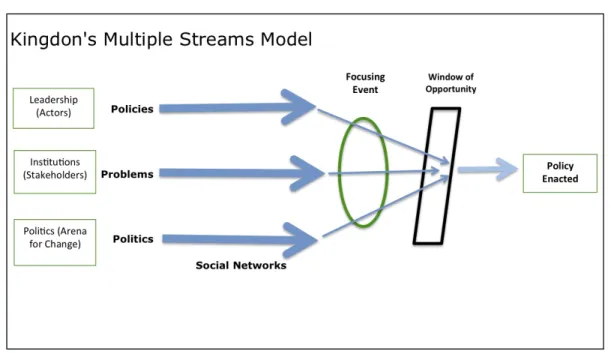
FIGURE 1 – Adaptation of Kingdon’s Multiple Streams Model... 47
! CHAPTER 1
INTRODUCTION
A. Background and Significance
The World Health Organization defines oral health as “a state of being free from chronic
mouth and facial pain, oral and throat cancer, oral sores, birth defects such as cleft lip and palate,
periodontal (gum) disease, tooth decay and tooth loss, and other diseases and disorders that affect
the oral cavity”.1 A multitude of studies have proven beyond any doubt that oral health is an
integral part of overall health. For example, an examination of the mouth may reveal signs of
poor health and disease, such HIV/AIDS, nutritional deficiencies, diabetes, and some cancers.2
Disease in the oral cavity may trigger and/or exacerbate other systemic disease conditions, such
as pulmonary infections, cardiovascular disease, brain abscesses, and hematological disease.
Yet, the financing and delivery of oral health care in the United States is separate from
the financing and delivery of health care. Most health insurance plans do not cover oral health
care and the personal costs for dental care are typically high. To reduce the out-of-pocket
expense, Americans may purchase dental insurance but employment-based dental insurance is
typically offered as a voluntary option and requires separate premiums, deductables and co-pays.
Most dental insurance plans also have waiting periods, typically six months in length, before
needed treatment may be performed, and some also include a “missing tooth” clause that
"
The magnitude of the problem is such that while 50 million Americans are without health
insurance, more than twice that or 130 million Americans have no dental insurance, an estimated
40% of the U.S. population.3National Medical Expenditure Panel Survey (MEPS) data show that
in 2004, 57% of individuals with dental insurance had at least one dental visit compared to 32%
of those with public dental coverage and 27% with no coverage.4 More than half of the U.S.
population does not receive an annual dental check-up.5 This means that access to oral health
care is unattainable for many Americans, including Medicare beneficiaries. The benefits package
for Medicare explicitly excludes dental care almost entirely and program enrollees must purchase
dental cleanings, fillings, and/or dentures out-of-pocket.
Vulnerable and underserved populations have a higher prevalence of oral diseases
compared to those with means. The health care safety net for low-income populations is
Medicaid primarily, and state Medicaid programs may provide dental care to eligible
low-income adults. However, fewer than half the states do so and benefits are typically restricted to
emergency services only.6 National dental care utilization rates for low-income adults in 2010
was 10% lower compared to 2002, and only two states, Maryland and Virginia, experienced an
increase among low-income adults.7 The lack of access to dental care for low-income adults,
especially prevention services, leads to rotten teeth and tooth loss. One in four American adults
ages 65 and older have lost all of their teeth.8 Arguing for the need for universal health insurance
coverage, the journalist Malcolm Gladwell called bad teeth in American society an “outward
marker of caste”.9
Studies have found that children also have inadequate access to oral health care. One out
of every five children ages one to 18, an estimated 17 million children in low-income families,
#
dental caries (e.g. tooth decay). As a consequence, dental caries is commonly found in children
who lack access to dental care or prevention. In1996, just before the enactment of the State
Children’s Health Insurance Program, only 26% of low-income children had dental insurance
coverage compared to 52% of children from all income brackets.11 Although Medicaid and the
Children’s Health Insurance Programs (CHIP) provide dental coverage for eligible children
through the Early Periodic Screening, Diagnosis and Treatment programs, many families
continue to have difficulty in accessing basic dental care because many dentists do not accept
Medicaid or restrict the number of Medicaid beneficiaries seen in their practices, creating long
waits for appointments. It is estimated that about 20 percent of the nation’s active practicing
dentists accept and provide care for Medicaid beneficiaries, and a majority of Medicaid
beneficiaries who receive dental care live in urban communities.12 More than 49 million people
live in dental Health Professional Shortage Areas as designated by the federal Health Resources
and Services Administration (HRSA).
In 2007,the Washington Post reported the death of twelve-year-old Deamonte Driver
from complications of emergency neurosurgery after he developed a brain abscess from
untreated abscessed teeth.13 Deamonte’s mother attempted for months to locate a dentist who
would accept Medicaid coverage, then her children’s Medicaid eligibility lapsed. The Post
reporter noted that fewer than one in three children enrolled in Maryland’s Medicaid Program
received any dental care. Deamonte’s tragic case highlights the barriers to access to dental care
experienced by many low-income families in America. A few days after Deamonte’s death in
2007, the Sun Herald, a newspaper in Biloxi Mississippi, reported the death of six-year-old
$
Alexander was able to access dental care but his infection was too severe and he succumbed to
complications from his treatment which could have been mitigated with low cost preventive care.
The research problem for this study is the persistent gap in dental coverage in the United
States, with an estimated 130 million Americans lacking dental insurance. This failure to ensure
comprehensive dental coverage raises questions about political activism and the effectiveness of
oral health policy groups. More than thirty years ago, the Institute of Medicine (IOM) released
Public Policy Options for Better Dental Health that noted the absence of oral health from the
larger public policy discussions.14The IOM report recommended that dental services be included
in national health insurance to overcome significant financial barriers to oral health care.
Children in families without dental insurance are three times more likely to have unmet dental
needs than children with either public or private insurance.15 Dental care utilization data for
coverage of low-income children in publicly funded Children’s Health Insurance Programs
(CHIP) demonstrate the powerful impact that coverage can have. National dental care utilization
in 2010 was 53% higher among low-income children relative to 2000, and all but three states,
Florida, Ohio, and Wisconsin, showed an increase. In Maryland, Deamonte Driver’s home state,
the dental utilization rate for low-income children more than quadrupled.7
B. Research Question and Historical Context of Federal Oral Health Policymaking
My research question is how do policy provisions toimprove children’s oral health
coverage get enacted into law. I used a case study research design to describe what tactics and
strategies are used, by whom, and under what circumstances. I reviewed the history of federal
oral health lawmaking to determine the historical events to improve dental care coverage and
identify an appropriate study case. One of the earliest examples of federal oral health
%
federal government did not provide dental care for soldiers and sailors so each were responsible
for obtaining dental care at personal cost. Dental check-ups might identify the risk for toothache
during combat. The American Dental Association, founded in 1859, organized civilian dentists
to petition the government to improve access to dental care for those enlisted in the military.
With bipartisan support, Congress created the U.S. Army Dental Corps in 1911.16 The Army
Corps enlisted dentists and developed a standard of dental health for military readiness, requiring
exams for all applicants, and providing dental care to enlisted servicemen and their dependents.
One year later, Congress enacted legislation to create the Navy Dental Corps. Dental exams to
improve military readiness were notable for identifying dental disease as a major reason for
rejecting recruits during World War I; one-third of new applicants were rejected for failing their
dental exam.17
The industrialization of the American economy stimulated urban growth in the early
1900s and an increasing number of Americans lived in unhealthy conditions, exposed to unsafe
work environments yet unable to afford the escalating costs of health care.18 The American
Association for Labor Legislation, a private reform organization, pursued a government
compulsory health insurance program as a benefit for workers. Initially supportive of the
concept, organized medicine as represented by the American Medical Association (AMA) grew
opposed to national health insurance for a variety of reasons, including fears over cuts in
earnings, decreased physician control of medical practice, and federal restrictions on provider
choice. AMA leaders spoke of how government-supported methods would lead to the
socialization of medical care.19 Organized dentistry, represented by the American Dental
Association, also challenged government insurance as too radical and supported a free market
&
and encourage personal responsibility and self-reliance to pay for care.20 National health
insurance failed but the debate over the role of government in organizing and overseeing the
health care system would persist as a deep concern of health professionals.
At the turn of the century, the health of women and children was especially vulnerable to
the socioeconomic inequities of the American free market system. Progressive reformers alarmed
by high infant mortality rates supported a social justice approach for women and children.21 In
1912 President Taft signed into law the Children’s Bureau to investigate and report on all matters
related to the welfare of children, including inequities in health.22 However the legislation did not
authorize any funding for direct provider care due to opposition from health professionals who
perceived the program as socialistic. In 1921, President Harding signed into law the Maternity
and Infancy Act, also known as the Sheppard-Towner Act, which provided the first federal
grant-in-aid program in health to create public clinics for women’s perinatal care and the health care of
children. In 1927, the American Medical Association succeeded in getting Congress to
discontinue funding for the program.23 The Great Depression in the 1930s motivated legislators
to enact the Social Security Act of 1935 that provided citizens with unemployment insurance and
established the nation’s first federal public assistance system, which included grants to states for
maternal and child welfare (Title V). Although direct payment to providers for care was not
included in the Social Security Act, Congress would amend this law in the 1950s and 60s to
address the health care needs of low-income families.24
In 1931, the U.S. Public Health Service (USPHS) provided a key opportunity for
institutional oral health leadership in government by establishing a Dental Hygiene Unit at the
National Institutes of Health (NIH). Dr. H. Trendley Dean was appointed as the first dental
'
Frederick McKay on “mottled enamel” in Colorado. They determined the condition was caused
during tooth development by fluoride in the drinking water. They also discovered that the
affected teeth were resistant to tooth decay, which was attributed to fluoride. The findings led to
the world’s first community water fluoridation program in Grand Rapids, Michigan in 1945.26
Thereafter, the U.S. Public Health Service adopted a national policy to promote
community water fluoridation. In 1948, President Truman signed the National Dental Research
Act into law, which created the National Institute for Dental Research (NIDR), predecessor to
the present-day National Institute for Dental and Craniofacial Research (NIDCR). Dr. Dean was
its first director. In 1956, President Eisenhower signed the National Health Survey Act created
by Congress to obtain statistical information on the scope and impact of health and illness in
America. The NIDR contributed expertise to develop dental examination measures for the
National Health Examination Survey, which in 1959 was considered one of the largest
epidemiological studies of its time.27
Dentistry also benefited from the government’s efforts to expand the nation’s medical
workforce in the early 1960s. In 1963, President Kennedy signed the Health Professions
Educational Assistance Act into law, which provided direct support for construction of new
dental schools, adding an estimated 1,000 more dentists to the workforce per year.28 Similar
legislation known as The Health Manpower Act of 1968 provided grants to measure the dental
workforce size and distribution as a component of health workforce estimation studies and
expanded the number of postgraduate dental training programs under Title VII of the Public
Health Service Act.29 It should be noted that prior to the passage of the 1964 Civil Rights Act,
southern state and local dental societies barred black dentists from membership in the American
( whose predominant membership was black.
President Lyndon Johnson signed into law the Social Security Act of 1965 to create
large-scale public insurance programs Medicare and Medicaid for the elderly and those living in
poverty. The American Dental Association lobbied for the inclusion of dental care as a benefit
under Medicaid but opposed dental care for the elderly under Medicare, instead calling on
Congress to expand the Kerr-Mills Act of 1960, which limited healthcare coverage to the aged
poor as determined by means-testing.30 The Medicaid law allowed states to determine benefits
for its citizens, and dental care could be considered as part of a state’s plan. Today, the types of
dental benefits offered vary greatly by state. For example in 2008, only emergency dental care
was available to adults in 16 states, and six states excluded any dental care for adults.31 In 1967,
Congress amended the Social Security Act to include a health benefit for children known as the
Early and Periodic Screening, Diagnosis, and Treatment (EPSDT) Program that had a statutory
requirement to provide exams as per a periodicity schedule determined by each state’s health
professionals, including dentists. As a result, the recommended periodicity for children’s dental
screening varied by state with most states opting for children to be seen by age three. Studies
using state Medicaid utilization data show in reality most children are not seen until age five.32
Children’s primary teeth typically erupt within the first six months and a dental exam by age one
allows the dentist to educate parents about brushing and dietary goals to prevent dental decay
and may reduce a child’s anxiety and stress for the dental visit.
Section 1862 (a)(12) of the Social Security Act states that no payment can be made under
Medicare Part A or Part B for the “care, treatment, filling, removal, or replacement of teeth or
structures directly supporting teeth”, creating a statutory dental care exclusion in Medicare.33 The
)
procedure such as reconstruction of the jaw after traumatic injury or the removal of teeth in
preparation for radiation treatment of neoplasms of the jaw. As a result of the expansion of
Medicare in 1972 to include persons with end-stage renal disease (ESRD) and permanent
disabilities, Part B may also pay for an in-hospital dental evaluation as part of a comprehensive
work-up for organ transplantation. However Medicare does not pay for dental treatment to
manage acute dental pain or infection.
Congress created the National Health Service Corps (NHSC) through the Emergency
Health Personnel Act of 1970 to promote rural health care workforce development, including the
expansion of dental workforce. The NHSC assigns eligible dentists to underserved areas to
provide care for a defined period of time in exchange for dental education loan repayment and/or
scholarship support. President Nixon signed into law the Comprehensive Health Manpower
Training Act of 1971, which sought to expand the federal government’s role in the financing of
health professions education, including dental education. This law not only sought to increase the
numbers of professional health care workers but also improve their distribution both
geographically and by type of specialty. In 1976, President Ford signed the Health Professions
Educational Assistance Act that also focused on improving the distribution of health
professionals by specialty area as well as geographic location. The law authorized new training
programs to expand the function of dental auxiliaries employed by dentists to improve the
efficiency of dental care delivery, which was not included in previous educational assistance
legislation.34
In 1989, Congress sought to improve access to healthcare for children by making changes
to the Medicaid EPSDT program as part of the Omnibus Budget Reconciliation Act (OBRA
!*
provide dental care at “intervals meeting reasonable standards of dental practice as well as at
medically necessary intervals”, and the required services must include “relief of pain and
infections, restoration of teeth, and maintenance of dental health”.35 To expand the number of
children enrolled, OBRA 89 required all states to increase Medicaid financial eligibility to 133
percent of the Federal Poverty Level (FPL), with an option to go to 185 percent FPL. It also
required Medicaid to cover services provided by federally qualified health centers (FQHC).
FQHCs provided health care, including basic dental services, to low-income populations.
Eight years later, President Clinton signed into law the State Children’s Health Insurance
program, which Congress passed as part of the 1997 Balanced Budget Act (Pub.L. 105-33).36
The law represented another progressive policy for vulnerable children, who were seen by
Congress as a sympathetic population. SCHIP enabled states to receive a block grant, not
open-ended funding, to enact the plan to provide health care coverage to eligible children based on
means testing. SCHIP expanded health insurance coverage for uninsured children age 19 and
younger by establishing the financial eligibility up to 200% of the FPL, or up to 50 percentage
points above a state’s existing Medicaid eligibility level. SCHIP required states to offer general
medical benefits comparable to benchmark benefit package in their state, such as a commercial
health benefits plan or the state employees’ health benefits package. States could expand
eligibility under Medicaid alone, create a separate SCHIP program, or use a combination of both
programs. SCHIP allowed nominal cost sharing (e.g., co-pays, deductibles) for children in
families with incomes below 150% FPL. SCHIP gave states the “option” of including dental
benefits as part of their core medical benefits, the only oral health-related policy included in the
!!
By FY 2003, 18 states had a separate SCHIP program, 13 states had expanded Medicaid
eligibility, and 18 states had combined their SCHIP and Medicaid programs.37 States that opted
for Medicaid expansion were required to include dental care as part of the Early and Periodic
Diagnosis and Screening (EPSDT) Program. States that opted to create separate SCHIP
programs could include dental care but were not required to. By 2009, fifty states and the District
of Columbia had chosen to include some type of dental benefit although the benefits (e.g.,
preventive, restorative) varied widely by state.38 Rozier (2008) determined that low-income
children enrolled in a separate SCHIP program model were more likely than children enrolled in
a Medicaid program to obtain dental care.39 The separate SCHIP program offered higher
reimbursement rates and administrative improvements for dentists that increased their
willingness and ability to treat eligible children. Many dentists refuse to participate in state
Medicaid programs, with inadequate payment the most frequently cited reason. In 2009, CMS
reported that locating a dentist who accepted Medicaid remained the most frequently reported
barrier to children seeking dental care, raising concerns about the adequacy of the dental
provider network available to Medicaid-eligible children.40
The first-of-its-kind Surgeon General’s Report on Oral Health was released in 2000. The
detailed report, prepared under Surgeon General David Satcher, serves as an informative
reference for policy work. The report called dental disease a “silent epidemic” and focused
attention on profound and enduring socioeconomic disparities in access to dental care in the U.S.
In 2002, Congress enacted the Dental Health Improvement Act, a bill co-authored by Republican
Senator Susan Collins of Maine and Democratic Sen. Russ Feingold of Wisconsin. To date, this
law is the only stand-alone oral health bill passed by Congress and it authorized the federal
!"
grants to states to develop innovative programs to strengthen the dental workforce in rural and
underserved communities. Congress reauthorized the program in 2008 as part of the Health Care
Safety Net Act.41 In 2003, Surgeon General Richard Carmona released a National Call to Action
to Promote Oral Health, which encouraged organized groups to build collaborations to expand
plans, activities, and programs to prevent oral disease and promote oral health for all.
In 2006, Congress began work on reauthorizing SCHIP. A number of oral health policy
initiatives were included in both House and Senate versions of the SCHIP reauthorization bills.42
In 2007, the 110th Congress passed legislation (H.R. 976) to reauthorize SCHIP that included a
dental coverage guarantee and other oral health policy provisions but President George W. Bush
vetoed the legislation on October 3rd. There were insufficient votes in Congress to override his
veto. A second compromise bill (H.R. 3963) was passed but President Bush also vetoed the
legislation and Congress failed again to override his veto. With SCHIP set to expire, President
Bush signed legislation (Pub.L. 110-173) to extend the program through March 31, 2009.
Democratic Congressional leaders persisted and in January 2009, the 111th Congress passed
legislation (H.R. 2) to reauthorize the program. President Obama signed the Children’s Health
Insurance Reauthorization Act of 2009 into law (Pub.L. 111-3) on February 4th. The program
thereafter became known as “CHIP” rather than “SCHIP”.
In summary, this historical review of federal policymaking suggests oral health policy
development occurs incrementally; there are no examples of sweeping change. Successes in
federal oral health policymaking have focused on improving but not radically changing the status
quo dental care delivery system. Existing federal policies strive to improve the availability of
dental care by increasing the supply of dentists (e.g., funding to expand dental education
!#
knowledge and skills to care for more diverse and challenging populations (e.g., Title VII
funding for postgraduate residency training), and investing in scientific innovations to improve
diagnosis and treatment outcomes (e.g., NIDR/NIDCR authorizations and funding for public
research). There is a critical need for policy development to increase access to affordable dental
care for vulnerable and underserved populations.
There were few examples of policymaking to expand dental insurance eligibility to close
the coverage gap. For vulnerable and underserved populations, the lack of equitable coverage is
likely influenced by the persistent continued separation of dental and medical care delivery
systems and financing plans. For the majority of the population, disease patterns have changed
and the use of dental care is increasingly cosmetic. Purchasers often view dental care costs as
discretionary spending. Typically, a consumer seeking dental care is in control of the services
consumed and will pay only for what is needed. This means that the cost of dental coverage is
calculated differently than for health insurance in which the risk of uncertainty is included. For
most dental care, costs are predictable and there is far less risk for uncertain but costly events
such as acute trauma. As a result, there is little leverage to regulate the cost of services in the
dental care delivery system except for public demand for services and the supply and distribution
of dentists. Second there is the issue of salience and the lack of information to quantify the
population risk of dying from a dental infection or toothache.
Both Medicaid and CHIP have received criticism for not going far enough to increase
access to dental care. High rates of dental disease and low utilization of dental services by
low-income families and the challenges of locating dentists who participate as Medicaid or CHIP
providers is a long-standing concern. Some have called for new regulatory policy for facilities
!$
innovative alternative practice models that could reduce costs and improve efficiency.43There is
also a question about whether the existing number of professionals or staff with oral health
“content expertise” in governing institutions is sufficient to champion oral health policies in the
federal administration. Supporting this assumption is the example of a proposed reorganization
of the Centers for Disease Control and Prevention (CDC) in 2011 that would have downgraded
the Division of Oral Health to a branch in another division, the second time the CDC has
proposed this.44
C. The Case Study
I selected the 2009 Children’s Health Insurance Program Reauthorization Act (CHIPRA)
for my case study research. I chose this law as my case because it created a dental coverage
guarantee and a number of other policy provisions to improve dental care coverage for
vulnerable children. CHIPRA requires states to provide dental coverage equivalent to a
benchmark benefits package, for example, a dental insurance plan chosen by most state
employees with dependents. CHIPRA also allows states to provide an optional Dental
Wrap-Around Benefit for CHIP-eligible children whose parents have medical but not dental coverage.
To do this, a state must certify that it does not have a waiting list for CHIP-eligible children,
provide all required services, and not impose a lower eligibility standard for any child receiving
dental benefits under this provision. CHIPRA also requires mandatory performance reporting by
states. All states must report on CHIP dental program performance, including the number of
enrolled low-income children who receive any preventive or restorative dental care under the
plan.
The law also requires, for the age grouping that includes children six to nine years of age,
!%
least one permanent molar tooth. Further, the law requires that states obtain this information
from managed care plans and other vendors who administer CHIP programs. Sealant utilization
among six to nine years of age is also a national health performance measure for State Maternal
and Child Health (MCH) Block Grant Needs Assessments. Prior to the oral health performance
measures enacted in CHIPRA, MCH was the only federal program that required states to report a
standardized oral health performance measure. Many states use MCH funding to support state
oral health programs, including the salaries of state dental directors, who can provide
institutional oral health content expertise for state Medicaid and CHIP programs.
CHIPRA also required the development of oral health quality assurance measures. The
law directs the Secretary of HHS, not later than January 1, 2010, to identify and publish for
comment, a recommended core set of child health quality measures for use by State programs
administered under titles XIX (Medicaid) and XXI (CHIP). The law further directs the
Secretary, not later than January 1, 2011, to establish a set of pediatric quality measures that
improves and expands the initial core measures. States and dental professionals, including
pediatric dental professionals, must be among those who are consulted in the development of
these measures. CHIPRA requires CMS to provide Congress with periodic reports on the quality
of children’s health care. Not later than January 1, 2011 and every 3 years thereafter, federal
reports must be submitted to Congress on the quality of children's health care under Medicaid
and CHIP, and must include information on the "status of efforts to improve dental care”.
CHIPRA also provided clarification that Federally Qualified Health Centers (FQHC) may obtain
contracts with private-practice dentists to provide dental services to underserved populations.
CHIPRA also requires, not later than two years after the date of enactment (i.e., February
!&
children in underserved areas. The study must describe access by children to preventive and
restorative services under Medicaid and CHIP, and include: the extent to which dental providers
are willing to treat children eligible for these programs; information on such children's access to
networks of care, including such networks that serve special needs children; and the geographic
availability of oral health care, including preventive and restorative services, under such
programs. The study must also determine the feasibility and appropriateness of using qualified
mid-level dental health providers, in coordination with dentists, to improve access for children to
oral health services and public health overall.
Within six months of enactment (i.e., August 4, 2009), CHIPRA requires the Secretary of
HHS to work with the states to create a complete list of dentists and “providers that provide
dental services to children” enrolled in Medicaid or CHIP. The federal government would
develop the Insure Kids Now website and hotline to help families locate the participating dental
providers and update this information quarterly. A description of dental services provided must
also be included on the website within six months of enactment and updated at least annually.
CHIPRA also requires all clinics that provide perinatal health care services to distribute oral
health education materials to parents on the risk of early childhood caries and the importance of a
!'
CHAPTER 2
REVIEW OF THE LITERATURE
A. Review Methods
I reviewed relevant literature to provide a theoretical orientation on the policymaking
process to focus and guide my case analysis. I performed this literature review using an iterative
strategy, beginning with a review of the book Theories of Policy Making by Paul Sabatier (2nd
Ed.) and electronic searches using the UNC Health Library electronic research databases to
identify relevant articles published in peer-reviewed journals from 1900 to 2012. Key sources
were also suggested by my dissertation committee and were included in syllabi for my required
courses. Primary E-Reference databases used were PubMed/MEDLINE, Google Scholar,
JSTOR, The International Bibliography of the Social Sciences, Project Muse, and EBSCO
CINAHL with text. The keywords used to perform the initial electronic searches were Public
Policy, Policymaking, Policy Development, Health Policy, Interest Group, and Pressure Group.
Primary subject terms used were Health, Public Health, Oral Health, Dental Care, Dentistry,
CHIP / SCHIP, and CHIPRA.
Keywords were combined and the search narrowed to identify papers that focused on
U.S. policymaking only and were written in English. Articles that focused on health policy
making were given additional scrutiny but I examined studies and commentaries that looked at
the policy making process in general. Policy case studies and other research papers were selected
!(
references to understand public policymaking but PubMed and the Bibliography of the Social
Sciences was beneficial for locating papers on CHIP/SCHIP/CHIPRA and health policymaking.
Relevant articles from these searches were identified, reviewed and used to perform additional
searches for related articles. One paper by Baumgartner and Leech included a citations list for
over 100 papers or books published about interest groups by a major university press or the
Brookings Institute between January 1996 and July 2011. A total of 448 manuscripts were
located and downloaded for review in portable document format. Citations were exported to
EndNote X2 software, which was also used to organize the electronic manuscript files. A 2012
IOM report titled Advancing Oral Health in America was used to inform the review of oral
health policy making in Chapter One.45 A paper by Burton Edelstein (2009) provided an
overview of Congressional actions to incorporate dental provisions in the 2009 CHIPRA bill.46
A theory posits a general explanation for a behavior or phenomenon that is then
confirmed or rejected through observational data collection and analysis. This review describes
the extant theories of policymaking—though not all are considered full-blown theories and are
often referred to as “frameworks.” I will describe the major interpretive theories or frameworks,
identify those that apply to oral health policy development, and provide support for my choice of
four specific frameworks. In the broadest sense, public policymaking is whatever governments
choose to do or not to do collectively.47 Public policies are the by-product of a political system in
which problems are defined as conditions that people find unacceptable and want to change. For
my research, policymaking is defined as a set of processes through which a desired action is
proposed, alternatives are considered, and a choice is made by elected members of Congress
about what action to take.48 Fenno (1973) studied the motivations of legislators to serve in
!)
their chamber, and good public policy.49 More recent studies have proposed a fourth goal to
attain and maintain majority party status.50 To enact good public policy, elected legislators
should determine what is and is not a problem, prioritize which problems to solve, identify
solutions, and act to enact policy.51
As the passage of CHIPRA was essentially a process focused on the creation and
approval of specific legislation, I reviewed the important descriptions of this part of
policymaking in the U.S. Harold Lasswell (1956) developed the classic heuristic model for the
legislative process, which describes a series of discrete development stages that a policy idea
goes through.52The stages model of policymaking is a process framework only, used to describe
the key stages of policymaking. The various discrete stages begin with problem identification
and agenda setting, then policy formation and adoption, followed by policy implementation,
evaluation, and reformulation. Each stage is differentiated by its functionality and the gains in
policy development are cumulative. Lasswell described seven functional stages for
policymaking:
! Collection of information about the problem
! Formulation of various solutions to the problem
! Prescription of a preferred alternative to the problem
! Invocation or provisional enforcement of the new policy
! Actual implementation of the policy
! Monitoring and evaluating the impact of the policy
"*
The stages model provides a methodological process framework for the study of
policymaking events to understand how problems are identified, agendas set and priorities
determined, and the formation and adoption of policies. Fenno noted that lawmakers often have
power to prioritize legislative agendas to pursue their policy goals through the congressional
committee and subcommittee leadership structure.45 A key criticism of Lasswell’s model is that
it describes a sequential stepwise linearity in the policy making process that does not exist in
many cases. More often than not, the policy process seems fluid, chaotic, and unpredictable.
One strategic ingredient is the importance of communication to influence or change the
policymaker’s perception. If public policymaking was solely a communication process then a
communication theory can be used to describe how communication through lobbying influences
policymaking.53 However, policy decisions are influenced by the bounded rationality of
decision-making and uncertainty about the impact of a policy or its unintended consequences,
and communication models alone do not account for why and how legislators make decisions
when opposing sides of an issue are well communicated.
Theories of interests groups in policy development are intended to explain how organized
groups work within governing institutions to create, implement, influence, and sometimes block
public laws.54 Many scholars have described the various roles of organized groups and their
behaviors to influence policy but there is a paucity of research on how organized interests
influence oral health policy. Using Sabatier’s listing of theories of the policy process, I will also
categorize the interpretive theories or frameworks in my review as pluralism or group theories,
influential process pathways and institutional or organizational arrangements, and motivations
and reasoning in policy decision-making. My review will also describe how federal health
"!
B. Theories of Interest Group Organization and Influence
Contending Group Pressures
I focus on theories of interest groups, because such groups are key to American politics
as well as the process of oral health policy making. As society grows in size and complexity, it
becomes increasingly difficult for any one individual to represent the will and desires of the
many. The assembly of people with similar concerns to petition government with a solution to a
problem is a fundamental facet of a republic. The three branches of American government are
intended to ensure the separation of powers and enable a system of checks and balances for
policy so that no individual alone could dominate law as occurs in authoritarian governments.
James Madison in the Federalists Papers (1787) described a representative government as a
vision of pluralism made of contending self-interests.55 Madison believed human self-interest
was inevitable in a free society and vested interests would compete to influence the fledgling
democracy for their own benefit, for example, citizens who seek to acquire and own property.56
Government is not a perfect institution and many have documented how decentralized
government power due to the separation of institutions and a politically diverse public
constituency with wide-ranging differences in beliefs and norms creates significant challenges
for individuals to influence public policy.
Pluralism holds that people adversely affected, or who perceive to be affected, by a
problem will organize with other people who share concern to rectify the problem through
unified collective action. In theory, pluralism enables multiple centers of power in the
population, which exert claims on each other and countervailing pressures so no one group can
""
his written account of the newly formed American government in 1835, observing how citizens
organized as groups that reflected the diversity of their goals and values. By the end of the
1800s, political scholars characterized pluralism as “pressure group politics” and believed
government’s core function was to mediate, with reason and ethics, competing interests.57
Pluralism as a theory for public policy action was further developed by Truman (1951)
who observed that interest groups developed out of the increasing complexity of society due to
differentiation in the division of labor and mass communication methods, a theory of group
formation that he termed disturbance theory. Truman noted that simple societies typically have
no group associations and the more complex a society becomes, the more likely interests will
become associated and seek influence through political pluralism.58 Truman defined interest
groups as any group that, on the basis of one or more shared attitudes, makes certain claims upon
other groups in a society for the establishment, maintenance, or enhancement of forms of
behavior that are implied by the shared attitudes. People are motivated to organize as interest
groups out of a disturbance or change in equilibrium, which alters their relationship with other
groups or institutions. Disturbance theory assumes a cause and effect relationship exists between
a disturbance and the formation of a new interest. Truman noted how formation of new interest
groups occurs in waves and the mobilization of one group may lead to counter-mobilization of
another. Truman defended pluralism as providing automatic checks and balances for public
policy in the way that interest groups scrutinize each other as they strive for power and
dominance. Dahl (1961) tested the concept of pluralism in his seminal case study of politics and
policy development in New Haven, CT. Dahl’s study confirmed the role of pluralism in public
policy, noting that although opposing views formed, power was fragmented among different
"#
Critical analysis of government in the 1950s challenged the pluralism model, noting a
fundamental flaw in the assumption that power is widely dispersed among many competing
interests, which would deter any one group from becoming too powerful and controlling. Critics
observed the co-optation of specific policy areas by powerful individuals and their own
self-serving interests, causing an unequal distribution of power and influence.60 The philosophy of
elitism flourished in the 1930s with Italian sociologists Vilfredo Pareto, who observed that
political power was distributed unequally, and Gaetano Mosca, who proposed all societies have a
class that ruled and a class that is ruled. In 1958, sociologist C. Wright Mills described the
potential for powerful elites, individuals that have unique attributes such as wealth or social
status, to influence legislators and dominate policymaking. Elitism presumes that individuals
who occupy powerful positions in dominate institutions act as gatekeepers of the process,
determining which issues make it to the policy agenda and which do not. Elites may control large
corporations, foundations, or nonprofit organizations or be in charge of institutional government
bureaucracies.
Pluralist models presume government is an open system and any person, even the
disadvantage and marginalized, may participate and express their views if they felt strongly
enough about an issue. Schattschneider (1955) criticized pluralism’s contention that citizens
exercise control over government through groups that speak on their behalf. He believed that a
strong business and “upper class” bias dominates in interest groups, which results in
disproportionate power sharing and “semi-sovereign” influence as they act for their own vested
interests.61 Gaventa studied socioeconomic inequities in the Appalachian Valley coal mining
community and concluded that “power serves to create power and powerlessness serves to
"$
disenfranchised and have few resources or the will to mobilize against dominant elite interests.
In comparison, elites have the social means and resources to define a problem (to their
advantage) and promote support for or block a policy action. People who are subject to
domination become powerless when they "acquiesce" and either actively learn to accept the
values of those who oppress them or just give up.
Community outsiders, such as labor union leaders, may challenge dominant power on
behalf of the disenfranchised by encouraging them to counter-mobilize through issue expansion.
They can expand the scope of conflict by going public with a problem to elicit public sympathy
and support or appeal to a higher decision making body, such as the judicial courts. In response,
dominant groups will work to contain the conflict. The acquiescence of marginalized populations
contributes to the challenge of organizing the public to engage in social movements or other
“bottom-up” approaches to challenge the status quo. However critics of disproportionate power
sharing theories note how some powerful elites have championed purposive goals to benefit the
disenfranchised rather than themselves. For example in the 1940’s, President Truman proposed a
single national health insurance system as part of Social Security to include coverage for those
without adequate means.
The concept of elitism was further developed in the 1960s as the metaphorical “iron
triangle” or “sub-governments” framework. The iron triangle is formed by particular interest
groups that develop close private relationships with the relevant Congressional committee
leadership and the relevant administrative bureaucrats at the government institution that oversees
the domain of interest. The iron triangle is described as an autonomous policy system in a
particular policy interest area that makes the major decisions to the advantage of the interest. The
"%
of these relationships. Critics of iron triangle models believe they oversimplify the process and
point to the tremendous growth in the number and size of interest groups in Washington,
particularly public interest groups such as the American Association for Retired People, that
have achieved influence despite insular iron triangles.
Walker (1983) identified prolific growth in the number and diversity of organized interest
groups after 1945.63 The number of groups representing broad public interests and the
disenfranchised in society also increased dramatically after 1960, which he attributed to political
mobilization in response to the passage of major social legislation (e.g., Medicaid) and the civil
rights unrest of the period. Walker discovered that new groups formed by obtaining large
contributions from foundations, corporations, and wealthy patrons that enabled growth beyond
the contributions of organizational membership. As government grew in size and scope,
organized interests grew in reaction. Others point to changes in Congressional committee
structure and procedural rules that decentralize and disperse power making it increasingly
difficult for groups to sustain the power through iron triangle monopolies. Congress also
improved its capacity to research challenging issues on its own by creating nonpartisan support
agencies to provide information. For example, Congress created the Congressional Budget
Office in 1974.
In the 1970s, theories of neopluralism emerged to describe how the dynamic interactions
of numerous organized groups in conflict enabled multiple co-equal groups to achieve insider
control (elitism) within policy domains, but their power is susceptible to countervailing pressures
from other groups in the policy domain. Lowi suggested that elite interest pluralism, or
"hyperpluralism", results in vast growth in the size and scope of government as selective
"&
demands, which he termed "interest group liberalism".64 Lowi contends that interest group
liberalism encourages growth in government size and bureaucracy as government subsystems
acquiesce to interest group demands and support policies and regulations favored by interests,
which often leads to conflicting policies as government attempts to appease different interests. A
strong interest group minority can become powerful enough to obtain government support for its
narrow interest over majority collective concerns.
Lowi also developed a typology to characterize policy types based on the perception of
policy impact. Lowi’s four types of policy actions are: regulatory, which serves to control or
direct (such as public health policy) and has no divisible benefit; distributive, in which
government distributes a benefit to a group, such as program funding; redistributive, in which
government takes benefits from one group and redistributes them to another, such as Social
Security; and constituencies, which enacts rules of order for other rules, such as Congressional
rules.65 Policymakers make distributive decisions without reference to their implications for
other decisions. However regulatory decisions imply a direct choice "as to who will be indulged
and who will be deprived", and redistributive decisions involve the greatest interconnection,
since they imply choices among broad classes of individuals. Lowi (1969) proposed that
pluralism will dominate policy development where there is no divisible benefit, but multiple
elites or “elite pluralism” dominates when there is divisible benefit, which may also in time,
erode governmental authority in the particular policy area.
Critics of group theories reject the notion that public policy is simply the outcome of
contending group pressures. Critics of the power of elite interests argue that it can be empirically
supported as a framework only if one group consistently defeats other groups. Such power is no
"'
of the American health care system weakened the medical profession’s dominance or elite
sovereignty over the structure and function of health care institutions and financing.66 As the
system of care evolved and became more complex, so did the number of parties of interest in
health care with stronger distribution of power. Many others have also described dramatic shifts
in the power and influence of different organized groups to control health policy. Organized
medical professionals are considered less powerful today than they once were. Pluralism and
elitism may both exist in health policy phenomenon because the complexity of policy making
cannot be explained or predicted entirely by the power of centralized elites or the equilibrium of
diverse groups. These models also do not fully account for the independent influence of
established institutions in health care, such as hospitals, corporations, medical businesses,
insurers, and employers.
Alford (1975) described the health policy domain as influenced by the interplay between
health elite, non-health elite, and non-elite organized interests.67 Health elite interests include the
medical profession and hospital groups primarily and represent the dominant interests in
controlling health policy. Non-health elites interests are described as health care “rationalizers”
who challenge the medical profession’s dominance and include the corporate purchasers of
health care benefits, health insurance executives, government bureaucrats in the health services
agencies, pharmaceutical manufacturers, politicians, and the business community. Non-elites
consist of the individuals and groups who represent health care consumers, including those who
represent disadvantaged and disenfranchised interests that lack access to care. Heaney (2006)
also described the power to influence health policy as no longer controlled by a powerful central
"(
some of who act as policy brokers. I will elaborate on Heaney’s brokerage concept in the section
on what motivates groups to act.
Pathways, Institutional, and Organizational Arrangements
The process of policy making is almost always a lengthy and complex path toward
eventual legislation, this proved true in dental health policy. A typical two-year Congress may
have over 10,000 bills introduced yet only about three to four percent of these will proceed to the
President for signature.68 Balancing the demands of organized interest groups and the influence
of powerful elites does not fully explain how and why legislators prioritize their policy agenda.
The posturing of politicians and interest groups may offer opportunities or create roadblocks to
action. Public elections motivate most legislators to enact good public policy due to a desire for
reelection and to exercise influence among colleagues.69 This logic presumes policymakers will
consider policy preferences that are favored by the median voter as ideological rather than their
own personal preference or the preference of elite interests.70 Denzau (1986) proposed that
organized interests have less impact on policy when the public that votes is well informed,
implying that constituents in the lawmaker’s home also wield power since legislators desire to
maximize votes. Society’s problems often require legislators to determine what is selectively
beneficial to their constituents back home.
The tension between national and local interests means that legislators will not always
support laws that are fair or beneficial to everyone and the lack of consensus frequently
contributes to inaction. Much policymaking is also characterized by multidimensional
complexity and uncertainty of impact.71 As a result, policy work can be painstakingly slow.
Charles Lindblom (1959) developed the concept of incrementalism in policy development, in
")
safe policy decisions, rather than by sweeping change, which has greater uncertainty. People
make incremental decisions due to “bounded rationality” when there is limited information and
insufficient time to make informed decisions. Incrementalism is a strategy that enables targeted
compromise as legislators develop greater consensus on complex policy goals over time, such as
was evident in the passage of SCHIP in 1997.72 Yet incremental change occurs when legislators
receive detailed information about issues and have the time to act, indicating there other
influencing factors that deter them from making, or acting on decisions.
In the 1980s, Kingdon proposed the Multiple Streams model for policymaking that
describes policy development occurring under conditions of ambiguity, conceptualized as a idea
“garbage can” (drawn from Cohen, March & Olsen) in which individuals deposit unrelated
problems and solutions.73 Three independent pathways influence policymaking which Kingdon
called “streams”, each stream moving randomly. The problem stream consists of the various
problems that people want fixed. The policy stream consists of the different ideas that people
propose as solutions. The political stream consists of the opinions, viewpoints, and ideology that
develop contextually in society. The political stream generates the pressures that create a demand
for action. A policy window develops when the three independent streams intersect and in their
confluence, windows of opportunity emerge and policymakers decide to act. Policy
entrepreneurs are individuals that have the ability to couple the problem, policy, and politics
streams and create the window of opportunity. Policy preferences can be manipulated by the
strategies used by the policy entrepreneurs.
Peterson (1997), a student of Kingdon, proposed an analytical framework based on the
multiple streams model for the systematic investigation of health policymaking. Peterson’s
#*
public’s perception of and reaction to problems or conditions that is expressed by constituents as
popular opinion (or vested interest) and which may influence electoral decisions (e.g., votes).
Politicians will consider the salience of a problem or issue, meaning its relative importance
compared to other problems. The institutional domain consists of the organizations by which
policy preferences are collected and scrutinized to guide policy decisions made by individuals in
authority, including elected, appointed, and/or employed individuals. The predominant
institutions for health policy includes Congress, the Presidency and the administrative agencies
(e.g. Centers for Medicare and Medicaid, etc.), organized interest groups, States, and the judicial
courts. Leadership consists of the different actions that must be completed by various individuals
for policy to be achieved. Leaders may debate policy to demonstrate an unyielding stance, or
they may negotiate policy, which presumes some flexibility on an issue. Successful leaders must
develop and nurture policy ideas, identify and take advantage of opportunities in the
policymaking process to advance policy preferences, and mobilize alliances and negotiate the
support needed to achieve a successful policy.
The Multiple Streams model has been criticized for examining only the “residue” of
collective action. It does not predict how interests organize themselves, but rather the
consequences of their organization and activity. Critics of Multiple Streams question whether the
three streams are truly independent of each other. Some contend the model’s assumption of
ambiguity does not establish a causal basis for regularities in policy output.75 The Multiple
Streams model also does not consider the policy “dimension” (meaning the number of “sides” or
preferences available for policy making) in his model. For example, is there a difference in
#!
In the 1990s, researchers studied patterns of policy development beyond the pluralist
influence in representative government. Frank Baumgartner and Bryan Jones (1993)
characterized policy making as experiencing periods of incrementalism that results in long-term
stability or equilibrium “punctuated” by short periods of major “sweeping” policy transformation
characterized as disequilibrium. The “punctuated equilibrium” model presumes that large-scale
policy change requires the use of competing policy images, political manipulation, and positive
feedback. Baumgartner defined the policy image as the way that people conceptualize a given
problem and set of solutions. Baumgartner observed that a policy image that triggers negative
feedback favors stability and equilibrium while a policy image that triggers positive feedback
favors sweeping change. Baumgartner also described the influence of the policy venue, the set of
actors or institutions that make decisions about a particular set of issues.
Punctuated equilibrium assumes that when a particular policy venue is dominant for an
extended period of time, the policy making process will be stable and incremental. Policy
monopolies also create equilibrium. When new actors and interests mobilize, shifts in collective
action occur (disequilibrium) and rapid bursts of change are possible. Howlett (2009) developed
a policy system taxonomy based on the Punctuated-Equilibrium theory.76 Peter Hall (1993)
developed by a social learning framework similar to punctuated equilibrium using Thomas
Kuhn’s (1962) taxonomy of scientific progress and paradigm shift. Hall proposed a hierarchy of
first, second, and third order policy change according to the magnitude of the resulting change.77
He described first- and second-order change as incremental and characterized primarily by social
learning within the relevant institution with recommendations made to policymakers based on
lessons learned from previous policy actions. However third-order, or major “sweeping” policy
#"
fights to affect the outcome. This model implies that most policy occurs when interest groups
work with government agencies to obtain incremental changes to policy.
Sabatier asserts that a mature policy subsystem is required to change policy over time.
The policy subsystem should have representative jurisdiction leaders, organized groups,
government agencies, corporations, businesses, and other institutions that have subunits
specializing in the policy topic for an extended period. Policy preferences form within these
mature subsystems and reasoning involves negotiations among issue specialists who perform
policy-oriented education. External factors are phenomenon that can alter the composition of the
policy subsystem and may be dynamic or static. Dynamic factors, such as unexpected tragedy or
a disruptive innovation, can change the context for policy learning and the urgency for decision
making. Static or “stable” factors rarely trigger change but these factors may influence the
available resources and constraints for policy activists. Critics have noted that Sabatier’s model
is more applicable to jurisdictional policy that requires legal decisions and civil judgments such
as environmental protection laws or other regulatory policy.
Wilsford (1994) also proposed a path dependency model for how public policies occur in
some jurisdictions. Wilsford studied the effect of path dependency in health systems and
determined that most policy is changed incrementally based on what has occurred before.78
Previous policy decisions and institutional structure and processes that constrain the feasibility
for change influence a path dependent sequence of public policy. Substantial change in health
policy may occur with technological innovations that creates new trajectories and disrupts
conventional paths, which he referred to as conjunctures. The proposition is similar to Kingdon’s
windows of opportunity. However when new burdens are imposed on the socio-economically