Original Research Article
Threshold shift validity by documenting sensorineural acuity level: a
useful tool for masking
Punnet Kapoor*, Nima Zangmo, L. N. Garg, Anu Saini, Manish Gupta
INTRODUCTION
Masking dilemma is a common clinical condition occurring in bilateral conductive hearing loss of any severity during pure tone audiometry (PTA).1-4 Clinical
records of our department showed 271 bilateral conductive hearing loss patients out of 1,443 total cases of PTA (from January 2019 to December 2019). It is defined as a condition where the width of masking plateau is too small and/or equals the two masking levels
i.e. minimum necessary masking level and maximum permissible masking level.1,3,4,5
True ear and frequency specific air conduction (AC) and bone conduction (BC) thresholds are imperative to arrive on a decision of management and as to which ear to be explored during surgery by otolaryngologist irrespective of conditions such as masking dilemma.6 The literature
search on the topic divulges three possible solutions in masking dilemma namely Fusion at the Inferred
ABSTRACT
Background: Masking dilemma is a condition prevalent whenever there is significant hearing loss in non-test ear and conductive hearing loss in test ear resulting into narrow or non-existent plateau width. Three feasible ways are divulged to circumvent this condition namely, Sensorineural acuity level testing, Fusion Inferred at threshold and use of insert type transducers. Different circumstances encountered when using insert type transducers and Fusion Inferred at threshold test has made it peril to use. Thus, administration of sensorineural acuity level test has been preferred. Sensorineural acuity level test involves computation of individual threshold shifts and its comparison with normal threshold shifts when a maximum level of bone conducted noise is presented at the centre of forehead via bone conduction vibrator. This research study aims to document normal threshold shifts and its validation in individual with bilateral symmetrical sensorineural hearing loss.
Methods: A prospective study was carried out among 50 normal individuals and 50 patients with bilateral symmetrical sensorineural hearing loss. Pertinent measures were taken to ensure fulfilment of all-inclusive and exclusive criteria. In addition, air conduction and bone conduction threshold were computed using conventional methods followed by administration of sensorineural acuity level test. Necessary comparison was made among the threshold shifts.
Results: Inferences drawn showed closer correlation between sensorineural acuity level threshold and bone conduction thresholds during puretone audiometry.
Conclusions: Sensorineural acuity level test has shown to be effectual in both rehabilitation and medical interventions. Besides, imperative role of an audiologist can be recognized in its administration and elucidation for better prognostication.
Keywords: Masking dilemma, Sensorineural acuity level test, Occlusion effect, Threshold shifts
Department of ENT, Maharishi Markandeshwar Institute of Medical Sciences and Research, Mullana, Haryana, India
Received: 09 February 2020
Revised: 31 March 2020
Accepted: 01 April 2020
*Correspondence:
Dr. Punnet Kapoor,
E-mail: [email protected]
Copyright: © the author(s), publisher and licensee Medip Academy. This is an open-access article distributed under the terms of the Creative Commons Attribution Non-Commercial License, which permits unrestricted non-commercial use, distribution, and reproduction in any medium, provided the original work is properly cited.
Threshold (FIT) solution, use of insert transducers and sensorineural acuity level (SAL) test.1,2,4-6 Due to
inaccessible of insert type transducers and confusing procedure of FIT solution, diligent audiologist is left with the solution of administering SAL test.2
SAL test was developed by Jerger and Tillman in 1960 as a modification to Rainville test (1955) which requires determination of masked AC threshold in presence of noise presented to cochlea via bone conduction placed at the centre of forehead.2,7 It aids in identifying
Sensorineural component by comparing threshold shifts in patient with threshold shifts in normal individuals.5,8
Although SAL requires simple procedure and fewer requirements, there is paucity in its use due to some reasons like unavailability of normative with respect to Indian context, occlusion effect and availability of a few studies related to SAL test.7,9
An effort is made in this article to understand, document normative of SAL test and to check the validity of these normative.
METHODS
A prospective research study was carried out in ENT department of Maharishi Markandeshwar Institute of Medical Sciences and Research (MMIMSR). The study was conducted between January 2019 and December 2019 after approval from institutional ethical committee. The aim of the study was to document threshold shift in normal individuals and validation of this threshold shifts in SNHL patient. A total of 50 normal individuals and 50 bilateral symmetrical moderate SNHL patients were included in present study.It was done under two stages which comprises of documentation of normative threshold shifts in 1st stage and checking the validity of
this normative shifts (frequency specific) in patient with sensorineural hearing loss in 2nd stage.
A total of 50 individuals (100 ears) with normal hearing were taken in first stage primarily to compute normative thresholds shifts with following criteria.
Inclusive criteria
Age range of 18 to 60 years. No complaint of tinnitus and decrease in hearing. No significant history of ear pathology. PTA ≤15 dBHL bilaterally.
Exclusive criteria
Age <18 years and >60 years. Those with significant ear related history. PTA >15 dBHL in either ear.
In stage one, finding the normative threshold shifts among 50 normal individuals was done for each ear by fixed level of bone conducted narrow band noise (frequency specific). Initially, air and bone conducted thresholds were measured in sound treated room with
calibrated diagnostic audiometer (interacoustic AC40) using TDH-39 supra aural earphone and B-81 bone vibrator with conventional method (Hughson Westlake up 5 down 10 procedure).4,5,10,11 The testing was done by
a proficient and competent audiologist and test – retest reliability was done.4,10 Following this, a special
arrangement was made with the placement of bone conduction vibrator at centre of forehead and air conducted ear phones on each specific ears. Thereafter, a precise and appropriate instruction was provided which included attention towards pure tone sounds and ignoring the noise. A maximum fixed level of bone conducted narrow band noise was presented at the centre of forehead while puretone was given via air conducted earphones.5
Masked threshold was remeasured at 250, 500, 1000, 2000 and 4000 Hz for both the ears at maximum fixed level of noise. Later, the normal threshold shifts were obtained by comparing the air conducted masked thresholds with unmasked air conducted threshold obtained through conventional approach which completed the first stage of research.4,5,7-9,10
For 2nd stage, patients with sensorineural hearing were
included with following criteria.
Inclusive criteria
Age range 18 to 60 years, no significant complaint and/or history of any conductive pathology in either ear, bilateral symmetrical mild to moderate sensorineural hearing loss were included.
Exclusive criteria
Age range <18 and >60 years, patient with conductive/or mixed hearing loss, hearing severity >56 dBHL PTA in either ear were excluded.
Air and bone conducted thresholds were obtained using same conventional method under same calibrated audiometer and in acoustically treated room by the same tester. Masking was not required since symmetrical hearing loss patients were included.1,3,4,12
Following this, SAL procedure was repeated and sensorineural levels were measured by comparing the threshold shifts by bone conducted noise in patient and from normative threshold shift which was obtained in stage 1. Later, these sensorineural levels were further compared with bone conducted thresholds obtained via conventional method to check the validity of normative data.
Statistical analysis
RESULTS
Present research study was carried out to document threshold shift in normal individuals (50) and validation of this threshold shifts in SNHL (50) patient. Standard A.C and B.C threshold were documented using conventional method followed by administration of SAL test. Besides, comparison between A.C, B.C and SAL thresholds were initiated.
Each frequency tested was designated with specific maximum bone conducted noise as shown in table 1. It is discernible that lower frequencies (250 and 500 Hz) has 40- and 60-dB lower level maximum bone conducted noise than the higher frequencies (1, 2 and 4k Hz with 70, 70, and 60 dB respectively). The possible effect of maximum bone conducted noise on threshold shifts can be erudite in following discussions.
Table 1: The maximum level of bone conducted narrow band noise for each frequency.
Level (dBHL)
Frequencies (Hz)
250 500 1000 2000 4000 40 60 70 70 60
Threshold shifts among 50 normal individuals were recorded and median statistical analysis was performed for each frequency as shown in table 2. Following, necessary comparison between two ears was done to reduce the biases and to enhance the accuracy of testing with respect to threshold shifts in normal individual.
Table 2: Median threshold shift in decibels produced in 100 normal ears by bone conducted narrow band
noise.
Frequency (Hz)
250 500 1000 2000 4000
40 60 60 55 50
Table 3: Comparison of median threshold shift between right and left ear in normal individuals.
Frequency (Hz)
Ear 250 500 1000 2000 4000
Right 40 60 60 55 50
Left 40 60 60 50 50
Table 4: Indicates gender threshold shifts differences in normal individuals.
Gender Frequency (Hz)
250 500 1000 2000 4000
Male 35 47.5 50 50 45
Female 37.5 50 50 45 45
Further, step was taken to reduce the discrepancy and variability among genders by contrasting their threshold
shifts in normal individuals as shown in following (Table 4).
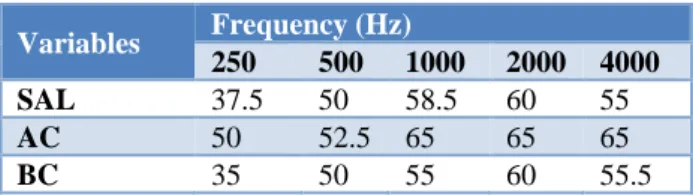
After documenting the threshold shifts among normal subjects and its collation based on different criteria, measures were instigated to see similar variations in sensori neural hearing loss patients. Subsequently, A.C, B.C and SAL threshold were compared to discern which measure correlates colossal with SAL thresholds. As evinced in (Table 5), it’s apparent that BC threshold shifts corresponds with SAL measurement.
Table 5: Reveals the comparison of median for sensorineural component predicted using SAL technique with bone and air conduction thresholds in
sensorineural hearing loss individuals.
Variables Frequency (Hz)
250 500 1000 2000 4000 SAL 37.5 50 58.5 60 55
AC 50 52.5 65 65 65
BC 35 50 55 60 55.5
DISCUSSION
When the sound is presented to one ear, it reaches to opposite cochlea intracranially via a phenomenon called cross over.1,4,6 However, the crossed over sound gets
attenuated on its pathway until it reaches the other ear. This attenuation of sound while travelling inter-aurally from one ear to another is termed as interaural attenuation.1,4,5 Interaural Attenuation is based depending
on three factors namely the transducer type, frequency spectrum of the test signal and the individual subject.1,4
With respect to transducer type, Interaural attenuation is almost 0 for bone conduction, thus masking non-test ear becomes indispensable during bone conduction testing.1,4
More the value of interaural attenuation less is the need for masking in puretone audiometry.1 Cases with bilateral
symmetrical mixed and conductive hearing loss are plagued with problems like inability to decide better ear, negligible plateau width, and maximum permissible masking (MPM) <minimum necessary masking (MNM).1,4,9 No precise techniques/methods have been
developed till date to overcome these problems.13
Because of obvious reasons SAL techniques has been the best solution that a conscientious clinician can administer. A conventional audiometer with air and bone conduction and a masking noise facility are the basic instrument requirement in SAL test.5,7
that predicted sensorineural loss as the difference between the amount of threshold shift produced by the noise in that patient and the threshold shift produced by the same noise in normal listeners.5,8,9,14
In stage 1 of this study, normative shift was calculated as shown in (Table 2). Pertinent precautions were taken during its administration. Due to subjective and instrumental variables, the bone conduction threshold obtained could not be 0 dBHL. Hence, the frequency specific values were added to its shifts to increase its accuracy of results as shown in (Table 2). Later, these threshold shifts were compared based on three domains namely ear (right vs left), gender (male vs female) and frequency wise.
The inferences drawn from aforementioned (Table 3) showed no significant difference in threshold shifts in both right and left ears. Reasons for such occurrences could not be delineated in any of the articles. Similar effort was made to compare the median threshold shifts in both genders and a finding of no momentous results can be evinced as given in (Table 4).
Greater Shifts were obtained at higher frequencies than at lower frequencies which indicates that bone conducted noise can mask the tone more efficiently for higher frequencies resembling the results obtained by Jerger, Tillman and Richard Dohohoo in their studies.7-9 The
probable justification noted till date reveals the role of occlusion effect, nature of ambient noise and availability of maximum level of bone conducted noise for occurrence of such phenomenon.7-9
Occlusion effect is defined as the enhancement or increase in loudness of bone conducted tone during pure tone audiometry.1 It is obtained by subtracting
unoccluded threshold from occluded thresholds. It has inverse relationship with frequencies tested and the head phone enclosure used during testing.1,4,6,12,15 Occlusion
effect is evident prominently at lower frequencies (250 and 500 Hz) which cause improved bone conduction thresholds, thus resulting in reduced threshold shifts at these frequencies.12 A survey conducted by Elpern and
Nauton showed following mean occlusion effects among five different types of air conducted transducer for frequencies from 250 to 4000 Hz.6
Table 6: Mean occlusion effect for TDH-39 air conducted transducer.
Frequency (Hz)
250 500 1000 2000 4000
TDH - 39 28 20 9 0 0
Other reasons that contribute to reduction in threshold shifts in lower frequencies include nature of ambient noise and feasible maximum level of bone conduction noise.13 As the testing was carried out in acoustically treated room, the interference from ambient noise was
minimal. In addition, different electrical and mechanical artefacts that could intervene with results were removed. Further, the presence of higher level of maximum bone conducted noise at higher frequencies than at lower frequencies as shown in (Table 1) succor greater threshold shifts at higher frequencies. Therefore, the findings in these articles with respect to frequencies can be explained with occlusion effect and presence of low maximum level of bone conducted noise for masking at lower frequencies than the higher frequencies.8,15,16
After finding out the normative data, it becomes crucial to confirm whether this data is valid or not.2,8 Hence, to
do this, the patients with pure symmetrical sensorineural hearing loss were chosen and SAL thresholds were obtained. In addition, comparison with bone and air conduction thresholds were made to estimate how well it agrees with these two indices. In these procedures, precautions like same headphone, bone vibrator, calibrated audiometer, and same acoustically treated room were taken to increase the accuracy of validity of testing by reducing the effectiveness of subjective and instrumental variables.
Analysis of (Table 5) reveals that out of five frequencies tested, lower frequencies (250 and 500 Hz) B.C thresholds were at closer consonance with SAL estimates than A.C thresholds. Nevertheless, B.C estimate at 500 Hz was equal to SAL measurement. Further, similar finding could be observed at 2000 Hz. At 250 and 1000 Hz, SAL measurement corresponded closely with A.C than B.C thresholds. However, at 4000 Hz, B.C has higher proximity with A.C than SAL measurements. Thus, such findings deduce SAL to be a good measurement as compared as conventional bone conduction audiometry.7,8
CONCLUSION
of SAL test and its interpretation for effectual prognosis and amelioration of individuals living.
ACKNOWLEDGEMENTS
We would like to express fathomless gratitude to ENT for referring the cases and the students of BASLP in documenting the normative data intended for these studies. Further, sincere appreciation to Mr. Shantanu Arya for his patience guidance and enthusiastic encouragement for this research. Besides, all thanks to all mighty and beloved parents for their blessing, love and care.
Funding: No funding sources Conflict of interest: None declared
Ethical approval: The study was approved by the Institutional Ethics Committee
REFERENCES
1. Jack K, Marshall C, Kristina E, Linda JH, Kim LT. Clinical Masking. Jack K. Handbook of Clinical Audiology, 7th Edition, Kanas, Wolters Kluwer
Health, New York; 2015;77-111.
2. Chaplin, Robert GMA, Richard TMD. The Masking Dilemma and its Solution: Fusion at the Inferred Threshold (FIT) and Sensorineural acuity level (SAL) Tests. American J of Otology. 1983:5(1):34-39.
3. Hall JW, Sanders JW. Clinical masking. In Musiek FE, Rintelmann WF, eds., Contemporary Perspectives in Hearing Assessment. Boston: Allyn and Bacon. 1999:84-86.
4. Hall JW, Mueller HG. Audiologists' Desk Reference. Diagnostic Audiology Procedures, Procedures, and Practices. San Diego: Singular Publishing Group; 1997:1.
5. Frederick NM, John GC. Masking Jeffery WJ. Introduction to Audiology, 11th Edition, Pearson
Education, Inc., Upper Saddle River, New Jersey; 2012:130-152.
6. Hall, James W. The Clinical Challenges of Bone-Conduction measurement. The Hearing J. 2005:58(3):10-15.
7. Eckley, Jennifer. Normative data for the sensorineural acuity level (SAL) test using
conventional earphones and insert earphones at frequencies 500, 1000, 2000 and 4000 Hz using narrowband noise. California State University, Long Beach. 2006:1437901.
8. Jerger, Tillman, Evanston, III. A New Method for the Clinical Deterination of Sensorineural Acuity Level (SAL). Archives of Otolaryngology. 1960;71(6):948-55.
9. Shekhar BR, Chandrashekhar SS, Ramanjaneyulu, Hazarika P. Sensori-Neural acuity level test in conductive and mixed hearing loss. Indian J of Otolaryngology. 1987:39(3):114-6.
10. Robert S, Schlauch, Peggy N. Pure tone Evaluation. Jack K. Handbook of Clinical Audiology, 7th Edition, Kanas, Wolters Kluwer Health, New York; 2015;29-48.
11. Christina P. Pure-tone audiometry and masking. International J of Audiology. 2011;50:138.
12. Stanley AG. Conductive Mechanism. Stanley AG. Hearing an Introduction to Psychological and Physiological Acoustics, 5th Edition. Informa
Healthcare, UK; 2010:51-70.
13. Maurice HM. How to eliminate air-bone gaps audiometrically: Use too much masking. ENT J. 2008;87(5):273-6.
14. Dhondt C, Wouters J, Verhaert N. The SAL test for the characterization of mixed hearing loss in Direct Acoustic Cochlear Implants. In Annual Congress of the Royal Belgian Society of Oto-Rhino-Laryngology, Head and Neck Surgery, Location: Leuven, Belgium; 2016.
15. John GC, Matthew B, Brian RE, Peter MS, Lianna S, Suzanne DC. Use of noise cancellation earphones in out of booth audiometric evaluations. Inte J of Audiology. 2017;56(12):989-96.
16. Michael AS, Anna MP, Patrick A, Brian CJM. A Technique for Estimating the Occlusion Effect for Frequencies Below 125 Hz. Europe PubMed Central. 2014;35(1):49-55.