K
0.53Mn
2.37Fe
1.24(PO
4)
3Mourad Hidouri* and Mongi Ben Amara
Faculte´ des Sciences de Monastir, 5019 Monastir, Tunisia Correspondence e-mail: [email protected]
Received 3 November 2010; accepted 6 December 2010
Key indicators: single-crystal X-ray study;T= 293 K; mean(Mn–O) = 0.003 A˚; disorder in main residue;Rfactor = 0.037;wRfactor = 0.089; data-to-parameter ratio = 12.8.
During an attempt to crystallize potassium manganese diiron phosphate KMnFe2(PO4)3by the flux method, a new phase, potassium dimanganese iron triphosphate, K0.53Mn2.37Fe1.24 -(PO4)3, was isolated. This phase, whose composition was confirmed by ICP analysis, is isotypic with the alluaudite-like phosphates, thus it exhibits the (A2)(A02)(A1)(A01)(A00
1)-(M1)(M2)2(PO4)3general formula. The site occupancies led to the following cation distribution: 0.53 K onA02 (site symmetry 2), 0.31 Mn onA001, 1.0 Mn onM1 (site symmetry 2) and (0.62 Fe + 0.38 Mn) onM2. The structure is built up from infinite chains of edge-sharing M1O6 and M2O6 octahedra. These chains run along [101] and are connected by two different PO4 tetrahedra, one of which exhibits 2 symmetry. The resulting three-dimensional framework delimits large tunnels parallel to [001], which are partially occupied by the K+ and Mn2+ cations.
Related literature
For the alluaudite structure, see: Fisher (1955); Moore (1971); Chouaibiet al.(2001); Corbinet al.(1986); Lee & Ye (1997); Hidouriet al.(2003, 2004, 2008) Antenucciet al.(1993, 1995); For P—O distances, see: Baur (1974). For bond-valence sums, see: Brown & Altermatt (1985). For ionic radii, see: Shannon (1976).
Experimental
Crystal data
K0.53Mn2.37Fe1.24(PO4)3 Mr= 505.28
Monoclinic,C2=c
a= 12.272 (2) A˚ b= 12.606 (2) A˚ c= 6.416 (4) A˚
V= 900.5 (6) A˚ Z= 4
MoKradiation
T= 293 K
0.430.090.02 mm
Data collection
Enraf–Nonius TurboCAD-4 diffractometer
Absorption correction: refined from
F(Parkinet al., 1995) Tmin= 0.42,Tmax= 0.81 1754 measured reflections
1308 independent reflections 1047 reflections withI> 2(I) Rint= 0.042
2 standard reflections every 120 min intensity decay: 1%
Refinement
R[F2> 2(F2)] = 0.037 wR(F2) = 0.089 S= 1.07 1308 reflections
102 parameters 2 restraints
max= 0.78 e A˚ 3
min=0.68 e A˚ 3
Data collection: CAD-4 EXPRESS (Enraf–Nonius, 1994); cell refinement:CAD-4 EXPRESS; data reduction:XCAD4(Harms & Wocadlo, 1995); program(s) used to solve structure:SIR92(Altomare et al., 1993); program(s) used to refine structure:SHELXL97 (Shel-drick, 2008); molecular graphics:SHELXTL(Sheldrick, 2008); soft-ware used to prepare material for publication:SHELXL97.
Supplementary data and figures for this paper are available from the IUCr electronic archives (Reference: BR2150).
References
Altomare, A., Cascarano, G., Giacovazzo, C. & Guagliardi, A. (1993).J. Appl. Cryst.26, 343–350.
Antenucci, D., Fransolet, A. M., Miehe, G. & Tarte, P. (1995).Eur. J. Mineral. 7, 175–181.
Antenucci, D., Miehe, G., Tarte, P., Shmahl, W. W. & Fransolet, A. M. (1993). Eur. J. Mineral.5, 207–213.
Baur, W. H. (1974).Acta Cryst.B30, 1195–1215.
Brown, I. D. & Altermatt, D. (1985).Acta Cryst.B41, 244–247.
Chouaibi, N., Daidouh, A., Pico, C., Strantrich, A. & Veiga, M. L. (2001).J. Solid State Chem.159, 46–50.
Corbin, D. R., Whitney, J. F., Fulz, W. C., Stucky, G. D., Eddy, M. M. & Cheetham, A. K. (1986).Inorg. Chem.25, 2279–2280.
Enraf–Nonius (1994).CAD-4 EXPRESS. Enraf–Nonius, Delft, The Nether-lands.
Fisher, D. J. (1955).Am. Mineral.40, 1100–1109.
Harms, K. & Wocadlo, S. (1995).XCAD4. University of Marburg, Germany. Hidouri, M., Lajmi, B., Driss, A. & Ben Amara, M. (2003).Acta Cryst.E59, i7–
i9.
Hidouri, M., Lajmi, B., Wattiaux, A., Fournes, L., Darriet, J. & Amara, M. B. (2004).J. Solid State Chem.177, 55–60.
Hidouri, M., Lajmi, B., Wattiaux, A., Fournes, L., Darriet, J. & Amara, M. B. (2008).J. Alloys Compd,450, 301–305.
Lee, K.-H. & Ye, J. (1997).J. Solid State Chem.131, 131–137. Moore, P. B. (1971).Am. Mineral.56, 1955–1975.
Parkin, S., Moezzi, B. & Hope, H. (1995).J. Appl. Cryst.28, 53–56. Shannon, R. D. (1976).Acta Cryst.A32, 751–767.
Sheldrick, G. M. (2008).Acta Cryst.A64, 112–122.
Structure Reports Online
supporting information
Acta Cryst. (2011). E67, i1 [https://doi.org/10.1107/S1600536810051238]
K
0.53Mn
2.37Fe
1.24(PO
4)
3Mourad Hidouri and Mongi Ben Amara
S1. Comment
The term alluaudite is referred to both natural and synthetic phosphates of compositions (Na+)(Na+, Ca2+)(M2+)
(Fe2+,Fe3+)
2(PO4)3 where M2+ is a divalent cation. The first detailed structural description was reported in 1971 by Moore
(Moore, 1971) who proposed the structural formula (X2)(X1)(M1)(M2)2(PO4)3. X1 and X2 are cationic sites available to
large monovalent and divalent cations such as Na+ and Ca2+ while M1 and M2 are octahedral sites containing a
distribution of divalent and trivalent cations of moderate size such as Mn2+, Fe2+ or Fe3+. More recently, detailed structural
analysis of several alluaudites demonstrated that the X2 site has two distinct positions labeled A2 (0, 0, 0) and A′2 (0,~0,
1/4) in a tunnel at (0, 0, z) and X1 has three distinct positions, labeled A1 (1/2, 0, 0), A′1 (0,~1/2, 1/4) and A′′1 (x, y, z) in a
tunnel at (1/2, 0, z). The general formula of Moore was then reformulated as [(A2)(A′2)][(A1)(A′1)(A′′1)](M1)
(M2)2(PO4)3. The crystal structure consists of M22O10 bioctahedral units of edge-sharing M2O6 octahedra, sharing
opposite edges with M1O6 octahedra that form zigzag chains of a sequence –M(2)—M(2)—M(1)-, running along the [1 0
- 1] direction. Adjacent chains are linked by the phosphate tetrahedra leading to what have been described as "pleated
sheets" perpendicular to the [0 1 0] direction (Fig. 1(b)). These sheets are connected by the phosphate groups giving rise
to a three-dimensional framework with two sets of tunnels parallel to [001] (Fig. 1(b)).
The title phase K0.53Mn2.37Fe1.24(PO4)3 was isolated during an attempt to synthesize KMnFe2(PO4)3 and its structure has
shown to be of the alluaudite type. The site occupancy factors indicated to the following cation distribution: 0.53 K on
A′2, 0.31 Mn on A′′1, 1.0 Mn on M1 and (0.62 Fe + 0.38 Mn) on M2. The partial occupancy of the large A sites has already been observed in several alluaudites being attributed to the great flexibility of these sites which allows them to be
filled totally, partially or left vacant without significant influence on the alluaudite framework. Assuming a maximum gap
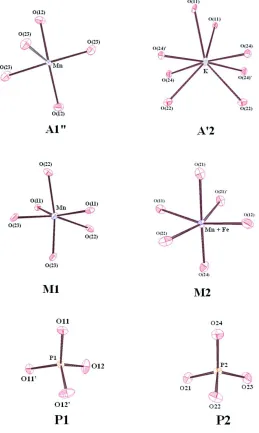
in the cation-oxygen distances, the envronment of the A′2 site (figure 2) consists of eight oxygen atoms forming what has
been called by Moore as a gable desphenoid (Moore, 1971). That of the A′′1 site (figure 2) onsists of five O atoms
forming a distorted trigonal bipyramid. The fivefold coordination of this site which is, to the best of our knowledge,
observed for the first time in an alluaudite-like compound can be attributed to the small size of the Mn2+ cation. Both the
M1 and M2 sites are octahedrally coordinated (figure 2). From the M1—O distances and cis O—M1—O angles, one can deduce that the M1O6 octahedron is strongly distorted. However, the mean M1—O> mean distance of 2.238 Å is close to
that 2.23 Å predicted by Shannon for octahedral Mn2+ cations (Shannon, 1976). The M2—O distances and cis O—M2—
O angles show the M2O6 octahedron to be less distorted than M1O6. The <M(2)—O> mean distance (2.068 Å) is between
2.03 Å and 2.23 Å, calculated by Shannon (Shannon, 1976) for the Fe3+ and Mn2+ cations, respectively. This result
confirms the presence of both atoms on the M(2) site. The PO4 tetrahedra have classical P—O distances with an overall
value of 1.537 Å close to that 1.537 Å, assigned by Baur for the monophosphate groups (Baur, 1974). The Bond Valence
estimate the occupancy. The sums around P1 and P2 of 4.92 and 4.98, respectively around the O sites (from 1.91 to 2.12)
are consistent with the predicted ones of 5 for P and 2 for O. In summery, the valence calculation results gave a good
confirmation of the structure, including the assigned oxidation states which cannot be determined by x-ray analysis.
S2. Experimental
Single crystals of the title phase were extracted from a mixture of nominal composition KMnFe2(PO4)3. The latter was
prepared by the flux method starting from a mixture of 2.042 g of KNO3, 2.589 g of Mn(NO3)2.6H2O, 8.245 g of
Fe(NO3)3.9H2O, 4.002 g of (NH4)2HPO4 and 0.719 g of MoO3. These reactants were dissolved in nitric acid and the
solution obtained was dried for 24 h at 353 K. The obtained dry residue was ground in an agate mortar to ensure its best
homogeneity, then heated in a platinum crucible to 673 K for 24 h in order to remove the decomposition products: NH3
and H2O. The sample was then reground, melted at 1173 K for 1 h and subsequently cooled at a 10 °.h-1 rate to 673 K.
The final product was washed with warm water in order to dissolve the flux. From the mixture, dark brown and
hexagonally shaped crystals were extracted. Their analysis using ICP confirmed the presence of only K, Mn, Fe and P in
[image:3.610.130.475.309.478.2]atomic ratio of 0.53:2.37:1.24:3, in accordance with the K0.53Mn2.37Fe1.24(PO4)3 composition.
Figure 1
Polyhedral representations of the K0.53Mn2.37Fe1.24(PO4)3 structure as projected along [010] (a) and along [001] (b). M1O6,
Figure 2
The environments of the A′1, A"2, M1, M2, P1 and P2 sites showing the anisotropic atomic displacements. The thermal
ellipsoids are drown at 50 % probability level.
Potassium dimanganese iron triphosphate
Crystal data
K0.53Mn2.37Fe1.24(PO4)3
Mr = 505.28 Monoclinic, C2/c Hall symbol: -C 2yc a = 12.272 (2) Å b = 12.606 (2) Å c = 6.416 (4) Å β = 114.87 (2)°
F(000) = 957 Dx = 3.727 Mg m−3
Mo Kα radiation, λ = 0.71073 Å Cell parameters from 25 reflections θ = 9.8–14.4°
µ = 6.07 mm−1
Enraf–Nonius TurboCAD-4 diffractometer
Radiation source: fine-focus sealed tube Graphite monochromator
non–profiled ω/2θ scans
Absorption correction: part of the refinement model (ΔF)
(Parkin et al., 1995) Tmin = 0.42, Tmax = 0.81 1754 measured reflections
1308 independent reflections 1047 reflections with I > 2σ(I) Rint = 0.042
θmax = 30.0°, θmin = 2.4°
h = −17→15 k = 0→17 l = 0→9
2 standard reflections every 120 min intensity decay: 1%
Refinement Refinement on F2 Least-squares matrix: full R[F2 > 2σ(F2)] = 0.037
wR(F2) = 0.089
S = 1.07 1308 reflections 102 parameters 2 restraints
Primary atom site location: structure-invariant direct methods
Secondary atom site location: difference Fourier map
w = 1/[σ2(F
o2) + (0.0451P)2] where P = (Fo2 + 2Fc2)/3 (Δ/σ)max = 0.001
Δρmax = 0.78 e Å−3 Δρmin = −0.68 e Å−3
Extinction correction: SHELXL97 (Sheldrick, 2008)
Extinction coefficient: 0.0009 (4)
Special details
Geometry. All e.s.d.'s (except the e.s.d. in the dihedral angle between two l.s. planes) are estimated using the full covariance matrix. The cell e.s.d.'s are taken into account individually in the estimation of e.s.d.'s in distances, angles and torsion angles; correlations between e.s.d.'s in cell parameters are only used when they are defined by crystal symmetry. An approximate (isotropic) treatment of cell e.s.d.'s is used for estimating e.s.d.'s involving l.s. planes.
Refinement. Refinement of F2 against ALL reflections. The weighted R-factor wR and goodness of fit S are based on F2, conventional R-factors R are based on F, with F set to zero for negative F2. The threshold expression of F2 > σ(F2) is used only for calculating R-factors(gt) etc. and is not relevant to the choice of reflections for refinement. R-factors based on F2 are statistically about twice as large as those based on F, and R- factors based on ALL data will be even larger.
Fractional atomic coordinates and isotropic or equivalent isotropic displacement parameters (Å2)
x y z Uiso*/Ueq Occ. (<1)
K 0.0000 −0.0116 (2) 0.2500 0.0229 (7) 0.531 (5)
Mn1 0.0000 0.26376 (7) 0.2500 0.0156 (2)
Fe2 0.22489 (4) 0.15521 (4) 0.13977 (8) 0.01004 (16) 0.6217 (6)
Mn2 0.22489 (4) 0.15521 (4) 0.13977 (8) 0.01004 (16) 0.3783 (7)
Mn3 −0.02360 (17) 0.49774 (17) 0.0393 (4) 0.0209 (5) 0.3064 (12)
P1 0.0000 0.28642 (11) −0.2500 0.0096 (3)
O11 0.0479 (2) 0.2160 (2) −0.0331 (4) 0.0138 (5)
O12 −0.0942 (3) 0.3615 (2) −0.2314 (6) 0.0251 (7)
P2 0.24436 (8) 0.10810 (7) 0.63905 (15) 0.0093 (2)
O21 0.2272 (2) 0.1782 (2) 0.8220 (4) 0.0156 (6)
O22 0.1735 (3) 0.1629 (2) 0.4048 (4) 0.0169 (6)
O23 0.3783 (2) 0.1019 (2) 0.6976 (6) 0.0255 (7)
Atomic displacement parameters (Å2)
U11 U22 U33 U12 U13 U23
K 0.0093 (10) 0.0218 (13) 0.0260 (13) 0.000 −0.0040 (9) 0.000
Mn1 0.0115 (4) 0.0202 (4) 0.0154 (4) 0.000 0.0058 (3) 0.000
Fe2 0.0065 (2) 0.0138 (3) 0.0065 (3) 0.00016 (18) −0.00043 (19) 0.0008 (2)
Mn2 0.0065 (2) 0.0138 (3) 0.0065 (3) 0.00016 (18) −0.00043 (19) 0.0008 (2)
Mn3 0.0156 (12) 0.0164 (9) 0.0165 (11) −0.0002 (9) −0.0070 (7) 0.0014 (9)
P1 0.0060 (5) 0.0140 (6) 0.0038 (5) 0.000 −0.0028 (4) 0.000
O11 0.0087 (11) 0.0193 (13) 0.0066 (11) −0.0027 (10) −0.0033 (9) 0.0028 (10)
O12 0.0149 (13) 0.0245 (15) 0.0301 (17) 0.0025 (12) 0.0037 (13) −0.0119 (14)
P2 0.0065 (4) 0.0123 (4) 0.0050 (4) 0.0004 (3) −0.0016 (3) 0.0012 (3)
O21 0.0128 (12) 0.0235 (14) 0.0078 (11) −0.0030 (11) 0.0017 (10) −0.0038 (11)
O22 0.0244 (14) 0.0141 (14) 0.0048 (11) 0.0003 (11) −0.0010 (10) −0.0007 (10)
O23 0.0114 (13) 0.0189 (15) 0.047 (2) 0.0003 (11) 0.0132 (14) −0.0018 (15)
O24 0.0127 (12) 0.0184 (14) 0.0171 (13) −0.0013 (11) 0.0012 (11) 0.0030 (11)
Geometric parameters (Å, º)
K—O24 2.608 (3) Mn1—O22i 2.315 (3)
K—O24i 2.608 (3) Mn1—O22 2.315 (3)
K—O24ii 2.767 (3) Fe2—O24ii 1.970 (3)
K—O24iii 2.767 (3) Fe2—O12x 2.027 (3)
K—O11iv 2.869 (4) Fe2—O22 2.049 (3)
K—O11v 2.869 (4) Fe2—O21xi 2.071 (3)
K—O22 2.929 (3) Fe2—O11 2.123 (3)
K—O22i 2.929 (3) Fe2—O21vi 2.167 (3)
Mn3—O23vi 2.253 (4) P1—O12xii 1.537 (3)
Mn3—O23vii 2.256 (4) P1—O12 1.537 (3)
Mn3—O12viii 2.294 (4) P1—O11xii 1.544 (3)
Mn3—O12 2.335 (4) P1—O11 1.544 (3)
Mn3—O23ix 2.400 (4) P2—O24 1.519 (3)
Mn1—O23vi 2.189 (3) P2—O23 1.526 (3)
Mn1—O23vii 2.189 (3) P2—O22 1.547 (3)
Mn1—O11 2.215 (3) P2—O21 1.553 (3)
Mn1—O11i 2.215 (3)
O24—K—O24i 174.63 (16) O23vi—Mn1—O11 86.39 (11)
O24—K—O24ii 73.24 (8) O23vii—Mn1—O11 118.95 (12)
O24i—K—O24ii 106.42 (8) O23vi—Mn1—O11i 118.95 (12)
O24—K—O24iii 106.42 (8) O23vii—Mn1—O11i 86.39 (11)
O24i—K—O24iii 73.24 (8) O11—Mn1—O11i 148.43 (15)
O24ii—K—O24iii 172.95 (16) O23vi—Mn1—O22i 159.42 (10)
O24—K—O11iv 114.87 (10) O23vii—Mn1—O22i 85.06 (10)
O24i—K—O11iv 70.34 (8) O11—Mn1—O22i 90.70 (10)
O24ii—K—O11iv 87.10 (9) O11i—Mn1—O22i 71.87 (10)
O24ii—K—O11v 99.26 (10) O11i—Mn1—O22 90.70 (10)
O24iii—K—O11v 87.10 (9) O22i—Mn1—O22 113.36 (14)
O11iv—K—O11v 52.22 (11) O24ii—Fe2—O12x 94.65 (12)
O24—K—O22 53.32 (8) O24ii—Fe2—O22 86.05 (12)
O24i—K—O22 121.80 (11) O12x—Fe2—O22 109.44 (13)
O24ii—K—O22 57.49 (9) O24ii—Fe2—O21xi 101.92 (12)
O24iii—K—O22 116.43 (11) O12x—Fe2—O21xi 87.13 (12)
O11iv—K—O22 144.11 (8) O22—Fe2—O21xi 161.16 (11)
O11v—K—O22 122.58 (8) O24ii—Fe2—O11 101.11 (11)
O24—K—O22i 121.80 (11) O12x—Fe2—O11 162.62 (11)
O24i—K—O22i 53.32 (8) O22—Fe2—O11 79.18 (11)
O24ii—K—O22i 116.43 (11) O21xi—Fe2—O11 82.52 (11)
O24iii—K—O22i 57.49 (9) O24ii—Fe2—O21vi 174.59 (11)
O11iv—K—O22i 122.58 (8) O12x—Fe2—O21vi 81.71 (11)
O11v—K—O22i 144.11 (8) O22—Fe2—O21vi 91.37 (11)
O22—K—O22i 82.66 (13) O21xi—Fe2—O21vi 81.97 (11)
O23vi—Mn3—O23vii 75.91 (14) O11—Fe2—O21vi 83.04 (10)
O23vi—Mn3—O12viii 84.68 (13) O12xii—P1—O12 104.0 (3)
O23vii—Mn3—O12viii 121.62 (16) O12xii—P1—O11xii 107.33 (17)
Mn1viii—Mn3—O12 76.0 (3) O12—P1—O11xii 114.23 (15)
O23vi—Mn3—O12 94.38 (14) O12xii—P1—O11 114.23 (15)
O23vii—Mn3—O12 79.85 (14) O12—P1—O11 107.33 (17)
O12viii—Mn3—O12 157.20 (11) O11xii—P1—O11 109.7 (2)
Mn1viii—Mn3—O23ix 69.7 (3) O24—P2—O23 110.71 (16)
O23vi—Mn3—O23ix 157.58 (11) O24—P2—O22 109.32 (15)
O23vii—Mn3—O23ix 123.93 (15) O23—P2—O22 111.67 (18)
O12viii—Mn3—O23ix 91.62 (14) O24—P2—O21 110.22 (17)
O12—Mn3—O23ix 80.58 (13) O23—P2—O21 108.50 (16)
O23vi—Mn1—O23vii 78.61 (15) O22—P2—O21 106.32 (16)
![Figure 1Polyhedral representations of the K0.53Mn2.37Fe1.24(PO4)3 structure as projected along [010] (a) and along [001] (b)](https://thumb-us.123doks.com/thumbv2/123dok_us/553374.554530/3.610.130.475.309.478/figure-polyhedral-representations-mn-fe-po-structure-projected.webp)