
TECHNICAL UNIVERSITY OF CLUJ-NAPOCA
ACTA TECHNICA NAPOCENSIS
Series: Applied Mathematics, Mechanics, and Engineering Vol. 61, Issue III, September, 2018
OPTIMIZING THE EVALUATION OF EYE TRACKING DATA TO
VALIDATE REQUIREMENTS IN VIRTUAL SPACE TO IMPROVE
CUSTOMER SATISFACTION
Jörg NIEMANN, Tim SCHEMANN, Justus ERKENS
Abstract: The purpose of the paper is to explain the theoretical background, the effects and the potential
of Servitization on today’s companies. Based on the basics of product service systems, the development from a net product manufacturer to a holistic solution provider is presented and corresponding business models are highlighted. In addition to the compilation of relevant information, a practical example of Servitization and the changes due to the evolution to a full-service provider will be described and emphasized. For the compilation and evaluation of the presented information, the method of secondary research was primarily used. The sources of information were recent economic and technical literature, scientific journals and current studies by various consulting companies.
Key words: Servitization, Product service systems, industrial operator model, fleet management
1. INTRODUCTION AND CONCEPTUAL CLASSIFICATION
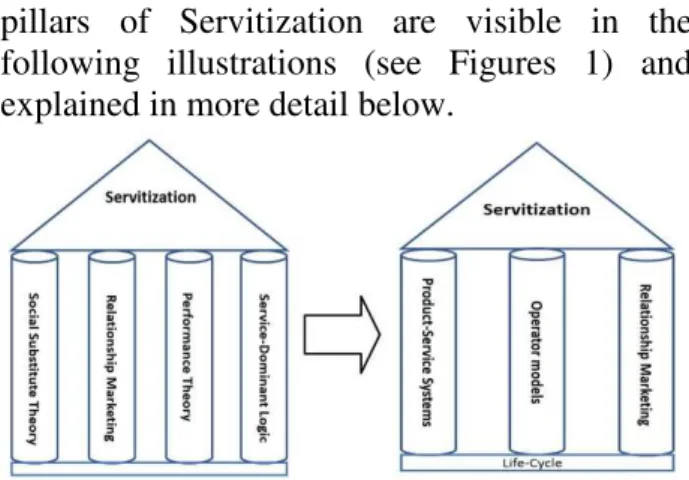
For the description and development of service company, there are innumerable terms, such as Service-Transformation or Servitization, which ultimately include the same thing, namely the development to a provider of services [1]. The foundation for Servitization was laid in the 20th century. After the end of the Second World War and the overcoming crisis during the "Cold War", new technologies and a cosmopolitan thinking led to an ever more connected world. In the course of this, the competitive pressure for companies has also increased, as companies from outside their national borders are now pushing on their home market. An increasingly global market economy developed. Especially for manufacturing companies, such as mechanical engineers, this development requires a rethinking and sometimes even a departure from the previous corporate strategy and orientation. The term Servitization implies "[..] the development of a company from a pure product manufacturer to a service provider" [2]. In order to achieve this far-reaching development, companies are required to make major changes in any area [1]. The basics and
pillars of Servitization are visible in the following illustrations (see Figures 1) and explained in more detail below.
Fig. 1. Fundamentalsof Servization (own figure)
company (performance theory). The service dominant logic shows a completely new approach. All companies are understood as service companies and treated as such. Customer needs are taken into account through its function as co-creator in the value added. However, it can be stated that all foundations adopt a very theoretical and socio-psychological approach. Thus, there is a lack of an intensive look at the necessary conversion to and from companies, to become service-oriented. Simply put, the inclusion of techniques for implementing Servitization is lacking. From these points of view, a new concept was designed based on the previous foundations as well as the most important concepts (see Figure 2). This concept should describe the foundations and thus the way of a company to Servitization. The most
important terminologies of
Service-Transformation are Hybrid Offerings, Integrated Solutions and Product-Service Systems. Hybrid Offerings, first described by Shankar et al. 2009 emphasizes the importance of combining products and services to create greater customer value. Building on this, Integrated Solutions are all about offering customized solutions to the customer. Product-Service Systems ultimately unite the world of products and services. The first development steps of manufacturing companies are evident in that they now offer their products in connection with various services, such as the storage of spare lines, maintenance contracts for their machines or different optimization options.[2]
A closer look at the three concepts raises the question as to what extent it makes sense to clearly separate these terms from each other. Ultimately, Integrated Solutions are a crucial component of the Product-Service Systems. These systems are highly relevant to the emerging customer relationship through customized solutions for their products and services. Product-Service Systems can not exist without Integrated Solutions, at least not in a successful and customer-oriented framework. Hybrid offerings also aim to increase or create customer value. In this closer examination, it becomes clear that the concepts are closely linked or even merge. Thus, a clear separation of concepts is not meaningful and correct. Below, the individual foundations are explained and set
fulfillment. The benefit for the company lies in the value added [1].
To sum up, Servitization is the transformation from a manufacturing company to a service company, with the goal of satisfying customer needs, sustaining the company's success and strengthening its competitiveness [1]. The entire build-up of Servitization is based on the customer lifecycle. This lifecycle is nothing more than the relationship between customer and company. More specifically, it is about the long-term customer loyalty, which is to be achieved by the customer loyalty management and the implementation of various measures.
2. THE WAY TO INTEGRATE SOLUTIONS
In the following section the development from a net product provider to a holistic solution provider is presented and corresponding business models are highlighted. Traditionally, manufacturer of capital-intensive goods include the production and sale of technologically leading, high-quality and competitively priced products as their core competencies. Product-accompanying services such as engineering, maintenance or spare parts, are offered as an additional offer along the product life cycle of the respective product. In turn, customers invest in capital-intensive goods, hire appropriate staff to operate them, and ultimately sell their own products to their customers [8]. The prerequisite for the processing of product service systems is initially the technical development of the material product, with the aim of providing services around the products life-cycle. The combination of material services with a dedicated service ultimately leads to the desired range of services for the holistic satisfaction of customer needs, which can be offered as a holistic solution [4].
Basically, today's companies can be differentiated between two different centered forms of orientation with regard to the offered value proposition. Product centric companies are trying to build competitive advantages and a strong market position based on superior products. For this, the entire organizational structure is geared towards the development,
production and distribution of high-quality products. Most of the success measurement is based on the observation of sales figures and the resulting revenues on the market. Increases in profitability result in most cases from the product focus through the optimization of upstream value creation or at subcontractor’s risk and expense. The actual value of the product for the customer is described here by means of various performance attributes. According to STOPPEN AND ROTH, the perceived value results from a subjective overall rating of a product by the customer, in which qualitative benefits and existing product features are weighed against monetary and non-monetary costs in the form of time, energy and effort. It is emphasized that the role, the context and the subjective assessment of the decision maker have a extensive influence on the perception and evaluation of the value. Therefore, the value depends on the quality of product attributes, which can be experienced at first hand and on the subjective perception of the recipient [11].
capabilities to solve a particular customer demand [11].
2.1 Stages of the product service continuum The development process from an industrial product manufacturer to a service provider requires a deep understanding of customer needs and a strategic realignment of the own business. Essentially, the product range is not just expanded or supplemented with services, but completely refocused on the requirements of service business. As a result, the original industrial product no longer represents the central value of an offer. Capital-intensive goods and services are understood as indivisible elements of a complex customer solution, instead of a additional feature focused on the enhancement of the actual product. The evolution to a service-oriented supplier is described as a longterm and complex process on a product-service continuum. The development requires a gradual shift of the activities of the producing company to the value creation of the customer [11]. Within the Product Service Continuum, the evolution from a simple product manufacturer to a holistic solution provider is characterized by the gradual change of business models towards service orientation and the changing understanding of products and services itself [1]. It can be distinguished between four evolutionary stages, which differ in their focus on product service systems and corresponding business models, which are presented below:
I Product-oriented business model
In the product-oriented business model, value creation is primarily based on the product produced and the benefits provided by the usage of the product. In addition, product-related services may be offered which are directly related to the core product and are aligned to the customer's operational processes. The aim is the sales support of the original product and the fulfilment of the statutory prescribed services, which results from the act of putting a product into circulation. The supply of goods and services is largely standardized and characterized by a superficial supplier-customer relationship. The products and services mentioned are paid by one-time payments or financing, whereby ownership passes from the manufacturer to the customer.
Fig. 2. Product-Service-Continuum (acc. to [9])
II. System solution-oriented business model The system solution-oriented business model describes the offer of bundled goods and services. In many cases, the tangible product is still in the focus of the offer but aggregated into a relatively complex product service system by adding appropriate services. The resulting product service system is characterized by a relatively high degree of standardization and still strongly focused on the customer's operational processes. At the highest stage of development, offers are linked with first performance guarantees that go beyond the original benefits of the product. This creates a risk transfer from the customer to the supplier, for example by guaranteeing a certain productivity of a product service system.
III. Service-oriented business model Within the service-oriented business model, the service moves to the center of an offer and represents the core value to the customer. Customer-specific services with a high proportion of services compared to product service systems are offered, which can also be offered completely independent of a tangible product. Therefore, this model sells only the actual benefits instead of the original industrial goods. In that case necessary products are provided by the service provider and remain in his property. The services can support the management of entire or partial business processes, which requires a much closer supplier-customer relationship.
business process. The provider acts as a strategic partner for a part of the customers value creation. This partnership requires the most complex supplier-customer relationship, compared to the already mentioned models. By focusing on specific customer needs and the customers business processes, customer satisfaction is sustainably increased and stronger customer loyalty can be achieved by the supplier. In addition, it is harder to imitate the offered performance, which in turn impedes market entry barriers for possible competitors. The following section deals in detail with the systematization of industrial operator models and their risks and opportunities for customers and suppliers.
2.2 Industrial operator models
Increasingly, companies in the industrial sector are considering whether the classic purchase of equipment and machinery is still timely or whether it makes sense to outsource the actual production processes and instead focus on their own core competencies. This means that in many cases manufacturer of capital-intensive goods are considered as possible operators. Despite this, many customers in the capital goods sector are questioning the credit-financed procurement of investments as well and are discussing usage-based fees instead of large-scaled investments in machines. This consideration is amplified by the increasing efficiency and the growing complexity of capital goods. Another reason for the discussion is the more and more relevant consideration of life-cycle costs. Within this approach, it is not the initial investment that matters, but the long-term cost of ownership within the entire life-cycle of a product. In addition, new business models can be used to acquire less fortunate customers even in stagnating markets, for which investing in a new asset has not been a viable option [8].
As a supplement to the sale of industrial goods, a large scale of complementary services is already being offered in industrial markets. This offer ranges from classic product-related services to product-independent consulting services and even performance and profit guarantees. One of the most common models in the field of service-oriented business models is
the so-called full-service model. For example, the plant manufacturer assumes responsibility for the entire range of maintenance and repair activities for a customer. Thus, the manufacturer has a great influence on the availability and the utilization of the customers system and can exploit the technical or economic potential in a capacity that was previously not achievable for the customer. The greatest advantage for the customer is the guaranteed availability of the system by the manufacturer at agreed fixed cost [5]. An extension of the full-service model is the so-called operator model. In those models the entire operation of a plant or a business process will be performed by a subcontractor, instead of a limited set of sub-activities. Thus, the actual capital goods remain in the hands of the manufacturer and are not transferred to the customer. As a result, the customer receives exclusively the usage or efficiency of the capital good. As a result, performance-based accounting procedures are often used, which will be discussed later in detail. The facility which needs to be operated is nonetheless a part of the user's value chain and naturally located on its property. Otherwise it's just outsourcing of an existing business process. According to this operator models are a special form of acquisition regarding utilization and represent an alternative to the purchase of products or possession of equipment [10]. Operator models are primarily systematized of due to the diversity in the transfer of ownership:
indicate all measures such as spare parts supply and maintenance that enable the basic operation of a system. In this case, the provider only offers services for a specific customer demand and is only slightly integrated into the customer's added value. To proactively increase the availability of an asset, certain services must also be provided proactively. This includes, for example, a twenty-four-seven diagnosis of the plant condition and a condition-based maintenance by the operator [10]. Due to the diversity of business models, various approaches for the billing of operator models are mentioned in the relevant literature. Instead of traditional product sales, other types of pricing can be used, which differ mainly in terms of the additional financial risk of the operator. Further differences exist in the risk assumption by the manufacturer and the demand of the liquidity of the customer. The following section introduces briefly the most common usage-based billing types:
Table 1. Usage-based billing models of industrial operator models
[10]
2.3 Opportunities and risks of industrial operator models
The use of operator models may increase the economic potential for the manufacturer and the supplier. The possible focusing or shifting of overall business activities to the actual core competencies represents a significant contribution to the success of the model. The customer can benefit from the specialist knowledge of the operator, which among other things can lead to more efficient utilization and an optimal deployment of resources within the production processes. Furthermore, it is always possible to make use of new and further developments in the technology used, which can make a further contribution to the optimization of business processes. Close coordination between the parties ensures high process reliability, high volumes and the necessary availability throughout the entire life cycle of the
plant. In addition to purely economic aspects, customers benefit from various organizational advantages, which are characterized by a leaner and more efficient operator unit, as well as a significant reduction in interfaces. The customer can ultimately save his liquidity by not having to bear the full cost of capital investment. The usage-dependent billing model converts the fixed investment costs for the acquisition of assets into variable costs and makes them highly calculable. As a result, the customer can save his budget and benefit from high-quality technologies that otherwise would not have been affordable [10].
must bear the full the full pre-financing risk. Beyond that appropriate staff must be set up for the foreign operation and must be trained for the use of the asset at the customer's site. The enormous resource commitment or the lack of experience can lead to some negative impacts on already existing business activities in long-term. By contrast, the customer may face a permanent loss of production knowledge and a decreasing image as technology leader in the market, which can lead to the total loss of competitiveness. Also, not to be neglected is the resulting dependence on the operator. Likewise, the resulting dependence on the operator must be taken into account and the associated planning and quality risks associated with a lack of performance, which was actually promised by the provider [10].
3. CASE STUDY
3.1 Presentation of the selected business model
A practical example of servicing and the changes due to the evolution of a service-oriented business will be described in the following section. For this purpose, the business model of a globally operating manufacturer of power tools will be illustrated and analysed in detail. Hilti develops technologically leading solutions for the construction industry and offers related software systems and services. Hilti's service portfolio includes assistance during the planning process, maintenance and repair of their power tools, as well as consultancy or training.47 Since 2001 Hilti offers its customers a special operator model in the form of fleet management under the slogan "Using instead of owning". According to their own statement, Hilti handles about 1.000.000 devices at 100.000 customers worldwide with corresponding service contracts [5].
Within the model, Hilti is responsible for the provision and maintenance of all equipment and complements this offer with a comprehensive range of services. Customers can access the entire Hilti portfolio and start a fleet contract with only one device. Hilti always remains the owner of the equipment and the ownership is replaced by a pure value acquisition. In case of
failure or theft Hilti is liable for the fastest possible replacement. For the benefit provided, Hilti calculates a fixed monthly fee depending on the fleet volume, which includes all services. All tools within the contract are serviced regularly and replaced by new models depending on the particular life cycle (mostly 3-5 years). In the event of a defect or a performance crash, Hilti takes care of the logistics and the repair process, provides a replacement device and guaranties a replenishment lead time of three days until the tool is fixed and back in place. The fleet remains always operational and technically up to date. In addition, the scope of the service contract is flexible and can be adapted to the respective project at any time. The device pool can also be extended temporarily, with a minimum usage time of 5 days, and adapted to demand peaks. At the beginning of the contract, an analysis of the previously used fleet can be performed to identify odd or not optimally working devices and as a result, optimize the tied-up resources. At the early beginning of the contract, as well as for extensions, a system-based credit check of the customer takes place and protects Hilti against any economic risks of a payment default.
3.2 Investigation of the selected business model
costs in new equipment. According to this additional capital is available for the operative business of the customer. For example, a cordless screwdriver with a gross list price of 684.71 € per piece costs only 6.00 € per day in a fleet contract, including all services for the entire life-cycle [5]. The demand for spare parts and repair costs cannot be predicted easily and thus have a significant impact on the life cycle costs. In addition, Hilti will replace the equipment at its own expense in the event of a breakdown or even theft. The economic benefits are obvious, considering the life-cycle costs and the fact that all necessary repairs and maintenance activities are already included in the price [5].
Hilti can benefit from improved customer satisfaction and become the preferred supplier or strategic partner to its customers. Moreover, Hilti can create an active market entry barrier to the competition through fleet contracts and maximize equipment throughput per customer. In addition, the revenue base may be extended by customers who, due to insufficient purchasing power, have not been suitable for the traditional sale of power tools in the premium segment. Hilti a various number of values:
Table 2. Addes value through the Hilti fleet management
The Hilti fleet management business model can be classified in the third category of the product-service continuum, the "service-oriented" business models. The focus is entirely on the service provided and only the resulting benefit is sold to the customer. The billing model uses the "pay per use" approach by charging a fee for using a device. This provides the customer with long-term price security and calculable costs. Furthermore, Hilti is responsible for the entire maintenance of the fleet and is integrated into the processes of each customer. Accordingly, this represents a so-called full-service model, which can be seen as a relatively simple form of an operator model, which is dominated by reactive services.
4. THE POTENTIAL OF SERVICIZING
4.1 Hazards and Risiks mitigated by Servicizing
Servitization allows companies to reduce or even eliminate some of the risks associated with normal product sales. For example, transaction risks are mitigated by Service-Transformation and the costs of transactions are also reduced. Because the information asymmetry associated with sales promotions is becoming less relevant as the manufacturer is liable for durability and reliability. The customer pays only for the functionality and no longer the cost of repairs, maintenance or the like [12].
by the manufacturer ultimately leads to many challenges and fields of conflict not even arising. Finally, Servitization leads to a reduction in
information asymmetry between the
manufacturer and the customer. Furthermore, new performance incentives are created, which ultimately leads to greater efficiency for customers and manufacturers. Thus, both parties can benefit from a service transformation, both monetary and non-monetary [12, 13, 14].
4.2 Emerging or shifting hazards and risks As stated earlier, Servitization enables companies to reduce / eliminate many challenges and risks. However, as with any change in business strategy, there are new risks involved. The risks listed below can be attributed to selection and moral problems. The result of the Service-Transformation is that the cooperation / relationship between customer and producer is significantly narrower, which can lead to a bilateral dependence at the same time. Because the customer transfers responsibility for the functionality of the product and the fulfillment of its requirements to the manufacturer of the product. In combination with a service contract, the relationship between the two parties is strengthened and closer coordination becomes necessary [12,13]. With the integration into the customer's production line, the producer bears a great responsibility for its functionality and efficiency. In the event of a fault, for example, the customer is dependent on the immediate service of the manufacturer. The bilateral dependence is also reflected in the profitability of the two parties, which are largely dependent on each other. For example, a reduction in the level of customer service negatively affects the profitability of the manufacturer. One result of bilateral dependency is the risk of transferring production losses, which has already been exemplified in the past. Because of the service contract, the customer is required, inter alia, to carry out maintenance and repair work by the manufacturer and may usually not commission external companies. In the event of a frequent failure of functionality or non-restoration of functionality by the manufacturer, the customer is in danger of a long downtime. The customer
can reduce this risk by means of contractual guarantees for functionality. The manufacturer also has the opportunity to mitigate the risk of loss of its customer's production by relying on its knowledge advantage in terms of product lifetime, thus making its maintenance efficient. At the same time, this prediction offers the manufacturer an option to keep costs to a minimum [12].
By specifying the service activities, the customer can distribute the risks very well. Product lifetime also plays a major role in Servitization, but in the form that the customer can transfer a certain percentage of the risk of technology obsolescence to the manufacturer. Due to flexible changes in expiring service contracts. In any case, the customer is focused on signing a contract with the manufacturer, which extends its commitment well beyond the time a new innovation reduces the market value of the service. The risk of market depreciation can be reduced by the possibility of early termination, but this must be explicitly stated in the contract. In addition to the challenges presented, there are many more problems that are largely shifted from the customer to the manufacturer. These challenges need to be solved by innovative services [12].
5. REFERENCES
[1] Bruhn, Manfred; Hadwich, Karsten (Hg.) (2016):
Servicetransformation. Entwicklung vom Produktanbieter zum Dienstleistungsunternehmen.
Springer Fachmedien Wiesbaden GmbH. Wiesbaden: Springer Gabler (Forum Dienstleistungsmanagement). [2] Niemann, J.: Die Services-Manufaktur, Industrielle Services planen –entwickeln – einführen. Ein Praxishandbuch Schritt für Schritt mit Übungen und Lösungen. Aachen, Shaker Verlag, 20167.
[3] Fließ, Sabine; Lexutt, Eva (2016): Erfolgsfaktoren der Service Transition – eine systematische Literaturanalyse. In: Manfred Bruhn und Karsten Hadwich (Hg.): Servicetransformation. Entwicklung
vom Produktanbieter zum
Dienstleistungsunternehmen. Wiesbaden: Springer Gabler (Forum Dienstleistungsmanagement), S. 49– 79.
[4] Haubold, Thomas; Möhrle, Martin (2014): Produkt-Service-Systeme. Ansätze, aktuelle Formen, Potenziale und Gestaltungshinweise. In: Thorsten Kliewe und Tobias Kesting (Hg.): Moderne Konzepte des organisationalen Marketings. Wiesbaden: Springer Gabler (Research), pp. 303–321.
https://www.hilti.de/content/hilti/E3/DE/de/company/ corporate-information/company-profile/about-us.html. (10.02.2018)
[6] Itzenplitz, Felix (2014): Fullservice- und Betreibermodelle im Anlagenbau. In: Michael Eßig und Andreas Glas (Hg.): Performance Based Logistics. Innovatives Beschaffungsmanagement für die Streitkräfte. Wiesbaden: Springer Gabler, pp. 351– 365. 16
[7] Kliewe, Thorsten; Kesting, Tobias (Hg.) (2014):
Moderne Konzepte des organisationalen Marketings. Wiesbaden: Springer Gabler (Research).
[8] Niemann, Jörg: Nicht nur das Preisschild zählt:
Gesamtkosten von Maschinen und Anlagen über deren komplette Laufzeit. In: Beschaffung aktuell (2005), Nr. 6, S. 38-39
[9] Marks, Frank; Ramselaar, Leon; Mulder, Jaak; Muller, Hester; Langkamp, Sarah; Boymans, Carmen (2011): Servitization in product companies. Creating business value beyond products. Hg. v. Atos Consulting. Utrecht.
[10] Schuh, Günther; Gudergan, Gerhard; Grefrath, Christian (2016): Geschäftsmodelle für industrielle Dienstleistungen. In: Günther Schuh, Gerhard Gudergan und Achim Kampker (Hg.): Management industrieller Dienstleistungen. Handbuch Produktion und Management. 2. Aufl. 2016. Berlin, Heidelberg: Springer Berlin Heidelberg (VDI-Buch), pp. 65–105.
[11] Stoppel, Eduard; Roth, Stefan (2016): Value-Based Pricing im Kontext der Servicetransformation. Von produktzentrierten zu servicezentrierten Wertverständnissen und Preissystemen. In: Manfred Bruhn und Karsten Hadwich (Hg.): Servicetransformation. Entwicklung vom Produktanbieter zum Dienstleistungsunternehmen. Wiesbaden: Springer Gabler (Forum Dienstleistungsmanagement), pp. 373–401.
[12] Toffel, Michael (2002): Contracting for Servicizing.
Hg. v. Harvard Business School. Retrieved from http://www.hbs.edu/faculty/Publication%20Files/08-063_17bf1f50-d901-42e6-8adf- 70e832ba49a7.pdf (05.02.2018), PDF-Document.
[13] Niemann, Jörg: Life Cycle Management- das Paradigma der ganzheitlichen Produktlebenslaufbetrachtung. In: Spath, Dieter; Westkämper, Engelbert; Bullinger, Hans-Jörg; Warnecke, Hans-Jürgen (Hrsg.): Neue Entwicklungen in der Unternehmensorganisation. Berlin, Springer-Vieweg, VDI Buch, 2017
[14] Niemann, Jörg: Ökonomische Bewertung von Produktlebensläufen- Life Cycle Controlling. . In: Spath, Dieter (Hrsg.) u.a.: Neue Organisationsformen im Unternehmen In: Spath, Dieter; Westkämper, Engelbert; Bullinger, Jörg; Warnecke, Hans-Jürgen (Hrsg.): Neue Entwicklungen in der Unternehmensorganisation. Berlin, Springer-Vieweg, VDI Buch, 2017
SERVITIZARE - CALEA DE TRANSFORMARE DE LA PRODUCĂTORUL PRODUSULUI CĂTRE UN FURNIZOR DE SERVICIU
Rezumat: Scopul lucrării este de a explica contextul teoretic, efectele și potențialul Servitizării asupra companiilor de
astăzi. Pe baza elementelor de bază ale sistemelor de servicii pentru produse, este prezentată dezvoltarea de la un
producător de produse la un furnizor de soluții holistice și sunt evidențiate modelele de afaceri corespunzătoare. În plus
față de compilarea informațiilor relevante, va fi descris și subliniat un exemplu practic de Servitizare și schimbările
datorate evoluției către un furnizor de servicii complete. Pentru compilarea și evaluarea informațiilor prezentate, sa utilizat
în principal metoda cercetării secundare. Sursele de informație au fost recenta literatură economicăși tehnică, reviste științifice și studii actuale efectuate de diferite companii de consultanță.
Jörg NIEMANN, Duesseldorf University of Applied Sciences, [email protected] Tim SCHEMANN, Duesseldorf University of Applied Sciences,
![Fig. 2. Product-Service-Continuum (acc. to [9])](https://thumb-us.123doks.com/thumbv2/123dok_us/7997696.2120600/4.892.446.784.128.321/fig-product-service-continuum-acc-to.webp)
