TECHNICAL UNIVERSITY OF CLUJ-NAPOCA
ACTA TECHNICA NAPOCENSIS
Series: Applied Mathematics, Mechanics, and Engineering Vol. 62, Issue IV, November, 2019
NEW APPROACHES IN ONLINE EVALUATION OF PHOTOVOLTAIC
SYSTEMS EFFICIENCY BY IMPLEMENTING IOT
MONITORING SOLUTIONS
Calin RUSU, Sorin BESOIU, Lorand KACSO-VIDREAN, Ciprian LAPUSAN
Abstract: The paper presents a new approach in evaluation of the photovoltaic systems efficiency in real time by integrating IoT capabilities. This approach aims to ensure a better productivity and an increase lifespan of the photovoltaic system by continuing monitoring of key parameters of the system and implementing proactive maintenance measures. The proposed approach uses data measured in real time from the PV system site and analyze these values in order to determine the efficiency in power production.
Key words: IoT system,photovoltaic system, PV system efficiency, real time monitoring.
1. INTRODUCTION
The last decade has shown an exponential increase in harvesting renewable energy resources as an alternative to natural resources exploitation [1]. This trend aims to decrease the negative impact of human activities on climate change and in the same time reduce the soil, water and air pollution across globe. As result multiple national and international programs stimulated the development of new renewable energy production. These programs corroborated with the technological development in the field and an increased interest from the private sector lead to development of many new sites in both urban and remote locations [2].
From the large pallet of renewable energy harvesting systems, the photovoltaic (PV) sites knew the most important growth in the last 5 years with an increase of more than 250% in energy production [2]. This evolution is justified by the scalability and easy adaptation of such systems to the needs of the end user. The PV systems could be found from small home applications in urban places to large power plant built in remote areas. These situations put the PV power panels in an outdoor harsh environment
that continuously affect the life span and efficiency of these systems [3].
The research in this area focused on the influence of temperature variation, soiling losses and aging of the PV panels in energy production [4], [5], [6]. These phenomena directly influence conversion efficiency by reducing the amount of solar radiation that is transformed into electric energy. As shown in [7] the voltage output of a PV panel shows an important reduction (comparing with the influence on the current) when the temperature rise, as result the maximum power generated is reduced. In the literature the average voltage reduction is approximated to 0.5% for each degree above 25℃.
The soiling loses refers to the decreasing in energy conversion as result of snow, dust, dirt or other contamination materials that covers the surface of the PV panel.
As can be seen in Figure 1 dust can form a thin layer that cover the surface of the PV module. The intensity of the dust contamination depends on the site location of the PV panels (urban or remote areas) and on the geographic position of the site. As shown in [8] the dust intensity varies around the globe, with higher values on north Africa, south Asia, and south America and moderate influence on Europe (central and south part of the continent).
The above mention factors directly influence the overall energy produced by the PV system on daily, monthly and annual basis. This led to an increase interest in reducing the negative impact of these factors and the development of new passive and active solutions that assist at the maintenance and proper functioning of the PVs modules.
A solution for this situation could be implemented by integration of IoT technology in the monitoring and management hardware of PV arrays, as shown in [9], [10]. This approach also facilitates the system overall performance evaluation and easy integration with new technologies like smart greed and smart buildings [11], [12], [13].
The interest of implementing this approach evolved beyond the research laboratories and more and more private companies try to develop and implement IoT monitoring solutions for their PV panels products. In this paper such an approach is presented. In this case a consortium of one Romanian company and three European
universities developed a joint research project that aimed to evaluate the opportunity of implementing such a system for Romanian PV panel power farms. The goal was to define new functionalities for these systems and contribute to the lifecycle management of the photovoltaic panel by implementing IoT.
The project was developed as a pilot project based on the cooperation model proposed in the Erasmus+ project Smart HEI-Business collaboration for skills and competitiveness
[HEIBus] [14]. The project was conducted during January – May 2018. In the following chapters part of the obtained results are presented.
2. PROPOSED MONITORING IoT SYSTEM
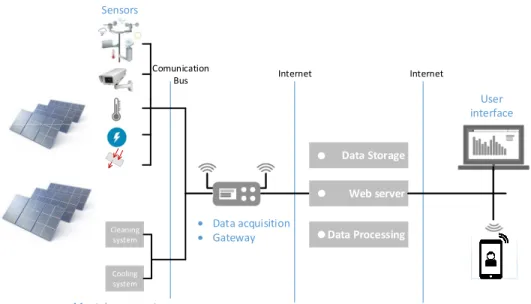
The architecture of the proposed system is shown in Figure 2. The main components of the systems are:
• Sensor systems: camera sensor, PV temperature sensors, PV voltage/current sensors, opacity sensor, whether station
• Maintenance systems: cooling systems (reduce the PV panels temperature), Cleaning systems (clean the PV panels)
• Data acquisition and gateway modules • Server modules for: data storage, web server and data processing
• User interface: web page, phone app etc.
User interface Sensors
Cleaning system
Cooling system
Mantainance systems Comunication
Bus Internet
Data Storage
Web server
Data Processing
Internet
• Data acquisition • Gateway
The communication between the Data acquisition system and the sensor system is performed using standardized Communication Bus. This allows a large number of sensors to be used to monitor the: temperature, opacity, voltage, current for each panel from the PV array and other important parameters.
The system integrates multiple video cameras that are used for security purposes. The data acquisition module/gateway have dedicated interfaces and necessary broadband to transmit images received from the cameras.
The server system/module have the capability to store all the data received from the sensors and provide a way for the supervisor to access them using a web page/dedicated interface. The server must analyze the incoming data and automatically decide/trigger and alarm if the PV panels are not working in predefine parameters (temperature, voltage, current, produced power, light intensity etc.).
When using IoT the value is in the data, therefore a prediction and fault diagnosis algorithm for PV arrays can be implemented.
From the continuous monitoring of PV’s parameters and the possibility to use this information for predictions, several advantages of IoT emerges:
- The need to visit the PV array and record performance parameters and faults is diminished
- The continuous record of parameters and faults can be used for analytics
- Prevents the frequent maintenance operations especially on remote locations
3. EXPERIMENTAL RESULTS
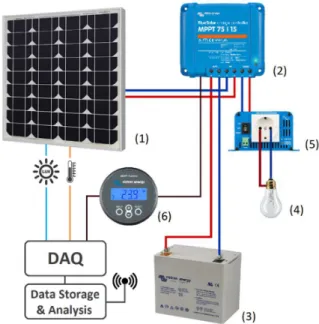
The experimental setup is presented next, is used to measure the total power and voltage of a 50W photovoltaic panel, taking also into account the sunlight illuminance and the temperature of the panel. Thus, the influence of the environmental factors (its temperature or various contamination materials that totally or partially cover the surface of the panel) on the energy efficiency can be evaluated.
The experimental data are used to determine an evaluation function that allows to estimate the power production of the PV panel in normal
conditions. The schematic of the developed experimental set up is illustrated in Figure 3.
Fig. 3. The experimental set up.
The photovoltaic panel used was Victronic 50W 12V monocrystalline panel SPM030501200 (1) with 36 solar cells. In order to capture a maximum of sunlight and therefore producing a maximum of energy, the PV panel has been mounted on a platform described in [15]. This platform ensures the orientation of the panel so that the sun's rays are perpendicular to the panel. The energy produced by the PV panel is applied to a Victronic MPPT 75/15 (2) voltage regulator and battery charger. It uses the Maximum Power Point Tracking (MPPT) technology, has a maximum input of 75V 15A for the PV panels, and a VE.Direct digital interface. The load consists of a bulk charging Victron Energy GEL Deep Cycle 12V/60Ah battery (3) and a 40W 230V AC incandescent bulb (4), using a Victron Energy Phoenix 12V/180VA, 12V DC - 230V AC inverter (5).
The Victronic MPPT Control interface (6) was connected to the VE.Direct output of the MPPT regulator, thus obtaining the PV total delivered power and PV voltage values (among others). The intensity of the solar rays and the temperature of PV panel was measured using appropriate sensors.
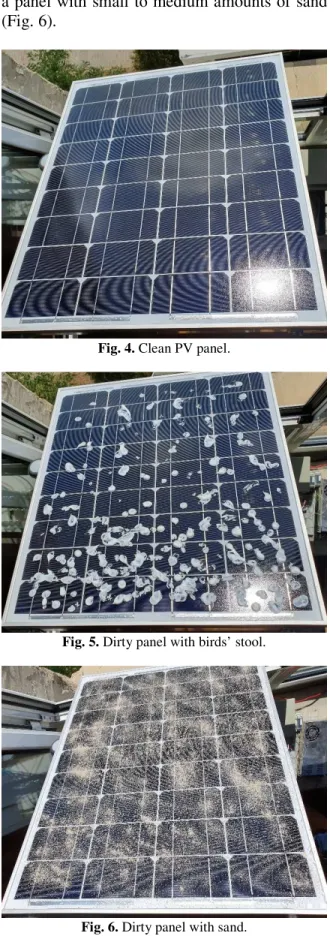
a panel with small to medium amounts of sand (Fig. 6).
Fig. 4. Clean PV panel.
Fig. 5. Dirty panel with birds’ stool.
Fig. 6. Dirty panel with sand.
In Figure 7 the results obtained after measuring the produced power, light intensity
and panel temperature for the three situations are presented. It can be observed that in the developed experiments the biggest influence on the power production is caused by the contamination with birds’ stool (x dots) in comparing with the results from the clean PV panel (o dots).
Fig. 7. Experimental Data.
The clean panel has generated on average 38W at 15,3V at 125,5 kLux and a temperature of 58 ℃. The panel contaminated with bird stool has generated about 32W at 16,3V at 118,8 kLux and a temperature of 56,1 ℃ on average. The panel contaminated with sand has generated about 34,5W at 15,5V at 135,9 kLux and a temperature of 54,3 ℃ on average.
After analyzing the measurements, it was observed that the panel temperature has a great influence on the power produced, the energy drop being on average about 1W and 0,4 V for every 5 ℃ increase above 25 ℃.
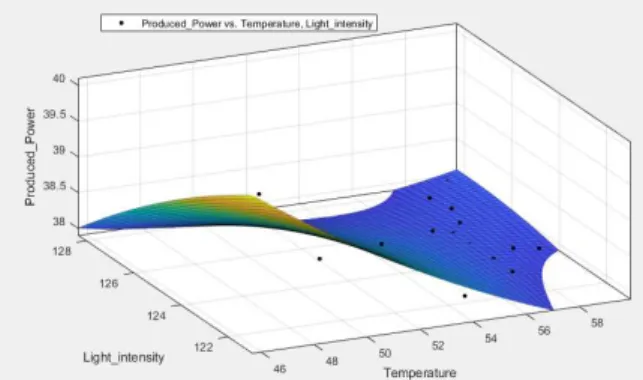
The measured data for the clean PV panel are used to determine an evaluation function based on the temperature, light intensity and produced power. As mention before the efficiency of the PV panel is dependent on the quantity of light that reach the panel and the temperature of the panel. With the change of these two parameters comes also the variation of the produced energy.
produced by the panel. The difference between the two will denote a malfunction in the system operation (surface contamination etc.).
Fig. 8. Evaluation function plot.
In obtaining the evaluation function the Matlab - Curve Fitting Tool is used. The estimation is performed using a polynomial function of the second order. The candidate function is:
, = + + + +
+ (1)
The obtained values for the function parameters are: p00=76.11; p10=-3.739; p01=1.123; p20=0.005325; p11=0.02479; p02 =-0.01019. The R-square error of the evaluation function obtained is 0.88.
This function is then used to calculate the predicted power output for the panel based on the inputs (light intensity and temperature) measured for the situation when the PV panel was contaminated with birds’ stool. The obtained results in comparation with the real measured power production are presented in Figure 9.
It can be observed that the difference between the two signal is maintained constant and the average absolute error is 15.2% (min: 13.6% and max: 15.9%). This value denotes a decrees of 15% in efficiency of the photovoltaic panel compared with the normal situation. This approach can be implemented to monitor and continuously evaluate the PV panel array performance and if certain level of decrease is meet an automated warning or active maintenance measures could be started.
Fig. 9. Comparison of the measured produced power and estimated values.
4. CONCLUSION
The paper presents an approach to evaluate in real time the efficiency of the PV panels using IoT capabilities. The method is demonstrated using real data measured for two contamination situations. It was observed that the obtained results can be used to determine under optimum functionalities of the PV Panels. The results of the method depend a lot on the quality of the initial data used to obtain the evaluation function.
It can be observed that by implementing IoT monitoring solutions the maintenance process of the PV panel sites could be easily automated ensuring an optimum power production.
5. ACKNOWLEDGEMENT
This work has been developed within the framework of the Smart HEI-Business collaboration for skills and competitiveness (HEIBus) Erasmus + Knowledge Alliances 2 project
6. REFERENCES
[1] Bagacean, D., Viorel, D., Natural resources and
energy, Acta Technica Napocensis-Series:
Applied Mathematics, Mechanics and Engineering, 57(2), 2014.
[2] Report - Renewables 2019 global status, REN21 Organization, 2019.
[3] Butuza, A., Reference selection procedure for studying the soiling effect on PV performance,
Mathematics, Mechanics and Engineering, 57(1), 2014.
[4] Kacso-Vidrean, L., Baidoc, R. D., Jucan, D. C., Pisla, A., Dust deposition calculation for pannels
robotized cleaning and maintenance, Acta
Technica Napocensis-Series: Applied Mathematics, Mechanics and Engineering, 61(4), 2018.
[5] Maghami, M., Hizam, H., Gomes, C., Radzi, M. A., Rezadad, M. I., Hajighorbani, S., Power loss
due to soiling on solar panel: A review, Journal
of Renewable and Sustainable Energy Reviews, 59, pp. 1307-1316, 2016.
[6] Catelani, M., Ciani, L., Cristaldi, L., Faifer, M., Lazzaroni, M., Rossi, M., Characterization of photovoltaic panels: The effects of dust, Proceeding of 2012 IEEE International Energy Conference and Exhibition (ENERGYCON), pp. 45-50, 2012.
[7] Popovici, C., Hudişteanu, S., Mateescu, T. D., Cherecheş, N., Efficiency improvement of photovoltaic panels by using air cooled heat
sinks, Energy Procedia, 85, 425-432, 2016.
[8] Ghazi, S., Sayigh, A., & Ip, K., Dust effect on flat
surfaces–A review paper, Journal of Renewable
and Sustainable Energy Reviews, 33, pp. 742-751, 2014.
[9] Spanias, A. S., Solar energy management as an
Internet of Things (IoT) application, 8th
International Conference on Information,
Intelligence, Systems & Applications (IISA), Larnaca, pp. 1-4, 2017.
[10] N. M. Kumar, K. Atluri and S. Palaparthi,
Internet of Things (IoT) in Photovoltaic Systems,
Proceedings of National Power Engineering Conference, Madurai, 2018.
[11] Yao, L., Lai, C. C., Lim, W. H., Home energy management system based on photovoltaic
system, Proceeding of 2015 IEEE International
Conference on Data Science and Data Intensive Systems, pp. 644-650, 2015.
[12] Lapusan, C., Balan, R., Rad, C., Plesa, A.,
Development of a multi-Room building thermal model for use in the design process of energy
management systems, Acta Technica Napocensis
- Series: Applied Mathematics, Mechanics and Engineering, 58(1), 2015.
[13] Lapusan, C., Balan, R., Hancu, O., Plesa, A.,
Development of a multi-room building
thermodynamic model using Simscape library,
Energy Procedia Journal, 85, pp. 320-328, 2016. [14] www.heibus.eu – information on HEIBus
project and EXPERT cooperation model
[15] Boanta, C., Besoiu, S., Brisan, C., Optimization of a Spatial 2 DOF Parallel Mechanism Used for
Orientation, New Advances in Mechanism and
Machine Science, Mechanisms and Machine Science, Vol. 57, Pag. 427-435, Springer, Cham, Print ISBN 978-3-319-79110-4, Online ISBN 978-3-319-79111-1, 2018.
Noi abordări în evaluarea online a eficienței sistemelor fotovoltaice prin implementarea unor soluții de monitorizare IoT
Rezumat: Lucrarea prezintă o nouă abordare în evaluarea eficienței sistemelor fotovoltaice în timp real prin integrarea capabilităților IoT. Această abordare își propune să asigure o productivitate mai bună și o durată de viață sporită a sistemului fotovoltaic prin monitorizarea continuă a parametrilor cheie ai sistemului respectiv si punerea în aplicare a unor măsuri de întreținere proactive. Abordarea propusă utilizează date măsurate în timp real din sistemul fotovoltaic și analizează aceste valori pentru a determina eficiența în producția de energie electrică.
Calin RUSU, Lecturer Dr. Eng., Department of Mechatronics and Machine Dynamics, Technical University of Cluj-Napoca, Romania.
Sorin BESOIU, Lecturer Dr. Eng., Department of Mechatronics and Machine Dynamics, Technical University of Cluj-Napoca, Romania.
Lorand KACSO-VIDREAN, PhD stud. Eng., Department of Design Engineering and Robotics, Technical University of Cluj-Napoca, Romania.
![Fig. 1. P-V arrays covered by dust in desert area [8].](https://thumb-us.123doks.com/thumbv2/123dok_us/7994564.2119974/1.918.559.753.946.1063/fig-p-v-arrays-covered-dust-desert-area.webp)