THE ABCDEF BUNDLE:
A CONCEPT TO ALIGN THE PEOPLE, PROCESSES AND TECHNOLOGY IN THE ICU
Brenda T. Pun
A dissertation submitted to the faculty at the University of North Carolina at Chapel Hill in partial fulfillment of the requirements for the degree of Doctor of Nursing Practice in the
Doctor of Nursing Practice Program in the School of Nursing.
Chapel Hill 2016
ABSTRACT
Brenda T. Pun: The ABCDEF Bundle: A Concept to align the People, Processes and Technology in the ICU
(Under the direction of Meg Zomorodi)
Intensive Care Unit (ICU) patients frequently suffer from multi-organ failure and often require advanced life support measures. However, many ICUs struggle with noncompliance on evidenced-based guideline recommended practices. Additionally, the interprofessional health care providers often care practices are often siloed and teamwork and collaboration suffer. The purpose of this project is to address this core problem of
the educational initiative on processes (i.e., compliance with the bundle elements), the people (i.e., teamwork and collaboration), and patient outcomes (e.g., ICU and hospital lengths of stay, hospital discharge location, and first time to ambulation). Baseline measures were obtained prior to the education and then patient compliance and outcomes were tracked for an additional 3 months.
This project demonstrated that introducing the ABCDEF bundle in a unit that already had each element in place resulted in improvement in element compliance and teamwork and collaboration. There was no overall effect on patient outcomes. However, it also
ACKNOWLEDGEMENTS
I would like to thank Dr Meg Zomorodi, chair of my DNP committee for her commitment to this project and me. She endured many of my “brains dump” sessions and has helped to greatly refine this project. She along with my entire committee provided invaluable feedback and guidance that was much needed and appreciated. Additionally, I would like to thank the staff of the MICU at UNC Hospitals. Thank you for allowing me to join your amazing team and to learn from the great work you are doing.
TABLE OF CONTENTS
LIST OF TABLES
LIST OF ABBREVIATIONS AND SYMBOLS
α Cronbach’s alpha
AITCS Assessment of Interprofessional Team Collaboration Scale AACN American Association of Critical Care Nurses
ARDS Acute respiratory disease syndrome; BPS Behavioral Pain Scale
BC Before Christ
CAM-ICU Confusion assessment method for the intensive care unit COPD Chronic obstructive pulmonary disease
CPOT Critical care pain observation tool DNP Doctor of Nursing Practice
EMR Electronic medical record
HWEA Healthy Work Environment Assessment ICU Intensive care unit
IQR Interquartile range.
IHI Institute for Healthcare Improvement IOM Institute of Medicine’s
i.e id est (that is)
e.g. exempli gratia (for example)
Mdn Median
MHA Michigan Hospital Association MI Myocardial infarction.
MICU Medical intensive care unit
RASS Richmond agitation-sedation scale SAS Sedation agitation scale
SAT Spontaneous awakening trial SBT Spontaneous breathing trial SCCM Society of Critical Care Medicine SD Standard deviation
CHAPTER 1: INTRODUCTION
Over 5 million critically ill patients are admitted to intensive care units (ICUs) each year in the United States (Society of Critical Care Medicine [SCCM], 2012). These patients often require advanced life support measures and technologies that include mechanical ventilation, hemodialysis, and extracorporeal membrane oxygenation. While the leading cause of morbidity and mortality in ICUs is multi-organ failure (SCCM, 2012), many members of the health care team still approach patient management from a single organ system (e.g. respiratory, cardiovascular, nephrology, musculoskeletal) perspective. These siloed care practices have hindered teamwork and collaboration (Johnson, Miller, &
Horowitz, 2008) and have resulted in the inability for ICU systems to implement and sustain interdisciplinary and interprofessional care measures resulting in practice gaps that are not approximating current clinical practice guideline recommendations (Barr et al., 2013). Advances in teamwork and collaboration are needed.
A possible cause of the poor compliance is lack of awareness of the
interconnectedness of both the patient care interventions and the staff involved in them and a corresponding lack of effective teamwork and collaboration. Vasilevskis, et al. (2010) proposed one strategy to bridge this gap and help “align the people, processes and
technologies” that are already in place was to package these ICU practices for sedation and delirium as a bundle of interventions (p.1225). The Institute for Healthcare Improvement (IHI) introduced the bundle concept in order to enhance teamwork and communication in ICUs (Resar, Griffin, Haraden, & Nolan, 2012). The use of bundles has been shown to improve communication and collaboration in the ICU and has resulted in improved compliance with guideline recommendations. The bundle concept provides a helpful framework for staff to see the interrelatedness of the people; processes and technology involved in patient care activities. The bundle proposed by Vasilevskis, et al. (2010) is now known as the ABCDEF bundle and includes 6 components: assess, prevent and manage pain (A), both spontaneous awakening trials and spontaneous breathing trials (B), choice of analgesia and sedation (C), delirium: assess, prevent and manage (D), early mobility and exercise (E), and family engagement and empowerment (F). Throughout the remainder of this manuscript this set of evidenced based interventions will simply be referred to as the ABCDEF bundle.
interprofessional engagement of the bundle. Specifically, this project aims to address the following questions:
1.Will an educational initiative that introduces the ABCDEF bundle concept improve the processes of care management (i.e., compliance with the bundle elements)?
2. Will an educational initiative that introduces the ABCDEF bundle concept improve the interaction between the people working in the ICU (i.e., teamwork and collaboration)?
CHAPTER 2: LITERATURE REVIEW Introduction of the ABCDEF Bundle Elements
Each of the ABCDEF bundle elements (i.e., assess, prevent and manage pain, both spontaneous awakening trials and spontaneous breathing trials, choice of analgesia and sedation, delirium: assess, prevent and manage, early mobility and exercise, and family engagement and empowerment) are evidenced based and received individual
recommendations in recent clinical practice guidelines from the SCCM for pain, agitation, and delirium (PAD) (Barr et al., 2013) and family support in the ICU (Davidson et al., 2007). Although they are separate interventions; they are interrelated and influence one another. Bundles have been shown to improve patient outcomes in common critical care conditions such as sepsis and ventilatory associated pneumonia (Chamberlain, Willis, & Bersten, 2011; Resar et al., 2012; Resar et al., 2005) by pulling multiple interventions together and
signifying their important and often synergistic role in preventing patient harm and/or improving patient outcomes. However, the elements of the ABCDEF bundle are often implemented independent of one another with little to no education of their interdependence. A brief description of each intervention is provided here.
A - Assess, prevent and manage pain. Pain is a significant struggle that many ICU
issues. While pain assessment is the foundation of pain management and self-report is the gold standard of pain assessment (Chanques et al., 2014), the assessment of pain is
particularly challenging in this patient population. They are often unable to self report pain secondary to altered levels of consciousness and/or the presence of endotracheal tubes thus making it difficult to ascertain when pain is present. However, there are now valid and reliable scales available for assessing pain in nonverbal ICU patients such as the Critical Care Pain Observation Tool (CPOT) (Gelinas, Fillion, Puntillo, Viens, & Fortier, 2006) and the Behavioral Pain Scale (BPS) (Payen et al., 2001). The SCCM guidelines recommend that patients be assessed regularly for pain using either self report (gold standard) or when unable the CPOT or BPS (Barr et al., 2013). Consistent and regular pain assessment using valid tools enables clinicians to detect pain, determine when to initiate treatment, either
pharmacologic or nonpharmacologic, and assess response to that treatment.
B - Both spontaneous awakening trials and spontaneous breathing trials.
Awakening and breathing trial protocols pair daily sedation interruption with spontaneous breathing trials. The seminal study of this strategy reported that when compared to patients receiving standard of care, patients who received daily sedative interruption had two fewer days of mechanical ventilation, three and a half fewer days in the ICU, and fewer
Patients who received this “wake up and breathe” protocol (Sessler, 2004, p.1413) also had better post hospital outcomes with improved 1-year survival and no increased long-term cognitive impairment (Girard et al., 2010; Girard et al., 2008). In a recent 20-site study, the implementation of the SAT plus SBT protocol resulted in decreases in mechanical ventilation duration, hospital length of stay, ventilatory associated events risk, and infection-related ventilatory-associated complications (Klompas et al., 2014). The SAT plus SBT protocol has been a successful sedation titration strategy and resulted in improved patient outcomes.
C - Choice of analgesia and sedation. Sedative medications are frequently used to
facilitate the invasive interventions, as well as, to provide anxiolysis and even amnesia while patients are in the ICU. However, due to lack of evidence the guidelines do not provide a prescriptive approach to choosing specific agents for sedation and instead provide a
recommendation against the general use of category of benzodiazepines (Barr et al., 2013). The recommendations for choice of sedation include either hypnotic sedatives (i.e.,
of the ICU, and had more disturbing memories of the ICU (Treggiari et al., 2009). These studies underscore that deep sedation is not benign, and together with other studies provide the evidence base for the recommendation that sedation be titrated to a light level, versus deep, sedation for critically ill patients unless clinically contraindicated (Barr et al., 2013). The guidelines also recommend the routine use of valid and reliable arousal scales for assessing sedation/agitation, setting targets sedation goals, and identifying the Richmond Agitation-Sedation Scale (RASS) and the Sedation Agitation Scale (SAS) as the two preferred sedation/arousal scales due to their psychometric properties (Barr et al., 2013). Thus the first step in choosing the right sedative is to set the sedation level goal and communicate that among the interprofessional team.
D - Delirium: assess, prevent and manage. While sedation strategies such as the
pharmacologic strategies have consistently shown effectiveness in either preventing or treating delirium, several studies point to sedatives as one of the risk factors for the
development of ICU delirium (Barr et al., 2013; Pandharipande et al., 2006). Thus strategies such as the ABC protocol that result in lower sedative use may help in decreasing the
incidence of delirium. The only other strategy that has been shown to decrease delirium is early mobility.
E - Early mobility and exercise. Early mobilization protocols focus on the
provision of the physical and occupational therapy as early as possible (usually within the first 48 hours) that is titrated as tolerated by the patient’s condition. The concept and feasibility of early mobility in the critical care setting was introduced in the last decade (Bailey et al., 2007; Morris et al., 2008) and since then has been gaining momentum (Truong, Fan, Brower, & Needham, 2009). Schweickert et al. (2009) reported that patients who received early mobility when compared to those who received physical/occupational therapy as ordered by the treatment team, were more likely to return to independent function by hospital discharge, had shorter duration of mechanical ventilation, and two fewer days of delirium. Quality improvement studies involving the implementation of early mobility protocols have found similar favorable outcomes (e.g. reduction in delirium and decrease in lengths of stay) (Engel, Needham, Morris, & Gropper, 2013; Needham et al., 2010;
F - Family engagement and empowerment. The central focus of all these
interventions is the patient. The Institute of Medicine’s (IOM) strong recommendation for the development of patient-centered care has been particularly difficult in the critical care setting because often the patients’ lack the full ability to communicate and participate in decision making (IOM, 2001). Thus, family members and loved ones become an essential voice for the patient. Historically, however, the ICU staff have limited the ways and times in which the family could be present and participate. Family presence in the ICU has been shown to improve patient outcomes (i.e. decreases anxiety and confusion, reduces cardiovascular complications and decreases lengths of ICU stay, and safety) while
simultaneously improving patient and family satisfaction (American Association of Critical Care Nurses, 2011; Davidson et al., 2007;). With these data as primary support, the SCCM released a clinical practice guideline in 2007 that recommended active family and patient (when able) participation in ICU care and in rounds (Davidson et al., 2007). In order to keep the interventions of the ABCDE bundle patient/family-centered, Davidson et al. (2013) suggested adding “F” for Family Involvement.
Bedside Practice Lagging Behind Recommendations
Despite the evidence to support these individual interventions, improve patient care, and have the potential to save lives, the compliance suffers at many institutions. A 2009 review of 19 international surveys found very few reports (n = 2) where the respondents reported consistent use of daily sedative interruption (Mehta et al., 2009). One survey reported that although 76% of respondents had a written policy for daily sedative
it (Tanios, de Wit, Epstein, & Devlin, 2009). The use of valid and reliable delirium
assessment tools are also sparse (Devlin et al., 2008; Patel et al., 2009; Pun & Devlin, 2013). Reports on the incorporation of early mobility into clinical practice indicate that the bedside practice rates are alarmingly low; with some reporting less than 25% of patients being
mobilized (Carrothers et al., 2013; Jolley, Regan-Baggs, Dickson, & Hough, 2014; Nydahl et al., 2014). Reasons for poor compliance include lack of personnel, poor education and/or equipment for the interventions, fears related to potential patient harm and lack of support from other disciplines, while team discussions on patient care rounds or shared meetings and open multidisciplinary communication were identified in multiple projects as facilitators for success (Engel et al., 2013; Harris & Shahid, 2014; Jolley et al., 2014; Miller et al., 2013; Tanios et al., 2009). Lack of teamwork and collaboration is a unifying theme for poor compliance in these studies. These protocols are recommended by clinical practice guidelines, yet there is still a gap in their routine bedside use and this gap appears to have roots in misalignment of people (i.e. the staff responsible for the interventions), the processes (i.e., the protocols and policies for the interventions) and the technology and tools [i.e., checklist, patient care rounds, collaborative involvement, electronic medical record (EMR) data entry and display].
The Use of Bundles to Bridge the Practice Gap
fashion and when they are managed from a fragmented linear approach, compliance suffers and effectiveness is lost. In an attempt to provide unification to these parts, Vasilevskis, et al. (2010) suggested they be bundled (i.e., at that time the ABCDE bundle) and described it as “a multicomponent process that is intentionally interdependent and designed to: (1) improve collaboration among clinical team members, (2) standardize care processes, and (3) break the cycle of oversedation and prolonged ventilation” (p.1226). Often hospitals will have these interventions in place, but do not have any framework for helping staff to see their interrelatedness (e.g., it is difficult to mobilize a deeply sedated patient). The ABCDEF bundle concept is a framework to align the people, processes, and technology and thus
improve compliance with these interventions and maximize their impact on patient outcomes. The idea of using a ‘bundle’ to connect care interventions in healthcare was
Since the addition of “family involvement” to the bundle (Davidson, et al. 2013) has been recent, all the studies to date have only included the ABCDE portions. The two existing studies have focused on the implementation of the ABCDE bundle and its elements and both have shown that the bundle implementation was associated with significant increases in compliance for all of the individual interventions (Balas et al., 2014; Carrothers et al., 2013). Balas, et al. (2014) reported that the bundle implementation also improved patient outcomes (i.e., fewer ventilatory days, less delirium and more patients ambulating in the ICU) (Balas et al., 2014). Carrothers (2013) focused on the contextual issues that affect the bundle
Aligning People, Processes, and Technology
Critically ill patients require management from multiple professionals working in close proximity and tight coordination with one another. Thus, it is no surprise that poor teamwork and collaboration are associated with negative patient outcomes and decreased staff satisfaction (Baggs, et al., 1999; Reader & Cuthbertson, 2011). Research supports that “cohesive, cooperative, nonhierarchical interprofessional team dynamics” are part of the foundational characteristics for successful guideline implementation (Sinuff, Cook, Giacomini, Heyland, & Dodek, 2007, p.2087). However, multiple barriers to effective teamwork have been identified for the ICU area. These include hierarchical structures that produce power shifts towards physicians, differing attitudes and understandings related to roles and responsibilities and constantly shifting staffing (Rose, 2011). Very few clinicians from any of the professions (i.e., nursing, medicine, rehabilitation therapy, pharmacy, respiratory therapy) experience any degree of training on interpersonal relationships in the health care setting (Rose, 2011; van de Cappelle, Hui, & Yan, 2012) and most learn on the job, often from dysfunctional teammates. Thus quality improvement initiatives should include elements that facilitate team development and team collaboration. Tools and
concepts such as bundles help guide interprofessional collaboration by explicitly identifying roles and responsibilities and providing clear communication channels for goal setting and progress tracking (Reader, Flin, Mearns, & Cuthbertson, 2009; Rose, 2011; Sinuff, et al., 2007).
gatherings of multiple healthcare providers to review individual patients and map out plans of care. From a systematic review of 43 studies, Lane, Ferri, Lemaire, McLaughlin, and Stelfox (2013) reported that when patient care rounds were multidisciplinary, followed a standardized structure and included daily goals checklists, the use of evidence-based
practices in the ICU improved. Daily goals checklists are written forms that are used during patient care rounds to summarize the discussion regarding the plan for each individual patient. Pronovost et al. (2003) reported that the inclusion of a daily goals checklist into patient care rounds significantly increased the nurses’ and doctors’ understandings of daily goals and simultaneously decreased patients length of stay. Daily goals checklists have also been shown to improve communication, synchronize care, improve adherence to guidelines, and decrease infections (Centofanti et al., 2014; Lane et al., 2013; Narasimhan, Eisen, Mahoney, Acerra, & Rosen, 2006; Pronovost et al., 2006; Simpson, Peterson, & O'Brien-Ladner, 2007). The use of these two tools (i.e., structured patient care rounds and daily goal checklists) in the context of the ABCDEF bundle could enhance interdisciplinary
communication and facilitate coordination of the bundle interventions.
Another tool that has been shown to be helpful in facilitating team based quality improvement are quality collaboratives. Quality collaboratives are multi-organizational groups that are focused on a single quality improvement topic. The participating
large-scale quality improvement collaborative (Levy, et al., 2010). Additionally, Michigan Hospital Association (MHA) has had a 12-year history of multiple ICU collaborative of ICUs in the state of Michigan focusing on patient safety and improving compliance with evidenced based recommendations (Goeschel & Pronovost, 2008).
Recently, with financial support from the Gordon and Betty Moore Foundation, SCCM opened enrollment for the ICU Liberation ABCDEF Improvement Collaborative set to launch in August 2015. This collaborative will be a quality improvement initiative focused on implementing the ABCDEF bundle involving 60 hospitals around the country. Member institutions will participate in regional training meetings that will focus both on the ABCDEF bundle components and on teamwork and communication. Central to the
collaborative model, the participating ICUs will have the opportunity to share experience, resources and materials (SCCM, 2015).
Summary
The components of the ABCDEF bundle (i.e., awakening and breathing trial coordination, delirium monitoring, early mobility, and family involvement) are evidence-supported and guideline-recommended, but yet many institutions have difficulty
implementing them into routine practice. It is essential to appreciate that these interventions are interrelated and interdependent (e.g. you cannot mobilize a patient who is deeply
CHAPTER 3: CONCEPTUAL AND THEORETICAL FRAMEWORK Introduction of General Systems Theory
General Systems Theory’s History and Overview
The concepts of General Systems Theory emerged in the 1920’s primarily from the biologist, Ludwig von Bertalanffy as an attempt to identify a larger theory to provide some degree of unity among the sciences. At that time scientific disciplines were becoming increasingly isolated and cross-pollination of ideas and learning was suffering. This
fragmentation led to unnecessary inefficiencies with the discoveries of identical principles in separate fields simply because they did not know a well-developed theory for that concept was already established in another field. This redundancy and unnecessary “reinvention of the wheel” was preventing all the sciences from further advancement. Classical science was the predominant basis of inquiry at the beginning of the 20th century. Accordingly, a system (e.g. a machine, organism, or a disease) was best understood by dissecting its parts and studying them individually and in a linear fashion. In-depth study of parts would provide explanation of the whole. This reductionist approach was helpful in adding a great deal of understanding to scientific understanding; however, it provided no assistance in explaining certain gaps and contradictions.
Bertalanffy revived this idea and provided detailed descriptions of system characteristics with solid mathematical modeling support and thus enabled systems thinking to infiltrate many sciences and disciplines (Bertalanffy, 1968). This theory would provide the basis of great scientific stimulation and led to the creation of models and tools for interdisciplinary use (Bertalanffy, 1968).
The universal commonalities that von Bertalanffy described form the basis of General Systems Theory. Concepts and assumptions are presented in Table 1. As stated above, according to General Systems Theory, systems are made up of elements or parts (Bertalanffy, 1968). These elements may be any number of things such as atoms, animals, humans, or even money. While the elements are important, how they relate with one another and the outside environment is most important to understanding the system of which they are part. The relationships of those parts can be described as interconnected, interdependent and co-evolving. Components of a system influence one another and that interconnectedness results mutual change over time that happens in nonlinear ways. Linear relationships are
proportional and thus one part changes in proportion to the changes of another part, always in a constant relationship. The relationships of the parts with one another and the responses of the parts to one another are essential to understanding the overall system (Bertalanffy, 1968). Using General Systems Theory to Align People, Processes and Technology
In addition to providing a framework for interdisciplinary teamwork, General Systems Theory provides the theoretical support for quality improvement initiatives and the need to align people, processes and technology to ensure success. This can be readily seen in the application of system thinking in high reliability organizations such as the airline
Cheese Model of Accident Causation. In this model, he proposed that active errors are often preceded by latent errors or holes in the system in which the error occurred (Reason, 1990). Many of these latent errors point to baseline issues with teamwork and communication. If those holes could be patched then the active errors will be much harder to make. This model led to the improvement of processes through the development of safety checklists and communication techniques that have advanced aviation safety (Shappell & Wiegmann, 2000). These aviation tools and techniques have been modified and applied to the hospital system and resulted in such tools and strategies as structured patient care rounds and daily goals checklists which have lead to improved teamwork and communication and positive patient outcomes (Centofanti et al., 2014; Lane, Ferri, Lemaire, McLaughlin, & Stelfox, 2013; Pronovost et al., 2003; Pronovost et al., 2006; Simpson, Peterson, & O'Brien-Ladner, 2007). Bundles rely heavily on the use of these types of tools to keep the shared goals on the forefront of each team member’s daily agenda for patients.
General Systems Theory provides a firm theoretical foundation of support for both understanding the problem for the ICU’s lack of compliance with the evidence-based recommendations and their roots in misaligned teamwork and communication. Also this theory provides a helpful framework for designing an intervention to enhance the
collaboration. There are many critical care interventions with strong evidence to support they advance patient outcomes and are thus recommended by guidelines (e.g. the ABCDEF bundle elements) and yet many units struggle to adopt them into daily practice. It is essential to appreciate that these interventions are interrelated and interdependent (e.g. you cannot mobilize a patient who is deeply sedated). It is equally important to note that these
care activities. The ABCDEF bundle acknowledges this interconnectedness of both the processes and the people involved. The principles of General Systems Theory support the concept of bundling these interventions and using checklists in patient care rounds to
facilitate teamwork within the multi-disciplinary ICU team. As teamwork and collaboration improve, the compliance with the interventions will as well, and thus the sum of the
Table 1. General Systems Theory Concepts and Assumptions Concepts
(Bertalanffy, 1968) Description
Relationships Parts of a system are interconnected, interdependent and co-evolving.
Coevolution Coevolution is when a part changes, or evolves, in response or reaction to the change in a related part.
Nonlinearity Linear relationships are proportional and thus each part changes in proportion to the changes of another part, always in a constant relationship. However, in nonlinear relationships, change affects the two parts in non-constant ways.
Open systems An open system is one that continual interacts with its
environment. A closed system is one that does not interact with its environment and its final state is directly related to the initial state. Equifinality In an open system the final state can be reach through a variety of
paths and initial conditions.
Assumptions (Skyttner, 2005) Laws must exist and there is a law of all laws.
CHAPTER 4: METHODOLOGY Introduction
In order to evaluate the impact of introducing the ABCDEF bundle concept, this quality improvement project evaluated the compliance with current recommendations for each bundle elements: assess, prevent and manage pain (A), both spontaneous awakening trials and spontaneous breathing trials (B), choice of analgesia and sedation (B), delirium: assess, prevent and manage (D), early mobility and exercise (E), and family engagement and empowerment (F). This study also examined the impact of introducing the bundle concept on teamwork and collaboration and patient outcomes. This pre-post implementation study design was approved by the hospital nursing research council and was determined by the institutional review board to meet criteria as a quality improvement initiative.
Project Questions
The project questions were:
1.Will an educational initiative that introduces the ABCDEF bundle concept improve the processes of care management (i.e., compliance with the bundle elements)?
2. Will an educational initiative that introduces the ABCDEF bundle concept improve the interaction between the people working in the ICU (i.e., teamwork and collaboration)?
Setting
This project took place in the medical ICU (MICU) of a large academic medical center in the southeast United States. The MICU is one of seven ICUs in the hospital and has 18 beds with 1100 annual admissions. The average length of stay is three days and while the unit manages a variety of medical conditions, the most common admitting diagnosis is severe sepsis.
Subjects/Sample
At the time of the study, the MICU leadership team consisted of a nurse manager, two assistant nurse managers, and a medical director who is a pulmonary critical care physician. When the census is full, the unit is typically staffed with 10-11 registered nurses assigned to bedside caregiving, one charge nurse, 10 house staff physicians, two attending physicians, two pharmacists, and two respiratory therapists. There are no unit based rehabilitation therapists (physical/occupational), thus rehabilitation services are achieved via formal consults. The unit utilizes daily interdisciplinary rounds on each patient, which routinely includes the physicians, registered nurses, respiratory therapists, and pharmacists. Implementation Procedures
Securing senior leadership commitment. Throughout the fall of 2014 and spring of
would provide outside context and legitimacy for the initial project proposed as well as a structure for building on progress made and sustainability. This project would serve as the initial start of the collaborative interventions in the MICU and then continued participation in the collaborative provides the framework and resources for sustained and building growth and development of the implementation of the bundle elements. In the spring of 2015, the MICU was selected to be a collaborative site.
The application process provided a formal mechanism for identifying core team members to serve as ABCDEF bundle experts and champions and identify a broader team who would become the ABCDEF bundle workgroup. The application also required securing senior leadership (i.e., chief executive officer, chief nursing officer, MICU nurse manager, the MICU medical director) signed commitments to provide both staff time and resources to the project. The Chief of Pulmonary contacted each senior leader by phone and/or email and introduced the project and requirements and after discussions obtained signed commitment from each.
Engaging and creating champions. In August of 2015 the SCCM hosted an
educational and leadership training meeting in Charlotte, NC for the ICU Liberation Campaign’s ABCDEF Bundle Collaborative. Each participating hospital was required to send a team of three interprofessional members to learn about quality improvement, teamwork and collaboration, and implementing the ABCDEF bundle. The MICU sent the medical director, a physical therapist, and a nurse to the SCCM training meeting.
engage this small core team from the MICU about the ABCDEF bundle and its elements and equip them with the tools to teach others.
Creation of interprofessional workgroup. This core team returned to the MICU and
assembled an interprofessional workgroup that included the core team of champions described above (i.e., the medical directory, a physical therapist, and a nurse) plus a
pharmacist, two respiratory therapists, and three physicians. Since the hospital utilizes Epic electronic medical records system it was also important to have a team member that worked closely with Informational Technology in order to investigate capabilities and make requests for changes. Two additional nurses were also recruited as additional educators and trainers who helped with rollout education. The medical director facilitated each meeting and the group members were given time for discussion. Group members’ were tasked to represent their respective professions in regards to items discussed and were in charge of disseminating information to their professions from the workgroup.
The ABCDEF introduction education planning and execution. Using the baseline
survey results as a guide, the workgroup created a 30-minute presentation that introduced the concept of bundles and the specifics of the ABCDEF bundle. The sessions stressed that protocols and/or policies were already in place for each element of the bundle and that the purpose of this first step was to help staff realize that these elements are connected to each other and as team members they are dependent on one another when providing patient care and using language such as the ABCDEF bundle can help remind everyone of that
connectedness. A total of 16 30-minute educational sessions were scheduled over a 10-day period. The educational sessions were offered at multiple different times of the day and included weekends and nights in order to provide convenient opportunities to staff working on all shifts. Each session was presented by at least two members of the workgroup from different professions a nurse, a pharmacist or a physician, and a nurse, and was attended by members from each professional group.
Additional efforts to introduce the bundle concept. In addition to these educational
sessions, there were two other efforts to introduce the concept of the ABCDEF bundle to the interprofessional team of the MICU. An educational bulletin board was created that
Data Collection
Specific measurement tools to address teamwork, bundle compliance, and patient outcomes are discussed below. For Aims 1 (processes) and 3 (outcomes), data were collected from the electronic medical records of patients admitted to the MICU over a four month period to represent a baseline month prior to the ABCDEF Bundle Education initiative and the three months following. These data were directly entered into electronic case report forms (eCRFs) in a secured password-protected database. For Aim 2 (people) the MICU interprofessional staff were surveyed at two time points – prior to the educational initiative (Baseline) and 3 months later (Post-Implementation). A link to the online staff surveys was distributed to via email to the respective professional groups. Additionally, hard copy surveys were handed out on the unit to the staff present and in ICU physician group
conferences. These hard copy surveys were later entered into the online survey database by the investigator or research assistant. The study utilized Research Electronic Data Capture (REDCap) for data collection, transmission and storage. All study data were entered via a password protected, study unique REDCap database website.
Measures
Compliance with ABCDEF bundle components (processes). Compliance with the
ABCDEF Bundle components was monitored throughout the course of the study on each patient on a daily basis for as long as 14 days, death or ICU discharge, as relevant. Patients with an ICU length of stay greater than 14-days are considered chronic critically ill and respond to treatments in a different way than those with shorter stays (Carson, 2012; Hough et al., 2015). Therefore this project focused only on the first 14 days of their ICU
online random number generator. Patients were excluded if they were not in the ICU for a minimum of 24 hours. Baseline compliance data was collected from the medical records for 30 patients admitted to the MICU during the 30 days prior to the end of the educational initiative.
Since the project was a rapid continuous quality improvement project it was
determined that testing monthly would give timely compliance data as feedback to refine the process. Compliance data were then collected for a subset of patients, identified using the online random number generator, for three months following the educational initiative. (i.e., Month 1, Month 2, Month 3). For Month 1, data were collected for 20 patients. After
reviewing the data from the Baseline and Month 1, and evaluating the feasibility of
Table 2. ABCDEF Bundle Element Compliance Definition Bundle Element Compliance Definition Assess, prevent and manage pain
The unit protocol requires that patients be assessed a minimum of every 4 hours for a total of 6 times per 24 hours with either the Numeric rating scale (NRS) when able to self report or the Non-Verbal Adult Pain Scale (NAPS) when unable to self report (e.g. when mechanically ventilated). The number of pain assessments/day that were documented in the nursing flowsheet was recorded.
Both spontaneous awakening trials (SAT) and spontaneous breathing trials (SBT)
SAT compliance was defined as the number of patient days that a patient was on continuous or intermittent sedatives and either received an SAT or there was documentation for contraindication to stopping the sedatives in the medical record.
SBT compliance was defined as the number of patient days that a patient was receiving invasive mechanical and there was either an SBT or there was documentation for contraindication to performing the breathing trial in the medical record.
Choice of analgesia and sedation
The foundational daily first step of the sedation protocol is for the interprofessional team to set a sedation scale target using, the Richmond Agitation-Sedation Scale (RASS). Additionally, the unit protocol requires that patients be assessed a minimum of every 4 hours for a total of 6 times per 24 hours with the RASS scale. During the 14-day data collection period, the number of RASS assessments that were
documented in the nursing flowsheet per day, the number of days a RASS target was documented in medical record, and the number of days that the actual assessment was not at the set target RASS were recorded.
Delirium: assess, prevent and manage
The unit protocol requires that patients be assessed a minimum of once per shift for a total of 2 times per 24 hours for delirium with Confusion Assessment Method for the ICU (ICU). The number of CAM-ICUs that were documented in the nursing flowsheet was recorded. Early mobility
and exercise
Early Mobility compliance was defined as the number of patient days that a patient either received early mobility or there was documentation for contraindication for mobility in the medical record.
Family engagement and
empowerment
Interprofessional teamwork survey (people). Interprofessional teamwork was
measured with two scales, the Assessment of Interprofessional Team Collaboration Scale (AITCS) and the American Association of Critical Care Nurses’ (AACN) Healthy Work Environment Assessment (HWEA) tool. The surveys were distributed to all potential interprofessional members of the MICU staff.
The AITCS is a 37-item survey designed to evaluate team collaboration (Orchard, King, Khalili, & Bezzina, 2012). Each item is preceded by the stem, “When we work as a team, all my team members are…” Each item is rated using a 5-option response scale (5 = always; 4 = most of the time; 3 = some of the time; 2 = occasionally, and 1 = never). The AITCS was developed based on four attributes of collaboration: cooperation, coordination, partnership and shared decision-making, and was revised based on feedback from content validity experts, factor analysis, and reliability testing. Items for the AITCS were developed following a literature search on interprofessional collaborative practice. Items were then subjected to validity testing with 24 interprofessional experts to review clarity,
comprehensiveness, and content validity. Following revisions by the experts, the AITCS was subjected to field testing with 125 health care professionals. Factor analysis revealed 3 factors (61.02% of variance). The overall internal consistency estimates for reliability were 0.98 for the total scale and ranged from 0.80 to 0.97 for the three subscales (Orchard et al, 2012). The final instrument includes 37 items: 19 items for partnership/shared decision making, 11 items for cooperation, and 7 items for coordination (Orchard et al, 2012).
The HWEA is an 18-item survey designed to evaluate teamwork and work
Collaboration Nurses, Effective Decision Making, Appropriate Staffing, Meaningful Recognition, Authentic Leadership (AACN, 2005). These standards were created by an expert panel to align with the IOM’s core competencies recommended for healthcare professionals and the 9 provisions in the American Nurses Association’s Code of Ethics (AACN, 2005). Respondents are asked to evaluate each item in regards to their agreement about the item’s applicability to their current work environment. The answer choices are “Strongly Disagree, “Disagree,” “Neutral,” “Agree,” and “Strongly Agree.” There was no evidence of any prior work to examine the reliability or validity of this instrument.
The ICU Care and Perceptions Survey was developed by subject matter experts in conjunction with the SCCM ICU Liberation Collaborative project. This survey contains 83 items and is designed to evaluate respondents’ perceptions and reported practice as they relate the individual elements of the ABCDEF bundle. This survey also evaluates
respondents’ awareness of polices and protocols for the bundle elements. The purpose of this survey is to serve as the basis of the needs’ assessment for the educational initiative and ongoing projects related to implementation of the bundle elements. There was no evidence of any prior work to examine the reliability or validity of this instrument.
Patient Outcomes Data. Patient outcome data were collected on the same patients
that compliance data were gathered on. The following outcome data were collected:
• ICU Length of stay – Length of ICU stay was measured from ICU admission
date/time until ICU discharge date/time or death date/time, whichever came first. The length was measured in days and rounded to the nearest half day.
or death date/time, whichever came first. The length was measured in days and rounded to the nearest half day.
• Discharge disposition – For patients who survived to hospital discharge, the specific location of discharge disposition was recorded. Discharge location possibilities include: home, assisted living, rehabilitation facility, long-term acute care center, nursing home, skilled nursing facility, another hospital, hospice or inpatient psychiatry.
Data Analysis Plan
To determine if the introduction of the ABCDEF Bundle concept has an impact on the compliance rates of each element of the bundle (Aim1: processes) the following statistics were used:
• Descriptive statistics were used to describe the general demographic characteristics of the patients (e.g., age, sex and admission diagnosis) in the compliance data collection in the baseline and post-education groups (i.e., Month 1, Month 2, and Month 3).
• Descriptive statistics including frequency and proportion were used for the ABCDEF compliance variables, which are binary. The compliance definitions provided in Table 2 were used to determine days of compliance for each element of the bundle. To determine if the introduction of the ABCDEF Bundle concept has an impact on teamwork and collaboration (Aim 2: people) the following data analysis plan was used:
teamwork survey and the HWEA survey between baseline and 3-month Post-implementation groups.
• Descriptive statistics including means and standard deviations were used for the survey subscales (i.e., partnership/shared decision making, cooperation, and
coordination) and the survey total scores, which are continuous variables. All surveys included questions that were used to generate an anonymous code (Damrosch, 1986), which allowed matching the pre- and post- surveys. For the surveys that could be matched, the paired t-test were used to examine if significant differences exist between the pre- and post- intervention groups. For the surveys that could not be matched Student’s t-tests were used.
• Cronbach’s alpha was used to measure the internal consistency of the AITCS and the HWEA surveys at both time points.
To determine the relationship of the ABCDEF Bundle concept with ICU and hospital lengths of stay, and hospital discharge location (Aim 3: patient outcomes) the following statistics were used:
• Descriptive statistics were used to describe the general demographic characteristics of the patients (e.g., age, sex and admission diagnosis) in the outcomes data collection in the baseline and post-intervention groups (i.e., Month 1, Month 2, and Month
• Descriptive statistics including medians and interquartile ranges were used for the continuous patient outcome data (i.e., ICU length of stay and hospital length of stay).
CHAPTER 5: RESULTS
Due to the sample size and nature of this continuous quality improvement project the data for Aims 1 (compliance) and 2 (outcomes) were not evaluated for statistical significance and thus any changes are reported as trends rather than significance. The data for Aim 2 (teamwork and collaboration) were evaluated for statistical significance and are reported as thus. The results for all three aims are presented below.
Compliance (Processes)
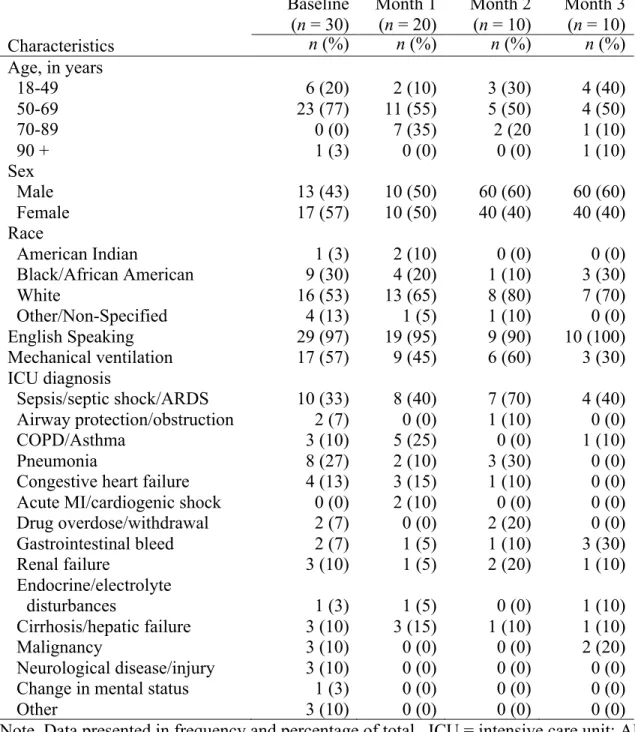
There were a total of 102 patients screened and 32 were excluded (31 that were in the ICU less than 24 hours and one whose chart access was restricted). A total of 70 patients were included in the chart audit over the four-month period. More than half of these patients were between the ages of 50-69, and most were white, English speaking, and admitted with the diagnosis of sepsis and/or septic shock. Demographics of each group are shown in Table 3.
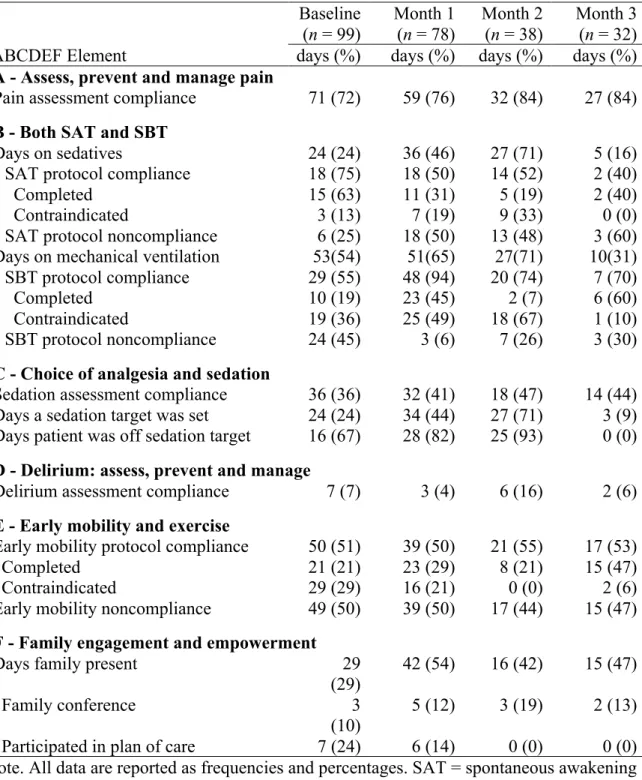
Compliance was tracked on days that patients were in the ICU for a full 24 hours and receiving aggressive care management (e.g. not on comfort care only status). This resulted in a total of 99 days for the Baseline month, 78 days for Month 1, 38 days for Month 2, and 32 days for Month 3. The compliance performance for each bundle element was variable over the four-month period. Compliance with both pain (A) and agitation-sedation (C)
assessments increased from baseline for Months 1, 2 and 3. Compliance with pain
Table 3. Patient Demographics
Baseline Month 1 Month 2 Month 3
(n = 30) (n = 20) (n = 10) (n = 10)
Characteristics n (%) n (%) n (%) n (%)
Age, in years
18-49 6 (20) 2 (10) 3 (30) 4 (40)
50-69 23 (77) 11 (55) 5 (50) 4 (50)
70-89 0 (0) 7 (35) 2 (20 1 (10)
90 + 1 (3) 0 (0) 0 (0) 1 (10)
Sex
Male 13 (43) 10 (50) 60 (60) 60 (60)
Female 17 (57) 10 (50) 40 (40) 40 (40)
Race
American Indian 1 (3) 2 (10) 0 (0) 0 (0)
Black/African American 9 (30) 4 (20) 1 (10) 3 (30)
White 16 (53) 13 (65) 8 (80) 7 (70)
Other/Non-Specified 4 (13) 1 (5) 1 (10) 0 (0)
English Speaking 29 (97) 19 (95) 9 (90) 10 (100)
Mechanical ventilation 17 (57) 9 (45) 6 (60) 3 (30)
ICU diagnosis
Sepsis/septic shock/ARDS 10 (33) 8 (40) 7 (70) 4 (40) Airway protection/obstruction 2 (7) 0 (0) 1 (10) 0 (0)
COPD/Asthma 3 (10) 5 (25) 0 (0) 1 (10)
Pneumonia 8 (27) 2 (10) 3 (30) 0 (0)
Congestive heart failure 4 (13) 3 (15) 1 (10) 0 (0)
Acute MI/cardiogenic shock 0 (0) 2 (10) 0 (0) 0 (0)
Drug overdose/withdrawal 2 (7) 0 (0) 2 (20) 0 (0)
Gastrointestinal bleed 2 (7) 1 (5) 1 (10) 3 (30)
Renal failure 3 (10) 1 (5) 2 (20) 1 (10)
Endocrine/electrolyte
disturbances 1 (3) 1 (5) 0 (0) 1 (10)
Cirrhosis/hepatic failure 3 (10) 3 (15) 1 (10) 1 (10)
Malignancy 3 (10) 0 (0) 0 (0) 2 (20)
Neurological disease/injury 3 (10) 0 (0) 0 (0) 0 (0)
Change in mental status 1 (3) 0 (0) 0 (0) 0 (0)
Other 3 (10) 0 (0) 0 (0) 0 (0)
Table 4. Frequency of Compliance Days with the ABCDEF Bundle Elements
Baseline Month 1 Month 2 Month 3 (n = 99) (n = 78) (n = 38) (n = 32)
ABCDEF Element days (%) days (%) days (%) days (%)
A - Assess, prevent and manage pain
Pain assessment compliance 71 (72) 59 (76) 32 (84) 27 (84) B - Both SAT and SBT
Days on sedatives 24 (24) 36 (46) 27 (71) 5 (16)
SAT protocol compliance 18 (75) 18 (50) 14 (52) 2 (40)
Completed 15 (63) 11 (31) 5 (19) 2 (40)
Contraindicated 3 (13) 7 (19) 9 (33) 0 (0)
SAT protocol noncompliance 6 (25) 18 (50) 13 (48) 3 (60) Days on mechanical ventilation 53(54) 51(65) 27(71) 10(31) SBT protocol compliance 29 (55) 48 (94) 20 (74) 7 (70)
Completed 10 (19) 23 (45) 2 (7) 6 (60)
Contraindicated 19 (36) 25 (49) 18 (67) 1 (10)
SBT protocol noncompliance 24 (45) 3 (6) 7 (26) 3 (30) C - Choice of analgesia and sedation
Sedation assessment compliance 36 (36) 32 (41) 18 (47) 14 (44) Days a sedation target was set 24 (24) 34 (44) 27 (71) 3 (9) Days patient was off sedation target 16 (67) 28 (82) 25 (93) 0 (0) D - Delirium: assess, prevent and manage
Delirium assessment compliance 7 (7) 3 (4) 6 (16) 2 (6)
E - Early mobility and exercise
Early mobility protocol compliance 50 (51) 39 (50) 21 (55) 17 (53)
Completed 21 (21) 23 (29) 8 (21) 15 (47)
Contraindicated 29 (29) 16 (21) 0 (0) 2 (6)
Early mobility noncompliance 49 (50) 39 (50) 17 (44) 15 (47) F - Family engagement and empowerment
Days family present 29
(29)
42 (54) 16 (42) 15 (47)
Family conference 3
(10)
Teamwork and Collaboration (People)
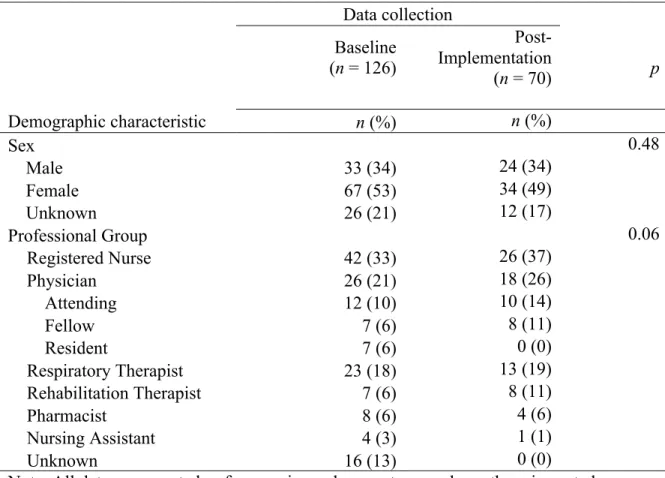
At the Baseline survey time point, a total of 158 staff surveys were collected. Of these surveys, 29 were not included because they were either blank or only contained demographic information resulting in a total of 126 surveys with at least one completed section completed, an overall response rate of 77%. A total of 80 Post-Implementation surveys were collected. Of these surveys, 10 were not included because they were either blank or only contained demographic information resulting in a total of 70 surveys with at least one completed section, an overall response rate of 38%. The mean age of respondents at Baseline of 38.35 years (SD = 11.21) was similar to the mean age at Post-Implementation (M = 35.92, SD = 11.21). The two groups were also similar in sex and professional group
composition. The majority of the respondents at both time points were nurses and
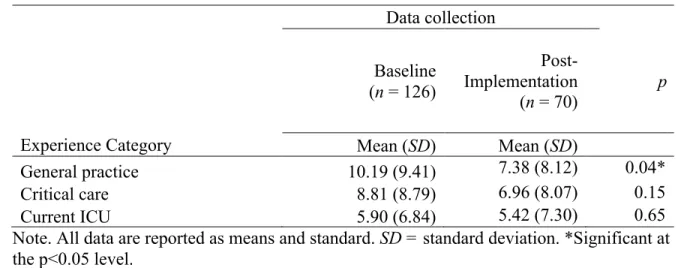
physicians. Table 5 provides demographic characteristics of the respondents at both time points. The two groups were similar in years of both critical care experience and experience in this ICU. However, the Post-Implementation respondents had significantly fewer years of critical care experience (M = 7.38, SD = 8.12) when compared to Baseline respondents (M = 10.19, SD = 9.41, p = 0.04). Table 6 provides the comparisons of the years of experiences of the two groups.
To obtain internal consistency estimates for each of the scales, Cronbach’s alpha was used. The overall reliability of the AITCS was 0.98 at Baseline with a range of 0.92 to 0.97 for the subscales. The overall reliability of the HWEA was 0.96 at Baseline with a range of 0.76 to 0.86 for the subscales.
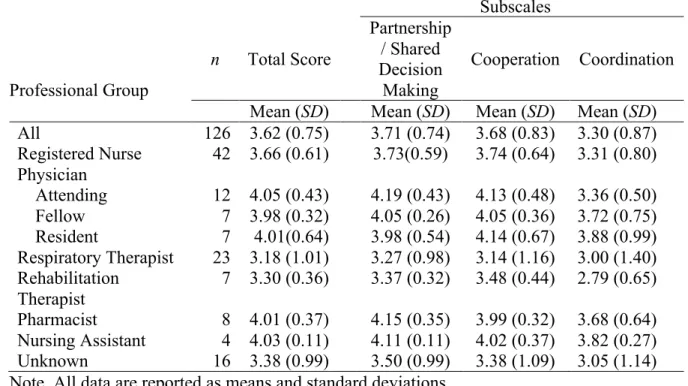
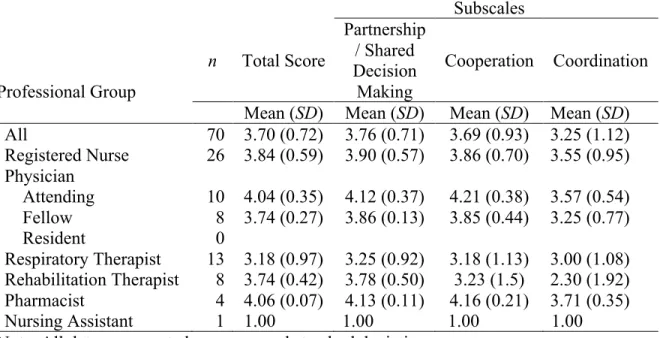
category marked. These surveys scored a mean of 3.38 (SD = 0.99) on the overall score. At the 3 Month time point, the mean score for the all the items of the AITCS for all respondents was 3.70 (SD = 0.72). Of the three teamwork and collaboration attributes measured by the AITCs, coordination had the lowest score for the overall respondents at both time points (M = 3.30, SD = 0.87 at Baseline and M = 3.25, SD = 1.12 at Post-Implementation).
Coordination was also the lowest scored category for each individual profession. Baseline AITCS scores are presented in Table 7 and 3 Month scores are presented in Table 8.
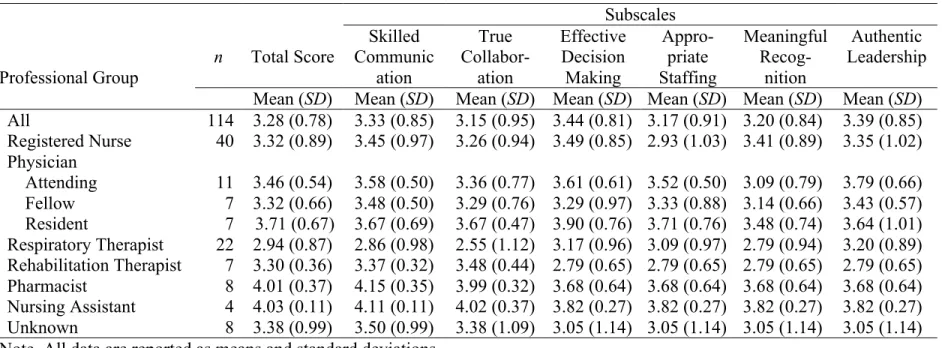
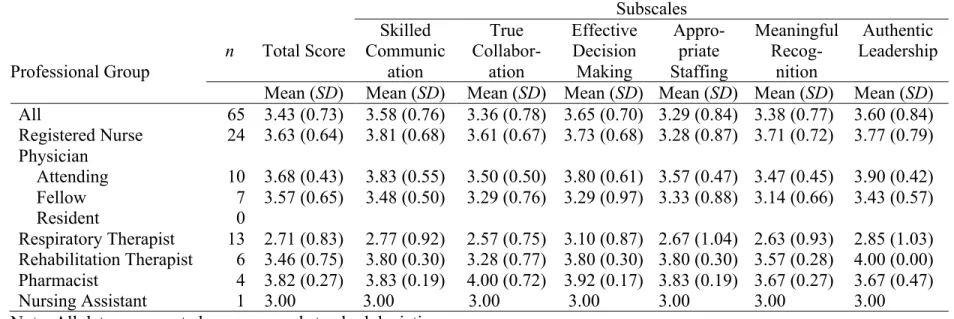
The overall HWEA mean score at baseline was 3.28 (SD = 0.78). There were 8 surveys that did not have a professional affiliation marked and these “unknowns” had an overall mean score of 3.22 (SD = 0.77). The 3 Month HWEA overall mean score was 3.43 (SD = 0.73). At the Baseline time point True Collaboration was the lowest subscale score (M = 3.15, SD = 0.95) and at the Post-Implementation time point Appropriate Staffing was the lowest subscale score (M = 3.29, SD = 0.84). Baseline HWEA scores are presented in Table 9 and 3 Month scores are presented in Table 10.
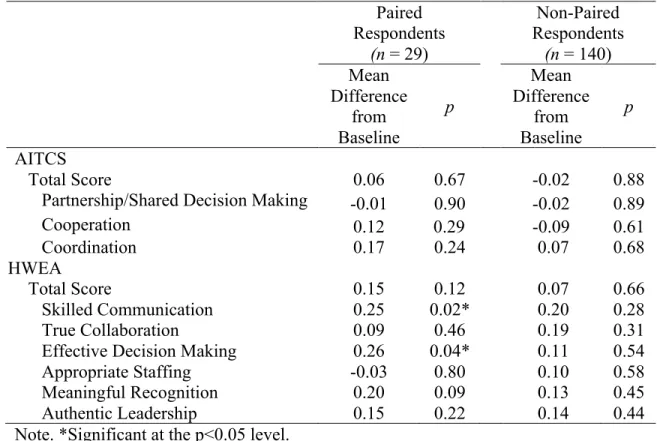
Baseline scores were compared to 3-Month scores and while both surveys, AITCS and HWEA showed increased scores in the 3 Month results, they were not statistically different from the Baseline scores. There were statistically significant improvements in the HWEA subscales of Skilled Communication (p =0.02) and Effective Decision Making (p =0.04). The comparisons of the paired survey responses and the non-paired survey
responses are reported in Table 11.
delirium” trended up from 46% at baseline to 93% at Post-Implementation. Similarly, the percentage of respondents that agreed/strongly agreed that the “ABCDEF bundle improves patient outcomes” trended up (85% at Baseline to 87% at Post-Implementation) and that they were “confident in the ability to use the bundle” also trended up (71% at Baseline and 77% at Post-Implementation). Also important to highlight, the percentage of respondents who agreed/strongly agreed that “All mechanically ventilated patients require sedative
medications while they are in the ICU” trended down from 23% at Baseline to 7% at Post-Implementation. There was a trend up in the percentage of respondents that agreed/strongly agreed that “keeping patients deeply-sedated negatively affects patient outcomes” (65% at baseline and 78% at Post-Implementation). Lastly, there was a trend up in the number of respondents that noted at Post-Implementation that they “actively participate in
interprofessional rounds daily” (75% at Baseline and 90% at Post-Implementation). Patient Impact (Outcomes)
Table 5. Demographic Data for Survey Respondents
Note. All data are reported as frequencies and percentages unless otherwise noted. Significant at the p<0.05 level.
Data collection Baseline
(n = 126)
Post-Implementation
(n = 70) p
Demographic characteristic n (%) n (%)
Sex 0.48
Male 33 (34) 24 (34)
Female 67 (53) 34 (49)
Unknown 26 (21) 12 (17)
Professional Group 0.06
Registered Nurse 42 (33) 26 (37)
Physician 26 (21) 18 (26)
Attending 12 (10) 10 (14)
Fellow 7 (6) 8 (11)
Resident 7 (6) 0 (0)
Respiratory Therapist 23 (18) 13 (19)
Rehabilitation Therapist 7 (6) 8 (11)
Pharmacist 8 (6) 4 (6)
Nursing Assistant 4 (3) 1 (1)
Table 6. Experience Years for Survey Respondents
Data collection
Baseline (n = 126)
Post-Implementation
(n = 70) p
Experience Category Mean (SD) Mean (SD)
General practice 10.19 (9.41) 7.38 (8.12) 0.04*
Critical care 8.81 (8.79) 6.96 (8.07) 0.15
Current ICU 5.90 (6.84) 5.42 (7.30) 0.65
Table 7. Means and Standard Deviations of the AITCS Survey Response Scores at Baseline
Subscales
Professional Group
n Total Score
Partnership / Shared Decision Making
Cooperation Coordination
Mean (SD) Mean (SD) Mean (SD) Mean (SD) All 126 3.62 (0.75) 3.71 (0.74) 3.68 (0.83) 3.30 (0.87) Registered Nurse 42 3.66 (0.61) 3.73(0.59) 3.74 (0.64) 3.31 (0.80) Physician
Attending 12 4.05 (0.43) 4.19 (0.43) 4.13 (0.48) 3.36 (0.50) Fellow 7 3.98 (0.32) 4.05 (0.26) 4.05 (0.36) 3.72 (0.75) Resident 7 4.01(0.64) 3.98 (0.54) 4.14 (0.67) 3.88 (0.99) Respiratory Therapist 23 3.18 (1.01) 3.27 (0.98) 3.14 (1.16) 3.00 (1.40) Rehabilitation
Therapist
7 3.30 (0.36) 3.37 (0.32) 3.48 (0.44) 2.79 (0.65) Pharmacist 8 4.01 (0.37) 4.15 (0.35) 3.99 (0.32) 3.68 (0.64) Nursing Assistant 4 4.03 (0.11) 4.11 (0.11) 4.02 (0.37) 3.82 (0.27)
Unknown 16 3.38 (0.99) 3.50 (0.99) 3.38 (1.09) 3.05 (1.14)
Table 8. Means and Standard Deviations of the AITCS Survey Response Scores at 3 Months Post-Implementation
Subscales
Professional Group
n Total Score
Partnership / Shared Decision Making
Cooperation Coordination
Mean (SD) Mean (SD) Mean (SD) Mean (SD) All 70 3.70 (0.72) 3.76 (0.71) 3.69 (0.93) 3.25 (1.12) Registered Nurse 26 3.84 (0.59) 3.90 (0.57) 3.86 (0.70) 3.55 (0.95) Physician
Attending 10 4.04 (0.35) 4.12 (0.37) 4.21 (0.38) 3.57 (0.54) Fellow 8 3.74 (0.27) 3.86 (0.13) 3.85 (0.44) 3.25 (0.77)
Resident 0
Respiratory Therapist 13 3.18 (0.97) 3.25 (0.92) 3.18 (1.13) 3.00 (1.08) Rehabilitation Therapist 8 3.74 (0.42) 3.78 (0.50) 3.23 (1.5) 2.30 (1.92) Pharmacist 4 4.06 (0.07) 4.13 (0.11) 4.16 (0.21) 3.71 (0.35)
Nursing Assistant 1 1.00 1.00 1.00 1.00
47
Table 9. Means and Standard Deviations of the HWEA Survey Response Scores at Baseline Subscales
Professional Group
n Total Score CommunicSkilled ation
True
Collabor-ation
Effective Decision Making
Appro-priate Staffing
Meaningful
Recog-nition
Authentic Leadership
Mean (SD) Mean (SD) Mean (SD) Mean (SD) Mean (SD) Mean (SD) Mean (SD) All 114 3.28 (0.78) 3.33 (0.85) 3.15 (0.95) 3.44 (0.81) 3.17 (0.91) 3.20 (0.84) 3.39 (0.85) Registered Nurse 40 3.32 (0.89) 3.45 (0.97) 3.26 (0.94) 3.49 (0.85) 2.93 (1.03) 3.41 (0.89) 3.35 (1.02) Physician
48
Table 10. Means and Standard Deviations of the HWEA Survey Response Scores at 3 Months Post-Implementation
Subscales
Professional Group
n Total Score CommunicSkilled ation
True
Collabor-ation
Effective Decision Making
Appro-priate Staffing
Meaningful
Recog-nition
Authentic Leadership
Mean (SD) Mean (SD) Mean (SD) Mean (SD) Mean (SD) Mean (SD) Mean (SD) All 65 3.43 (0.73) 3.58 (0.76) 3.36 (0.78) 3.65 (0.70) 3.29 (0.84) 3.38 (0.77) 3.60 (0.84) Registered Nurse 24 3.63 (0.64) 3.81 (0.68) 3.61 (0.67) 3.73 (0.68) 3.28 (0.87) 3.71 (0.72) 3.77 (0.79) Physician
Attending 10 3.68 (0.43) 3.83 (0.55) 3.50 (0.50) 3.80 (0.61) 3.57 (0.47) 3.47 (0.45) 3.90 (0.42) Fellow 7 3.57 (0.65) 3.48 (0.50) 3.29 (0.76) 3.29 (0.97) 3.33 (0.88) 3.14 (0.66) 3.43 (0.57)
Resident 0
Respiratory Therapist 13 2.71 (0.83) 2.77 (0.92) 2.57 (0.75) 3.10 (0.87) 2.67 (1.04) 2.63 (0.93) 2.85 (1.03) Rehabilitation Therapist 6 3.46 (0.75) 3.80 (0.30) 3.28 (0.77) 3.80 (0.30) 3.80 (0.30) 3.57 (0.28) 4.00 (0.00) Pharmacist 4 3.82 (0.27) 3.83 (0.19) 4.00 (0.72) 3.92 (0.17) 3.83 (0.19) 3.67 (0.27) 3.67 (0.47)
Nursing Assistant 1 3.00 3.00 3.00 3.00 3.00 3.00 3.00
Table 11. Significance Testing for AITCS and HWEA survey scores between Baseline and 3 Months Post-Implementation
Paired Respondents
(n = 29)
Non-Paired Respondents (n = 140) Mean
Difference from Baseline
p
Mean Difference
from Baseline
p
AITCS
Total Score 0.06 0.67 -0.02 0.88
Partnership/Shared Decision Making -0.01 0.90 -0.02 0.89
Cooperation 0.12 0.29 -0.09 0.61
Coordination 0.17 0.24 0.07 0.68
HWEA
Total Score 0.15 0.12 0.07 0.66
Skilled Communication 0.25 0.02* 0.20 0.28
True Collaboration 0.09 0.46 0.19 0.31
Effective Decision Making 0.26 0.04* 0.11 0.54
Appropriate Staffing -0.03 0.80 0.10 0.58
Meaningful Recognition 0.20 0.09 0.13 0.45
Authentic Leadership 0.15 0.22 0.14 0.44
!
Table 12. Descriptive Statistics for the Patients’ ICU and Hospital Lengths of Stays
Baseline Month 1 Month 2 Month 3 Length of Stay Category (n = 30) (n = 20) (n = 10) (n = 10) Mdn (IQR) Mdn (IQR) Mdn (IQR) Mdn (IQR)
ICU 3.00 (4.38) 4.00 (3.13) 2.5 (3.38) 3.75 (4.13)
Hospital - for all patients 9.25 (13.00) 10.25 (18.63) 11.00 (11.63) 10.50 (8.25) Hospital - excluding patients
!
Table 13. Frequency and Percentages of Discharge Disposition of Survivors
Baseline Month 1 Month 2 Month 3
(n = 17) (n = 15) (n = 7) (n = 6)
Discharge Location n (%) n (%) n (%) n (%)
Home 13 (76) 9 (60) 3 (43) 5 (83)
Assisted Living 0 (0) 0 (0) 0 (0) 0 (0)
Rehabilitation Center 0 (0) 1 (7) 0 (0) 0 (0)
Long Term Acute Care Hospital 0 (0) 0 (0) 0 (0) 0 (0)
Nursing Home 0 (0) 0 (0) 0 (0) 0 (0)
Skilled Nursing Facility 1 (6) 3 (20) 4 (57) 1 (17)
Another Hospital 1 (6) 0 (0) 0 (0) 0 (0)
Hospice 1 (6) 1 (7) 0 (0) 0 (0)
Inpatient Psychiatry 1 (6) 0 (0) 0 (0) 0 (0)
!
CHAPTER 6: DISCUSSION
The purpose of this project was to evaluate the impact of introducing the concept of
the ABCDEF bundle on people (teamwork and communication), processes (compliance with
bundle elements) and outcomes (patient outcomes). The project found that while there was an
impact, it was small, and more work is needed.
Three of the bundle elements strongly rely on the use of patient assessment tools for
pain, agitation, and delirium (i.e., A, C, and D). While both pain (A) and sedation/agitation
(C) assessments had slightly improved by the end of the 3-month observation period, delirium
(D) assessments remained relatively unchanged by the end of the 3-months. Both the pain
and sedation/agitation assessment tools are well established for use in ICUs and easy to use
with little training. They are both assessed more frequently than delirium by unit policy (i.e.
pain and agitation/sedation is assessed every 4 hours and delirium is assessed every 12 hours)
and both had greater than 4 assessments per day in the Baseline month. However, delirium is
a more recent concept in the critical care setting and the assessments tools are relatively new
(Barr et al., 2013). Although the unit had a delirium assessment tool and policy in place, there
was only an average of 0.3 assessments done per day in the Baseline month. The ABCDEF
workgroup acknowledged that this is not surprising giving the lack of importance that
delirium assessment has received over the past few years and earmarked it as an area of
needed future education and training especially for new staff members.
The B element of the bundle includes both SATs and SBTs and demonstrated mixed
!
that patients in the Month 3 cohort had a lower percentage of days on sedation and those that
had a target set were always titrated to target. This could suggest that there are some overall
changes happening in the MICU culture toward lighter sedation practices. The remaining
patients that are on sedation might be the ones that are more difficult to sedate and thus, staff
are more resistant to performing SATs. There are some data that suggest that tight and light
sedation titration is more effective than SATs (Mehta et al., 2012). Patients that are more
awake are more capable of participating in early mobility. While the early mobility (E)
protocol compliance did not change over the course of the observations, Month 3 patients had
the highest percentage days of early mobility, in other words less patients had
contraindications for having early mobility and thus progressed to getting mobility. The ICU
Care and Perceptions results supports this, indicating a culture change in the MICU with a
greater percentage of respondents reporting that not all ventilated patients need sedation and
deep sedation is dangerous. These changes in staff perceptions represent a shift in attitudes
about sedation and that in turn impacts patients’ abilities to do the other elements of the
bundle.
The last element of the bundle, family presence, was particularly challenging to
measure since this was not recorded in a consistent location in the medical record.
Additionally, there is not a consistent mandate in the family visitation policies that guide the
staff on documentation of family presence or involvement and this could be underreported
because it is not frequently documented even when it does happen. Month 3 had a higher
percentage of patient days where family presence was documented;, however, there were less
days when family engagement (i.e. family conferences or involvement in the plan of care) was
!
extubation and transition to comfort care) were excluded from evaluation, and those days may
have included more family conferences.
Perhaps the most important observation in this study was the observation of the
ABCDEF workgroup that greater use of the goals sheets that included the ABCDEF bundle
elements at the end of the 3 month observation period helped to facilitate discussions during
patient rounds. In a meeting at the end of this 3-month observation period, the ABCDEF
workgroup expressed that there was greater use of the ABCDEF goals sheets and that it is
helping to facilitate discussions in rounds. Additionally, a greater percentage of staff members
were observed participating in interprofessional rounds. While large differences in practices
were not observed at the 3-Month follow-up period, these small changes point to changes in
overall MICU practices and also underscore the interrelatedness and interdependency of the
ABCDEF bundle elements. These findings indicate a culture change towards improving
teamwork and collaboration in the MICU, and support the concept that the ABCDEF bundle
helps to align not just processes but the staff associated with it. This is important, as the
ABCDEF bundle includes interventions and practices that require multiple professionals in
the ICU to work in a coordinated and collaborative fashion.
The introduction of the ABCDEF bundle framework and language also made an
impact on teamwork and collaboration. While the overall mean scores for the AITCS (3.62 to
3.70) and HWEA (3.28 to 3.43) did not improve significantly, they did increase. The lack of
significance can be due to the small sample size and the low response rate at Month 3. Staff
turnover, especially from the resident and nursing professions, was not measured, but