CRAFTING A CAREER: ETHEL WATERS AND CABIN IN THE SKY
Briana Joy Frieda
A thesis submitted to the faculty at the University of North Carolina at Chapel Hill in partial fulfillment of the requirements for the degree of Master of Arts in Musicology in the Music
Department in the School of Music.
Chapel Hill 2015
Approved by:
Jocelyn R. Neal
Andrea Bohlman
Chérie Ndaliko
iii ABSTRACT
Briana Joy Frieda: Crafting a Career: Ethel Waters and Cabin in the Sky (Under the direction of Jocelyn Neal)
Ethel Waters (1896–1977) was a path-breaking African American entertainer whose
career spanned nearly sixty years, moving from vaudeville to Hollywood. This thesis addresses
the 1943 film Cabin in the Sky as a pivotal moment in Waters’s dramatic output, with her playing
a role that served as culmination of the themes of her earlier career and as the transition to a new
type of character. Beginning before Cabin, and moving through the end of her career, this
analysis draws from biographical accounts in combination with close readings of the film to trace
four main characteristics that govern her career and public persona: her assertion of creative
control, her personal conflicts with female co-stars, her public expressions of religious piety, and
her complex experiences with the racial politics of her era. Her oft-overlooked portrayal in
iv
TABLE OF CONTENTS
LIST OF FIGURES ... v
INTRODUCTION ... 2
Writing Waters ... 3
Cabin in the Sky Summary ... 6
CHAPTER 1: ETHEL WATERS BEFORE CABIN IN THE SKY (1896–1940) ... 12
CHAPTER 2: ETHEL WATERS IN CABIN IN THE SKY (1943)... 30
“New Negro Womanhood”: Ethel Waters and Lena Horne, Katherine Dunham ... 31
Petunia, Waters, and Religion ... 35
Ethel Waters, Vernon Duke, and the Music of Cabin in the Sky ... 38
Waters’s Image and Cabin in the Sky ... 49
CHAPTER 3: ETHEL WATERS AFTER CABIN IN THE SKY (1943–1977) ... 54
CONCLUSION ... 61
v
LIST OF FIGURES
2
INTRODUCTION
In 1943 at the Metro Goldwyn Mayer studios in Beverly Hills, California, rehearsals and
shooting for the upcoming film musical, Cabin in the Sky, were in full swing. Two years earlier,
the Broadway version of the show had finished a successful run, with Waters in a leading role.
The renowned performer was making her way through the studio when she passed the sound
department in time to hear her cast-mate Lena Horne’s rendition of the movie’s raunchiest
number, “Honey in the Honeycomb.” Raving that the younger singer was parodying her style,
Waters went into one of her characteristic fits of anger and indignation, and – according to the
account of co-star Eddie “Rochester” Anderson – did some “voodoo” on the dance floor right
where Horne would soon be rehearsing. Much to everyone’s dismay (save Waters’s), the new,
young actor fell and broke her ankle shortly thereafter, resulting in her recovering in a leg-cast
and a dance sequence being cut from the film.1
By this point in her career, Waters had made a name for herself in the all-black revues of
Harlem, and had successfully transitioned into the more mainstream Broadway theaters.
Audiences knew her well from her early 1920s “race records” released on the Black Swan label,
her raunchy dance-moves, or her iconic performance of “Stormy Weather,” her signature
torch-song that helped her break into Broadway roles. Her film career had begun by 1929 with a cameo
in On with the Show. By 1943, however, she was no longer the shimmying dance goddess or
3
expressive singer of previous decades; she had gained not only wide-renown, but also a bad
reputation in the industry for production spats with directors and co-stars, and not a few pounds.
Her self-image and public persona had both faltered. For an entertainer at her particular career
juncture, the chance to star in a film adaptation of Cabin in the Sky was a prime opportunity to
re-assert her position as a performer at the top of her game.
Although often overlooked by scholars, the 1943 film musical Cabin in the Sky presents a
defining moment in Waters’s career. Analysis of Waters’s career choices prior to and following
the 1943 film suggests that Cabin in the Sky was a pivot point in the types of characters Waters
portrayed. Through close reading and analysis of her musical and dramatic performances within
the show, this thesis argues that Waters’s performance in the role of Petunia was more than
merely the typecasting of an aging black woman as supportive wife. Instead, it was through her
performances as Petunia, both on-stage and on-screen, that Waters was able to articulate her
continuing control over the roles she would play as an extension of her public persona, express
her values in terms of religion, power, and her own identity construction, and negotiate her own
place within the fraught racial environment of 1940s show-business in America.
Writing Waters
In recent decades, much attention has been paid by musicologists to the study of “race
shows,” here defined as musicals and plays in which most or all of the cast is African American,
and/or the topical focus of the show is race. Most significant of these studies is Todd Decker’s
Show Boat: Performing Race in an American Musical, which uses Show Boat as a case study of
a Broadway musical in which its specific casting shaped the show itself, and placed black and
4
now in its fourth edition, is a wide-ranging assessment of African American performance in
films. Bogle gives an in-depth analysis of the portrayals of black characters in American movies,
and provides a strong background for understanding the problematic, traditional representations
at play in many all-black films as well as in Cabin.2 In terms of studies dedicated to Cabin in the
Sky, however, little exists.
Musicological approaches to the film have been undertaken by a handful of authors, most
importantly by James Naremore, Susan Smith, and Kate Weber-Petrova. Smith approaches the
music from a film-studies background; her examination of Cabin supports a racially-progressive
reading of the film as one challenging the expected performances of black actors on screen,
while also noting gender-progressive performances.3 Naremore’s essay contextualizes Cabin as
part of a line of mostly or all African American-cast movies, during a time when studios were
working to produce more films in that genre and the entertainers were fighting for better
treatment from said studios.4 Weber-Petrova’s 2008 master’s thesis provides one of the first
accounts of Cabin that applies ideas such as Bogle’s caricature studies to the film.5 Her study
offers a complete reading of the film through an investigation of the thematic materials of
religion and folklore and the rural-urban binary, racial caricaturing, and her own interpretation of
Waters Water’s scenes as sites of new, liberal female blackness. What is missing, however, is a
contextualization of Cabin in the Sky as an important pivot point in Waters’s own career.
2Donald Bogle, Toms, Coons, Mulattoes, Mammies, and Bucks: An Interpretive History of Blacks in American Films, 4th ed. (New York: Continuum, 2001).
3Susan Smith, The Musical: Race, Gender and Performance (New York: Wallflower, 2005). 4James Naremore, “Uptown Folk: Cabin in the Sky,” in The Films of Vincente Minnelli (New York: Cambridge University Press, 1993).
5
The broadest selection of material related to the topic at hand are biographical writings on
Waters. James F. Wilson, in his essay “’Hottentot Potentates’: The Potent and Hot Performances
of Florence Mills and Ethel Waters,” presents a comparison between the two nightclub
performers while noting their unique abilities to critique black social status and the sexual
autonomy of early- to mid-century female performers.6 In African American Actresses, Charlene
Regester presents an artist biography of Waters, alongside other African American actresses of
the first sixty years of the twentieth century, including Lena Horne; Regester’s focus is on the
racial and sexual “othering” ascribed to these women in typical Hollywood narratives.7 Glenda
Gill offers a brief but informative essay in which she presents the idea that Waters’s character
choices may have reflected a decline in self-image, an interpretation to which this thesis will
return.8 Finally, Shane Vogel gives a compelling assessment of black female performativity in
his article “Performing ‘Stormy Weather,’” in which he outlines Waters’s early career and
discusses her early application of vocal authority to the pieces she chose to perform.9
Indispensable to the current study is Donald Bogle’s later book, Heat Wave.10 This
biography of Ethel Waters tracks her entire lifetime, offering a comprehensive account of her
career as an entertainer, and contains invaluable information referenced from primary sources, as
6James F. Wilson, “’Hottentot Potentates’: The Potent and Hot Performances of Florence Mills and Ethel Waters,” in Bulldoggers, Pansies, and Chocolate Babies: Performance, Race, and Sexuality in the Harlem Renaissance” (Ann Arbor: University of Michigan Press, 2013).
7Charlene Regester, African American Actresses: The Struggle for Visibility, 1900–1960 (Bloomington: Indiana University Press, 2010).
8Glenda E. Gill, “Tough Life, Tough Roles, Tough Woman: The Struggle of Ethel Waters,” in Gender in Popular Culture: Images of Men and Women in Literature, Visual Media, and Material Culture
(Cleveland, OK: Ridgemont Press, 1995).
9Shane Vogel, “Performing ‘Stormy Weather’: Ethel Waters, Lena Horne, and Katherine Dunham,” in South Central Review 25/1 Staging Modernism (Spring 2008), 93-113.
6
well as the author’s own interviews. Furthermore, he draws from contemporaneous popular press
sources, and the scholarship about Waters’s colleagues to more fully illustrate her public persona
and relationship to others.
Ethel Waters’s own papers and memoirs provide primary source materials that richly
inform this study. In her autobiography, His Eye Is on the Sparrow, she offers a personalized
account of her life from the very beginning.11 Tracing her difficult childhood through her early
show-business activity and her multiple romantic attachments, Waters provides detailed and
intimate illustrations of who she wants her fans to think she is. Published first in 1950, it came at
a point in her career when she was still active in the field and was, indeed, on the upswing
professionally. A later autobiography, To Me It’s Wonderful, follows Waters’s career through
1972, with a special focus on her time touring with evangelical preacher Billy Graham. In
Sparrow, Waters offers her fans a carefully crafted and expertly pruned version of the biography
she wishes to promote; in Wonderful, the perspective is still idealized, but is primarily a
faith-based narrative in which Waters reflects on her earlier life and highlights the successes as results
of her religion.
Cabin in the Sky Summary
Cabin in the Sky was the Broadway, and later Hollywood, incarnation of a story written
by Lynn Root called Little Joe. In it, Root tells the tale of fictional Little Joe Jackson, a working
black man in the south, who struggles with gambling and the allure of a woman who is not his
wife. Despite trying his best to reform, on the very morning that he is to return to the fold of his
church on his wife Petunia’s arm, Joe succumbs to the pleasures of dice and ends up getting shot.
7
After feverishly tossing in bed, Joe dies, but through the power of Petunia’s prayer, the Lord’s
General is convinced to give him a six-month second chance on Earth to prove his goodness and
save his soul. During his six-month trial return to Earth, Joe makes some improvements but is
ultimately torn away from the righteous path by Lucifer, Jr., and his minions, characters who
engineer temptations and lure Joe away from Petunia. Petunia observes his dalliances and casts
him off, after which Joe takes up with Georgia Brown, a woman known for working the
nightclub circuit, and lives the high-life from the winnings of a lottery. One night, Petunia shows
up to Joe’s regular gambling house in a new, glamorous gown and attempts to show herself off to
Joe, his gambling cronies, and Georgia. She leaves her intentions ambiguous, whether she is
trying to win him back or simply make him realize what he has lost. Her flirtations get Petunia
more attention than she had bargained for, and she calls to Joe to rescue her. In the ensuing
melee, Joe and Petunia are both fatally shot; but not before Petunia can pray for God to destroy
the house of sin in which they are standing. Petunia and Joe are taken to the Gates of Heaven,
where Petunia is instantaneously granted access, but Joe’s account is tallied by Lucifer and the
Lord’s General and comes up short. Again, through the power of Petunia’s prayer, Joe secures
the Lord’s grace and the couple ascends the stairway to heaven hand in hand. As they climb
toward heaven, the scene dissolves and the audience realizes everything that followed the first
shooting was all a dream. The moment of Joe’s death never really occurred, nor any of the events
afterward. Upon Joe’s reawakening, Petunia returns to his side and – we presume – they live
happily ever after.
The music for the Broadway version of Cabin in the Sky was written by Vernon Duke
and John Latouche. Duke was at a party when he was approached by Lynn Root to write the
8
own autobiography that he had some doubts about his ability to write in the African-American
musical idiom; after some reflection, he rescinded his initial refusal and got in touch with the
other members of the creating team. After conferring with Broadway writer and comedian (and
brother of Lorenz) Teddy Hart, producer Milton “Doc” Bender, and Broadway choreographer
George Balanchine, Duke began the search for a lyricist to work with. His favored partner was
Ira Gershwin, but he was already engaged in writing a show with Kurt Weill and Moss Hart.
Duke also asked Yip Harburg to collaborate on the score, but Harburg turned him down for what
Duke later recalled was the show’s “lack of significance, social or otherwise.”12 Eventually,
Duke was able to secure a writing partner in Johnny Latouche, a young man from Richmond,
Virginia, whom Duke had assisted in selling some music. Latouche was enthusiastic, and was
brought on board the project at the same time as producer Albert Lewis. Duke also collaborated
on the music for the ballet sequences with Balanchine.13
The collaboration of Duke, Ballanchine, and Teddy Hart was one in a long series of
Broadway teams comprised of white, Jewish men. Ballanchine and Duke were, furthermore, of
Russian descent, along with costume and set designer Boris Aronson. According to Duke, the
“three Russians […] pitted against the prodigiously gifted and eager, but bewildered, Negro
members of the cast” made for interesting and highly-charged rehearsals.14
Financial support for the new show, now called Cabin in the Sky, was not initially
forthcoming, though by the summer of 1940 it was almost fully funded. Backers included white
12Duke, Passport, 384. It is worth noting that Harburg indeed ended up providing songs for the musical once it reached movie form.
9
Broadway theater owner-operator and producers Martin Beck, Gilbert Miller, Sam H. Harris, and
W. Horace Schmidlapp.15
Procuring the talent for the show seemed to have been an easier task. The producers and
music-writers first approached Ethel Waters, a hard-sell, as she had just finished a successful run
on Broadway in the show Mamba’s Daughters. Having been asked to read for the new musical,
Waters complained that she had objections to the show’s treatment of religion, and wanted to
insert her own flavor into the character of Petunia. Eventually, she agreed to take the role.
Following the star’s signing, actors Todd Duncan, Rex Ingram, and Katherine Dunham
were more easily attracted to the project. Dunham’s dance troupe worked with choreographer
Balanchine to create the dance numbers, but Waters had something to say about that as well,
getting Dunham kicked out of two dance numbers so Waters could dance with her new beau,
Archie Savage. 16
In September of 1940, rehearsals began at the Martin Beck Theater. Tensions ensued
between the set of white-Russian, Jewish “creators” and the all-black cast, frequently revolving
around issues of conflicting dance styles, dialectic misunderstandings, and authority – broadly
speaking. Although there were plans to have a pre-Broadway opening in Boston, a shortage of
funds prevented it; there were a handful of relatively unsuccessful previews/dress-rehearsals in
New York. It was only in the last two of these that the cast and crew realized that the show
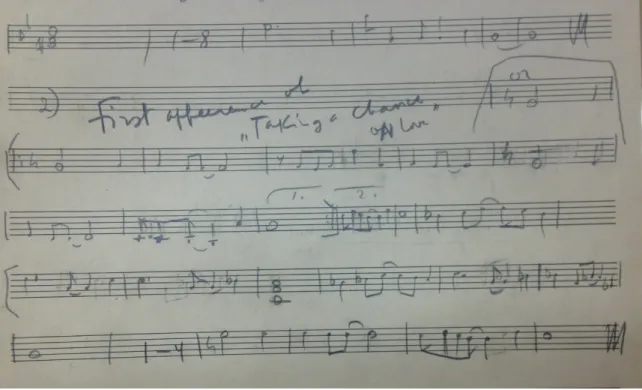
needed an early “heart-warming” song to hook the audience in the first half, resulting in the
last-minute addition of Duke’s possibly best-known song, “Taking a Chance on Love.”17
15Ibid., 388. Profiles for these Broadway-men were all found through The Internet Broadway Database, http://ibdb.com/person.php?id=24027. It should be noted that in Passport, Duke referred to Schmidlapp as “Harris” Schmidlapp.
10
Cabin’s reception was generally positive, leading the show to run for 156 performances
over the course of nearly five months, an impressive stretch.18 Although initially a financial
“bust,” – it lost $25,000 for the producers – the show was respected as an artistic endeavor, and
did well on the road, playing to standing-room-only audiences across the country. The success
of the musical play led quickly to the idea of a film. MGM studios purchased the show for
$40,000 – a boon for the Broadway team.19
The film version of Cabin in the Sky was released in 1943, directed by Vincente Minnelli
– the third film from the young director. Although some music from the Duke-Latouche pair was
kept, Yip Harburg, George Bassman, and Roger Edens contributed much original scoring and
several new songs to the movie. Dance numbers became less frequent, and through a series of
directorial and performer decisions, the main characters engaged in only limited dancing on
screen.
In March 1943, Lena Horne, Eddie “Rochester” Anderson, and Duke Ellington all signed
onto the film version of Cabin in the Sky. Waters was to reprise her role as Petunia. From the
beginning, the diva clashed with fellow cast and artistic staff over her part:
When we made Cabin in the Sky there was conflict between the studio and me from the beginning. For one thing, I objected violently to the way religion was being treated in the screen play. Eddie (Rochester) Anderson, Lena Horne, and many other
performers were in the cast. But all through that picture there was so much snarling and scrapping that I don’t know how in the world Cabin in the Sky ever stayed up there. I won all my battles on that picture. But like many other performers, I was to discover that
17Duke, Passport, 391.
18Cabin in the Sky was performed 156 times at the Martin Beck Theater between 25 October 1940 and 8 March 1941. “Cabin in the Sky,” on Internet Broadway Database, accessed 25 February 2015.
11
winning arguments in Hollywood is costly. Six years were to pass before I could get another movie job.20
These “battles” that Waters fought included her using her sway as an important performer to
garner the respect she thought was due her by the Hollywood industry, to craft the character to
what she wanted her to be, and, eventually, to secure parts even more complex than Petunia,
allowing her to explore her own range as an actor. In the end, the role of Petunia succeeded in
establishing Waters as a major Hollywood actress, and served as the culmination of the young
characters Waters would play, before pivoting to more mature character-types.
12
CHAPTER 1: ETHEL WATERS BEFORE CABIN IN THE SKY (1896–1940)
In all of her career, Ethel Waters claimed that her most important role was that of Hagar,
in the 1939 production Mamba’s Daughters. By 1939, she had established herself as a vaudeville
star and was about to root herself firmly in the Broadway tradition as well. Hagar won her
critical acclaim, while also showcasing the full range of her emotional and professional identity
that she had cultivated up to that point. More significantly, it was the role that directly preceded
her portrayal of Petunia in Cabin in the Sky, and, as such, helps illustrate Waters’s complicated
sense of self and accomplishment at the moment when she embarked on Cabin. A careful
reading of her career up to that point, informed by Waters’s own recounting of it, reveals four
main character traits – sometimes in tension with each other – that most strongly defined Waters
at that point in her career. Those traits came together in a unique and powerful way in the role of
Petunia, but in their full manifestation, they also redirected Waters’s career that followed Cabin,
making the role of Petunia a noteworthy pivotal moment in her life.
Four character traits emerge over the span of her pre-Cabin career, both in secondary
sources and in Waters’s own accounts of her early professional life. First, Waters became deeply
invested in her own agency within her career, from song-selection to contract negotiation. Such
expressions of power and accounts of incidents where she triumphed were unquestionably an
important part of her personal narrative as an African American woman working in the interwar
era, yet they most significantly explain many of her decisions in the process of accepting and
13
infamous temper and inability to get along with female co-stars. Tucked into both her and others’
accounts of her professional life are an unavoidable number of anecdotes about her temper, even
when she attempts to soften or deflect attention from those incidents. The third character trait
that evolved over the span of her career was the public expression of her religious convictions.
More-so than the others, this trait reveals the pivotal effect of her time working on Cabin,
wherein not only are Satan and the Lord represented by specific characters in the show but also
Petunia’s religious faith provides the cornerstone of the plot. For a woman whose post-Cabin
career would be tied extensively to the evangelical preacher Billy Graham, the expression of
religious identity emerged very slowly over her early career. Fourth, and finally, Waters’s
pre-Cabin career is marked by a series of successes whereby Waters broke racial barriers in the
entertainment industry, something of which she was sufficiently proud that it becomes a theme in
her autobiographical literature. Those successes set up yet another way in which Cabin’s Petunia
was a pivotal moment for her when she would confront black protestors objecting to the
portrayal of African American individuals in the show, a show that she defended as a triumph in
part for its all-black cast. The emergence and maturation of these four traits over the span of her
early career provide the context for understanding Waters in Cabin, a production that for her
marked the end of one professional era and, for the audience at large, sat at a pivotal moment in
American cultural history.
Although she often lied about her date of birth, claiming to be four years younger, Ethel
Waters was born 31 October 1896 in Chester, Pennsylvania; she maintained for many years that
she was born in 1900. Her mother, Louise, was thirteen when she gave birth to Ethel, who was
the product of rape at the hands of a white man named John Waters.21 He was not present for
14
most of her life, although his relatives and even his children crossed paths with Waters
personally and professionally. Louise’s own mother, Sally, was more responsible for caring for
Waters than she was; Waters called Louise “Momweeze” throughout her life, but called Sally her
real “Mom.”22
Through her grandmother’s care, Waters was in and out of schools and churches, to
which she attributed her love of both singing and of Jesus, whom she later wrote that she had
found when she was twelve years old. She performed in church when she was only five years
old. Thanks to Sally, Waters was able to take dance classes and attend a Catholic school; she
claimed that the first time she truly felt loved was when she was under the tutelage of the nuns.
School became a moot point, however, when Waters was thirteen. Her mother had granted
permission for an older man to take Waters as his wife. The two divorced after just a year of
marriage, and Waters returned to the life the rest of her family and friends led, taking odd jobs
usually in hotels and enjoying the musical offerings available at the cabarets and clubs near her
home. She claimed to have never consciously planned or hoped for a career in entertainment, but
her early attempts to craft a colorful identity might suggest otherwise. She seemed to fall into the
career, according to the now-legendary story of her discovery.
On her birthday – Halloween – in 1917, Waters was with some friends at an amateur
night at Jack’s Rathskeller club. Her friends convinced her to get on stage, so she did. Waters
sang “When You’re A Long, Long Way From Home,” and the crowd went wild. In the audience
that night was the vaudeville recruitment pair, Braxton and Nugent; they liked what Waters did
and approached her after her performance. The agents offered her a contract on the “chitlin’
circuit” (Baltimore, Washington D.C., Chicago, etc.), with a guaranteed income of ten dollars a
15
week. At that time she was working as a maid and making less than four dollars a week, so to
Waters this appealed to her as a great way to make more, and – even if it turned out not to work
– it would be a quick chance to make some cash. She accepted the offer and left shortly
thereafter on her first tour, performing first at Lincoln Theater in Baltimore, Maryland.
Even at this early stage of her career, Waters was exercising control over what she would
perform, and how. As she relates in her autobiography:
I wanted to sing a new number that I’d once heard Charles Anderson, a very good female impersonator, do. Braxton and Nugent said it was a restricted song and I’d have to get permission from the copyright owners, Pace and Handy, in Memphis,
Tennessee, before I could sing it on stage […] The song I wanted to sing was “St. Louis Blues.” Pace and Handy answered my letter by granting me permission. That was how I, a seventeen-year-old novice, became the first woman – and the second person – ever to sing professionally that song which is now a classic and, according to many people, the greatest blues ever written.23
W.C. Handy’s jazz-pop crossover hit, “St. Louis Blues,” gave Waters the chance to do a little
acting as part of her singing, and really tell a story, which is one of the facets of her performance
that is often discussed in academic-literature about her career.
Early in her career, Waters had to learn how to handle monetary negotiations, as well as
to navigate within the established social codes of the theater business. Dealing as a woman, even
a reputedly strong-willed one, with agents, producers, and co-stars whom she had to out-smart
was a challenge. She learned the hard way that some representatives were dishonest and would
hold out on their clients, especially if the clients were young women. One evening after a
performance at the Lincoln Theatre in Baltimore, Waters overheard Braxton and Nugent
discussing how they would split the fifteen dollars they would have left of the money Waters was
earning; the theater was paying the agents twenty-five dollars for her to perform, but she was
16
only getting ten.24 Upon learning of that arrangement, she left mid-contract. From that point on,
Waters made a point of being in control of the financial aspect of her career, never trusting her
managers to dictate her pay, but always holding the reigns in terms of how much she asked for
performances, and deciding where she would play.
After her short engagement in Baltimore and some short tours with the Hill Sisters,
Waters moved back to Philadelphia, Pennsylvania, where she performed at the Standard until
1917, when she moved to Barry Gordon’s saloon. To cater to her audience’s preferences, Waters
maintained a repertoire of blues tunes and other raunchy songs that skewed sharply toward
double-entendre-laden lyrics. Accompanying her suggestive singing was her equally suggestive
dancing. A car accident that had occurred in Birmingham, Alabama, during her time touring with
the Hills left Waters with a weak leg, which kept her from most styles of dancing. This was no
block to her shimmying in these Philadelphia joints, however. The shimmy was a popular dance
move used in vaudeville that involved vigorous shaking of the shoulders and the hips, seen as
exotic and erotically-charged. According to cultural historian James F. Wilson, Waters was
responsible for introducing the shimmy to middle-class black audiences, assimilating the move
within social dances and, eventually, in Broadway. The shimmy, as Wilson argues, was a symbol
of the independent, modern woman; the physicality of the motions involved were signs of a
newly liberated expression of female sexuality, especially relative to the prior predominant
Victorian sensibilities.25 In the 1920s, and into the Depression-Era, the shimmy was a release for
working-class women from the sometimes oppressive demands of their domestic lives.
24Donald Bogle, Heat Wave, 29.
17
By 1919, Ethel Waters was moving up in the entertainment world and tried to relocate to
the heart of the industry: New York City. Her first engagement was at Leroy’s Cabaret. This
venue still catered to African-American audiences, but was a step up in terms of audience
members’ socio-economic statuses. It gave her a glimpse of the kind of society people she could
strive to perform for, while still doing the kinds of acts she knew how to do. Also in 1919,
Waters joined the cast of her first musical revue: Hello, 1919! The revue had skits, songs, and
dances, including one with Waters performing in blackface makeup and a dingy gingham dress.
This kind of experience did not suit her, and helped her to cultivate the strong stance regarding
race representation on stage that would re-surface later in her career, so she returned to
Philadelphia.
Returning to Philadelphia to work clearing dishes at an automat was less desirable to the
now more-worldly Waters; she went from pulling in a respectable sum down to seventy-five
cents and a warm meal a day. So when a friend offered the chance for her to perform in New
York again, she took it. The job was at the Lincoln Theatre in Harlem New York, where she had
a one-week contract. Her act – much like what she did in Philadelphia – was well-received by
audiences, causing the Lincoln producers to extend her contract by another week. Her main
duties were “singing the blues between acts” and “a few lines to speak in the olio show.”26
For the next four years, Waters would perform at a small venue in Harlem known as
Edmond’s. During her time at Edmond’s, Waters perfected her shimmying dances and her
bawdy-but-not-too-dirty songs. There she also began to attract some of the wealthier patrons,
both black and white, who had heard of her during summer engagements outside of the city.
However, Waters was also beginning to enact the kinds of artistic conflicts that would occur
18
frequently in her later career. For example, at one point, Edmond himself – the venue owner –
tried to dictate what she could perform, and only allowed her to sing with a small jazz ensemble;
when he would not give in to her demands, she quit for the summer.27
Also during her time performing at Edmond’s, and while beginning to perform
elsewhere, Waters began to realize that there was more to skin color than being black or white.
In Harlem, she was already noticing a preference for the casting of lighter-skinned women in
musicals and reviews. She had already suffered rejection from a new show, Shuffle Along,
seemingly because she had a darker skin tone than the girls who were hired.28 Performing with
other black entertainers until that point had not really been an issue; Waters was still young and
thin, in her prime.
Her live performances had been so successful that by 1921 Ethel Waters began a
recording career. She made several recordings with Cardinal Records, and later with Black
Swan, a label specializing in “race records.” One of the tunes she popularized, “Georgia Blues,”
ended up becoming part of a Broadway show, although she did not. Her successes on vinyl led to
a seven-month tour with a group called the Black Swan Troubadours. Between her live
performances and the proceeds from her recordings, Waters was reported as being the “highest
salaried phonograph star in the country.”29
In 1923, Waters went on multiple tours, one with Earl Dancer, another with the Rabbit
Foot Minstrels, and one with Fletcher Henderson. Waters was the primary, and sometimes only,
planner for the Henderson tour. On this tour, Waters demonstrated an unmatched level of control
27Ibid., 133.
28Bogle, Heat Wave, 58.
19
over the content and appearance of the shows, compared both to her earliest jobs and to
contemporaneous black actors and singers. She not only decided what to wear, what to sing, and
which skits to put on, but also often wrote her skits herself, and planned costuming to match skit
themes. For comedic routines she would prefer an old-fashioned, down-home look of bandanas,
aprons, and ginghams; but for glamorous songs and sketches she hired fancy stylists to design
dazzling gowns.30
The tour with Dancer occurred in large part because Waters’s longtime friend and fellow
entertainer, Ethel Williams, married and left the industry; the two Ethels had often performed
together before, and now Waters was left alone. While in Chicago, learning of Williams’s
seeming desertion, Earl Dancer found his chance to work with Waters and took it. After the
success of their joint tour, he asked to take over as Waters’s manager – she agreed. After the
debacle of management from Braxton and Nugent, Dancer was Waters’s new ally in many ways.
Further to her benefit, Dancer convinced Waters to take to the white vaudeville circuits.
Her tour with Earl Dancer was a success in both artistic and financial terms. Billboard
reported in August of 1924 that the high-point of the season had been “the spectacular rise into
prominence of Ethel Waters, the first colored woman in years to command a route and stellar
salary on the Keith or Orpheum line.”31 Among the changes brought about at this time were that
her pianist Fletcher Henderson left the Waters tour to begin his own jazz career. Henderson was
replaced by Pearl Wright, beginning a working relationship that would span nearly the remainder
of Waters’s career. Yet for all the success, at the end of the tours, Waters was drained
30Bogle, Heat Wave, 92.
20
emotionally and physically from the tour schedule, her own expectations of perfection, and the
demanding rehearsal schedule. The tour taught her about her own limitations of endurance.
Waters’s career in the city was also growing significantly, with many advancements
happening by 1925. That spring marked the first offer made for Waters to perform at the New
York Plantation Club, where she began influencing songwriters with her distinctive performance
style. She auditioned for the new show, Tan Town Topics, for the composers of the show
themselves – Harry Akst and Joe Howard.32 Akst and Howard gave Waters the song “Dinah,”
and initially asked her to sing it quite upbeat; they did not like it that way, so they asked her to
work it up and come back and sing it how she thought it should be sung. After working on it
overnight, she came back and sang it in her own way - more relaxed and slower-paced – and they
loved it, proving that Waters’s fierce independence as a performer was something that could be
trusted, and allowing her to craft her image during this early part of her career.
Waters’s time at the Plantation Club also put her into early contact with one of her
longtime rivals, Josephine Baker. Waters was ill during a couple of shows, so Baker was put in
to substitute. The crowds adored Baker; not necessarily more than Waters, but enough that
no-one missed the originally cast star. Hearing of Baker’s success, Waters came back to work before
she perhaps should have. Encountering Baker on her first night back, she called her a “stupid
darky.”33 Despite the progress Waters had made and the different kinds of performers she had
encountered, she was still judging – both herself and others – based on the darkness of their skin;
Baker had very dark skin, while Waters was lighter – each still were navigating the fact that the
racial codes of darkness were still in place. In other situations, Baker and Waters would continue
21
their feud, with Baker even saying that Waters “made a career of being black.”34 This episode
illustrates both Waters’s conflicted sense of racial identity within the entertainment sphere and
also her growing tendency to fuel conflict with female co-stars, both characteristics that would
reach a boiling point in the film production of Cabin in the Sky.
Over the next decade, Waters clashed with other black female singers as well as Baker,
although the events do not always seem to be aligned with the prevailing skin color code, but
often with what Waters must have perceived as threats to her success. Sometimes this was
because the performers were younger, or thinner. In 1935, she overheard Billie Holiday taking an
audition in Philadelphia with the song “Underneath the Harlem Moon.” Perhaps any other song
would not have caused the same response, but that song “was Miss Waters’ big number,”
Holiday later remembered. “I hadn’t finished the first chorus when Ethel Waters bounced up in
the darkened theatre. 'Nobody’s going to sing on this goddam stage,’ she boomed, ‘but Ethel
Waters and the Brown Sisters.’ That settled that.”35 These kinds of clashes seemed always to be
brought on by young, up-and-coming, Black female entertainers; the most drastic conflicts
occurred between Waters and Baker, and later Lena Horne. The problems were rare to
nonexistent in most of her interactions with male entertainers, based on extant documentation;
problems with management and artistic control came up between Waters and some of the men
she worked with, but men did not seem to represent the same level of threat as women.
Between 1925 and 1927, Waters was still a prominent stage entertainer. In 1925, she
toured again. The primary show that year was Miss Calico, a “tab show” – basically a revue –
written by Earl Dancer, Donald Heywood, and Waters herself. Through 1926 and a new revue
34Bourne, Ethel Waters, 11.
22
tour, New Vanities, Waters kept working with Dancer, keeping control over the writing, stage,
and major decisions relating to her performance.36 For many of the revues in 1925–26, Waters
had to perform signature songs even when they did not make sense in context; audiences
clamored for these tunes and without them, may not have come to the theater.37 Even with the
popular standards, Vanities faced financial difficulty and had to shut down.
At that point Waters decided it was time to clean up her image from her sexy cabaret
persona, and craft one that would be recognized for more than a decade. The first step was to
make clear her marital status, and make it clear that she was not “living in sin” with a man
named Eddie Matthews. Many articles and advertisements had called them a couple, and it
appeared that they did live together; in order to avoid more confusion, Waters and Matthews
simply established a public farce of marriage and allowed people to believe that they were
married, rather than confirm that they were living together out of wedlock. Another aspect of her
identity that Waters wished to highlight was her pride in her African American heritage; to that
end she began telling people that Frederick Douglass was her great-grandfather.38 One might
expect this new pride to come with a new political conviction as well, but Waters was never one
to make direct comments on race, politics, or society. More apparent as an important part of her
character was her religious devotion. Many colleagues had seen or heard Waters praying and
fans had read interviews in which the star professed her love of Jesus.
36Bogle, Heat Wave, 132. 37Ibid., 134.
23
In 1928, Waters signed with a new agent, Harold Gumm – who was white. He was an
effective representative and only asked 5% of her takings.39 He helped her establish a new west
coast tour in 1929; while she was performing at both white and black theaters in Los Angeles,
Waters began to wonder about a Hollywood career. Her reputation as a talented performer was
becoming widespread enough that Hollywood producers were also beginning to wonder about
her. Waters was approached by former colleague Harry Akst and asked to consider becoming
part of the new film production On With The Show. To her dismay, Akst and fellow composer
Grant Clarke only wanted her for two musical numbers, not a full character part. Despite this
letdown, Waters took control and negotiated for $1,250 a week for a guaranteed four weeks of
filming work, arguing that she would have to leave her guaranteed gig at the Orpheum to take
part in their picture; what Akst and Clarke did not know was that Waters might already have
been considering taking a break from the theater, as her accompanist was going to be taking a
leave for a surgical procedure.40 Her performance for On With the Show was a good experience
for Waters, and was well-received by the studio. “Birmingham Bertha” and “Am I Blue?” were
Waters’s songs in the new film and they allowed her to draw on previous experiences. They also
turned out to be apropos of the times in her life. “Birmingham Bertha” was something of a
farewell song to the spirit of the 1920s, which were ending; “Am I Blue?” was an introspective
song, one of the more raw performances people had seen from Waters thus far; while she
managed to maintain her composure, her palpable emotion in performance would later become a
hallmark of her dramatic career. What this two-song appearance did for her career was
significant in itself as it presented her to a wider audience, but was also important for what it did
39Ibid., 161.
24
for other African American female performers. She was the first black star to be prominently
featured in a Hollywood musical – Waters opened the door for other actors and singers of color
to perform on film.41
Throughout the 1930s, Waters steadily added to her resume of musical revues and
musical plays. One of her bigger successes was Lew Leslie’s Blackbirds of 1930, which led to a
collaboration between the pair the next year for Rhapsody in Black. Her demands for working for
him on this show were steeper than she had asked before; not only did she ask for $1,250 per
week, she insisted on being able to finish the current vaudeville tour she was on, and join
rehearsals late – she got everything she asked for.42 Rhapsody was unique in that it had no black
caricatures, no comedians, no chorus girls, and no scenery. In terms of serious material, this was
the first such show Waters was involved in. Part of Waters’s contract an agreement from the
producers to make sure the music assigned to her role kept her happy. The songs she was given
in Rhapsody, “Washtub Rhapsody” and “You Can’t Stop Me From Loving You,” did more than
“keep her happy.” They allowed her to showcase her acting ability as she had to enact new
characters for each sequence; furthermore, there was no double-entendre, or off-color content.
The show itself was rather a bust, but Waters’s performance garnered praise all around.43
41Bourne, Ethel Waters, 16. Josephine Baker had acted on film before, for a European company in 1927; however, the market reached by that kind of release was not that reached by American Hollywood. Waters’s role in On With the Show was as herself; that is, she performed as Ethel Waters performing in a revue.
25
In 1933 more cast-mate clashes caused Waters to quit Rhapsody and begin to search
again for new performance opportunities. She ended up at the Cotton Club.44 Her most-famed
performance to date occurred during the 1933 Cotton Club Parade; the song was “Stormy
Weather.” Her biggest crossover hit, “Stormy Weather” became a legendary part of Waters’s
status as a creative powerhouse with control over her performances. The vision she had was
opposite that of the producers, but she brought them over to her way of thinking.
They had a new number that Harold Arlen had written. They were using a lot of mechanical devices to get storm effects. It was a wonderful number. But after listening to it I told them that the piece should have more to do with human emotions and should be expressed that way instead of with noise-making machines to interpret the rumblings and rattlings of Old Mother-Nature. [She told the producers:] I’ll work on it with Pearl. This song should be given a dramatic ending. I’m gonna see if I can’t give it that. But if I do, I will only want to sing it at one show a night. I want to give it everything I got. That will take too much out of me if I have to sing it in more than one show.45
When she made her appearance in “Stormy Weather,” the mechanics were gone and it was just
Waters. Her backdrop was a log cabin, and she stood against a lamppost; a blue spotlight shone
on her. That was all there was.46 The effect was hypnotic. People who had never ventured to
nightclubs heard about Waters’s new number made their way in to see her. She recorded it and it
was a hit. Irving Berlin saw it and immediately asked her to join his new show As Thousands
Cheer; he bought out her contract from the club in order to work with her. For the first time in
her nearly eighteen-year career, Ethel Waters got top billing. Granted, it was alongside white
44The Cotton Club was an important nightclub in Harlem, frequented by white audiences but usually featuring prominent black artists.
26
actor Helen Broderick; but it was a milestone for Waters, Broadway, and the entertainment
industry in general.
Off of the stage and screen, Waters had also matured. After several highly-publicized
relationships, a European tour, and a string of lucrative, if not critically-acclaimed, jobs, she
knew how to carry herself as a sophisticated woman. By this point, she knew how to handle the
media: when to smile or laugh, when to keep quiet, and when to keep her temper under wraps.
Waters marketed herself as humble and shy, and made sure she always balanced her success with
modesty. Her piety and pride, combined, helped her manage her public identity.
At Home Abroad opened in 1935 and solidified Ethel Waters as a Broadway superstar.
The staging and costumes were done by Vincente Minnelli, later to be her director for Cabin in
the Sky. Arthur Schwartz and Howard Dietz wrote the songs, with four solo pieces for Waters,
and a duet for her and Eleanor Powell – a white actor. The press, knowing her reputation for
conflict when working with younger actors, published a story about Waters and Powell, claiming
that the two had a foul rivalry. Falsified letters were printed, until Waters herself sent one in
setting the record straight.47 Beside Powell was another white star, Beatrice Lillie; she and
Waters did not get along. This was partially due to the fact that Waters fought for top billing
alongside Lillie; after Lillie and her agents balked at that idea, Lillie’s name ended up above the
title, with Waters’s slightly below hers – but still above the title. The success in At Home
Abroad helped Waters to keep spirits high and socialize. This socialization got her into the role
that she felt was the most important personal and dramatic moment of her career: Hagar in
Mamba’s Daughters.
27
During a private party in 1935 held in honor of Robert Mamoulian, director of the new
opera Porgy and Bess, Waters inadvertently made contact with the famed novelist DuBose
Heyward and his wife. She was sitting with a woman who asked what she thought of the show,
then the novel written by DuBose Heyward; Waters began discussing her opinion of another of
Heyward’s novels: Mamba’s Daughters. She was singing its praises, discussing how the story
paralleled her own family, and explaining how she would love to perform in it, when the woman
announced that she was Dorothy Heyward. DuBose joined the conversation and it quickly turned
into a soft plan to turn the novel into a play, starring Waters.48 The play was written, and plans
went ahead to get the production to Broadway. Hiring Ethel Waters however was a dangerous
choice; she was viewed by many as an asset, but more as a liability. Her reputation for causing
strife between cast-members and making extreme demands made directors and producers wary
of working with her. After two others had refused to direct or produce, Guthrie McClintic finally
agreed to work with her, but had to finish an ongoing show, so rehearsals had to be postponed
until winter of 1939.49
Because of the desire to keep Waters at the center of the production, the Heywards
eliminated or pared down the white characters. Due to this, and its content, Mamba’s Daughters
was a startling show for its time. As Donald Bogle explains: “Here was a Broadway play that
dramatized the tensions, conflicts, and aspirations of three generations of African American
women. The Great White Way had never seen such a drama before.”50 Mamba’s Daughters ran
for 162 performances in its first New York engagement, but only seventeen in its second.
48Ibid., 273–74.
49Ibid., 303.
28
The role of Hagar was the most intense Waters had played to date, with the deepest
character development of any role she ever played. In talking about her performance, Waters said
“Even when I read it for the first time I understood instinctively that there could be no greater
triumph in my professional career than playing Hagar; all my life I’d burned to tell the story of
my mother’s despair and long defeat.” Indeed, to Waters, Hagar was Louise; and Waters became
Hagar. The role established Ethel Waters as a major force on the American stage, and earned her
accolades from critics, fans, and colleagues alike. Her performances were sometimes described
as disturbing and overly-violent; she admitted to really almost choking the actor who played the
man Hagar was supposed to kill.51
Although respectful of her performance, Waters’s costars almost unanimously agreed that
she was a nightmare to work with. Waters was specifically mean to Alberta Hunter, who recalled
“she treated me like a dog. Fine artist, but, oh, she was so mean. She called me every name in the
book and wanted to hit me.”52 Other cast-members, Maude Russell and Revella Hughes, agreed.
Russell reported: “she was the kind who would cuss out the whole cast with the foulest language
you ever heard and then get sanctimonious and say ‘Oh, Lord, they’re mistreating me.’”53 Later
Waters would reflect as well: “When I don’t rest I get mad and bitter and I’ll scream at people.
I’m still a mite savage, I guess. Maybe there’s real craziness in me. I’ll say things I don’t mean. I
can’t help it. I’ll say them.”54 With the success of the stage run, Mamba’s Daughters was almost
made into a movie. No funding could be secured, however, so the film never came to be.
51Ibid., 245.
52Frank C. Taylor and Gerald Cook, Alberta Hunter: A Celebration in Blues (New York: McGraw-Hill, 1987), 147.
53Ibid.
29
The experiences she had had through 1939 and 1940 helped Ethel Waters to feel secure
in making her own creative and dramatic choices for the future. That future would hold the role
30
CHAPTER 2: ETHEL WATERS IN CABIN IN THE SKY (1943)
One night, some months after Petunia has thrown over Little Joe, she decides to track him
down and get her share of his sweepstakes winnings. She correctly assumes he is at Jim Henry’s
Paradise Club, with Georgia Brown. As she enters the club, all eyes turn to Petunia, clad in a
sparkly gold dress and lacy mantilla. “Good evening, riffraff!” she greets the patrons. “Hello, Jim
Henry, thought I’d just drop around and give your joint the once over!”55 Along with the
attention of all the other men in the “joint,” Petunia has secured Joe’s. The estranged couple
engage in a tense exchange, with Petunia explaining that Joe would be paying for her fancy new
clothes and that she was sending her lawyer to collect her half of the lottery prize money. A
moment later, referring back to an earlier scene in the movie, Petunia offers to shoot Jim Henry
for a drink, with his own dice; he instantly understands that she knows his dice are loaded and
offers the drink without “the formalities.” While she waits for her “double King Kong,” Petunia
flirts with Domino Johnson, the man who had shot Joe earlier in the film. After having a drink or
two and throwing some insults at Georgia, Petunia asks Henry to have his orchestra to play some
music so she can get in the mood “to give out,” and breaks into a dance with Domino.56
This sequence, like many other scenes in the film, illustrates in myriad ways how
Waters’s personal views on religion and power play into the roles she was accepting, the
characters she was portraying, and the way she was crafting her own identity for the public. In
55Ethel Waters as Petunia Jackson, Cabin in the Sky, Metro-Goldwyn Mayer (1943).
31
her 2008 thesis, Kate Weber argues that in Cabin in the Sky, the scene where Ethel Waters
dances in the club – mentioned above – is one in which she leaves behind her persona as Petunia
Jackson, and performs as Ethel Waters.57 Taking this idea even further, Waters’s performance in
Cabin in the Sky is a very specific culmination of the major threads of her career up to that point,
where Waters the performer and Petunia the character merge entirely. Her interactions with
Georgia Brown – although presented in the film in the guise of a betrayed wife revolting against
the woman who stole her husband – mirror those between Waters and many of her contemporary
black, female actors and singers; certainly, the sentiment Petunia expressed toward Georgia
mirrored that which Waters exhibited toward Horne. Furthermore, Waters’s negotiation as an
aging entertainer presents itself through her adaptation of a role that at once maintained a respect
for her religion, but also allowed her to exhibit her lasting skills as “Sweet Mama Stringbean,”
the persona from her earlier vaudeville days.
“New Negro Womanhood”: Ethel Waters and Lena Horne, Katherine Dunham
While Cabin in the Sky was still on Broadway and on tour – before Lena Horne had
anything to do with the show – Ethel Waters was already displaying anxious and jealous
behaviors. Collaborating with choreographer George Ballanchine was dancer and troupe leader
Katherine Dunham, an African American woman who had studied anthropology and dance, and
chose show business over academia. Waters’s jealousy toward Dunham surfaced when she felt
her romantic relationship was being impinged upon, even if the “impinging” was in a purely
professional setting. She did not like Dunham dancing with her newest love interest, Archie
32
Savage. To that end, she had Dunham removed from two dance numbers – including the scene at
Jim Henry’s Paradise club – in order to dance with her paramour herself.58 Noting that Waters
became testier after Dunham and her dance troupe received a rousing response from the
audience, Dunham recalled:
Ethel Waters was a difficult person, and I think it was because of her experience in an all-white Broadway theater […] I would say that Ethel Waters did exhibit a certain amount of jealousy–not just toward me, but toward the whole company. When you’re starring and some other person or group of persons can get just as much applause as you do at a certain time, I think everyone has a certain jealous feeling.59
Despite Dunham’s non-confrontational handling of her co-star’s temper, she was not asked to be
part of the film version of Cabin in the Sky.
The studio decided to turn the character of Georgia Brown into a sexier temptress than
that which was portrayed on-stage. A possible option in casting the role was Fredi Washington,
who had played Lissa (daughter of Hagar) in Mamba’s Daughters.60 The younger actor had
formed a strong bond with Waters, who had asked her to address her as her mother. Waters very
clearly did not feel threatened by this potential co-star. Had the casting turned out this way, the
film would unquestionably have been very different; as it was, MGM decided to take a chance
with an up-and-coming singer and actor, Lena Horne, instead. Waters did not have a positive
relationship with Horne, seemingly due to the latter’s youth, talent, and beauty.
58Gill, “The Struggle of Ethel Waters,” 66. Katherine Dunham (1912–2006) was an African American dancer and anthropologist. Her anthropological studies took her to Haiti, where she did research that resulted in her thesis regarding Haitian dances. Rather than further pursuing academia, she decided to purse show-business. She began her own dance troupe and opened a New York City dance school in 1944.
33
A witness to Waters’s studio antics was dancer Joan Croomes, who recalled “[…] she
would call Lena every name, like ‘bitch’ or whatever. I remember Ethel going off into the corner
many many times and she’d be mumbling ‘mother fucker’ and she would be looking up at the
sky and talking to Jesus…hoping maybe a light would fall on Lena.”61 On other occasions,
Waters would torture Horne in more specific ways, using her character Petunia’s lines from the
scene before shooting: “Georgia, ain’t it time for your cooch dance? And that’s the way she said
it, only nastier,” said Croomes.62
One of the more famous anecdotes about Waters’s behavior around Horne, as recounted
previously, occurred when the older actor – incensed by what she thought was the young singer
mocking her vocal style – flew into a fit of rage.63 Waters had other similar outbursts directed
toward Horne. “It was very tense with Ethel, and the fact that she was once young and beautiful
like Lena, and Lena was stealing her thunder. And I guess she was a very, very bitter woman. I
think she felt that she was the star of the thing but she really wasn’t the star of the film […]”
reported Lennie Bluett, an uncredited dancer from Cabin’s “Paradise” scenes.64
In film-scholar Charlene Regester’s account of African American women in film, she
recounts how Lena Horne herself theorized Waters’s outbursts. Horne saw the outburst as a
lashing out against “the whole system that had held her back and exploited her.”65 At this time a
61Donald Bogle, Heat Wave, 386.
62Ibid., In the film, Petunia turns from the bar and growls to Georgia: “Brown!” Ain’t it ‘bout time for you to get into that cooch dance!?” This is just one in a series of lines swapped between Petunia and Georgia which pivots around presumed jealousy, or basic insults.
63Buckley, The Hornes, 164–65. 64Bogle, Heat Wave, 386.
34
new class of black women entertainers was emerging. Hattie McDaniel – known primarily for
her role as Mammy, in Gone with the Wind – termed this the “new Negro womanhood,” and
lumped Horne into that caste.66 The “new negro woman,” as understood by McDaniel–and
Waters, it would seem–was the lighter-skinned black woman; a sultry, “mulatto” type. The older
generation of black actors, to which Waters and McDaniel belonged, were darker-skinned and
tended to be cast in the stereotypes of mammies and maids. There was privilege afforded the
lighter actors that the darker women were not granted. Although neither Waters nor McDaniel
discussed the accompanying exploitation which came with the other stereotype; this kind of
professional and industrial bias led to the prejudices felt on both sides, as exhibited by Waters
and Horne.
This element of skin shade was especially complex for Waters, who differed from most
of the actors with whom she was concerning herself, because she had a white father. Next to
light-skinned actors like Lena Horne, Waters indeed embodied the darker-skinned description of
black actors; however, as discussed regarding her earlier career in relation to Josephine Baker,
Waters considered herself better off than Baker in a similar comparison of skin-color.
Combined with her reactions to Horne’s successes, Waters can be seen as reacting to the
institutionalized preference for lighter skin tones in her acceptance of and behavior within the
role as Petunia. In the context of the plot, Petunia was portrayed as “the better” character. In
terms of moral fortitude, Petunia is the respectable woman in the film, a point that Waters
considered especially important in her decision to take the role. From the personality traits to the
musical numbers assigned to her, Georgia’s role is intended to be seen as the lesser-valued of
Little Joe’s love-interests.
35 Petunia, Waters, and Religion
Throughout the film, Petunia is seen as a pious, God-fearing woman; she is constantly
praying to and praising the Lord, and early on in the movie she brings Joe back to the fold after a
recent bout fighting his gambling problems. It is her prayer that convinces the Lord and his
General to give Joe a second chance at life. At the end of his six-month do-over, Joe is about to
be denied entry into heaven a second time, but again Petunia’s prayers and long-lasting devotion
push God’s choice in the couple’s favor, and they ascend to heaven together.
In her own accounts of her life, written many years after Cabin, Ethel Waters consistently
ties her success to her faith. This applies in both entertainment realms and personal life issues. In
a strange parallel to her character Petunia, Waters was betrayed by a real-life Little Joe – Archie
Savage. Some argue that her relationship to Savage allowed Waters to take on a maternal, or
mentor, role, but friend and writer Zora Neale Hurston reported: “She is in love with Archie
Savage, who is a talented dancer, and formerly of the [Katherine] Dunham group. They met
during the rehearsals for Cabin in the Sky and the affair is on! It looks as if they will make a wed,
because they are eternally together.”67 During their fiery affair, Savage stole thousands of
dollars’ worth of cash and jewelry from Waters; her response was, fittingly, “God will take care
of everything!”68 Like Petunia, she left her rotten man, but trusted in her faith to help her
through.
67Fellow Cabin dancer Joan Croomes said “I knew that [he] was gay. And he didn’t really deny it.” Quoted in Bogle, Heat Wave, 343. Whether the actor was or was not gay is immaterial, the important point to glean from this is Waters’s unwavering belief that God would provide.
36
Calling Waters his talisman after her great success in his first Broadway show (At Home
Abroad, 1935), Vincente Minnelli recounts in his autobiography that Waters attributed her every
victory, including those on the Cabin set, to God:
My good luck charm came through. Ethel translated her bravura, outsize stage performance into a more naturalistic film portrayal. She owed it to her very expressive face and eyes. Ethel, however, claimed she owed it all to God. She has a direct pipeline to Him, you know.69
Petunia’s religious conviction was one of the sticking points that Waters took issue with
when deliberating over whether or not to join the “Little Joe”/Cabin in the Sky project. She
recalled in her 1951 autobiography:
The role the producers wanted me to play was Petunia, the wife of Little Joe, a bad man […] I rejected the part because it seemed to me a man’s play rather than a woman’s. Petunia, in the original script, was no more than a punching bag for Little Joe. I objected also to the manner in which religion was being handled. After some of the changes I demanded had been made I accepted the role, largely because the music was so pretty. But right through the rehearsals and even after the play had opened, I kept adding my own lines and little bits of business to build up the character of Petunia.70
Waters also objected to what she felt was the film’s mockery of religious subject matter. Indeed,
to the modern viewer, the religious figures appear as caricatures.71
In newspaper interviews following the premiere of the musical, Waters claimed that she
explained her qualms to the producers.
Do you think I’d pray to God, that’s been so good to me, for a rascal like this Joe–the way you’ve made him in the story? Why, it
69Vincente Minnelli, I Remember it Well (Garden City, NY: Doubleday & Co, Inc., 1974), 126. 70Waters, Sparrow, 255.
37
wouldn’t be fair to God. I don’t mind the wrong things Joe does, if there’s just some good in him somewhere. [About reluctance to join “Little Joe” after Mamba’s Daughters] It had to be something I could care about. That was one reason I was so stubborn about Little Joe and the way Petunia was going to pray for him. I wanted it to be true. I wasn’t stubborn for myself: I was stubborn for God. Because I’ve got ideas about praying, and I wouldn’t stand for giving the audience what I didn’t believe in. Petunia couldn’t just pray for a man’s carcass; it is Little Joe’s soul she’s got to pray for.72
So, to suit their star, producers and writers changed Joe to be a more likeable character, one who
was working toward salvation. In this way, Waters transformed Petunia from the hopeless
“punching bag” for Joe to the powerfully-willed prayer soldier that helped to save his soul. Only
by re-writing the characters and morphing the plot into one “she could care about,” did the
creators of Cabin in the Sky secure Waters’s commitment, who was to continue accepting these
types of roles.
Backstage, Waters’s love of Jesus and her constant prayer were no secrets. She prayed
each night, before the curtain rose, for God to help her perform. “Here in my dressing room I
said, ‘Lord, the curtain is going up, and I know it wouldn’t go up if it wasn’t Your will. So
please, Lord, just put it in my mouth to do all right.’ I went on, and He put it in my mouth.”73
She reveled in the cast singing hymns and spirituals, to ease nerves, and was frequently heard
talking to Jesus while she was between scenes. When she became demanding or discourteous
when others made mistakes, she claimed it was because everything had to be done with an eye to
heaven for the Lord’s approval.74
72“A Mirror, and Her Simplicity, Only School for Ethel Waters,” in New York Herald Tribune (10 November 1940), CF.
73Ibid.