Running head: ALTERING PERCEPTIONS OF POVERTY AND WELFARE 1
Altering Perceptions of Poverty and Support for Welfare Programs: Utilizing Cues and a Perspective Taking Simulation
Miranda Teixeira
ALTERING PERCEPTIONS OF POVERTY AND WELFARE 2 Abstract
Social programs like welfare are controversial and largely dependent on attitudes individuals have towards those in poverty (Cammett, 2014). Those who believe poverty is a personal fault tend to support eliminating welfare programs while those who believe poverty is out of an individual’s control do not support cutting welfare. In two studies, I examine the impact of
cueing bias and the use of perspective taking on perceptions of poverty and attitude/support for welfare programs (considering participants’ political ideology). In Study 1, I hypothesized that if participants were presented with a cue that brought their racial or gender biases to the forefront then their perceptions of poverty and welfare programs would be reduced. In Study 2, I
hypothesized that undergoing perspective taking would shift viewpoints towards viewing poverty as an institutional problem and increase support for welfare programs. Results of Study 1
ALTERING PERCEPTIONS OF POVERTY AND WELFARE 3 Altering Perceptions of Poverty and Support for Welfare Programs: Utilizing
Cues and a Perspective Taking Simulation
Nowadays there really is no primary poverty left in this country. In Western
countries we are left with the problems which aren't poverty. All right, there may be poverty because people don't know how to budget, don't know how to spend their earnings, but now you are left with the really hard fundamental character—
personality defect. – Margaret Thatcher, 1978
British Prime Minister Margaret Thatcher was not alone in her sentiment that poverty is the result of laziness rather than broken social structures. According to several studies (c.f., PSARI, 2016; Shildrick & MacDonald, 2013), United States citizens generally think that the poor are poor by choice and that they have all the tools to be prosperous. Yet, research suggests there are many structural barriers to lower socio-economic individuals that prevent those in poverty from finding employment opportunities to better their status. These barriers include lack of recent work experience, inadequate child care needs, lack of transportation, mental health issues, lack of higher education, physical disabilities, and history of drug or alcohol problems (Rubio, 2015). The transportation barrier seems especially important as people under the poverty line spend anywhere from 2.3% to 4.6% more time on commuting to work than the general population. Moreover, an average of 10% more of the income of those in poverty goes directly towards transportation and housing (Puentes, 2008).
ALTERING PERCEPTIONS OF POVERTY AND WELFARE 4 differences among races in each state. These numbers provide evidence that Black Americans are more likely to be unemployed than White Americans (Emeka, 2018).
In areas of high poverty, education level serves as a major barrier for intergenerational mobility. High school students in urban areas of high poverty have a statistically lower chance of being successful (Chapman, Laird, Ifill, & KewalRamani, 2011). Students who live in
households that are in the lower 20% economically are five times more likely to not complete high school than students who live in the top 20%. Another study found that the barriers these same students face when it comes to accessing higher education including inadequate access to money, time and information (Drotos & Cilesiz 2016).
Taken together, these findings suggest that there are many structural factors that
contribute to and perpetuate poverty. In other words, rising out of poverty is not simply a choice – as Thatcher and many American believe. There are challenges that individuals in poverty face
that perpetuate their status. As such, social programs like Welfare are critically important to provide basic support for those in poverty and are utilized by 21% of the U.S. population (U.S. Census Bureau,2015). Welfare programs have shown a positive effect on child outcomes (Moffitt, 1998). For example, the Women, Infants, and Children (W.I.C.) program which provides support for healthcare for pregnant mothers, welfare checks, food and formula for the infant after delivery has shown an increase in proper pre-natal care, a healthier gestational age, and lower infant-mortality rates (Moffitt, 1998).
Consequences of Fixed Attitudes Toward Poverty
ALTERING PERCEPTIONS OF POVERTY AND WELFARE 5 from biases (Walker, 2014). These negative attitudes can have detrimental effects on not just those in poverty, but on the economy in general (Lakasing, 2015). When those in poverty experience shame for being impoverished, they are less likely to seek aid which can make it harder to rise socio-economically. Research examining those labeled by the government as living below the poverty line shows that even people who fall below this line tend to avoid labeling themselves as poor and also hold negative perceptions about those impoverished. Shildrick and MacDonald (2013) found that people in poverty in Britain, when asked about their status, would say that they were “getting by”. Then when asked about their thoughts of people in poverty they
thought of people in third world countries, not themselves. These perceptions can also lead to less desire to get out of poverty because of internal blame, and not seeing a way out of the poverty cycle. This strain of an internal locus of control comes with guilt and shame and leads to lower quality of life (Walker, 2014). Shame does not lead to motivation in individuals, but a tendency to withdraw from society in order to protect themselves from external judgement (Gupta, 2015).
Perhaps most importantly, policy implications are also impacted by negative perceptions of those in poverty. If individuals do not see a purpose in giving aid to the poor, then the
government is less likely to fund welfare programs. Governmental defunding of such programs can be detrimental because so many people rely on welfare and other forms of government aid to maintain basic quality of life. Out of the percentage of the U.S. population that utilizes
ALTERING PERCEPTIONS OF POVERTY AND WELFARE 6 access to needed aid. With public opinion often being a factor in policy, and that it played a major part in the Welfare reform in the 1990s (Soss & Schram 2007), it is important to examine these perceptions.
Predictors of Attitudes Toward Poverty and Welfare
A large body of research suggests that there are many predictors of negative attitudes toward the poor. Despite the fact that in the United States the majority of welfare recipients are White, the perceptions of Black Americans on welfare drive perceptions (Cammett, 2014). There is a strong correlation between viewpoints such as “blacks are lazy” and welfare recipients being undeserving (Gilens, 1999), showing that racial bias is a major predictor of perception. In an experimental study, Frederico (2005) found that when a racial cue was presented, participants were more likely to have hostile emotions towards welfare. The racial cue was also a significant predictor of a negative perception of the poor (Federico, 2005). This research shows us that if one is thinking of “black poverty” one is more likely to have a negative perception.
Research also shows us that perspectives on women in poverty is another predictor of attitudes. Along with the belief that many of the recipient of welfare programs are African American, many Americans believe women make up a disproportionate number of welfare recipients. This belief is amplified when picturing women with multiple children (Thomas, 1997). Another prevalent belief in perceptions of gender bias in poverty is that women lack the knowledge, and work ethic to be successful (Bullock, 2013). Taken together, there is strong evidence that gender’s effect on the perception of welfare stems from the stereotypical
ALTERING PERCEPTIONS OF POVERTY AND WELFARE 7 put into child care is undervalued and not compensated compared to the time one puts into a paid employment. This undervaluation plays a major factor in gender perspectives (Orloff, 1996).
Political ideology is another predictor of attitudes towards welfare. Edemen (1977) defines the right/conservative viewpoint as one who blames the individual for their problem citing low morality, intelligence and ambition; and the left/liberal viewpoint as one who sees the individuals as victims to social and economic structures that put them at a disadvantage. A study done while controlling for other important factors such as race and economic status supported that attitudes towards welfare programs are impacted by political ideology with the stratification of political ideology aligning with differing viewpoints on individual versus structural poverty (Groskind, 1994).
Interventions to Reduce Negative Perceptions of Poverty and Welfare
ALTERING PERCEPTIONS OF POVERTY AND WELFARE 8 Conversely, past research has also shown that individuals who undergo perspective taking have less bias (Müller, 2017).Müller and other researchers showed that perspective taking allows one to mentally assimilate with the targeted perspective and therefore reduces the
imagined gap between the individual and the perspective taken (Wang, Ku, Tai, & Galinsky, 2013). Examining how people perceive the poor is an examination of how an individual
perceives their outgroup members. Perspective taking has been utilized to increase empathy for non-Asian Americans towards outgroup Asian Americans (Shih, Wang, Bucher, & Stotzer, 2009). Participants in Shih and colleagues (2009) study that underwent the perspective taking condition viewed a video clip, and were asked to imagine themselves in the position of the main character. The clip featured a young Asian American discussing the challenges she faced. The participants in the control condition were also shown the video but were asked to think of what a newspaper reviewer might write about the clip. All participants were asked to write a paragraph on their thoughts, and then evaluate an undergraduate application packet of either a White, or an Asian student and rate how likely they were to admit the student. Their results showed that the participants in the perspective taking condition put themselves in the shoes of the Asian American, showed more empathy for the outgroup and were more likely to admit the outgroup student than the control. These results are in line with previous research (Müller, 2017) and shows that perspective taking is a reasonable technique in reducing bias and inducing a more empathetic perspective on a member of an outgroup.
ALTERING PERCEPTIONS OF POVERTY AND WELFARE 9 study compared two different techniques that can operationalize perspective taking, reading a narrative and playing a video game. In this video game participants undertook the role of a black graduate student and had to navigate difficulties that arose pertaining to obtaining a degree. They then measured the efficiency of both techniques by having participant in both conditions take an Implicit Association Test. Their findings were that participants who played the game showed less implicit racial bias than those who read the narrative.
Present Research
I conducted two studies to determine the many factors that impact attitudes toward poverty and support for welfare programs. In Study 1, I explored how perceptions of poverty are associated with support for welfare programs. I also considered the impact of subtle cues on perceptions of poverty and attitudes/support for welfare programs with the prediction that those primed with race or gender cues would have a less structural perspective on poverty and less support for welfare than those not primed with those cues. In Study 2, I explored the impact of a simulation designed to encourage participants to take the perspective of lower-income
individuals on attitudes toward poverty and support for welfare programs with the prediction that taking part in a perspective-taking activity would think poverty is more structural and be less likely to support elimination of welfare programs. Both studies consider key demographic (e.g., race, sex, socio-economic status, political ideology) factors that may impact the effectiveness of these manipulations.
Study 1 Methods
Participants
ALTERING PERCEPTIONS OF POVERTY AND WELFARE 10 were college students. The mean age for the participants was 25.86 (SD = 10.41). In terms of racial identity 89 identified as “White”, 12 identified as “Black or African American”, 10 identified as “Asian”, 12 identified as “Multi-racial and 13 identified as “American Indian or Alaskan Native”, “Hispanic” or other. Participants’ socioeconomic status was normally distributed with most identifying as “Middle Class” (30%) followed by “Upper Middle Class” (26%) and Lower Middle Class” (24%). The majority of the participants self-identified as politically liberal (47%) followed by “Moderate” (35%) and “Conservative” (13%). Six percent
chose not to respond.
Participants were recruited through email list serves, in- class presentations, and social media platforms. All participants provided informed consent and were debriefed afterwards. Participants were provided with a chance to win a $25 and $50 gift card if they chose to enter their email after the completion of the study. They were notified about their right to withdraw their participation at any point during the study.
Design
I utilized a between groups, posttest only experimental design. The independent variable in the experiment was the presentation of bias cues. Participants completed one of three different study conditions: two experimental variations and one control. All participants self-reported perceptions of poverty (two items) and attitude/support for welfare programs (four items).
Materials and Procedures
ALTERING PERCEPTIONS OF POVERTY AND WELFARE 11 race, age, sex, SES, and political ideology) questions. After responding to the questions the participants viewed their randomly assigned condition - either the cued racial bias, cued gender bias, or the control condition. See Appendix I for information sheet, demographic and
classification questions.
In the first treatment condition, I operationalized the racial bias cue by asking the
participants to rate the amount of Black and White Americans’ use of various welfare programs.
In the second treatment condition, I operationalized the gender bias cue by asking the
participants to rate female and male Americans’ amount of use of various welfare programs. In
the control condition, the participants were asked to rate the percentage of the general population using welfare programs. Percent using welfare programs ranged from 0-100. The statements were as follows: “Receives government aid”, “Receives food Stamps”, “Is on Medicaid”, “Gets unemployment benefits”, and “Is considered as living in poverty”.
In the Cued Racial Bias condition, the participants were also asked to rate the same set of statements in the control group, and a follow up race specific question. This question asked the participants to look at the following government assistance programs and rate them on a five-point scale from “Majority Used by White Americans” to “Majority Used by Black Americans”. The programs listed were “Food Stamps”, “Medicaid”, “Public Housing”, “Welfare”, and “Unemployment Benefits”.
In the Cued Gender Bias condition, the participants were asked to rate the same
statements in the control group, and a follow up gender specific question. The same format of the race specific question was used. This question asked the participants to look at the same
ALTERING PERCEPTIONS OF POVERTY AND WELFARE 12 After their treatment condition was presented, all participants were asked to respond to several attitude questions assessing their perceptions of poverty and support for welfare programs. Poverty items included: “Do you think poor people are responsible for their own poverty?” with a 3-point scale from “Yes” to “Maybe” to “No” and “Do you think poor people can get out of poverty by themselves?” with a 5-point scale from “Definitely yes”, “Probably yes”, “Might or might not”, “Probably not”, “Definitely not”. As the poverty items used different
response scales, they were not aggregated into a single scale. Attitudes toward welfare were assessed using three statements: “Welfare programs help more than they hinder”, “Welfare
programs serve a purpose” and “Welfare programs are a good thing” on a 4-point scale from “Strongly Agree” to “Strongly Disagree”. These three questions were aggregated to form an overall “Welfare Attitude” scale ( = .70). A final item assessing support for Welfare item asked
participants to respond to the statement: “If I could choose, I would get rid of Welfare programs”
on the same 4-point scale from “Strongly Agree” to “Strongly Disagree”. At the end of the study, participants were debriefed. See Appendix II for poverty and welfare items.
Study 1 Results
Before testing my primary hypothesis, I examined relations between demographic variables, perception of poverty, and support for welfare items (see Table 1). I also conducted multiple stepwise regression analyses to examine the a) relation between perceptions of poverty and attitude/support for welfare and b) the impact of political ideology on welfare attitudes and support for welfare. In line with previous research, regression analysis suggested that each of the two perceptions of poverty items were associated with overall attitudes toward welfare when controlling for experimental condition, b = -0.29, SE = 0.08, p <.001, and b = -0.20, SE = 0.05, p
ALTERING PERCEPTIONS OF POVERTY AND WELFARE 13 negatively associated with support for welfare. Including political ideology in the models
resulted in a significant increase in R2, F(1,117) = 6.28, p <.01 (R2
adjusted = .31).
Similar results were obtained when examining the single support for welfare item. Regression analysis suggested that each of the two perceptions of poverty items were associated with support for welfare when controlling for experimental condition, b = -0.29, SE = 0.08, p
<.001, and b = -0.20, SE = 0.05, p <.001, respectively (R2adjusted = .28). Higher levels of
endorsement of the poverty items were negatively associated with support for welfare. Including political ideology in the models resulted in a marginally significant increase in R2, F(1,117) = 3.08, p =.08 (R2adjusted = .29). These findings suggest that perceptions of poverty are important
predictors of attitudes/support for welfare. Moreover, political ideology is an important factor to consider when examining perceptions of poverty and attitudes/support for welfare (see Figures 1 and 2).
My primary hypothesis was that if participants were presented with a cue that triggered an individual’s make up of poverty, then their perspective on poverty and welfare programs could be altered. To test whether mean levels of agreement differed between the race cue, gender cue, and control conditions, I conducted several ANOVAs, controlling for political ideology.1 Results of the one-way ANOVAs indicated no omnibus differences in agreement of the
statement “Do you think poor people are responsible for their own poverty?” (F(2, 118) = 0.914
p = .404, p = .02), no significant differences on the statement “Do you think poor people can
get out of poverty by themselves?” (F(2, 118) = 0.20 p = .817, p = .003), and no significant
differences on the overall Welfare Attitude scale (F(2, 118) = 0.54 p = .58, p = .009.
ALTERING PERCEPTIONS OF POVERTY AND WELFARE 14 However, results of the one-way ANOVAs examining the impact of cue on welfare
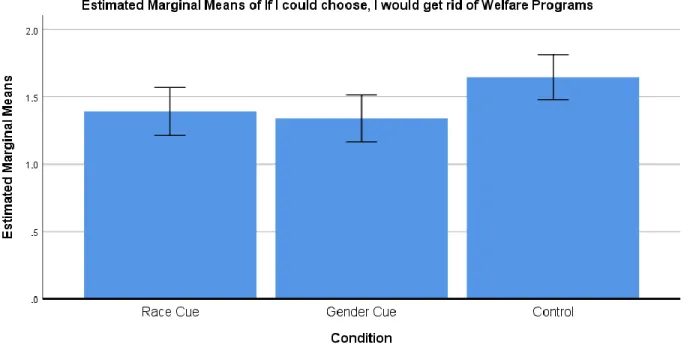
support for welfare suggested omnibus differences, F(2, 120) = 3.66 p = .029, p = .058. A
contrast indicated no significant difference between the gender and racial cue conditions but a significant difference between the race cue and control conditions and the gender cue and control conditions (see Table 2). Contrary to my prediction, participants in the control condition were significantly more likely to endorse the statement “If I could choose, I would get rid of welfare
programs” relative to those in the cue conditions (see Figure 3).
Study 1 Discussion
I hypothesized that if participants used their biases to develop an image of poverty, their perception of poverty and attitude/support for welfare programs would change for the worse. However, I saw that the opposite effect occurred in relation to support for welfare programs. This study was designed to understand the possibility of cues in two sub-sections; namely, the effect on perceptions of poverty and the effect on attitudes towards and support for welfare programs. For the effect on perceptions of poverty, I found no significant effect on the cueing of racial or gender bias on an individual’s perception of those in poverty. This is based on the two
poverty perception questions mentioned above. There was evidence to suggest that the cueing of racial and gender biases might be an effective way to increase support for welfare programs, however. Despite these mixed results, political ideology emerged as a strong underlying factor to be considered when examining perceptions of poverty and support for welfare programs. The bias cued individuals were more likely to disagree with the statement, demonstrating that bias plays a factor in support of welfare programs.
ALTERING PERCEPTIONS OF POVERTY AND WELFARE 15 Participants who self-identified as liberal were more likely to place less fault on, and
acknowledge the difficulties of those in poverty than those who identified as conservative.
Liberal participants showed a more positive attitude, and more support towards welfare then their counterparts. Moderate individuals fell in-between the two.
These results are consistent with previous research in two main ways. The first is that the analysis of the data showed that biases are still important factors that influence people’s
perception of poverty. This is consistent with Federico’s (2005) research on racial perceptions on
poverty, where he found that if participants were asked about a black man vs a man their perceptions changed. In this study participants bias was measured before undergoing the
treatment and it was observed that if participants previously possessed bias they were more likely to use that bias when in the cued condition. However, although my results showed that bias is a factor the effect of such bias in this study differs from what Federico observed. That experiment saw an increase in negative perceptions of people in poverty, while the current study showed an increase in support for welfare programs. These results may seem conflicting, but it is important to note that perceptions of poverty were measured differently in both studies. The present study is consistent with Orloff’s (1996) research on gender, who saw that individuals still saw single mothers as a big percentage of those on welfare as well as the group with the most need. The second is that while they are closely related, perceptions of poverty and support for welfare are distinct constructs (c.f. Smith, 2014). Individuals may be in favor of supporting welfare but still believe the poor are poor by choice (and vice versa). Perhaps most importantly of all, political ideology emerged as an important factor in understanding perceptions of poverty and
ALTERING PERCEPTIONS OF POVERTY AND WELFARE 16 Study 2 expanded on Study 1 by using the same questions but changing the experimental condition from using a bias cue to the use of a perspective-taking simulation. The use of the simulation allows the examination of a perspective taking effect on the same set of poverty and welfare questions while also considering political ideology.
Study 2 Methods
Participants
I recruited a convenience sample of 516 adults. Of those, 11 were removed due to incomplete responses leaving a sample of 505 (402 females, 98males, 4 transgender, 1 self-describing). A large percentage (84.4%) of the sample were college students. The mean age for the participants was 22.61 (SD = 8.94). In terms of racial identity, 301 identified as “White”, 47 identified as “Black or African American”, 81 identified as “Asian”, 40 identified as “Multi-racial” and 36 identified as “American Indian or Alaskan Native”, “Hispanic” or “Other". Participants’ socioeconomic status was skewed towards the lower class with most identifying as “Middle Class” (35.5%) followed by “Middle Class” (31.6%) and Lower Middle Class” (20.7%).
The majority of the participants self-identified as politically liberal (55.9%) followed by “Moderate” (36.8%) and “Conservative” (7.4%).
ALTERING PERCEPTIONS OF POVERTY AND WELFARE 17
Design
In line with Study 1, I utilized a between groups, posttest only experimental design. Participants completed one of two conditions, the simulation condition or the control. All participants self-reported perceptions of poverty and support for welfare programs. The independent variable was the participation in perspective taking. In the treatment condition, I operationalized this construct by asking the participants to undergo a simulation that takes form as a question-based journey through various situations an individual in poverty might experience.
Materials and Procedure
The survey was administered online through Qualtrics. All participants were presented with a research information sheet, informed of their risks, and informed that they could terminate their participation at any time, before they were asked for their consent. After consent was obtained, both groups were asked the same demographic and classification questions from Study 1. Participants in the simulation condition underwent the simulation and were asked a set of questions on their opinions, followed by a set of questions on their overall perspective on Welfare Programs (these questions were the same as in Study 1 as seen in Appendix
B).Participants in the control group proceeded directly to the opinions and overall perspective on Welfare Programs questions.
The simulation started out with the statement “Over 14 million Americans are
ALTERING PERCEPTIONS OF POVERTY AND WELFARE 18 in rent, transportation costs and distances from work. Another example is that the participant was notified that they had not done laundry in a while and they had to choose whether to go to the laundry mat and wash all the clothes, wash their child’s clothes, or have both themselves and
their child wear dirty clothes to save money. The program kept track of how much money the participant had based on the choices they made. The simulation was intentionally difficult but based on statistics of those in poverty. If the participant ran out of money, the simulation ended and they were presented with a statement asking the participant to imagine if they had to live like this for an extended amount of time. If the participant made it to the end of the simulation they were presented with a congratulatory message for surviving on the bare minimum.
The survey system kept track of how much money the participant had left subtracting and adding to the original $1000, when the participant reached an amount less than or equal to $0 the simulation part of the survey ended. The participants were periodically reminded of how much money they had remaining. After the simulation had ended the participants were asked how this effected their current views of poverty.
In the control condition the participants proceeded from the demographic questions to the attitude questions and did not receive the simulation. At the end of the study, participants were debriefed.
Study 2 Results
ALTERING PERCEPTIONS OF POVERTY AND WELFARE 19 when controlling for experimental condition, b = -0.17, SE = 0.05, p <.001, and b = -0.11, SE = 0.03, p <.001, respectively (R2
adjusted = .08). Higher levels of endorsement of the poverty items
were negatively associated with support for welfare. Including political ideology in the models resulted in a significant increase in R2, F(1,448) = 49.54, p <.001 (R2adjusted = .17).
Similar results were obtained when examining the single support for welfare item. Regression analysis suggested that each of the two perceptions of poverty items were associated with support for welfare when controlling for experimental condition, b = -0.31, SE = 0.06, p
<.001, and b = -0.12, SE = 0.04, p <.001, respectively (R2adjusted = .11). Including political
ideology in the models resulted in a significant increase in R2, F(1,448) = 34.18, p <.001 (R2adjusted = .17). These findings suggest that perceptions of poverty are important predictors of
attitudes/support for welfare. Moreover, political ideology is an important factor to consider when examining perceptions of poverty and attitudes/support for welfare (see Figures 4 and 5).
My primary hypothesis was that if participants completed a simulation demonstrating how difficult it is to live/get out of poverty, their perspective on poverty and welfare programs could be altered. To test whether mean levels of agreement differed between the simulation and control conditions, I conducted several ANOVAs, controlling for political ideology.2 Results indicated no difference between the simulation and control conditions in agreement of the statement “Do you think poor people are responsible for their own poverty?”, F(1,453) = 0.01, p
= .921,
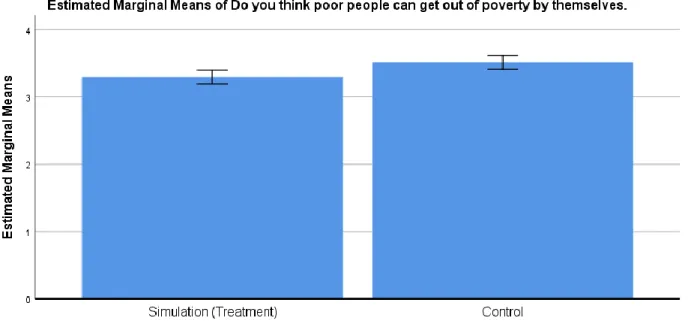
p = .00. There was, however, a significant difference between treatment and control on
the item “Do you think poor people can get out of poverty by themselves?”, F(1,453) = 5.35, p
=.003,
p = .019 (see Figure 6). Those in the treatment condition were less likely to think that
the poor could get out of poverty themselves (M = 3.30, SD = 0.85) compared to the control (M
ALTERING PERCEPTIONS OF POVERTY AND WELFARE 20
= 3.51, SD = 0.78). There were no significant differences on the Welfare Attitude scale,
F(1,454) = 0.11, p = .741, p = .00, or support for welfare, F(1,454) = 0.21, p =.645, p = .00.
Study 2 Discussion
The main hypothesis of this study was that perspective taking would reduce
individualistic perceptions on poverty and improve attitude/support for welfare programs. This experiment, like Study 1, was designed to divide this hypothesis into two sub-sections, the effect on view on poverty and the effect on views on welfare. For the effect on attitude on and support for welfare programs I found no effect of perspective taking on an individual’s view of welfare
programs. There were no significant differences between the control and experimental group based on the welfare attitude and welfare support measures (the same measures as in Study 1).
I did find a significant effect of the experimental condition on participants’ perception of poverty. The participants who underwent the simulation as a form of perspective taking were more likely to view poverty as an institutional problem. They understood that being in poverty was a difficult situation and that getting out of poverty is difficult to do without assistance from the outside. The secondary hypothesis of this study was the same as in Study 1, that different individual characteristic lead to a difference in view on poverty. I replicated the results found in Study 1, and determined that political ideology is a significant predictor of an individual’s view
on poverty when examining the three poverty measures. The same trends from conservative to moderate to liberal were seen on all four measures, the same as in Study 1.
ALTERING PERCEPTIONS OF POVERTY AND WELFARE 21 Specifically, perceptions towards those in poverty is improved with an increased understanding of the difficulties those in poverty face. When it comes to factors that influence perceptions of poverty there was a replicate pattern from Study 1, in which key demographic characteristics are correlated with perceptions and attitudes.
General Discussion
The studies presented were aimed at examining not only peoples’ perceptions of poverty and attitudes/support towards welfare, but also seeing if these viewpoints could be altered for the better and worse. As so many Americans rely on social welfare programs, attitudes toward those in poverty and support for welfare have strong policy implications (Soss & Schram, 2007). Two poverty measures and two welfare measures (one scale and a single-item measure of general support) were examined across two studies. In both studies, demographic factors were examined and analyzed for correlations. Moreover, the impact of cue and perspective taking were
examined in the two studies.
Study 1 demonstrated that if a participant’s view of poverty was directed towards a certain image, an image that triggers bias, then their opinions would be altered. An important aspect of this manipulation was to avoid having a participant shield their explicit bias by
ALTERING PERCEPTIONS OF POVERTY AND WELFARE 22 Study 1 results show that although participants in the gender or bias cued conditions generally showed that they had more positive attitudes and support towards welfare, there was no effect on perceptions of poverty. The greatest effect was on the support for welfare where those in the gender cue condition were significantly less likely to get rid of welfare programs than those in the control. Although the idea that bias affects one’s view on welfare is supported by previous research (Federico, 2005), being cued by gender bias (and to a lesser extent, racial bias) increased support for welfare. These findings appear inconsistent with Federico’s (2005) work. This leads me to believe that being cued into one’s bias increases the appearance of the necessity
of those programs. If a participant believe that a group is below them, or need more help than themselves, they may also realize a greater disparity for those groups.
Study 2 examined the impact of a simulation designed to get participants to assume the role of someone in poverty. To operationalize perspective taking I designed a simulation based on national statistics, and realistic scenarios. The goal was that by undergoing the simulation there would be an increase in empathy and understanding for individuals in poverty. The results show that when a participant underwent perspective taking that their understanding of the structural barriers that those in poverty face increased. For the question “Do you think poor
people can get out of poverty by themselves?” participants in my poverty simulation treatment were more likely to believe that they could not get out by themselves. However, I found almost no difference between the treatment and control condition on the poverty question “Do you think poor people are responsible for their own poverty” with most participants choosing either
“maybe” or “no”. This demonstrates that although perspective taking did affect the perceived
ALTERING PERCEPTIONS OF POVERTY AND WELFARE 23 This is reasonable because the simulation only had the participants make choices as if they were in poverty, and had no contextualization of how one gets into poverty.
Study 1 and Study 2 had a different pattern of results when it came to altering perceptions of poverty and support for welfare. The bias cue manipulation in Study 1 significantly affected attitudes towards welfare while the perspective taking manipulation in Study 2 affected
perceptions of poverty; neither study did both. It is plausible that the cueing in Study 1 impacted attitudes towards welfare programs and not perceptions of poverty because there might be more implicit bias involved in attitudes towards welfare, while for perceptions of poverty the bias is freely displayed. The manipulation may have magnified already held biases, rather than altering them. Therefore, if a person has more subconscious bias involved in the thought process behind keeping welfare programs, then this would explain the observed effect. It is important in future studies to examine the differentiation of mind that happens between perceptions of the poor and assistance to the poor.
In Study 2 it is easier to understand why there was only a significant effect of the manipulation for the perception of poverty measures. The simulation was meant to be an act of perspective taking, which decreases the perceived difference between two groups (Wand et al., 2013); in this case the participant and the poor. The simulation put the participants through an experience that reflected the difficulties of living in poverty, not the necessity of welfare programs. As such the results show only differences in the perceived difficulties of being in poverty.
ALTERING PERCEPTIONS OF POVERTY AND WELFARE 24 identified as liberal were more likely to see poverty as difficult to get out of, and less of the fault of the individual than those who identified as conservative. Conservatives were more likely to get rid of welfare programs and saw them as less positive programs than liberals. These are consistent with past analysis of political ideology that those who relate to a conservative
perspective put more weight on individual choices and actions and those who relate to the liberal perspective put more weight on institutional structures as it relates to poverty (Edelmen, 1977). The above findings indicate that both bias, and political ideology are factors when it comes to views on poverty and welfare. They also indicate that perspective taking is a way to increase understanding and empathy for those in poverty.
Limitations and Future Directions
There are some limitations to the research conducted. One limitation is the
operationalization of cueing individuals’ view of poverty based on bias in Study 1. Although I found that the treatment did have an effect, it is not certain if the cue changed the participant’s
ALTERING PERCEPTIONS OF POVERTY AND WELFARE 25 convenience, the majority of participants were female, college students in their 20’s which is not a representative sample.
Future research should be done to further determine the various factors that influence poverty and welfare program perceptions. I found that bias, political ideology, and empathy (triggered by perspective taking) are important factors. At the same time, opinions on this matter are complex and it is important to look at other variables. Additional factors that could be
examined in future research include participants’ zip codes to see if location has an effect on perception of poverty, participant or participant’s child participates in the national free and reduced lunch program, and employment status. It is necessary to determine the different factors that influence perceptions in order to educate the public on poverty and welfare programs
efficiently and effectively. An altogether different but equally important line of research should explore ways to lessen the race and gender biases as they pertain to welfare and government assistance programs. Perspective taking in this study was not used as way to reduce bias, but it would be relevant to see if procedures from the simulation conditions and bias cued conditions could be combined to see if perspective taking reduced the effect of the bias. Wider studies should be done on the use of perspective taking for the general population and see if similar results are observed.
Conclusion
The study of perceptions on poverty and welfare programs is important and relevant in today’s society. When these perceptions are negative and lacking a factual basis the
ALTERING PERCEPTIONS OF POVERTY AND WELFARE 27 References
Bullock, H. E. (2013). Women and poverty : Psychology, public policy, and social justice. Retrieved from https://ebookcentral-proquest-com.libproxy.lib.unc.edu, 46-50. Cammett, A. (2014). Deadbeat dads & welfare queens: How metaphor shapes poverty law.
Boston College Journal of Law & Social Science, 34. 233-265.
Chapman, C., Laird, J., Ifill, N., & KewalRamani, A. (2011). Trends in high school dropout and completion rates in the United States: 1972-2009. (NCES 2012-06). Washington, D.C.: National Center for Education Statistics, Institute of Education Sciences, U.S.
Department of Education. http://nces.ed.gov/pubsearch/pubsinfo.asp?pubid=2012006 Chung, A.H. & Slater, M.D. (2013), Reducing Stigma and Out-Group Distinctions Through
Perspective-Taking in Narratives. Journal of Communication, 63: 894-911. doi:10.1111/jcom.12050
Di Tore, P. (2014). Perception of space, empathy and cognitive processes: Design of a video game for the measurement of perspective taking skills. International Journal of Emerging Technologies In Learning (IJET), 9(7), pp. 23-29.
doi:http://dx.doi.org.libproxy.lib.unc.edu/10.3991/ijet.v9i7.3718
Dishon, Gideon & Kafai, Yasmin B. (2020). Making more of games: Cultivating perspective taking through game design. Computers & Education, Volume 148.
https://doi.org/10.1016/j.compedu.2020.103810.
ALTERING PERCEPTIONS OF POVERTY AND WELFARE 28 Edelman, Murray. (1977). Political Language: Words That Succeed and Policies That Fail. New
York: Academic Press.
Gilens, M. (1999). Why Americans hate welfare: Race, media, and the politics of antipoverty policy. Chicago. University of Chicago Press, p. 92.
Groskind, F. (1994). Ideological Influences on Public Support for Assistance to Poor Families. Social Work, 39(1), 81–89.
Gupta, A. (2015). Poverty and shame - messages for social work. Critical and Radical Social Work, 3(1), 131-139.
doi:http://dx.doi.org.libproxy.lib.unc.edu/10.1332/204986015X14212365837689
Gutierrez, B., Kaatz, A., Chu, S., Ramirez, D., Samson-Samuel, C., & Carnes, M. (2014). "fair play": A videogame designed to address implicit race bias through active perspective taking. Games for Health Journal, 3(6), 371-378. doi:10.1089/g4h.2013.0071
Federico, C. (2005). Racial Perceptions and Evaluative Responses to Welfare: Does Education Attenuate Race-of-Target Effects? Political Psychology,26(5), 683-697.
Lakasing E. (2015). The concept of the 'undeserving poor': pejorative stereotypes and worsening inequalities undermine welfare reform. The British journal of general practice : the journal of the Royal College of General Practitioners, 65(641), 652.
doi:10.3399/bjgp15X687925
Michels, H. (2013). The 'Underclass' Debate – A Discourse that Maligns People Living in Poverty. Social Change Review, 11(1), pp. 45-57.
ALTERING PERCEPTIONS OF POVERTY AND WELFARE 29 Müller, P., & Scherr, S. (2017). Reducing the Bias: How Perspective Taking Affects First- and
Third-Person Perceptions of Media Influence. Communication Research Reports, 34(2), 134-142. doi: 10.1080/08824096.2017.1280453
Olgstad, K. (2016). Knowledge and Perceptions about Welfare and Welfare Recipients among Minnesota Millennials (MSW Clinical Research Paper). St. Catherine University and the University of St. Thomas St. Paul, Minnesota.
Orloff, A. (1996). Gender in the Welfare State. Annual Review of Sociology,22, 51-78. http://www.jstor.org/stable/2083424
Princeton Survey Research Association International (PSRAI) (2016). Poverty Survey Attitudes toward the Poor, Poverty, and Welfare in the United States. http://www.aei.org/wp-content/uploads/2016/08/2016-Poverty-Survey_AEI_Los-Angeles-Times_Topline.pdf Puentes, R. (2008). Commuting to opportunity: The working poor and commuting in the united
states. Washington: The Brookings Institution. Retrieved from ProQuest Central
http://libproxy.lib.unc.edu/login?url=https://search-proquest-com.libproxy.lib.unc.edu/docview/1793350673?accountid=14244
Roussos, G., & Dovidio, J. F. (2016). Playing below the poverty line: Investigating an online game as a way to reduce prejudice toward the poor. Cyberpsychology:Journal of Psychosocial Research on Cyberspace, 10(2), article 3.
http://dx.doi.org/10.5817/CP2016-2-3
ALTERING PERCEPTIONS OF POVERTY AND WELFARE 30 Shildrick, T., & MacDonald, R. (2013). Poverty Talk: How People Experiencing Poverty Deny
Their Poverty and Why They Blame ‘The Poor.’ The Sociological Review, 61(2), 285–
303. https://doi.org/10.1111/1467-954X.12018
Smith, T.W., Davern, M., Freese, J., and Hout, M. (2014). General Social Surveys [machine-readable data file] / Sponsored by National Science Foundation. --NORC ed.-- Chicago: NORC, 2018: NORC at the University of Chicago [producer and distributor]. Data accessed from the GSS Data
Soss, J., & Schram, S. (2007). A Public Transformed? Welfare Reform as Policy Feedback.
American Political Science Review, 101(1), 111-127. doi:10.1017/S0003055407070049 Thomas, Susan (1997) Women, welfare, reform and the preservation of a myth. The Social
Science Journal, 34:3, 351-368, DOI: 10.1016/S0362-3319(97)90034-3
U.S. Census Bureau (2015). 21.3% of US Participates in Government Assistance Programs Each Month. https://www.census.gov/newsroom/press-releases/2015/cb15-97.html
http://www.umdurham.org/assets/files/pdf/SPENT1mmRelease_FINAL.pdf
Walker, R. (2014). Constructions of Shame. The Shame Of Poverty, 32-52. doi: 10.1093/acprof:oso/9780199684823.003.0003
Wang, C. S., Ku, G., Tai, K., & Galinsky, A. D. (2013). Stupid doctors and smart construction workers: Perspective-taking reduces stereotyping of both negative and positive
ALTERING PERCEPTIONS OF POVERTY AND WELFARE 31 Table 1
Perceptions of Poverty Variables, Attitudes Towards Welfare Variables, and Demographic Variables: Correlations and Descriptive Statistics (Study 1)
Variables 1 2 3 4 5 6 7 8 9 10
1. Age -
2. Sex -.030 -
3. Race -.067 -.134 -
4. Education level .496*** .117 -.195* -
5. Political ideology -.271** .119 .127 .110 -
6. Socio-economic status -.046 .060 -.088 .015 -.001 -
7. Do you think poor
people are responsible
for their own poverty?
-.159 .189* -.082 .197* .527*** .139 -
8. Do you think poor
people can get out of
poverty by themselves.
-.003 .222* -.051 .270** .448*** .162 .434*** -
9. Welfare Attitude .103 -.179* .127 -.213* -.468*** -.054 -.458*** -.448*** -
10. Welfare Support .030 -.135 .075 -.182* -.417** -.025 -.477** -.402** .574** -
***. Correlation is significant at the 0.001 level (2-tailed). **. Correlation is significant at the 0.01 level (2-tailed). *. Correlation is significant at the 0.05 level (2-tailed).
Variables 1 2 3 4 5 6 7 8 9 10
Mean 25.86 1.87 1.88 4.83 2.36 2.89 2.49 3.51 1.85 1.46
Std.
Deviation
10.42 .40 1.39 1.74 .71 1.03 .58 .90 .53 .62
ALTERING PERCEPTIONS OF POVERTY AND WELFARE 32
Table 2
Rank the following statements on whether you agree or disagree. - If I could choose, I would get
rid of Welfare Programs (lower numbers = more agreement)
Condition Mean Std. Deviation N
Race Cue 1.39 .679 38
Gender Cue 1.30 .516 40
Control 1.68 .601 44
Total 1.47 .619 122
Contrast Results (K Matrix)
Condition Simple Contrasta
Dependent
Variable
Level 1 vs. Level 3 Contrast Estimate -.255
Hypothesized Value 0
Difference (Estimate - Hypothesized) -.255
Std. Error .123
Sig. .040
95% Confidence Interval for
Difference
Lower Bound -.498
Upper Bound -.012
Level 2 vs. Level 3 Contrast Estimate -.305
Hypothesized Value 0
Difference (Estimate - Hypothesized) -.305
Std. Error .122
Sig. .014
95% Confidence Interval for
Difference
Lower Bound -.547
Upper Bound -.064
ALTERING PERCEPTIONS OF POVERTY AND WELFARE 33 Table 3
Perceptions of Poverty Variables, Attitudes Towards Welfare Variables, and Demographic Variables: Correlations and Descriptive Statistics (Study 2)
Variables 1 2 3 4 5 6 7 8 9 10
1. Age -
2. Sex .013 -
3. Race .020 -.032 -
4. Education level .054 -.058 -.131** -
5. Political ideology -.034 .052 .022 .108* -
6. Socio-economic status -.048 -.093* -.236*** .055 -.090* -
7. Do you think poor
people are responsible
for their own poverty?
-.042 .159*** -.027 .072 .374*** -.103* -
8. Do you think poor
people can get out of
poverty by themselves.
.042 .179*** -.072 .082 .307*** -.087 .394*** -
9. Welfare Attitude -.086 -.071 .027 -.186*** -.397*** .086 -.246*** -.2.38*** -
10. Welfare Support -.053 -.064 .043 -.175*** -.372*** .117* -.313*** -.240*** .604*** -
***. Correlation is significant at the 0.001 level (2-tailed). **. Correlation is significant at the 0.01 level (2-tailed). *. Correlation is significant at the 0.05 level (2-tailed).
Variables 1 2 3 4 5 6 7 8 9 10
Mean 26.66 1.82 1.94 4.43 2.48 3.11 2.55 3.40 1.78 1.52
Std.
Deviation
90.98 .42 1.31 1.24 .63 1.02 .54 .83 .52 .65
ALTERING PERCEPTIONS OF POVERTY AND WELFARE 34
ALTERING PERCEPTIONS OF POVERTY AND WELFARE 35
ALTERING PERCEPTIONS OF POVERTY AND WELFARE 36
ALTERING PERCEPTIONS OF POVERTY AND WELFARE 37
ALTERING PERCEPTIONS OF POVERTY AND WELFARE 38
ALTERING PERCEPTIONS OF POVERTY AND WELFARE 39
ALTERING PERCEPTIONS OF POVERTY AND WELFARE 40 Appendix A
ALTERING PERCEPTIONS OF POVERTY AND WELFARE 43 Appendix B