Cover Page
The handle http://hdl.handle.net/1887/67115 holds various files of this Leiden University dissertation.
Author: Lukac, M.
Title: Grassroots prescriptivism
Published by
LOT phone: +31 30 253 6111
Trans 10
3512 JK Utrecht e-mail: [email protected]
The Netherlands http://www.lotschool.nl
ISBN: 978-94-6093-301-1 NUR 616
Grassroots Prescriptivism
Proefschrift
ter verkrijging van
de graad van Doctor aan de Universiteit Leiden, op gezag van Rector Magnificus prof.mr. C.J.J.M. Stolker,
volgens besluit van het College voor Promoties te verdedigen op donderdag 22 november 2018
klokke 15.00 uur
door
Morana Lukač
Prof. dr. C. Mair (Albert-Ludwigs-Universität Freiburg)
Promotiecommissie Prof. dr. M. Hannay (Vrije Universiteit Amsterdam)
Prof. dr. H. de Hoop (Radboud Universiteit) Prof. dr. J.C. de Jong (Universiteit Leiden) Dr. S. Moody (Universiteit Leiden)
Table of contents
Acknowledgments ... V Abbreviations ... VII
1. Introduction ... 1
1.1. Grammar vigilantes ... 1
1.2. The end of prescriptivism? ... 6
1.3. For how long has the language been in decay? ... 9
1.4. Thesis outline ... 19
2. Grassroots prescriptivism: An analysis of individual speakers’ efforts at maintaining the standard language ideology ... 25
2.1. Introduction ... 25
2.2. Who complains about language use? ... 27
2.2.1 Letters to newspaper editors ... 29
2.2.2 The survey ... 34
2.3. Which linguistic features are stigmatised in public discussions on usage? ... 37
2.3.1. Comparing The Times and The New York Times ... 37
2.3.2. The survey ... 41
2.4. Conclusion ... 42
3. Linguistic prescriptivism in letters to the editor ... 45
3.1. Introduction ... 45
3.2. The ‘misused’ possessive apostrophe ... 46
3.3. Data ... 48
3.4. Semantic analysis ... 51
3.4.1. Key words and key semantic domains ... 51
3.4.2. Key word analysis ... 53
3.4.3. Key semantic domains ... 55
3.5. Conclusion ... 66
4. From usage guides to language blogs ... 69
4.1. Introduction ... 69
4.2. The popularity of grammar blogs ... 73
4.3. Grammar Girl as a usage guide 2.0... 75
4.4. Comments on the Grammar Girl website ... 81
4.4.1. The commenters’ identity construction ... 82
4.4.2. Types of comments ... 87
4.4.4 Repetitive narratives and humour in metalinguistic
discourses ... 96
4.5 Conclusion ... 98
5 From usage guides to Wikipedia: Re-contextualising the discourse on language use ... 101
5.1 Introduction: Expert discourses on language use ... 101
5.2 The usage guide as a genre ... 105
5.3 The history of collaboration in knowledge creation: From the OED to Wikis ... 107
5.4 Wikipedia: The online collaborative encyclopaedia community ... 109
5.4.1 Related work ... 111
5.4.2 The structure of Wikipedia entries and Talk pages .. 112
5.5 Analysing Wikipedia entries on language use ... 116
5.5.1 The editors ... 118
5.5.2 Wikipedia entries on usage items ... 121
5.5.3 Corpus-based comparison of Wikipedia entries and usage guides ... 123
5.5.4 Comparing Wikipedia Talk pages and entries on usage items ... 129
5.6 Conclusion ... 133
6. What is the difference between thus and thusly? ... 137
6.1. Introduction ... 137
6.2. The prescriptivists ... 139
6.3. The general public ... 143
6.3.1. The survey ... 143
6.3.2. Acceptability of thusly ... 145
6.3.3. Differences among demographic groups ... 147
6.4. Actual usage ... 150
6.4.1. Genre differences in the usage of thus and thusly ... 150
6.4.2. Differences in meaning between thus and thusly .... 154
6.4.3. Verbs modified by thus and thusly ... 156
6.5. Conclusion ... 159
7. Conclusion ... 161
7.1. Revisiting the concept of grassroots prescriptivism ... 161
7.2. Bridging the gap ... 163
7.3. Changing prescriptivism ... 166
7.5. Moving forward ... 172
Appendix A: English Today features ... 175
Apostrophe(’)s, who needs them? ... 175
Grammar Advice in the Age of Web 2.0: Introducing the new (and keeping the old) language authorities ... 178
Appendix B: Bridging the Unbridgeable blog entries ... 183
Jafaican: ‘Ali G would understand it perfectly’ ... 183
Out with whom, in with the split infinitive ... 184
David Crystal and the history of English spelling, or how the Internet is killing off silent letters ... 187
The history of txt spk and Queen Victoria ... 188
Who’s to blame for literacy levels in England and Northern Ireland ... 190
‘Could care less’ or ‘couldn’t care less’ ... 192
Censoring the ‘G-word’ ... 194
Railway station or train station? ... 196
The future of English ... 198
#Fundilymundily the language of the UK general election 2015 200 Murphy’s Law and other mistakes prescriptivists make ... 202
Migrants: the language crisis ... 204
Adding the Mx: Gender-neutral titles and pronouns ... 207
The descriptive backlash ... 209
Can your local accent hold you back? ... 210
Appendix C: Flat adverbs survey ... 213
Appendix D: List of newspaper sources for the Letters corpus ... 217
References ... 219
Samenvatting ... 241
Acknowledgments
I would like to thank the many people who have helped me write this thesis. Firstly, I would like to thank my supervisor for providing me with the opportunity to take part in the Bridging the Unbridgeable project, and for her advice and guidance. I would like to thank the members of project for the useful discussions throughout the years. I am indebted to Robin Straaijer, Robert Gutounig, Tony Parr, the members of the committee, and the anonymous reviewers of the stud-ies included in this thesis for reading some or all of its chapters. Each commented in their distinctive way and provided useful feedback. For her editing the Dutch summary of this thesis written by Robin Straaijer, I thank Renée Dekker. Professor Christian Mair gave me valuable advice in crucial stages of the work and helped me make the most of my stay at the University of Freiburg. All of them have my thanks and have helped to make this a better book than would have otherwise been the case.
I would like to thank Bobby Ruijgrok and Chris Engberts for sharing the PhD experience with me. I am also thankful to Mignon Fogarty, survey participants, and journalists for their answers to my questions and for providing me with the data without which this thesis would not have been possible.
Abbreviations
AE06 AHD AP APA BBC BE06 BLOB BNC COCA COHA CMC FLOB GG GloWbE HUGE LE LL LLOCE LOB NPOV NYC MLA NS NNS PMW POS MEU OED ODO TEDThe American English 2006 Corpus
American Heritage Dictionary
Associated Press
The American Psychological Association British Broadcasting Corporation
The British English 2006 Corpus Before Lancaster-Oslo/Bergen Corpus British National Corpus
Corpus of Contemporary American English Corpus of Historical American English Computer-mediated communication
The Freiburg-Lancaster-Oslo/Bergen Corpus
Grammar Girl
The corpus of Global Web-based English Hyper Usage Guide of English
Letters to the editor Log likelihood
Longman Lexicon of Contemporary English
Lancaster-Oslo/Bergen Corpus Neutral Point of View
The New York Times
Modern Language Association Native speaker of English Non-native speaker of English (Frequency) per million words Part of speech
Modern English Usage Oxford English Dictionary Oxford Dictionaries Online
1
Introduction
1.1 Grammar vigilantes
‘For years I’ve heard rumours that here in Bristol someone has been
skulking around the streets late at night correcting poor punctuation on
shop fronts and signs. Now I always thought it was just an urban myth,
but then I heard from a friend of a friend who said it was true.’ This is
an introduction to the BBC Radio 4 programme ‘The Apostrophiser’
(Ledgard, 2017) about a self-proclaimed grammar vigilante who
gar-nered much media attention in 2017 for his mission to purge the streets
of Bristol of errant apostrophes (e.g. Kentish, 2017). The so-called
Banksy of punctuation (Morris, 2017), however, is hardly a unique case
of public linguistic censorship enforced by a layperson. Inspired by the
success of Lynne Truss’s bestselling prescriptive guide to punctuation,
Eats, Shoots & Leaves (2004), Jeff Deck and Benjamin Herson created
the Typo Eradication Advancement League and travelled around the US
armed with markers and correction fluid righting the spelling and
punc-tuation errors displayed in public spaces (cf. §3.2; Beal, 2009).
Since the web created a new public platform for both debate and
publishing, it is unsurprising that the efforts to clean up and preserve
the language have continued unfolding in digital form. Thus, in 2015, a
Wikipedia editor, Bryan Henderson, removed 47,000 instances of the
of its redundancy (Shariatmadari, 2015). Henderson claims that
‘com-prised of’ is a conflation of ‘com‘com-prised’ and ‘composed of’, and the
more appropriate alternative is ‘consist of’. According to the myriad
reports on the matter, grammar activism is widespread, and it is not
only displayed through the public corrections of disputed items of
lan-guage use. Attitudes and activities of the self-styled linguistic censors
can also be traced through letters to the editors of newspapers that
con-tain criticisms of usage features deemed problematical or nonstandard.
Letters containing complaints regarding usage are arguably as old as the
letter-to-the-editor genre itself. The dates of publication of such letters
correspond to the earliest found in online newspaper databases, such as
the ProquestHistorical Newspaper Database, of which the following—
criticising non-standard syntactic constructions found in American
Eng-lish—is an example:
(1) I read with interest an article in your Times of to-day on the pho-nology and orthography of our language. Will not your corre-spondent give our young and old men, our children and old wom-en some scathing remarks that shall cause them to eschew ‘I done’, ‘I come to town’, ‘I seen’, ‘I hadn’t ought, had I?’ and a longer list, which I spare you, of syntax so abominable that the young ladies of ‘the family’, strange to say, blush when the un-grammatical member’s mouth is opened. (‘Solecisms of speech’,
New York Times, 27 August 1876)
Prescriptive practices, as Cameron has already pointed out (1995,
p. 2), are fundamental to language use. And, as Burridge puts it, they
‘belong to our tabooing behaviour generally’ and are part of, she
claims, a wider ‘human struggle to control unruly nature’ (2010, p. 3).
to newspapers, radio phone-ins, online discussions, and even on
Twit-ter, that are central to this thesis. Instead of focussing on formal acts of
censorship that are carried out institutionally by language planning
boards, governmental committees, and agencies, the present thesis
sheds light on the attempts of lay people to identify and eradicate
per-ceived linguistic mistakes, which are here dubbed ‘grassroots
prescrip-tivism’.
Before going on to describe the contents of my work, I would like
to clarify several points and elaborate on the context in which the
stud-ies presented in the following chapters were conducted. My views on
popular perceptions of language were shaped by investigations into
letter-to-the-editor sections of newspapers across the English-speaking
world (cf. Chapters 2 and 3); interviews with British journalists who
were either in charge of their media institution’s stylistic guidelines or
were in constant contact with their audience concerning matters relating
to language at the time this study was conducted (§2.3); online surveys
devised to test the attitudes of the general public on usage (§2.4, §2.5.2,
§6.3); and an analysis of online usage discussions found in a grammar
blog (Chapter 4) and on Wikipedia (Chapter 5). Public views on
lan-guage have also been brought into relation with actual usage based on
patterns identified in state-of-the-art corpora—such as the Corpus of
Contemporary American English (Davies, 2008–) (Chapter 6)—and the
prescriptive advice found in both traditional, print usage guides (§5.2,
§6.2), and their online equivalents (Chapters 4 and 5).
It is these three perspectives on language use, that of the general
ex-plored within the research project ‘Bridging the Unbridgeable:
Lin-guists, Prescriptivists and the General Public’ (2011–2016) led by
Pro-fessor Ingrid Tieken-Boon van Ostade of which this study is part. In the
attempts of bridging gaps among the three communities, I have reached
out to the general public by engaging in discussions on the topics
relat-ing to prescriptivism, which is somethrelat-ing that had rarely been done
be-fore this project began. I have also solicited responses from the public
to questions pertaining to the acceptability of different usage features.
Much of this communication was conducted through blog posts on our
website (https://bridgingtheunbridgeable.com/) and articles featured in
the English Today journal from the first issue of 2014 until the last one
published in 2016. Considering the relevance placed on interaction
within the course of my investigation, I have chosen to include
exam-ples of it in the form of my own English Today articles (Appendix A)
and blog posts (Appendix B) in this thesis. These pieces exemplify an
interactive and crowdsourcing methodological approach in linguistics,
widely separated from the pronouncements of what Cameron refers to
as ‘the finger-wagging tradition’ (1995, p. 3), in which speakers are
seen as separate from the language they use, and their attitudes and
per-ceptions relating to usage as irrelevant and possibly harmful.
It is worth noting that this study is embedded in a larger research
agenda whose remarkable development I have been able to observe
since I started conducting my investigation, and which I will here
out-line only briefly. In 2012, the field saw new editions of two
ground-breaking classical works, Milroy and Milroy’s Authority in Language
comprehen-sive accounts of prescriptivism, such as Curzan’s Fixing English
(2014), have appeared in print as well. Moreover, in spite of the
recur-ring pronouncements that ‘linguists have [just] not been good about
informing the general public about language’ (Bauer & Trudgill, 1998,
p. xv), a number of linguists have recently been communicating their
thoughts on usage and prescriptivism through blogs (Language Log,
http://languagelog.ldc.upenn.edu/nll/), TED talks (McWhorter, 2013;
Curzan, 2014), podcasts (Slate’s Lexicon Valley, http://www.slate.com/
articles/podcasts/lexicon_valley.html), and even guest appearances on
late night television (The Late Show with Stephen Colbert, 2018).
Re-search projects on language standardisation have proliferated, a prime
example of which is the Europe-wide network Standard Language
Ide-ology in Contemporary Europe (SLICE). Studies on prescriptivism and
its various aspects are continuing to appear in growing numbers in print
and they are presented at conferences. (Five conferences on
prescrip-tivism have been organised so far.1) Researchers are beginning to
an-swer some of the fundamental questions relating to prescriptivism, the
most prominent among which is: What is its effect on language change?
(e.g. Auer & González-Díaz, 2005; Poplack & Dion, 2009; Anderwald,
2011; Hinrichs, Szmercsanyi, & Bohmann, 2015).
The five case studies presented here are the result of writing my
way into an explanation of grassroots prescriptivism, which comprises
yet another factor in this complex field. In doing so, I relied on both the
methodology and theoretical insights stemming primarily from
1 The conferences were organised in Sheffield (2003), Ragusa (2006), Toronto (2009),
linguistics, more specifically, its strands investigating language
atti-tudes, language change, as well as computer-mediated communication,
and corpus linguistics, for the purposes of key word and key semantic
analysis, as well as the presentation of frequency-related observations
of linguistic variation and change. I will return to these in describing the
work’s outline at the end of this introduction.
1.2The end of prescriptivism?
Two contradictory views seem to coexist among linguists pertaining to
the current developments and the future of prescriptivism, one of which
argues for its apparent demise, and another for linguistic censorship
being as vital as ever before. David Crystal, in his chapter ‘Into the
twenty-first century’ in Mugglestone’s The Oxford History of the
Eng-lish Language (2006, p. 408), advocates the former:
During the latter part of the twentieth century, a noticeable trend towards a more egalitarian society began to reduce the severity of social-class distinctions, recognise the value of diversity, safe-guard the rights of minorities, and revitalise demotic values. The immediate linguistic effect was a move away from the prescriptive ethos of the past 250 years […] and it brought the introduction of new educational paradigms of language study.
Other linguists have also observed the parallelism between the relaxing
social norms and those relating to language use and attitudes. In his
1997 chapter ‘Parallel Corpora’ in Corpus-Based Studies in English,
Christian Mair offered social explanations for the diachronic frequency
changes he observed in the four parallel corpora of the Brown family,
Brown (US, 1961), Frown (US, 1992), LOB (GB, 1961), and FLOB
de-noting a tendency for written norms to become more informal and
clos-er to the spoken language.2 The term has been taken up many times
since then to account for the increase in the use of, to name only a few
examples, contractions of negatives (not to n’t) and verb forms (it’s,
we’ll) (e.g., Leech et al., 2009, p. 240), the growth of the progressive in
writing (e.g., Levin, 2013, p. 215), as well as zero-relative clauses, and
get-passives (e.g., Mair, 2006, p. 189) (cf. Appendix B, ‘Out with
whom, in with split infinitives’). I also observed linguistic norms
seem-ingly loosening in my effort to keep records of the changing guidelines
among informal authorities in the English language over the past five
years. As of April 2012, the Associated Press allows for the usage of
hopefully as a sentence adverbial, and, as of March 2014, the same
source accepts over to indicate greater numerical value instead of more
than. The Washington Post made headlines across the world in
Decem-ber 2015 when it accepted the usage of the often-disputed singular
they,3 as well as the spelling email, website, mic, and Walmart, in place
of the earlier variants e-mail, Web site, mike, and Wal-Mart.
The growing informality of language is not the only indicator of
changes, but so are the attitudes towards perceived standards. ‘Talking
proper’—a phenomenon which Mugglestone traces back to late
eight-eenth-century London (2007, pp. 279–80)—has been replaced with the
notion of ‘talking posh’. The superior status of the standard is now
chal-lenged as well (Coupland, 2010, pp. 137–38) by the majority of those
2 Biber and Finegan (1989, p. 515) preceded Mair’s observation by a decade in noting
that ‘[t]he development of a popular literacy fostered a shift towards more oral styles’.
3 Singular they was the winner of the American Dialect Society’s annual word of the
who are not born into it. It has also been suggested, and largely
accept-ed, that we are currently witnessing a kind of norm-levelling,
destand-ardisation, or the democratisation of the standard through which
non-standard variants are incorporated and absorbed (Coupland, 2010, p.
145; Coupland & Kristiansen, 2011, pp. 11–35; Armstrong &
Macken-zie, 2013, pp. 161–207). In spite, however, of what we may expect at a
time when many are arguing against discrimination and for equality of
all groups of people, linguistic prejudices are still largely accepted
(Burridge, 2010, p. 4). New generations of ‘language mavens’,
‘ped-ants’, and ‘wordwatchers’ (Millar, 1998, pp. 177–8) seem to be
reiterat-ing much of the older pronouncements in support of the standard
lan-guage ideology. Severin, for instance, has shown in her sociolinguistic
study of young Australians’ attitudes towards disputed items of usage
that, in spite of their greater awareness of the social factors governing
usage, prescriptive attitudes and scrutiny remain among this group of
speakers (2017, p. 79). A British example of a young person acting as a
grassroots prescriptivist is included in the Albert Gifford story in
Chap-ter 2.
The prescriptive backlash is also evident in the rising number and
popularity of usage guides across the English-speaking world
(Tieken-Boon van Ostade, in progress). These publications have not as a matter
of course become more lenient in their approach since appearing as a
separate genre in the eighteenth century (Tieken-Boon van Ostade &
Ebner, 2017). Recent examples of usage guides that, contrary to
ling-uistic evidence in favour of the features’ spread and acceptability,
ad-verbial, or spelling alright as one instead of two words (all right), are
Simon Heffer’s Strictly English (2010), and Caroline Taggart’s Her
Ladyship's Guide to the Queen's English (2010). Bryan Garner is
per-haps the best-known American answer to the current legacy of the
pre-scriptive usage guide tradition. In spite of referring to himself as a
‘pre-scriptive descriptivist’ (Hingston, 2012) and making use of corpus
lin-guistic tools in the newest edition of Garner’s Modern English Usage
(2016), he continues, in many instances, to make prescriptive ipse dixit
judgements on language in disseminating usage advice (cf. §5.5.4, §6.1,
and §6.5). Finally, this study too would not have been possible without
relying on the plethora of language commentary that can be found in all
types of media outlets, from newspapers (Chapters 2 and 3), and blog
comments (Chapter 4), to discussions on Wikipedia’s Talk pages
(Chapter 5). As these accounts jointly demonstrate that grassroots
pre-scriptivism, and not only the more institutionalised forms of linguistic
censorship, is alive and well in the twenty-first century.
1.3For how long has the language been in decay?
The short answer to this question is: probably since speakers were
aware of any norms being attached to language use. A more detailed
answer requires a closer look at the scholarship on the topic of
grass-roots prescriptivism. The most notable attempt to devise a theoretical
account of popular commentary on what is perceived as incorrect usage
was made by Milroy and Milroy in the first edition of their book
Au-thority in Language (1985). The two authors introduced the concept of
about so-called misuse of language and linguistic decline, [which] has
altered little since the eighteenth century’ (Milroy & Milroy, 2012, p.
vii). In their seven-stage standardisation model, they place the
com-plaint tradition in the final stage of the process of standardisation, i.e.
prescription, which follows the selection of a variety, its acceptance by
influential social groups, geographical and social diffusion,
mainte-nance, elaboration of function, and codification (2012, p. 22). Their
model explains well the perpetuating nature of popular linguistic
com-plaints. Although Milroy and Milroy’s standardisation model builds on
the one introduced by Haugen (1966; 1987), which is arguably the most
commonly applied model among linguists, it differs from it in a
funda-mental way. Whereas Haugen views standardisation as a teleological
phenomenon that reaches its final point when the standard variety is
fully established, the Milroys see it is a ‘process which—to a greater or
lesser degree—is always in progress in those languages that undergo it’
(2012, p. 19). Moreover, Haugen’s model lacks a prescription stage
(Tieken-Boon van Ostade, 2012), which is relevant for the topic dealt
with in this collection.
In describing the complaint tradition, Milroy and Milroy
intro-duced a simple typology and distinguished between the so-called
legal-istic and morallegal-istic complaints.4 The authors define legalistic
com-plaints as ‘concerned with correctness [and the] “mis-use” of specific
parts of phonology, grammar, vocabulary of English’ (2012, p. 31). An
4 A newer, fourfold typology of prescriptivism was introduced by Curzan (2014),
example of such a complaint from the data collected for my analysis is
the following comment from the New York Times on the usage of the
euphemism extraordinary rendition. At the time the letter was written,
debates took place in the US regarding the transfer of people from one
country another for interrogation under torture, which is what the said
euphemism denotes.
(2) How can this country maintain that it is a true democracy and the moral leader of the world yet permit atrocities under its program of ‘extraordinary rendition’? (2 March 2005)
The moralistic complaints, towards which the authors are more
sympa-thetic, ‘recommend clarity in writing and attack what appear to be
abus-es of language that may mislead and confuse the public’ (2012, p. 31).
They are anticipated in Jonathan Swift’s A Proposal for Correcting,
Improving and Ascertaining the English Tongue (1712), and perhaps
best exemplified in the still often-cited essay written by George Orwell
Politics and the English Language (1946). A more recent example
comes from the following letter to the New York Times, whose author
brings to the editor’s attention the usage of the term partner instead of
spouse in reference to same-sex married couples:
(3) If Gary Sullivan and Mark Young married in 2005, why do you refer to Mr. Young as Mr. Sullivan’s ‘partner’ rather than his spouse? Using the former term tends to suggest that married same-sex couples are somehow less married than their different-sex counterparts, whom you would never call ‘partners’. (4 May 2007)
pub-lic consciousness of the standard [and a belief] that there is a “right” way of using English’ (2012, p. 25). What example (3) demonstrates, however, is that prescriptive rhetoric can also be harnessed for political-ly responsive purposes (cf. Curzan, 2014, p. 24). More recent examples of discussions relating to moralistic complaints see are included in Ap-pendix B in the blog posts entitled ‘Censoring the G-word’ and ‘Mi-grants: the language crisis’.
Previous research on the topic has covered popular linguistic
complaints and comments appearing from the eighteenth century
on-wards. These earliest records of public prescriptive efforts were
ana-lysed by Carol Percy, who set up and anaana-lysed a database of book
re-views in two eighteenth-century periodicals, the Monthly Review and
the Critical Review published at the time (the database itself is still
available online, http://projects.chass.utoronto.ca/reviews/) Percy’s
analysis (2008; 2009) yielded many valuable insights into the period in
which language seemingly became an objective index of the quality of
the book under review. Through the lens of the current analysis, the
book reviewers are considered to be the earliest among the grassroots
prescriptivists. They pointed out instances of non-standard usage to the
readers, and such usage was interpreted as an index of the author’s level
of education, social background, and professional competence (Percy,
2010, p. 59). On the market in which high social capital was beginning
to be attached to good grammar, reviewers became self-appointed
lan-guage educators and entertainers of their readers by critically judging
contemporary literature. Reviewers appropriated the ideology of
legitimacy through the book review genre, which was just beginning to
develop. Percy’s is the first historical sociolinguistic overview of
com-plaints in print media. Comcom-plaints dating from the twentieth century
onwards are taken up elsewhere for analysis.
There are two trajectories of research among the studies that
sys-tematically account for linguistic complaints, those that seek to examine
linguistic complaints by providing overviews of the problematical
us-age features and those that do so with the aim of analysing
metalinguis-tic discourses. The studies conducted by Algeo (1985) and Crystal
(1997) are examples of the former. Both authors examined public
lin-guistic grievances expressed in the media. Algeo did so by analysing a
variety of columns and letters by readers in the US, reporting in most
detail on the Dear Abby advice column, which, in spite of not
specialis-ing in language, included many contributions that touched on usage
during the long period of its existence (1956–2009). Algeo concluded
that, in spite of a sizeable portion of the reading public being interested
in language, it is the topics of lexis rather than grammar that are the
subject of popular worry (1985, pp. 57, 63). Homophones (
wreck-less/reckless), variant forms with the same stem (healthy /healthful),
and redundant expressions (most unique, personal opinion) incite much
debate. Conversely, grammatical items (sentence-final prepositions, the
past tense of hang and sneak, it is we/it is us) are rarely discussed
ac-cording to the author (1985, p. 64)
Crystal introduced a ‘Grammatical Top Ten’ list into The
Cam-bridge Encyclopaedia of the English Language (1997, p. 194), which
the listeners of the BBC Radio 4’s program English Now hosted by the
author. He lists the top ten features in the following order: (1) between
you and I, (2) split infinitives, (3) the placement of only next to a word
it does not modify as in I only saw Jane instead of I saw only Jane, (4)
the usage of none with a plural instead of a singular verb, (5) differently
to/than instead of differently from, (6) sentence-final prepositions, (7) I
will/you shall/he shall to refer to future time instead of I shall/you
will/he will, (8) the usage of sentence-initial hopefully in the sense of ‘it
is to be hoped that’, (9) replacing who with whom as the objective form
and (10) double negatives. It is worth mentioning that this list served as
one of the starting points in establishing the categories of usage
prob-lems in the Hyper Usage Guide of English, or HUGE database
devel-oped within ‘Bridging the Unbridgeable’ project (Straaijer, 2014).5 The
database comprising 77 usage guides, and 123 mostly grammatical
us-age problems, its purpose, and some examples of the ways in which it
can be used by researchers, are described in Chapters 4, 5, and 6 of this
thesis.
Instead of focusing on single usage features as did Algeo and
Crystal, González-Díaz (2007) and McManus (2008) examined
ideo-logical underpinnings of linguistic purism through a corpus-based
anal-yses of reader letters from databases of The Times and The Guardian.
González-Díaz (2007) compared the findings from contemporary
sour-ces—the letters published in the two newspapers in the period between
1995 and 2005—with the descriptions of the eighteenth-century
5 More information on the construction of the HUGE database is available on the
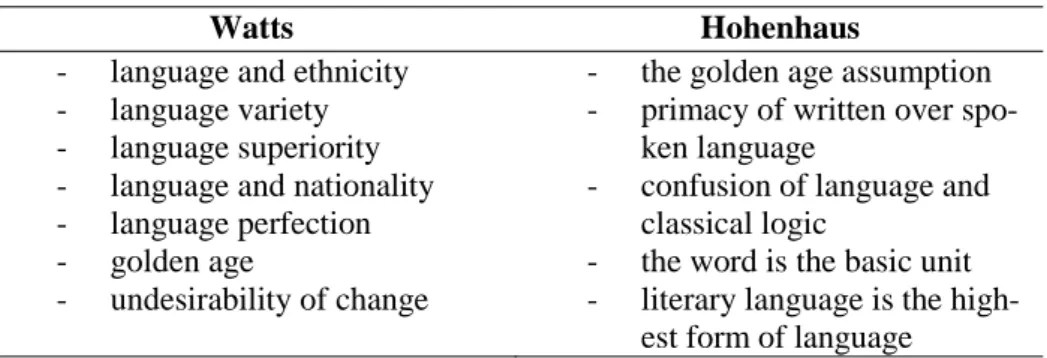
scriptive strands provided by Watts (2000) and Hohenhaus (2002),
which are listed in Table 1.1.
What González-Díaz found is quite indicative of the repetitive
and perpetuating nature of prescriptivism (cf. §4.4.4). Namely, many of
the historical strands mentioned by the two authors have survived until
today and the ones that most commonly reappeared in present-day
Eng-lish were the belief in language as a symbol of national identity and the
belief in a Golden Age of the English language.
Table 1.1 Mythical strands in in the ideology of prescriptivism accord-ing to Watts (2000, p. 41) and Hohenhaus (2002, p. 155)
Watts Hohenhaus
- language and ethnicity - language variety - language superiority - language and nationality - language perfection - golden age
- undesirability of change
- the golden age assumption - primacy of written over
spo-ken language
- confusion of language and classical logic
- the word is the basic unit - literary language is the
high-est form of language
Both González-Díaz (2007) and McManus (2008) adopted
Halli-day’s transitivity model in an attempt to discover differences in the
ide-ological stance between the two British quality newspapers, one
tradi-tionally conservative and the other liberal and to identify a ‘moral
pan-ic’ in the letters.6
Whereas they did not find any evidence of a moral
6 The concept of ‘moral panic’ is defined as an episode ‘where the media and society
panic in the analysed data, their studies produced interesting results
nevertheless. McManus compared letters published in the 1980s (1985–
89), that is in the period of the so-called grammar panic stirred by the
national curriculum debate in the UK (Cameron, 1995, pp. 79–116;
Milroy & Milroy, 2012, pp. 132–6), with letters published in the 1990s
(1995–99). Significant differences were found only in the linguistic
levels that the published letters addressed, for which McManus does not
offer an explanation. Whereas in the 1980s the main topics of concern
were related to lexical items (51%), which corresponds to Algeo’s
find-ings mentioned above, the focus in the letters studied by González-Díaz
and McManus was on matters of orthography and spelling (63%) in the
1990s. Finally, both studies suggest that the Times letters are more
alarmist in their tone when compared to those found in The Guardian.
We can tentatively conclude that the letters published in the more
con-servative paper of the two are more prescriptive in their tone.
The introduction of the internet saw the rise of the complaint
tra-dition in the new medium as a result. The ‘digital’ complaint tratra-dition
has been explored in several studies all of which explored online
com-plaints within different research endeavours. Skrede Pontes (2007) thus
analysed comments on two language-related blogs with the aim of
ex-ploring how the complaint tradition as described by Milroy and Milroy
(2012) is reflected on blogs as new channels of complaints. In the blogs
analysed, she found that people complained more often about written
than spoken language and about grammar more than any other
compo-nent of the language (such as spelling, punctuation, pronunciation, and
Chapman (2012) looked at the relationship between politics and
prescriptivism in the US by examining the online complaints made
con-cerning the language of politicians. His analysis of web forums and
blogs showed that linguistic prescriptivism wins most support from the
political left. Chapman was not the first, however, to look at the
correla-tion between political views and prescriptivism, Cameron did so before
him in her account of the debate surrounding the national curriculum in
the UK (1995, pp. 78‒115). Her results run counter to Chapman’s, as
she found that it was the conservatives, and not the liberals, who were
the most strident supporters of prescriptivism. It needs to be
acknowl-edged here, however, that the comparisons between their findings are
restricted by the differences between the political systems of the two
countries and their different language ideologies (cf. Milroy, 2001;
§2.3.1). Linguistic criticism of politicians, Chapman concludes, is
premised on an assumed connection between a person’s language skills
and their ability to govern: people should be governed by the
‘educat-ed’, the participants of the online discussions conclude, that is, by those
able to use an ‘educated style’. Usage in these debates may thus be seen
as an index of group identity. Problematical features and ‘incorrect’
usage are, however, often not identified in any linguistic detail by the
participants in the online discussions Chapman analysed. The
com-plaints as such can thus be viewed as no more than stereotypes of the
politicians’ language and of the language of the groups to which they
cater.
Finally, Heyd (2014) analysed folk-linguistic photo blogs that
The blogs analysed in her study record the usage of emphatic quotation
marks (e.g. New 'management', Fresh brown 'eggs') and they are in
effect examples of language policing online in the sense that their
au-thors are displaying nonstandard linguistic features and are
consequent-ly shaming and stereotyping the speakers who use them, as shown in
Figure 1.1. Heyd found that, regardless of the explicit stance expressed
by the blog authors in presenting the contents of their blogs, the blogs
are all either overtly or covertly prescriptive. In the digital sphere, she
goes on to conclude, folk-linguistic photo blogs are prime examples of
grassroots prescriptivism.
Figure 1.1 Sample picture from a folk-linguistic photo blog (from Heyd, 2014, p. 491)
Whereas the case studies presented above focus on public
of the aims of the present work is to introduce a view that offers
conti-nuity and contrast between the old and the new media, as the analyses
in Chapters 2 and 5 will demonstrate.
Moreover, a socio-linguistic examination of prescriptive efforts
from below has so far been limited at best or based on anecdotal
evi-dence. Whereas my findings represent only snapshots of grassroots
pre-scriptivism, they are the result of systematic analyses of the
demograph-ic groups of grassroots prescriptivists, and at the very least provide
pro-visional insights as to the backgrounds and motivations of the people
engaging in linguistic criticism and correction.
1.4 Thesis outline
This work offers a new perspective on prescriptive efforts from below,
which have been of particular importance in the history of the English
language, a language that, for better or worse, lacks a single, formal,
institutional authority. Although they take historical aspects into
ac-count when necessary, the case studies introduced are primarily
syn-chronic and aim to capture the state of twenty-first-century
prescrip-tivism. Methodologically speaking, while the current work can be
placed alongside societal treatment studies—the approach within atti-tude studies in sociolinguistics that looks at content of various sources found ‘out there’ in society (Garrett, 2010, p. 51)—it owes equally to the tradition of corpus-based discourse analysis and tools applied in corpus linguistics and variationist sociolinguistics in general.
Chapter 2 directly connects with the basic sociolinguistic
pro-vide a provisional overview of the landscape of grassroots
prescrip-tivism and sets the stage for further exploration. A comparative
per-spective is adopted in exploring grassroots prescriptivism in both
tradi-tional and new media. The aim of the chapter is to answer the
ques-tions: ‘Who are the people engaging in usage discussions?’; ‘Which
usage features are speakers particularly worried about?’; ‘Can we trace any changes regarding the features addressed in the debates?’. In
at-tempting to provide answers to them, I first turn to the analysis of letter
to the editors of The Times and The New York Times published between
2000 and 2010. This rich source of data allows for insights into the
identity of the authors, as well as for a comparison on the state of
pre-scriptivism on both sides of the Atlantic. One of the few attempts of
comparing the way that the standard language is ideologised in Britain
and the United States has been made by Leslie Milroy (2001). My
anal-ysis sets out to provide empirically supported insights on the topic. The
second part of the chapter explores the results of an online survey that
set out to investigate the practices of voicing linguistic complaints in
traditional and new media alike (cf. Appendix C). By doing so, a
pre-liminary comparison is drawn between the traditional forms of
grass-roots prescriptivism, i.e. letters to the editor, and their digital
counter-parts.
Both Chapters 2 and 3 share their focus on letters to the editor.
They differ in that whereas Chapter 2 aims to provide a top-down
so-ciolinguistic overview, Chapter 3 focuses on a staple theme of usage
debates in such letters, namely, the misused apostrophe. They
topics and identities of the authors of such letters, and of the discursive
strategies they use. In attempting to answer the research question ‘What
are the characteristics of prescriptive language in letters to the editor?’,
Chapter 3 employs a corpus-based approach to exploring a collection of
letters published across the entire English-speaking world on the topic
of the misused apostrophe. The analysis relies on the corpus-based key
word and key semantic domain analysis and contrasts the two
respec-tive approaches.
The next two chapters comprise yet another topical unit in that
they both deal with instances of digital grassroots prescriptivism and
bring them into relation with the traditional prescriptive canon as it is
represented in the HUGE database. Chapter 4 looks into the comment
section of the US-based usage blog Grammar Girl. The central research
questions in this chapter are: ‘How similar is an online usage guide to its traditional counterparts?’ and ‘What are the characteristics of the
comment section of the Grammar Girl website?’. The findings show
that, in spite of the change in the medium, prescriptive advice has
re-mained much the same in terms of its content. By way of a qualitative
analysis, the chapter chronicles the commenter identity constructions as
well as the types of comments they post, the support for the arguments
they offer, and, finally, their use of humour and anecdotes. Wikipedia’s
Talk pages comprise the second online platform for grassroots
prescrip-tivism explored in this thesis. Chapter 5 thus sets out to answer the
differences between the advice formulated through grassroots efforts on
Wikipedia and the usage advice disseminated by authors of usage
guides included in the HUGE database?’.
Chapter 6 departs from previous chapters, which focus on
grass-roots prescriptivism proper, in that it explores the gradual, albeit
lim-ited, acceptance of a stigmatised usage feature, the controversial adverb
thusly. Whereas complaints and speaker attitudes are explored,
corpus-based analysis of the feature’s usage takes centre stage. The question posed in the title, ‘What is the difference between thus and thusly?’, is
explored through triangulation of research methods. The chapter
exam-ines the viewpoint of prescriptivists on the usage of thusly (by tracing
the word’s history in usage guides), the general public (through an
atti-tudes survey), and its actual usage (as it is evidenced in language
corpo-ra). The respective methodological triangulation is included to
exempli-fy the approach embedded in the wider agenda of the ‘Bridging the
Un-bridgeable’ project, namely, one that takes into consideration the three
sides of the debate (linguists, prescriptivists, and the general public) in
exploring the prescriptively stigmatised linguistic features. Chapter 7
revisits the key terminology, summarises the main findings of this
the-sis, reflects on the methodology, and looks towards the future of
pre-scriptivism.
When I started my journey into this topic, the amount of material
available seemed overwhelming, which is in itself a testament to the
presence and relevance of grassroots prescriptivism. It has become clear
quite quickly that the topic is complex enough to engage many
starting to take a more distinct shape. This work is a summary of the
paths I have taken in describing grassroots prescriptivism, and of the
arguably early attempts at empirically examining questions that have
Grassroots prescriptivism: An analysis of
individual speakers’ efforts at maintaining the
standard language ideology
12.1 Introduction
People engage in discussions on which linguistic items are ‘correct’ and ‘incorrect’, ‘acceptable’ and ‘unacceptable’ on a daily basis. They do so
in private conversations, but also publicly by way of telephone calls to
radio stations, letters to newspapers and, since the dawn of the
partici-patory internet, on social media platforms, such as blogs, microblogs
(i.e. Twitter), forums and Facebook. Conspicuously, however, in
lin-guists’ theoretical models of language standardisation, speakers have
traditionally been marginalised as passive followers of the norms
estab-lished by language authorities. The types of discussions mentioned are
viewed as having no impact on actual usage or on what it is that
consti-tutes the standard variety, while standard language norms are, according
to such accounts, enforced by language experts, codifiers and ‘model speakers [such as journalists and newsreaders] and authors’ (Ammon,
2015, p. 65).
Deborah Cameron is among the most prominent figures who
challenged this strand of thought more than two decades ago in her
in-fluential book Verbal Hygiene (a term she uses to refer to
1 Lukač, M. (in press). Grassroots prescriptivism: An analysis of individual speakers’
tivism). In doing so, she urged professional linguists to reconsider their
perception of bottom-up prescriptive practices as ‘irrelevant, futile and
misguided’ ([1995] 2012, p. vii). Linguists have since then continued to
argue, from different perspectives, for the need to explore the role of
language users in the process of standardisation (Hundt, 2009; Davies
and Zigler, 2015, p. 4). My own study—which is part of the research
project ‘Bridging the Unbridgeable: Linguists, Prescriptivists and the
General Public’—is embedded in this proliferating field of research. In
my analysis, I explore bottom-up prescriptive efforts of language users
from all social backgrounds, which I refer to by the term ‘grassroots prescriptivism’. Bottom-up or grassroots prescriptive efforts are here
understood as those initiated by lay members of the general public,
es-pecially in contrast to top-down prescriptivism that is carried out
insti-tutionally. Whereas the most commonly explored prescriptive efforts
are those initiated by official language institutions and authorities,
grassroots prescriptivists wage their battles in the media by writing
let-ters to newspaper editors, calling radio stations and engaging in online
discussions on topics relating to usage. In shedding light on such
prac-tices, the analysis of discussions on linguistic features that speakers
stigmatise—such as the word literally to mean ‘figuratively’, and
con-structions such as between you and I instead of between you and me—
proved to be a good starting point. Whereas it is fairly easy to identify
where such discussions can be found, narrowing down all that is
availa-ble to compile a collection suitaavaila-ble for analysis proved to be
challeng-ing. Nevertheless, the instances of metalinguistic discussions that I
peo-ple’s practices of engaging in grassroots prescriptivism were
investigat-ed allowinvestigat-ed me to explore, among other things, the following questions:
Who are the people engaging in usage discussions? Which usage
fea-tures are speakers particularly concerned about? Can we trace any
changes regarding the features addressed in the debates? This paper
describes the methodology employed in answering these questions and
it offers provisional answers to them.
2.2 Who complains about language use?
People complaining about usage, whom I refer to as ‘grassroots
pre-scriptive activists’, come from all walks of life. While we may expect
older people to complain more often about linguistic decline, examples
such as those of the 15-year-old prescriptivist Albert Gifford prove such
expectations wrong (Gifford, 2014). Gifford obliged Tesco to
acknowledge a grammatical mistake in orange juice packaging (most
tastiest instead of most tasty) and received a considerable amount of
media coverage as a result. Prescriptive attitudes to language are also
often viewed as being intertwined with conservative beliefs and
po-litical attitudes (Cameron, [1995] 2012, p. 9). Chapman (2012),
howev-er, demonstrates in his analysis of online complaints about the language
of politicians in the US that linguistic prescriptivism wins most support
from the political left in this country. He suggested that the supporters
of the Democratic Party associate stigmatised linguistic features with a
lack of education of conservative politicians. A recently published
study by Boland and Queen (2016) states that sensitivity to linguistic
catego-ries (such as gender, age and level of education), but that it is rather
related to personality traits. According to the two authors, less
agreea-ble and more introverted people prove to be more sensitive to
grammat-ical errors, and it may be such people who tend to voice their
com-plaints.
Although Boland and Queen’s study is informative as to what
kind of people are more inclined to evaluate negatively authors of texts
that contain linguistic errors, voicing complaints publicly is
never-theless a different matter altogether from critically evaluating language
use in private. Not all people who are sensitive to errors become
grass-roots prescriptive activists and write letters to newspapers or engage in
online discussions on grammar. To explore the social background of
this group of people I searched through newspaper databases of The
Times and The New York Times (NYT) for readers’ letters containing
linguistic complaints, which is where metalinguistic discussions are
documented in the pre-internet age. Seeing that public discussions on
language today are largely led online, I decided to widen the scope of
the analysis and, together with Ingrid Tieken-Boon van Ostade, I
launched an online survey in 2015 in which respondents were asked
about their practices of publicly voicing complaints on usage both
of-fline and online. The findings presented below aim to feed into wider
debates about the participation in and the dynamics of grassroots
2.2.1 Letters to newspaper editors
Both The Times and The NYT are quality daily newspapers ranking high
in national circulation: sixth in the UK (Mayhew, 2018) and second in
the US (The Associated Press, 2013), respectively. Quality press,
for-merly referred to as ‘broadsheet press’ in the UK, is distinguished by
the seriousness of the topics it addresses (including politics, economics
and sports), and the higher education of its readers (cf. Bednarek, 2006,
p. 13) when compared to popular press. I retrieved letters from both
newspapers published during a four-month timespan (March–July)
across a period of ten years, between 2000 and 2010.2 The search led to
a collection of one hundred and five letters from The Times (comprising
7,769 words) and fifty letters from The NYT (5,692 words). Although
the two collections are not representative of either the language-related
letters published in national newspapers of the two countries or even of
the newspapers themselves, they nevertheless offer an insight into
top-ics written in such letters and into the identity of their authors, who are
required to sign their letters and who occasionally provide personal
in-formation as well. The following passage taken from a reader’s letter
published in The Times illustrates both the typical format and content of
such letters:
(1) Sir, Full marks to Sir Jim Rose for at last acknowledging the im-portance of oral grammar in our education system. More than course work, teachers must be encouraged to correct incorrect grammar in the classroom. Not an easy task but a very necessary
2 Due to the number of letters published in newspapers it would have been excessively
one. While going about this, perhaps they could help to discour-age the use of the word like, with which most young people tend to preface each phrase. (The Times, 28 April 2009)
The author, while referring to a previously published article, focuses on
a particular grammatical feature—in this case the use of like as a
dis-course marker—and identifies ‘most young people’ as language
offend-ers. Complaints like these frequently offer solutions to the perceived
declining language standards, and this letter does so by urging teachers
to correct their students’ grammar.
Before analysing the letters themselves, I conducted interviews
with a number of British journalists who engage in dialogue with the
general public on matters of linguistic complaints to find out how they
perceived grassroots prescriptivists. Oliver Kamm, the author of the
language column The Pedant published in The Times, describes the
grassroots prescriptivists as ‘generally […] people of an older genera-tion who were taught “rules” at school and have been carrying these with them ever after’ (personal communication, 6 May 2015). Stephen Pritchard, who is the readers’ editor of The Observer, adds that topics
addressed in such letters reveal the older age of their writers (personal
communication, 11 December 2015). Gender, too, may play a role as to
the identity of the people voicing the complaints, claims Ian Jolly, the
BBC’s chief style editor, who receives a large number of both emails and letters from the audience: ‘If there’s one thing I’d say they tend to be mostly men’ (personal communication, 7 September 2015). If we
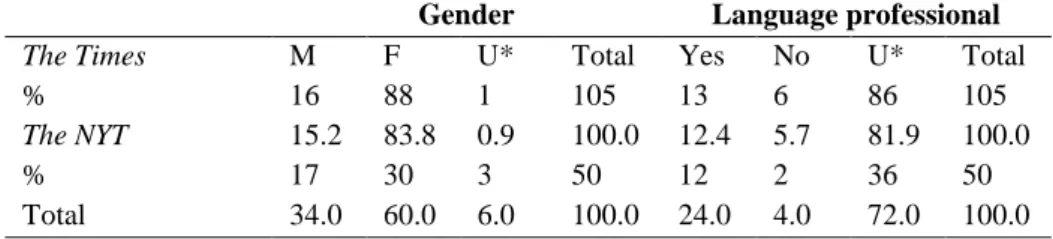
look at the gender of the authors of the letters that I collected, Jolly’s
males formed an overwhelming majority, with gender bias being lower
in The NYT (M = 60%, F = 34%) than in The Times (M = 83.8%, F =
15.2%).3 People writing to the newspaper also occasionally identified
themselves further by indicating their title or profession (28% of The
NYT and 18.1% of The Times letter writers), as indicated in Table 2.1
below.
Table 2.1 Authors of the Times and the NYT letters: sociolinguistic data
Gender Language professional
The Times M F U* Total Yes No U* Total
% 16 88 1 105 13 6 86 105
The NYT 15.2 83.8 0.9 100.0 12.4 5.7 81.9 100.0
% 17 30 3 50 12 2 36 50
Total 34.0 60.0 6.0 100.0 24.0 4.0 72.0 100.0
U* undecided
Whereas professions mentioned included bankers and medical
doctors, the majority of those who indicated what they did for a living
were language professionals: English teachers, copy editors and
pro-fessors of sociolinguistics. Although the people who wrote letters to the
editor were not only lay members of the general public, but also
lan-guage professionals (as many as 12.4% in The Times and 24.0% in The
NYT), in their efforts the professionals too were engaging, I argue, in
grassroots prescriptivism. They were contributing to public usage
dis-cussions instead of acting in their professional capacity. The contents of
the letters written by language professionals indicated that in
mention-ing their skills and competence, the authors were attemptmention-ing to gain
3 In all but four letters in my collection where the name was either gender-neutral or
distinction, lend credibility to the content of their letters and position
themselves as experts in the public discussions on the readers’ pages of
the newspaper, as did this author of the following letter published in
The NYT.
(2) As a teacher of English, a part-time poet and a full-time wordie, I took genuine delight in Patricia T. O’Conner’s review of books about language by Ben Yagoda and David Crystal (1 April 2007)
By revealing their credentials, writers of letters—such as the one in
example (2)—appeal to what the sociologist Pierre Bourdieu calls
‘cul-tural capital’ (1986, p. 242), that is, to the knowledge that they have as
members of the community of language professionals. It is this type of
specific cultural capital that raises their status in usage debates and
dis-tinguishes them from lay participants.
This sociolinguistic overview of the letter writers, limited
though it is, reveals two points that are relevant for my analysis of
grassroots prescriptivism. First, males form a majority among them,
which thus confirms the gender bias identified by Ian Jolly already
re-ferred to and the findings of earlier scholars who studied the genre (e.g.
Wahl-Jorgensen, 2002, p. 184). Second, language professionals seem to
dominate the discussions on usage among readers of the newspapers
studied. This may be because they are more interested in the topic than
lay readers or because their letters are selected more frequently by
edi-tors. Media scholars generally agree that letter pages are dominated by
authors belonging to social elites: those who are more educated,
et al., 2004; Richardson, 2007). As useful a source on grassroots
pre-scriptivism as the letters are, it needs to be noted that they form what
are at best ‘hazy reflections of the public opinion’ (Grey and Brown,
1970, p. 580). The voices of those otherwise belonging to the less
influ-ential social groups are, by contrast, not heard in traditional public
fo-rums and many of them may not decide to engage in discussions and
write letters to begin with. This general observation translates into the
more specific context of discussions on usage as well. Finally, I
re-trieved twice as many letters from the British than the American
news-paper. This is a consequence of what I believe is a greater interest in the
phenomenon among British readers.4 In my analysis of letters to the
editor published across the English-speaking world (Lukač, 2016), I
found that the practice of publishing letters on language use is not
lim-ited to a particular country. It is, however, the most popular in Australia
and New Zealand,5 followed by Ireland and the UK, and least
estab-lished in the US and in Canada.
4 The difference in the number of published letters to the editor may also be partly
explained by the fact that The NYT had already dedicated a section to language use in
its On Language column in the period between 1979 and 2009, which largely
coincid-ed with the period covercoincid-ed in my collection. In comparison, The Times started
featur-ing its language column The Pedant only in 2009.
5 The high number of letters on usage published in Australia and New Zealand can
2.2.2 The survey
Although letters to the editor may be among the oldest public media
platforms, today they comprise only a fraction of public discussions on
language: the liveliest arenas for such discussions can be found online.
The survey which Ingrid Tieken-Boon van Ostade and I created in order
to find out whether and in what respect the participants of online
dis-cussions differ from those writing letters to newspapers was made
available through the social media channels of the ‘Bridging the
Un-bridgeable’ project between July and September 2015. It was completed
by altogether 212 respondents, primarily university-educated (93%) due
to the channels through which we distributed it,6 who included both
native (NS) (55.6%) and non-native (NNS) (44.4%) speakers of
Eng-lish. Among the NSs, 55% indicated their variety as British and 25% as
American English, while for the NNSs, the most commonly chosen
linguistic model was British English (47.4%).
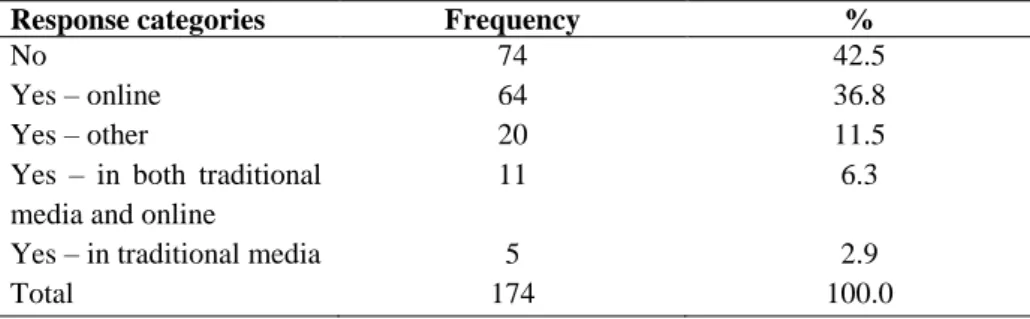
Very few respondents (16 out of the 174 who answered the
question) confirmed that they had at some point in the past phoned in
on a television or radio programme or written a letter to a newspaper in
order to express their opinions on a particular linguistic feature. When
compared with participation in online discussions (75/174), the
differ-ence is considerable: more people clearly engage in public discussions
online than in traditional media, as the summary in Table 2.2 below
goes to show. The reason for this is that there are fewer, if any,
res-trictions for doing so online; unlike newspaper editors, website
6Since the responses were not obligatory, the percentages indicated are relative to the
tors can often be bypassed, since the amount of filtering and selection
of potentially undesirable content online varies considerably from
web-site to webweb-site. On the whole, publishing has become effortless in the
new media, at least for those living on the ‘right’ side of the digital
di-vide.7
Table 2.2 ‘Have you ever engaged in public discussions about language and grammar?’
Response categories Frequency %
No 74 42.5
Yes – online 64 36.8
Yes – other 20 11.5
Yes – in both traditional media and online
11 6.3
Yes – in traditional media 5 2.9
Total 174 100.0
Moreover, the participants in online discussions tend to be
younger than the writers of letters to the editor. (Only 3 out of 16 letter
writers among the survey respondents were younger than 40.) Speakers
aged under 40 are well acquainted with an environment in which
opini-ons are shared publicly online, whereas older participants were used to
expressing their views publicly decades ago only through letters and
phone-ins. Digital debates are thus not only gaining ground, but those
led in traditional media are also losing ground as forums for public
dis-cussion.
7 According to the website Internet World Stats, currently 51.7% of the world