ENVIRONMENTAL EDUCATION 2.0: TOWARD A THEORY OF ECOLOGICALLY MINDED TEACHING
Scott A. Morrison
A dissertation submitted to the faculty of the University of North Carolina at Chapel Hill in partial fulfillment of the requirements for the degree of Doctor of Philosophy in Culture, Curriculum, and Change in the School of Education.
Chapel Hill 2013
ABSTRACT
SCOTT MORRISON: Environmental Education 2.0: Toward a Theory of Ecologically Minded Teaching
(Under the direction of Jocelyn Glazier)
Since the 1970s, the environmental education movement has been positioned as one of the primary means to cultivate the knowledge, values, dispositions, and behavior needed to preserve and protect the planet. Ample research suggests, however, that environmental education has failed to meet its goals, and that the state of the
environment is worsening. There are organizations and frameworks that recognize the limits of traditional environmental education and that are pushing school reform broadly, and environmental education in particular, in new directions—what I call the Environmental Education 2.0 movement. In this study, I focus on one framework in particular, EcoJustice education. EcoJustice theorists posit that the ecological crises we face are rooted in culture and, more specifically, that Westernized culture has produced ecological crises through the pervasive homogenization, monetization, and privatization of existence. The result is alienation of community, the loss of forms of
intergenerational wisdom that sustain healthy communities, and the erasure of cultural diversity into a global monoculture. The premise of Ecojustice education is that
teachers and students need to understand these realities and then work to challenge them. Seven educators and I, all committed to preserving and protecting the
For my children: Julian Madelyn
ACKNOWLEDGMENTS
First and foremost, I am very thankful for the guidance, support, encouragement, and advice provided by my dissertation committee members. They have all shaped this dissertation in different ways and, more importantly, modeled for me what it means to be a teacher-‐scholar. Special thanks to my advisor, Jocelyn Glazier, for the countless hours she spent reading drafts, listening to my ideas and frustrations, and pushing me to dig deeper.
Finally, I am eternally grateful for the love and support of my family. Without the backing of my parents my dreams of graduate school would have fizzled. They sustained me in innumerable ways, as they always have. My best friend and wife, Anna, celebrated with me on my best days and tolerated me on my worst. I could not imagine a better partner. She defines beauty. Together we are privileged to raise four
wonderful children, to whom I have dedicated this dissertation. The focus of my work is to make the world a better place. My hope is that Julian, Madelyn, Kalen, and Brayden will take seriously the call to love their neighbors—both human and more-‐than-‐human.
PREFACE
TABLE OF CONTENTS
List of Tables………xii
Chapter 1: Soil……….……….1
Fixated on Growth….………..………1
Ecological Overshoot………..………..………4
Our Greatest Challenge………..………..…..8
The Limits of Environmental Education……….12
Environmental Education 2.0………17
The Study……….22
Chapter 2: Theoretical and Historical Context………28
Globalization and Neoliberalism……….28
Historical Roots………35
Resistance………41
Chapter 3: Research Methods………44
Ecological and Postcritical Research……….44
Recruitment………46
Data Collection………...47
Participants………...50
Jane………...50
Brent………...52
Eric………...54
Clint………...55
Abby………...56
Justin………...56
Context……….58
Data Analysis………...59
Positionality………...60
Limitations………...62
Chapter 4: Ecologically Minded Teaching………..……65
Prelude………...65
Five Practices………...68
Externalities……….…71
Engaging Experiences………73
Multiple Perspectives………77
Critical Questions……….…80
Partnerships……….…84
Challenges………...87
Resistance……….…88
The Dominance of the Banking Model……….……89
Student Hardships………..90
The First Year……….…….……92
Personal Cost………..…93
Flashback………...94
Reflection………...96
Chapter 5: EcoJustice Education………100
The Commons………...104
Defining Moments……….…115
Unsettling Identity……….…120
Transformative Learning………127
Community and Collaboration………..…129
Reflection………...132
Chapter 6: Seeds………...136
Wide Awake………...136
Review………..………...137
So What………...143
Limitations………...146
Going Forward………...148
Appendix A………...154
Appendix B………...155
Appendix C………...156
List of Tables Table
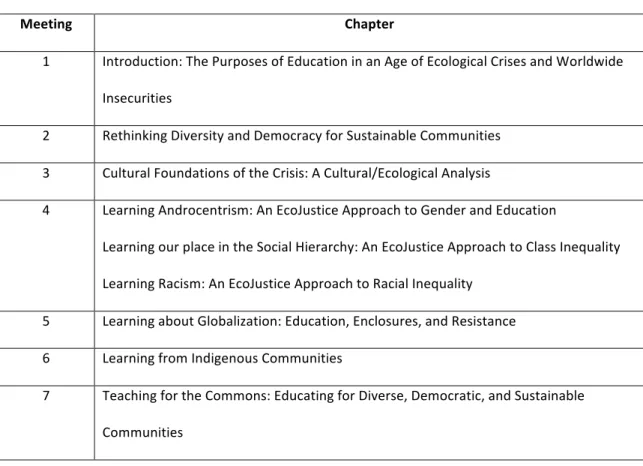
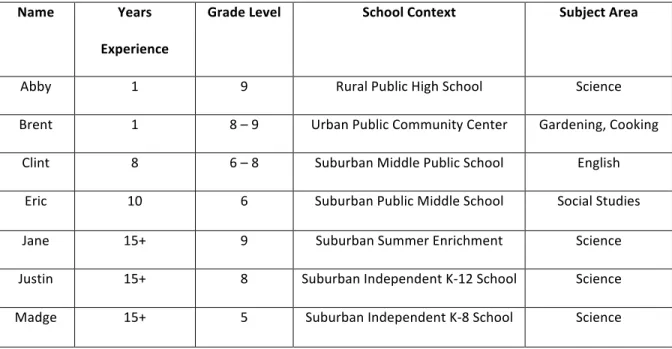
1. Book chapters read for each meeting………...49 2. Participant information………58
CHAPTER 1
Soil
We are destroying our country—I mean our country itself, our land. This is a terrible thing to know, but it is not a reason for despair unless we continue the destruction. If we decide to continue the destruction, that will not be because we have no other choice. This destruction is not necessary. It is not inevitable, except that by our submissiveness we make it so.
—Wendell Berry (2005, p. 21) Fixated on Growth
Not long ago, as my family and I drove home from a morning out, my wife said, “Look, kids,” and pointed out the driver’s side window. We all turned to see an array of bulldozers and dump trucks pushing, hauling, and organizing mounds of soil. Five acres of lush green trees, for me a pleasant buffer between gas stations and grocery stores, had been transformed into reddish brown flatland. Roots protruded from the ground as if raising their arms in surrender. “Wow,” I heard one of my kids whisper, not sure if awe or sadness inspired the utterance.
I think about that moment frequently, an example of how millions of kids in the United States and other Westernized1 cultures are exposed, most often uncritically, to
1 Following Hall (1996), I use the term Westernized as a historical rather than a
the might of modern industrialism, to the power humans exert over nature. I think about how we communicate our faith in machines, technology, and science, the enculturation process that teaches children—in both subtle and obvious ways—to associate automobiles and shopping malls and skyscrapers with goodness and progress. In Westernized cultures, altering the environment is typically referred to as
“development”2 and justified along economic lines: cutting down trees, leveling land, and constructing buildings provides jobs, creates new markets, and boosts the economy. The entire phenomenon is framed as a necessary net positive, in which what is gained, economically and materialistically speaking, overshadows any biological or cultural loss.
In his essay, “The Tyranny of Entitlement,” Derrick Jensen (2011) wrote that he is stunned that so many otherwise sane people believe infinite economic growth is
possible on a planet with biophysical limits. “Perpetual economic growth and its cousin, limitless technological expansion,” he penned, “are beliefs so deeply held by so many in this culture that they often go entirely unquestioned” (p. 5). Indeed, the primacy of “the economy” and “economic growth” is fairly standard in the U.S. To cite one recent example, in the 2012 presidential debates, the topic of climate change made a single, industrialized, developed, urbanized, capitalist, and modern. Mehmet (1995) described Westernization as “reconstructing or shaping the rest of the world on western norms and institutions” (p. 2). In the past two centuries colonization and globalization have led to the Westernization of cultures around the world. For examples of Westernization see Norberg-‐Hodge (1991) and Thong (2012).
brief appearance. The moderator of the second debate, Cindy Crowley, chose not to call on the audience member with a question about global warming. “I had that question, all you climate change people,” she said. “We just, you know, we knew that the economy was still the main thing” (Bauerlein & Jeffery, 2012, p. 5).
The economy being “the main thing” is certainly not new, but the focus has intensified since the end of World War II (Collins, 2000) and is now the “organizing ideology for corporations and individuals, for American capitalists and Chinese
communists, for Democrats and Republicans. For everyone” (McKibben, 2007, p. 10). This fixation, however, is proving problematic, as it produces more inequality and insecurity than prosperity and progress, requires high levels of energy, generates loads of pollution and waste, and, perhaps most ironically, bears little correlation to human happiness (Begley, 2004; McKibben, 2007). “A single-‐minded focus on increasing wealth has driven the planet’s ecological system to the brink of failure,” McKibben (2007) wrote, “without making us happier” (p. 42). Dietz and O’Neill (2013) called the pursuit of
never-‐ending economic growth dysfunctional: “An economy that chases perpetually increasing production and consumption, always in search of more, stands no chance of achieving a lasting prosperity” (p. ix).3
For decades the alarm has been sounded that perpetual growth—of economies, of scale—is unsustainable (Berry, 1977; Carson, 1962; Gore, 1992; McKibben, 1989; McKibben, 2007; Meadows, Randers, Meadows, & Behrens, 1974; Polanyi, 1944; The Ecologist, 1972; Sale, 1980; Schumacher, 1973). But the reform efforts that have
accompanied the warnings, especially the environmental movement broadly speaking, have proven no match for the magnitude and power of economic growth. According to Speth (Goodell, 2008):
[O]ur efforts to clean up the environment are being overwhelmed by the sheer increase in the size of the economy… Capitalism is a growth machine. What it really cares about is earning a profit and reinvesting a large share of that and growing continually. Profits can be enhanced if the companies are not paying for the cost of their environmental destruction—so they fight [paying it] tooth and nail. The companies themselves are now quite huge, quite powerful, quite global, and no longer just the main economic actors in our society. They are the main political actors also. And so all of these things combine to produce a type of capitalism that really doesn’t care about the environment, and doesn’t really care about people much either. What it really cares about is profits and growth, and the rest is more or less incidental. (para. 7-‐9)
Without altering an economic system that has become the dominant mode of
organizing human life and that depends on perpetual growth and profits, there is little hope for the future (Jensen, 2006). Changes undoubtedly have to occur, as the planet is simply not able to accommodate continued stress.
Ecological Overshoot
Footprint Network determined that humans have been in ecological overshoot since the 1970s with annual demand on resources exceeding what the planet can regenerate each year (Ewing, Moore, Goldfinger, Oursler, Reed, & Wackernagel, 2010).4 Between
2001 and 2005, The Millennium Ecosystem Assessment (2005) calculated the
consequences of ecosystem change for human well-‐being and reported the following: Over the past 50 years, humans have changed ecosystems more rapidly and extensively than in any comparable period of time in human history, largely to meet rapidly growing demands for food, fresh water, timber, fiber, and fuel. This has resulted in a substantial and largely irreversible loss in the diversity of life on Earth. (p. 1)
The report acknowledged that human alteration of ecosystems has contributed to gains in “human well-‐being and economic development” but that “these gains have been achieved at growing costs in the form of the degradation of many ecosystem services, increased risks of nonlinear changes, and the exacerbation of poverty for some groups of people” (p. 1).
Perhaps most famously, the Intergovernmental Panel on Climate Change (IPCC) released a report in 2007 that stated that the warming of the climate system is
unequivocal based on observations of increases in global average air and ocean
temperatures, widespread melting of snow and ice, and rising global average sea level. As a result,
[t]he resilience of many ecosystems is likely to be exceeded this century by an
unprecedented combination of climate change, associated disturbances (e.g. flooding, drought, wildfire, insects, ocean acidification) and other global change drivers (e.g. land-‐use change, pollution, fragmentation of natural systems, over-‐ exploitation of resources).
Two years after the IPCC report, Rockstrom et al. (2009) developed a framework for understanding human effects on the environment based on planetary boundaries. The boundaries “define the safe operating space for humanity with respect to the Earth system and are associated with the planet’s biophysical subsystems or processes” (p. 472). The authors pinpointed “the Earth-‐system processes and associated thresholds which, if crossed, could generate unacceptable environmental change” (p. 472). The nine boundaries include climate change, rate of biodiversity loss (terrestrial and marine), interference with the nitrogen and phosphorus cycles, stratospheric ozone depletion, ocean acidification, global fresh water use, change in land use, chemical pollution, and atmospheric aerosol loading. The authors concluded that for three of the planetary processes (climate change, biodiversity loss, and the nitrogen cycle), humanity is now exceeding the planet’s safe operating boundary, and by a large margin in some cases. The National Climate Assessment and Development Advisory Committee (2013) just recently released a climate assessment report with contributions from over 240 authors.5 According to the executive summary, there is abundant evidence of climate
change, from the top of the atmosphere to the bottom of the ocean. The changes in climate will produce “a variety of stresses on society, affecting human health, natural
ecosystems, built environments, and existing social, institutional, and legal agreements. These stresses interact with each other and with other non-‐climate stresses, such as habitat fragmentation, pollution, increased consumption patterns, and biodiversity loss” (National Climate Assessment, 2013, p. 5). Other consequences could include “reduced water supply and quality, the loss of iconic species and landscapes, distorted rhythms of nature, and the potential for extreme events to eliminate the capacity of ecosystems to provide benefits” (p. 5).
In sum, evidence of anthropogenic climate change is accumulating. Last year was the hottest year on record in the U.S. (Gillis, 2013), and extreme weather events around the world are increasing in intensity as well as frequency (Miller, 2012). Many assume climate change only means rising temperatures, but effects include intense, unpleasant, anomalous weather of all kinds (Lyall, 2013). And as weather patterns change, there are social and economic consequences. Farmers in North Dakota, for example, are struggling to adapt to warmer and wetter growing conditions (Hertsgaard, 2012). When wheat, rice, corn, and soybean crops suffer, food security worldwide is threatened.
the effects of pollution from human activities.6 Such results should not be surprising,
however. For one, in a culture that celebrates material accumulation and is dependent upon economic growth, environmental concerns are often neglected or minimized.7
Our Greatest Challenge
In early 2012, New York Times columnist Tom Friedman argued that the crop of Republican presidential candidates was out of touch with the three greatest challenges facing the U.S. today. The first challenge was “responding to the challenges and
opportunities of an era in which globalization and the information technology revolution have dramatically intensified, creating a hyperconnected world” (para. 7), and the second was “our huge debt and entitlement obligations” (para. 9). The third challenge was
how we power our future — without dangerously polluting and warming the earth — as the global population grows from 7 billion to 9 billion people by 2050, and more and more of them want to drive, eat and live like Americans. Two billion more people who want to live like us? We can’t drill our way out of that challenge. (para. 11)
Friedman’s third point is undeniable. When population and consumption rates are expected to explode—and by association rates of extraction, production, and disposal as
6 For comparison, a 2012 Pew Research Center poll reported that 67% said there is solid
evidence that the earth’s average temperature has been getting warmer over the past few decades. In addition, 42% said the warming is mostly caused by human activity, such as burning fossil fuels, and 19% said it is mostly caused by natural patterns in the environment.
well—and when evidence suggests humans are overshooting the planet’s carrying capacity and degrading ecosystems beyond their ability to repair themselves (Archer & Rahmstorf, 2010; Hansen, 2009; Hossay, 2006; Jensen & Draffen, 2003; McKibben, 2011; Meadows, Meadows, & Randers, 1992; Speth, 2004), there are inevitable and ominous consequences. If we are to avoid future catastrophes beyond those that exist already, then we need to be working toward solutions as quickly and as intelligently as possible. This is a great challenge indeed.
While Friedman’s worry is fixed somewhat narrowly on “powering” the future without polluting and warming the earth, education scholars have expressed broader but similar concerns. Capra (1999), in his Liverpool Schumacher Lectures, wrote that, “our greatest challenge to is to build and nurture sustainable communities—social, cultural, and physical environments in which we can satisfy our needs and aspirations without diminishing the chances of future generations” (p. 1). Reynolds, Brondizio, Robinson, Karpa, and Gross (2010) declared, “A central challenge of twenty-‐first-‐century society is thus to bring the nature and scope of the human endeavor into a sustainable relationship with the biosphere” (p. xiv). And Bowers (2011), encompassing more than just preserving and restoring the environment, made this assertion:
This awareness that educational goals need to be focused on fostering ecologically healthy ways of thinking and living is not necessarily new, but the attention has gained momentum and will most likely continue to increase. The ability to adapt to ecological circumstances, to “apply what we learn about how human activity impinges on
ecosystems so as to do less harm and once again live sustainably” (Goleman, 2009, p. 43), is more important than ever.
Last year the editors of Rethinking Schools (Editors, 2011) wrote that the climate crisis is an education crisis. They argued that schools, specifically in the U.S., have failed to teach students about ecology in both environmental and socio-‐political senses, about life-‐giving and life-‐sustaining interrelationships that must be honored and nurtured for the survival of all living beings, about the larger ecosystems humans are embedded in and how particular cultural habits and ways of thinking undermine, neglect, and destroy those systems. In the same issue, teacher, activist, and writer Bill Bigelow (2011) shared his experience teaching high school students about coal, about the ways coal “powers” the lives of so many, but also about the “dirty” side of coal: mountain top removal and strip mining, air and water pollution, corporate malfeasance, and the exploitation of workers and communities. I agree with Bigelow and the editors of Rethinking Schools: teachers should not merely prepare their students to participate in a global economy that harms both people and the planet. Instead, they must take up the commitment— the ethical obligation—to teach about the drawbacks of globalization and Westernized culture, about thinking and living more sustainably, about the cultural roots of
Orr (2004), however, argued that our current form of education is not capable of preventing ecological catastrophe. When we address the natural world in schools, we tend to emphasize theories and not values, abstraction rather than consciousness, neat answers instead of questions, and technical efficiency over conscience. Because “all education is environmental education” (p. 12), students are constantly taught that they are not a part of the natural world when curricular and pedagogical choices do not make that embedded-‐ness clear. As a partial remedy, Orr recommended that students be required to show mastery of topics like environmental ethics, the basics of the principles of ecology, carrying capacity8, the limits of technology, and sustainable agriculture before graduating. This would, theoretically, shift the focus of education from a means to “get ahead” and gain access to certain kinds of employment to a means to alter the cultural patterns that lead to the destruction of the environment.
In North Carolina, the state where I live and work, effort has been made to adhere to the advice offered by Orr. In the fall of 2008, the North Carolina Department of Public Instruction (NCDPI) and Department of Environment and Natural Resources (DENR) partnered to develop the North Carolina Environmental Literacy Plan (NCELP; n.d.).9 The team of writers acknowledged in the introduction that there is a need for
“environmentally literate citizenry who make informed decisions about complex environmental issues affecting the economy, public health and shared resources,” that
8 Carrying capacity refers to the number of people, other living organisms, or crops that a region can support without environmental degradation (Rees, 1992).
9 As of this writing, a draft of the plan is available but a final version has not been
environmental literacy “gives individuals the tools to be good stewards of the
environment,” and that environmental literacy is “an essential part of a well-‐rounded education” (NCELP, n.d., p. 1). Moreover, they recognized that because “[t]he health of the environment is inseparable from humans’ well-‐being,” it is important for “children and adults to know how ecological systems work, the benefits of these systems to humans and to the planet, and how human actions both positively and negatively impact these systems” (p. 2). The authors defined environmental literacy as “the ability to make informed decisions about issues affecting shared natural resources while balancing cultural perspectives, the economy, public health, and the environment” (p. 3-‐ 4), and offered four characteristics of an environmentally literate citizen—from
understanding how natural and human social systems are interconnected to fostering the attitudes and skills needed for ecologically responsible decision making.
The development of the NCELP reflects a notable shift in emphasis on the current purpose of schooling—from preparing students to participate and succeed in the global economy to preparing students to care for the planet. And there are other, similar top-‐down initiatives in other U.S. states, including Maryland, Connecticut, and Nevada. This trend is certainly worth applauding, but research suggests that the effects of this sort of environmental education, as historically construed and practiced, are quite limited.
The Limits of Environmental Education
principles are inseparable from social realities (Palmer, 1998). The movement began in the United States in the late 1960s, marked by the publication of the first issue of The Journal of Environmental Education, which included the first definition of environmental education: “Environmental education is aimed at producing a citizenry that is
knowledgeable concerning the biophysical environment and its associated problems, aware of how to help solve these problems, and motivated to work toward their solution” (Stapp, 1969, p. 30). Sauve (2005) identified fifteen different “streams” of environmental education that have contributed, over the past 30 years, to the richness and complexity of the field—from conservationist to holistic to feminist. Internationally, The Belgrade Charter (UNESCO-‐UNEP, 1976), The Tbilisi Declaration (UNESCO-‐UNEP, 1978), Agenda 21(UNCED, 1992), and most recently, the UN Decade of Education for Sustainable Development (2005-‐2014) (UNESCO, 2003) have articulated widespread concern for the health of humans and the planet because of the destructive effects of Westernized culture, and each one calls for remedies grounded in environmental education.10
And yet, so far, the promise of environmental education, just like the
environmental movement writ large, has not achieved its goals. “Regardless of what we as educators would like to think,” wrote Hungerford and Volk (1990), “we can point to relatively few successes that offset the severity of environmental degradation” (p. 15). In 1992, Sterling used the word “disappointing” to describe the limited progress made by environmental education during the previous 20 years (cited in Huckle, 1993). Coyle
(2005) summarized almost a decade of research and concluded that most U.S. citizens are both uninformed and misinformed about the complexities of ecology. Most recently, Saylan and Blumstein (2011) argued that environmental education “has failed to bring about the changes in attitude and behavior necessary to stave off the detrimental effects” of biodiversity loss and degradation the planet is currently experiencing, and added that educational institutions “do not provide the tools necessary for critical thinking and for understanding the modern world” (p. 1).
Over twenty years ago, van Matre (1990) attributed the failure of environmental education to “shallow” environmental thinking, broad and thus vague objectives, a supplemental approach to educational programs, emphasis on short-‐term projects rather than long-‐term lifestyle decisions, and a willingness to accept funds and sponsorships from the corporations responsible for creating the problems in the first place. A few years later, Fein (1995) critiqued the “technocratic approach” of
place.
Gruenewald (2004) suggested that the potential transformative power of environmental education is undermined by its institutionalization. Because it operates within the anthropocentric and Westernized norms of general education, mainstream environmental education practices perpetuate the problematic assumptions of
Westernized culture that are at the root of the crisis. Similarly, Blenkinsop and Egan (2009) argued that the problem with environmental education is that it lacks an adequate theoretical foundation. They asserted that environmental education theory draws uncritically from general education theory, which is grounded in Westernized cultural assumptions that separate humans from the natural world. In other words, an environmental education theory that does not operate within an eco-‐centric or holistic education theory—as opposed to the current anthropocentric and Westernized one— finds itself in conflict with its own goals.
the outdoors and primitive living skills. But in the early 1970s, environmental education morphed from nature study and immersion into a means to recruit children to solve problems like rainforest destruction and ozone depletion. In addition, Orr claimed that environmental education, in an effort to be validated in formal education like reading and math, “got reduced to a set of facts to be mastered, content to be internalized and regurgitated. In the effort to gain legitimacy and solve pressing problems, all the joy was sucked out of environmental education” (para. 35).
In the 40th anniversary edition of The Journal of Environmental Education, Strife (2010) questioned why environmental education has not played a larger role in the emerging environmental awakening in the U.S.:
If a central goal of environmental education is to motivate human engagement and action in resolving environmental problems (Intergovernmental Conference on Environmental Education, 1977), then why isn’t it the centerpiece of this go-‐ green and sustainability enthusiasm? More importantly, why is environmental education still considered “supplementary education” and not seen as a critical approach to developing a more sustainable society in the U.S.? (p. 180)
She determined that what is needed is a philosophical and paradigmatic shift in both environmental education curriculum theory and pedagogical practice. This includes a shift from a “save the trees” approach to environmental education to one that
education:
One that encompasses multidisciplinary teaching approaches. One that seeks to cultivate scientific and civic literacy. One that stimulates community
engagement, fosters an understanding of moral systems, and reinforces the appreciation of aesthetics. (p. 3)
While they recognized that there are obstacles to such an educational approach, they insisted, “a comprehensive, integrated, revitalized, and revised environmental
education is essential for the survival of us all” (p. 4). This, more broadly, necessitates “sweeping, ongoing, and creative” (p. 194) school reform.
Environmental Education 2.0
To be sure, there are organizations, frameworks, and movements that recognize the limits of “traditional” environmental education and that are pushing school reform broadly, and environmental education in particular, in new directions. In fact, the title of this dissertation—Environmental Education 2.0—points to this phenomenon. The term “2.0” is most often used to describe the second generation of web content and applications. Whereas Web 1.0 is text-‐based, linear, and static, Web 2.0 is multimodal, collaborative, and dynamic. Examples of Web 2.0 include social networking media like Facebook and Twitter, blogs, wikis, and video sharing sites like YouTube. Thus, “2.0” has emerged to describe an evolutionary breakthrough in the development and usage of web technology.
extends and enriches the first wave of environmental education. Whereas the first wave might be characterized as nature appreciation, science-‐based, and focused primarily on technofixes to environmental problems, the second wave integrates the social, cultural, and ecological and is woven into English, math, and history classes. Since the problems we face are complex, the solutions will be as well. The
Environmental Education 2.0 movement is varied and evolving, but what is common is a commitment to alleviate the strain humans are causing the planet, to cultivate ways of living that are more humane and sustainable, and to move toward an ethical system and sense of justice that considers healthy and sustainable ecosystems and communities as the number one priority.11
Recent studies have pointed toward these new directions environmental education is taking. Reid and Scott (2006), for example, surveyed environmental education scholars for their thoughts on where the field is headed in the future. Responses included increased attention to ontology, epistemology, and theoretical approaches; dominant educational and environmental discourses; an interrogation and exploration of the relationship between theory and practice; and the relationship between race, culture, and power, and its influence on environmental education and research. Just last year Ardoin, Clark, and Kelsey (2012) investigated the future trends in environmental education broadly and environmental education research in particular.
In addition to surveys and content analysis of journals, they interviewed leading environmental education scholars regarding the effects of global trends like the
technology revolution, the globalization of environmental issues, and new urbanization might have on the field of environmental education in the coming years. The authors found four recurring trends: a focus on community, connections between the social and the ecological, the urban context, and the rise of the digital age. “The relevance of EE research,” they wrote, “seems to be expanding as EE intertwines with health, justice, resilience, and other frameworks that recognize social-‐ecological interconnections” (p. 16).
There is one particular framework, EcoJustice education, which speaks to these emerging trends, especially the focus on community, the connections between the social and ecological, and the relationship between race, culture, power, and the environment. EcoJustice education is grounded in eco-‐feminist philosophy and place-‐ and community-‐based education and has been theorized by Bowers (2001) and, more recently, Martusewicz et al. (2011). The primary premise is that the ecological crises we face are rooted in culture, and that too many humans have lost sense of themselves as beings in relationship with and dependent upon larger ecological systems. Moreover, Westernized culture has produced ecological crises through the pervasive
homogenization, monetization and privatization of existence, resulting in the alienation of community, the loss of forms of intergenerational wisdom that sustain healthy communities, and the erasure of cultural diversity into a global monoculture.
2003), or to unpack and critically examine the cultural roots and contemporary manifestations of Western discourses that shape modern culture, including the ways culture shapes people psychologically, practically, epistemologically, linguistically, and emotionally.12 For example, EcoJustice educators teach about the ways individualism, anthropocentrism, rationalism, scientism, and consumerism permeate Westernized culture. These cultural conceptualizations, what Martusewicz et al. (2011) call discourses of modernity, contribute to ways of thinking and being in the world that divide, marginalize, and exploit, and they must be named, critically examined, and resisted. EcoJustice educators also critique modern capitalism, especially as it is
manifested in globalized neoliberal economic theory, and the ways in which the cultural and environmental commons13 is enclosed and marginalized. Decolonization is an unlearning process, a means of deconstructing and abandoning what dominant culture broadly, and schooling in particular, teaches.14
12 Gruenewald (2003) uses the terms decolonize and reinhabit to describe the work of what he calls a “critical pedagogy of place.” I borrow the terms here as I think they also apply to the work of EcoJustice education.
13 The cultural and environmental commons can be defined as “the right of local people to define their own grid, their own forms of community respect for watercourses, meadows, or paths; to resolve conflicts their own way; to translate what enters their ken into the personal terms of their own dialect; to be ‘biased’ against the ‘rights’ of outsiders to local “resources” in ways usually unrecognized by modern laws; to treat their home not simply as a location housing transferrable goods and chunks of population but as irreplaceable and even to be defended at all costs” (The Ecologist, 1994, p. 111). Additionally, the cultural and environmental commons represents “the lived alternatives to money-‐dependent activities” and “potential sites of resistance to the spread of the consumer-‐dependent lifestyle” (Bowers & Martusewicz, 2009, p. 273).
At the same time, EcoJustice education works toward reinhabitation
(Gruenewald, 2003), or the ways in which humans can live in harmony with each other and their local ecosystems. It involves determining the cultural patterns that are sustainable and those that are not, which requires fostering what Martusewicz and Edmundson (2005) call an eco-‐ethical consciousness: “a way of thinking and acting necessary to creating and protecting just and sustainable communities” (quoted in Martusewicz et al., 2011, p. 9). EcoJustice educators teach ways to recover or revitalize the commons (Bowers, 2006), the public spaces and places that provide sustenance, security, and interdependence, which include but are not limited to trees, minerals, water, animals, language, time, silence, seeds, and streets. Preserving the commons is an effort that values and honors local space, resources, and culture, and actively resists the forces of global monoculture.15
Finally, EcoJustice educators employ place-‐based pedagogy in an effort to reintegrate individuals with the landbases and communities in which they are
interdependently linked (Gruenewald & Smith, 2008; Smith & Sobel, 2010; Sobel, 2004). It involves using the local community and environment as the context for all learning and is much broader and more inclusive than environmental education. Rather than limiting the focus to natural science—i.e. field ecology and nutrient cycles—place-‐based education includes the study of local history, folk culture, community infrastructure, and
perpetuate human separation from and exploitation of nature, decoding “the taken-‐for-‐ granted cultural patterns that otherwise control thought and behavior” (Bowers, 1993, p. 114-‐115).
how they all interact and shape each other. 16 This approach “helps students develop
stronger ties to their community, enhances students’ appreciation for the natural world, and creates a heightened commitment to serving as active, contributing citizens” (Sobel, 2004, p. 7).
In sum, EcoJustice education takes a different approach from traditional environmental education, one that delves deeper into the cultural roots of ecological and social crises, into the assumptions and conceptualizations that position humans as separate from and superior to ecosystems and that rationalize the domination,
exploitation, and marginalization of people groups, Indigenous knowledge, and the natural world. EcoJustice education is, in many ways, the centerpiece of this study. The Study
Postman and Weingartner (1969) wrote that they maintained “a belief in the improvability of the human condition through education” (p. xiii). I, too, share that belief, especially regarding the ability of teachers to make a significant difference in the lives of children. I spent eleven years with adolescents in a small K-‐8 school. For most of that time I taught European history and parts of speech and how to write a five-‐ paragraph essay. In my final two years, though, I built and maintained a garden with my students. We started from scratch the first year. With the help of a local landscaping company, we put together four raised beds beside the parking lot. We cleared gravel, leveled and amended the soil, and planted some vegetables in the spring. A confluence of factors inspired my garden experiment, from my desire to incorporate more hands-‐on
learning to reading books that critiqued the fast-‐paced, instant-‐gratification, and profit-‐ driven food culture in the U.S. (Spurlock, 2005; Schlosser, 2005; Critser; 2003).
Gradually, I became more concerned about what I was doing to promote healthy and sustainable lifestyles for my students and our community than test scores or the Standard Course of Study. I felt an ethical conviction to offer an alternative to the logic of capitalism that so many of us in Westernized cultures consider normal. I did not know the best way to do it, so I grabbed a shovel.
Other teachers have taken similar actions, like taking kids outside and talking about the ways in which everything thrives in complicated interdependencies, like incurring in their students a love of the outdoors, of plants and animals, of healthy ecosystems. Perhaps, as it was for me, that is their means of fighting back, of rewriting culture, of telling kids different stories about the world, stories not framed by the global economy and the pursuit of material wealth. They are working to give children
the movement described by Hawken. They are contributing to what Thomas Berry (1999) calls “the Great Work”: carrying out “the transition from a period of human devastation of the Earth to a period when humans would be present to the planet in a mutually beneficial manner” (p. 3). For this dissertation study, I set out to learn as much as I could about the “Great Work” in my community. If there were teachers who
recognized that infinite economic growth is not only impossible but also abusive, who worked toward fostering ethical values based on the health and well being of humans and ecosystems, who advocated—however they could, in a variety of ways—for just, democratic, and sustainable communities, then I wanted to talk with them and learn from them.
I recruited participants for the study via an email that began with the following three questions: Interested in learning about EcoJustice Education? Interested in collaborating with other teachers who are teaching for ecological and social justice? Interested in invigorating your teaching and curriculum with place-‐based and justice-‐ oriented projects? I specifically targeted teachers that were interested in teaching about the environment and social justice. In order to learn more about the
participants—who they are, what they teach, why they teach what they do—I began with the following research questions:
• What are the beliefs, aims, and motivations of the participants?
• What kind of work are they doing already? That is, what strategies, projects, and
methods do they use?
I believed their stories, journeys, and experience could help me understand more about the work of teaching for a more just and sustainable future.
Seven educators agreed to participate in a Critical Friends Group (CFG) that met seven times over the course of five months. CFGs are a particular type of professional development community for teachers dedicated to improving their practice through collaborative learning (Bambino, 2002). Curry (2008) noted two premises of CFGs. First, “that classrooms ought to be the center of school reform efforts and that teachers should lead educational change” (p. 735). Second, “that schools cannot be intellectually engaging places for students unless their teachers are likewise actively engaged in learning, thinking, reading, and discussing” (p. 735). The purposes of CFGs include making teaching practices explicit by talking about teaching, critically reflecting on practice, turning theory into practice, and improving teaching and student learning. In addition, CFGs are characterized by, “teacher-‐driven management, close attention to classroom practice, relaxed and collegial ethos, and reliance on structured conversation guides called protocols” (Curry, 2008, p. 735).17 CFGs, therefore, are a grassroots effort
to bring about educational reform, teacher learning, and student achievement. By design they stand in opposition to top-‐down and touch-‐and-‐go models of teacher professional development.
The springboard for our discussions was the book EcoJustice Education: Toward Diverse, Democratic, and Sustainable Communities (Martusewicz et al., 2011). So, in addition to the questions above, I also set out to learn what it means for educators to
immerse themselves in the study of EcoJustice education. The additional research questions, then, were these:
• What happens when teachers committed to the preserving and protecting the
environment engage in collective conversation about EcoJustice education?
• In what ways does EcoJustice education enrich, extend, challenge, and trouble
the work that they do already?
While eco-‐feminists (Plumwood, 1993, 2001; Warren, 2000), environmental
philosophers (Berry, 1999; Merchant, 1980), and social ecologists (Bookchin, 2005) have been writing for years about the complex relationship between culture and ecology, their work is not typically utilized in teacher education programs or professional development workshops. I think it is imperative that teachers, and by extension their students, learn to identify and critique the cultural habits that injure humans and ecosystems and to practice ways of thinking and acting that restore sustainable, just, and democratic communities. Perhaps EcoJustice education could succeed where environmental education had failed and show promise as a powerfully transformative framework that shapes how teachers might integrate ecological and social issues into the classroom. In order to find out, I introduced seven educators to EcoJustice education.
CHAPTER 2
Theoretical and Historical Context
Our great modern powers of science, technology, and industry are always offering themselves to us with the suggestion that we know enough to use them well, that we are intelligent enough to act without limit in our own behalf. But the evidence is now rapidly mounting against us. By living as we do, in our ignorance and our pride, we are diminishing our world and the possibility of life.
—Wendell Berry (2005, p. 125) Globalization and Neoliberalism
In the 21st century, globalization is affecting nearly everyone and everything. According to Scholte (2000), there are five aspects or effects of globalization:
internationalization, the growth in international exchange and interdependence;
liberalization, the increased freedom of movement between countries; universalization, the sharing of ideas, aspirations, and experiences; modernization, the spread of
new ones have arisen. And while the global economy has lifted some out of poverty, it has also produced globalized externalities and enhanced global inequities (Bauman, 1998; Shiva, 2005).
Saul (2005) referred to globalization as the rise of corporate economic ideology and the erosion of democracy. Numerous scholars have described how this corporate economic ideology, neoliberalism, is driving globalization, shaping and framing
globalization in terms of markets and opportunities for growth (Bordieu, 1998; Chomsky, 1998; Giroux, 2004; Grossberg, 2005; Sassen, 1998; Stiglitz, 2002). Harvey (2004)