DUAL ABANDONMENT: RURALITY, HOMELESSNESS, AND PUBLIC CULTURE
Grover Wehman-Brown
A dissertation submitted to the faculty at the University of North Carolina at Chapel Hill in partial fulfillment of the requirements for the degree of Doctor of the Philosophy in the
Department of Communication.
Chapel Hill 2016
ii © 2016
iii
ABSTRACT
Grover Wehman-Brown: Dual Abandonment: Rurality, homelessness and public culture (Under the direction of Sarah Sharma)
This dissertation examines the specifically rural contours of inadequate housing in one community in the mountains of California. It does so within the context of an overwhelmingly urban conception of homelessness in the popular imaginary as well as political and theoretical frameworks. While urban homelessness dominates public discourse about the problem and its most visible forms stand in for the entire system of living without adequate housing in the United States, rural homelessness is a different experience in a variety of ways. This work identifies how rural inadequate housing is informed by specifically rural phenomena, such as rural housing stock, reduced physical visibility but increased social visibility, and far physical distances
between amenities. There are discrepancies between how people survive being inadequately housed in the region and how housed people talked about homelessness. I argue that the
discursive strategies used to talk about homelessness are products of social imaginaries. Housed residents rely on these imaginaries to distance themselves from collective responsibility to rectify housing insecurity and to deflect reckoning with their own position within tiers of economic insecurity that are widespread in the region.
town-iv
hall style democracy, rural exceptionalism. I argue that rural exceptionalism obstructs small-town communities from reckoning with the economic disinvestment that influences difficult problems such as inadequate housing; it orients critique of local problems inward instead of outward, resting on the belief that ideal democratic practice should be able to deal with problems such as an unhoused person in the community. This inward-focus detracts from the way wider-scale debates about the distribution of resources are enacted through dominant forms of public cultural practice. I argue that these dominant forms, particularly the administrative form most often used to manage and deliberate about homelessness, are urban-biased. Rural inadequate housing is the experience of dual abandonment- first, abandonment outside of the system of housing, then a regional abandonment from the administrative form said to manage and deliver aid. I analyze the way life is lived in dual abandonment, showing how disposability is productive of certain disposable practices of care, what Desmond (2012) calls disposable ties. Within the realm of disposability, violence and risk are differentially experienced, in this case based on gender. The systems of homelessness and the prison industrial complex are used to manage misogyny’s excess, and as such, differential disposabilities should be considered when making claims about precarity and disposability.
v
ACKNOWLEDGEMENTS
This project has been many eventful years in the making. I want to thank some of the people who made it possible. First, I am very grateful to the people in Hills County who took the time to talk to me about oftentimes troubling topics. This dissertation is only one step towards working to fix some of the very difficult problems at hand. Huge thanks are due to the members of my committee for supporting my research by asking hard questions. Each of them has
schooled me in some foundational aspect of this work. Sarah Dempsey guided me to the
doorways of scholarly research on homelessness and economic class when I was brand new and had no idea how to start. She also taught me the art of generous reading. Her mentorship over the years has been invaluable. I learned a great deal about Foucault and mobilities literature from Jeremy Packer who always has a knack for keeping theory connected to everyday life. Christian Lundberg’s generosity in rising to an argument about homelessness and public culture enabled me to find my own footing in these conversations. Banu Gökarıksel’s Feminist Geography seminar helped me identify methodological approaches that resonated with my political
investments, which ultimately grounded me through field research and writing. I would also like to thank Stephen Crofts Wiley at North Carolina State University. His Advanced Qualitative Methods course forced me to find a way to feel okay conducting research with humans which resulted in the method of disclosure. It worked much as I thought, and did not work much as he thought—this project is a productive result of both the trial and error.
vi
faculty in the UNC Department of Communication— particularly Carole Blair, Patricia Parker, and Lawrence Rosenfeld—whose flexibility enabled me to complete my work at a distance. Special thanks to Kate Sullivan and Ingrid Hoffius as well for the technical support in navigating bureaucracy from afar.
I owe a great intellectual debt to Natalie Fixmer-Oraiz for showing me exactly how I could pursue work on classism in a PhD program and who held my hand as I took the on-ramp. Teaching her work in Gender, Communication, & Culture over the years kept me attuned to the dogged paths that must be taken to dismantle sexism. It reminded me to take misogyny seriously as an intellectual concern even when my own work seemed far afield. I had (what I consider to be) the great pleasure of being part of a pleasantly assertive cohort of smart and socially engaged graduate student peers. I specifically want to thank Armond Towns, Carey Hardin, Adam
Rottinghaus, Kurt Zemlicka, Freya Thimsen, Robert McDonald, Jennifer Cronin, and Julia O’Grady for discussing some aspect of this research with me. Jessica Rich’s bi-monthly
Thursday morning calls were immensely helpful in breaking the isolation of dissertation writing. She helped me find my way out of the weeds many times. I am grateful to Eve Shapiro, Christine Rinki, Misha MacLaird, and Sonya Dublin for friendship as well as generous wisdom that helped keep my research attached to the big picture of scholarly research.
vii
for doing the caring labor that kept me sheltered, fed, and forward-moving during my own housing crises.
In many ways this work is possible because of the transformative process of organizing working with North Carolina member-leaders as part of Southerners on New Ground and with All of Us North Carolina. Your commitment to stay in the room through difficult conversations to work for racial, immigrant, and gender & sexuality justice (while attempting to bridge the rural-urban divide) restored my hope that political work by everyday community members is not only possible, but necessary. This work helped transform my class-based despair into productive engagement once again.
I am so grateful for my children, who give me razor-sharp focus. Their presence forces me to get to the heart of the matter and finish for the day. If you read now (way to go!) and are reading this, know that my work is stronger because of you. The physical care performed by many amazing women made my research and writing possible. Thank you in particular to my mother-in-law, Pamela Brown, for helping Nova and children when I’m away. My mom, Karen Wehman, set a bold example of a woman committed to learning and hard work. Thank you for letting me rise into my full self with all the bumps and falls, and for being here at the end. We are grateful that you show up with such enthusiasm for our family across great distance. The fierce and generous care of our babies provided by Jenise Frangella and Veronica Carranza enabled my fieldwork and writing. Thank you!
viii
ix
TABLE OF CONTENTS
ABSTRACT ... III
ACKNOWLEDGEMENTS ... V
CHAPTER 1: INTRODUCTION ... 1
Homelessness in the United States… ……….4
Naming Housing Deprivation…………...……….7
Rural homelessness. ………...………...9
Rural Homelessness in the United States………...………..11
Conceptions of Rurality………...………17
Rural Idyll…………...……….20
Regional Bias and Public Culture………...……….26
Homelessness and Public Culture………...……….27
Public Culture and the City. ………...……….30
Politics of Abandonment and Disposability………..………..36
Preview of Chapters………...………..43
CHAPTER 2: DEFENSIBLE SPACE: EMBODIED RESEARCH IN THE FORESTS OF HILLS COUNTY ... 48
Hills County, California………..………49
Economic History…...……….53
Methods of Research………56
Data Analysis………...………62
Researcher Positionality……..………64
x
CHAPTER 2: WHAT’S RURAL ABOUT INADEQUATE HOUSING IN HILL
COUNTY? ... 74
Visibility……….……….…75
LYNXSTER ... 77
Disappearing and Being Seen in the Rural Landscape………...……….80
LEONARD ... 82
Mobility……...……….83
DAVID ... 89
Rural Reasons to Stay, Rural Reasons to Go………...………92
ILANA ... 92
In-Migration………...………..95
OLIVIA ... 96
Rural Housing Stock………...……….98
BONNIE ... 99
Rural Renter Housing Cost Burden…...………101
CATHY ... 102
Limited Options and Long Distances………...………..105
Rochelle and Tim ... 106
Conclusion: Rural Inadequate Housing………...………..110
CHAPTER 4: “REAL” HOMELESSNESS AND THE ROLE OF THE SOCIAL IMAGINARY ... 112
Seeing the Urban for the Trees………...………...114
The Infamous Homeless Person……..……….……….118
In the Woods………..122
Down the Mountain……...………125
At the Midpoint………..127
xi
Conclusion: Real Homelessness………...……….132
CHAPTER 5: RURAL EXCEPTIONALISM ... 134
Divisions and Exclusions………...………148
Small Town Disappointments………...……….………155
Conclusion: Rural Exceptionalism…………...………..159
CHAPTER 6: DUAL ABANDONMENT: RURAL HOMELESSNESS AND PUBLIC CULTURE ... 162
Regional Bias of Public Culture……….165
The Sisyphean Project………...……….168
Theorizing Regional Disinvestment………...………170
CHAPTER 7: DIFFERENTIAL DISPOSABILITY: MANAGING MISOGYNY’S EXCESS ... 176
Disposable Care………...………..179
Differential Risk……….187
Severed Social Connections………...………190
Managing Misogyny’s Excess………...………195
Conclusion: Analyzing Disposability………...……….199
CHAPTER 8: CONCLUSION: ... 201
Implications………..……….206
Individual Interventions……...………..212
Future Research………..213
xii
TABLE OF FIGURES
Figure 1 - Wrought Iron Table ... 72
Figure 2 - Freedom of Speech ... 135
Figure 3 - Gilmore Girls at a Town Hall Meeting ... 136
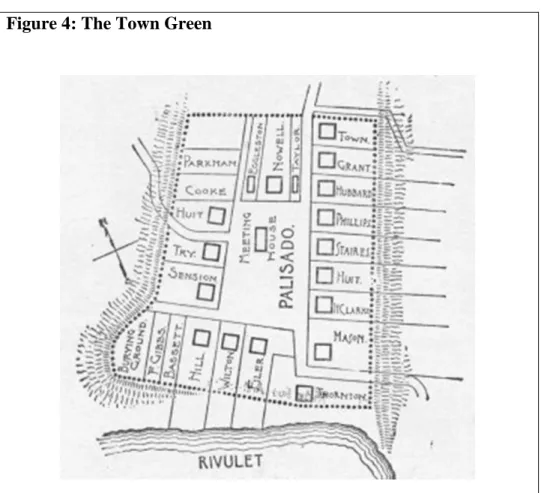
Figure 4 - The Town Green ... 140
Figure 5 - Protest at Alameda City Council in November, 2015 ... 142
1
Chapter 1: Introduction
“Many would argue that while our metropolises are the economic heart of our nation, our small towns are where you find our soul. Livability’s editors have traveled many a blue highway and kicked up a lot of dust in our rental cars headed on letter-named county roads with paper maps to backup our GPS units. We’ve walked into many a diner where we were clearly a
stranger as we entered, but left with new friends and promises to visit again” (Carmichael, 2015). This description of how the editors of Livability.com chose their “Top 100 Great Small Towns” invokes many core ideas about an essential goodness that resides in small towns throughout the United States. In depicting the small town as a place to “find your soul” the editors of
Livability.com step into a long tradition of portraying American small towns as social-emotional vessels of harmony. The small-town diner often serves as a picturesque campaign stop for politicians attempting to convey an image of connection with the average citizen. Livability’s editors draw upon this legacy. The diner seems to serve as a magic tollbooth that transforms strangers into friends over the course of a paid meal.
2
covered by clothes and blankets sleeps upright on a bench in front of a bus stop full of people. In the New York picture, a food vender cart frames the image of an older Black man as he sleeps on top of a military camouflaged blanket atop an artistically beveled stone slab bench. This list, dominated by images such as these, was shared 14,655 times, circulating as part of the spectacle of urban homelessness.
It’s generally well accepted that homelessness and rural poverty are significant problems in the United States and yet, rural homelessness in the United States is often thought to be an oxymoron, a spatial and social impossibility. It is overwhelmingly minimized in comparison to urban homelessness. The thing called homelessness in the United States is not one clear-cut experience, practice, or status. It is a phenomenon made up of a collection of habitual practices related to sleeping and mobility. Sleeping on a bench, sidewalk, under a tarp in the woods, in a storage locker, or in a shelter are some of the practices regularly identified as “homelessness.” Where and when one moves, and what is done in that movement is often dictated by housing status. A person who sleeps in their car might drive to a grocery store as their morning routine, both using the restroom and buying breakfast. Homelessness is also a social status, often invoked to represent the very bottom-end of a hierarchy of social class in the U.S. Finding oneself
identified and marked as such can have profound social and economic consequences, so adults often attempt to hide their housing status from potential employers, and youth attempt to hide their status from peers. The system of homelessness is made up of economic relations, influenced by the people who own and manage private housing stock, government agencies, and
3
other people, and circulate as part of a field of discourse. These discourses are often articulated through spatial conceptions such as good or bad neighborhoods, or houses as appropriate sleeping spaces, and public spaces as inappropriate. Homelessness is formally regulated by institutional entities, primarily the police and social service agencies.
Rural areas are diverse, complex places. Rural places in the U.S. are different from each other, characterized by different landscapes and their related economic and cultural dynamics. They are also diverse within communities. Rural places are made up of multiple generations of people, newer and longer-term residents, owners of land and the means of production, and the people that work those places. Small towns are valorized as ideal sites for face-to-face
democratic practice, a place where people are thought to take care of one another. Rural inadequate housing persists across the United States, but is rarely acknowledged in public discussion about homelessness, and under researched. This dissertation examines inadequate housing in one rural community in the mountains of California, a place I call Hills County.
Drawing from interviews, participant-observation, and ethnographic field work, I examine what is specifically rural about inadequate housing in Hills County. The physical practices of living without adequate housing in Hills County both shares characteristics with homelessness in urban areas, and have some distinct differences. For example, many
4
Local interactions are informed by wider-scale regional power dynamics that structure the possibilities of how housing inadequacy is talked about, responded to, and experienced. This work incorporates findings about how inadequate housing in Hills County is experienced with an analysis of the social, political, and economic power dynamics that shape these experiences. The widespread discursive field through which homelessness is understood as an inherently urban problem informs the way locally housed residents view the problem of housing inadequacy in their community. Homelessness, inadequate housing, and most major grievances that are informed by the state and national scale are debated, managed, and resolved through the
institutional form. I show how the institutional form relied upon to manage and deliberate about housing inadequacy and other critical problems facing this community is urban biased. This can be seen in the way funds to minimize the impacts of inadequate housing are distributed via the Continuum of Care program from the Department of Housing and Urban Development. This program privileges the number of people experiencing housing deprivation in the allocation of funds over other ways that could be used to determine need. This has significant implications for people enduring rural housing inadequacy, and rural communities in general in economically disinvested areas of the United States.
Homelessness in the United States
5
usually done early in the morning on a day in January, counting only those in transitional housing or shelter facilities and those most vulnerable people sleeping in visible, identifiable locations. This limits the number of unhoused people who are acknowledged to be without adequate shelter, and makes it seem as if people are unhoused primarily in urban areas (Toomey and First, 1993).
The technical definition of “homelessness” in the United States extends beyond street and service shelter homelessness, and includes any person who lives in a shelter not designed for or deemed adequate for human habitation (a car, dilapidated buildings, barns, tents, etc.), children who live in houses with more than one family present (“doubling up”), who live in campgrounds, or are migratory (United States Department of Housing and Urban Development, 2009). Less research has been done to understand the actual pervasiveness of homelessness and housing inadequacy in the United States beyond studying those who experience homelessness on the street or in regulated shelter or treatment facilities, such as the pervasiveness of couch-surfing, or inadequate housing in rural areas. The intense focus on those who are most critically at risk of death and physical harm due to their shelter status is understandable, and yet, if we are to address and eradicate homelessness in the United States we must prevent long-term and chronic
homelessness from happening in the first place. In order to do so, we need to understand the extent to which people are inadequately housed, how and where people survive during times of housing inadequacy, and how they come to lose housing.
6
produced homelessness for the women we met bespoke material and physical insecurity. These, in turn, imply an inevitable, accompanying emotional insecurity. However, in contrast to studies suggesting that family homelessness is, in part, caused by personal dysfunction and the
7
Naming Housing Deprivation
Scholars studying rural housing and homelessness have come up with a variety of terms to describe homelessness/housing inadequacy, each which highlights specific aspects of the problem. For example, Stover (1999) provides distinctions between kinds of housing inadequacy with the terms “literal homelessness” and “without permanent adequate homes”. “Literal
homelessness” refers to sleeping rough or having no place to stay, which usually happens in episodic spurts. These spurts are part of a longer experience of being without permanent
adequate homes and include substandard, overcrowded, and high-cost-burdened housing (Stover, 1999, p. 76). Stover provides an excellent articulation of some of the problems with the federal definition of homelessness, which she characterize as a difference in defining homelessness “according to a person’s or family’s options rather than needs. For example, a woman who lives in a domestic violence shelter usually is classified as homeless. However, a woman who lives in an area where a domestic violence shelter is unavailable and flees domestic violence by doubling up with another household, no matter how precarious that household’s situation becomes,
8
they are spending fifty percent or more of their gross household income on shelter costs
regardless of tenure, or because they lack security of tenure.” He differentiates this from what he terms “absolute homelessness” which “refers to not having one’s own place to stay for the night” (Bruce, 2006, p. 64). Cloke, Milbourne, and Widdowfield (2001) found that the urban-biased language, with its emphasis on visibility of people who are sleeping on the street, produces a cyclical relationship of invisibility, lack of documentation, and lack of funding to address the problem. Because of the stigma and urban associations of homelessness, when rural people in the UK are faced with housing loss, they’re hesitant to seek services from the county officer tasked with responding to homelessness. Because there are no visible signs of homelessness such as day centers, the general community tends to think the problem doesn’t exist (Cloke et. al., 2001, p. 108). There were similar trends at work in Hills County to reckon with a disconnect between the lack of visibility of inadequately housed people, the urban-normative-ness of homelessness, and an investment in an idyllic rural community. I explore these issues further in chapter four, examining the social imaginaries at work in discourses of “real” homelessness.
9
that fund these services; the laws, corporate-public partnership policies, and policing that are debated and enacted to manage de-valued people living and congregating on the street; media, art, and research entities that produce and circulate knowledge about homelessness; and the discursive unities produced and circulated by the general population in the United States through conversation, representation, and taboo. Because of the techniques used to measure it and the terms used to talk about it, the system of homelessness generally focuses on the urban form. Rural homelessness is a present, but largely under-recognized part of the system of
homelessness.
Rural homelessness
About 16% of rural people in the U.S. live in poverty. 63% of rural people living in poverty are white, though they are only 16% of white people living in poverty, meaning that rural white people experience poverty much more than urban white people. Poverty rates among rural people of color are more than twice that of rural white/not-Hispanic population. 34% of rural African-Americans experience poverty, approximately 30% of rural Native Americans, and 28% of rural Latina/Hispanic Americans (Housing Assistance Council, 2012). Poverty correlates with inadequate housing in rural areas in a number of ways. People living in poverty in rural areas are more likely to have restricted funds to fix broken heating systems, plumbing,
electricity, building materials, or to afford the fuels to heat their houses. They’re more likely to be unable to pay their rent or mortgage for a period of time than non-poor rural residents. The distance between housing and employment may limit employment options and/or result in loss of income or firing when transportation fails.
10
to measure. It is hard to measure because people who experience homelessness in areas with low population density are often not visible, because of limited service organizations to represent and count inadequately housed people, and because of conflicting definitions of both rural and homeless (National Alliance to End Homelessness, 2012; National Coalition for the Homeless, 2007; Hayatt, 2013). As a result, urban-based data overwhelmingly informs polices to address homelessness and informs how homelessness is characterized and perceived by the general public. A report on Rural Homelessness issued by the United States Government Accountability Office (GAO) (2010) illustrates some very specific reasons rural homelessness is difficult to identify. The report, “Rural Homelessness: Better Collaboration by HHS and HUD Could Improve Service Delivery in Rural Areas” compares how the definition of homelessness is used by the Department of Housing and Urban Development (HUD) and other agencies that also provide services to people who experience homelessness, such as the department of Health and Human Services, Veterans Affairs, or the Department of Education. The HUD definition is based on the McKinney Vento Homeless Services Act, and is much narrower than other agencies’ definitions (United States Government Accountability Office, 2010, p. 4-5). The HUD definition and related funding is linked explicitly to “literal” homelessness such as living in a shelter or areas not meant for human habitation. It does not include precarious housing situations such as overcrowding, dilapidated housing, or doubling up.
11
organizations that join together and petition for funds in order to implement specific programs. Later I analyze the ways in which the CoC grant program was a barrier to a small
non-governmental service organization in Hills County to compete for grant funding in order to provide emergency services to people experiencing or at risk of housing loss. This inability to compete for funding produces the experience of dual abandonment for people experiencing inadequate housing in rural areas. There is first the experience of being abandoned outside the system of housing, and then the inability to access services that are available in urban areas even if these services are flawed, and part of a widespread system of capitalization on surplus lives.
Cloke and Milbourne (2006) note that researchers of rural homelessness in the US and UK consistently note the ways in which homelessness is articulated, researched, and funded as an inherently urban issue. While housing deprivation in wealthy nations such as the US and UK, especially in impoverished rural areas where there seems to be abundant housing, seems
“unthinkable”, they propose that we move on to “investigate more closely the ways in which the state is imposing order on the complexity of everyday life by making homelessness legible in certain spaces and certain social groups, yet illegible elsewhere” (2006, p. 261). The hyper-legibility of homelessness in urban areas obscures the range of housing inadequacy in urban areas, and all kinds of housing deprivation in rural areas.
Rural Homelessness in the United States
12
ways from the U.S., but these studies are helpful in understanding rural homelessness in the United States in ways that informs our thinking about the problem in its current context. Cloke, Milbourne and Widdowfield (2002) discuss ways in which rurality and homelessness are discursively articulated and conceived of separately, as well as some of the ways in which the ways to exist while homeless in urban and rural areas contributes to the over-identification of homelessness with urbanity and under- identification of homelessness with rurality.
Rural homelessness, they argue, is generally characterized by ‘hidden homelessness’’— homelessness that is not “sleeping rough” or serviced by institutions such as shelters or
13
terms “near homeless” which referred to dilapidated or overcrowded shelter that most of the people she interacted with lived in, and “rooflessness”, the experience of being without a house-shelter (Fitchen, 1991). In addition to identifying survival strategies used by people in rural inadequate housing, such as doubling up, frequent moves, and sleeping in dilapidated shelters, Fitchen (1992) analyzes the housing-market factors influencing increased inadequate housing in rural areas. They include increasingly depressed incomes of rural residents, the emergence of single-parent families, both of which strain the low-income rental housing. Housing insecurity has increased as non-mortgaged home ownership through inheritance has decreased. In previous generations more families inherited their homes, they then owned outright or lived in a building on land owned by their parents. She also cites the lack of owned-outright housing as related to the increased enforcement of land-use regulations, which can restrict use of mobile-homes, or piecemeal, DIY expansion of a house while still living in it. Finally, she notes that with the rise of rural gentrification, which has seen urban dwellers with higher incomes buy property in rural areas, insecure tenancy has risen as rental properties get sold to new residents, housing prices rise, and the increased cost of land and competition for rental plots leaves some rural low-income residents with no place to put their owned mobile-home (Fitchen, 1992).
First, Rife, & Toomey (1994) conducted in-depth interviews with over 900 people in 21 rural counties in Ohio. They found that most people without housing in rural areas were
14
also cited conflict with family as the primary reason they are currently inadequately housed (p. 101). They found that respondents were much less likely (approximately 50%) to say they felt they had friends and family they could count on in the area for help, compared to 90% of housed residents in rural regions who felt they had friends and family they could count on (First, Rife, and Toomey, 1994, p. 102).
15
There is a diverse range of coping strategies used by inadequately housed people in rural areas of the U.S. (Hilton and DeJong, 2010). Patricia Post (2002) summarizes the shelter
strategies typically used by people who lose housing in rural areas as cyclical. They often stay with friends or family until they “wear out their welcome”; live in shelter not intended for permanent habitation such as shacks, abandoned houses, vehicles, or other temporary shelter; then move to more urbanized areas in search of services, jobs, or other support networks “beginning the cycle anew” (Post, 2002, p. 8). This cycle is generally consistent with cycles of coping strategies used by inadequately housed participants I talked with in Hills County. However, the cycles and survival strategies varied or were complicated by other influencing factors such as gender, or whether or not they were currently under the supervision/restrictions imposed by the criminal justice system. While Post didn’t identify the low-cost motel within the cycle of shelter strategies, it was a central to coping strategies of people in Hills County. The narrative that people migrated to larger cities was certainly invoked by service providers, and conforms to Post’s (2002) findings. However, I did not find that unhoused participants considered out-migration a strategy they intended to use, and in one case an informant in-migrated to the rural area away from a service-dense urban area. In chapter three I analyze this phenomenon in greater detail. Fitchen (1992) noted that people living on the edge of
16
researchers’ findings and my own warrant more research on migration patterns, motivations, and demographics of unhoused people moving between rural and urban areas.
Hilton and Trella (2014) found that unhoused parents of children in the rural region of the Upper Peninsula of Michigan spent much of their days “survival parenting”, “a unique
combination of near panic in response to the gravity of living homeless with children and a hyper-vigilance in doing anything necessary to protect and provide for children” (2014, 455). Survival parenting often involved taxing, day-long efforts to meet the basic survival needs of their kids, such as hauling a baby in a stroller across town and back more than four times to make appointments required to get a hotel voucher for the night, attend Child Protective Services meetings, wash clothes, and get food (Hilton and Trella, 2014, 455). Most of the fifty-four parents that Hilton and Trella interviewed were receiving support from homeless service
agencies in one of the three major towns in the areas1, but found that the agencies were not able to provide assistance that actually met the families’ needs. For example, they said that informants referred to a HUD emergency housing voucher as “winning the lottery”. “By the time we
completed our interviews human service agencies had stopped putting new names on waiting lists because they believed there was no chance that any families just becoming homeless would ever secure a voucher” (Hilton and Trella, 2014, p. 464). Rural areas have fewer service
providers, government agencies, and related funds than urban areas (Post, 2002; Edwards, Torgerson, & Sattem, 2009; Hilton and DeJong, 2010). In Hills County the services for people experiencing housing crisis were certainly limited, though when they were accessed by people in housing crisis, they were often, as Hilton and Trella (2014) found, not robust enough to meet an
17
individual or family’s full needs. This is not necessarily a failing on the part of one, or even the network of service providers. The inability of an organization to adequately resolve a housing crisis is informed by anemic funding to rural areas to respond to rural housing crises. The reduced options for funding rural housing assistance is always combined with the generalized inability of service organizations to rectify the causal factors of inadequate housing that are rooted in economic inequality and exacerbated by limited housing options. Further on I argue that the administrative public form that dominates struggles over what and who counts as homeless and inadequately housed, and therefore receives funding from the federal government to address these problems, are regionally biased. This bias functions not just through the
distribution of funds to urban areas and not rural ones. It also restricts the ability of people in rural areas to organize into formations that are state and nationally recognized, and therefore able to practically deliberate and advocate for the needs of everyday people in economically
disinvested rural regions.
Conceptions of Rurality
18
inherent in demarcating the rural based on US Census designations, wherein an ‘urbanized area’ in the year 2000 includes anyplace with:
“’a population density of at least 1,000 people per square mile’ (Census, 2000) This definition identifies Bloomington, IN and Appleton, Wisconsin as ‘urban’ “alongside what the Web site curiously hyphenates as ‘New York—Newark, NJ—NJ—CT’ and ‘Los Angeles—Long Beach—Santa Ana, CA….’ Given these loose examples of the static term ‘urban,’ the geographic pratfalls of numerically defining what counts as ‘rural’ or an ‘urban’ space should become less transparent. This is especially so when we consider the logistics of ‘core census blocks’ that have, say, a population density of 999 people per square mile and are deemed ‘rural’ by technicality. Or when we question who, exactly, decided to hyphenate ‘areas’ like New York, New Jersey, and Connecticut as a singular ‘urbanized’ population chain. Some folks in the Jersey Pinelands might disagree.” (Herring, 2010, p. 8)
Some places that are considered ‘urban’ according to census designations are dense clusters of housing, shopping, and services in the middle of rural regions far from the
metropolitan centers of state, economic, and cultural decision making. People who live in these peripheral places, even if they are cities of sixteen thousand people are spatially distant from these decision-making centers and often culturally distinctive. Marc Auge (1995) argues that anthropological “places” are named and recognizable to a wide general population. The White House and the Kremlin are the two examples he gives, linking “the identification of power with the place where it is exercised” (Auge 1995, 63). Auge’s places are named sites that house those that benefit from unequal power relations. Doreen Massey (2005) theorizes place not as a thing, but a co-produced ‘constellation’, an “event of place” that is “the coming together of the
previously unrelated, a constellation of processes rather than a thing” (Massey, 2005, 141). The naming of a place, as Auge argues, is surely one way to recognized a Massey-place is
19
U.S. government can seem too blunt of a tool to understand the way culture, landscape, distance, and economic distribution intersect to produce a “region”. But a region is important in
understanding the contestations at work in rural public culture and rural inadequate housing. The region is identified primarily through proximity. There is the sense of proximity that is
determined by how long it takes to get from one place to another. While one big city might seem somewhat close to Hills County when looking at a Cartesian map, the quality and path of a roadway will greatly influence how close that city actually is. Proximity is complicated by landscape, because while Hills County is in the Sierra Nevada Mountain Range, and shares economic and cultural characteristics with areas is other parts of the range, they are virtually un-reachable through the range itself. To go from one part of the Sierra Nevada to another by car, you would have to venture into other regions, such as the foothills or the valley.
20
still rural, and these rural places contain their own complex nexuses of human culture informed by weather and landscape. From people fishing off a rickety boat in the swamplands of the Florida panhandle, to the Shoshone Anti-Nuclear Test Site activists occupying federally claimed land in the desert of Nevada, rural cultural practices in the U.S. are complex; they are informed by weather, landscape, and industry, and competing priorities of human settlement.
Rural Idyll
In the United States the countryside is often represented as a beautiful, romantic, clean, adventurous, and safe place to live, raise kids, and visit (Wile, 2016; Mortenson, 2009; Dunford, 2007; Buzzfeed, 2012). The city that topped Livability’s “Top 100 Small Towns,” Lebanon, NH, is depicted in the article first by a picture of people skiing down a hillside. The skier-dotted hill seems to be tucked right in the center of a residential area with brightly painted two and three story houses. Lebanon topped their list because while it’s the town center of a rural area, it’s economically stable, with low unemployment. It has a major hospital that employs most people, good public schools, and an Ivy League school the next town over. “Not many other cities this size can boast a diversified economy with a range of headquarters in everything from aerospace to biotech to ski equipment” (Carmichael, 2015). He’s right. They sure can’t.
21
because it represents racialized anxiety about slavery and white supremacy. Rural areas of the southeast are often characterized by racialized economic inequality, with a small number of wealthier whites in town-centers, and many poor black and some poor white people in the peripheries of rural landscape. There remains a visual legacy and current practices of white-supremacist intimidation of Black and immigrant residents. While these unequal power relations are true, they’re often they’re held up as reasons rural areas are “uncivilized” or helpless. The rural site is dismissed as backwards rather than invested in as a place in immediate need for collective reckoning and investment to end the racist dynamics at work. They city, not justice, is held up as the viable alternative.
Rural places represented as “good” tend to be wealthier and populated with more white people. These are places such as wine country in California, the fall foliage in Vermont or New Hampshire, the powdery slopes of Colorado, or the rolling hills of Iowa corn. They are presented as “nice” rural places to visit, the places to fix the national narratives of American rurality to (Fatoozi, 2015; Lovejoy, 2015). Recently a string of articles in major newspapers have compared the quality of life in rural and urban areas, noting that crime and pollution has decreased in urban areas, making them less threatening, while urban dwellers maintain better physical health and decreased death from accidents (Netburn, 2013; Beck, 2011; Walsh, 2013). The implication of these (urban based) popular press articles seem to be: see, the city’s better for you anyway—feel good about living here. Even as the majority of people in the U.S. live in urban areas, the idea that these kinds of rural areas are nice palaces to be remains salient. This can be seen within rural subcultural arenas such as country music, as well as more urban-based cultural products
22 Atwell, 2015).
David Bell (2006) says the rural idyll is “first and foremost a symbolic landscape into which is condensed and onto which are projected a whole host of things: identifications,
imaginings, ideologies” (Bell, 2006, p. 151; See also Marx, 2000). As part of this, the rural idyll is a repository for national identity, a reminder of a (usually golden) past, and a place to go to commune with nature (Bell, 2006). Bell identifies trends in which tourists flock to countrysides all over the U.S. and UK to take in some of the idyllic aspects of rural areas—the scenery, sounds of machines replaced with sounds of nature, hopeful simplicity that accompanies pseudo-isolation. However, tourists that seek out the idyll also threaten it. Their cars demand better roads, their city consumption tastes influence store offerings, their vacation housing jacks up rural housing costs, changing the cultural makeup of the area. Bell argues that the rural idyll is the product of bourgeois imaginary, developed alongside urbanization and industrialization, and that anti-idyll sentiments that attempt to boundary-police and “purify” rural space and
communities to keep them idyllic are the product of “new managerialist (and new traditionalist) homeowners” (Bell, 2006, 158). Even if the term rural idyll emerged to describe some idealized rural setting in relation to some “monstrous” urban-industrializing setting, I find that putting the responsibility of idealizing rural areas on urban cultural practice off the mark. Idealized notions of rural areas are not confined to urban formations, and are often used to anchor rural community identity and practice. Mary Grey (2009) sees the dichotomous juxtaposition between an idyllic but static countryside and a dynamic city life productive, even if not ‘true’ in and of itself, because the juxtapositions “signal the shared anxieties that structure every rural” (Gray, 2009, pp. 39) and within the arguments that Bell makes, extend that to urban, life.
23
beginning of the study of otherness in Rural Studies. He argued that researchers should stop researching the seen and the obvious (farming, masculinity, nuclear-families, etc.), instead working to understand ‘others’ within rural areas including youth and elders, gay and lesbian rural people, women, and non-white people. Philo’s essay initiated ongoing debates about how to best study ‘otherness’ and power inequalities in rural areas. These debates have centered on what groups might be included as rural ‘others’, whether the rural is in and of itself an ‘other’ to the urban, and the processes through which these divisions are formed (Murdoch and Pratt, 1993, 422; Little, 1999, 437; Cloke, 2006b, 448). Research about the lives of rural ‘others’ is
important because it refutes dominant popular conceptions of the rural as mono-cultural, free of conflict or inequality, or as an unbroken web of kinship ties and community cooperation
(Valentine, 1997; Harper, 1997; Chakraborti and Garland, 2004; Malcolm, 2004). Paul Cloke (2006) notes that the idealized “close”, everybody-knows-your-name character of rural sociality is at times part of an exacerbated experience of otherness.
24
is unable to make change or have substantial engagement about difficult issues such as homelessness or class inequality because the democratic practices and effective public
deliberative bodies to petition the state are not in place. Joan Tronto (2013) advocates for a shift in values that centers care, not market logics, as the foundation of democratic political practice. She argues that instead of focusing on distribution (who gets what, when, how) in democratic society, we instead focus on how we assign responsibilities of care as a way to think about political life. I argue that the naturalized legacy of care-for-your-neighbor 1-1 political practice that is attached to the rural and small town form obscures collective demands for equal
distribution of resources at the state and national scales. It would seem that Tronto’s concern with centering care and my analysis of the operations of differential distribution are at odds. However, in many ways our concern with politics and care are compatible; the discourse that rural people will and should care for their neighbors emerges from the absence of the state-based support and unequal distribution of resources. In an atmosphere of widespread disinvestment, the need to actually care for your neighbor increases, while the capacity to do so diminishes.
DuPuis and Goodman (2005) use the term “unreflexive localism’ to describe the way in which idyllic notions of rurality are used within the emergent “local food” movement in the U.S. and Europe. They critique “local” food movements’ tendency to conflate the local as inherently alternative and essentially critical to the international-based scale within the food system. The global is often conflated with ‘capitalist’ and therefore considered inherently unjust within the literatures of local-food movements. They argue that the presumption that local food is
25
example. They argue instead for “letting go of a local that fetishizes emplacement as intrinsically more just. We have to move away from the idea that food systems become just by virtue of making them local and toward a conversation about how to make local food systems more just” (DuPuis & Goodman, 2005, p. 364). They encourage scholars of local food politics to more fully integrate critiques of ‘geographical fetishism’ (Castree, 2004) and the processes of the social construction of place (Massey, 1999; Swyngedouw, 1997; Amin, 2002). Their intervention is useful, in that it exposes the way in which the cultural ideas that rural areas and ‘local’ or small-scale places are somehow inherently or more just or pure than urban or global small-scales are flawed.
In search of solutions to the unreflexive localism of the local food movement discourses, DuPuis and Goodman propose next questions about processes of local food systems should consider: “which local institutions are more successful in promoting democratic, reflexive localist solutions and which merely perpetuate local inequalities?” (2005, p. 367). While this question is at first glance a generative one—and an analysis of which institutions perpetuate local inequalities should certainly be rife with possible targets—it is presumptive that local intuitions in rural areas can promote solutions to problems in rural areas. It presumes that local institutions in these areas can form and be recognized by the wider systematic operations that inform the inequalities of the rural place. In Chapter six, I argue that inadequately housed people in disinvested rural areas such as Hills County experience “dual abandonment.” They are
abandoned first from the system of housing, and then from the public processes of deliberation to be recognized as inadequately housed, which restricts the ability to make claims to have that inadequacy rectified. The problem of homelessness is deeply entrenched in the administrative public form, which is incompatible with the economic and spatial disinvestment that is
26
the rural is ‘the other’ to the urban (Herring, 2010; Grey, 2009; Bell, 2003; Halberstam, 2005). Dual abandonment focuses on the ways the administrative form prevents members of disinvested rural regions from competing for collective resources at state and national scales.
Regional Bias and Public Culture
27
theories, she argues, are based on metronormative assumptions about access to common, public, and visible community infrastructures, and presume a certain amount of economic and physical circulation of people and things (Gray 2009, pp. 94). She cites Michael Warner’s (2005) use of Christopher Street in Manhattan as the foundational space in formulating a theory of queer counterpublics as an example of the metronormative foundation of ideas about public culture. Warner, Frazer, Habermas, and the more classical public sphere theorists from which they build arguments about counterpublics rely on the ability of a ‘critical mass’ to influence dominant political conversations and organizational structures. In the rural context, Grey argues, ‘minoritarian others’ cannot achieve a numerical critical mass. “As such, their assertions of visibility challenge the urban bias that undergirds these theories of counterpublics” (Gray, 2009, pp. 94). This example shows how a certain formation—critical mass—is thought to be a basis for public and counter-public deliberation, but is unable to happen in rural contexts. Understanding how this spatial inequality contributes to what’s perceived as “local” inequality, such as rural homelessness in one community, will expand a roadmap of public political cultures, and within it possibilities of improving conditions for ‘the other’ in rural areas, such as poor and inadequately housed people in rural areas.
Homelessness and Public Culture
28
part of the public exchange within the marketplace (1958, p. 163). Arendt’s tracing of ideal public life and liberal democracy emerges with the collection of families into city-states and the congregation of (male) citizens outside of their home deliberating and persuading each other. This congregation is made possible by the maintenance of the physical and social self in the site of the home, and home ownership was required for entry into citizenry.
The private was the realm of biological maintenance and reproduction, the labors of which were performed exclusively by women, children, and slaves. Private reproduction of the species and maintenance of the body enabled the male citizen to participate in public culture and politics. Arendt (1958) characterizes political participation as “the highest possibility of human existence” whereas “to have no private place of one's own (like a slave) meant to be no longer human" (Arendt, 1958, p. 64). This historical account of the emergence of public culture, we can see, seems to be inherently predicated on a person possessing a building, and place to call home. Feminist-Marxist critique has located the public/private split within patriarchal domination based on sex, and enacted through labor segregation and exploitation within the site of the home
(Frazer, 1992; Weintraub, 1997; Young, 1985). Even as the possibility of who can be a citizen expanded to include non-property owners, women, or laborers, the inclusion within the system of housing has remained a central way of organizing people into various spatial publics such as with a nation, a town, and a neighborhood.
29
discourse as the fundamental threat to the public use of public space” (Kawash, 1998, p. 325; see also Benhabib, 1993; Hillis, 2008). Scholars have been attempting to argue that people who live or sleep on the street and other public spaces are part of a public and able to participate in public culture, not exist outside of it, in a variety of ways (Hodgetts et. al., 2008; Howley, 2003; Harter, et. al., 2004). For example, Kawash (1998) argues, “The image of the homeless as essentially other than the public fails to recognize and account for the political and economic activities of the homeless, which include self-organizing for political advocacy, participation in public discourse through electronic networks or street newspapers, and the making and selling of goods” (Kawash , 1998, p. 321). Torck (2001) finds that, after analyzing four different street papers produced (in part or whole) by people who are or were formerly homeless, the papers do little to give people experiencing homelessness a real platform for public engagement that’s taken seriously by readers, instead serving as a small business for a few people, maintaining conditions of inequality, and soothe the conscience of the privileged (Torck, 2001, p. 338). However effective a street paper, or an advocacy organization, or a public protest initiated by unhoused people may be in forming, as Harter, et al. (2004) call it, an “alternative discourse community” or a “counter-public” as Warner (2005) does, I argue that these formations are formulations of public culture that are predicated on mass, the ability of exchange texts, or ability to form into recognized bureaucratic formations. These formations are attached to urban social and technical formations.
Formations used to constitute a public to advocate for unhoused people— be they through textual, masses in proximity, or bureaucratic techniques—do not break apart the
30
widely represented by administrative and bureaucratic publics. In chapter six, I rely on the work of Craig Willse (2015) to explore the relationship between administrative public formations and the system of homelessness in more depth. Specifically, I consider the ability of people in disinvested rural places to form into administrative publics, and the ability of these publics to be able to compete within the deliberative and distributive realms that the issues of homelessness, inadequate housing, and poverty take place. Reviewing some of the foundational concepts used in public cultural practice will help us see just how deeply tied the public cultural form is to both to an urban-bias, and the administrative form as the public-cultural form that is most widespread in liberal societies.
Public Culture and the City
There are two primary ways of thinking about how a public body is formed. Public formations are forged via proximity within a designated spatial or scalar designation, such as a nation, a town, or a neighborhood (Calhoun, 1997) or through shared ideas, interests, or
31
communications usually relies on high literacy skills and access to the means of distribution (Shumow, 2015; Salvador and Sias, 1998).
The era of modernity was characterized by a move away from feudal (largely agrarian) society towards capitalism, industrialism, and the production of the city. The shift in Western European society from agrarian-centered to urban-centered was accompanied by the emergence of a scientific focus on rationality and reason as the appropriate criteria through which to make decisions. Emmanuel Kant (1784) believed that "the public use of one's reason must be free at all times, and this alone can bring enlightenment to mankind" (Kant, 1784). The city as a formation and the intellectual traditions modernity spawned are deeply intertwined. However, Georgio Agamben (1998) traces the links between the city and ideal intellectual practices back to Aristotle and the differentiation between living beings who have voice and Man who has language. With this language man can sort through the just and the unjust, “the community of these things makes dwelling and the city” (Aristotle, 1253a, 10-18 cited in Agamben, 1998, p. 8). Regardless of its origins, some form of appropriate intellectual skills and those skills’ relation to the form and proximity of the city emerges in each additional form of public life. John Dewey (1954) argues that the elements required for a democratically organized public sphere include freedom of social inquiry and its conclusions, full transparency about consequences that concern the public and rigorous scientific empiricism about life (Dewey, 1954, p. 166- 178).
As the city-state is seen as the place where public life emerged and that enabled the production of collaborative citizens, it is understandable that theorists would presume the city the natural site for public culture. The form of public culture emerged along with spatial
32
technical, institutionalized public practices in the administrative form. Ideas about empiricism and scientism emerged alongside the machine that enabled the dispersion of public ideas in mass textual form—the printing press. Jürgen Habermas identifies the commercialization of the press as an influential leveling of influence and access to information among members of a public (Habermans, 1991, p. 181). While these formulations of ideal public participation are not spatially specific like Arendt’s emphasis on proximity and property, they rely on cultural practices that are associated with a certain kind of intellectual and scientific knowledge that has its roots in university-based training, and elite intellectual debate, both housed in cities
throughout Europe. To obtain these skills of participating in the public, one must have access to teachers, literacy, and the technical means to produce distributable texts such as presses or internet connectivity and computers. The emphasis on rationality, argument, and formal inquiry explain the emphasis in normative publics on proximity, spoken and printed discourse, and the belief that circulation of printed texts is an inherent part of effective public culture.
33
concerned with the ability of marginalized and oppressed populations to participate in public deliberation. At times these updates are centered on ability of a speaker or speaking body to be recognized as a citizen or member of the collective with the legitimacy to speak (Werner, Counterpublics; Frazer,1992; Black Public Sphere; Young, I.M., 1985; Benhabib, 1992; Black Public Sphere Collective, 1995).
Scholars have specifically showed how the presumption that proximity or diversity of ideas does not necessarily result in public deliberation (Amin, 2008), showing how the regulation and production of governable subjects via race and gender, for example, at times literally
removing people from collective public spaces, (Sharma, 2010; Silva, 2010; O’Neill, 2012) or relegating them to maintenance of culture social life via discourses of privacy, and excluding them from political and economic spaces and decision making (Harewood, 2010; Benhabib, 1993). Staeheli, Mitchell, & Nagel (2009) agree that engagement in spaces deemed “public” do not necessarily result in productive engagement or inclusion in a collective body, but also argue that engagements about issues of collective belonging in the public is not place-less. “The structure of the public realm is conditioned by specific arrangements of material space, social relations, and institutions; a public realm is impossible without some ‘place’ where that realm exists, even if that place is shaped as much by (for example) current media arrangements or networks of communication as it is by real property” (2009, p. 647). They argue that “geography of publicity” is claimed through both intentional “properly political” visibilities such as protest, as well as the banality of moving through space or engaging metaphorically through
34
practices of co-presence, proximity, density, or the material networks that anchor textual communication. Even if current understandings of the public sphere do not explicitly focus on these formations, they remain central to the possibility of exchange.
In documenting a transition of public culture from the small-town ideal of 1-1
democracy, or the pre-industrial idea of the town square as the ideal site for public address and engagement, Habermas (1991) articulated how the institutionalization of civil society and the formation of administrative publics became a central aspect in the industrial-era bourgeois public sphere. In this new era of public culture, experts came to represent the interests of the general public produced a separate class of technical public administrators (Habermas, 1991, p. 83). In this formation of the public, the role of non-institutionalized public actors was to hold
institutional administrative public organizations accountable, and in doing also, those
organizations would be tasked with holding the state accountable (Calhoun, 1992, p. 23). Over this historical progression, ideal spaces in which private persons who come together as a public might debate about the “general rules governing relations” (Habermas, 1991, p. 26) shifts from the polis, to the public square, through the press, and onto institutionalized groupings. Spatial notions of proximity and population density undergird ideas of the public via the public square, the polis, verbal deliberation, and the ability to organize into an administrative unit. The
administrative form is deeply intertwined with the phenomenon of homelessness, creating the conditions of regional and biopolitical abandonment, which results in dual abandonment.
35
Lawrence (1995) argued that rural homelessness in Iowa required people to discursively and materially articulate their needs placelessness, as homelessness in rural areas is often an
experience of being literally un-seen. Because rural people experiencing homelessness are often associated with the un-specific and often voiceless “nature” or landscape that they are thought to dwell within, they are often also considered voiceless, they slip through the cracks of discursive attempts to be identified and paths to secure housing identified. I found this to be true in part, as evidenced by my chapter on real homelessness. If people are thought to be “in the woods” and “the woods” are essentially to be out-of-place, then they can’t be found, and therefore are no-one’s collective problem. In reality the administrative form is the primary entity that the national collective has used to identify and manage homelessness and housing insecurity. It’s a collection of practices that identify and then dole out resources to (theoretically) reduce the harsh impacts of homelessness. Even as this administrative form is problematic in a variety of ways, it’s still the public formation tasked to manage homelessness, and it is largely absent or ineffective in this rural community.
Habermas (1991) posited that the creation of experts to represent the interests of the general public produced a separate class of technical public administrators. In this formation of the public, the role of non-institutionalized public actors was to hold institutional administrative public organizations accountable, and in doing also, also hold also the state accountable via the proxy organization (Calhoun, 1992). The ideal spaces in which private persons who come
36
relationship between the state and its management of people corresponding at the same time. Chantelle Mouffe (1999) makes a distinction between “politics,” the actual techniques and practices through which deliberation occurs, and “the political” which are the ways in which relationships to one another are organized. This distinction acknowledges the limitations and problematic organizations of unities, divisions, and distribution of resources. The political draws attention to the very ability to form into something that is recognizable as a public formation and the ability of this public formation to petition and be seen by non-rural entities. The distinction between politics and the political also allows us to name the limitations of what counts as politics when the political itself is not organized in a recognizable form. So how can two deliberations in a public practice based on the representative power of numbers, critical mass such as protest, or representative claims making such as “I speak this truth but I speak it for X people” compete in debates about the distribution of resources between urban and rural environments? This problem is especially exacerbated by rural needs and claims that originate from disinvested rural regions such as Hills County. In chapter six I show how the reliance on the administrative form restricts the capacity of disinvested rural communities to create the political bodies able to deliberate on the state and national scale. This exclusion from the forms of public deliberation produces a dual abandonment for inadequately housed people in the region; there is first an abandonment outside the system of housing, then from the ability to petition the state about this exclusion.
Politics of Abandonment and Disposability
37
power focused on regulating bodies through spacing, sterilization, surveillance, etc. and augments these techniques with a focus on the management of the whole population in general (Foucault, 1997, p. 242). Disciplinary techniques of governance are certainly at work in the lives of people without adequate housing in the United States. Surveillance, regulation of cleanliness, and the containment of out-of-place populations such as those with mental illness are certainly still at work in regulating the system of homelessness. The biopolitical is concerned with “the population as a political problem” (Foucault, 1997, p. 254), and homelessness in the United States is managed as such, with urgency about “fixing” the problem of homelessness that accompanies economic downturns, and congratulations that homelessness was reduced to apparently tolerable levels after slight reductions and bursts of new management techniques. (Willse, 2015)
Inadequate housing in Hills County encompasses a variety of intersecting ways in which the people of Hills County are on the periphery of investment in biopolitical formulas of
38
residents minimized or did not see homelessness in Hills County, or attached homelessness to “infamous” characters that could be considered unordinary because of apparent mental illness. These social imaginaries are discourses that permeate and are thought to be true on a wide-spread scale even when they’re not, because they do something for the dominant population (Castordiadis, 1997). In this case, I argue that discourses about “real” homelessness rely on spatial conceptions of distance that are thought to protect the region from housing deprivation associated with the urban form. In doing so, it allows the housed community member to avoid responsibility to their fellow-man, in part. But more so, this social imaginary of “real”
homelessness allows her to distance herself from the widespread economic and related social insecurity that plagues the region. To do so would require a housed resident reckoning with her own precarity within a social and economic system that has dramatically changed in her lifetime (Sherman, 2009).
The widespread economic insecurity in the region is the result of economic and industrial changes in the United States in the last twenty years, including increased mechanization and reduction of manual labor, the reliance on non-U.S. timber and paper products, and reduction in logging of public lands attached to a federal environmental protection court decision. The contraction of the timber, sawmill, and railroad industries resulted in widespread un- and under employment. But this decline was not met with widespread state re-investment in alternative economies, or added welfare-like social safety nets. The regional calculations to not invest in entire areas deemed unproductive, or a concession to other calculations about environmental policy (in this case) are part of the use of spatial containers to regulate and manage the
39
are sorted into those who matter and those who don’t “necropower.” “(S)overeignty means the capacity to define who matters and who does not, who is disposable and who is not” (Mbembe, 2003, p. 27). The regional bias of public culture that I am concerned with in this work is part of understanding the complex way lives are deemed disposable or worthy of being managed and maintained through the various forms of making-lives offered by the state such as services, state-funded entitlements like SSDI, infrastructure, etc. There are layers of how people are disposable.
Elizabeth Povinelli’s (2011) book Economies of Abandonment is concerned with social projects that “exist in the precarious zone of being and not being” (p. 31), which in part is the precarious zone of a human life between life and death, even more specifically, between making live and letting die. The book takes up “three modes of their life: social belonging, abandonment, and endurance” (p. 31) and is specifically concerned with the way in which cultural projects are considered to “fail” in late-liberalism, and what the conditions of surviving in this era are. “If a social welfare program, for instance, can be shown to lengthen life and increase health, but cannot at the same time be shown to produce a market value, this lengthened life and increased health is not a value to be capacitated. Indeed, it is a value to be actively attacked and rooted out of the state and national psyche” (Povinelli, 2011, p. 22). In Chapter five I argue that
inadequately housed people in Hills County are abandoned first outside a system of adequate housing, and then experience the additional exclusion of not even being re-captured and
managed by administrative forms, however dismal or profit-producing those forms are (Willse, 2015).
Recently homelessness advocacy organizations have raised the alarm about widespread and increasing incidents of hate crimes against people who experience homelessness,