Adolescent Perceptions of Parent’s Failure and Intelligence Mindsets
Jessica Lynne Hayden. MA, CAS
A dissertation submitted to the faculty of the University of North Carolina at Chapel Hill in partial fulfillment of the requirements for the degree of Doctor of Philosophy in the School of
Education department of School Psychology
Chapel Hill 2019
ii ©2019
iii
ABSTRACT
Jessica Lynne Hayden: The Development of Growth Mindset in Adolescence (Under the direction of Rune J. Simeonsson)
iv
also likely to view their parents as having strong beliefs that failure is debilitating to the learning process and strong beliefs that intelligence can’t change, but the beliefs of older students were not as strongly associated with the beliefs they perceived their parents to hold. Adolescent intelligence mindset (growth and fixed) was not a significant predictor of academic outcomes, nor were the perceptions of parent beliefs about mindset (failure and intelligence). However, after controlling for demographic factors, perception of dissonance between home and school and academic efficacy, were found to play a significant role in academic achievement. Findings have implications for education of adolescents and the role of parent influences on adolescent intelligence mindset and academic achievement.
v
ACKNOWLEDGEMENTS
I would like to first acknowledge my friends and family for the encouragement to take the risk and to keep on going. Thank you to my parents for their support throughout this academic
vi
TABLE OF CONTENTS
ABSTRACT ... iii
ACKNOWLEDGEMENTS ...v
TABLE OF CONTENTS ... vi
LIST OF TABLES ... viii
LIST OF FIGURES ... ix
LIST OF ABBREVIATIONS ...x
Chapter I: Introduction ...1
Chapter II: Review of the Literature ...3
School Transition in Adolescence ... 3
Motivation and Achievement in Adolescence ... 4
Protective Factors... 4
Social-Cognitive Perspective of Achievement Motivation... 5
Theories of Intelligence ... 11
Growth Mindset and Achievement ... 12
Development of Motivation ... 14
Parent Impact on Motivation and Achievement ... 18
Purpose of the Current Study ... 24
Chapter III: Research Methods ...29
vii
Measures ... 30
Perceptions of Parents’ Failure Mindset (PPFM). ... 30
Procedures ... 35
Analytic Strategy ... 37
CHAPTER IV: RESULTS ...39
Preliminary Analyses ... 39
CHAPTER V: DISCUSSION ...47
Developmental Patterns of Relationships ... 50
Predictors of Academic Outcome ... 51
Limitations ... 53
Conclusions ... 56
APPENDIX 1: TEACHER FLYER ...58
APPENDIX 2: PARENT FLYER...59
APPENDIX 3: PARENT CONSENT ...60
APPENDIX 4: ADULT CONSENT ...63
APPENDIX 5: ASSENT (AGES 7-11) ...66
APPENDIX 6: ASSENT (AGES 12-17) ...69
APPENDIX 7: STUDENT Survey LINK ...72
APPENDIX 8: ACADEMIC BELIEFS ABOUT LEARNING SURVEY ...73
viii
LIST OF TABLES
Table 3. 1 Measure of Mindset ...31
Table 3. 2 PALS Measures ...31
Table 4. 1 Descriptive Statistics of Variables ...39
Table 4. 2 Bivariate Pearson Correlation Matrix of PALS, Mindset, and Grades ...41
Table 4. 3 Pearson Correlations Between Mindset Variables Across Grade Levels ...44
Table 4. 4 Mann Whitney U Test: Differences in Early and Late Adolescence ...44
ix
LIST OF FIGURES
x
LIST OF ABBREVIATIONS
AP Advanced Placement
ELA English Language Arts GPA Grade Point Average
PALS Patterns of Adaptive Learning Scales PPFM Perceptions of Parent Failure Mindset PPGM Perceptions of Parent Growth Mindset SAT Scholastic Aptitude Test
1
CHAPTER I: INTRODUCTION
Adolescence is marked as a difficult developmental period for students, as students transition from elementary to middle and high school. This developmental stage has been linked to decreased motivation (Anderman Maehr, & Midgley, 199), academic achievement, and self-esteem; and increases in psychological distress (Chung, Elias, & Schneider, 1998). Student belief systems, or mindsets, have been found to temper the deleterious effects of this transition
2
Growth mindset has been associated with adaptive outcomes including self-regulated learning (Dweck & Master, 20008), academic achievement (Blackwell, et al., 2007), and the use of corrective strategies when faced with failure (Nussbaum & Dweck, 2008). According to the literature, mindsets shape interpretations of failure and performance, and have been found to improve academic achievement in underrepresented minorities and women in the math and sciences (Aronson, Fried, & Good, 2002; Good, Aronson, & Inzlicht, 2003; Good, Rattan, & Dweck, 2012), historically male dominated fields.
Claro, Paunesku, and Dweck (2015) found that children’s mindsets temper the effect of poverty, one of the most significant predictors of academic success (Reardon, 2011) suggesting the impact of growth mindset for narrowing the achievement gap. These findings would support the use of growth mindset intervention as a viable strategy for schools to utilize for their
everyday practices.
3
CHAPTER II: REVIEW OF THE LITERATURE
This chapter provides an overview of adolescent transition to junior high school and high school, the social-cognitive framework of the origins of growth mindset as an academic
motivational construct, development of growth mindset, applications of mindset, and parent influence on growth mindset.
School Transition in Adolescence
Adolescence has been targeted as a critical period in human development, marked by rapid growth and maturation, shifting academic demands, navigation of more complex social relationships, novel education experiences, and increased societal expectations (e.g., Chung, Elias, Schneider, 1998; Akos, 2004). Transitions from elementary school to middle school and from middle school to high school have been found to be significant times of distress for students (Chung, 1998). Specifically, the transition from elementary school to junior high has been
4 Motivation and Achievement in Adolescence
Adolescents face many challenges during middle school and high school that affect academic experiences, motivation, self-perception, and self-regulatory beliefs (Parker, 2013; Perkins, 1995). There is a wealth of evidence demonstrating a decline in academic motivation and achievement in early adolescence and high school (Dweck, 2002; Eccles & Midgley, 1989; Eccles, Midgley, et al., 1993; & Eccles, 2002). These transitions have been associated with declines in achievement (Alspaugh, 1998; Blackwell, Trzesienowski, & Dweck, 2007), decreases in motivation (Eccles et al., 1993), increases in test anxiety (Wigfield, Byrnes, & Eccles, 2006), and focus on self-evaluation and performance rather than task mastery (Anderman & Midgley, 1997); which predicts truancy, dropout, and high school failure (Roeser & Eccles, 1998).
Interestingly, not all students experience decreased motivation and disengagement in school. Some students thrive and can overcome the challenges and setbacks of the transitions in adolescence (Henderson & Dweck, ,1990; Wigfield & Eccles, 2002). Research has focused on preventative measures building on students’ protective factors and identifying ways to increase resilience in adolescence during the transition period.
Protective Factors
Students demonstrating resiliency through stressful events have been found to possess positive personal coping resources such as a sense of autonomy, personal self-efficacy, a sense of self-competence (Bandura, 1986; Harter, 1990), and incremental theories of intelligence
(Blackwell, et al., 2007). Of increasing interest is the impact of implicit theories of intelligence on resilience and response to academic challenges. Also known as “intelligence mindset”,
5
predetermined at birth are considered entity theorists, while those who think of intelligence as something that is malleable and can be developed are considered incremental theorists (Dweck, 1999).
According to Dweck (1999),incremental theorists (or those with growth mindset) can be described as those who (a) focus on learning goals (aimed at increasing ability); (b) believe that effort is both useful and necessary for growth and mastery; (c) attribute failure to low effort; and (d) demonstrate change in effort or strategy when facing challenges (mastery-oriented strategies). Conversely, entity theorists (a) focus on performance goals (aimed at demonstrating ability); (b) believe increased effort indicates low ability; (c) attribute failure to ability or helplessness; and (d) display helpless strategies, inflexible strategy use, and avoidance when faced with challenge. Dweck, et al. termed the motivational framework Implicit Theories of Intelligence, and more recently has termed it Mindsets. Before exploring how this motivational framework impacts students, it is important to first explore the theoretical underpinnings of implicit theories of intelligence.
Social-Cognitive Perspective of Achievement Motivation
6
comparisons and self-efficacy (Schunk & Usher, 2012). Current theories of motivation propose that an individual’s thoughts, beliefs, and emotions are central to motivation towards learning (Schunk, 1991).
Born out of self-efficacy, learned helplessness, implicit theories, attribution theory, and goal orientation research, Dweck and Leggett’s (1988) social-cognitive approach to motivation and personality specified how individuals’ implicit theories of intelligence oriented them to set different goals and influenced their perceived ability (attributes), their cognitive and affective response mechanisms, and their behavior patterns. The role of self-efficacy, control beliefs, goal orientations, attributions, and response to failure lay the foundation of implicit theories of intelligence.
Self-Efficacy. Self-efficacy, the perception one has about their abilities to perform a specific task impacts cognitive processes in a variety of aspects (Bandura, 1997). Students with high self-efficacy demonstrate higher academic motivation in choices of activities, higher level of effort (Schunk & Hanson, 1985), persistence (Schunk, 1981), and moderated emotional reactions (Pajares & Kranzler, 1995). Additionally, efficacy has been linked to the self-regulated learning constructs of monitoring, self-evaluation, use of learning strategies, and academic achievement (e.g., Pintrich, 2004).
7
ability in the general subject (concept). Students often experience this phenomenon as they attribute their perceptions to their abilities to succeed (Pajares & Miller, 1994). Both efficacy and concept operate on perceptions of abilities to perform a task within a discipline or to do well in that discipline holistically (Zimmerman, 1995). Perceived capabilities can be conceived as outcomes people anticipate based on their own judgements of their ability to perform in certain contexts (Bandura, 1986).
Self-efficacy has also been found to be related to goal-setting behavior. According to Zimmerman, Bandura, and Martinez-Ponz (1992) a student’s judgement of capability is directly related to setting more challenging goals. Goal setting behavior determines adaptive or
maladaptive responses to challenges (Bandura, 1997). Students with adaptive responses seek challenges and persist on difficult and challenging tasks, whereas students with maladaptive responses may avoid challenge and/or exhibit limited persistence (Dweck, 1986). Over the past three decades, Dweck (1986) and colleagues have studied the impact of these self-efficacy beliefs and individual attributions. (Dweck & Bempechat, 1983; Dweck & Leggett, 1988; Dweck, 2006). Task avoidance and diminished persistence are characteristics of learned helplessness.
Control Beliefs. Research on learned helplessness led to the understandings of attributions and indicators of control beliefs (e.g., Dweck & Reppucci, 1973; Weiner, 1972). Learned helplessness refers to the learning or perception that one has no control over their ability to overcome aversive events (Abramson, Seligman, & Teasdale, 1978). Interested in determining the impact of learned helplessness on children’s internal vs. external attribution outcomes,
8
attribute their outcomes to their ability rather than their behavior. That is, children who demonstrated characteristics of helplessness were more likely to attribute failure to the lack of ability and less likely to respond to failure with effort or perseverance (e.g., Dweck & Repucci, 1973; Weiner & Kukla, 1970).
Diener and Dweck (1978; 1980) further investigated the response styles of fifth grade children of similar ability level and their approach to a difficult concept formation task. Children were asked to complete easier tasks in the beginning, but by the end the tasks grew increasingly complex and extremely difficult to complete in the given amount of time. All children completed the initial tasks with ease but failed to complete the more complex tasks. Analysis of cognition, affect, and behavior during the complex tasks revealed two polarized response styles that Diener and Dweck (1980) termed helpless and mastery-oriented. Deiner and Dweck (1980) found that children with mastery-oriented responses endorsed the difficult items as being challenging, demonstrating positive affect and optimism about their ability. Of these children, 80%
maintained or increased problem-solving strategies during the more complex trials, engaging in verbal strategies and hypothesis testing that guided their performance. Conversely, children with helpless-oriented responses expressed negative self-talk focusing on perceived incompetence, negative affect, and a desire to “give-up.” Additionally, and perhaps most alarming, 60% of these children demonstrated a decline in their use of effective strategies, as demonstrated during the easier tasks (Diener & Dweck, 1980).
9
students with a mastery-oriented attributional style significantly outperformed those with a helpless style. These results further supported the notion that achievement could be impacted by children's control (attribution) orientations and the level of demands of specific skill areas (Licht & Dweck, 1984).
Goal Orientations. Achievement motivation theorists have studied the role of two types of goals impacting motivation: learning goals and performance goals. Learning goals are associated with the desire to increase competence by mastery and understanding of novel tasks; while performance goals are associated with avoidance of negative judgments of competence, or desire to gain favorable external judgments of competence (Nicholls, 1984).
Students with mastery goals have also been found to have positive self-perceptions of academic ability and self-efficacy (Midgley et al., 1998), increased persistence (Elliot & Dweck, 1988), and use of deeper adaptive strategies for learning (Meece & Miller, 2001). Conversely, students exhibiting performance goals engage in more cognitive learning strategies
(memorization), which do not positively relate to a deeper understanding of information (Grant & Dweck, 2003). Performance goals have been associated with cheating (Anderman, Greisinger, & Westerfield, 1998), lower grades (Elliot & Church, 1997), and maladaptive learning strategies (Urdan, Midgley, & Anderman, 1998).
10
demonstrating a helpless response style. These students were more likely to give up, avoid negative judgments, and express the desire to prove competence.
Effort vs. Ability. Not only do people have beliefs about specific attributes, but also about the nature of attribute existence. Attributes take the shape of being entity (fixed) or incremental (growth) views. An entity view, or fixed mindset, assumes a trait is static, stable, innate, and unchangeable. On the other hand, an incremental (growth) view, implies traits are malleable, and can be changed. These views can ultimately impact behaviors, cognitions, perceptions, and responses (Dweck & Leggett, 1988; Dweck, 2008; Dweck, 2009; Burnette, O’Boyle, VanEpps, Pollack, & Finkel, 2013). It has been shown that these mindsets are related to goal orientation (learning vs. ability validation; e.g., Dweck & Leggett, 1988), different views of effort (productive vs undermining; e.g. Blackwell, et al., 2007), and different reactions to set-backs (mastery oriented vs. helpless; Blackwell, et al., 2007; Hong, et al., 1999).
Studies on attribution theory and goal orientation have highlighted the differences in perception of effort between those with learning goals/mastery response orientations and those with helpless responses/performance goal orientations (Diener & Dweck, 1980; Elliot & Dweck, 1988; Licht & Dweck, 1984). Students with performance goals attribute their negative
performance to lack of ability, rather than lack of effort, leading to helpless coping styles when faced with failure or challenging tasks. This type of orientation can be understood to undermine resilience (Blackwell, et al., 2007).
11
the use of different strategies. Placing more value on effort over outcomes leads to a resilient coping style and increases self-regulated learning (e.g., Pintrich, 2004).
Dweck, Chiu, and Hong (1995) demonstrated that attributions are pivotal in motivation and are central to one’s style of coping, but do not address strategies for achievement or the belief systems people have about particular situations. In response to these missing links, Dweck (1996) proposed a motivational model that demonstrated how implicit theories direct one’s beliefs about ability, that guides their choice and pursuit of goals. This framework posits that people’s implicit theories of intelligence guide their motivations prior to an outcome and create a meaning system within which attributions occur.
Theories of Intelligence
In efforts to optimize educational experiences and learning, factors contributing to student achievement and non-cognitive skills have been researched, with a focus on students’ perceptions about their competence (Leondari & Gialamas, 2002). Student’s beliefs about their academic competence can affect their achievement and how they behave in academic settings (Weiner, 1992; Stipek & Gralinski, 1996). When faced with challenging tasks, these beliefs promote learning by influencing engagement in self-regulation (Dweck, 1999).
Following their initial model of implicit theories, Dweck and colleagues (e.g., Molden & Dweck, 2006) proposed that implicit theories of intelligence provide a broad cognitive
12 Growth Mindset and Achievement
Curious about the relationship between implicit theories of intelligence (mindset) and academic achievement, Dweck and colleagues have conducted numerous studies with middle school students to measure the impact of mindset on achievement (e.g. Blackwell, et al., 2007; Romero, Master, Paunesku, Dweck, & Gross, 2014; Claro, et al., 2016). Students with incremental beliefs of intelligence (growth mindset) see intelligence as malleable; view challenges as learning opportunities; and view failure and mistakes as part of the learning process. Students holding an entity view of intelligence (fixed mindset) reject challenging academic tasks for fear of failure; attribute mistakes to lower intelligence and fixed abilities; and believe that intelligence is stable.
In a longitudinal study measuring theory of intelligence and achievement amongst junior high students in a New York City school, Blackwell, et al., (2007) found that adolescents who reported stronger beliefs that intelligence is malleable also endorsed stronger learning goals, held positive beliefs about effort and made fewer ability based “helpless attributions, than adolescents who reported stronger beliefs that intelligence is fixed. In turn, students who reported stronger growth mindset chose more positive, effort-based strategies in response to failure, boosting mathematics achievement over the junior high school transition. Incremental theorist students in this study increased their math grades over two years compared to those endorsing an entity theory. This was the first study to fit a viable model demonstrating the effects of incremental theories on learning goals, effort beliefs, positive strategy use, and low helplessness attributions on grades.
13
through eighth grade of students in a suburban school. Findings indicated that students who endorsed higher scores in 6th grade on growth mindset had higher grades and chose more challenging math courses in 7th and 8th grade, than students who endorsed higher fixed mindset in 6th grade.
Additionally, mindsets have been shown to temper the impact of poverty on academic success. Claro, et al. (2016) examined the relationship between mindset and academic
achievement across the entire nation of Chile. Using a national dataset of all tenth-grade students in Chile, the researchers attached the measure of growth mindset to the annual standardized tests administered to tenth grade students. They found that an incremental or growth mindset reliably predicted achievement across a national sample, and in students from low socioeconomic backgrounds. The study revealed that students from lower-income families were less likely to hold a growth mindset compared to their more economically advantaged peers, but those in poverty holding a growth mindset demonstrated higher achievement than their peers who held a fixed mindset.
While these studies offer significant implications about the positive effects of having a growth mindset, several limitations in the research exist. Academic achievement can be an ambiguous term as measures for academic standards vary across different contexts. Some schools require homework and effort to be included in final grades, while others do not. Li and Bates (2017) were unsuccessful in their attempts to replicate studies by Mueller Dweck (1998), Dweck (1999), and Blackwell, et al. (2007). The researchers found that the belief about fixed ability was not significantly related to academic achievement (grades) with Chinese subjects from the People’s Republic of China (Li & Bates, 2017).
14
achievement, but instead mediate the relationship between mastery goals and achievement (Dupeyrat & Marine, 2005; Leondari & Gialamas, 2002). That is, having a mastery approach goal orientation is predictive of academic success, and those who have a mastery goal approach are more likely to have growth mindset. Bahnik and Vranka (2017) found no statistically significant differences in Scholastic Aptitude Test (SAT) scores between university students (N = 5,653) who endorsed high scores on the growth mindset measure compared to those who endorsed low scores on the same measure. Further, a study conducted by the Education
Endowment Foundation (2019), in England, revealed no significant differences between control and treatment groups following the implementation of a mindset intervention with (n = 5018) sixth grade students. Students in the eight-week intervention showed no more progress in literacy, numeracy, reading, grammar, punctuation, spelling, and math compared to those in the control group. Likewise, students, who received the intervention, did not demonstrate
statistically significant differences in their non-cognitive skills: intrinsic value, self-efficacy, test anxiety, and self-regulation compared to students who did not receive the intervention
(Education Endowment Foundation 2019).
Despite these limitations, Zhang, Kuusisto, & Tirri (2017) found, after reviewing 22 articles from 1998 to 2017, most research on mindset has demonstrated students’ mindset to play the roles of cause and mediator of academic achievement; supporting Dweck’s theory of
mindsets.
Development of Motivation
15
The Definition of Intelligence. Researchers have shown that younger children identify being “smart” or “intelligent” as having knowledge and attaching social connections to their beliefs. As children mature into late elementary, they describe intelligence as “having an abundance of knowledge and demonstrating academic success”, while middle schoolers attach this knowledge to traits of the process of intelligence (e.g., Yussen & Kane, 1985; Lepper, Henderlong, & Gingras, 1999; Kurtz-Costes, McCall, Kinlaw, Wiesen, & Joyner, 2003). Studies of mindsets over time indicates some evidence that more kindergarteners and first graders view ability to be incremental compared to older students (Harari & Covington, 1981).
16
mindsets were much more likely to attribute success in others to their actions, such as studying or practice.
In the second part of the study Bempechat and colleagues (1991) discovered that fifth and sixth grade children’s theories could be manipulated. Participants were given directions to
complete a task that were oriented to fixed or incremental theories of intelligence. The
researchers then asked participants to choose goals and judge their own performance. Children who were assigned to the incremental condition were more likely to choose learning goals over performance goals and children in the entity condition readjusted their expectancies more than those in the incremental group. The researchers concluded that introducing a fixed ability task initiated maladaptive views of achievement, whereas incremental ability directions reinforced and enhance adaptive views of achievement (Bempechat, London, & Dweck, 1991).
Multiple studies have investigated the development of beliefs about the component structure of intelligence, by investigating beliefs about verbal and nonverbal abilities (e.g. Nicholls, Patashnick, & Mettetal, 1986; Nicholls et al., 1984). These studies found that older students endorsed verbal tasks being easier to learn than nonverbal tasks, whereas younger children endorsed tasks involving verbal ability to be more indicative of being smart or having knowledge. Critics have argued, however, that as children develop they are exposed to the “institution of assessment of intellect”, which forms their opinions about intelligence (Rosenholtz & Simpson, 1984). This means, throughout their lives, students are exposed to messages from educational institutions that intelligence tests are important indicators of ability.
17
children’s theories about intelligence become more mature, they begin to use their perception of ability to interpret performance differences among children, indicating an understanding of causal outcomes (Stipek & Tannatt, 1984). When asked about the criteria used to judge intelligence, younger students have difficulty providing clear definitions for intelligence (“smartness”), and when they do, their responses are simplistic and broad, indicating a “good-bad” scheme of conceptualization (Bempechat et al., 1991; Heyman, Dweck, & Cain, 1992). These schemas suggest that younger children have not yet developed the ability to differentiate conceptualizations to make reliable judgments.
Thus, the development of theories of intelligence imply that younger children
characterize knowledge as something one has, whereas older children place significance on a range of definitions from the process of using knowledge, to other characteristics of intelligence such as work habits and behavior associated with being smart (Yussen & Kane, 1985).
Muenks and Miele (2017) argue that this conceptualization of the development of implicit theories may only appear to follow the traditional developmental trajectory because researchers have not investigated the impact of different combinations of beliefs and
environmental contexts. Muenks and Miele (2017) posit that children may apply different ideas about effort and ability depending on context. Certain environmental cues (e.g., social
comparison and competition) and beliefs (e.g., an entity theory of intelligence) lead students to think in terms of an inverse relation between effort and ability, whereas other environmental cues (e.g., classrooms goals for understanding; see Middleton & Midgley, 2002) and beliefs (e.g., an incremental theory of intelligence) may lead students to think in terms of a positive relation.
18
understand the relationship between effort and ability until age fourteen (Harari & Covington, 1981). More specifically, children may understand that hard work leads to high level of ability in some situations such as in sports, but not in others such as math. Surber (1984) argues that these differences may be attributed to the differences in the cognitive demands of the tasks being required of children. The task of reasoning between ability and effort may be more cognitively demanding for younger children and may not emerge in studies where processing task demands are high. Therefore, the study of theories of intelligence might be more reliable once children enter middle and high school.
Parent Impact on Motivation and Achievement
Social-cognitive theorists agree that interpersonal relationships are highly influential in academic motivation (Juvonen & Wentzel, 1996; Wentzel, 1998; Dweck & Haimovitz, 2016). Perceived social and emotional support and family cohesion have been positively associated with perceived competence, sense of relatedness, and academic effort and interest in school (Cauce, Felner, & Primavera, 1982; Connell, Spencer, & Aber, 1994).
Autonomy-supportive parenting styles (i.e. Authoritative) has been shown to promote adaptive motivational processes in children (Pomerantz, Grolnick, & Price 2005). Conversely, controlling or permissive parenting styles undermine motivation and resilience. Parental expectations, mindset (Moorman & Pomerantz, 2010), goals and aspirations (Wentzel, 1998), and use of language (Gunderson, et al., 2013) have all been shown to significantly impact the mindset, graduation rates, and academic achievement of their children.
19
perceived quality of relationships with parents, teachers, and peers and goals and academic interests, Wentzel surveyed (N= 167) sixth grade students from a suburban, middle class
community on their goal orientations; distress; interest in school and class; and perceived support from parents, teachers, and peers and their impact on academic achievement. Findings from the study suggest that peer support predicts pro-social goal pursuit, while parent support was a positive predictor of school-related interest and goal orientations. Overall parent, peer, and teacher supportive relationships were indirectly related to GPA through school and class related interest and pursuit of goals. This study supports the evidence that motivational processes are interpersonal outcomes that might explain the connection between socialization experiences and academic achievement (e.g., Eccles, 1993). More specifically, findings underscored the
importance of parenting relationships in adolescent academic motivation.
Home-School Dissonance. Students who feel their parents share similar values and beliefs as their school culture tend to perform better in school as there is a mutual trust and goal consensus (Phelan, Davidson, & Cao, 1991). Some children are able to integrate their roles in one context when difference between parents and home conflict, while others struggle (Levine & Moreland, 1995). It is especially troublesome when children experience discomfort when one context (i.e. home) conflicts with another by sending degrading or devaluing messages to students. Feelings of “dissonance” between home and school have been linked to lower achievement, cheating behavior, disruptive classroom behavior, decreased academic
self-efficacy, increased feelings of hopelessness about the future, and increased feelings of anger and self-deprecation (Arunkumar, Midgley, Urdan, 1999; Brown-Wright, Tyler, Graves, Thomas, Steven-Watkins, & Mulder, 2013).
20
and interactions in shaping children’s self-perceptions of ability. Frome and Eccles (1998) identified the following beliefs that impact development of their children’s beliefs: expectations and confidence in abilities; beliefs about failure and strategies for success; attributions of performance; standards; and values. That is, a child’s self-perception of competence can be predicted by the expectations that parents and teachers have of a child’s level of competence (e.g., Frome & Eccles, 1998). Competence related beliefs in children are strongly related to performance (Dweck, 2002). In both math and English, mother’s perceptions of their children’s ability and effort were stronger predictors of children’s self-perceptions than their child’s past performance. Frome and Eccles (1998) posit that parents may influence expectancies through the messages they provide to their children regarding their perceptions of their children’s ability and effort.
Parent Praise. Parent praise has been found to be an important mechanism by which children internalize beliefs about ability and effort. Mueller and Dweck (1998) found that when children are praised for effort (process praise) they are more likely to persist on difficult tasks and attribute success to their own hard work. Conversely, when children are praised for their ability (person praise), they are much more likely to believe these sources of their success are fixed, leading them to helpless coping styles, in turn thwarting perseverance (Zentall & Morris, 2010).
Using observational qualitative data, Gunderson and colleagues (2013) studied the style of praise parents of toddler children used and its impact on their children five years later.
21
interaction between caregiver and children as either process praise (“good try”) or person praise (“you’re smart”). When children reached the ages of seven and eight, they were presented with oral questionnaires regarding their motivational framework. Parents were also surveyed to determine their incremental theories of intelligence. Gunderson and colleagues (2013) found a significant correlation between parents’ use of process praise and children’s beliefs (intelligence is malleable) and behaviors (preferring challenge, and attributing failure and success to effort associated with incremental theories. Gunderson and colleagues (2013) did not, however, find an inverse relationship in parent use of person praise and children endorsing an entity framework, and found that parents mindsets did not predict their children’s mindsets.
Perceptions of Competence. Parent perceptions of their children’s competence may predict their child’s self-perception of competence (e.g., Frome & Eccles, 1998). Children’s academic functioning is supported when parents hold positive perceptions of their child’s academic competence. Frome and Eccles (1998) found that adolescent self-views in math and English were predicted by their parents’ views of their ability and effort, despite having good grades. Parents’ perceptions of their children’s ability were more robust than teachers’ perceptions in predicting children’s academic achievement (Gut, Reinmann, & Grob, 2013).
22
expectancies that focus more on the mastery goals and the process of learning, attributing success to effort and contextual events (Moorman & Pomerantz, 2010). Parent and teacher behavior associated with these expectancies and goals (Friedel, et al., 2007) has been shown to impact the mind-set of children, but surprisingly, just having a teacher or parent who has a growth mind-set does not predict growth mind-set in children (Gunderson et al., 2013).
Haimovitz and Dweck (2016) posit that failure mindsets of parents are performance and control oriented, causing parents to send distressing signals to their children that poor performance is worrisome; in turn, teaching their children that intelligence is fixed. Conversely, parent growth mind-set is not as visible, providing fewer emotionally explicit cues to their children. Research by Haimovitz and Dweck (2016) provides a good starting point to further understanding the impact of beliefs on performance goals and expectancies, which in-turn may impact the development of the beliefs their children hold.
23
Moorman and Pomerantz posited that parents holding fixed mindsets exhibit a higher degree of externalizing responses to their children’s failure.
Failure Mindsets. In an effort to understand the inconsistent association between the mindsets of parents and their children, Haimovitz and Dweck (2016) studied parents’ beliefs about failure. Haimovitz and Dweck (2016) found that parents who believe failure is a
debilitating experience may have children who have stronger beliefs that intelligence is fixed. The findings suggest that this phenomenon may be attributed to the external and affective reactions of parents to their children’s failures by focusing more on their children’s ability or performance than on their learning. When parents believe failure is debilitating, they demonstrate concerns and behaviors that are visible to their children; which in turn shapes the development of their beliefs (implicit theories). These findings have significant implications as students’ mind-sets, about intelligence, influence their motivation and achievement (e.g., Blackwell, et al., 2007; Mangels, Butterfield, Lamb, Good, & Dweck, 2006).
Understanding the impact of perceived parental failure mindsets can shape future intervention practices that targets behaviors and language parents use with their children when their children are faced with challenges and failure. This finding is significant, as children who can see failure and challenge as a means of learning, are more likely to master learning and attain academic achievement (e.g., Blackwell, et al., 2007; Mangels, et al., 2006). By focusing more on their children’s ability or performance than on their learning, parents may send distressing signals to their children that poor performance is worrisome; in turn, teaching their children that intelligence is fixed. The focus on ability or performance is hypothesized to shape the
development of their children’s implicit theories (Haimovitz & Dweck, 2016).
24
expectations, they may engage in dialogue with their children about “unfairness, difference, and fixed states”. This type of behavior has the potential to negatively impact children’s motivation to complete new tasks, especially when generalized comparisons are drawn (Cimpian, Arce, Markman, Dweck, 2007), failure is attributed to external controls (i.e. teacher expectations) (Dweck & Legget, 1988), or when failure is seen as being debilitating (Haimovitz & Dweck, 2017). These messages can unintentionally create mindsets in children that undermine resilience (Yeager & Dweck, 2012).
There is evidence that student mindsets have been shown to temper the deleterious effects of stereotype threat, poverty, and middle school transitions on academic outcomes in
adolescence, but little is known how parent mindset impacts academic outcomes. Given the paucity of research, it is important to investigate the relationships between beliefs of parents and the beliefs of their adolescent children.
Purpose of the Current Study
25
own mindset but does align with their parents’ failure mindsets. Parents who believe failure is debilitating may focus more on their children’s performance and ability versus on their children’s mastery, learning from mistakes and failure.
It is likely that children’s perceptions of their parent’s mindset change as they mature and progress through school, and evidence suggests their understanding of intelligence becomes more complex (e.g., Yussen & Kane, 1985, Heyman & Compton, 2006). Evidence also suggests that mindsets are malleable and can be changed (Dweck, 1999). The questions that will be examined in this study are, whether, and how the messages that adolescents perceive from their parents regarding goals of achievement, beliefs about intelligence, and their responses to failure may be associated with their own mindset and academic outcomes. Critical aspects of home environment and socialization from parents such as attitudes toward homework, grades, tests, enrichment activities, and school involvement may be related to the child’s own attitudes and subsequent motivation and school behavior. Although there is little research on the role of child perceptions of parent’s intelligence and failure mindsets, there is strong evidence that perceived parent goals contribute to student motivational, emotional and behavioral patterns of learning, including mindset (Gonida, et al., 2007; Friedel, Cortina, Turner, & Midgely, 2010). Considering Dweck’s (1999) framework of “theories of intelligence” encompass elements of achievement-goal orientation, self-efficacy, and coping strategies, it is likely that development and impact of mindset processes on academic outcomes mirror that of the development of goal orientation.
26
debilitating) and perceptions of their parent’s intelligence mindset (growth vs. fixed), in 6th through 12th grade students. (e.g., Gunderson et al., 2013; Haimovitz & Dweck, 2016).
This study will focus on student beliefs and perceptions of their parents’ beliefs and how they relate to academic achievement, goal orientation, mindset, and academic efficacy. The rationale behind this strategy is based on the widely held belief that children are active organizers of their own experience, as well as research that has demonstrated more accurate accounts of parents’ beliefs and behavior from their children, than from parents themselves (Grolnick, Ryan, & Deci, 1991). Results will point to our understanding of how adolescent’s beliefs relate to their academic achievement, perceptions of their parents’ beliefs about
intelligence and failure, and their perceptions of intelligence. Specifically, the following research questions will be explored:
Research Question 1: Are there associations among adolescent beliefs about intelligence, academic efficacy, their achievement goals, their discomfort about differences perceived
between parent and school values, their perceptions of their parent’s achievement goals, and their parent’s beliefs about intelligence and failure?
Given the literature on the development of beliefs about intelligence and the
understanding of the complex nature of intelligence (Bempechat et al., 1991; Heyman, Dweck, & Cain, 1992), it is expected that the following variables will yield strong associations:
27
between adolescent’s perceptions of their intelligence mindset and their perceptions of their parents’ mindset.
Research Question 2.What is the pattern of relationships among variables across grade levels? Are there significant differences between early and late adolescence?Many researchers have found students’ perceptions of their parents’ goals continue to predict their own
achievement goal orientations in middle and high school (Gonida, Kiosseoglou, & Voulala, 2007). Considering literature on developmental trends of achievement goals (Midgley, Maehr, Ghen, Hruda, Marachi, Middleton, & Nelson, 2000; Gonida, et al., 2007) and research
demonstrating the alignment of parent performance goals with fixed mindset (Haimovitz and Dweck, 2016), this study aims to explore the relationship between the developmental trends of mindset and goal orientation. The purpose of question two is to address if adolescent perceptions of parent goals and mindsets and student goal orientations and mindsets change from early adolescence to late adolescence.
Research Question 3a.Do performance approach goals, performance avoid goals, perceptions of parent goals, mastery goals (PALS) significantly increase the prediction of GPA over and above control variables (attendance, gender, primary parent, age)?
Research Question 3b. Do adolescent’s beliefs about intelligence and their perceptions of their parents’ beliefs about intelligence and failure significantly predict GPA over and above PALS variables?
28
late adolescence (Gonida et al., 2007). Similarly, perceptions of parent fixed mindset have been found to predict fixed mindset in their children (Haimovitz & Dweck, 2016) and fixed mindset has been associated with lower grades (Trzesniewski & Dweck, 2007). Students’ possessing performance goal structures and higher fixed mindset are likely to have lower classroom achievement compared to those with mastery goal orientations (Anderman & Midgley, 1997; Anderman & Anderman, 1999; Midgley & Urdan, 2001; Urdan et al., 1998) Previous studies have shown a negative relationship between students’ performance goal structures and classroom achievement (Anderman & Midgley, 1997; Anderman & Anderman, 1999; Midgley & Urdan, 2001; Urdan et al., 1998) and a negative relationship between students’ fixed mindset and their classroom achievement. Therefore, the third goal of this study is to explore student goal
orientations and perceptions of parents’ goal orientations as predictors of academic achievement above and beyond that of the control variables (i.e attendance, gender, honors/AP course
29
CHAPTER III: RESEARCH METHODS
The present study used a quantitative research design to analyze the relationships between adolescents’ perceptions of their parents’ beliefs about intelligence (intelligence mindset) and failure (failure mindset), their beliefs about intelligence, and their achievement in terms of academic outcomes. The study included the collection and analysis of quantitative data from self-report measures. Perception of Parent Intelligence Mindset Scales (Haimovitz & Dweck, 2016) and Perception of Parent Failure Mindset Scale (Haimovitz & Dweck, 2016) were used to measure adolescents’ perceptions of their parents’ mindset. Adolescent intelligence mindset was measured using Dweck’s (1999) modified growth mindset scale, as used in Haimovitz and Dweck’s (2016) study. The Patterns of Adaptive Learning (PALS) measure (Midgley, Maehr, Hruda, et al., 2000) was used to assess the academic related beliefs and
achievement goal orientations of adolescents, their perceptions of their parents achievement goal orientations, and the levels of discomfort felt due to perceived differences between parent and school values. Analyses focused on testing the research questions related to the nature of the relationships between adolescent perceptions of parent mindsets (intelligence and failure), and perceptions of parent goal orientations (performance and mastery) and adolescent mindsets (intelligence) , goal orientations (performance and mastery), and academic outcomes (grades). Participants
30
educational needs, family of origin, and grade point averages. The criteria for participant recruitment included (1) students enrolled in a North Carolina public charter school, (2) ages 21, and (3) in grades 6-12. The sample of convenience included 145 recruited students, aged 11-18, Mean (µ) age = 14.8, with 42 percent of the sample self-identified as male and 55% as female, 1.4% as transgender, and less than one percent self-identified “preferred not to say”. Ethnicity of the participants was unknown, as this question was mistakenly eliminated from the final survey.
Measures
All measures (Perceptions of Parents’ Failure Mindset, Perceptions of Parents’ Intelligence Mindset, Patterns of Adaptive Learning Scales, and Academic Outcomes) were completed by students using an on-line survey generated using Qualtrics software, Version [April 2019] of Qualtrics, copyright © (2019) Qualtrics. Qualtrics and all other Qualtrics product or service names are registered trademarks or trademarks of Qualtrics, Provo, UT, USA.
https://www.qualtrics.com. See Table 3.1 for measurement information on Mindsets and Table 3.2 for measurement information on PALS.
Demographic Information. The demographic survey for adolescents consisted of a set of questions that asked about general information, including dominant parent (i.e. please indicate which parent helps you most with your school work: mom, dad, my parents are not involved), gender (“please choose the gender that you most identify: female, male, transgender, and I prefer not to say”), honors course and/or AP enrollment(yes/no), grade level (6th
, 7th 8th, 9th, 10th, 11th 12th), attendance history, and age.
31
mindset (the belief that failure enhances or debilitates performance/learning). See Table 1. This Table 3. 1 Measure of Mindset
Measures of Mindset
Measures of Mindset Constructs Composite Scores Validity Reliability
Implicit Theories of Intelligence (Cain & Dweck, 1995)
Growth vs. Mindset 1-6 1: Growth 6: Fixed Confirmatory Factor Analysis per (Dweck, Chiu, and Hong, 1995)
α = .85 to .94
Perceptions of Parent Intelligence
Mindsets (Haimovitz & Dweck, 2016)
Perceptions of Parents Intelligence Mindset
Growth vs. Fixed
1-6: 1: Growth 6: Fixed
None Found α= .77
Perceptions of Parents’ Failure Mindsets (Haimovitz & Dweck, 2016) Perceptions of Parents’ Failure Mindset Debilitating vs. Enhancing 1-6: 1: Enhancing 6: Debilitating
None Found α= .77
study uses the measures from Haimovitz and Dweck (2016) and the researchers have not yet validated these questions, but reliability in their study yielded adequate reliability (α=.77)
(Haimovitz & Dweck, 2016). The PPFM is comprised of three items scored on a six-point Likert scale (1 = “strongly disagree” to 6 = “strongly agree”), indicating their extent of agreement with the items. A reverse code (i.e., strongly disagree = 6 and strongly agree = 1) is used with
32 Table 3. 2 PALS Measures
PALS Measures
Measures Constructs
Composite
Scores Validity Reliability
Patterns of Adaptive Learning (Midgley, et al., 2000)
Personal Achievement Goal Orientations
1-5
1: Not at all true 3: Somewhat True 5: Very True
Confirmatory Factor Analysis GFI= 0.97
AGFII = 0.95
See subscales
Achievement-Related Beliefs
Perceptions of Home and Life Subscales Personal Achievement Goal Orientation Mastery Goal Orientation 1-5
1: Not at all true 3: Somewhat True 5: Very True
α= .85
Performance Approach Goal Orientation
α= .89
Performance Avoid Goal Orientation α= .74 Academic-Related Perceptions, Beliefs, and Strategies
Academic Efficacy 1-5
1: Not at all true 3: Somewhat True
5: Very True
α= .78
Perceptions of Parents, Home Life, and Neighborhood
Perceptions of Parent Performance Goal Orientation
1-5
1: Not at all true 3: Somewhat True
5: Very True
α= .71
Perceptions of Parent Mastery Goal Orientation
α= .71
Perceptions of Parent Dissonance
α= .76
33
Mindset questions were conducted prior to data analysis, reliability indicated lower reliability (α=.62). For the purpose of this study, a continuous variable was derived in which high scores reflected adolescent perceptions that parents believe intelligence is fixed, and lower scores indicated perceptions that parents believe intelligence can grow (e.g., Haimovitz & Dweck, 2016).
Adolescent Intelligence Mindsets. The Implicit Theories of Intelligence Survey (TOI), developed by Cain and Dweck (1995), is comprised of four questions that assess intelligence mindset (the belief that intelligence can grow or that or that it is fixed), with the word
“intelligent” in the adult version changed to “smart” (e.g. Haimovitz & Dweck, 2016). See Table 1. The four questions used in the survey were: “how smart you are is something about you that you can’t change very much”, “you can learn new things, but you can’t change how smart you really are”, “you’re a certain amount smart, and you can’t really do much to change it”. High scores on this scale indicate a fixed (entity) mindset on intelligence, while low scores indicate a growth (incremental) mindset on intelligence. Consistent with previous methods of scoring growth mindset (Claro, et al., 2016; Schleider et al., 2016), a total score was calculated by summing the three items. For the purpose of this study, a continuous outcome was used, where high scores reflected stronger beliefs that intelligence is fixed, and lower scores indicated stronger beliefs that one can grow their intelligence (e.g., Claro, et al., 2016; Dweck &
Haimovitz, 2016; Snipes & Tran, 2017).
Confirmatory factor analysis, across five validation studies, confirmed theories of
34
self-presentation concerns, indicating good discriminant validity against a range of potentially confounding variables.
Student Achievement Goal Orientations. Previous studies have shown that people who hold beliefs that intelligence can grow are more likely to be motivated by the mastery
(understanding) of academic content, than demonstrating their knowledge through performance indicators (i.e. grades or looking smart); while those holding beliefs that intelligence is fixed are more likely to be motivated by indicators of performance than by mastering content learned (understanding of the material). These student achievement goal orientations were measured using three scales taken from the PALS (See Table 2) developed by Midgley et al. (2000) according to the trichotomous theoretical framework (e.g., Middleton & Midgley, 1997). The three scales consist of six items each: a) mastery goal orientation (e.g., “one of my goals in class is to learn as much as I can”), b) performance-approach orientation (e.g., “one of my goals is to look smart in comparison to other students”), and c) performance-avoidance orientation (e.g., “one of my goals is to keep others from thinking I’m not smart in class”).
Academic-Related Perceptions, Beliefs, and Strategies. Achievement related beliefs were measured using the Academic Efficacy scale (five items) taken from Academic-Related Perceptions, Beliefs, and Strategies section of the PALS developed by Midgley, et al. (2000). Elevated scores on academic efficacy (e.g., “I’m certain I can figure out how to do the most difficult class work”) indicates perceptions of greater competence of students to do their classwork (See Table 2).
35
conflict between values of parents and the school culture (dissonance between home and school). The following subscales were used: Parent Mastery Goal Orientation (six items), Parent
Performance Goal Orientation (five items) and Perceived Parent Dissonance (five items). Elevated scores on the parent mastery goal subscale (e.g., “My parents want my work to be challenging for me.”) are indicative of adolescent’s beliefs that their parent is focused more on mastery learning goals. Elevated scores on the parent performance goal subscale (e.g., “My parents don’t like it when I make mistakes in my class work.”) indicate students see their parents as being more focused on competence and performance. Elevated scores on the parent
dissonance subscale (dissonance between home and school) (e.g., “I don’t like to have my parents come to school because their ideas are very different from my teachers’ ideas”) indicate high level of concern or discomfort of students due to perceptions of conflict between parent and school values. Two of the five questions on the Perceptions of Parent Dissonance were
eliminated, for purposes of final analysis, as they did not specifically mention “parent” in the question.
Academic Outcomes. The sum of English Language Arts (ELA) and Math grades were used to measure academic outcomes. These grades were comprised of homework and test scores. Students used their transcripts to enter their grades at the time of administration of the survey. Procedures
36
their school. This study utilized a sample of convenience, and all students in the school were offered the opportunity to participate. Consent was collected via paper pen method and using Qualtrics, an online data collection service. Consent forms were stored in a secure location on Qualtrics or with the researcher. Consent collection and recruitment occurred in four waves, as described below.
Wave 1. Flyers with information and a link to the survey were given to parents during the last quarterly portfolio review night. Copies of the flyers can be found in Appendix 6. Review of portfolios required students and parents to meet with teachers to review the student’s progress and discuss work samples. Teachers passed the flyer on to parents, and parents were able to access consent via their smart devices by typing in a link or scanning the quick response (QR) code. Paper consent forms were also available in the main office. This method yielded 60 parent consents.
Wave 2. A link (see Appendix 7) mirroring the flyer, was posted in the weekly bulletin delivered to parents’ email addresses. This method yielded 85 additional parent consents.
Wave 3. Consent was collected via paper pen method while parents waited in the carpool lane. This method yielded 21 additional parent consents. Following wave 3, there was a total of 166 students with permission from their parents to participate in the study.
Wave 4. Wave 4, initiated on the day of survey administration, targeted students ages eighteen and older who were offered participation on the day of survey administration via the survey link.
37
devices or school Chromebooks available to all students, were required for students to participate. The survey was accessible via link or QR code.
Students with parent consent were given a copy of their transcript and a link to survey assent. Students over the age of 18 were given a copy of their transcripts and a link to consent. Once students consented or assented, they were automatically directed to a link to the survey. Average time to complete the survey was approximately 11 minutes, ranging between 4.5 minutes to 30 minutes. Survey data was stored in Qualtrics, a password protected on-line assessment tool. No personal identifying information was collected.
Analytic Strategy
Data collected in this study including demographic information and information from the Perceptions of Parents Mindset, Perception of Parent Failure Mindset, and Intelligence Mindset was initially imported into Microsoft Excel, and cleaned. Survey data were then imported into SPSS v.26 (IBM Corp, 2019) and analyzed using descriptive statistics with reliability tests run to ensure internal consistency. Summary scores on the PALS, Perceptions of Parent Intelligence Mindset, Perceptions of Parent Failure Mindset, and Scores of Adolescent Mindset were entered as continuous variables to estimate the strength of relationships addressed in the following research questions.
1: Are there associations among adolescent beliefs about intelligence, academic efficacy,
their achievement goals, their discomfort about differences perceived between parent and school values, their perceptions of their parent’s achievement goals and their parent’s
beliefs about intelligence and failure?
2. What is the pattern of relationships among variables across grade levels? Are there
38
3a. Do PALS variables (performance approach goals, performance avoid goals,
perceptions of parent goals, mastery goals) significantly increase the prediction of GPA
over and above control variables (attendance, gender, primary parent, age)?
3b. Do adolescent’s beliefs about intelligence and their perceptions of their parents’
beliefs about intelligence and failure significantly increase the prediction of GPA over
and above PALS variables?
39
CHAPTER IV: RESULTS
Preliminary Analyses
Prior to addressing the research questions, descriptive statistics were derived for all study variables as shown in Table 4.1. Modifications were made to several variables for specific analyses. Many variables were collapsed to obtain a more parsimonious and compact summary of the data. ELA and Math grades were averaged to provide an overall Grades score, identified as Grades. Attendance, a categorical variable with five levels to indicate days missed (0= 0 days; Table 4. 1
Descriptive Statistics of Variables
Variable Range Mean Std. Deviation
Age (years) 11-18 14.79 2.25
Grades (Avg. ELA and Math grades) 0-100% 86.79 8.94
Parent Performance Goal Score 5-25 14.42 4.47
Parent Mastery Goal Score 6-30 21.62 4.76
Parent Dissonance Score 3-15 5.92 2.77
Parent Failure Mindset Score 3-18 8.09 3.56
Parent Intelligence Mindset Score 2-12 5.19 2.16
Academic Efficacy Score 5-25 18.77 4.37
Performance Avoid Goal Score 5-25 11.45 4.43
Performance Approach Goal Score 5- 25 13.18 5.31
Mastery Approach Goal Score 5-25 19.61 4.41
Adolescent Intelligence Mindset Score 4-24 10.22 4.63
Frequency
Gender 42% Male, 58% Female .56 .50
Honors (Enrollment) 52.4%Yes, 47.6% No .48 .50
Attendance (Days Missed) 42.8% <6 days, 47.6% >6 days .57 .49
Parent Identified 90.3% Mother, 9.7% Other .10 .30
Note: Parent = Parent most involved; Honors = Enrolled in honors or Advanced Placement classes; Grades = Sum of English Language Arts and Math grades
40
(missed less than 6 days, missed more than 6 days). Gender was dummy coded to enter in the regression equation, female, the largest group, was used as the control variable. To answer research question two, age, a continuous variable was collapsed into two levels (early
adolescence = 0, late adolescence = 1) where ages eleven through fourteen were considered early adolescence and ages fifteen through eighteen and older were considered late adolescence. Ninety percent of students identified their mother as being the parent most involved in school, thus parent most involved in school was collapsed into two variables (mother = 0, other = 1) where “other” included aunt, grandmother, father, stepmother and other. All variables are derived from adolescent perceptions, thus parent variables can be defined as “perceptions of parent”.
Question 1: Are there associations among adolescent beliefs about intelligence,
academic efficacy, their achievement goals, their discomfort about differences perceived
between parent and school values, their perceptions of their parent’s achievement goals, and their parent’s beliefs about intelligence and failure?
41
report having higher academic efficacy (beliefs they can do well in school), and to be more motivated by mastering academic content (mastery goals) over demonstration of academic competence through performance (performance goals).
Table 4. 2
Bivariate Pearson Correlation Matrix of PALS, Mindset, and Grades
Variable 1 2 3 4 5 6 7 8 9 10 11
Grade
PFM -.13
PIM -.02 .28**
PPG -.12 .50** .08
PMG .12 -.24** -.21* .18*
PD -.34** .31** .16 .34** -.04
AE .28** -.24** -.12 -.01 .44** -.28**
PAG .02 .38** .01 .34** -.05 .16 -.11
PApG .05 .39** .06 .35** .01 .08 -.05 .79**
MAG .18* -.26** -.18* -.04 .49** -.33** .59** -.02 .05
AIM -.13 .25** .49** .14 -.14 .39** -.24** .22** .19* -.31**
Range 117-200 3-18 2-12 4-24 5-25 9-30 4-20 5-25 5-25 5-23 7-25
Mean 174.04 7.94 5.21 10.15 14.27 21.79 11.44 13.22 19.84 10.13 18.87
SD 16.28 3.45 2.16 4.60 4.41 4.66 4.39 5.27 4.15 4.17 4.24 Note. N = 145; AIM = Adolescent Intelligence Mindset’ AE =Academic Efficacy; MAG = Mastery Approach Goals; PD = Parent Dissonance; PFM =Parent Failure Mindset; PIM = Parent Intelligence Mindset; PMG = Parent Mastery Goal ; PPG = Parent Performance Goals; PApG = Performance Approach Goals; PAG = Performance Avoid Goals; * p <.05 ** p<.01
Students who reported having higher levels of discomfort due to perceived differences between parent and school values were more likely to believe that intelligence is fixed, be less motivated by mastery of content learned in school and report having lower academic efficacy. These students were also likely to perceive their parents to have stronger beliefs that failure is debilitating and be more focused on their children’s performance and demonstration of ability than on their mastery of content.
42
enhancing to the process of learning were likely to report lower academic efficacy, report being more motivated by demonstration of competence through performance and less by mastery of content, have stronger beliefs that intelligence is fixed, and report higher levels of discomfort due to differences between parent and school values.
Overall, the associations of measured variables suggest that adolescents have stronger beliefs that intelligence is fixed tended to endorse being more motivated by demonstrating knowledge and competence through performance and less motivated by mastering content learned in school, while also having less faith in their ability to succeed (academic efficacy).
Question 2. What is the pattern of relationships among variables across grade
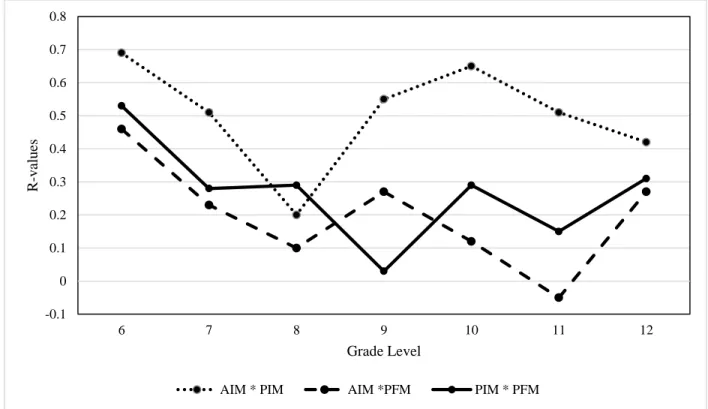
levels? Are there significant differences between early and late adolescence? In an attempt to align with previous research, grade, instead of age, was used to explore relationships among variables. Pearson correlation coefficients and descriptive statistics for the variables under examination in the seven grade groups are shown in Figure 1 and Table 4.3. It is noted that there were not enough participants in each grade level to establish sufficient power to report
significance. Correlations were consistently high across 6th grade. Students in 6th grade were likely to hold beliefs about intelligence that were closely related to the perception of their parent’s beliefs about intelligence and failure. Apart from 8th
43
Figure 4. 1. Patterns of Relationships Between Mindset Variables
found between adolescents’ beliefs about intelligence and what they perceive their parents to believe about intelligence in all grades except 8th and 12th, both transitional grades.
Because variables of parent intelligence mindset, parent failure mindset, adolescent intelligence mindset and grades were not normally distributed, the test for differences between students in early and late adolescence was performed with the Mann-Whitney U test (Table 4.4). The analysis indicated that adolescent intelligence mindset scores were significantly lower, that is more growth oriented, in early adolescence (Mdn= 8.00, n = 68) than in late adolescence (Mdn= 11, n = 77), U = 1950.0, z = -2.66, p = .008, with a small effect size r = -.22). No other significant differences were found between early and late stages of adolescence.
-0.1 0 0.1 0.2 0.3 0.4 0.5 0.6 0.7 0.8
6 7 8 9 10 11 12
R
-v
alu
es
Grade Level
44 Table 4. 3
Pearson Correlations Between Mindset Variables Across Grade Levels
PFM PIM Mean SD
Grade 6 PFM 7.08 3.33
N = 25 PIM .53** 4.68 2.51
AIM .46** .69** 9.0 4.90
Grade 7 PFM 8.48 3.50
N = 23 PIM .28 5.04 2.10
AIM .23 .51* 10.04 5.50
Grade 8 PFM 7.67 3.18
N = 15 PIM .29 5.40 2.44
AIM .10 .20 9.47 4.37
Grade 9 PFM 8.33 3.46
N = 18 PIM .03 5.0 2.20
AIM .27 .55* 10.22 4.26
Grade 10 PFM 9.11 3.07
N = 18 PIM .29 5.22 2.24
AIM .12 .64** 10.67 4.26
Grade 11 PFM 8.17 4.17
N = 24 PIM .15 5.25 1.23
AIM -.05 .51* 10.13 3.72
Grade 12 PFM 8.0 3.95
N = 22 PIM .31 5.86 2.42
AIM .27 .42 12.05 4.82
Note. AIM = Adolescent intelligence mindset; PIM = Perception of parent intelligence mindset, PFM = Perception of parent failure mindset
** p<.01, * p<.05
Table 4. 4
Mann Whitney U Test: Differences in Early and Late Adolescence
Variable
Early Adolescence Late Adolescence
n = 68 n = 78
Mdn Mdn U z p
Grades 177.0 178.82 2411 -.82 .41
AIM 8.0 11 1950.0 -2.66 .01*
PFM 7.87 8.29 2812.0 .77 .44
PIM 2.5 2.67 2884.5 1.07 .29
Note. PFM = Parent Failure Mindset; PIM = Perception of Parent Intelligence Mindset; AIM = Adolescent Intelligence Mindset