A Limited Dependent Variable Analysis of Integrated Pest Management Adoption in Uganda
Jackline Bonabana-Wabbi; [email protected] Daniel B. Taylor1; [email protected] Valentine Kasenge2; [email protected]
Selected Paper #156185 prepared for presentation at the American Agricultural Economics Association Annual Meeting, Long Beach, California, July 23-26, 2006
This research was supported by the Integrated Pest Management Collaborative Research Support Program – USAID Grant Number LAG-G-00-93-00093-00
1
Ph.D. Student and Professor, Department of Agricultural and Applied Economics, Virginia Polytechnic Institute and State University, Blacksburg, VA 24061
2
Senior Lecturer, Department of Agricultural Economics and Agribusiness Management, Makerere University, P.O. Box 7062 Kampala, Uganda
Keywords: Integrated Pest Management, Multivariate logit, Uganda
Copyright ©2006 by J. Bonabana-Wabbi, D. Taylor and V. Kasenge. All rights reserved. Readers may make verbatim copies of this document for non-commercial purposes by any
A Limited Dependent Variable Analysis of Integrated Pest Management Adoption in Uganda
(Abstract)
In Uganda overall crop loss due to pests exceeds that caused by drought, soil infertility, or poor planting material. Integrated Pest Management (IPM) technologies can reduce pest damage to crops by emphasizing non-chemical control methods thereby reducing potential negative effects of chemicals on the environment while preserving profitability. This study investigates the adoption of eight IPM practices including intercropping, crop rotation, two improved varieties, incorporating an ‘exotic weed chaser’, optimal planting dates, optimal planting density and fertilizer use. Variables include market forces, social factors, management factors, and technology delivery mechanisms. Results were consistent across the multivariate logit and ordered logit analyses. The single most important category of influential factors across all crops and technologies is economic/market forces, including labor availability, technology resource requirements, technology complexity, and the level of expected benefits. Social factors are generally less associated with IPM technology adoption than either market or institutional factors. Management factors are not important for adoption of the IPM technologies evaluated for the cowpea crop, while with groundnut IPM practices, no social or institutional factors are found to be important. High expected/potential benefits from the groundnut IPM technologies increase the probability of their adoption, as does the availability of off-farm income and farmers’ membership in farm organizations. Generally high levels of adoption (>75%) were observed with crop rotation, and improved varieties. Other technologies registered low levels of adoption (<25%), the least popular being the application of fertilizer on sorghum fields.
Background
Groundnuts (Arachis hypogaea L.), cowpeas (Vigna unguiculata) and sorghum (Sorghum bicolor) are important crops in Uganda. Groundnuts and cowpeas are the second and third most widely grown food legumes after common beans (Phaseolus vulgaris), while sorghum is the third most important cereal crop after maize and millet. FAO statistics estimate that 64,000ha, 208,000ha and 282,000ha of groundnuts, cowpeas and sorghum were grown in 2002 (FAOSTAT, 2002).
The productivity of these crops is constrained by numerous factors including low planting density, unfavorable rainfall patterns, soil infertility, and low yield of current varieties. For instance, farm level yield of groundnuts is estimated at only 800kg/ha while potential yields are 3,000kg/ha (Busolo-Bulafu, 2000). However the most important factor leading to low yields at the farm level exceeding crop loss due to drought, soil infertility or poor planting material is insects and diseases (Kyamanywa, 1996).
Field monitoring in Eastern Uganda revealed high insect levels on cowpea, sorghum and groundnuts. Major insect pests on cowpea included blister beetles, aphids, pod-borers, thrips and leafhoppers (IPM CRSP Annual Report, 1996). Insect damage contributes to 24-48% of the total variation in cowpea yield in Kumi district (Karungi et al., 1999). On sorghum, striga is the most serious weed, while on groundnuts, the diseases groundnut rosette and cercospora leafspot frequently lead to total crop failure. The most common intervention to address pest problems has been the application of pesticides (Van der Merwe, 2000). In fact cowpea is one of the crops that are consistently sprayed by farmers at almost all stages of the crop’s development (Adipala et al., 1999). Those who can
afford to use pesticides may not be effectively using them. Unfortunately continued improper use of pesticides is associated with: environmental degradation, build-up of pest resistance, killing of non-targeted beneficial organisms, and endangering human health.
IPM Intervention
Mitigating the adverse effects of pesticides has become a focus for many research programs. For example, a diverse range of non-chemical pest control options have been introduced including biological, cultural control (including the manipulation of planting dates and cropping patterns such as crop diversity and crop rotation), plant-host resistance, genetic transformation and hand removal of infected plants. In general individual methods of pest control may contribute to pest and disease suppression however no single method provides satisfactory results and as such an integrated approach is necessary. Producers need alternative pest management approaches that are feasible and economically sustainable. One such alternative is integrated pest management (IPM) that can help to increase agricultural production and reduce pesticide misuse. Although some literature indicates uncertainty of IPM profitability (Abara and Singh, 1993) or profitability of some, but not all parts of the total IPM package (Smith, Wetzstein and Douce, 1987), several studies demonstrate that benefits such as increased yields and net farm incomes can accrue from IPM adoption (Olson and Heady, 1982; Smith, Wetzstein and Douce, 1987; Mullen, Norton and Reaves 1997; Fernandez-Cornejo, 1998; Ogrodowczyk, 1999). In Uganda Bashaasha et al., 2000 established benefits ranging between Shs 101,3781 and Shs 255,908 per cropping season from adopting IPM CRSP (Collaborative Research Support Program) systems for striga
1
control. In another study, Bonabana et al., 2001 estimated a marginal rate of return of 870% by adopting a disease resistant variety as an IPM CRSP strategy for groundnuts. When IPM is profitable society can benefit from its adoption. However there is a lack of understanding of the factors affecting the adoption of IPM technologies on farming systems in Uganda. These factors may either be barriers to or enhancers of adoption. The factors could be a complex set of interactions or conditions involving the technology, the institutions, the potential/targeted adopter or the general setting in which the technologies are introduced. Only with an understanding of these factors affecting adoption can further insight be developed concerning strategies to promote IPM.
Objectives
The objectives of this study were threefold: (i) to establish the extent of IPM adoption among sorghum, cowpea and groundnut farmers, (ii) to identify and understand the factors that determine or constrain adoption of IPM practices on cowpea, groundnut and sorghum and (iii) to evaluate the relative contribution of each factor in the observed levels of IPM technology adoption.
The Pest Problem
Striga is the most serious pest of sorghum affecting yields in Uganda. This parasitic weed has a widespread distribution in Kumi. Ninety seven percent of sampled farmers in the 1996 IPM CRSP participatory assessment were able to identify it on their farms (Erbaugh et al., 2001) while over 40% sorghum farmers’ fields were affected in 2002 (Bonabana, 2002). The gravity of the striga problem is thought to stem from the fact that the seed evolved in such a way that it only germinates naturally when within the vicinity of a
sorghum (or other host) root. Eradication of this weed has been problematic and as such recent discussions suggest biotechnology as the most probable solution (Third World Network, 2003). However counter arguments indicate that poor farmers in Africa would be much better served by development of inexpensive methods of striga control rather than biotechnology. In Uganda IPM CRSP striga control methods include intercropping sorghum with celosia argentia and with silver leaf desmodium, planting striga tolerating genotypes, sorghum seed coating with herbicides, two weedings, manipulation of planting dates and crop rotation.
Pest occurrence on the cowpea crop is high. Major insect pests included aphids (A. craccivora), blister-beetles (Epicauta spp.), bollworms (Helliothis armigera), pod-borers (M. testularis) and stinkbugs (Nezara viridula). Diseases include cowpea mosaic virus (CMV), leaf rust (Uromyces vignae) and anthracnose (Colletotrichum lindemuthianum). Disease control efforts on cowpea are not as intense as insect control probably because the vectors of the disease are insects. A number of studies revealed that cowpea production could be improved and increased through well-defined IPM systems (Jackai et al., 1985; Isubikalu, Erbaugh and Semana, 1997). Among the most promising strategies developed by IITA (International Institute of Tropical Agriculture) in collaboration with IPM CRSP include improved storage techniques using solar drying and the use of botanical pesticides (CGIAR, 2002). Current cowpea IPM practices disseminated to farmers include close spacing (30cm x 20cm), well-timed defoliation, intercropping with sorghum at a spacing of 60cm x 20cm, and strategic insecticide application (spraying once at budding, flowering, and podding).
Insect incidence on groundnut is fairly high, although little effort was put into controlling them as two diseases significantly impact groundnut yield. They are cercospora leafspot and groundnut rosette. IPM practices developed by researchers include early planting, manipulation of planting density (30cm x 10cm or 45cm x 15cm), planting a resistant variety and maintaining a minimum spray schedule of 2-3 Dimethoate or 1-2 Dimethoate and Dithane M45. The crop is also often intercropped with maize as a control strategy (IPM CRSP Annual Reports, 1998-2000).
The Study Area
The study area is Kumi district in Eastern Uganda. Kumi is of interest because it is a large producer of sorghum, cowpea and groundnuts, with 80% of farmers in the district growing the three crops (Erbaugh et al., 2001). It is also one of the IPM CRSP primary research sites in Uganda. With an estimated land area of 2,457sq km the district occupies about 1.2% of the country’s total land area and a population of more than 236,700 people. Agriculture is the main economic activity in the district. Main crops produced include grains like millet groundnuts, sorghum, cowpea, rice and cotton. The crops are grown under a bimodal rainfall pattern – the longer first rains are from March-July and shorter second rains from September-November.
Data Collection
Both qualitative and quantitative data were collected from sorghum, cowpea and groundnut farmers with open-ended and structured questions administered through personal interviews with 212 farmers in the Spring of 2002. Questions asked can be categorized as: demographic information, general farming practices, occurrence of
insects and diseases on farmer’s crops, farmer’s knowledge of specific IPM practices and their perceptions of the requirements of various IPM practices compared to their conventional practices. The potential variables used to explain adoption of various practices included information in four broad categories: economic, social, management and institutional factors. Specific variables included were farmer’s age, household size, education, farm size, farming experience, and farm yields. Other questions asked pertained to institutional aspects such as farmer’s accessibility to agricultural information, prior participation in pest control activities or farmer’s accessibility to agricultural extension staff. In addition, farmer’s access to credit, their input-acquisition decision making process, and their managerial ability were other factors that were studied.
Data Analysis
Data was analyzed in two steps. Step 1 involved running simple analyses on the data such as descriptive analyses, cross-tabulations with chi-square tests, and analysis of variance. In addition collinearity diagnostics were conducted to determine the presence of linear dependences among variables. Highly collinear variables were eliminated from the models. The use of computer algorithm alone to select variables to include in a model is inappropriate and inclusion of certain variables of special interest even when they are not statistically significant may be more important than reliance on computer-generated models. Variable selection for the models in this study therefore involved manual stepwise procedures through likelihood ratio tests. Stepwise procedures involve running univariate analyses and selecting independent variables individually that had a significant relationship with the independent variable; multivariate analysis using all variables
Fertilizer application Celosia Crop rotation Seed coating with herbicides*
Sorghum
Seed dressing* Defoliation* Minimum spray schedule*
Close spacing* Intercropping Early planting** Improved variety** Cowpea Close spacing Improved variety Timely planting* Minimum spray schedule*
Groundnuts Integrated Pest Management
Package
retained from the univariate analysis; and finally elimination of insignificant variables based on Wald tests and likelihood ratios. This procedure ensures retention of variables that explain the underlying complexity with the simplest model (Hosmer and Lemeshow, 2000)
Step 2 was a two-tiered analysis involving identification of determinants of adoption of eight technologies individually on the three crops, and then of determinants of the extent of adoption relating to the adoption of multiple technologies. Because the three crops are different in nature and different pests attack them, the IPM CRSP developed different control strategies for the different crops. The individual practices may not be new phenomena, however, their combination into a set of practices for pest control is a “new idea” developed and disseminated by the IPM CRSP (See figure 1). Consequently the proposed models differ slightly based on the specific characteristics of the technology for each crop.
* IPM technologies not investigated2
** Non-IPM CRSP pest control technologies investigated
Figure 1: Components of IPM pest control strategies on cowpea, sorghum and groundnuts
2
These practices were mostly found to have either 100% adoption or 0% adoption. In this case, the dependent variable becomes a constant, and does not provide enough variability to estimate a valid model. In addition, with these extremes in responses the fitted probability is either zero or one and this leads to failure to converge (McCullagh and Nelder, 1989). Finally, some of these practices are “new” and it is too early to evaluate their adoption.
The Models
Adoption is an end-result of farmers’ decisions based on economic expectations. It is assumed that rational farmers’ objective is to maximize utility. They may adopt a technology whose expected benefits are at least as large as those of the current technology. These benefits may include increased production, increased profitability and food self-sustainability. Many factors determine both the rate and extent of acceptability of technologies by farmers. These factors can be institutional, social, economic or even managerial characteristics of the potential adopter.
Economic factors include labor availability, technology resource requirements, farm size, technology complexity and the level of expected benefits. The effect of farm size has been variously found to be positive (Feder, Just and Zilberman, 1985; Fernandez-Cornejo, 1996; Kasenge, 1998), negative (Harper et al., 1990) or even neutral to adoption (Mugisa-Mutetikka et al., 2000). Farm size affects adoption costs, risk perceptions, labor requirements and more. With some technologies the speed of adoption is different for small- and large-scale farmers. Farmers operating larger farms tend to have greater financial resources and access to credit than small farms. The rate and scope of adoption tend to be positively related to farm size, except in the case of an input-saving technology such as land-saving or labor-intensive technology. The decision to adopt is often an investment decision. Therefore adoption can be expected to be dependent on cost of a technology and on whether farmers posses the required resources. Technologies that are capital-intensive are only affordable by wealthier farmers (El Osta and Morehart, 1999) and hence adoption of such technologies is limited to larger farmers who have the wealth (Khanna, 2001). The level of expected benefits from adoption affect the rate and extent of
adoption as higher benefits can motivate people to adopt. As many researchers have found, a higher percentage of total household income coming from the farm tends to correlate positively with adoption of new technologies (McNamara, Wetzstein and Douce, 1991; Fernandez-Cornejo, 1996).
Among the social factors affecting adoption is the age of the adopter. However, contention on the direction of the effect of age on adoption exists with researchers finding mixed effects of age. Age’s positive influence on adoption of sorghum in Burkina Faso, IPM on peanuts in Georgia and on adoption of chemical control of rice stink bugs in Texas, is found in Adesiina and Baidu-Forson, 1995; McNamara, Wetzstein and Douce, 1991; and Harper et al., 1990 respectively. However age was found to be either not significant or negatively correlated with adoption of land conservation practices in Niger (Baidu-Forson, 1999), rice in Guinea (Adesiina and Baisu-Forson, 1995), and fertilizer in Malawi (Green and Ng’ongo’ola, 1993). The negative relationship is explained by the assumption that as farmers grow older, there is an increase in risk aversion and a decreased interest in long-term investments. The positive effect of age is thought to stem from accumulated knowledge and experience of farming systems obtained from years of observation and experimenting with various technologies.
Institutional factors include information accessibility and availability of extension contacts. Access to information affects farmers’ perceptions of risk associated with a technology’s performance. Feder and Slade (1994) indicate how, provided a technology is profitable, increased information induces its adoption. However some argue that it’s the right mix of information properties such as accuracy, reliability and consistency that
is effective in impacting adoption. Good extension programs and contacts with producers are enhancers to technology adoption especially since new technology is often said to be as good as the mechanism of its dissemination.
The farmer’s managerial capabilities that may discourage or enhance adoption include membership in farm organizations, participation in on-farm trials, their quest for improved varieties and input purchase decisions. Farmers’ membership and active participation in farm organizations and pest training/control farm demonstrations is indicative of farmers’ interest in good husbandry practices and enables them to improve their farm decision-making processes. See Table 1 for a listing and description of the variables considered in the models in this study.
Table 1: Description of variables used in the models
Var. Name Type Description [Value] Economic Factors
PEST Discrete Incidence of insects (INSECT)/weeds (WEED)/diseases (DZZ) on crops [0=No, 1=Yes, 2=Don’t know]
HIRE Binary If farmer hires labor [1=Yes, 0=No] FMSZ Continuous Total farm size (ha)
YIELD Continuous Crop yield in last season (kg) [SGYD, CPYD, GNYD] FTANY Binary If farmer uses fertilizers on any other crops [0=No, 1=Yes] RACRE Continuous Proportion of total farm acreage under specific crop (ha) FMLBR Continuous Number of family members working on farm
OFFLBR Continuous Family members working off the farm
INCMSC Binary If farmer has off-farm income sources [0=No, 1=Yes] RFMLBR Continuous Proportion of family members working on farm
RSCEREQ Discrete Resource requirements: Management Time (MGT), Labor (LBR), Land (LND), Cost (COST), Knowledge/Skill (KNOW) for IPM practice (Fertilizer use FTIS, Crop rotation ROTN, Timely planting TPCP, Intercropping ICCP and Close spacing CLSP relative to
conventional practices [1=High, 0=Otherwise] Social Factors
AGE Continuous Age of respondent
MSF Dummy Farmer’s marital status [0=Not married 1=Married 2=Divorced/Widowed/Separated]
HHSZ Continuous Number of household members (Persons) EDUC Continuous Number of years of formal schooling (Years) FMEXP Continuous Length of farming experience (Years)
GENDER Binary Gender of farmer [0=Female, 1=Males]
RFMEXP Continuous Proportion of farming years to age of respondent Management Factors
BFCP Binary Whether farmer borrows to finance crop production [0=No, 1=Yes]
HARM Dummy Perception of hazardous effect of pesticides [0=No harm, 1=Harm, 2=Don’t know]
PURCH Binary Who makes input purchase decisions (Fertilizer, Pesticide, Seed, Farm implement) [1=Exclusively Males, 0=Otherwise]
ONFTR Binary If farmer participates in on-farm trial demonstrations [0=No, 1=Yes]
BFMORG Binary If farmer belongs to a farmer organization [0=No, 1=Yes] OWNIPM Binary If farmer ‘owns’ plots with any IPM recommended practice
[0=No, 1=Yes]
VARIETY3 Binary If farmer grew improved variety [0=No, 1=Yes] Institutional Factors
EXTS Dummy Frequency that farmer has had contacts with extension staff [0=None, 1=Few, 2=Many]
TRNNG Binary If farmer had had other training in pest control[0=No, 1=Yes] HDIPM Binary If farmer has heard of IPM [0=No, 1=Yes]
INFOSC Continuous Number of farming information sources available to farmer INFOTYPE Information from MUK, MAAIF& Farm organizations (RSCH)/
NGOs, neighbors & friends (INFNNF) /radio & newspapers (MEDIA)
3
Empirical Model
When the dependent variable can take on a number of discrete values or is dichotomous, use of continuous data analytical tools is inappropriate. In adoption decisions, the random variable is discrete or dichotomous and such responses are best modeled using limited dependent variable models such as the Probit, Logit and Tobit, or in other words, logistic regression models. Logistic models use the method of Maximum Likelihood Estimation (MLE) to give unbiased and efficient estimates of the probability that the dependent variable will take on the discrete or dichotomous values (Amemiya, 1981). The method of maximum likelihood finds the function that maximizes the ability to predict the probability of the dependent variable based on what is known about the independent variables. The first approach taken in this analysis is to consider adoption decisions as binary choices, where adoption either occurs or does not. In the case of such dichotomous responses the ordinary logit model is sufficient to model such responses as:
ln
∑
= + + = ⎥ ⎥ ⎦ ⎤ ⎢ ⎢ ⎣ ⎡ = − = n i X e X Y p X Y p i i 1 ) 1 ( 1 ) 1 ( β α (1) Where:p(.) = Probability that an IPM technology (Y) is adopted α =Constant term
X = A set of core explanatory variables
β = A vector of unknown parameters
e = Disturbance term
The binary dependent variables in the eight models: FERT (fertilizer), ECAT (celosia argentia), ROTN (crop rotation), for sorghum; CLSP (close spacing), IGNV (improved
groundnut variety) for groundnuts; and TPCP (early planting), ICPV (improved cowpea variety), ICCP (cowpea intercrop) for cowpea denote whether a farmer practiced the technology or not. For example FERT is equal to 1 if the respondent adopted fertilizer use and 0 otherwise. Modeling binary decisions in a logit is equivalent to estimating a linear regression model where the dependent variable is the logarithm of the odds of adoption. Hence the logit is linear in the explanatory variables. However the parameter βdoes not mean the change in probability per unit change in the independent variable
but can be converted to marginal probabilities which allows the determination if a change in farmers adoption behavior if the dependent variables change by a given amount.
⎥⎦ ⎤ ⎢⎣ ⎡ ⎥ ⎥ ⎦ ⎤ ⎢ ⎢ ⎣ ⎡ ∑ + = ∂ = ∂ + + ∑ X Y e e X X Y p e X e X 2 ) 1 ( ) 1 ( β β =βp(Y =1X)[1−p(Y =1X)] (2)
However this model is not sufficient for examining the extent and intensity of adoption. Feder, Just and Zilberman (1985) argue that adopters do not only have a binary choice; that there are varying stages of adoption, hence there is variation within the class of adopters. Adopters may choose to adopt a subset of the technological package or all of the components of a package. In such a case the use of dichotomous models may misrepresent decisions made by such farmers.
The second approach taken in this study examined farmers’ adoption decisions when the technologies can be complementary. For example a sorghum farmer can be said to be an adopter of intercropping, celosia, or fertilizer individually, or in combination with one or more other practices. These options are possible because farmers’ decisions to use these practices need not be simultaneous or sequential. In addition, although individual
technologies are parts of an overall IPM package, they are not necessarily technically interdependent. In this study, unlike in some adoption studies (Kato, 2000), a two-tiered process of analysis is employed first, to identify adopters and non-adopters of a single technology, and then within the class of adopters, to consider the intensity of adoption. In this case because the outcome of a decision can take on a set of ordinal categories also known as multi-category responses, cumulative logit analysis that incorporates orderings in responses has a greater power to explain behavior. Suppose the dependent variable (Y) can take on three discrete categorical values and let
p1=P(Y=1), p2=P(Y=2), and p3=P(Y=3) (3)
Then the ordinal logistic regression models the relationship between the cumulative logits of Y, that is ln ⎟⎟ ⎠ ⎞ ⎜⎜ ⎝ ⎛ − 1 1 1 p p =ln ⎟⎟ ⎠ ⎞ ⎜⎜ ⎝ ⎛ + 3 2 1 p p p , and ln ⎟⎟ ⎠ ⎞ ⎜⎜ ⎝ ⎛ + − + ) ( 1 1 2 2 1 p p p p = ln ⎟⎟ ⎠ ⎞ ⎜⎜ ⎝ ⎛ + 3 2 1 p p p (4)
The model assumes a linear relationship for each logit (like in the ordinary logit) but with parallel regression lines, so that for each cumulative logit the parameters are the same except for the intercept a
ln ⎟⎟ ⎠ ⎞ ⎜⎜ ⎝ ⎛ − 1 1 1 p p = ai +
∑
bX (i= 1,2,3) (5)Where p1is predicted probability of adoption of any one technology, a is the intercept, b is a vector of parameter estimates and X the set of explanatory variables. The model estimates b show how changes in the log odds of adoption occur with changes in the explanatory variables. If parameter b>0 then p1, the predicted probability of (Y=1) as well as the cumulative probability of (Y=1 or Y=2), p1+p2, are higher for higher values of
x. This approach provides adoption indices based on the intensity of adoption of various technologies. The dependent variable in these models is a multi-category variable with an index “1”, “2” and so forth representing adoption of one, two, and so forth technologies.
Results and Discussion
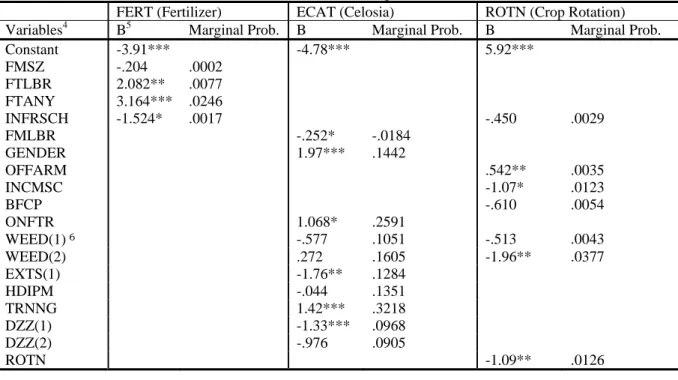
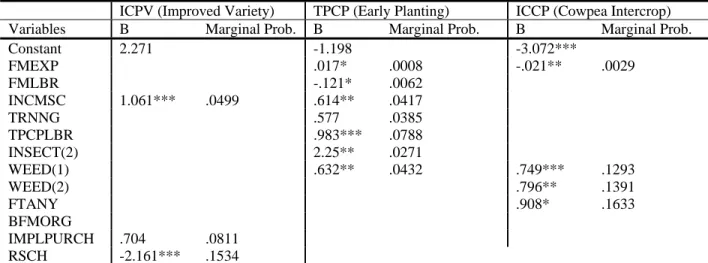
Statistically significant and theoretically important predictors were selected from a set of variables given in Table 1 above using stepwise analysis (Hosmer and Lemeshow, 2000). Maximum likelihood estimates of the logit model are presented in tables 2-4 together with marginal probabilities of the explanatory variables. The marginal probabilities are evaluated at the mean of the continuous variable and at the mode for the non-continuous variables. Because the nature of each technology is different, each model includes different blocks of independent variables.
Table 2: Maximum Likelihood Estimates for the Sorghum models
FERT (Fertilizer) ECAT (Celosia) ROTN (Crop Rotation)
Variables4 B5 Marginal Prob. B Marginal Prob. B Marginal Prob.
Constant -3.91*** -4.78*** 5.92*** FMSZ -.204 .0002 FTLBR 2.082** .0077 FTANY 3.164*** .0246 INFRSCH -1.524* .0017 -.450 .0029 FMLBR -.252* -.0184 GENDER 1.97*** .1442 OFFARM .542** .0035 INCMSC -1.07* .0123 BFCP -.610 .0054 ONFTR 1.068* .2591 WEED(1) 6 -.577 .1051 -.513 .0043 WEED(2) .272 .1605 -1.96** .0377 EXTS(1) -1.76** .1284 HDIPM -.044 .1351 TRNNG 1.42*** .3218 DZZ(1) -1.33*** .0968 DZZ(2) -.976 .0905 ROTN -1.09** .0126 4
See Table 1 for description of variables.
5
*** Significance at the 5% level, while ** and * is significance at the 10% and 20% levels.
6
The reference category with dummy variables is the absence of the value category, that is, when the value of the category is zero, that category is used as the reference.
Table 3: Maximum Likelihood Estimates for the Cowpea models
ICPV (Improved Variety) TPCP (Early Planting) ICCP (Cowpea Intercrop)
Variables B Marginal Prob. B Marginal Prob. B Marginal Prob.
Constant 2.271 -1.198 -3.072*** FMEXP .017* .0008 -.021** .0029 FMLBR -.121* .0062 INCMSC 1.061*** .0499 .614** .0417 TRNNG .577 .0385 TPCPLBR .983*** .0788 INSECT(2) 2.25** .0271 WEED(1) .632** .0432 .749*** .1293 WEED(2) .796** .1391 FTANY .908* .1633 BFMORG IMPLPURCH .704 .0811 RSCH -2.161*** .1534
Table 4: Maximum Likelihood Estimates for the Groundnut models
Variables IGNV (Improved Variety) CLSP (Close Spacing)
B Marginal Prob. B Marginal Prob.
Constant .604 -1.786*** IGOLAYD -.037 .0222 GENDER ..411* .0745 INCMSC .890*** .1984 FTANY -1.236** .1692 BFMORG .792*** .1902 CLSPLND .676** .1081 FMLBR .140*** .0309 CLSP .768*** .1433 ONFTR .626 .1210 IGNV INFNNF -.732** .1558
Three models: CLSP, TPCP, and ECAT had more highly significant variables than the other adoption models. For the fertilizer model, the level of adoption is extremely low. As such, for this model only a few variables remained after the stepwise analysis. Although not significant, the FERT model shows that farm sizes (FMSZ) is negatively correlated with fertilizer adoption for weed control in sorghum, while prior participation in pest control training (TRNNG) and in on-farm trial demonstrations (ONFTR) positively influences adoption of celosia. Highly significant variables in the adoption model for improved cowpea (ICPV) and groundnut (IGNV) varieties are economic factors.
Goodness-of-fit tests
Several goodness-of-fit tests tell how well the model fits the data. Results generally show that the variables included in each model explain some variability of the dependent variables, as shown by the values of the McFadden’s R2 (Table 5 below). In addition, the correctly predicted percent is high, ranging from 69.8% to 97.5%. Overall, models were significant at the 0.05 level (except ICCP and IGNV, significant at the 0.1 level). However, coefficients of many variables are not different from zero (at the 0.05 level), as shown by the Wald tests. The model fitting procedures attempted to find the most important variables explaining adoption. The model chi-square of 19.89 for the FERT model corresponds to p=0.000 with 5 degrees of freedom shows the model is highly significant. All models do relatively well in terms of correctly classifying adopters from non-adopters.
Table 5: Summary Goodness-of-fit Statistics for Logit Models
Statistic FERT ECAT ROTN ICPV ICCP TPCP CLSP IGNV
Initial LL 54.49 149.26 113.13 122.67 225.24 212.45 287.75 229.23 Final LL 34.6 95.96 89.75 104.96 209.13 179.05 253.44 214.07 Chi-square 19.89 53.3 23.39 17.72 16.117 33.40 34.31 15.16 Model sign.[df] .001[5] .00[13] .009[9] .013[7] .064[9] .005[15] .001[13] .056[8] Obs. Correctly classified (%) 97.5 91.9 92.9 91.9 78.9 82.8 69.8 77.4 McFadden’s R2 .36 .36 .207 .144 .072 .157 .119 .066 No.of iterations 7 6 6 6 4 4 3 4
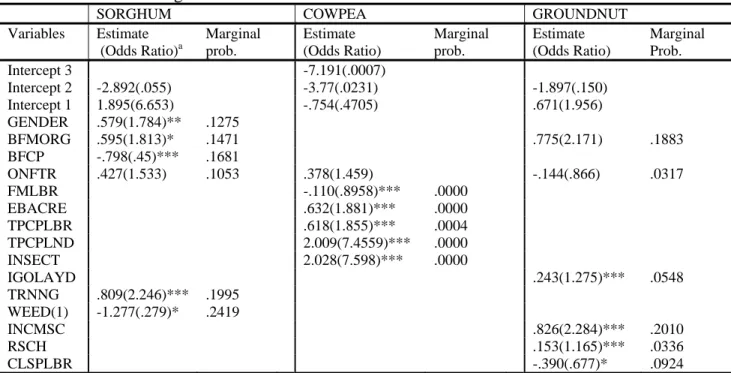
Table 6 below reports summary results of cumulative logit model estimates for adoption of one, two or three technologies for the three crops
Table 6: Cumulative logit estimates
SORGHUM COWPEA GROUNDNUT
Variables Estimate (Odds Ratio)a Marginal prob. Estimate (Odds Ratio) Marginal prob. Estimate (Odds Ratio) Marginal Prob. Intercept 3 -7.191(.0007) Intercept 2 -2.892(.055) -3.77(.0231) -1.897(.150) Intercept 1 1.895(6.653) -.754(.4705) .671(1.956) GENDER .579(1.784)** .1275 BFMORG .595(1.813)* .1471 .775(2.171) .1883 BFCP -.798(.45)*** .1681 ONFTR .427(1.533) .1053 .378(1.459) -.144(.866) .0317 FMLBR -.110(.8958)*** .0000 EBACRE .632(1.881)*** .0000 TPCPLBR .618(1.855)*** .0004 TPCPLND 2.009(7.4559)*** .0000 INSECT 2.028(7.598)*** .0000 IGOLAYD .243(1.275)*** .0548 TRNNG .809(2.246)*** .1995 WEED(1) -1.277(.279)* .2419 INCMSC .826(2.284)*** .2010 RSCH .153(1.165)*** .0336 CLSPLBR -.390(.677)* .0924 a
Asterisks indicate level of significance: ***, ** and * for 5%, 10% and 20% levels
Recall that the cumulative logit model assumes a linear relationship but with parallel regression lines, so that for each cumulative logit the parameters are the same except for the intercept. So in Table 6 above the adoption of any one (of the three) sorghum IPM CRSP technology is dependent on six variables: only the variable ONFTR (participation of farmers in on-farm trials) does not have a significant effect on adoption of one and two sorghum technologies, but membership in farmers’ organizations (BFMORG), GENDER, prior training in pest control and weed incidence (WEED) do. Estimated odds of 1.81 for the BFMORG variable indicate that the likelihood of adoption of sorghum technologies increases almost two-fold when farmers belong to farmers’ organizations than when they do not.
The adoption of one and two sorghum technologies declines when the availability of crop financing increases (BFCP). This is a rather strange finding. The more training (TRNNG)
farmers obtain, the more likely they are to adopt one or two IPM sorghum technologies. Availability of family labor (FMLBR), acreage in improved variety (EBACRE), insect incidence (INSECT) and labor constraints (TPCPLBR) at the time of planting are significant in explaining the three levels of cowpea technology adoption. The negative coefficient on family labor (FMLBR) indicates that the variable is associated with reduced adoption of any cowpea technology. Higher yield of Igola-1 (IGOLAYD) is positively related to adoption of groundnut pest control strategies. Availability of off-farm income (INCMSC) and off-farmer membership in off-farm organizations (BFMORG) positively influences their adoption of groundnut technologies.
Economic factors
Fertilizer use on other crops (FTANY) in the farmer’s cropping system promotes its use in sorghum. This is in fact the most influential factor in fertilizer adoption as gauged from the high value of its marginal probability. The positive coefficient on the variable representing labor constraints in fertilizer use (FTISLBR) is unexpected as it indicates that high labor requirements involved in fertilizer use do not negatively influence its adoption. Economic factors that are important in explaining adoption of celosia and other Striga chasers include availability of farm labor and disease incidence, both factors affecting adoption negatively. High availability of unpaid family labor (FMLBR) negatively affects adoption of celosia technologies. Also, farmers who adopt celosia report low crop disease incidence.
In the sorghum crop rotation model, 80% of the significant variables are economic factors. The most important variable explaining the adoption of crop rotation was weed
incidence, with farmers who adopt the practice being less prone to experience weed problems. This variable is a proxy for the level of expected benefits from adoption of a technology. Availability of off-farm income (INCMSC) acts as a hindrance to adoption of crop rotation. That is, farmers with more income appear to prefer to use their finances in other practices other than crop rotation. High management time requirements involved in crop rotation (ROTNMGT) also acts as a barrier to this practice’s adoption.
Crop losses due to high pest incidences (WEED and INSECT) provide an incentive for pest control in cowpea production, through practicing timely planting. In addition labor constraints at planting time (TPCPLBR) induce farmers to plant early to avoid peak labor demands. This is important to ensure the cowpea crop reaches maturity before the pest populations peak. Intercropping cowpea with cereals is positively influenced by weed incidence (WEED) in the cowpea plots implying that perhaps, as a weed control strategy, farmers who experience high weed incidences are induced to intercrop. In groundnuts, close spacing was positively influenced by availability of off-farm income (INCMSC), but negatively by use of fertilizer on other crops (FTANY). High farm labor availability (FMLBR) positively influences adoption of the improved groundnut variety.
Social factors:
Social factors were generally not related to sorghum technology adoption except celosia. The positive coefficient on the gender variable (GENDER) indicates that males were more likely to adopt celosia than females. In groundnut production the gender variable was positively associated with practicing close spacing.
Farming experience (FMEXP) positively influenced early planting of cowpea. Farmers with accumulated farming experience probably acquire knowledge of seasonal changes that signal the approaching sowing season and thus prepare resources necessary for sowing. In addition, these farmers may have acquired encouraging returns from the practice and thus continue with it anticipating continued benefits. Both these aspects could influence farmers’ inclination to plant at the on-set of rains. On the other hand, accumulated farming experience acted as a barrier to intercropping cowpea with cereal crops. It is probable that past experience with poor performance of cowpea intercrops may discourage increased intercropping.
Management related factors:
Management factors played no significant role in FERT, while with celosia, farmers’ participation in on-farm trials (ONFTR) increased the likelihood of the practice’s adoption in sorghum. When males purchase implements (IMPLPURCH) the probability of practicing crop rotation in sorghum decreases, as seen from this variable’s negative coefficient. None of the management factors analyzed in this study were related to cowpea technology adoption. In groundnut production, however, results show that adoption of close spacing was induced by farmers’ membership in organizations (BFMORG), participation in on-farm demonstrations (ONFTR), and the variety farmers grew (IGOLA). Ideas obtained from farmers organizations may be related to planting at high plant density because of the benefits gained from either improved yields or from less pest pressure on the close spaced crop.
Institutional factors:
In sorghum models, three institutional factors affect the adoption of celosia and fertilizer adoption. Information from researchers (RSCH) does not positively influence farmers to use fertilizer, while it has a pronounced positive effect on celosia adoption. In addition, attaining pest control training (TRNNG) increases the probability of celosia adoption. Adoption of improved Ebelat cowpea variety does not seem to be positively influenced by information from researchers. This finding is not unexpected. Growing an improved cowpea variety as a pest control strategy was not an IPM recommendation in the study area. This technology was included in this analysis to examine how responsive farmers were of other potential technological changes. Nonetheless, farmers’ access to informal sources of information like friends, neighbors and others (INFNNF) had a positive effect on the likelihood of the improved cowpea variety adoption. Groundnut technologies were not affected by institutional factors.
Policy Implications and Future Direction
Results from this analysis reinforce similar findings by other researchers. That labor is important in adoption models is evident in Bartel and Lichtenberg (1987) and in Green and Ng’ong’ola (1993) among others. Bartel and Lichtenberg (1987) found that it is not the availability of labor, but rather how skilled the labor is that would be important in technology adoption. In their study of factors affecting fertilizer adoption in Malawi, Green and Ng’ong’ola (1993) found that the availability of regular labor positively influenced a practice’s adoption.
Farm labor availability in this study positively influenced growing of improved groundnut variety Igola-1. This variable was positively correlated with household size suggesting that a big household yielded a large family labor force. In general, big households have larger food demands than smaller ones. The improved disease-resistant varieties were also high yielding. Therefore the high involvement of family members in growing high yielding varieties is consistent with households’ food consumption requirements.
The most influential variables in celosia adoption are institutional/informational factors, including farmers’ access to information from researchers and training in pest control activities. These services have been part of an ongoing IPM CRSP study involving farmer field schools. The big influence they have suggests that continuing and/or intensifying their activities would further enhance technology adoption.
Another important factor with a positive influence on celosia technology adoption was farmers’ participation in on-farm trial demonstrations. It should be noted that celosia technology is largely a ‘new’ technology, and farmers are likely to attach a higher risk premium to such technology than on the more ‘indigenous’ practices. It is not surprising that its adoption is encouraged more through farmers having hands-on experience than might be the case with the more indigenous technologies. This suggests that the introduction of such ‘exotic’ practices should be preceded by encouraging higher farmer participation in on-farm trial demonstrations as a means of increasing farmers’ practical experience with the introduced technologies.
The positive effect that the variable off-farm income (INCMSC) had on adoption of close spacing highlights how essential availability of non-farm earnings may be in financing the purchase of inputs, such as labor, necessary for practicing close spacing. Females were more inclined to borrow to finance crop production than males. In the event that the borrowed capital is directed to purchasing these inputs, providing accessible credit to women farmers would enhance the adoption of this practice. Males were more likely than females to adopt celosia technology. Celosia technology is an exotic control method and accessibility to information about such technologies may be mostly a preserve for males. To change this, programs that target both gender groups would be necessary to ensure equitable adoption of practices between males and females.
None of the management factors analyzed in the study were related to cowpea technology adoption. This suggests that high managerial capacity of farmers may not be an important aspect in efforts to disseminate these cowpea technologies. Management factors in several studies (McNamara, Wetzstein, and Douce, 1991; Waller et al., 1998) were found to hinder technology adoption. In the latter study the more intensive the management effort required for integrated pest management the less likely potato farmers were to adopt these technologies. The finding here that management factors do not play an important role in cowpea technology adoption implies that introduction of this cowpea IPM technology in Uganda can take place regardless of cowpea farmers’ managerial capability.7
7
Recall: Factors under this broad category of management included ability for farmers to borrow for crop production, membership in farmers’ organizations, input purchase decision making, and participation in on-farm trial demonstrations.
Farmers’ perception of the harmful effect of chemicals did not influence farmers’ decisions in regard to IPM technology adoption. This is in spite of farmer’s high knowledge about this issue. A plausible explanation would be that these farmers do not consider environmental and health impacts important considerations when choosing farming practices or that they feel that they do not have an alternative to pesticides. A similar result was also found in the analysis of adoption of non-chemical methods for controlling olive pests in Albania (Daku, 2002). Educational programs geared to increasing awareness about the effects of chemicals and the effectiveness of alternative methods of pest control could transform this attitude and hence influence farmers to adopt IPM practices.
The effect of size of farm holdings (FMSZ) was unimportant in adoption decisions. A study analyzing factors affecting adoption of new bean varieties in Uganda found a similar result (Mugisa-Mutetikka, 2000). In the current study, in the fertilizer adoption model where this farm size variable was not eliminated at the preliminary analysis stage, its effect was negative (although insignificant). That this variable was not significant in explaining adoption might suggest that IPM technologies are mostly scale neutral. This finding is particularly important for IPM dissemination in the study area implying that IPM practices could be introduced to farming systems regardless of the farmer’s scale of operation.
Females had less formal education than males. And perhaps to make up for this, they strive to acquire information and skills by belonging in farmers’ organizations. However, membership in farmers’ organization was not a significant factor in adoption of many
practices except close spacing of groundnuts (CLSP) and celosia (ECAT). In fact, for the case of celosia adoption, this variable exerted a negative influence on the probability of adoption. The most plausible explanation is that information obtained in the farmer organizations may not have contained information about celosia. Providing IPM-content information at farm organization meetings might enhance dissemination of these technologies and in particular this would target women farmers whose membership in farm organizations was significantly higher than males.
Overall, it appears that these policy changes are mostly applicable to institutional and management factors. Economic and social factors could be effected through institutional changes. Also important to note is that it appears that the more ‘exotic’ an introduced practice is, the more its adoption will be dependent on how the information about the practice is presented. This argues for the intensification of training and educational programs for potential adopters of that unfamiliar practice.
References
Abara, I. O. C. and S. Singh. “Ethics and Biases in Technology Adoption: The Small Farm Argument.” Technological Forecasting and Social Change. 43 (1993): 289-300.
Adesiina, A.A. and J. Baidu-Forson. “Farmers’ Perceptions and Adoption of New
Agricultural Technology: Evidence From Analysis in Burkina Faso and Guinea, West Africa.” Journal of Agricultural Economics. 13 (1995):1-9.
Adipala, E., C.A. Omongo., A. Sabiti., J.E. Obuo., R. Edema., B. Bua and M.W.
Ogenga-Latigo. “Pests and diseases of cowpea in Uganda: Experiences from a diagnostic survey.” African Crop Science Journal. 7(4) (December 1999):465.
Amemiya, T. “Qualitative Response Models: A Survey.” Journal of Economic Literature. The American Economic Association. 19 (1981):1483-1536.
Baidu-Forson, J. “Factors Influencing Adoption of Land-enhancing Technology in the Sahel: Lessons from a Case Study in Niger.” Journal of Agricultural Economics. 20(1999):231-239.
Bashaasha, B., V. Kasenge., D.B. Taylor., J. Olupot and M. Erbaugh. “An Economic
Assessment of the Integrated Striga Management Strategy for Small-scale Sorghum Farmers in Uganda.” Annual Report, IPM CRSP, 2000.
Bonabana, J., D. B. Taylor., V. Kasenge., B. Bashaasha and M.J. Erbaugh. “Assessing the Economic Impacts of IPM CRSP Strategies on Groundnut Diseases in Kumi-Uganda.” Annual Report, IPM CRSP, 2001.
Bonabana J. “Assessing Factors Affecting Adoption of Agricultural Technologies: The case of Integrated Pest Management (IPM) in Kumi District, eastern Uganda.” MS thesis, Virginia Polytechnic Institute and State University, 2002
Busolo-Bulafu C.M. “Breeding and New Releases of Groundnuts in Uganda.” Proceedings of the Stakeholders workshop, Mbale, Uganda 24-25 February 2000
CGIAR, Consultative Group on International Agricultural Research. (Online) URL:
http:///www.cgiar.org September 2002.
Daku, L. “Assessing farm-level and aggregate economic impacts of olive integrated pest management programs in Albania.” PhD. Dissertation. Virginia Polytechnic Institute and State University, 2002
El-Osta H.S and M.J. Morehart. “Technology Adoption Decisions in Dairy Production and the Role of Herd Expansion.” Agricultural and Resource Economics Review. 28 (1999): 84-95.
Erbaugh J.M., S. Kyamanywa, P. Kibwika, D. Taylor, V. Odeke and E. Mwanja. “Baseline II: A Follow-up survey of farmer pest management practices and IPM knowledge diffusion.” Working paper 01-2. IPM CRSP. October, 2001.
FAOSTAT, The Food and Agricultural Organization of the United Nations Production Databases [Online], URL: http://www.fao.org. January 20, 2002, October 18, 2002, May 2002.
Feder, G. and R. Slade. “The acquisition of information and the adoption of new
Technology.” American Journal of Agricultural Economics. American Agricultural Economics Association. 66 (August 1984):312-320.
Feder, G., E. R. Just and D. Zilberman. “Adoption of Agricultural Innovations in
Developing Countries: A Survey.” Economic Development and Cultural Change. 33 (1985):255-298.
Fernandez-Cornejo, J. “Environmental and Economic Consequences of Technology Adoption: IPM in Viticulture.” Agricultural Economics, 18 (1998):145-155.
Fernandez-Cornejo, J. “The Microeconomic Impact of IPM Adoption: Theory and Application.” Agricultural and Resource Economic Review. 25 (October 1996):149-160. Green, D.A.G., and D.H. Ng’ong’ola. “Factors Affecting Fertilizer Adoption in Less
Developed Countries: An Application of Multivariate Logistic Analysis in Malawi.” Journal of Agricultural Economics. 44 (1) (January 1993):99-109.
Harper, J.K., M.E. Rister, J.W. Mjelde, B.M. Drees and M.O. Way. “Factors Influencing the Adoption of Insect Management Technology.” American Journal of Agricultural Economics. 72(4) (November 1990):997-1005.
Hosmer, D. W. and S. Lemeshow. Applied Logistic Regression. A Wiley-Interscience
publication. Wiley Series in Probability and Mathematical Statistics. New York: 2nd Edition John Wiley & Sons, 2000.
IPM CSRP, Integrated Pest Management Collaborative Research Support Program homepage. http://www.ag.vt.edu/ipmcrsp March 9th 2001.
Isubikalu, P., J.M. Erbaugh and A.R Semana. “Understanding Farmer Knowledge
Regarding Cowpea Production and Pest Management: A Case Study of Kumi, Pallisa and Katakwi Districts in Eastern Uganda.” MS thesis, Makerere University, 1997.
Jackai, L.E.N, S.R. Singh, A.K. Raheja, F. Wiedijk. “Recent Trends in the Control of
Cowpea Pests in Africa.” Cowpea Research, Production and Utilization. S.R. Singh and K.O. Rachie. eds. pp. 233-243. Institute of International Tropical Agriculture (IITA) World Cowpea Research Conference. John Wiley & Sons, 1985.
Kato, E. “An Analysis of Factors Affecting Adoption of K131 Bean Variety by Women Groups in Luuka County, Iganga District.” MS thesis, Makerere University, 2000.
Karungi, J., E. Adipala., P. Nampala., M.W. Ogenga-Latigo and S. Kyamanywa. “Population dynamics of selected cowpea insect pests as influenced by different management strategies in eastern Uganda.” African Crop Science Journal. 7(No.4) (1999):487-495
Khanna, M. “Sequential Adoption of Site-Specific Technologies and its Implications for Nitrogen Productivity: A Double Selectivity Model.” American Journal of Agricultural Economics. 83(1) (February 2001):35-51
Kyamanywa, S. “Current Status of IPM in Uganda.” Proceedings of the IPM Networking in Sub-Saharan Africa Workshop, 14-16 October 1996. IPM Networking in Sub-Saharan Africa. Gebrekidan B, Amirault J.P, Abate T. Eds. pp 28-36. Virginia Tech, 1996.
McCullagh, P. and A. Nelder. Generalized Linear Models. 2nd edition. Monographs on Statistics and Applied Probability. New York: Chapman and Hall, 1989.
McNamara, K. T., M.E. Wetzstein, and G.K. Douce. “Factors Affecting Peanut Producer Adoption of Integrated Pest Management.” Review of Agricultural Economics. 13 (1991):129-139.
Mugisa-Mutetikka, M., A.F. Opio., M.A. Ugen., P. Tukamuhabwa., B.S. Kayiwa, C.
Niringiye and E. Kikoba. “Logistic Regression Analysis of Adoption of New Bean Varieties in Uganda.” Unpublished, 2000.
Mullen, J.D., G.W. Norton and D.W. Reaves. “An Economic Analysis of Environmental Benefits of Integrated Pest Management.” Journal of Agricultural and Applied Economics. Southern Agricultural Economics Association. 29 (2) (December 1997):243-253
Ogrodowczyk, J.D. “Policies Affecting Production Practices and Adoption of Integrated Pest Management for Jamaican Farmers in Ebony Park, Clarendon.” MS thesis, Virginia Polytechnic Institute and State University, 1999.
Olson, K.D., J. Langley and E.O. Heady. “Widespread Adoption of Organic farming
Practices: Estimated Impacts on US agriculture.” Journal of Soil and Water Conservation. 37(January-February 1982):41-45.
Smith, G.S., M.E. Wetzstein and G.K Douce. “Evaluation of Various Pest management
Characteristics.” Southern Journal of Agricultural Economics. Southern Agricultural Economics Association. (December 1987):93-101.
Third World Network – Africa. “Genetically Modified Crops and Sustainable Poverty Alleviation in Sub-Saharan Africa. An Assessment of Current Evidence. GMWATCH.ORG, June 2003.
Van der Merwe P.J.A. “Groundnuts production in Africa and the role of ICRISAT Lilongwe groundnuts breeding project.” Proceedings of stakeholders’ Mbale, Uganda, 24-25 February, 2000.