Potentially traumatic experiences and sexual health among orphaned and
separated adolescents in
fi
ve low- and middle-income countries
Christine L. Graya, Kathryn Whettenb,c, Lynne C. Messera,b,d, Rachel A. Whettenb, Jan Ostermannb, Karen O’Donnellb,e, Nathan M. Thielmanb,f and Brian W. Pencea,b
a
Department of Epidemiology, Gillings School of Global Public Health, University of North Carolina, Chapel Hill, NC, USA;bCenter for Health Policy, Duke Global Health Institute, Duke University, Durham, NC, USA;cTerry Sanford Institute of Public Policy, Duke University, Durham, NC, USA;dCollege of Urban and Public Affairs, Portland State University, Portland, OR, USA;eCenter for Child and Family Health, Duke University, Durham, NC, USA;fDepartment of Medicine, Division of Infectious Diseases and International Health, Duke University, Durham, NC, USA
ABSTRACT
Orphans and separated children (OSC) are a vulnerable population whose numbers are increasing, particularly in sub-Saharan Africa and Asia. Over 153 million children worldwide have lost one or both parents, including 17 million orphaned by AIDS, and millions more have been separated from their parents. As younger orphans enter adolescence, their sexual health and HIV-related risk behaviors become key considerations for their overall health. Importantly, their high prevalence of exposure to potentially traumatic events (PTEs) may put OSC at additional risk for adverse sexual health outcomes. The Positive Outcomes for Orphans study followed OSC randomly sampled from institution-based care and from family-based care, as well as a convenience sample of non-OSC, at six sites infive low-and middle-income countries. This analysis focused on the 90-month follow-up, during which adolescents 16 and older were assessed for sexual health, including age at sexual debut, past-year sex, past-year condom use, and perceptions of condom use. We specifically examined the relationship between PTEs and sexual health outcomes. Of the 1258 OSC and 138 non-OSC assessed, 11% reported ever having sex. Approximately 6% of participants reported recent sex and 5% reported having recent unprotected sex. However, 70% of those who had recent sex reported that they did not use a condom every time, and perceptions of condom use tended to be unfavorable for protection against sexual risk behavior. Nearly all (90%) of participants reported experiencing at least one lifetime PTE. For those who experienced“any”PTE, we found increased prevalence of recent sex (PR = 1.39 [0.47, 4.07]) and of recent unprotected sex (PR = 3.47 [0.60, 19.91]). This study highlights the need for caregivers, program managers, and policymakers to promote condom use for sexually active OSC and identify interventions for trauma support services. Orphans living in family-based care may also be particularly vulnerable to early sexual debut and unprotected sexual activity.
ARTICLE HISTORY Received 5 May 2015 Accepted 22 January 2016
KEYWORDS Orphans; sexual health; potentially traumatic experiences; LMIC; sexual debut
Introduction
Orphans and separated children (OSC) are a vulnerable population whose numbers are increasing, particularly in sub-Saharan Africa and Asia (UNICEF,2012). Over 153 million children worldwide have lost one or both parents, including 17 million orphaned by AIDS, and millions more have been separated from their parents due to abandonment, war, or other such circumstances. Providing supportive services for this large number of orphans through childhood and adolescence has become a major challenge for individual governments and inter-national donors (UNICEF,2009).
As younger orphans enter adolescence, their sexual health and HIV-related risk behaviors become key health
considerations. Earlier sexual debut has been associated with forced sex, older partners, lower educational attain-ment, multiple lifetime partners, and reduced probability of condom use at most recent sexual encounter, all of which increase risk of acquiring HIV or other sexually transmitted diseases (Hallett et al.,2007; Lugoe, Klepp, & Skutle, 1996; Pettifor, O’Brien, Macphail, Miller, & Rees,2009; Pettifor, van der Straten, Dunbar, Shiboski, & Padian,2004). Some research has shown earlier sexual debut among maternal and double orphans, but has been limited to single-country studies (Birdthistle et al.,2008; McGrath, Nyirenda, Hosegood, & Newell,2009; Mkan-dawire, Tenkorang, & Luginaah, 2013; Thurman, Brown, Richter, Maharaj, & Magnani, 2006). Palermo
© 2016 The Author(s). Published by Informa UK Limited, trading as Taylor & Francis Group
This is an Open Access article distributed under the terms of the Creative Commons Attribution-NonCommercial-NoDerivatives License (http://creativecommons.org/licenses/by-nc-nd/ 4.0/), which permits non-commercial re-use, distribution, and reproduction in any medium, provided the original work is properly cited, and is not altered, transformed, or built upon in any way.
CONTACT Christine L. Gray [email protected] Department of Epidemiology, Gillings School of Global Public Health, CB #7435, University of North Carolina, Chapel Hill 27599-7435, NC, USA
et al. found an association between orphanhood and ear-lier sexual debut using the Demographic and Health Sur-veys (DHS), but data were limited to females 17–19 (Palermo & Peterman,2009).
OSC may be at particular risk for poor sexual health due not only to loss of their parents but also to increased exposure to other potentially traumatic experiences (PTEs) (Whetten, Ostermann, Whetten, O’Donnell, & Thielman, 2011). PTEs such as exposure to violence and sexual abuse have been associated with sexual health risk among adolescents in other populations (Cedar Pro-ject et al.,2008; Wilson, Woods, Emerson, & Donenberg,
2012). Further, trauma has been associated with out-comes such as depression and anxiety, as well as with poor coping and reduced social functioning, all of which have been shown to predict risk behaviors, includ-ing sexual risk behaviors, in adolescents (Okello, Naki-muli-Mpungu, Musisi, Broekaert, & Derluyn, 2013; Talbot et al.,2013). Given the high prevalence of trauma in general and abuse in particular in the OSC population (Gray et al, 2015a; Whetten et al., 2011), sexual debut and perceptions of safer sex behaviors among OSC may be affected by those earlier traumas.
The unique experience of OSC, coupled with their increased vulnerability to adverse health outcomes including HIV infection, necessitates a better understand-ing of their sexual health behaviors. Associations between PTEs and sexual health are of particular interest given that PTEs are highly prevalent in OSC in low- and middle-income countries (LMIC), PTEs have been linked to sex-ual health in other adolescent populations, and adolescent OSC in LMIC are disproportionately exposed to HIV. The Positive Outcomes for Orphans (POFO) study longitud-inally followed OSC randomly sampled from both insti-tution-based care and family-based care for 90 months. Here, we examine multiple aspects of sexual health behav-ior at 90-month follow-up among older adolescents and young adults, with emphasis on exploring the association of lifetime trauma history with current sexual practices. The results will inform interventions around sexual health as well as policies aimed at caring for the increasing OSC population.
Methods
Recruitment
The POFO study is a longitudinal study conducted at six sites infive LMIC: Battambang District, Cambodia; Addis Ababa, Ethiopia; Hyderabad, India; Nagaland, India; Bun-goma District, Kenya; and Kilimanjaro Region, Tanzania. These six sites were selected to reflect geographic, political, religious, and cultural diversity of places OSC live.
OSC are children who have had one or both parents die (orphaned) or who have been separated from one or both parents due to abandonment, war, or other such circumstances, with no expectation of reunification with the parent(s). At baseline, OSC between ages 6–12 were enrolled from two groups: those living in insti-tution-based care and those living in family-based care. At each study site, 250 OSC were randomly sampled from a comprehensive list of institutions, defined as structures housing children from at least two different families and at least five total children. An additional 250 family-dwelling OSC were randomly sampled from families in 50 geographic clusters defined at each site. Community lists or house-to-house census enabled identification of households for random selection. Finally, a convenience sample of 50 non-OSC was enrolled from the same geographic areas as the family-based OSC, providing a non-orphan qualitative com-parison group from the same region. Additional sampling details are defined elsewhere (Whetten et al.,
2009,2011).
Baseline data collection occurred between May 2006 and February 2008, depending on site. Surveys were administered verbally in the child’s native language by gender-specific interviewers who underwent substantial training and observation before being certified to con-duct interviews. The current analysis focuses on partici-pants at the 90-month follow-up, when measures of sexual health were added for participants who were ≥16 years old.
Measures
Sexual health
Participants who were at least 16 years of age were asked if they had ever had a sexual partner (yes or no), and were then asked the age at which theyfirst had vaginal or anal sex. Interviewers specified that the sex could have been either consensual or forced. Due to cultural differences surrounding the assessment of age, in some cases children who were 15 were considered “older” and responded to questions targeting older children; in those instances, their information was retained in the analysis. This phenomenon occurred at all sites.
Participants who reported ever having sex were also asked if they had vaginal or anal sex in the past year (recent sex) and if so, if they had used a condom
“never”, “some of the time”, “most of the time”, or
overall outcome prevalence for unprotected sex was low and further splitting the data would produce imprecise estimates, (2) prior precedent for dichotomization (Pence et al.,2010,2012), and importantly, (3) substan-tive interest in describing behavior that puts adolescents at risk of HIV. Any unprotected sex elevates risk, par-ticularly in areas with relatively high HIV prevalence. For both the recent sex and unprotected sex variables, participants who had already indicated they had never had sex were coded as 0.
Additionally, participants were asked if they had ever heard of condoms and about their perceptions of peer norms surrounding condom use. Peer norms were assessed with a series of seven questions such as“People I know talk about condoms with a partner”; answers were recorded on a 4-point Likert scale from 0 =“strongly disagree” to 3 =“strongly agree”. The scale constructed from these seven items had high internal consistency (Cronbach’s alpha 0.91), and an exploratory factor analysis showed strong support for a single factor. Participants with missing data on up to two questions were assigned a score reflecting the mean of the answered items, as recommended to produce the most valid esti-mates possible (Siddiqui,2015).
Potentially traumatic experiences
We assessed PTEs with the Life Events Checklist (LEC), which includes a 17-item list of“things I have seen and heard”. The LEC has been used cross-culturally and vali-dated in multiple populations (Elhai, Gray, Kashdan, & Franklin,2005; Gray, Litz, Hsu, & Lombardo,2004). Par-ticipants indicated whether they had experienced each event never, once, or more than once. They further indi-cated whether the event occurred in the past year, prior to the past year, or both. Because we were interested in lifetime trauma, we considered the event to be endorsed if it occurred one or more times, at any point in the past year or prior to the past year.
For consistency across POFO studies (Gray et al.,
2015a, 2015b; Whetten et al., 2011), and in keeping with similar work (Mugavero et al.,2006), we collapsed the 17 PTEs into six mutually exclusive categories: (i)dis-asters or accidents, (ii) war, riots, or killings, (iii) physical or sexual abuse, (iv) witnessing violence in the care set-ting, (v) witnessing family death, and (vi) being forced to the care setting. Endorsement of any item in a cat-egory was coded as endorsement of the catcat-egory. Because parental death or separation was the defining character-istic for the OSC population, it was not considered a PTE, unless the participant was present at the death and watched the death happen, in which case an item in the category“witnessing family death” was included.
We additionally defined “any” trauma as endorsement of any of the six trauma categories. We also calculated a continuous trauma score (“total trauma”) ranging from 0 to 17 representing a sum of traumas experienced by the child.
Covariates
We included several covariates in our analyses: gender (male as referent), study site (Kenya as the referent because it had the greatest number having initiated sex), orphan type (institution-dwelling OSC (referent), family-dwelling OSC, non-OSC), OSC status (both parents alive (referent), one parent deceased, both parents deceased), age in years (continuous), grade-for-age (continuous), and ever alcohol use (binary). Updates to OSC status before 90-month follow-up were incorpor-ated into adjusted analyses.
Grade-for-age reflected the departure from expected educational achievement given the participant’s age. On-target was given a value of 0; below-target was assigned a negative value reflecting the number of years behind; and above-target was assigned a positive value reflecting the number of years ahead. The highest expected attainment in this population is 12 years. Assuming schooling began at age 5, maximum attain-ment was expected at age 17; therefore,“on-target”was 12 years for anyone≥17.
Alcohol use was specified as drinking“more than a few sips”and excluded drinking for religious purposes. Most respondents were non-drinkers, so we dichotomized alcohol use into a binary variable (0 = never, 1 = ever).
Analyses
We estimated the prevalence (or mean) of each of the four sexual health outcomes (any recent sex, any unpro-tected recent sex, ever heard of condoms, and condom norms) for each level of each of the key study character-istics (site, gender, OSC type, OSC status, alcohol use, and age) to explore variation in outcomes among key characteristics. For binary outcomes, we used log-bino-mial regression to estimate prevalences and 95% confi-dence intervals (CIs); for the continuous outcome, we used linear regression to estimate means and 95% CIs. We then estimated the association between each of the trauma categories and each sexual health outcome, con-trolling for the above-described covariates.
All models were weighted to account for the complex survey design, including stratification by site and cluster-ing by samplcluster-ing unit (institution or geographic cluster of families), as detailed elsewhere (Whetten et al., 2009). Sampling weights for institution-based OSC were calcu-lated as the inverse of the product of the probabilities of selection at the institution and child levels; the enumer-ated lists of institutions and children in each study region enabled calculation of those probabilities. Because the overall population sizes for family-based OSC and non-OSC were unknown, such probabilities could not be calculated; each subject was therefore assigned a weight of 1, as in prior analyses (Whetten et al., 2009,
2014).
The Duke University Institutional Review Board (IRB) as well as local IRBs at each site approved this study. Primary caretakers or institutional administrators provided consent at baseline and when survey changes were made; all subjects provided assent until they could provide consent at 18. Site-specific protocols were developed for handling reports or observations of abuse or other adverse events.
Analyses were conducted in Stata 13 (StataCorp,
2013).
Results
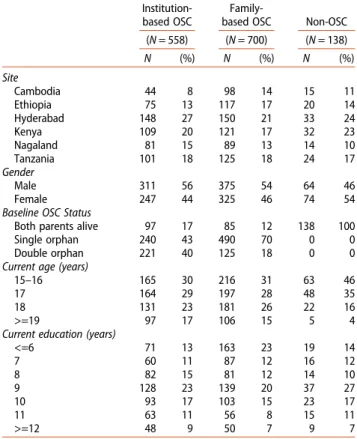
At 90-month follow-up, 1258 OSC and 138 non-OSC were assessed (Table 1). Participant ages ranged from 15–20 years, (mean 17.1; standard deviation 1.2). Among OSC, 44% were institution-dwelling and 56% were family-dwelling. The gender distribution was simi-lar across the three types of children (56% male insti-tution-dwelling OSC, 54% male family-dwelling OSC and 46% male non-OSC). Double orphans were more likely to be in institution-based care (40%) than family-based care (18%). By 90-month follow-up, most participants had attained at least eight years of education. Most participants (89%) reported they had never had vaginal or anal sex (Table 2). By age 15, less
than 10% of the overall sample had initiated sexual activity (Figure 1). The cumulative proportion of sexual initiation by age 20 was approximately 25%. Stratified Kaplan–Meier estimates showed slightly earlier sexual debut among males, with the gap narrowing as age approached 20. Kenyan and Tanzanian participants showed earlier sexual debut compared to the other four sites. Family-dwelling OSC reported earlier sexual debut than either institution-dwelling OSC or non-OSC, a gap that persisted at age 20. We observed no differences in age of sexual debut associated with any trauma or with abuse by age 12.
Approximately 6% of participants reported recent (past-year) sex. While only 4% of the total sample reported having unprotected sex, 70% of those who had recent sex reported they did not use a condom every time. Mean agreement with statements about con-dom use norms were neutral, closer to disagreement on the 0–3 scale, indicating that participants were less likely to perceive their peers as using or talking about condoms with their partners.
Nearly all (90%) of participants reported experiencing at least one lifetime PTE; the most common was witnes-sing family death.
Prevalence and mean estimates indicate variation in sexual health across many subgroups (Table 3). Kenya and Tanzania had the highest prevalence of recent sex, recent unprotected sex, and condom awareness. How-ever, other sites had more favorable condom use percep-tions, with the exception of Ethiopia. Females generally had slightly less favorable outcomes than males. Family-based OSC had much higher prevalence of recent sex and recent unprotected sex compared to institution-based OSC, but had more favorable condom use percep-tions. Older age and any alcohol use both had higher prevalence of recent sex and unprotected sex; both also had more favorable condom use perceptions.
Discussion
We found that less than 10% of OSC and non-OSC reported ever having sex by age 15. While overall preva-lence of recent (past-year) sex was fairly low (6%), the prevalence of unprotected sex among those who had recent sex was high (70%). Exposure to trauma, particu-larly war, riots and killings and“any trauma”was associ-ated with recent sex and recent unprotected sex. All trauma exposures were slightly positively associated with perceptions of condom use. However, overall per-ceptions of safer sex norms were generally unfavorable.
Thesefindings suggest the need to improve awareness of and comfort with sexual health among adolescents in LMIC, where HIV prevalence is high. For context, esti-mated adult (ages 15–49) HIV prevalence in 2014 was: Cambodia (0.6%), Ethiopia (1.2%), India (0.3%), Kenya (5.3%), and Tanzania (5.3%) (World Bank, 2012; UNAIDS, 2012). Though most report not having sex and most report having heard of condoms, the vast majority of sexually active adolescents are not always using condoms.
Furthermore, OSC are in need of protective and sup-port services regarding PTEs. Abuse is of particular con-cern for sexual risk behavior that can increase the probability of acquiring HIV, and recentfindings indicate boys are as vulnerable as girls to physical and sexual abuse
(Gray et al.,2015b), suggesting programs for boys are as greatly needed as those for girls. Surprisingly, neither any trauma by age 12 nor abuse by age 12 predicted age of sexual debut, possibly due to generally low prevalence of sexual activity. However, our findings do suggest increased prevalence of unprotected sex associated with any trauma and with physical or sexual abuse. In general, PTEs are strongly associated with depression, anxiety, poor coping, and reduced social functioning in children and adolescents; these outcomes in turn increase risk of maladaptive behaviors including sexual risk-taking (Okello et al., 2013; Pynoos, Steinberg, & Piacentini,
1999; Talbot et al.,2013). Promising intervention studies have suggested that evidence-based, locally feasible sup-port such as trauma-focused cognitive behavioral therapy may reduce negative symptomatology from PTEs in LMIC (Murray et al.,2014; O’Donnell et al.,2014).
A noteworthyfinding is that OSC in institution-based care were less likely to report having recent sex or recent unprotected sex than non-OSC or OSC in family-based care. Family-dwelling OSC also reported earlier sexual debut. In general, the growing OSC population is resulting in additional economic constraints and increasing care-giver burden felt by families in LMIC (Heymann, Earle, Table 1.Characteristics of older adolescents in the POFO study
population at 90-month follow-up. Institution-based OSC
Family-based OSC Non-OSC (N= 558) (N= 700) (N= 138)
N (%) N (%) N (%)
Site
Cambodia 44 8 98 14 15 11
Ethiopia 75 13 117 17 20 14
Hyderabad 148 27 150 21 33 24
Kenya 109 20 121 17 32 23
Nagaland 81 15 89 13 14 10
Tanzania 101 18 125 18 24 17
Gender
Male 311 56 375 54 64 46
Female 247 44 325 46 74 54
Baseline OSC Status
Both parents alive 97 17 85 12 138 100
Single orphan 240 43 490 70 0 0
Double orphan 221 40 125 18 0 0
Current age (years)
15–16 165 30 216 31 63 46
17 164 29 197 28 48 35
18 131 23 181 26 22 16
>=19 97 17 106 15 5 4
Current education (years)
<=6 71 13 163 23 19 14
7 60 11 87 12 16 12
8 82 15 81 12 14 10
9 128 23 139 20 37 27
10 93 17 103 15 23 17
11 63 11 56 8 15 11
>=12 48 9 50 7 9 7
Table 2.Distribution of sexual health outcomes and potentially trauma exposure experience variables.
Denominatora n (%)
Outcomes
Ever had sex? 1265 142 11
Had sex in past year? 1258 73 6
Had unprotected sex in past year? 1258 50 4
Heard of condoms? 1376 1155 84
Safer Sex Peer Normsb Denominatora Mean SD
People I know use condoms when they have sex with new partners (range: 0–3)
679 1.33 1.04
Using condoms with new sex partners is viewed by people I know as the right thing to do (range: 0–3)
714 1.61 1.04
People I know will say“no”to sex if a partner won’t use condoms (range: 0–3)
633 1.12 1.00
I talk about condoms with my closest friends (range: 0–3)
967 1.09 1.08
People I know will talk about condoms with a partner (range: 0–3)
667 1.27 1.01
People I know use condoms when they have sex with their main partner (range: 0–3)
638 1.28 1.00
People I know will be able to refuse sex with their current partners (range: 0–3)
619 1.02 0.96
PTEs Denominatora n (%)
Disaster or accidents 1396 246 18 War, riots, killings 1396 431 31 Physical or sexual abuse 1396 799 57
Family violence 1396 713 51
Witnessing family death 1396 981 70 Forced to leave home 1396 322 23
Any trauma 1396 1258 90
aNumber who answered the question. b
Rajaraman, Miller, & Bogen,2007; Kidman & Thurman,
2014; Miller, Gruskin, Subramanian, Rajaraman, & Hey-mann, 2006). Studies have reported that economically constrained or inadequate orphan care in resource-poor areas can contribute to child- or sibling-headed house-holds, increased child labor, reduced school attendance, and reduced educational attainment, all of which are
associated with increased sexual health risk (Birdthistle et al., 2009; Case, Paxson, & Abledinger 2004; Cluver, Orkin, Boyes, Gardner, & Meinck, 2011; Dalen, Naki-tende, & Musisi,2009; Daniel & Mathias,2012).
Our study has several strengths. The sample was statisti-cally drawn to be representative of both institution-dwell-ing and family-dwellinstitution-dwell-ing OSC at six sites infive LMIC; an
additional convenience sample of non-OSC was identified as a qualitative comparison group. Furthermore, the POFO study has high overall retention: 82% at 36-month follow-up and 69% at 90-month follow-follow-up. We attribute this to dedicated study staff and the rapport interviewers built with study participants. Although the current analysis draws primarily on the 90-month follow-up interview due to the recent introduction of sexual health questions,
the longitudinal nature of the study has created long-stand-ing rapport between participants and interviewers, allow-ing sensitive questions such as those used here to be asked. Importantly, we documented rates of sexual debut across multiple geographically and politically diverse LMIC, across male and female genders, and across multiple ages of adolescence.
This study has several limitations. First, the cross-sec-tional nature of the current analysis prevents complete temporal assessment. Because trauma exposures are life-time measures and sexual risk was assessed within the past-year, it is reasonable to assume that most trauma experiences occurred before the sexual risk behaviors, though reverse causality cannot be ruled out. Second, we used self-reported traumatic events and sexual health behaviors. However, a prior study in this population showed that caregiver reports under-reported traumatic experiences (Rajan et al.,2014). The sensitive nature of sex-ual behavior questions can result in reporting more socially desirable answers. Substantial efforts were made to enhance the validity of self-reported data, including matching participants with an interviewer of the same gen-der, pairing participants with the same interviewer over time, and reminding participants at key points that their responses were confidential. Many respondents did not answer the safer sex peer norms questions. We investigated possible selection bias; responses were non-differential by gender, age, or OSC type, but were differential by site. Nagaland had a very low response percentage (4%); sensi-tivity analyses excluding Nagaland negligibly changed esti-mates and conclusions remained the same. The topic may be particularly sensitive there, warranting consideration when formulating educational programs. Finally, measur-ing PTEs can be difficult, particularly across cultural set-tings. The LEC was selected for its ability to predict anxiety and depression and its wide use across different cultural settings (Elhai et al.,2005).
Healthy sexual behaviors are critically important for adolescents in all settings, but OSC in areas with high preva-lence of HIV/AIDS are particularly vulnerable to adverse consequences of risky sexual behavior. This study high-lights the need for caregivers, program managers, and pol-icymakers to normalize condom use and identify interventions for trauma support services. Orphans living in family-based care may be particularly vulnerable to early sexual debut and unprotected sexual activity.
Acknowledgements
We acknowledge the following individuals for their essential contributions in study implementation and data collection: Chris Bernard Agala, BA, University of North Carolina at Cha-pel Hill, ChaCha-pel Hill, NC, United States of America; Misganaw Table 3. Prevalence of sexual health outcomes by key
characteristics. Past-year sex Past-year unprotected sex Heard of condoms Safer sex normsa
Characteristicb Prevalence (95% CI) Prevalence (95% CI) Prevalence (95% CI) Mean (95% CI) Site Cambodia 6.0 (3.5, 10.2) 4.7 (2.5, 8.7) 81.5 (73.7, 90.2) 14.3 (13.7, 15.0) Ethiopia 0.3 (0.0, 1.9) 0.3 (0.0, 1.9) 84.7 (73.9, 97.1) 3.2 (1.5, 4.9) Hyderabad 0.2 (0.0, 1.6) 0.2 (0.0, 1.6) 67.5 (58.0, 78.4) 11.2 (10.3, 12.1) Kenya 13.5 (0.1, 19.0) 8.5 (5.8, 12.4) 91.9 (87.9, 96.1) 7.5 (6.7, 8.2) Nagaland 2.5 (0.0, 5.6) 1.9 (0.7, 5.0) 83.6 (78.3, 89.3) 12.1 (11.2, 13) Tanzania 10.5 (0.1, 16.3) 7.3 (4.4, 12.2) 95.0 (91.6, 98.5) 8.8 (7.8, 9.8) Gender Male 4.4 (0.0, 6.5) 2.5 (1.6, 4.0) 80.7 (75.0, 86.8) 8.2 (7.1, 9.3) Female 4.7 (0.0, 6.7) 3.8 (2.6, 5.5) 84.0 (79.9, 88.3) 7.6 (6.5, 8.7) Setting Institution 2.4 (0.0, 3.9) 1.6 (0.9, 2.8) 80.1 (73.0, 87.8) 6.9 (5.3, 8.4) Family 8.1 (0.1, 10.5) 5.7 (4.2, 7.8) 84.3 (81.4, 87.3) 9.0 (8.4, 9.6) Non-OSC 2.4 (0.0, 7.1) 0.8 (0.1, 5.6) 87.0 (81.7, 92.5) 8.8 (7.6, 10.1) OSC Status Both parents alive 2.2 (0.0, 4.8) 0.7 (0.2, 2.9) 77.4 (70.9, 84.4) 9.0 (7.1, 10.8) Single orphan 6.1 (0.0, 8.4) 4.1 (2.8, 5.9) 84.0 (80.5, 87.6) 9.2 (8.6, 9.8) Double orphan 3.6 (0.0, 5.9) 3.0 (1.8, 5.1) 82.2 (74.4, 90.8) 6.0 (4.2, 7.9) Alcohol use
Never drink 2.7 (0.0, 4.1) 2.0 (1.3, 3.1) 80.2 (75, 85.7) 7.3 (6.0, 8.6) Ever drink 10.0
(0.1, 14.8) 6.5 (3.8, 11) 88.8 (84.1, 93.8) 13.2 (12.5, 14.0) Age
15–16 2.1 (0.0, 3.9) 1.5 (0.7, 3.1) 78.7 (72.8, 85.1) 7.8 (6.6, 9.1) 17 3.4 (0.0, 5.5) 2.2 (1.2, 4.1) 78.3 (72.0, 85.2) 8.1 (7.1, 9.0) 18 5.7 (0.0, 8.7) 3.5 (2.1, 5.9) 86.2 (81.0, 91.6) 6.8 (4.8, 8.7) >=19 9.8 (0.1, 14.5) 7.3 (4.8, 11.3) 90.9 (86.3, 95.6) 9.4 (7.8, 11) a
Mean score assessing agreement with condom use norms; higher is more favorable.
b
Eticha Dubie, MA, Stand for Vulnerable Organization, Addis Ababa, Ethiopia; Dafrosa Itemba, MSc, Tanzania Women Research Foundation, Moshi, Tanzania; Mao Lang and Van-roth Vann, MBA, Homeland (Meatho Phum Ko’mah), Bat-tambang, Cambodia; Dean Lewis, Venkata Gopala Krishna Kaza, MA, and Ira Madan, MA, Sahara Centre for Residential Care & Rehabilitation, Delhi, India; and Augustine Wasonga, MA, MBA, Ace Africa, Bungoma, Kenya.
Disclosure statement
No potential conflict of interest was reported by the authors.
Funding
This study was funded by the National Institute of Child Health and Development [5R01HD046345-04].
References
Birdthistle, I., Floyd, S., Nyagadza, A., Mudziwapasi, N., Gregson, S., & Glynn, J. R. (2009). Is education the link between orphanhood and HIV/HSV-2 risk among female adolescents in urban Zimbabwe? Social Science & Medicine,68(10), 1810–1818.
Birdthistle, I. J., Floyd, S., Machingura, A., Mudziwapasi, N., Gregson, S., & Glynn, J. R. (2008). From affected to infected? Orphanhood and HIV risk among female adoles-cents in urban Zimbabwe. AIDS, 22(6), 759–766.doi: 10. 1097/QAD.0b013e3282f4cac7 00002030-200803300-00011 Case, A., Paxson, C., & Ableidinger, J. (2004). Orphans in
Africa: Parental death, poverty, and school enrollment. Demography,41(3), 483–508.
Cedar Project, P., Pearce, M. E., Christian, W. M., Patterson, K., Norris, K., Moniruzzaman, A.,…Spittal, P. M. (2008). The Cedar Project: Historical trauma, sexual abuse and HIV risk among young Aboriginal people who use injection and non-injection drugs in two Canadian cities. Social Science Medicine, 66(11), 2185–2194. doi: 10.1016/j. socscimed.2008.03.034 S0277-9536(08)00178-0 [pii] Cluver, L., Orkin, M., Boyes, M., Gardner, F., & Meinck, F. (2011).
Transactional sex amongst AIDS-orphaned and AIDS-affected adolescents predicted by abuse and extreme poverty. JAIDS Journal of Acquired Immune Deficiency Syndromes, 58(3), 336–343.doi: 10.1097/QAI.0b013e3182 2f0d82
Dalen, N., Nakitende, A. J., & Musisi, S. (2009).“They don’t care what happens to us.”The situation of double orphans heading households in Rakai District, Uganda.BMC Public Health,9, 321.doi: 10.1186/1471-2458-9-321
Daniel, M., & Mathias, A. (2012). Challenges and coping strat-egies of orphaned children in Tanzania who are not ade-quately cared for by adults. African Journal of AIDS Research,11(3), 191–201.doi: 10.2989/16085906.2012.734978 Elhai, J. D., Gray, M. J., Kashdan, T. B., & Franklin, C. L. (2005). Which instruments are most commonly used to assess traumatic event exposure and posttraumatic effects? A survey of traumatic stress professionals. Journal of Traumatic Stress,18(5), 541–545.doi: 10.1002/jts.20062 Gray, C. L., Pence, B. W., Ostermann, J., Whetten, R. A.,
O’Donnell, K., Thielman, N., & Whetten, K. (2015a). Prevalence and incidence of traumatic experiences among orphans in institutional and family-based care settings in five LMIC: A longitudinal study. Global Health: Science and Practice, 3(3), 395–404. Published online 2015 Aug 25.doi: 10.9745/GHSP-D-15-00093
Gray, C. L., Pence, B. W., Ostermann, J., Whetten, R. A., O’Donnell, K., Thielman, N., & Whetten, K. (2015b). Gender (in)differences in prevalence and incidence of trau-matic experiences among orphaned and separated children living in five low and middle income countries. Global Mental Health, 1–11.doi: 10.1017/gmh.2015.1
Gray, M. J., Litz, B. T., Hsu, J. L., & Lombardo, T. W. (2004). Psychometric properties of the life events checklist. Assessment, 11(4), 330–341. doi: 11/4/330 [pii]10.1177/ 1073191104269954
Hallett, T. B., Lewis, J. J., Lopman, B. A., Nyamukapa, C. A., Mushati, P., Wambe, M.,…Gregson, S. (2007). Age at first sex and HIV infection in rural Zimbabwe. Studies in Family Planning,38(1), 1–10.
Heymann, J., Earle, A., Rajaraman, D., Miller, C., & Bogen, K. (2007). Extended family caring for children orphaned by AIDS: Balancing essential work and caregiving in a high HIV prevalence nations.AIDS Care,19(3), 337–345. doi: 10.1080/09540120600763225
Kidman, R., & Thurman, T. R. (2014). Caregiver burden among adults caring for orphaned children in rural South Africa.Vulnerable Children and Youth Studies, 9(3), 234– 246.doi: 10.1080/17450128.2013.871379
Lugoe, W. L., Klepp, K. I., & Skutle, A. (1996). Sexual debut and predictors of condom use among secondary school students in Arusha, Tanzania. AIDS Care, 8(4), 443–452. doi: 10. 1080/09540129650125632C44WK8B82T8ERYHT [pii] Table 4.Multivariable associations between trauma types and sexual health outcomes.
Past-year sex Past-year unprotected sex Heard of condoms Safe sex normsa
Traumab PR (95% CI) PR (95% CI) PR (95% CI) Coefficient (95% CI)
Any Trauma 1.39 (0.47, 4.07) 3.47 (0.60, 19.91) 1.02 (0.87, 1.20) 0.50 (−1.61, 2.62) Physical or sexual abuse 1.01 (0.53, 1.91) 1.29 (0.55, 3.02) 1.07 (1.00, 1.14) 1.33 (−0.21, 2.88) Disaster or accidents 1.44 (0.76, 2.75) 1.16 (0.45, 3.02) 1.08 (1.00, 1.16) 0.61 (−0.44, 1.66) War, riots,killings 1.61 (0.65, 4.00) 2.37 (0.89, 6.33) 1.08 (1.00, 1.16) 0.20 (−1.07, 1.48) Family Violence 1.41 (0.74, 2.70) 1.26 (0.56, 2.88) 1.04 (0.97, 1.12) 1.26 (0.17, 2.34) Witnessed Family Death 1.03 (0.50, 2.15) 1.20 (0.47, 3.05) 1.02 (0.92, 1.13) 0.73 (−0.57, 2.02) Forced to leave home 0.72 (0.41, 1.26) 0.82 (0.46, 1.49) 1.00 (0.89, 1.11) 0.50 (−0.97, 1.97) Total Traumac 1.06 (0.93, 1.20) 1.10 (0.94, 1.08) 1.02 (1.01, 1.04) 0.18 (−0.14, 0.50) aA linear scale based on seven questions with Likert responses ranging from strongly agree to strongly disagree; higher value is more favorable.
b
Each estimate is from a separate model with one trauma type as the exposure and adjusted for site, setting, gender, grade-for-age, orphan type, age, alcohol use; all estimates are weighted using sampling weights.
c
McGrath, N., Nyirenda, M., Hosegood, V., & Newell, M. L. (2009). Age at first sex in rural South Africa. Sexually Transmitted Infections,85(Suppl 1), i49–i55.doi: 10.1136/ sti.2008.03332485/Suppl_1/i49 [pii]
Miller, C. M., Gruskin, S., Subramanian, S. V., Rajaraman, D., & Heymann, S. J. (2006). Orphan care in Botswana’s work-ing households: Growwork-ing responsibilities in the absence of adequate support. American Journal of Public Health, 96 (8), 1429–1435.doi: 10.2105/AJPH.2005.072280
Mkandawire, P., Tenkorang, E., & Luginaah, I. N. (2013). Orphan status and time tofirst sex among adolescents in northern Malawi.AIDS and Behavior,17(3), 939–950.doi: 10.1007/s10461-011-0120-y
Mugavero, M., Ostermann, J., Whetten, K., Leserman, J., Swartz, M., Stangl, D., & Thielman, N. (2006). Barriers to antiretroviral adherence: The importance of depression, abuse, and other traumatic events.AIDS Patient Care and STDs,20(6), 418–428.doi: 10.1089/apc.2006.20.418 Murray, L. K., Skavenski, S., Michalopoulos, L. M., Bolton, P.
A., Bass, J. K., Familiar, I.,…Cohen, J. (2014). Counselor and client perspectives of Trauma-focused Cognitive Behavioral Therapy for children in Zambia: A qualitative study.Journal of Clinical Child and Adolescent Psychology, 43(6), 902–914.doi: 10.1080/15374416.2013.859079 O’Donnell, K., Dorsey, S., Gong, W., Ostermann, J., Whetten,
R., Cohen, J. A.,…Whetten, K. (2014). Treating maladap-tive grief and posttraumatic stress symptoms in orphaned children in Tanzania: Group-based trauma-focused cogni-tive-behavioral therapy.Journal of Traumatic Stress,27(6), 664–671.doi: 10.1002/jts.21970
Okello, J., Nakimuli-Mpungu, E., Musisi, S., Broekaert, E., & Derluyn, I. (2013). War-related trauma exposure and mul-tiple risk behaviors among school-going adolescents in Northern Uganda: The mediating role of depression symp-toms. Journal of Affective Disorders,151(2), 715–721.doi: 10.1016/j.jad.2013.07.030
Palermo, T., & Peterman, A. (2009). Are female orphans at risk for early marriage, early sexual debut, and teen pregnancy? Evidence from sub-Saharan Africa. Studies in Family Planning,40(2), 101–112.
Pence, B. W., Raper, J. L., Reif, S., Thielman, N. M., Leserman, J., & Mugavero, M. J. (2010). Incident stressful & traumatic life events and HIV sexual transmission risk behaviors in a longitudinal, multi-site cohort study. Psychosomatic Medicine,72(7), 720–726. PMCID: PMC3691861
Pence, B. W., Shirey, K., Whetten, K., Agala, B., Itemba, D., Adams, J.,…Shao, J. (2012). Prevalence of psychological trauma and association with current health and functioning in a sample of HIV-infected and HIV-uninfected Tanzanian Adults.PLoS One,7(5), e36304. PMCID: PMC335144 [pii] Pettifor, A., O’Brien, K., Macphail, C., Miller, W. C., & Rees, H. (2009). Early coital debut and associated HIV risk factors among young women and men in South Africa. International Perspectives on Sexual and Reproductive Health,35(2), 82–90.doi: 10.1363/ifpp.35.082.093508209 Pettifor, A. E., van der Straten, A., Dunbar, M. S., Shiboski, S.
C., & Padian, N. S. (2004). Early age of first sex: A risk factor for HIV infection among women in Zimbabwe. AIDS,18(10), 1435–1442.doi: 00002030-200407020-00010 [pii]
Pynoos, R. S., Steinberg, A. M., & Piacentini, J. C. (1999). A developmental psychopathology model of childhood
traumatic stress and intersection with anxiety disorders. Biological Psychiatry,46(11), 1542–1554.
Rajan, D. G., Shirey, K., Ostermann, J., Whetten, R., O’Donnell, K., & Whetten, K. (2014). Child and caregiver concordance of potentially traumatic events experienced by orphaned and abandoned children. Vulnerable Children and Youth Studies, 9(3), 220–233. doi: 10.1080/ 17450128.2013.855346
Siddiqui, O. I. (2015). Methods for computing missing item response in psychometric scale construction. American Journal of Biostatistics,5(1), 1–6.doi:10.3844/amjbsp.2015.1.6. StataCorp. (2013).Stata statistical software: Release13. College
Station, TX: StataCorp LP.
Talbot, A., Uwihoreye, C., Kamen, C., Grant, P., McGlynn, L., Mugabe, I.,…Zolopa, A. (2013). Treating psychological trauma among Rwandan orphans is associated with a reduction in HIV risk-taking behaviors: A pilot study. AIDS Education and Prevention, 25(6), 468–479. doi: 10. 1521/aeap.2013.25.6.468
Thurman, T. R., Brown, L., Richter, L., Maharaj, P., & Magnani, R. (2006). Sexual risk behavior among South African adolescents: Is orphan status a factor? AIDS and Behavior,10(6), 627–635.doi: 10.1007/s10461-006-9104-8 UNAIDS, Government of India. (2012). Technical report,
India. HIV estimates 2012. Retrieved Feburary 12, 2015, from http://www.unaids.org/sites/default/files/en/media/ unaids/contentassets/documents/data-and-analysis/tools/ spectrum/India2012report.pdf
UNICEF. (2009).Promoting quality education for orphans and vulnerable children. 2009. Retrieved April 15, 2015, http:// www.unicef.org/spanish/education/files/Promoting_Quality_ Education_for_Orphans_and_Vulnerable_Children_ Programmes_from_Eastern_and_Southern_Africa.pdf UNICEF. (2012).State of the World’s Children 2012: Children
in the urban world. New York. Retrieved April 25, 2014, from, http://www.unicef.org/sowc2012/pdfs/SOWC202012-Main20Report_EN_13Mar2012.pdf.
Whetten, K., Ostermann, J., Pence, B. W., Whetten, R. A., Messer, L. C., Ariely, S.,…Positive Outcomes for Orphans Research, T. (2014). Three-year change in the well-being of orphaned and separated children in institutional and family-based care settings in five low- and middle-income countries. PLoS One, 9(8), e104872. doi: 10.1371/ journal.pone.0104872
Whetten, K., Ostermann, J., Whetten, R. A., Pence, B. W., O’Donnell, K., Messer, L. C., & Thielman, N. M. (2009). A comparison of the wellbeing of orphans and abandoned children ages 6–12 in institutional and community-based care settings in 5 less wealthy nations. PLoS One, 4(12), e8169.doi: 10.1371/journal.pone.0008169
Whetten, K., Ostermann, J., Whetten, R., O’Donnell, K., & Thielman, N. (2011). More than the loss of a parent: Potentially traumatic events among orphaned and aban-doned children. Journal of Traumatic Stress, 24(2), 174– 182.doi: 10.1002/jts.20625
Wilson, H. W., Woods, B. A., Emerson, E., & Donenberg, G. R. (2012). Patterns of violence exposure and sexual risk in low-income, Urban African American girls. Psychology of Violence,2(2), 194–207.doi: 10.1037/a0027265