SCALING ROBOT MOTION PLANNING TO MULTI-CORE PROCESSORS AND THE CLOUD
Jeffrey Ichnowski
A dissertation submitted to the faculty at the University of North Carolina at Chapel Hill in partial fulfillment of the requirements for the degree of Doctor of Philosophy in the Department of
Computer Science.
Chapel Hill 2019
ABSTRACT
Jeffrey Ichnowski: Scaling Robot Motion Planning to Multi-core Processors and the Cloud
(Under the direction of Ron Alterovitz)
Imagine a world in which robots safely interoperate with humans, gracefully and efficiently accomplishing everyday tasks. The robot’s motions for these tasks, constrained by the design of the robot and task at hand, must avoid collisions with obstacles. Unfortunately, planning a constrained obstacle-free motion for a robot is computationally complex—often resulting in slow computation of inefficient motions. The methods in this dissertation speed up this motion plan computation with new algorithms and data structures that leverage readily available parallel processing, whether that processing power is on the robot or in the cloud, enabling robots to operate safer, more gracefully, and with improved efficiency.
The contributions of this dissertation that enable faster motion planning are novel parallel lock-free algorithms, fast and concurrent nearest neighbor searching data structures, cache-aware operation, and split robot-cloud computation. Parallel lock-free algorithms avoid contention over shared data structures, resulting in empirical speedup proportional to the number of CPU cores working on the problem. Fast nearest neighbor data structures speed up searching in SO(3) and SE(3) metric spaces, which are needed for rigid body motion planning. Concurrent nearest neighbor data structures improve searching performance on metric spaces common to robot motion planning problems, while providing asymptotic wait-free concurrent operation. Cache-aware operation avoids long memory access times, allowing the algorithm to exhibit superlinear speedup. Split robot-cloud computation enables robots with low-power CPUs to react to changing environments by having the robot compute reactive paths in real-time from a set of motion plan options generated in a computationally intensive cloud-based algorithm.
To my spouse, Chrissy Kistler, whose support and encouragement made this possible. To my little dudes, Roy and Carl, who made this worthwhile.
To my mom, Jeanne. To my sister, Amy and her little dude, Alexander (Sasha). To Peggy and John Seymore. To Charlie and Nancy Kistler. In
ACKNOWLEDGEMENTS
I would like to thank Ron Alterovitz for his invaluable guidance over the course of pursuing my PhD and for creating and supporting opportunities beyond just the research and writing. I would also like to thank my committee for their time, feedback, and the unique perspectives that they each provided that improved my dissertation: Jan Prins, for his guidance and discussions that help inspire and put the finishing touches on many aspects of the research; James Anderson, for discussions on the importance of real real-time computing in robots and for creating the opportunity to apply my research to a self-driving car; Jack Snoeyink, for his valuable discussions and advice on both research and writing; and Kostas Bekris, for his advice, discussions, and prior contributions that helped extend this work to the cloud.
The research in this dissertation was supported in part by U.S. National Science Foundation (NSF) under awards IIS-1117127, IIS-1149965 and CCF-1533844, and by the National Institutes of
TABLE OF CONTENTS
LIST OF FIGURES . . . xii
CHAPTER 1: INTRODUCTION . . . 1
1.1 Problem and Motivation . . . 4
1.1.1 Robot Motion Planning and Parallel Computation . . . 4
1.1.2 Approaches to Parallelizing Motion Planning . . . 6
1.1.3 The Economic Case for Robot Cloud Computing . . . 8
1.2 Research Challenges . . . 11
1.2.1 Research Challenges in Parallel Computation of Robot Motion Plans . . . 11
1.2.2 Research Challenges in Cloud-based Computation of Robot Motion Plans . . 13
1.3 Contributions . . . 14
1.3.1 Motion Planning with Superlinear Speedup . . . 15
1.3.2 Fast Nearest Neighbor Searching in SO(3) and SE(3) . . . 15
1.3.3 Concurrent Nearest Neighbor Searching . . . 15
1.3.4 Cache-Aware Sampling-based Motion Planning . . . 16
1.3.5 Cloud-based Motion Planning in Dynamic Environments . . . 16
1.3.6 Efficient Motion Planners via Templates . . . 17
1.4 Thesis Statement . . . 17
1.5 Organization . . . 17
CHAPTER 2: MOTION PLANNING WITH SUPERLINEAR SPEEDUP . . . . 19
2.1 Related Work . . . 22
2.2 Problem Formulation . . . 24
2.2.1 Parallel Computing Environment . . . 24
2.3 PRRT . . . 26
2.3.1 PRRT Threads . . . 27
2.3.2 Building a Lock-Free kd-Tree . . . 27
2.3.3 Querying a Lock-Free kd-Tree . . . 30
2.4 PRRT* . . . 31
2.4.1 PRRT* Threads . . . 31
2.4.2 PRRT* Rewiring . . . 32
2.4.3 Asymptotic Optimality of PRRT* . . . 34
2.5 Results . . . 35
2.5.1 PRRT on the Alpha Puzzle Scenario . . . 36
2.5.2 PRRT on 6-DOF, 10,000 Random Spheres . . . 37
2.5.3 PRRT* on the Cubicles Scenario . . . 39
2.5.4 PRRT* for a 2D Holonomic Disc-shaped Robot . . . 40
2.5.5 PRRT* for a 2-handed SoftBank Nao 10 DOF Task . . . 41
2.5.6 PRRT* for 1/10 Scale Self-Driving Car . . . 44
2.6 Conclusion . . . 45
CHAPTER 3: FAST NEAREST NEIGHBOR SEARCHING IN SO(3) AND SE(3) 47 3.1 Related Work . . . 48
3.2 Problem Definition . . . 49
3.3 Method . . . 51
3.3.1 Projected Partitioning of SO(3) . . . 51
3.3.2 Static KD-Tree . . . 54
3.3.3 Dynamic KD-Tree . . . 55
3.3.4 Kd-Tree Search . . . 57
3.3.5 Nearest, k-Nearest, and Nearest in Radiusr Searches . . . 60
3.4 Results . . . 61
3.4.1 Random SO(3) Scenario . . . 61
3.4.2 Random SE(3) Scenario . . . 61
3.4.4 RRT* on the Home Scenario . . . 62
3.5 Conclusion . . . 63
CHAPTER 4: CONCURRENT NEAREST NEIGHBOR SEARCHING . . . 66
4.1 Related Work . . . 68
4.2 Problem Definition . . . 69
4.3 Method . . . 71
4.3.1 Data Storage . . . 72
4.3.2 Inserting Data . . . 72
4.3.3 Searching Operations . . . 75
4.4 Correctness and Analysis . . . 76
4.5 Results . . . 78
4.6 Conclusion . . . 82
CHAPTER 5: CACHE-AWARE SAMPLING-BASED MOTION PLANNING . 83 5.1 Related Work . . . 85
5.2 Problem Formulation . . . 86
5.3 The CARRT* Algorithm . . . 87
5.3.1 Sampling Region Queue . . . 88
5.3.2 Integrated KD-Tree . . . 89
5.3.3 Planning Within a Region . . . 90
5.3.4 Rewire Update Strategy . . . 92
5.4 Results . . . 93
5.4.1 KD-Tree Cache Impact . . . 93
5.4.2 7 DOF Ball Obstacle . . . 94
5.4.3 Baxter Robot 7 DOF Task . . . 95
5.5 Conclusion . . . 95
CHAPTER 6: CLOUD-BASED MOTION PLANNING IN DYNAMIC ENVIRON-MENTS . . . 98
6.3 Method . . . 103
6.3.1 Roadmap-Based Robot Computation . . . 104
6.3.2 Roadmap-Based Cloud Computation . . . 105
6.3.3 Lock-free Parallelk-PRM* with a Roadmap Spanner . . . 107
6.3.4 Roadmap Subset for Serialization . . . 109
6.4 Results . . . 110
6.5 Conclusion . . . 114
CHAPTER 7: EFFICIENT MOTION PLANNERS VIA TEMPLATES . . . 116
7.1 Design Principles . . . 118
7.1.1 Performance over runtime flexibility . . . 118
7.1.2 Floating-point precision selection . . . 118
7.1.3 Custom state and trajectory data types . . . 118
7.1.4 (De-)Composable Metric Spaces . . . 119
7.1.5 Multi-core Ready . . . 119
7.1.6 C++ 17 Header-only Library . . . 119
7.2 Related Work . . . 119
7.3 Background . . . 121
7.3.1 Motion Planning Problem . . . 121
7.3.2 Compile-time Polymorphism . . . 122
7.3.3 C++ Template Metaprogramming . . . 123
7.4 Approach . . . 123
7.4.1 Scenario Specification . . . 123
7.4.2 (De-)Composable Metric Spaces . . . 125
7.4.3 Nearest Neighbors . . . 126
7.4.4 Planner Algorithm Selection . . . 127
7.5 Applications . . . 127
7.5.1 Small Humanoid Motion Planning using an Intel Atom . . . 128
7.5.2 Rigid Body Motion Planning using a Raspberry Pi . . . 129
7.6 Conclusions and Future Work . . . 130
CHAPTER 8: CONCLUSION AND FUTURE WORK . . . 132
8.1 Future Work . . . 133
LIST OF FIGURES
1.1 CPU trends vs. Moore’s law . . . 2
1.2 Physical robots use in experiments . . . 5
1.3 Simulated robots used in experiments . . . 6
1.4 C-space obstacles for a 2D 2-link planar robot . . . 7
1.5 Example of maximizing profit with cloud computing . . . 11
2.1 PRRT* on 2D holonomic scenario . . . 20
2.2 The Alpha 1.2 scenario . . . 36
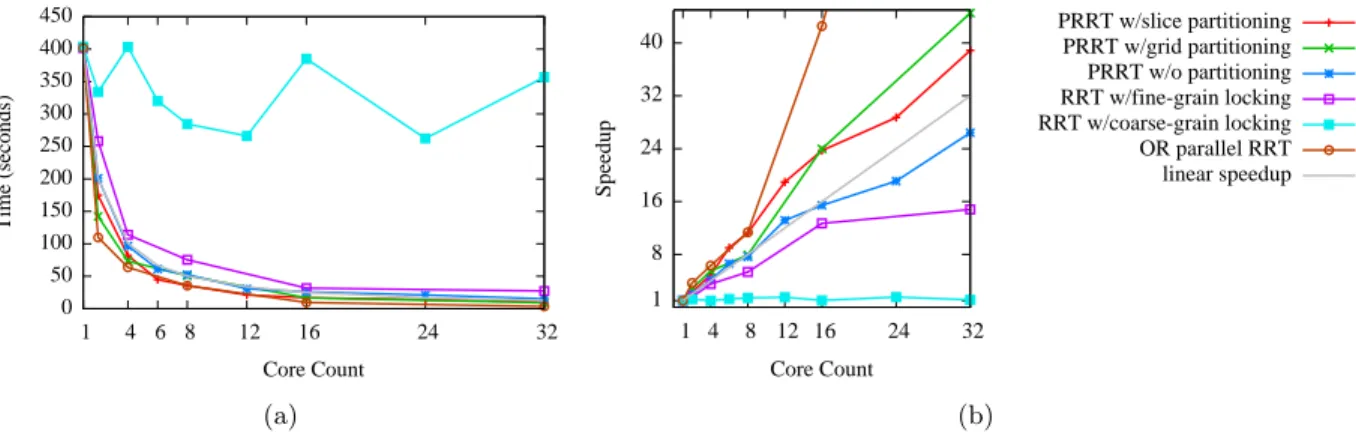
2.3 Performance of PRRT and related methods run on the Alpha Puzzle scenario . . . . 37
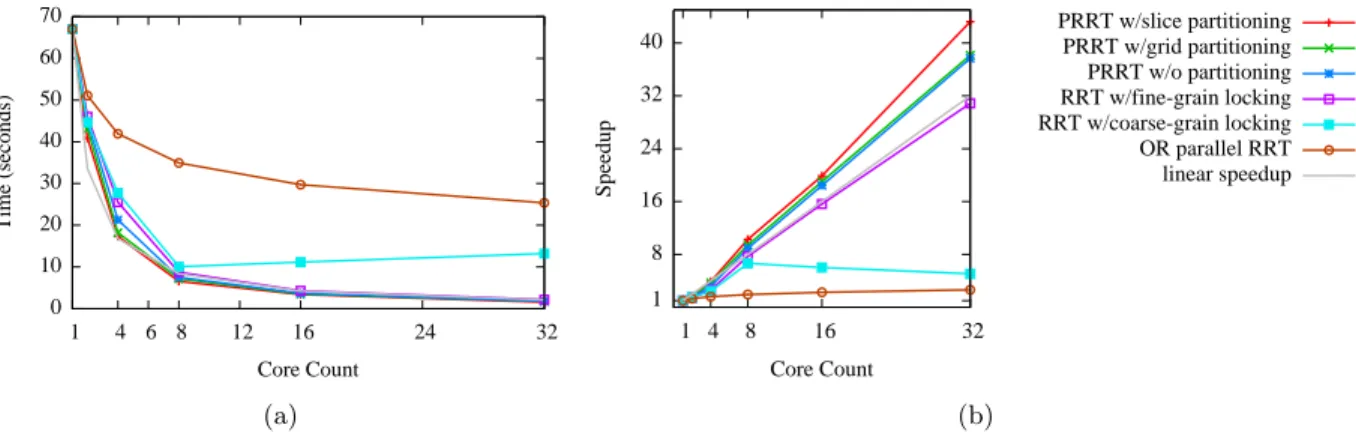
2.4 PRRT and related methods run on the 6-DOF random spheres scenario. . . 38
2.5 PRRT* solves on the Cubicles scenario . . . 38
2.6 Performance of PRRT* on the Cubicles scenario . . . 39
2.7 PRRT* run for 10 ms on 2D holonomic robot . . . 40
2.8 Example PRRT* motion plan created for the Aldebaran Nao robot . . . 41
2.9 Performance of PRRT* and related methods run on the Nao 10 DOF task for 100,000 configurations . . . 42
2.10 Time to target path cost for PRRT* . . . 43
2.11 PRRT* startup overhead . . . 44
2.12 PRRT* run for 3 seconds on Nao 10 DOF task . . . 44
2.13 PRRT* planning for 1/10 scale self-driving car . . . 45
3.1 Kd-tree projected onto the surface of a 2-sphere . . . 52
3.2 A kd-tree search for q determining if it should traverse the second node. . . 58
3.3 Comparison of nearest neighbor search time and distance checks plotted with increasing configuration count in the searched dataset. . . 62
3.4 Comparison of nearest neighbor search time for random configurations in SE(3). . . . 63
3.5 Twistycool scenario and RRT nearest neighbor search times. . . 64
3.6 Home scenario and RRT* nearest neighbor search times . . . 65
4.3 Steps of splitting a leaf while operating under concurrency . . . 74
4.4 The proposed data structure speeds up parallelized motion planning in the “Home” SE(3) scenario from OMPL . . . 79
4.5 Speeding up planning on OMPL’s “Cubicles” scenario . . . 80
5.1 Example cache hierarchy a typical modern CPU . . . 84
5.2 Cache effect on nearest neighbor searching . . . 85
5.3 Average time for a single nearest neighbor search with increasing kd-tree size (n) . . 94
5.4 CARRT* and RRT* compute plans for the 7 DOF ball obstacle scenario. . . 95
5.5 Baxter robot following motion plan generated by CARRT* . . . 96
5.6 CARRT* and RRT* planning time and resulting cost for the Baxter 1-arm 7 DOF scenario . . . 97
6.1 Comparison of robot only and cloud computing for robot motion planning . . . 100
6.2 The Fetch robot using our cloud-based motion planning . . . 111
6.3 Effect of different values for Rsim and tLsim. . . 112
6.4 Effect of tmax on size of graph on robot and robot’s task completion wall clock time . 114 7.1 The process flow of Motion Planning Templates (MPT) . . . 117
7.2 Comparison of runtime polymorphic calls to compile-time polymorphic calls . . . 122
7.3 SE(3) states in runtime-polymorphic and compile-time polymorphic systems . . . 125
7.4 MPT’s compile-time algorithm to select nearest neighbor data structure. . . 126
7.5 Nao perform 10 DOF task computed through MPT. . . 127
7.6 Comparison of MPT’s RRT compute time probability of finding a feasible path . . . 128
7.7 Nao computes a 5 000 vertex RRT* graph . . . 128
7.8 The Raspberry Pi 3 computes 10 000 vertex RRT* graph . . . 129
CHAPTER 1 Introduction
Consider a robot that needs to plan its motions to autonomously complete a task. The planned motion needs to avoid obstacles, obey task-specific constraints, and reach a goal within a timely manner. Computing motion plans quickly can be computationally demanding; the general motion planning problem is PSPACE-hard [98], and the time required grows exponentially in the robot’s configurable degree’s of freedom. Thus, while rapid online motion planning around moving obstacles for robots with few degrees of freedom (e.g., a disc robot vacuuming a floor, or a self-driving car) may be tractable with modern motion planning algorithms, adding just a few degrees of freedom to the problem (e.g., an articulated robot arm) requires new tools and more computational processing power. Fortunately we are living in an era in which computational processing power is growing exponentially—but tapping into that power requires novel work in parallel and cache-aware algorithms and concurrent data structures. Moreover, due to physical limits and power constraints, the computing power required to plan motions may not be housed within the robot’s physical body— and thus we also need novel approaches to utilizing computing power outside the robot’s body. This dissertation presents and demonstrates the effectiveness of multi-core parallel computation, made scalable through concurrent data structures and sped up by making the computation cache-aware, to solve challenging motion planning problems quickly, both within the robot and via cloud-based computers.
10−1 100 101 102 103
1996 1998 2000 2002 2004 2006 2008 2010 2012 2014 2016
GFLOPS
or
core
coun
t
Year Avg GFLOPS per CPU
Avg Cores per CPU Avg GFLOPS per Core Moore’s Law
Figure 1.1: CPU trends vs. Moore’s law [115]. Moore’s law predicts an exponential trend in processing performance. Around 2005, due to physical limitations, the trend in single-core processing power began to taper. Around the same time CPU manufacturers began introducing additional processing cores to each CPU—allowing them to perform mutiple concurrent threads of operation. When the single-core performance trend is multipled by the number of cores, the resulting trend continues on along the Moore’s law prediction. The implication is that in order to continue to gain exponential growth in performance, computer algorithms must make use of computational parallelism.
being capable of running one or more independent threads of execution. When we multiply these trends out, we can observe that computation power has indeed continued on the exponential growth that Moore’s law predicted. But the implication is that we need to make use of computational parallelism in order to get this benefit.
to shared data structures must look beyond locking for exclusive access. This dissertation presents and evaluates lock-free data structures, as well as using characteristics inherent to motion planners that allow for asymptotically diminishing wait times. The result is motion planners that can speed up in proportion to the amount of computational parallelism available.
One of the side effects of accelerating a motion planner with computational parallelism is that they can generate a lot of data quickly—quickly enough that the slow access time of RAM becomes a performance issue. RAM’s slow access time (relative to a CPU’s computing speed) is often effectively hidden by a CPU’s high-performance memory cache. The cache allows a program’s frequently accessed data to be serviced quickly without being delayed by RAM; however, the performance benefit of these caches disappears when a program’s working data set exceeds the size of the memory cache. The data set grows faster, thus exceeds the cache size sooner, when generated by a highly parallelized motion planner. In order to avoid having the working data set exceeding the cache size, this dissertation explores the use of cache-aware algorithms and data structures in motion planning. Keeping the motion planner’s working data set in cache avoids the bottleneck of slow RAM access times, and keeps the motion planner running faster for longer.
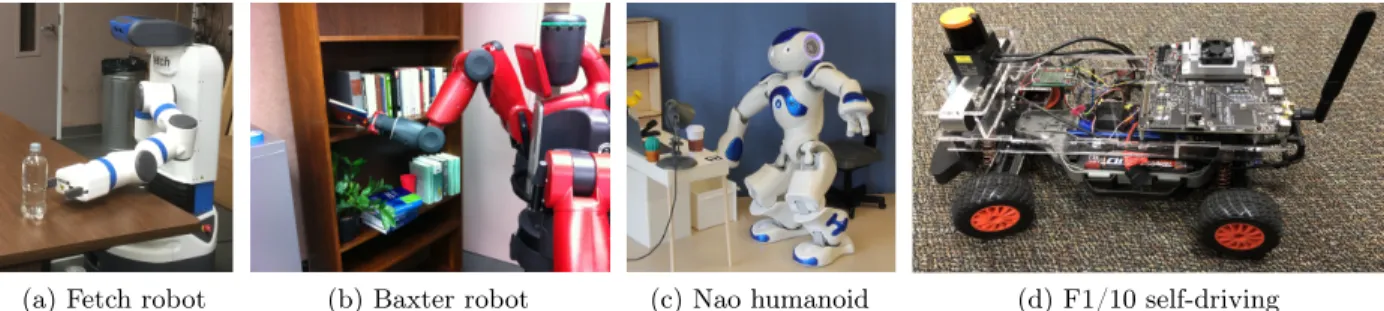
In order for a robot to plan motions in a dynamic environment, that is, an environment with moving obstacles, the robot may need more computing power than it can carry and power onboard. Moving obstacles may block a robot’s previously computed motion plan, or unblock a better path that the robot should follow—necessitating rapid updates to the existing motion plan, or generation of a new motion plan. The CPU of a sufficiently high degree-of-freedom robot may not be able to keep pace with environment changes (e.g., the Nao small humanoid robot [108] in Fig. 1.2 (c)). This problem is worsened when the physical design of a robot mandates using smaller, lighter, and lower energy-consuming mobile CPUs. While mobile CPUs benefit from a Moore’s law-like trend in increasing parallelism, their small size and low energy usage means that they may not be able to compute motion plans fast enough to interact with dynamically changing environments. Thus, to get sufficient computing power for motion planning, some robots will have to leverage computing power from somewhere else.
request as little or as much computational parallelism as it needs depending on the complexity of its motion planning tasks. Cloud-based computers can be cost-effective, since they allow the robot to potentially have a cheaper onboard CPU, and pay only for the computation that they use, as they use it. But for all the computational benefits of the cloud, there are challenges in how to coordinate the split in computation between the robot and the cloud and overcome bottlenecks introduced by the network connection between the robot and cloud-based computers. In order to overcome these bottlenecks, this dissertation introduces algorithms in which the robot navigates a dynamically changing environment using a small, but relevant, portion of the result of a computationally intensive cloud-based motion planner.
This dissertation advances the ability of robots to solve complex motion planning problems quickly. It does this through contributions of novel approaches to scalable parallel computation and concurrent data structures, and by embedded cache awareness. It further enables these advances to be effectively utilized whether the motion planner runs purely on the robot or in tandem with the cloud. The effectiveness of all the advances are demonstrated on physical robots in real-world scenarios. In concert with the research for this dissertation, we also released open-source projects that will allow these advances to be utilized in practice everywhere.
1.1 Problem and Motivation
In this section we define our motion planning problem, and we motivate extending it to a cloud-based solution.
1.1.1 Robot Motion Planning and Parallel Computation
Motion planning solves the problem of how to move a robot from a start configuration to a goal configuration while avoiding obstacles and remaining within task-specific constraints. As the definition of what is a robot is broad (e.g., Figs. 1.2 and 1.3), so too is the definition of motion planning for robots. Solving the general case of motion planning typically requires identifying and planning the motion for the robot’s degrees of freedom—e.g., joint angles for an articulated robot, or position and orientation on a floor for a vacuuming robot. The degrees of freedom form the configuration space (C-Space) of the robot’s motion planning problem. Motion planning in the C-Space allows the motion plan to be naturally converted to a sequence of actions to execute (e.g., a
(a) Fetch robot (b) Baxter robot (c) Nao humanoid (d) F1/10 self-driving
Figure 1.2: Physical robots used in experiments. The motion planning algorithm research in this dissertation computes motion plans that we use to move physical and simulated robots around obstacles to a goal. The robots have varying characteristics including: (a) a mobile base and single arm, (b) two articulated arms and a stationary base, (c) arms, legs, and feet, and (d) a wheeled vehicle.
to the robot’s motions, it causes the dimensionality of the planning problem to grow with the degrees of freedom and induces complex obstacle geometries in theC-Space that are impractical to compute
(see example in Fig. 1.4). This is one the main reasons that motion planning is computationally difficult.
In adynamic motion planning problem, the goal and/or obstacles in the environment change over the course of the robot’s motion. The robot must still avoid obstacles in such adynamic environment, potentially by rapidly recomputing a new motion plan or updating its existing motion plan. If the robot fails to compute fast enough, the robot may not reach its goal in a timely manner, or worse, may collide with an obstacle.
A highly successful set of approaches to solving the motion planning problems in the general case are sampling-based motion planners [20]. Sampling-based motion planners operate by sampling random robot configurations, testing them against collisions and task-specific constraints, and connecting them to form a graph of valid motions. By testing random configurations, sampling-based planners do not need to directly compute obstacle geometries inC-Space and thus avoid one of the
(a) 2D Holonomic Disc (b) Alpha puzzle (c) Twistycool
(d) Cubicles scenario (e) Home scenario
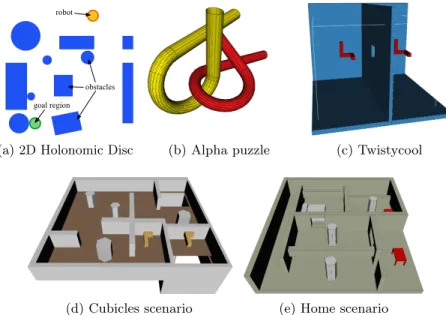
Figure 1.3: Simulated robots used in experiments. We experiment with simulations of various robot types and scenarios. In (a) is an example of a 2D holonomic disc motion planning problem, and in (b) – (e) are 3D rigid-body problems from OMPL [113] for planning in SE(3).
to a cost function) with probability 1.0, given infinite time. The implication is that asymptotically optimal motion planners converge towards an optimal solution as they spend more time computing. In order to find motion plans sooner, or converge towards optimal motion plans faster, a sampling-based motion planner must thus be able to generate and evaluate more random samples at a faster rate. Evaluating samples at a faster rate, regardless of algorithmic advances, is inherently tied to the diminishing single-core performance trend of CPUs, unless the motion planner can make use computational parallelism. Exploiting computation parallelism in sampling-based motion planners that are sequential in design (e.g., RRT [76], RRT* [60]), requires novel approaches in order to gain parallelism that is scalable. With parallelism that is scalable, increasing parallelism by a factor of p
leads to decreasing the solution time by a factor of1/p. With CPUs having as many as 32 cores (64
threads) becoming readily available, a parallelized motion planning algorithm has the potential to enable difficult motion planning problems that take minutes on a single-core, to take seconds when computed in parallel. But scaling to 64 threads requires novel approaches to coordinating the work between parallel threads in order to avoid slowdown.
1.1.2 Approaches to Parallelizing Motion Planning
joint
end effector
base
(a) 2D 2-link planar robot (b) Obstacles inC-space
Figure 1.4: C-space obstacles for a 2D 2-link planar robot[44]. In (a) a 2-link robot operates in a workspace with four polygonal robots of varying colors. The robot’s links can rotate around a fixed base and at a single joint, giving the robot two degrees of freedom. These obstacles are shown with the same colors in the visualization of theC-Space in (b). A rotation around the base
corresponds to moving the + horizontally, and a rotation around the joint corresponds to moving the + vertically. The shape of the C-Space obstacles are irregular and difficult to define in closed
form, especially in higher dimensions.
checking for collisions, then this approach leads to a solution that parallelizes the collision-detection subroutines [16]. Or, as analysis shows that the big-O runtime of a motion planner will eventually be dominated by nearest neighbor searching [68, 45], one might focus attention on speeding up nearest neighbor searching. However, focusing attention on speeding up one portion of the motion planning is inherently limited by Amdahl’s law [6]—which argues that the maximum speedup one can observe is limited by the portion of the code that cannot be parallelized. Thus parallelizing the “outer loop” of the motion planner avoids this limitation, and is the focus of this dissertation.
use lock-free atomic updates to shared data structures, data structures designed for concurrency, as well as exploiting properties of the motion planning algorithms to reduce likelihood of contention.
The longer a sampling-based motion planner runs, the larger its underlying data structures grow. Eventually the data structures will grow to exceed the size of the CPU’s cache. When that happens, threads will increasingly access the data that they need from much slower RAM. The result can be a dramatic slowdown in the algorithm’s performance. With a parallelized motion planner, this cache-based effect happens sooner, and thus this dissertation contributes novel approaches that make motion planning algorithms cache-aware.
1.1.3 The Economic Case for Robot Cloud Computing
Computing motion plans for high-degree-of-freedom robots typically requires a capital expense of thousands of dollars to purchase a high-end computer capable of computing timely solutions. As an alternative, would you prefer gaining access to the latest computational hardware on demand, and for cents per task? That is the promise of cloud computing for robots—a potential to lower costs and improve efficiency for a variety of robotics applications.
Cloud computing has the potential to change the way we design, use, and pay for robotic systems. Unlike traditional robots, which are purchased upfront, cloud computers are billed in units of usage time. Thus, when using cloud computing one can and should approach solving problems in the most cost-effective way possible. To illustrate, for $10 000 one could purchase a high-end computer, or one could get 117 647 hours on a compute-optimized single-core cloud computer, 3 267 hours on a 36-core cloud computer, or one hour of 117 647 cores1. With a parallel algorithm for motion planning [4] and
externalizing the robot’s computation (e.g., [52]) to a cloud-based computer, one could dramatically reduce the time to solve a complex task. New robotics algorithms that leverage this computing power may extend a robot’s service life and battery-based operation time, and reduce its initial and operating costs.
The cloud is already changing the way we think about computing for robots, but its full potential has not been tapped. To date, many data-centric, and pre-computation approaches leverage the cloud [62]. What about solving complex tasks withnear-term deadlines by using the cloud to add
computing power in response to the changing demands of a problem? This will be particularly valuable for network-connected robots that face challenging motion planning problems that involve high-degree-of-freedom systems, dense cluttered environments, learning complex task models, or managing high levels of uncertainty. In this section, we present an economic motivation for, and the research challenges posed by, leveraging cloud-based computation in online and interactive robot motion planning algorithms. Bringing the benefits of cloud-based computing to robots poses multiple open research challenges, such as: how to cost-effectively allocate computing, how to design algorithms around network bottlenecks, and how to split computation between a robot and the cloud.
The cloud changes the cost model of computing by shifting it from a capital expense (CapEx) to an operational expense (OpEx). Typically, robots require a large upfront CapEx, driven in part by the cost of the robot’s computer. Using the cloud makes computing become an OpEx over the service life of the robot. With the right algorithms and utilization, an increase in a robot’s OpEx will be offset by, not only a reduced CapEx, but also an increased service life, increased battery-based operation time, and a net improvement in operational efficiency.
Lower CapEx by extending a robot’s service. A robot’s service life may be extended through the use of cloud computing. The service life starts at purchase and ends when the robot’s utility decreases to the point it is removed from service. Increasing the service life reduces the number of robots purchased over time, leading to a reduced CapEx. Consider a home assistance robot that aids someone with a variety of daily tasks of living. Such a robot could gain additional functionality by following a process similar to that of installing applications and updates to a smartphone or tablet. In this scenario, the robot becomes obsolete and needs replacement due to either physical component wear or due to advances in software exceeding the capabilities of the robot’s computing hardware.
will have almost 9 times less computing power than its replacement. At the end of a car’s 11.1 years, a robot will have almost 170 times less. The computing platform on a robot is fixed, but cloud services offer computers that are routinely upgraded. A robot that effectively utilizes the cloud for computation could thus potentially extend the time before it becomes computationally obsolete, and correspondingly extend its service life.
Cheaper robots with longer battery life. Incorporating a reliance on cloud computing into the physical design of a mobile robot will allow for cheaper robots with longer battery-based operation time. The computing platform in a robot is necessarily limited by economic factors, including price and, for mobile robots, physical size and battery capacity. Embedding high-end CPUs and GPUs enables higher performance computing, but comes at a cost of dramatically increased price and energy drain for the robot. Higher energy drain either requires increased battery size and weight, or results in reduced battery-based operation time. If instead, a robot’s designers look to lower-power computing platforms sufficient to running baseline algorithms, while offloading intensive computation tasks to the cloud, their robot design can offer decreased battery size or allow for an increased battery-based operation time, all for a reduced upfront cost.
Robots that learn from their environment and from humans are examples that could naturally benefit from such a cloud-enabled robot design [120]. Cloud-based computation accelerates the learning of a model, while the robot need only use the learned model with low-powered computation. Such a system could be used in robots that are deployed to unfamiliar environments and expected to adapt rapidly to them as they operate. Novel cloud-based learning solutions [59], and low-powered fast convolutional network processors [30] and FPGAs [90], are making this closer to reality.
(a) Robot picking from shelf
35 40 45
55 60 65
motion time (seconds) tasks/hour tasks/hour
motion time
$260 $280 $300 $320 $340
2 16 32 48 64 96 128 $0 $20 max
income/hour cost/hour
Computing power (number of cores)
revenue/hour profit/hour cost/hour
(b) Efficiency gained with cloud computers
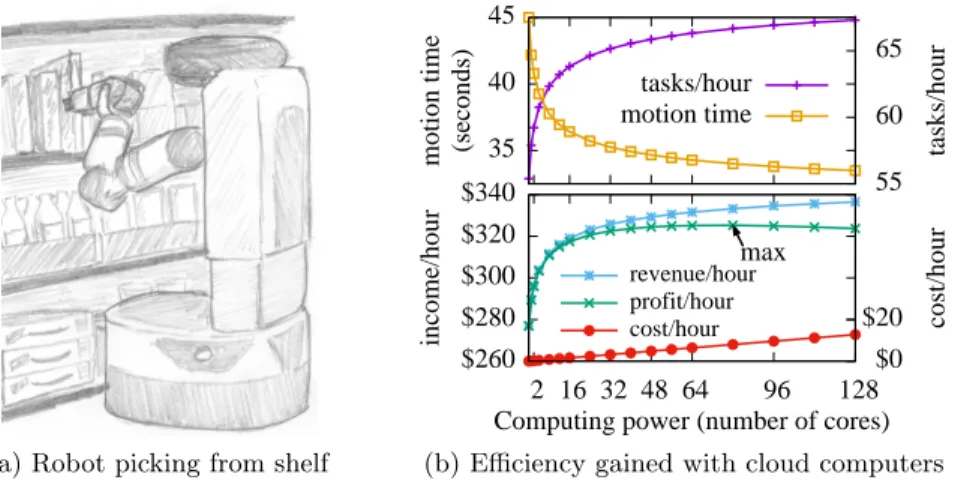
Figure 1.5: Example of maximizing profit with cloud computing. A warehouse packs packages using robots (a). The robots avoid collision with an ever-changing inventory by using motion planning algorithms. In (b), the warehouse wishes to maximize profit/hour, which here is computed as(revenue/hour)−(cost/hour). Each task the robot completes results in revenue for the company, thus moretasks/hour means morerevenue/hour. The robot uses cloud computation of an asymptotically optimal motion planner to reduce motion time and thus pack more boxes per hour. The warehouse can adjust the amount of cloud-based computing resources it uses so that it maximizes profits.
faster when given more computing power or computational parallelism [49]. By leveraging parallelism of cloud computers for motion planning [12, 51], robots can complete tasks faster. When accelerating robot motions results in more revenue, the OpEx associated with cloud computing could be justified by net improved profits (see Fig. 1.5). When a fixed number of tasks are required per unit time, faster completion times means fewer robots are required, thus lowering CapEx.
1.2 Research Challenges
In this section we present the research challenges of accelerating motion planning on multi-core computers and extending it to a cloud-based solution.
1.2.1 Research Challenges in Parallel Computation of Robot Motion Plans
The problem of accelerating motion planning is broken down here into the design of parallel algorithms, novel concurrent data structures, and cache-aware planning.
with up to 72-cores CPUs. The trend in both robot and cloud-based CPUs is towards increasing core counts. This problem is thus creating sampling-based motion planning algorithms that make use of this parallelism, while overcoming scaling limitations, ideally gaining linear (or better) speedup.
Nearest neighbor searching in SO(3) and SE(3). Nearest neighbor searching is an important performance bottleneck in sampling-based motion planners. Its computational complexity grows as the motion planner runs longer, and eventually dominates the computation time. Two important topological spaces in robot motion planning are SO(3) and SE(3), which are used for planning rigid body motions. This problem is thus accelerating nearest neighbor searching within the context of our concurrent nearest neighbor data structure using a novel space-partitioning approach.
Concurrent nearest-neighbor searching. In parallelized sampling-based motion planners, nearest-neighbor searching data structures need to be updated and queried concurrently. In tradi-tional approaches to nearest neighbor searching data structures, exclusive access is required during inserts to avoid data structure corruption. Exclusive access, by definition, does not allow concurrent operation, and thus causes parallel sampling-based motion planners to slow down. This problem is thus creating a concurrent nearest-neighbor searching data structure that allows concurrent queries and updates and minimizes the possibility of waits.
Cache-aware motion planning. Gaining the benefits of a parallelized sampling-based motion planner means that motion plans will have significantly more samples in the same amount of wall-clock time. This presents a problem not typically seen with non-parallelized motion-planners—the motion planning graph and nearest-neighbor data-structures exceed the size of the CPU’s high-speed memory caches. As a result, the traditional approach to sampling-based motion planners begins to dramatically slow down as memory access time can be orders of magnitude slower than cache access times. This problem is thus making motion planners cache-aware, and thus able to maintain the speed benefits of using the CPU’s cache.
data structures from this dissertation into a reusable, highly efficient, motion planning software library. The challenge is thus creating a reusable motion planning software library that has an expressive language capable of supporting a wide variety of robots, and that produces highly efficient robot-specific code.
1.2.2 Research Challenges in Cloud-based Computation of Robot Motion Plans Cloud computing offers many potential benefits, but realizing them presents several open research problems. Cloud computing services offer scaling computing power in a wide variety of options, from a single core virtualized on a server, to all cores on a high-end multi-core computer, to arrays of GPUs, to networked combinations of these. Motion planning algorithms that benefit from parallelism typically run with fixed parallelism configured a priori. With cloud computing, the amount of parallelism to allocate to a problem becomes a question of balancing benefit to the cost (instead of availability) of computing. Robots also must interact with a changing world, and in order to respond to changes (e.g., to sense and avoid collisions with obstacles) they must take into account the network latency (i.e., round-trip time) and bandwidth limits. One option is mixing or splitting computing between multiple sites: the robot’s onboard computer and the cloud-based computers, ideally gaining the benefits of each site’s strengths while avoiding the weaknesses. This research focus on using the cloud to speed up the motion planning computation—when the cloud is unavailable, the robot will have to fallback to slower planning using on-board computing or simply refuse to operate. The research challenges are thus: how to utilize the parallelism afforded by cloud computing, and how to adapt algorithms to work around limitations of the network.
intensive pre-computation of a robot’s path through its environment (barring dynamic obstacles) can be rapidly computed by high-performance parallel computing in the cloud. As a general research challenge, can we design robot algorithms that split portions of computation between multiple computing sites and thus gain the benefits of the cloud’s massive computing power while meeting the demands of a problem that requires low-latency computation?
Network bottlenecks and deadlines. Robot algorithms that rely on cloud computing must consider and address the limitations imposed by the network. Advances in networking technology may improve the latency and bandwidth to an extent, but communication networks will always be slower than the interconnect between the robot and its onboard or co-located computer. This limit is fundamentally insurmountable, since it is a direct result of the speed of light. As such, network limitations vary by domain, and the challenges imposed by the network bottlenecks for robots in home and warehouse environments significantly differ from robots tasked with deep-sea and space exploration. For the class of algorithms and scenarios in which the results can be pre-computed, the network might not warrant concern. However, robots operate in the real world, and they must be able to sense and respond quickly to changes in the environment in order to avoid undesirable or harmful outcomes, especially in safety-critical scenarios, such as warehouse robots operating in close proximity to humans or with medical robots working with, or operating on, humans. To avoid undesirable outcomes, we pose the research challenge by borrowing language from the real-time computing community, and considering computing tasks with hard deadlines andsoft deadlines. For robots computing tasks with hard deadlines (ones that cannot be missed), how can we ensure that a robot’s motion planning algorithm will meet the deadline (or at worst, minimize the chance of missing the deadline)? For robotic tasks with soft deadlines (ones for which a miss results in reduced benefit or increased cost), how can a robotic algorithm maximize the benefit or minimize the cost of these tasks? More parallel processing can speed up computation to get ahead of the deadline, but the network remains a bottleneck of fundamental importance to these research challenges.
1.3 Contributions
algorithms. This thesis also extends these advancements to work on power-constrained robots using a novel algorithm and system architecture for partitioning the dynamic motion planning problem between a robot’s CPU and a cloud-based high-power multi-core CPU. These advancements are made available as open-source software libraries that make use of a novel template-based software architecture. This section outlines these aforementioned contributions.
1.3.1 Motion Planning with Superlinear Speedup
To address the challenge of efficiently and scalably parallelizing a sampling-based motion planner, we take the approach parallelizing the “outer loop” of the RRT [76] and RRT* [60] sampling-based motion planners. By parallelizing at this level, we parallelize the entire algorithm, and thus avoid the limitations described by Amdahl’s law. To get around slowdown and contention associated with locks, we present an algorithm that updates shared data structures through lock-free atomic operations. With these approaches, the algorithm demonstrates linear speedup with additional parallelism. With some inherent work-saving from this approach, and a simple partitioning of samples, the motion planner exhibits superlinear speedup.
This contribution appears in Chapter 2 and was originally presented at IROS [48] and later in journal form [49].
1.3.2 Fast Nearest Neighbor Searching in SO(3) and SE(3)
To address the challenge of having a fast nearest neighbor searching data structure for topological spaces common to robotic motion planning problems, we present a novel space-partitioning data structure for SO(3) and SE(3). For SO(3) searching it uses the distance metric defined by the shortest great-arc that subtends two rotations. For SE(3), it uses a metric that is the weighted sum of SO(3) and Euclidean. This data structure is based on the kd-tree [13], but uses partitioning hyperplanes that pass through the origin of a unit 4-sphere of the quaternion [70] representation of the rotation. The data structure’s performance is demonstrated both with random samples, and embedded in a sampling-based motion planner.
This contribution appears in Chapter 3 and was originally presented at WAFR [46]. 1.3.3 Concurrent Nearest Neighbor Searching
This data structure defers partitioning decisions in order to generate splits that are better balanced than prior approaches, resulting in measurably faster performance in sampling-based motion planning problems. In order to support fast concurrent operation, the data structure makes use of lock-free atomic operations, memory-ordering directives, and fine-grain locks. We provide proofs of correct operation under concurrency through the use of linearization points, and we provide a proof of asymptotically wait-free operation in motion planning.
This contribution appears in Chapter 4 and was originally presented at WAFR [45]. 1.3.4 Cache-Aware Sampling-based Motion Planning
To address the challenge induced by sampling-based motion planners generating working data sets that exceed the CPU’s cache size, we present a novel approach to sampling-based motion planning that is cache-aware. This approach successively partitions the sampling space to keep the working data set to a size that fits in the cache. The proposed motion planner integrates its sampling strategy with a space-partitioning nearest neighbor structure thus constraining its queries to a small portion of the nearest neighbor data structure. In experiments, the cache-aware approach leads to measurable performance improvement—as much as halving the wall-clock time to compute a solution when compared to a non-cache aware approach.
This contribution appears in Chapter 5 and was originally presented at ICRA [50]. 1.3.5 Cloud-based Motion Planning in Dynamic Environments
To address the challenge of gaining large-scale multi-core parallelism on power-constrained robots, we present a novel approach to partitioning the motion plan computation between a robot’s CPU and a cloud-based computer. In this algorithm and system, the robot, with its fast access to its environment through its sensors and actuators, is responsible for reacting to and avoiding dynamic obstacles. The cloud-based computer, with its high degree of parallelism, is responsible for generating a large asymptotically optimal roadmap of options for the robot. The approach works around network bottlenecks by selecting and sending only the relevant portions of a roadmap given the robot’s likely path. We experimentally validate the algorithm and system on a physical robot interacting with a obstacle sensed through an RGB+depth camera.
1.3.6 Efficient Motion Planners via Templates
To make the contributions available in a reusable form, this thesis also presents and distributes an open-source software library for concurrent nearest neighbor searching and motion planning on multi-core system that is based upon C++ templates. The C++ template-based software architecture uses compile-time polymorphism to generate code that is custom to the robot’s motion planning tasks. This type of customization produces motion planners run measurably more efficiently (both in memory and runtime) than equivalent planners based upon runtime polymorphism. While this library may have wide applicability, it is originally intended to run on power-constrained robots running multi-core CPUs one might find in mobile phones or similar mobile computing devices. We demonstrate the performance impact of this software architecture on a suite of benchmarks running on low-power CPUs.
This contribution is described in Chapter 7, will be presented at ICRA [47], and is available in source code with a free-to-use license.
1.4 Thesis Statement
This dissertation proposes and demonstrates that motion planning for robots can be accelerated through the use of algorithmic and data structure advances that leverage multi-core CPU architecture— whether the CPU is inside the robot or accessed through the cloud. With computational speed that effectively scales with increasing core count, robots are able to accomplish their tasks faster, thus enabling new tasks. This dissertation aims to prove the following thesis statement:
Robot motion planning algorithms using multi-core parallelism, concurrent data structures, and cache-awareness can demonstrate superlinear speedup. With this speedup, robots can solve complex motion planning problems sooner and converge towards optimal motion plans faster. The resulting faster motion planning can enable robots to effectively operate in dynamically evolving scenarios, including cases in which a robot with a low-power CPU gains access to faster motion planning through computers deployed in the cloud.
The chapters in this dissertation support this thesis statement as outlined below. 1.5 Organization
CHAPTER 2
Motion Planning with Superlinear Speedup
Incremental sampling-based motion planners, such as the Rapidly-exploring Random Tree (RRT) and RRT*, are used in a variety of robotics applications including autonomous navigation, manipulation, and computational biology [75, 60]. The objective of these planners is to find a feasible or optimal path through the robot’s free configuration space from a start configuration to a goal configuration. In this chapter, we introduce PRRT (Parallel RRT) and PRRT* (Parallel RRT*), parallelized versions of the single-tree RRT and RRT* motion planners that are tailored to execute on modern multi-core CPUs.
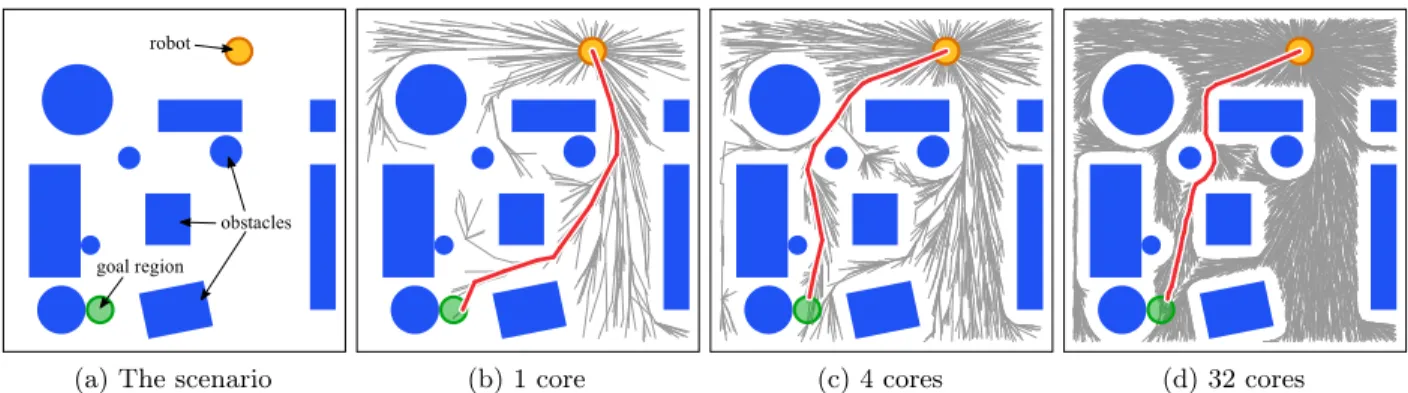
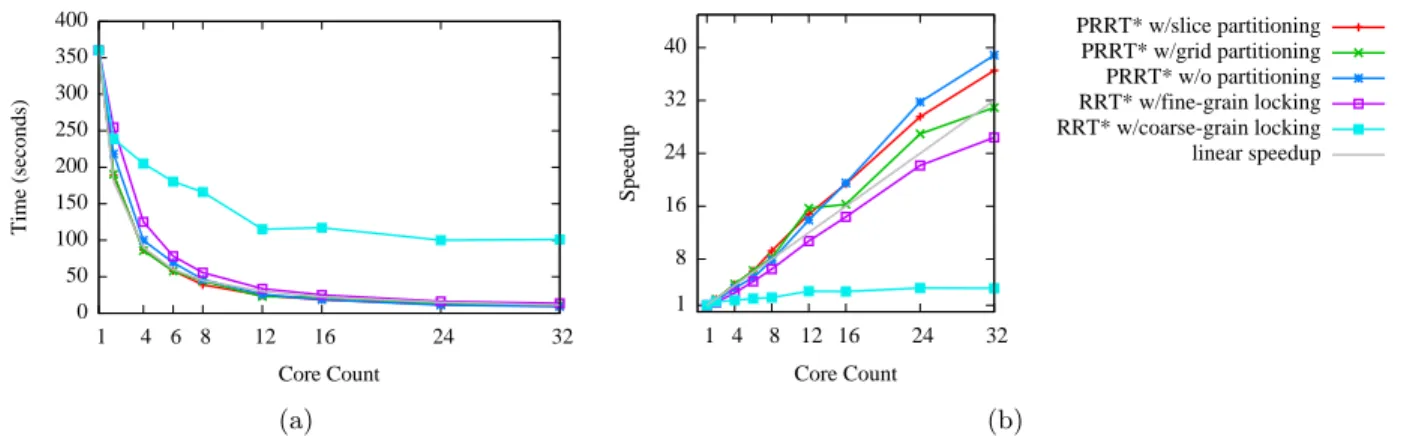
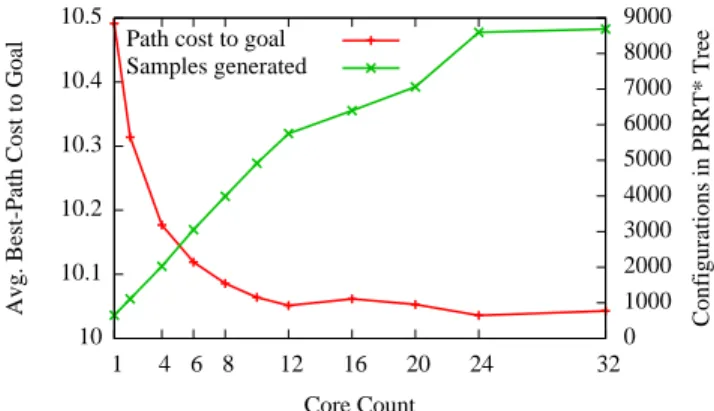
Most modern PCs and mobile devices have between 2 and 32 processing cores with shared memory, and the number of cores is increasing. PRRT and PRRT* are designed to scale and efficiently utilize all available cores concurrently, enabling motion planning with substantialspeedup with respect to the number of cores processing in parallel (see Fig. 2.1). Speedup, defined as the factor by which compute time is reduced with additional processing cores, is ideally proportional to the number of processing cores. In practice though, speedup is typically hindered by the overhead of coordinating updates between multiple cores. The methods proposed in this chapter reduce this overhead to the point at which speedup is nearlinear with the number of cores—thus, PRRT and PRRT* computing withp cores can reduce compute time to1/p over an equivalent single-core motion plan computation.
(a) The scenario (b) 1 core (c) 4 cores (d) 32 cores
Figure 2.1: PRRT* on 2D holonomic scenario. We ran PRRT* for a 2D holonomic motion planning problem for a disc-shaped robot for 10 ms on 1, 4, and 32 processor cores. The red line shows the optimal path found. With the same wall clock time, adding more processor cores increases the size of the tree, enabling fast computation of higher quality motion plans on modern multi-core computers.
and PRRT* algorithmic enhancements that allow parallel operation to effectively reduce both the amount of work required and the time it takes to do that work.
Our focus is on challenging motion planning scenarios for which a large number (tens or hundreds of thousands) of configuration samples is typically necessary to find a feasible path or to compute a plan with the desired closeness to optimality. In RRT and RRT*, the time spent computing nearest neighbors grows logarithmically with each iteration as the number of samples rises, whereas the time spent per iteration on collision detection decreases as the expected distance between samples shrinks. Collision detection typically dominates computation time in the early iterations. But as the number of iterations rises and the number of samples increases, nearest neighbor search will dominate the overall computation.
To enable speedup regardless of the computational bottleneck (e.g. collision detection or nearest neighbor searching), we parallelize the outer loop of RRT and RRT*: we create multiple threads that each generate samples and incrementally extend the motion planning tree based on those samples. To parallelize at this level, independently working threads must share access to a nearest neighbor searching data structure and to the motion planning tree.
threads or high overhead; either approach typically results in sublinear speedup. Blocked threads result from locking too large of a data structure, leading to threads spending time waiting instead of computing. High overhead results from repeatedly locking small portions of a data structure. With increasing processor counts, the sublinear effect of locking is only compounded as more threads must contend for the same resources.
To reduce causes of sublinear speedup and create opportunities, but not a guarantee, for superlinear speedup, PRRT and PRRT* introduce three key components relevant to multi-core concurrency. The first is lock-free concurrency using atomic operations. To eliminate slowdowns caused by lock overhead and contention, PRRT and PRRT* use lock-free shared data structures that are updated using an atomic compare-and-swap (CAS) operation, a universal primitive [116]. A CAS operation has three arguments: a location in shared memory, the expected value stored therein, and a new value to replace the previous. In a single atomic step, CAS loads the value stored in memory, compares it to the expected value and, only if they are the same, stores the new value in memory. Without the atomic guarantee, another concurrent thread would be able to store a different value between the CAS’s load and store. The atomic operation removes the need for locks when updates to shared data structures can be formulated into a single update. When a comparison fails due to a change made by another thread, the update is reformulated with the new information and tried again until it succeeds or is no longer necessary. In PRRT and PRRT* we observe that as the number of nodesn in a motion planning tree increases, the probability that any of thepthreads are updating
the same part of the motion planning tree decreases (limn→∞O(p/n) = 0). As a consequence, CAS
operations rarely fail, and we avoid the unnecessary blocking and overhead associated with locks. Lock-free operations eliminate the need for locks and hence reduce the overhead that might otherwise be associated with concurrent access to a shared-memory data structure. Lock-free operations by themselves at best enable linear speedup, but can be used in conjunction with other components to create opportunities for superlinear speedup.
reducing CAS failures. Second, as each processor core is expected to work in a smaller subset of the nearest neighbor data structure, more of the relevant structure can reside in each core’s cache [1], thus creating an opportunity for superlinear speedup. Cache-efficiency, while not affecting the algorithmic complexity, can lead to significant real-world performance gains on modern CPU architectures [73].
The third component introduced to create opportunities for superlinear speedup in PRRT* is parallel work-saving. During the rewiring phase of RRT*, the algorithm evaluates the costs of paths to nearby nodes, rewires them through the new node if such routing would produce a shorter path, and percolates updates up the tree. To reduce the number of rewiring operations in RRT*, we ensure that when multiple threads attempt to rewire the same portion of the tree, only the one with the better update continues. This frees the other threads to continue expanding the RRT*, effectively reducing computation effort relative to single-threaded RRT* for percolating rewiring up the tree. Parallel work-saving can enhance an algorithm’s performance and can in some cases enable superlinear speedup.
PRRT and PRRT* are designed to run on standard shared-memory, multi-core, CPU-based computing platforms (rather than, for example, a cluster or a GPU). This facilitates easy direct integration with existing libraries for collision detection, robot kinematics, and physics-based simulation [103, 113]. The contributions of this chapter were originally introduced in a conference paper [48] and a journal paper [49]. We provide pseudocode sufficiently detailed to show where CAS operations are used, how they impact the surrounding instructions, and how we ensure correctness under concurrency. We demonstrate the fast performance and scalability of PRRT for feasible motion planning using the Alpha Puzzle scenario and a random spheres scenario, and we demonstrate PRRT* for optimal motion planning using the Cubicles scenario, a holonomic disc-shaped robot, and a SoftBank Nao [108] small humanoid robot performing a 10 degree of freedom 2-handed task. 2.1 Related Work
Parallelizing RRT introduces new challenges since the validity of the tree must be maintained as it is updated by multiple concurrent threads of execution. A direct approach on a shared-memory system is to use locks on shared data structures, which is one of the methods proposed by Carpin et al. [19] and implemented as pRRT in OMPL [113]. Parallelizing RRT has also been investigated for distributed-memory systems common in clusters. Devaurs et al. [23] propose collaborative building of an RRT across multiple processes using message passing. This approach achieves a sublinear speedup as the number of available processors increases. Jacobs et al. [57] introduce speedups by adjusting the amount of local computation before making an update to a global data structures and by radially subdividing the configuration space into regions. Approaches targeting distributed-memory systems (e.g., [23, 57]) can also be run on memory systems, but they do not take advantage of
shared-memory primitives that can offer additional opportunities for speedup. KPIECE [114] prioritizes cells in a discretized grid for sampling based upon a notion of each cell’s importance to solving a difficult portion of the motion plan and has been demonstrated to parallelize on shared-memory systems using locking primitives. Our focus is on shared-memory systems (common in PCs and mobile devices), which enables us to utilize atomic CPU operations and cache-friendly algorithms to set up conditions under which superlinear speedup might occur for a single RRT.
Bialkowski et al. [16] parallelize RRT* and related methods by improving the rate of collision detection. This approach results in substantial speedups for environments where collision detection dominates processing time. But due to Amdahl’s law [6], parallel performance will taper as the number of samples increases and nearest neighbor checks begin to dominate computation time.
Partitioning of configuration space has been used to various effect in motion planning. For example, Rosell et al. [102] hierarchically decomposes C-space to perform a deterministic sampling sequence that allows uniform and incremental exploration. Morales et al. [87] automatically decompose a motion planning problem into (possibly overlapping) partitions well-suited for one of many (sampling-based) planners in a planning library. Yoon et al. [125] show how cache-efficient layouts of bounding volume hierarchies provide performance benefits in the context of collision detection.
GPU-based parallel computation has also been used to accelerate motion planning, including GPU-based methods for the PRM [95], rasterization-based planning [77], Voronoi diagram-based sampling [65, 35], and R* [66]. Implementing GPU-based algorithms is challenging in part because the single-instruction-multiple-data (SIMD) execution model of GPU’s constrains algorithm design. When each thread needs to do something different (inherently divergent), such as traversing a space partitioning tree, the SIMD model loses nearly all ability to parallelize [43]. Another challenge with GPU approaches is that, while they can gain the benefit of the high computational throughput associated with GPUs, they sacrifice some interoperability with standard systems and libraries based upon CPUs.
2.2 Problem Formulation
In this section, we formally define the computing environment and motion planning problem. 2.2.1 Parallel Computing Environment
Our target computing environment is the one available in almost every modern computer: a multi-core/multi-processor concurrent-read-exclusive-write (CREW) shared-memory system with atomic operations that synchronize views of memory between threads running on different cores [40]. This is the model in the current generation of x86-64 and ARM multi-core processors as well as many other CPU architectures.
simultaneous to the threads running on the other cores. The total number of cores in the system is:
p= (# of cores per processor)×(# of processors).
For example, a system with four processors, where each processor has 8 cores, has p= 32.
Speedup refers to how much a parallel algorithm is faster than a corresponding sequential algorithm. Let Tp be the execution time of a program that is executed using p cores. Formally, speedup Sp is the ratio of the sequential (single-threaded) execution time T1 to parallel execution timeTp withp cores:
Sp =
T1
Tp
.
Linear speedup means Sp=p, and superlinear speedup meansSp > p.
To avoid sublinear speedup, we use the atomic compare-and-swap (CAS) operation for fast lock-free updates to data structures. To help enable superlinear speedup, we exploit the fast, but limited in size, CPU memory cache. Modern processors typically have a cache hierarchy between the core and RAM that includes one or more small but fast caches local to each core (L1 and L2) and a larger and slower cache shared among cores (L3). When the data set in use by a core is smaller, the core uses the faster local caches more often and gains a proportional speed benefit. CPU caches can be leveraged to gain superlinear speedups by distributing the working dataset into smaller chunks across multiple cores.
2.2.2 Problem Definition
Let q∈ C be ad-dimensional vector representing the configuration of a robot,dis the number of
degrees of freedom, andCis the set of all possible configurations the robot may take (theconfiguration
space). Let Cfree ⊆ C denote the subset of the configuration space for which the robot is not in
collision with an obstacle.
The objective of PRRT (feasible motion planning) is to find a path in the robot’s configuration space that is feasible (e.g., avoids obstacles) and reaches the goal region. Formally, the objective of PRRT is to compute a path Π : (q0,q1,q2, . . . ,qend) such thatq0 =qinit, qend∈Qgoal,Πlies in
goal region and minimizes a user-defined cost function. An example cost function is the minimum total Euclidean length of the segments in the planned path.
2.2.3 Problem-specific Functions
Similar to their sequential motion planning counterparts RRT and RRT*, PRRT and PRRT* require as input the definition of problem-specific functions. For two configurations q1,q2∈ C, the functionSTEER(q1,q2)returns a new configuration that would be reached if taking a trajectory from
q1 heading toward q2 up to some maximum user-specified distance. The functionFEASIBLE(q1,q2) returns false if the local path from q1 to q2 collides with an obstacle or violates some motion constraint, and true otherwise. For PRRT*, the functionCOST(q1,q2) specifies the cost associated with moving between two configurationsq1andq2, which can equal control effort, Euclidean distance, or any problem-specific user-specified metric that can be used with RRT* [60]. We also require a function GOAL(q) that returns trueif q∈Qgoal and falseotherwise.
The above problem-specific functions are standard in RRT and RRT*, which enables current implementations of these problem-specific functions to be used in PRRT and PRRT* unchanged, provided the functions allow for correct concurrent evaluation.
2.3 PRRT
In this section, we present Parallel RRT (PRRT), a lock-free parallel extension of the RRT algorithm. We describe the algorithm in sufficient detail to show where atomic operations are used, how they impact the algorithm design, and how we ensure correctness under concurrency.
The PRRT algorithm maintains data structures that are shared across all threads, including the data structure for nearest neighbor searching, the RRT tree τ, the approximate iteration number,
Algorithm 1PRRT
1: initializeτ
2: fori= 1. . . thread_countdo 3: s← partition(i, thread_count)
4: wi← start new threadPRRT_Thread(τ, s)
2.3.1 PRRT Threads
The algorithm for each thread of PRRT is shown in Algorithm 2. PRRT is nearly identical to the standard RRT algorithm except that (1) each thread only samples in its partition, (2) PRRT uses a lock-free nearest-neighbor data structure (introduced in Sec. 2.3.2), and (3) all graph updates are lock-free. We note that although sampling is local to a partition, the nearest-neighbor data structure and graph of motions spans the entire configuration space and is shared by all threads.
As in the standard RRT algorithm, the function PRRT creates a new node for qnew and sets its parent pointer to the node ofqnear (line 6) and then inserts the node into the lock-free kd-tree (line 7). The ordering is important since PRRT must ensure that other threads only see fully initialized nodes, and the new node will become visible as soon as it is inserted into the kd-tree.
Complicating matters, modern CPUs and compilers may speculatively execute memory reads and writes out-of-order as a performance optimization. These optimizations are done in a manner that guarantees correctness from the view of a single thread, but out-of-order writes may cause a thread executing concurrently on another core to see uninitialized or partially initialized values, resulting in an incorrect operation. The solution to this problem is to issue a memory barrier (also known as a memory fence) [83]. A memory barrier tells the compiler and CPU that all preceding memory operations must complete before the barrier, and similarly no memory operations may speculate ahead of the barrier until after the barrier completes. In many CPU architectures, atomic operations such as compare-and-swap imply a memory barrier. For PRRT_Threadto operate correctly, it must
ensure that a memory barrier is issued before a new node becomes visible to another thread, which is done in the lock-free kd-tree insertion algorithm described next.
2.3.2 Building a Lock-Free kd-Tree
The RRT algorithm requires an algorithmNearest(τ,q) for computing the nearest neighbor in
τ to a configuration qin configuration space. Using a logarithmic nearest neighbor search rather
Algorithm 2PRRT_Thread(τ, s)
1: while notdone do
2: qrand ←random sample from s 3: qnear←Nearest(τ,qrand) 4: qnew←STEER(qnear,qrand) 5: if FEASIBLE(qnear,qnew) then 6: τ ←τ∪edge(qnear,qnew)
7: LockFreeKDInsert(qnew)
8: if GOAL(qnew) then 9: done ← true
Algorithm 3LockFreeKDInsert(qnew)
1: nnew ← {value:qnew,split:∅,a:∅,b:∅}
2: qmin←minimum bounds of sample space 3: qmax←maximum bounds of sample space 4: nptr ← pointer tokd_root
5: ford= 0→ ∞ do 6: a←dmodκ
7: if node in nptr isnull then
8: nnew.split←Split(qmin,qmax,qnew, a) 9: — memory barrier —
10: if CAS(nptr,null, nnew) then
11: return
12: if q[a]< nptr.splitthen 13: qmax[a]←nptr.split 14: nptr← pointer tonptr.a 15: else
16: qmin[a]←nptr.split 17: nptr← pointer tonptr.b
for nearest neighbor searches we use a variant of a kd-tree data structure [13] that we adapt to allow for concurrent lock-free inserts using CAS.
Each node of the kd-tree is ak-dimensional point (i.e., a configuration in PRRT), where k=dis
the dimension of the configuration space. The kd-tree is a binary tree in which each non-leaf node represents an axis-aligned splitting hyperplane that divides the space in two—points on one side of this hyperplane are in the left subtree of that node and the other points are in the right subtree. The axis associated with a node is based on its depth (i.e., level) in the tree. For example, in 3D Euclidean space the hyperplane for a node in the first level of the kd-tree is perpendicular to the
x-axis based on that node’s x dimension value. For successive layers, the splitting is perpendicular
To insert a node in the kd-tree for fast nearest neighbor searching, PRRT_Thread calls the
lock-free kd-tree insert functionLockFreeKDInsert shown in Algorithm 3. It starts with a pointer
to the root (line 4), then traverses down the kd-tree by different dimensions (lines 5, 6) until it finds an empty branch (line 7). Once found, it generates and records the split (line 8), performs a memory barrier, and then a CAS (lines 9, 10) to change the pointer from nullto the new node that
was allocated and initialized in line 1. If the CAS succeeds, the node is inserted and the algorithm returns. If another thread already updated the pointer, the CAS will fail, and the algorithm will continue to walk down the tree until it can attempt another insert. The memory barrier before the CAS ensures that the node is fully initialized before it is visible to other threads when the CAS succeeds.
In line 8,Split denotes a function that generates the hyperplane. The split is generated based
upon the bounds of the region of the node’s parent. The bounds are initialized in lines 2 and 3 and updated in lines 15 and 18. If the bounds are known and finite,Splitforces a mid-point split [81]
by returning(qmin+qmax)/2. If the bounds are not known, as might happen with the initial values at the root of the tree,Split returnsqnew[a], causing the inserted value to define the split.
The kd-tree handles most spaces relevant to motion planning in configuration spaces, including
Rn, Tn, and combinations thereof with an appropriate distance metric [123]. For Rn spaces,
we consider Euclidean distance metrics. For Tn spaces (with unbounded revolute joints where
θ=θ+ 2nπ for any integern) we consider distance metrics based on a circular distance in the form
distS1(θ1, θ2) = min(|θ1−θ2|,2π− |θ1−θ2|). For a combination of these spaces, we consider the
root sum of squares.
We augment the lock-free kd-tree to support SE(3) and SO(3) by defining splits based on the approach of vantage-point trees (vp-trees) [124]. The kd-tree defines a split on an SO(3) component using an orientationasplit in space and a pre-defined distanceφfrom the orientation. The distance function is the shortest arc-length between two orientations and thus ranges from 0 toπ. Representing
orientations using quaternions [39],distSO3(a1,a2) = arccos|a1·a2|. Orientations that are less than
φaway fromasplit are on one side of the split, and orientations greater thanφaway are on the other side. We preselectφ assec 30◦, as that produces an even split on the orientations in SO(3). The
Split function on the SO(3) component generates a split orientation by rotating the orientation
on the split. This vp-tree-based approach enables the lock-free kd-tree to efficiently support the SE(3) and SO(3) configuration spaces.
PRRT and PRRT* builds up the lock-free kd-tree on the fly by inserting randomly generated configuration samples. The resulting tree remains relatively balanced. It can be shown that the expected number of comparisons required to insert a random sample into a binary tree generated with uniform random insertions is about2 lnn[69, p. 430–431].
The kd-tree can be used for any number of dimensions, but may become inefficient in very high dimensional spaces [123]. Even in such cases, kd-trees distribute random updates throughout the tree, leading to low contention over insertion points. In brute-force approaches based upon arrays or lists, inserts at a single insertion point (e.g. the tail of the list/array) may result in contention. 2.3.3 Querying a Lock-Free kd-Tree
For a given query sample,Nearest and Nearsearch the lock-free kd-tree for the sample closest
to it, or all samples within a radius of it, respectively. They successively compare the query to each traversed node’s splitting hyperplane, and recurse down the side on which the query sample lies (the “near” side). Recursion ends when encountering empty branches. Upon return from the near side, the methods traverse the “far” side of the hyperplane only if it is possible that points in that part of the tree would be closer than the closest found so far (Nearest) or within the search radius (Near).
In practice PRRT can be used with other nearest-neighbor search approaches that allow for non-blocking searches and low-contention updates, and provide partitioned locality properties. The alternative of using a nearest-neighbor data structure with locks is also possible, but as shown in the results in Sec. 2.5, unlike the lock-free kd-tree, a lock-based kd-tree will result in sublinear speedup as different threads contend for access to the structure.
Algorithm 4PRRT∗
1: initializeτ
2: fori= 1. . . thread_countdo 3: s← partition(i, thread_count)
4: wi← start new threadPRRT∗_Thread(τ, s)
results, the choice of partitioning scheme has an impact on the overall performance of the motion planner depending on the scenario.
2.4 PRRT*
In this section, we present Parallel RRT* (PRRT*), a lock-free parallel extension of the RRT* algorithm. The PRRT* algorithm shares across all threads the data structure for nearest neighbor searching, the RRT* treeτ, the approximate iteration number, and the best path to the goal found
by any of the threads. PRRT*, shown in Algorithm 4, begins just like PRRT except it launches threads ofPRRT∗_Thread(τ, s).
2.4.1 PRRT* Threads
PRRT* expands the motion planning tree much like PRRT except that it includes the additional step of “rewiring” a small neighborhood of the tree to enable finding optimal paths. PRRT∗_Thread,
shown in Algorithm 5, is the main loop of a thread of PRRT*.
At a high level, PRRT* works much like standard RRT*. In the outer loop, it randomly samples a configuration, finds the sample’s nearest neighbor in the motion planning tree, and computes a new configuration by steering from the nearest neighbor toward the sampled configuration (lines 2–5). PRRT* then searches for all the configurations in a ball around the new configuration (line 6) using the ball radius from RRT*[60]. PRRT* then connects the new configuration to the configuration in the ball that produces the shortest path (lines 8–17), and then inserts the newly connected configuration into the nearest neighbor structure (line 21). Finally, it rewires any configuration in the ball radius that produces a shorter path to goal through the newly added configuration.
![Figure 1.1: CPU trends vs. Moore’s law [115]. Moore’s law predicts an exponential trend in processing performance](https://thumb-us.123doks.com/thumbv2/123dok_us/8328703.2208858/15.918.248.658.110.378/figure-trends-moore-moore-predicts-exponential-processing-performance.webp)
![Figure 1.4: C-space obstacles for a 2D 2-link planar robot [44]. In (a) a 2-link robot operates in a workspace with four polygonal robots of varying colors](https://thumb-us.123doks.com/thumbv2/123dok_us/8328703.2208858/20.918.204.719.103.375/figure-obstacles-planar-operates-workspace-polygonal-robots-varying.webp)